DR. ALMAS
MUHAMMAD ARSHAD
BDS (UOL), RDS,
PGAGD
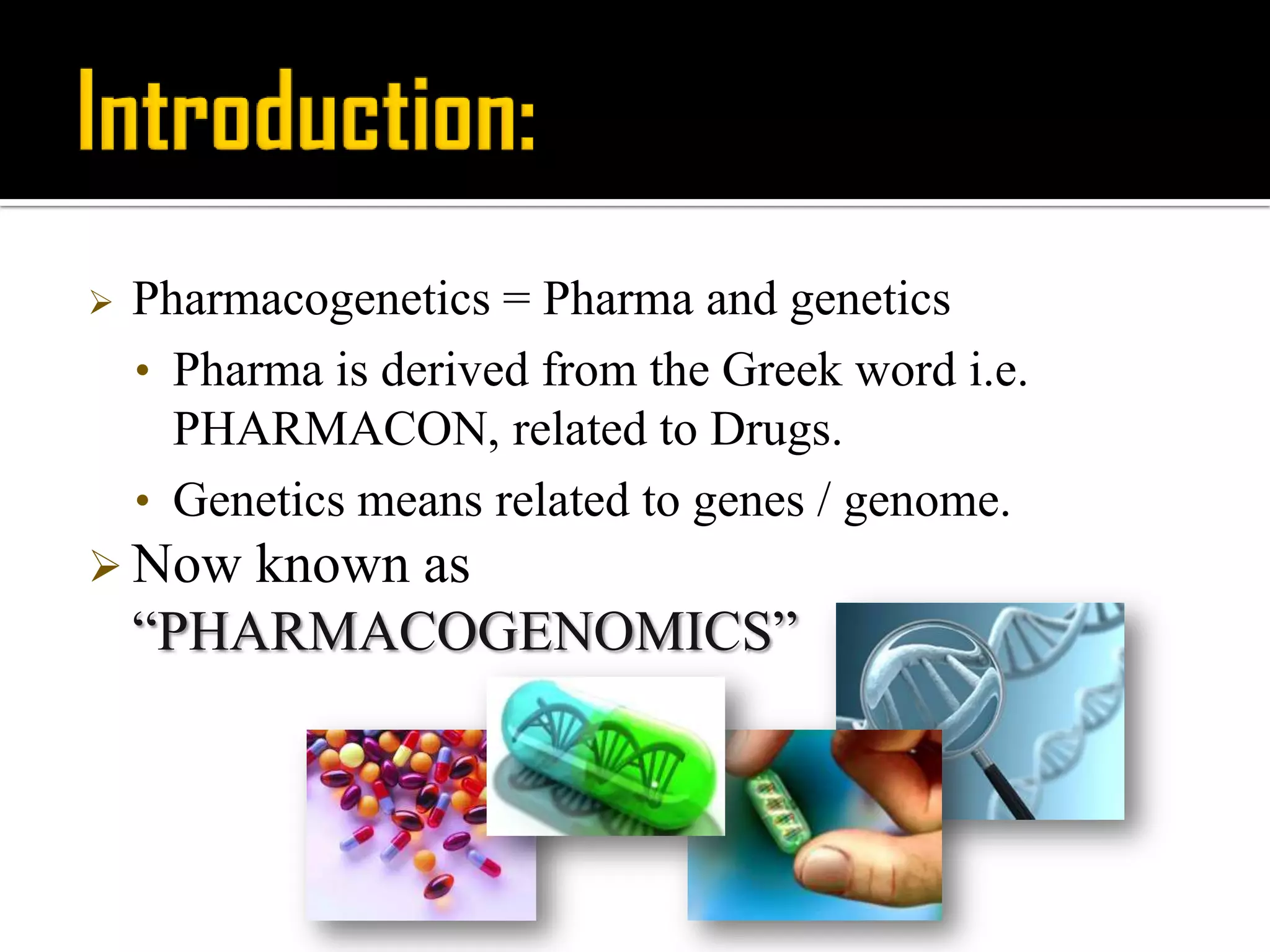
 Pharmacogenetics = Pharma and genetics
• Pharma is derived from the Greek word i.e.
PHARMACON, related to Drugs.
• Genetics means related to genes / genome.
 Now known as
“PHARMACOGENOMICS”
“..It is the branch of
Pharmacology, that deals
with the altered drug
response shown due to
variation in the Genetics..”
 Are described as naturally occurring
genetic differences among individuals of
the same species.
 Occur during crossing over of DNA
during Meiosis (type of cell division).
Two types of variation are common in the
genome:
1. Changes in single letters called ‘Single
nucleotide polymorphisms‘ ( SNPs)
2. Changes in DNA, can be a missing whole
block of DNA (a deletion), or might have
one, two, three or more copies. This is
known as Copy number variation.
 It is significant in the modification of drug
therapy with respect to the patients Genotype
to:
• Ensure maximum efficacy and
• Minimize the adverse effects
of a drug.
 It lead to the development
of Personalized medicine.
 Abbreviated as ‘PM’
 It is the use of Pharmacogenetics to form a drug
therapy according to individual’s drug response.
 It increases the chances of a
successful outcome and reduced
possible adverse effects of a
drug therapy.
Tailored Drug therapy limits down the
complications of altered drug response.
Alterations in drug response can be
dangerous.
Did You Know?
Studies show that every year about 2
million people are hospitalized for drug
adverse reactions. And every year
100,000 people die because of these
reactions
This makes it the 6th leading cause of
Unusual drug responses include accumulation of the drug in the
body leading to adverse effects, that can sometimes prove fatal.
We may say that ONE
type of Drug cannot FIT
ALL!
While prescribing, a drug,
dosage and frequency of
administration, genetic
differences MUST be
considered by the
physician.
 Genetic variations are seen following protein
structures due to differences in the genes.
1. Receptors
2. Enzymes
1. Receptors:
o Cell surface proteins where the drug will bind.
o Absence of receptors on the effector organ will
result in no therapeutic effect but adverse effects
due to the accumulation of drug.
2. Enzymes:
o Are globular proteins that are
responsible for metabolizing drugs.
o Deficiency or other defects in enzymes will result in
no drug breakdown and thus accumulation of drug
in the body, showing drug’s adverse effects.
o Example: G-6-P-D deficiency,
Pseudocholinesterases deficiency.
1. Less active or inactive
Cytochrome P450:
o The system is unable to breakdown and
efficiently eliminate the drug from the body
which leads to drug over-dosage and thus
adverse effects in patients.
o E.g.: Slow Hydroxylation of Warfarin cause
accumulation of drug and resulting in Warfarin
side effects
2. Cytochrome 2C19 Deficiency:
o It is a type of P450, that are liver enzymes.
o The Cytochrome 2c19 catalyzes the hydroxylation of
Mephenytoin ( i.e. an anti-epileptic drug)
o Results in Mephenytoin adverse effects.
Some Drugs whose metabolism is affected by
P450 Variants:
o Anti-arrhythmics
o Beta – Adrenergic receptor blockers
o Neuroleptics
o Tricyclic Anti-depressants
o Decongestants
3. Pseudocholinesterases
Deficiency:
o An enzyme that breaks down cholines.
o It’s deficiency causes increased sensitivity to certain
muscle relaxant drugs (Succinylcholine) used during
general anesthesia.
o Patient will be unable to move or breathe on their own
for a few hours after the drugs are administered.
o Incidence of this deficiency is 1/3000 patients.
4. Glucose-6-Phosphate
Dehydrogenase Deficiency:
o It is an enzyme that converts Glutathione to a
reduced form, that keeps membrane proteins in
operative condition.
o Deficiency leads to altered cell membrane and
thus causing hemolysis on administration of some
drugs like Anti-malarial, Sulphonamides,
Analgesics, Sulphones etc
5. Vitamin D Resistance:
o X-linked genetic variation
o Patient fails to metabolize Vitamin D to it’s active
form and develop Vitamin D resistant rickets.
6. Acetylation:
o Defect is less synthesis of N-acetyltransferase
(liver) Slow Acetylation. Rest, Fast Acetylators!
o Slow Acetylation may lead to higher blood levels
of the drug and thus, result in toxic effects.
o Drugs Metabolized by Acetylation:
Isoniazid
Procainamide (antiarrhythmic)
Sulfa drugs (e.g. sulfonamide antibiotics)
Dapsone (anti-leprosy, antiparasitic)
7. Malignant Hyperpyrexia:
 Autosomal Dominant Disorder
 Mutation of the Ryanodine receptor, located on
sarcoplasmic reticulum mediate the release
of calcium ions resulting in a drastic increase in
intracellular calcium thus, muscle contraction
 consumes large amounts of ATP and generates the
excessive heat (hyperthermia)
 Triggered by exposure to certain drugs used
for general anesthesia (Halothane etc)
8. Acatalasia
o Single gene defect
o Complete lack of enzyme ‘Catalase’
o Hydrogen peroxide ineffective to the patient
9. Acute Intermittent Porphyria
o Rare Autosomal dominant metabolic disorder
o Deficiency of the enzyme ‘Porphobilinogen
deaminase’
o anti-psychotics aggravate the disease.
10. Methaemoglobinaemia:
o Patient lacks the enzyme 'Methaemoglobin
reductase’ that normally prevent formation of
Methaemoglobin.
o Drugs that cause Methaemoglobinaemia in this
case:
 Sulphonamides
 Phenacetine
 Nitrates
 Quinones
Katzung – Basic and Clinical
Pharmacology (12th Edition)
Lippincott Illustrated Review (5th
Edition)
Katzung & Trevors Pharmacology
Review (9th Edition)
Almas Muhammad A
Roll No. 01

Pharmacogenetics

  • 1.
  • 2.
     Pharmacogenetics =Pharma and genetics • Pharma is derived from the Greek word i.e. PHARMACON, related to Drugs. • Genetics means related to genes / genome.  Now known as “PHARMACOGENOMICS”
  • 3.
    “..It is thebranch of Pharmacology, that deals with the altered drug response shown due to variation in the Genetics..”
  • 4.
     Are describedas naturally occurring genetic differences among individuals of the same species.  Occur during crossing over of DNA during Meiosis (type of cell division).
  • 5.
    Two types ofvariation are common in the genome: 1. Changes in single letters called ‘Single nucleotide polymorphisms‘ ( SNPs) 2. Changes in DNA, can be a missing whole block of DNA (a deletion), or might have one, two, three or more copies. This is known as Copy number variation.
  • 6.
     It issignificant in the modification of drug therapy with respect to the patients Genotype to: • Ensure maximum efficacy and • Minimize the adverse effects of a drug.  It lead to the development of Personalized medicine.
  • 7.
     Abbreviated as‘PM’  It is the use of Pharmacogenetics to form a drug therapy according to individual’s drug response.  It increases the chances of a successful outcome and reduced possible adverse effects of a drug therapy.
  • 9.
    Tailored Drug therapylimits down the complications of altered drug response. Alterations in drug response can be dangerous.
  • 10.
    Did You Know? Studiesshow that every year about 2 million people are hospitalized for drug adverse reactions. And every year 100,000 people die because of these reactions This makes it the 6th leading cause of Unusual drug responses include accumulation of the drug in the body leading to adverse effects, that can sometimes prove fatal.
  • 11.
    We may saythat ONE type of Drug cannot FIT ALL!
  • 12.
    While prescribing, adrug, dosage and frequency of administration, genetic differences MUST be considered by the physician.
  • 13.
     Genetic variationsare seen following protein structures due to differences in the genes. 1. Receptors 2. Enzymes
  • 14.
    1. Receptors: o Cellsurface proteins where the drug will bind. o Absence of receptors on the effector organ will result in no therapeutic effect but adverse effects due to the accumulation of drug.
  • 15.
    2. Enzymes: o Areglobular proteins that are responsible for metabolizing drugs. o Deficiency or other defects in enzymes will result in no drug breakdown and thus accumulation of drug in the body, showing drug’s adverse effects. o Example: G-6-P-D deficiency, Pseudocholinesterases deficiency.
  • 16.
    1. Less activeor inactive Cytochrome P450: o The system is unable to breakdown and efficiently eliminate the drug from the body which leads to drug over-dosage and thus adverse effects in patients. o E.g.: Slow Hydroxylation of Warfarin cause accumulation of drug and resulting in Warfarin side effects
  • 17.
    2. Cytochrome 2C19Deficiency: o It is a type of P450, that are liver enzymes. o The Cytochrome 2c19 catalyzes the hydroxylation of Mephenytoin ( i.e. an anti-epileptic drug) o Results in Mephenytoin adverse effects. Some Drugs whose metabolism is affected by P450 Variants: o Anti-arrhythmics o Beta – Adrenergic receptor blockers o Neuroleptics o Tricyclic Anti-depressants o Decongestants
  • 18.
    3. Pseudocholinesterases Deficiency: o Anenzyme that breaks down cholines. o It’s deficiency causes increased sensitivity to certain muscle relaxant drugs (Succinylcholine) used during general anesthesia. o Patient will be unable to move or breathe on their own for a few hours after the drugs are administered. o Incidence of this deficiency is 1/3000 patients.
  • 19.
    4. Glucose-6-Phosphate Dehydrogenase Deficiency: oIt is an enzyme that converts Glutathione to a reduced form, that keeps membrane proteins in operative condition. o Deficiency leads to altered cell membrane and thus causing hemolysis on administration of some drugs like Anti-malarial, Sulphonamides, Analgesics, Sulphones etc
  • 20.
    5. Vitamin DResistance: o X-linked genetic variation o Patient fails to metabolize Vitamin D to it’s active form and develop Vitamin D resistant rickets.
  • 21.
    6. Acetylation: o Defectis less synthesis of N-acetyltransferase (liver) Slow Acetylation. Rest, Fast Acetylators! o Slow Acetylation may lead to higher blood levels of the drug and thus, result in toxic effects. o Drugs Metabolized by Acetylation: Isoniazid Procainamide (antiarrhythmic) Sulfa drugs (e.g. sulfonamide antibiotics) Dapsone (anti-leprosy, antiparasitic)
  • 22.
    7. Malignant Hyperpyrexia: Autosomal Dominant Disorder  Mutation of the Ryanodine receptor, located on sarcoplasmic reticulum mediate the release of calcium ions resulting in a drastic increase in intracellular calcium thus, muscle contraction  consumes large amounts of ATP and generates the excessive heat (hyperthermia)  Triggered by exposure to certain drugs used for general anesthesia (Halothane etc)
  • 23.
    8. Acatalasia o Singlegene defect o Complete lack of enzyme ‘Catalase’ o Hydrogen peroxide ineffective to the patient 9. Acute Intermittent Porphyria o Rare Autosomal dominant metabolic disorder o Deficiency of the enzyme ‘Porphobilinogen deaminase’ o anti-psychotics aggravate the disease.
  • 24.
    10. Methaemoglobinaemia: o Patientlacks the enzyme 'Methaemoglobin reductase’ that normally prevent formation of Methaemoglobin. o Drugs that cause Methaemoglobinaemia in this case:  Sulphonamides  Phenacetine  Nitrates  Quinones
  • 25.
    Katzung – Basicand Clinical Pharmacology (12th Edition) Lippincott Illustrated Review (5th Edition) Katzung & Trevors Pharmacology Review (9th Edition)
  • 26.