TOPIC : STARCH
SUBJECT : BIODEGRADABLE POLYMERS
STARCH
Starch Molecule
 Starch is a polysaccharide.
 Polysaccharide is made up of hundreds or thousands
of glucose molecules.
 Starch molecule composed of many linked glucose
molecules
 Terminology
 Polysaccharide – a complex carbohydrate.
 Glucose – a monosaccharide or simple sugar.
 widely in vegetables kingdom.
 > 80 % of all food crops -- cereals and starchy food crops
 Natural polymer of D-glucose.
 a very high proportion of world’s food energy intake.
 Occurs in nature as microscopically small, spherical particles /
granules -- whose size and shape are characteristic  each
species.
 Formed in plants  condensation of large no. of glucose
molecules -- into two types of polymers :
 1. Amylose -- linear polymer > 2000 glucose units -- α-1,4
glycosidic linkage.
 2. Amylopectin -- highly branched -- each branch -- 20 - 30
glucose units & each molecule  hundreds of these
branches.
 Glucose units in linear branch -- α-1,4 linkage
.
 Branch points -- α-1,6-glycosidic linkages.
 Both amylose and amylopectin  deposited in starch
granules  an orderly radial pattern.
STRUCTURE OF STARCH
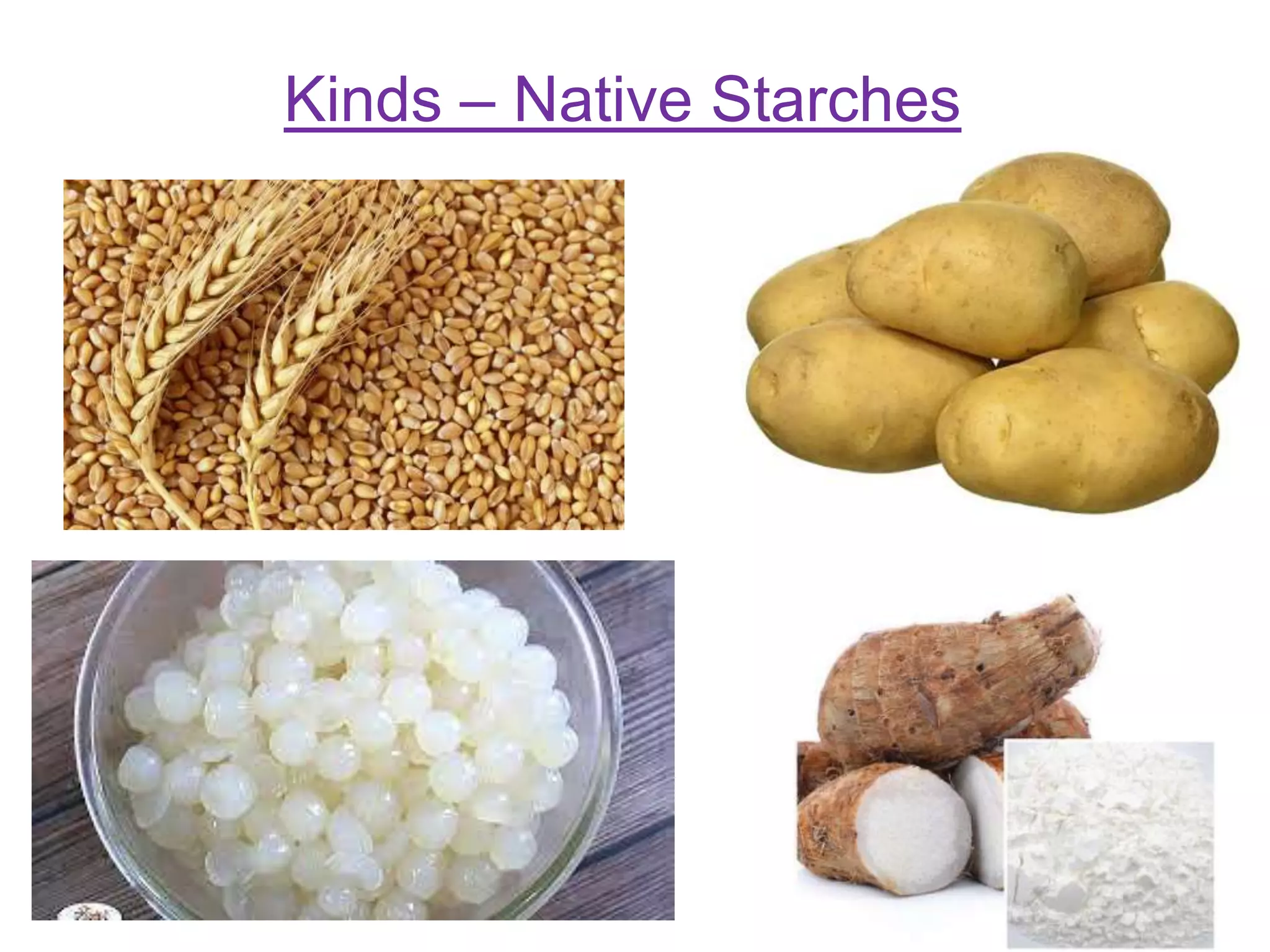
Kinds – Native Starches
 Cornstarch
 Tapioca
 Wheat
 Potato
 Rice
 Arrowroot
 Sago
Kinds – Native Starches
Composition and Structure
 Starch granule
 Starch is deposited in plants in organized units called
granules.
 Starch molecules structured to form crystalline-
like patterns in the granule
 With polarized light, a Maltese cross pattern can be
observed under microscope
 Called birefringence
 Pattern disappears when starch is heated
(i) Cereals and millets (65 to 85 %) e.g., rice, wheat, maize
(ii) Roots and tubers (19 to 35 %) e.g. tapioca, potato
 Cereal starch paste (5%)  on cooling sets  a thick jelly
 Turber starch paste (5%)  a fluid & does not set  to a thick jelly.
 Cereals  low moisture  starch granules are embedded  in a
hard, proteinaceous matrix  requires preliminary softening 
starch extraction.
 Potato  high moisture and no preliminary softening required.
Characteristics of Starches
 Amylose
 Amylopectin
• Found in Amorphous region
• Upon Heating - leached out allowing
water to enter and swell the starch
granule in the crystalline region
• Found in Crystalline region
• Highly influences on viscosity changes due to water and heating
(gelatinization)
Kinds - Resistant
 Resistant starch is not digested by human
body
 Four main types
 RS1
 RS2
 RS3
 RS4
 May be used in food to increase fiber content
Effect of Heat and Cooling
 Dry heat
 Starch becomes more soluble
 Reduced thickening ability
 Dextrinization
 Brown, nutty, toasted flavor develops
 Examples
 Brown roux and Espagnole sauce
 A higher proportion of starch to liquid is needed
Effect of Heat and Cooling
 Moist heat
 Starch granules insoluble in cold water
 Colloidal dispersion produced with heating
 Starch paste
 Long unbranched chain of D-glucose (500 to 5,000 glucose
molecules) -- linked -- α-1,4 linkage
 Molecular weight -- 105 to 106 daltons .
 Retrogradation -- process -- solution (on keeping) turns turbid
-- due to precipitations of amylose.
 Responsible -- stiffening of cooked rice (on standing).
 Blue colour with iodine.
 Amylose content of starch -- vary  botanical species.
 Cereal starches :
 wheat starch  25 – 30% amylose,
 corn starch (amylomaize)  40 – 80% amylose.
 Waxy maize  0% starch.
 Branched chain polysaccharide  component of starch
 Chains linked  α-1,6 linkages
 Molecular weight  107 to 108 daltons
 One molecule  50,000 to 5,00,000 molecules of D-
glucose
 Gives  purple colour with iodine
What are BIO-based plastics?
Bioplastics help manufacturing companies stay competitive by
helping to meet rising consumer expectations of sustainability.
They are often derived from various biomass sources, the most
widely used being starch, which is a natural polymer that can be
incorporated in various materials. Starch-based plastics can be
used in a variety of applications since they can be incorporated
with various petroleum-based polymers or biopolymers to create
unique composite materials. These composite materials can then
be injection molded or extruded using standard processing
machinery.
Approximately 50% of the bioplastics used
commercially are prepared from starch. The
production of starch-based bioplastics is simple, and
they are widely used for packaging applications . The
tensile properties of starch are suitable for the
production of packing materials, and glycerol is
added into the starch as a plasticizer. The required
characteristics of the bioplastics are achieved by
fine-tuning the quantities of the additives. For trade
applications, the starch-based plastics are regularly
mixed with eco-friendly polyesters.
An analysis of a new market research report
stated that “starch blends are expected to account
for the largest share in the market” from 2015 to
2020. Out of the 2.05 million tons of bioplastics
produced in 2017 worldwide, starch blends
accounted for 18.8%. In fact, European
Bioplastics stated that “Bioplastics are used in an
increasing number of markets, from packaging,
catering products, consumer electronics,
automotive, agriculture/horticulture and toys to
textiles and a number of other segments.”
How commonly used are
starch-based plastics?
Starch can be used to reduce the
carbon footprint of traditional
resins because they can replace
petroleum-based polymers with
natural ones. It is also highly
degradable, meaning it can be
used alongside a compostable
polymer without interfering with
the degradation process.
Environmental benefits
The Green Dot Bioplastics team has successfully
developed cell phone cases from compostable, starch-
based plastics. Additional opportunities are expected in
compostable yard and kitchen bags, food service
disposables and various types of packaging.
Starch-based plastics have increased in relevance with the
introduction of improved resin grades, their ability to blend
with other biopolymers and an increasing number of
suppliers. In fact, starch-based bioplastics are widely
employed in the medical industry because of their
biocompatibility, low toxicity, degradation properties and
mechanical properties.
The challenges for researchers and the packaging industry in
terms of producing starch-based blends with commercial
utility are :
a) Overcoming miscibility problems at high starch contents,
b) Avoiding mechanical property deterioration at high starch
contents, even in compatibilized blends,
c) Reducing costs, especially for biodegradable starch-
polyester blends at low starch contents (<30 wt.%) .
2) Antimicrobial packaging film:
Antimicrobial packaging refers to the integration of an
antimicrobial agent into packaging systems for the purpose of
preventing microbial growth on food products and extending
its shelf life .
The packaging materials may acquire antimicrobial activity
i) By incorporating antimicrobial components in a polymer
matrix,
ii) Surface irradiation of polymer matrix which produces
reactive oxidizing species,
iii) By gas emission/flush through modified atmosphere
Futuristic Approach
Focused research is needed in bringing more values
such as making the packaging material simpler yet
smarter, where consumer is able to assess the quality,
safety, shelf-life, and nutritional values of the contents of
packet with cost effectiveness. The benefits however
should not come at the cost of the cost of curing
environmental issues and should eco-friendly.

Starch

  • 1.
    TOPIC : STARCH SUBJECT: BIODEGRADABLE POLYMERS STARCH
  • 2.
    Starch Molecule  Starchis a polysaccharide.  Polysaccharide is made up of hundreds or thousands of glucose molecules.  Starch molecule composed of many linked glucose molecules  Terminology  Polysaccharide – a complex carbohydrate.  Glucose – a monosaccharide or simple sugar.
  • 3.
     widely invegetables kingdom.  > 80 % of all food crops -- cereals and starchy food crops  Natural polymer of D-glucose.  a very high proportion of world’s food energy intake.  Occurs in nature as microscopically small, spherical particles / granules -- whose size and shape are characteristic  each species.
  • 4.
     Formed inplants  condensation of large no. of glucose molecules -- into two types of polymers :  1. Amylose -- linear polymer > 2000 glucose units -- α-1,4 glycosidic linkage.  2. Amylopectin -- highly branched -- each branch -- 20 - 30 glucose units & each molecule  hundreds of these branches.  Glucose units in linear branch -- α-1,4 linkage .  Branch points -- α-1,6-glycosidic linkages.  Both amylose and amylopectin  deposited in starch granules  an orderly radial pattern.
  • 5.
  • 6.
    Kinds – NativeStarches  Cornstarch  Tapioca  Wheat  Potato  Rice  Arrowroot  Sago
  • 7.
  • 8.
    Composition and Structure Starch granule  Starch is deposited in plants in organized units called granules.  Starch molecules structured to form crystalline- like patterns in the granule  With polarized light, a Maltese cross pattern can be observed under microscope  Called birefringence  Pattern disappears when starch is heated
  • 9.
    (i) Cereals andmillets (65 to 85 %) e.g., rice, wheat, maize (ii) Roots and tubers (19 to 35 %) e.g. tapioca, potato  Cereal starch paste (5%)  on cooling sets  a thick jelly  Turber starch paste (5%)  a fluid & does not set  to a thick jelly.  Cereals  low moisture  starch granules are embedded  in a hard, proteinaceous matrix  requires preliminary softening  starch extraction.  Potato  high moisture and no preliminary softening required.
  • 10.
    Characteristics of Starches Amylose  Amylopectin • Found in Amorphous region • Upon Heating - leached out allowing water to enter and swell the starch granule in the crystalline region • Found in Crystalline region • Highly influences on viscosity changes due to water and heating (gelatinization)
  • 11.
    Kinds - Resistant Resistant starch is not digested by human body  Four main types  RS1  RS2  RS3  RS4  May be used in food to increase fiber content
  • 12.
    Effect of Heatand Cooling  Dry heat  Starch becomes more soluble  Reduced thickening ability  Dextrinization  Brown, nutty, toasted flavor develops  Examples  Brown roux and Espagnole sauce  A higher proportion of starch to liquid is needed
  • 13.
    Effect of Heatand Cooling  Moist heat  Starch granules insoluble in cold water  Colloidal dispersion produced with heating  Starch paste
  • 14.
     Long unbranchedchain of D-glucose (500 to 5,000 glucose molecules) -- linked -- α-1,4 linkage  Molecular weight -- 105 to 106 daltons .  Retrogradation -- process -- solution (on keeping) turns turbid -- due to precipitations of amylose.  Responsible -- stiffening of cooked rice (on standing).  Blue colour with iodine.  Amylose content of starch -- vary  botanical species.  Cereal starches :  wheat starch  25 – 30% amylose,  corn starch (amylomaize)  40 – 80% amylose.  Waxy maize  0% starch.
  • 16.
     Branched chainpolysaccharide  component of starch  Chains linked  α-1,6 linkages  Molecular weight  107 to 108 daltons  One molecule  50,000 to 5,00,000 molecules of D- glucose  Gives  purple colour with iodine
  • 18.
    What are BIO-basedplastics? Bioplastics help manufacturing companies stay competitive by helping to meet rising consumer expectations of sustainability. They are often derived from various biomass sources, the most widely used being starch, which is a natural polymer that can be incorporated in various materials. Starch-based plastics can be used in a variety of applications since they can be incorporated with various petroleum-based polymers or biopolymers to create unique composite materials. These composite materials can then be injection molded or extruded using standard processing machinery.
  • 19.
    Approximately 50% ofthe bioplastics used commercially are prepared from starch. The production of starch-based bioplastics is simple, and they are widely used for packaging applications . The tensile properties of starch are suitable for the production of packing materials, and glycerol is added into the starch as a plasticizer. The required characteristics of the bioplastics are achieved by fine-tuning the quantities of the additives. For trade applications, the starch-based plastics are regularly mixed with eco-friendly polyesters.
  • 20.
    An analysis ofa new market research report stated that “starch blends are expected to account for the largest share in the market” from 2015 to 2020. Out of the 2.05 million tons of bioplastics produced in 2017 worldwide, starch blends accounted for 18.8%. In fact, European Bioplastics stated that “Bioplastics are used in an increasing number of markets, from packaging, catering products, consumer electronics, automotive, agriculture/horticulture and toys to textiles and a number of other segments.” How commonly used are starch-based plastics?
  • 21.
    Starch can beused to reduce the carbon footprint of traditional resins because they can replace petroleum-based polymers with natural ones. It is also highly degradable, meaning it can be used alongside a compostable polymer without interfering with the degradation process. Environmental benefits
  • 22.
    The Green DotBioplastics team has successfully developed cell phone cases from compostable, starch- based plastics. Additional opportunities are expected in compostable yard and kitchen bags, food service disposables and various types of packaging. Starch-based plastics have increased in relevance with the introduction of improved resin grades, their ability to blend with other biopolymers and an increasing number of suppliers. In fact, starch-based bioplastics are widely employed in the medical industry because of their biocompatibility, low toxicity, degradation properties and mechanical properties.
  • 23.
    The challenges forresearchers and the packaging industry in terms of producing starch-based blends with commercial utility are : a) Overcoming miscibility problems at high starch contents, b) Avoiding mechanical property deterioration at high starch contents, even in compatibilized blends, c) Reducing costs, especially for biodegradable starch- polyester blends at low starch contents (<30 wt.%) . 2) Antimicrobial packaging film: Antimicrobial packaging refers to the integration of an antimicrobial agent into packaging systems for the purpose of preventing microbial growth on food products and extending its shelf life . The packaging materials may acquire antimicrobial activity i) By incorporating antimicrobial components in a polymer matrix, ii) Surface irradiation of polymer matrix which produces reactive oxidizing species, iii) By gas emission/flush through modified atmosphere
  • 24.
    Futuristic Approach Focused researchis needed in bringing more values such as making the packaging material simpler yet smarter, where consumer is able to assess the quality, safety, shelf-life, and nutritional values of the contents of packet with cost effectiveness. The benefits however should not come at the cost of the cost of curing environmental issues and should eco-friendly.