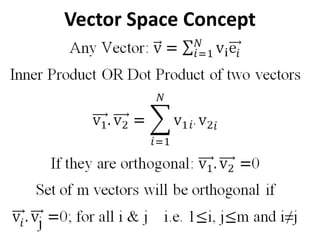
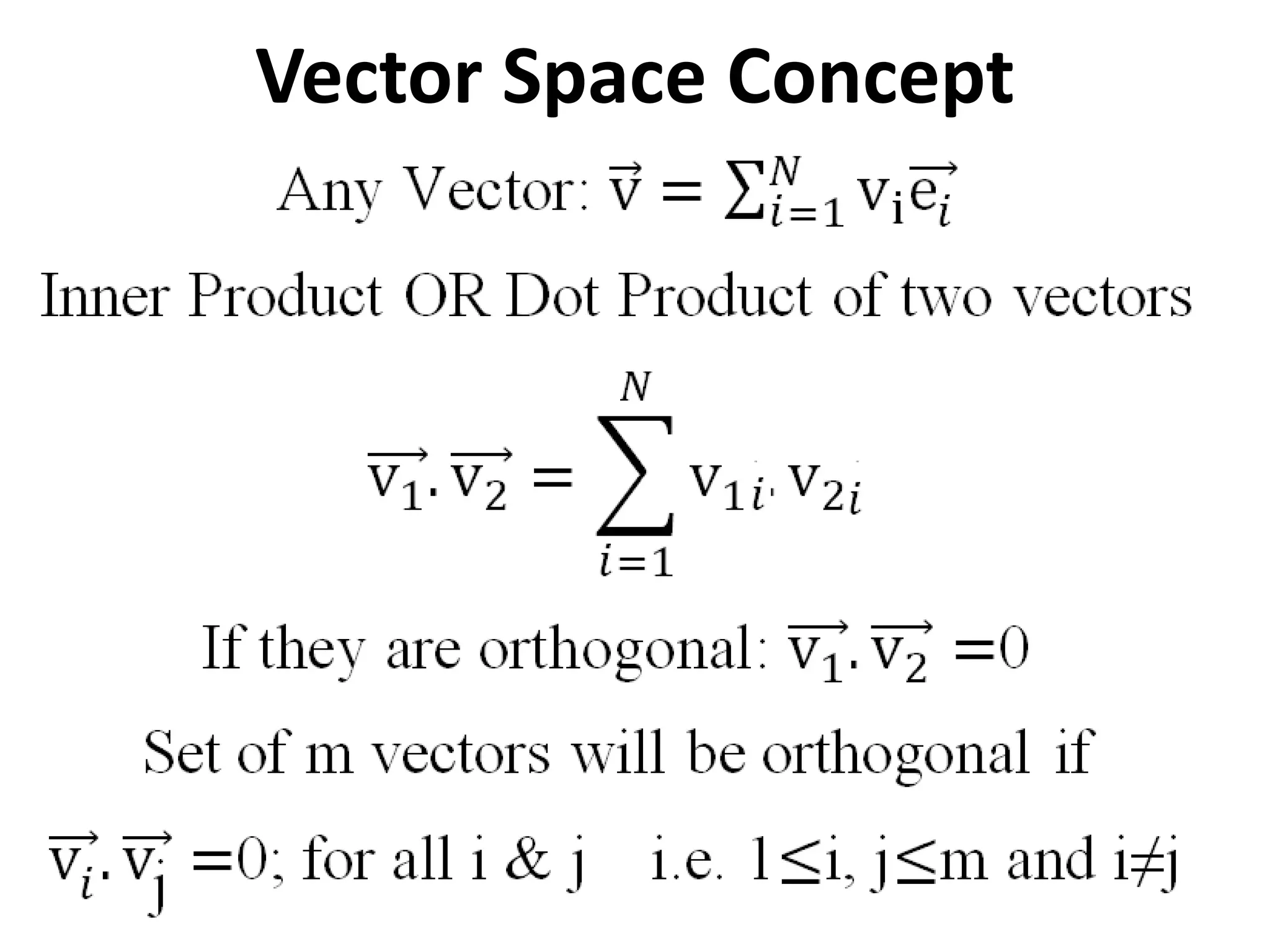
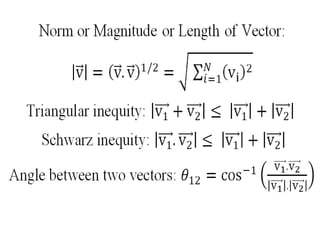
Vector Space Concept
Signal Space Concept
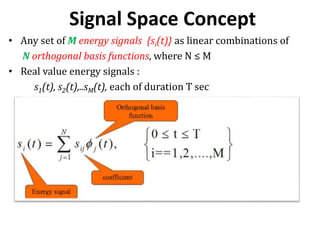
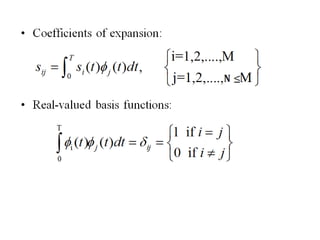
• Any set of M energy signals {si(t)} as linear combinations of
N orthogonal basis functions, where N ≤ M
• Real value energy signals :
s1(t), s2(t),..sM(t), each of duration T sec
• The set of coefficients si can be viewed as a
N-dimensional vector.
• Bears a one-to-one relationship with the
transmitted signal si(t)
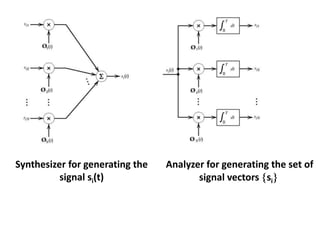
Synthesizer for generating the
signal si(t)
Analyzer for generating the set of
signal vectors si
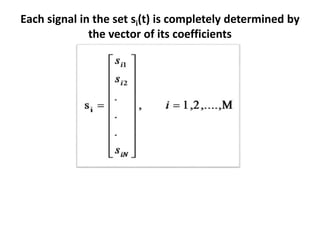
Each signal in the set si(t) is completely determined by
the vector of its coefficients
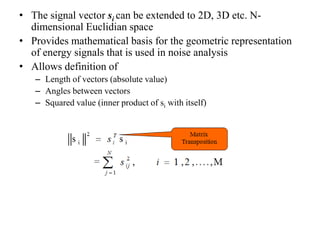
• The signal vector si can be extended to 2D, 3D etc. N-
dimensional Euclidian space
• Provides mathematical basis for the geometric representation
of energy signals that is used in noise analysis
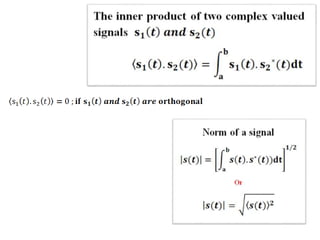
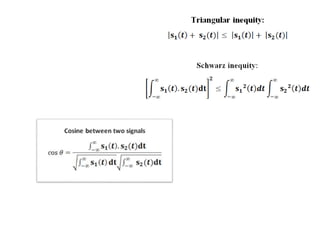
• Allows definition of
– Length of vectors (absolute value)
– Angles between vectors
– Squared value (inner product of si with itself)
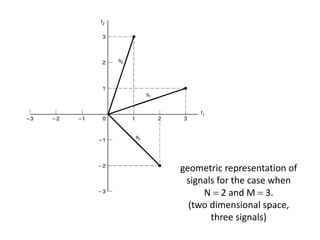
geometric representation of
signals for the case when
N  2 and M  3.
(two dimensional space,
three signals)
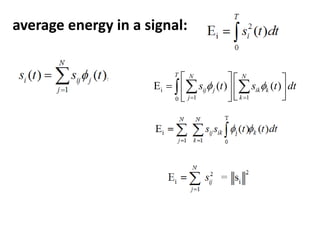
average energy in a signal:
i
1 10
E ( ) ( )
T N N
ij j ik k
j k
s t s t dt 
 
   
    
  
 
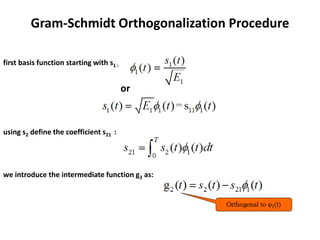
Gram-Schmidt Orthogonalization Procedure
first basis function starting with s1 :
or
using s2 define the coefficient s21 :
we introduce the intermediate function g2 as:
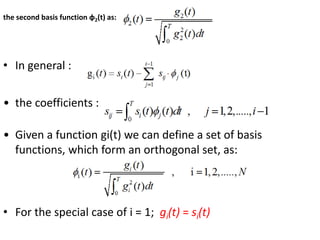
the second basis function φ2(t) as:
• In general :
• the coefficients :
• Given a function gi(t) we can define a set of basis
functions, which form an orthogonal set, as:
• For the special case of i = 1; gi(t) = si(t)
NUMERICLAS …
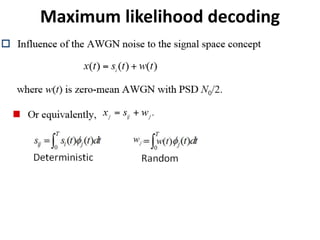
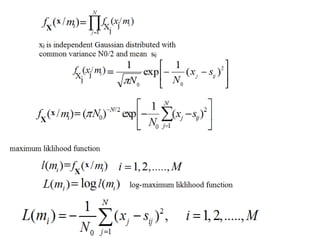
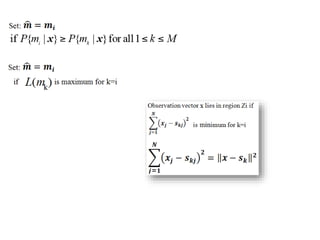
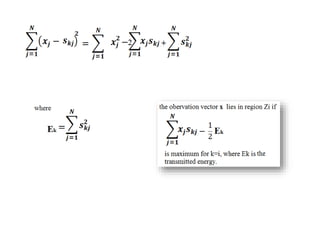
Maximum likelihood decoding
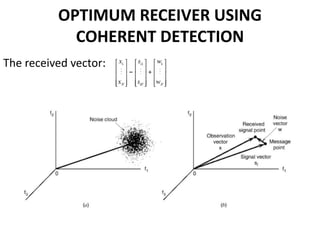
OPTIMUM RECEIVER USING
COHERENT DETECTION
The received vector:
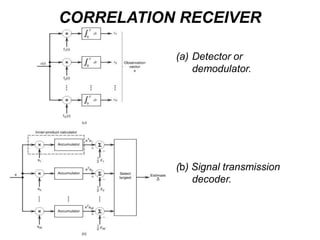
CORRELATION RECEIVER
(a) Detector or
demodulator.
(b) Signal transmission
decoder.
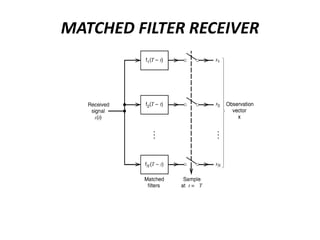
MATCHED FILTER RECEIVER
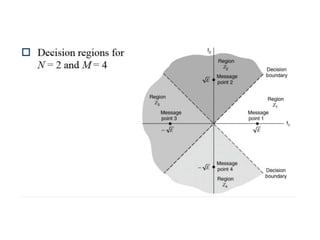
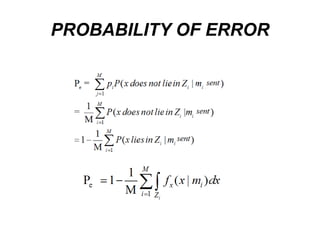
PROBABILITY OF ERROR
• The probability of error is invariant to rotation and
translation of the signal constellation.
– In maximum likelihood detection the probability of symbol error Pe depends
solely on the Euclidean distances between the message points in the
constellation
– The additive Gaussian noise is spherically symmetric in all directions in the
signal space.

Digital Communication Unit 1

  • 1.
  • 3.
    Signal Space Concept •Any set of M energy signals {si(t)} as linear combinations of N orthogonal basis functions, where N ≤ M • Real value energy signals : s1(t), s2(t),..sM(t), each of duration T sec
  • 7.
    • The setof coefficients si can be viewed as a N-dimensional vector. • Bears a one-to-one relationship with the transmitted signal si(t)
  • 8.
    Synthesizer for generatingthe signal si(t) Analyzer for generating the set of signal vectors si
  • 9.
    Each signal inthe set si(t) is completely determined by the vector of its coefficients
  • 10.
    • The signalvector si can be extended to 2D, 3D etc. N- dimensional Euclidian space • Provides mathematical basis for the geometric representation of energy signals that is used in noise analysis • Allows definition of – Length of vectors (absolute value) – Angles between vectors – Squared value (inner product of si with itself)
  • 11.
    geometric representation of signalsfor the case when N  2 and M  3. (two dimensional space, three signals)
  • 12.
    average energy ina signal: i 1 10 E ( ) ( ) T N N ij j ik k j k s t s t dt                 
  • 13.
    Gram-Schmidt Orthogonalization Procedure firstbasis function starting with s1 : or using s2 define the coefficient s21 : we introduce the intermediate function g2 as:
  • 14.
    the second basisfunction φ2(t) as: • In general : • the coefficients : • Given a function gi(t) we can define a set of basis functions, which form an orthogonal set, as: • For the special case of i = 1; gi(t) = si(t)
  • 15.
  • 16.
  • 18.
    OPTIMUM RECEIVER USING COHERENTDETECTION The received vector:
  • 22.
    CORRELATION RECEIVER (a) Detectoror demodulator. (b) Signal transmission decoder.
  • 23.
  • 24.
  • 25.
    • The probabilityof error is invariant to rotation and translation of the signal constellation. – In maximum likelihood detection the probability of symbol error Pe depends solely on the Euclidean distances between the message points in the constellation – The additive Gaussian noise is spherically symmetric in all directions in the signal space.