A Roadmap for Installing and
Commissioning New Equipment
-
Introduction
Sonja Dieterich, Ph.D.
Associate Professor, UC Davis
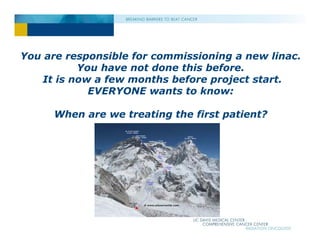
You are responsible for commissioning a new linac.
You have not done this before.
It is now a few months before project start.
EVERYONE wants to know:
When are we treating the first patient?
Learning Objectives
1. To learn how to build a new equipment commissioning
project plan
2. To identify equipment , personnel resources and
commissioning time required
3. Understand how to account for commissioning new
technology with small install base
4. Learn to develop a representative commissioning plan for a
linac, CK, HDR unit or treatment planning system
The handout of this lecture is available as pdf on meeting website
“An ounce of preparation is
worth a pound of cure”
(Benjamin Franklin)
In so much more words …
• Good preparation saves you
time. Lots of it.
• Good preparation helps you
understand precisely what you
need to do.
• Good preparation lowers the risk
of serious errors
• Good preparation allows you to
recover quickly from the
unexpected 1/3 of accidents have
contributing causes originating
from inadequate preparation
Typical Schedule of Events
1. Construction and Install
• Removal of existing equipment (riggers)
• Room Infrastructure (hospital/vendor contractor)
• Install of new equipment (riggers, vendor)
• Cosmetic fixes (hospital contractor)
2. Acceptance testing
• Physicist with vendor personnel
• Tests defined in vendor acceptance testing document
3. Commissioning
• Radiation Safety Measurements
• Beam Data
• TG‐119, Imaging QA, E2E tests, TPS for new machine …
• Policies and procedures
4. Clinical Go‐Live
• Training
• First patients
Construction: Building and Room
• Mostly handled by facilities/vendor except:
• Planning phase:
• Shielding calculation, peer review of shielding calculation
• Room design: storage, cable ducts, monitors & camera
positions …
• Actual construction:
• Go visit the site regularly!!!
• Base frame on wrong site of couch!
• empty soda can thrown into primary barriers …
• Take photos for future reference: e.g. cable duct location
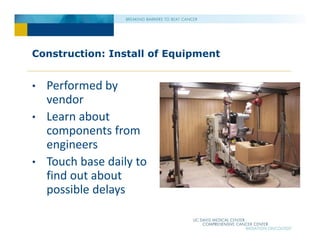
Construction: Install of Equipment
• Performed by
vendor
• Learn about
components from
engineers
• Touch base daily to
find out about
possible delays
Acceptance Testing
• Definition: Vendor demonstrates to you that the machine
fulfills all specs as defined in the purchase contract
 Get a copy of the purchase contract and acceptance testing
document well in advance
• Time for acceptance testing is often NOT included in install
time estimates!
• Your signature on acceptance testing document transfers
the machine from vendor owned to hospital
• Any changes made after this will be covered by service
contract (if applicable) or charged
• Therefore: do not accept tests results that are just barely
meeting specs (e.g. 0.95 mm for a 1 mm tolerance)
• Diplomatically but firmly push the engineer
• remember 80/20 rule.
Where do I find information on what I need to
do for commissioning?
• AAPM TGs:
• Tests and tolerances
• Equipment
• No information on time or personnel  except TG 179 
• Publications:
• Detectors, methods
• Reference beam data (e.g. small field output factors)
• TPS manuals (e.g. Pinnacle has a nice guide specifying beam
data needed for modeling)
• Peers:
• Copy of commissioning reports
• Time estimates
• Lots of useful tips & tricks
Commissioning
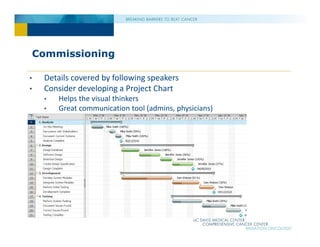
• Details covered by following speakers
• Consider developing a Project Chart
• Helps the visual thinkers
• Great communication tool (admins, physicians)
Commissioning: People and Coverage
• Staff
• How many people available for commissioning?
• Make sure not taking vacation gets discussed …
• Possibly working early/late shifts?
• Who covers the rest of the clinic?
• Other departments:
• IT: connectivity, firewalls, backup
• RSO: Shielding Survey
Commissioning: Equipment
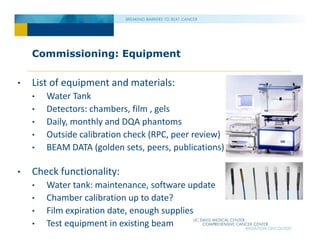
• List of equipment and materials:
• Water Tank
• Detectors: chambers, film , gels
• Daily, monthly and DQA phantoms
• Outside calibration check (RPC, peer review)
• BEAM DATA (golden sets, peers, publications)
• Check functionality:
• Water tank: maintenance, software update
• Chamber calibration up to date?
• Film expiration date, enough supplies
• Test equipment in existing beam
Commissioning: Preparing A Road Map for Tasks
• Create a road map document:
• List of measurement tasks (use outline function).
Under each list entry, write down:
• Estimated time needed***
• Equipment needed
• 1‐2 sentences on setup
• Data processing method (if applicable)
• List tolerances if applicable
• Result: Pass/Fail
• Create table of contents from outline
• This list is your BLUEPRINT for the commissioning
report!
• Use Table of Contents as checklist
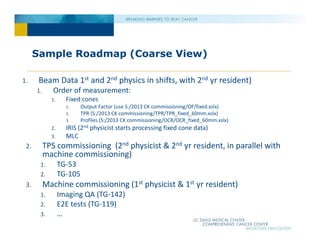
Sample Roadmap (Coarse View)
1. Beam Data 1st and 2nd physics in shifts, with 2nd yr resident)
1. Order of measurement:
1. Fixed cones
1. Output Factor (use S:/2013 CK commissioning/OF/fixed.xslx)
2. TPR (S:/2013 CK commissioning/TPR/TPR_fixed_60mm.xslx)
3. Profiles (S:/2013 CK commissioning/OCR/OCR_fixed_60mm.xslx)
2. IRIS (2nd physicist starts processing fixed cone data)
3. MLC
2. TPS commissioning (2nd physicist & 2nd yr resident, in parallel with
machine commissioning)
1. TG‐53
2. TG‐105
3. Machine commissioning (1st physicist & 1st yr resident)
1. Imaging QA (TG‐142)
2. E2E tests (TG‐119)
3. …
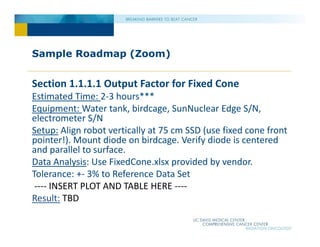
Sample Roadmap (Zoom)
Section 1.1.1.1 Output Factor for Fixed Cone
Estimated Time: 2‐3 hours***
Equipment: Water tank, birdcage, SunNuclear Edge S/N,
electrometer S/N
Setup: Align robot vertically at 75 cm SSD (use fixed cone front
pointer!). Mount diode on birdcage. Verify diode is centered
and parallel to surface.
Data Analysis: Use FixedCone.xlsx provided by vendor.
Tolerance: +‐ 3% to Reference Data Set
‐‐‐‐ INSERT PLOT AND TABLE HERE ‐‐‐‐
Result: TBD
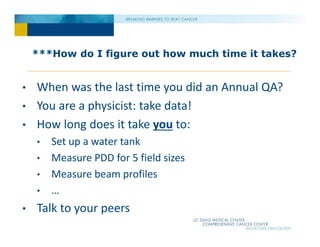
***How do I figure out how much time it takes?
• When was the last time you did an Annual QA?
• You are a physicist: take data!
• How long does it take you to:
• Set up a water tank
• Measure PDD for 5 field sizes
• Measure beam profiles
• …
• Talk to your peers
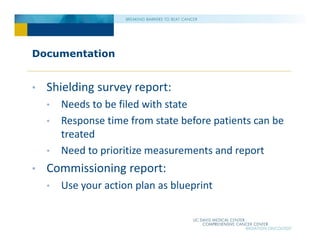
Documentation
• Shielding survey report:
• Needs to be filed with state
• Response time from state before patients can be
treated
• Need to prioritize measurements and report
• Commissioning report:
• Use your action plan as blueprint
Who needs what information from you?
• Everyone: How long will each step take?
• Physicians:
• Impact on their patients
• How to scheduling patients on new machine
• Training
• RTTs/Schedulers:
• Day the machine will go down
• Day the new machine will be up
• Training

77-22545-313436-91480.pdf

  • 1.
    A Roadmap forInstalling and Commissioning New Equipment - Introduction Sonja Dieterich, Ph.D. Associate Professor, UC Davis
  • 2.
    You are responsiblefor commissioning a new linac. You have not done this before. It is now a few months before project start. EVERYONE wants to know: When are we treating the first patient?
  • 3.
    Learning Objectives 1. Tolearn how to build a new equipment commissioning project plan 2. To identify equipment , personnel resources and commissioning time required 3. Understand how to account for commissioning new technology with small install base 4. Learn to develop a representative commissioning plan for a linac, CK, HDR unit or treatment planning system The handout of this lecture is available as pdf on meeting website
  • 4.
    “An ounce ofpreparation is worth a pound of cure” (Benjamin Franklin)
  • 5.
    In so muchmore words … • Good preparation saves you time. Lots of it. • Good preparation helps you understand precisely what you need to do. • Good preparation lowers the risk of serious errors • Good preparation allows you to recover quickly from the unexpected 1/3 of accidents have contributing causes originating from inadequate preparation
  • 6.
    Typical Schedule ofEvents 1. Construction and Install • Removal of existing equipment (riggers) • Room Infrastructure (hospital/vendor contractor) • Install of new equipment (riggers, vendor) • Cosmetic fixes (hospital contractor) 2. Acceptance testing • Physicist with vendor personnel • Tests defined in vendor acceptance testing document 3. Commissioning • Radiation Safety Measurements • Beam Data • TG‐119, Imaging QA, E2E tests, TPS for new machine … • Policies and procedures 4. Clinical Go‐Live • Training • First patients
  • 7.
    Construction: Building andRoom • Mostly handled by facilities/vendor except: • Planning phase: • Shielding calculation, peer review of shielding calculation • Room design: storage, cable ducts, monitors & camera positions … • Actual construction: • Go visit the site regularly!!! • Base frame on wrong site of couch! • empty soda can thrown into primary barriers … • Take photos for future reference: e.g. cable duct location
  • 8.
    Construction: Install ofEquipment • Performed by vendor • Learn about components from engineers • Touch base daily to find out about possible delays
  • 9.
    Acceptance Testing • Definition:Vendor demonstrates to you that the machine fulfills all specs as defined in the purchase contract  Get a copy of the purchase contract and acceptance testing document well in advance • Time for acceptance testing is often NOT included in install time estimates! • Your signature on acceptance testing document transfers the machine from vendor owned to hospital • Any changes made after this will be covered by service contract (if applicable) or charged • Therefore: do not accept tests results that are just barely meeting specs (e.g. 0.95 mm for a 1 mm tolerance) • Diplomatically but firmly push the engineer • remember 80/20 rule.
  • 10.
    Where do Ifind information on what I need to do for commissioning? • AAPM TGs: • Tests and tolerances • Equipment • No information on time or personnel  except TG 179  • Publications: • Detectors, methods • Reference beam data (e.g. small field output factors) • TPS manuals (e.g. Pinnacle has a nice guide specifying beam data needed for modeling) • Peers: • Copy of commissioning reports • Time estimates • Lots of useful tips & tricks
  • 11.
    Commissioning • Details coveredby following speakers • Consider developing a Project Chart • Helps the visual thinkers • Great communication tool (admins, physicians)
  • 12.
    Commissioning: People andCoverage • Staff • How many people available for commissioning? • Make sure not taking vacation gets discussed … • Possibly working early/late shifts? • Who covers the rest of the clinic? • Other departments: • IT: connectivity, firewalls, backup • RSO: Shielding Survey
  • 13.
    Commissioning: Equipment • Listof equipment and materials: • Water Tank • Detectors: chambers, film , gels • Daily, monthly and DQA phantoms • Outside calibration check (RPC, peer review) • BEAM DATA (golden sets, peers, publications) • Check functionality: • Water tank: maintenance, software update • Chamber calibration up to date? • Film expiration date, enough supplies • Test equipment in existing beam
  • 14.
    Commissioning: Preparing ARoad Map for Tasks • Create a road map document: • List of measurement tasks (use outline function). Under each list entry, write down: • Estimated time needed*** • Equipment needed • 1‐2 sentences on setup • Data processing method (if applicable) • List tolerances if applicable • Result: Pass/Fail • Create table of contents from outline • This list is your BLUEPRINT for the commissioning report! • Use Table of Contents as checklist
  • 15.
    Sample Roadmap (CoarseView) 1. Beam Data 1st and 2nd physics in shifts, with 2nd yr resident) 1. Order of measurement: 1. Fixed cones 1. Output Factor (use S:/2013 CK commissioning/OF/fixed.xslx) 2. TPR (S:/2013 CK commissioning/TPR/TPR_fixed_60mm.xslx) 3. Profiles (S:/2013 CK commissioning/OCR/OCR_fixed_60mm.xslx) 2. IRIS (2nd physicist starts processing fixed cone data) 3. MLC 2. TPS commissioning (2nd physicist & 2nd yr resident, in parallel with machine commissioning) 1. TG‐53 2. TG‐105 3. Machine commissioning (1st physicist & 1st yr resident) 1. Imaging QA (TG‐142) 2. E2E tests (TG‐119) 3. …
  • 16.
    Sample Roadmap (Zoom) Section1.1.1.1 Output Factor for Fixed Cone Estimated Time: 2‐3 hours*** Equipment: Water tank, birdcage, SunNuclear Edge S/N, electrometer S/N Setup: Align robot vertically at 75 cm SSD (use fixed cone front pointer!). Mount diode on birdcage. Verify diode is centered and parallel to surface. Data Analysis: Use FixedCone.xlsx provided by vendor. Tolerance: +‐ 3% to Reference Data Set ‐‐‐‐ INSERT PLOT AND TABLE HERE ‐‐‐‐ Result: TBD
  • 17.
    ***How do Ifigure out how much time it takes? • When was the last time you did an Annual QA? • You are a physicist: take data! • How long does it take you to: • Set up a water tank • Measure PDD for 5 field sizes • Measure beam profiles • … • Talk to your peers
  • 18.
    Documentation • Shielding surveyreport: • Needs to be filed with state • Response time from state before patients can be treated • Need to prioritize measurements and report • Commissioning report: • Use your action plan as blueprint
  • 19.
    Who needs whatinformation from you? • Everyone: How long will each step take? • Physicians: • Impact on their patients • How to scheduling patients on new machine • Training • RTTs/Schedulers: • Day the machine will go down • Day the new machine will be up • Training