Information, sources and
arguments in care order decisions
By Line Marie Sørsdal, University of Bergen.
1
2
When (and how) are the legal criteria for a care
order fulfilled?
Who provides the County board
with information (sources)?
What type of
arguments do the
County board use
(evidence)?
How do the board
argue that the
decision is in
“best interest” of
the child?
The County social welfare board
• Established in 1993.
• The County boards are
independent and have a
court like structure.
• In care order cases the
board is set by three
judges; one professional
judge, one lay judge and
one expert lay judge.
• There are 12 County
boards in Norway, each
board covers one or two
counties.
3
The case material
31 care order cases from 2013.
29 cases ends with a care order.
6 different County boards.
10 cases with children between 0-6
years.
11 cases with children between 7-12
years.
10 cases with children between 13-
18 years.
There are 38 children in total, 21 girls
and 17 boys. The age of the children
ranges from 4 months (born 2013) to
17 and 11 months (born 1995).
The verdicts are between 6-17
pages.
4
The Child Welfare Act (1992), section 4-12:
A care order may be made
(a) if there are serious deficiencies in the everyday care received by the
child, or serious deficiencies in terms of the personal contact
and security needed by a child of his or her age and development,
(b) if the parents fail to ensure that a child who is ill, disabled or in
special need of assistance receives the treatment and training
required,
(c) if the child is mistreated or subjected to other serious abuses at
home, or
(d) if it is highly probable that the child's health or development may be
seriously harmed because the parents are unable to take adequate
responsibility for the child.
An order may only be made pursuant to the first paragraph when necessary
due to the child's current situation. Hence such an order may not be made if
satisfactory conditions can be created for the child by assistance measures
pursuant to section 4-4 or by measures pursuant to section 4-10 or section
4-11.
5
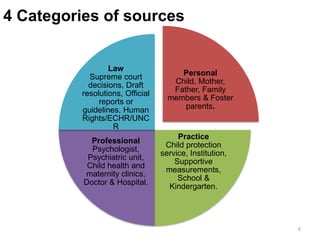
4 Categories of sources
6
Personal
Child, Mother,
Father, Family
members & Foster
parents.
Practice
Child protection
service, Institution,
Supportive
measurements,
School &
Kindergarten.
Professional
Psychologist,
Psychiatric unit,
Child health and
maternity clinics,
Doctor & Hospital.
Law
Supreme court
decisions, Draft
resolutions, Official
reports or
guidelines, Human
Rights/ECHR/UNC
R
7
0
5
10
15
20
25
30
35
Mother
Child
Father
Familymembers
Fosterparents
Childprotection…
Institution
Supportive…
School
Kindergarten
Psychologist
Psychiatricunit
Childhealthand…
Doctor
Hospital
Law
Supremecourt…
Draftresolutions
Officialreportsor…
Human…
Cases
Source
Distribution of sources by category
Source
Arguments related
to the parents (care)
Arguments related
to the child (needs)
Argument related to
help or support (least
intrusive measurement)
Personal
Lack of understanding
of the child’s basic
needs (e.g., adequate
food, clothing and
shelter).
Placement, visitations
(where the child
wants to live).
Disagreeing, resisting or
want different help then
given.
Behavioral problems
(substance abuse).
Practice
Inadequate
supervision, ignoring
or failure to respond to
the child’s needs
(interaction,
stimulation).
Social skills
(kindergarten,
school).
Parents do not
cooperate, do not comply
with or resists help.
Development skills,
self-esteem( child
protection service).
Professional Mental health issues.
Medical neglect (mal
nutrient, obesity).
Parents do not want to or
cannot change. 8
Section 4-1. Consideration of the child’s
best interests.
When applying the provisions of this
chapter, decisive importance shall be
attached to framing measures which are in
the child’s best interests. This includes
attaching importance to giving the child
stable and good contact with adults and
continuity in the care provided.
9

Information, sources and arguments in care order decisons

  • 1.
    Information, sources and argumentsin care order decisions By Line Marie Sørsdal, University of Bergen. 1
  • 2.
    2 When (and how)are the legal criteria for a care order fulfilled? Who provides the County board with information (sources)? What type of arguments do the County board use (evidence)? How do the board argue that the decision is in “best interest” of the child?
  • 3.
    The County socialwelfare board • Established in 1993. • The County boards are independent and have a court like structure. • In care order cases the board is set by three judges; one professional judge, one lay judge and one expert lay judge. • There are 12 County boards in Norway, each board covers one or two counties. 3
  • 4.
    The case material 31care order cases from 2013. 29 cases ends with a care order. 6 different County boards. 10 cases with children between 0-6 years. 11 cases with children between 7-12 years. 10 cases with children between 13- 18 years. There are 38 children in total, 21 girls and 17 boys. The age of the children ranges from 4 months (born 2013) to 17 and 11 months (born 1995). The verdicts are between 6-17 pages. 4
  • 5.
    The Child WelfareAct (1992), section 4-12: A care order may be made (a) if there are serious deficiencies in the everyday care received by the child, or serious deficiencies in terms of the personal contact and security needed by a child of his or her age and development, (b) if the parents fail to ensure that a child who is ill, disabled or in special need of assistance receives the treatment and training required, (c) if the child is mistreated or subjected to other serious abuses at home, or (d) if it is highly probable that the child's health or development may be seriously harmed because the parents are unable to take adequate responsibility for the child. An order may only be made pursuant to the first paragraph when necessary due to the child's current situation. Hence such an order may not be made if satisfactory conditions can be created for the child by assistance measures pursuant to section 4-4 or by measures pursuant to section 4-10 or section 4-11. 5
  • 6.
    4 Categories ofsources 6 Personal Child, Mother, Father, Family members & Foster parents. Practice Child protection service, Institution, Supportive measurements, School & Kindergarten. Professional Psychologist, Psychiatric unit, Child health and maternity clinics, Doctor & Hospital. Law Supreme court decisions, Draft resolutions, Official reports or guidelines, Human Rights/ECHR/UNC R
  • 7.
  • 8.
    Source Arguments related to theparents (care) Arguments related to the child (needs) Argument related to help or support (least intrusive measurement) Personal Lack of understanding of the child’s basic needs (e.g., adequate food, clothing and shelter). Placement, visitations (where the child wants to live). Disagreeing, resisting or want different help then given. Behavioral problems (substance abuse). Practice Inadequate supervision, ignoring or failure to respond to the child’s needs (interaction, stimulation). Social skills (kindergarten, school). Parents do not cooperate, do not comply with or resists help. Development skills, self-esteem( child protection service). Professional Mental health issues. Medical neglect (mal nutrient, obesity). Parents do not want to or cannot change. 8
  • 9.
    Section 4-1. Considerationof the child’s best interests. When applying the provisions of this chapter, decisive importance shall be attached to framing measures which are in the child’s best interests. This includes attaching importance to giving the child stable and good contact with adults and continuity in the care provided. 9