FIBULAR DEFICIENCY
K.SAIKRISHNA
 The term Fibular deficiency is congenital absence of all
or a part of fibula and is the most common long bone
deficiency.
 The syndrome of fibular deficiency encompasses a
spectrum of abnormalities affecting the
femur,knee,tibia,ankle and foot.
Aetiology--
 It is a rare disorder occuring in only 1 in 40,000 births.
Bilateral fibular hemimelia is even rarer.
 The precise cause of fibular hemimelia is unknown in
most of the cases and the deformity normally occurs
sporadically.
 Although genetic abnormalities are linked to FH, the
condition is not heritable. The gene mutations and
abnormalities are occurring only in the forming limb and
not anywhere else, and thus cannot be transmitted to
the next generation.
 Graham 1993 suggested that vascular or mechanical
interference with embryonicapical ectodermic ridge
might lead to fibular hemimelia.
 Angiographic study has detected vasculature
abnormalities including persistence embryonic vascular
pattern, failure of plantar arch formation, absence of
anterior tibial artery or absence of normal trifurcation of
the popliteal artery at the level of the knee, and
presence of one large posterior artery in the leg
Classification
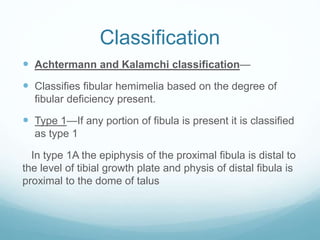
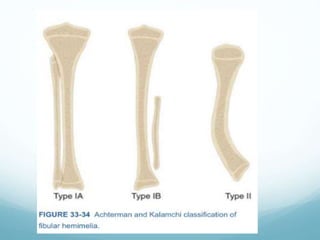
 Achtermann and Kalamchi classification—
 Classifies fibular hemimelia based on the degree of
fibular deficiency present.
 Type 1—If any portion of fibula is present it is classified
as type 1
In type 1A the epiphysis of the proximal fibula is distal to
the level of tibial growth plate and physis of distal fibula is
proximal to the dome of talus
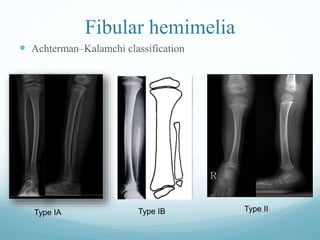
Fibular hemimelia
 Achterman–Kalamchi classification
Type IA Type IB Type II
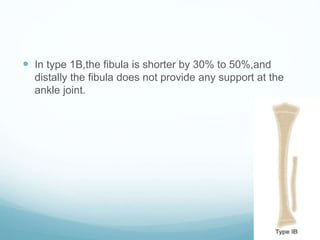
 In type 1B,the fibula is shorter by 30% to 50%,and
distally the fibula does not provide any support at the
ankle joint.
 The reported total limb length discrepancy at maturity
was 12% in type 1A and 18% in type 1B.
 If the fibula is completely absent,the deformity is
classified as type 2.
 Limb length discrepancy was 20% in type 2.
Birch classification
 A major short coming of other classifications is that they
do not deal with shortening of the total limb which is
one of the most important factor.
 A functional foot was defined as one that was or could
be made plantigrade and had 3 or more rays.A direct
corelation was found between the number of rays and
chances of preserving the foot.
 It was possible to preserve all 5 rayed feet whereas no
foot with 2 or fewer rays was salvageable.
Classification Treatment
Type 1 functional foot
1A=0% to 5% inequality
1B=6% to 10% inequality
Orthosis,epiphysiodesis
Epiphysiodesis+/-linb
lengthening
1C= 11% to 30% inequality One or 2 limb
lengthening/Amputation
1D = >30% inequality More than 2 limb
lengthening/Amputation
Type 2 non functional foot
2A=Functional upper limb Early amputation
2B Non functional Upper limb Consider limb salvage
Other classifications==
Stanitski Classification
Frantz and O`Rahilly Classification
Coventry and Johnson classification
Clinical features
 Children with fibular hemimelia present with three
major complaints:
 Limb length discrepancy
 Foot and ankle deformities
 Knee deformity
 Other deformities—ACL deficiency,absence of tibial
spine and tarsal coalition.
Limb length problems--
 Unilateral fibular hemimelia leads to length discrepancy
due to inhibition of growth of the tibia and foot. In
addition, many children with FH have some femoral
growth inhibition (congenital femoral deficiency).
 The foot grows shorter in height, contributing to limb
length discrepancy, but it is also shorter in length.
 This limb length discrepancy follows a Shapiro 1a
curve, meaning its growth inhibition remains constant .
This characteristic makes the leg length discrepancy of
FH predictable using the Anderson and Green ,
Moseley straight line graph , Amstutz method or Paley
Mul- tiplier method .
 The limb length discrepancy with FH ranges from very
mild to very severe inhibition, ranging at maturity of the
patient from 2 to 25 cm in the absence of femoral
deficiency discrepancy. With combined inhibition of the
femur and tibia the magnitude of leg length dis-
crepancy at maturity can be [30 cm].
Foot and ankle problems--
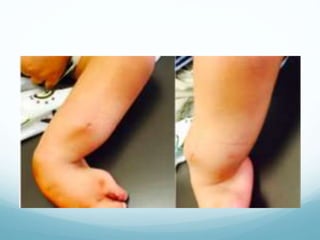
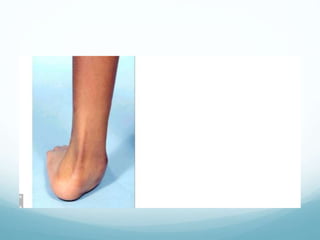
 Foot and ankle deformities have been the most
challenging and disabling problems with FH. FH foot
deformity has many components. At the ankle there is a
dysplasia of the distal tibia and of the talus, which
ranges from mild valgus of the distal tibia to severe
dysplasia with flat malformed, maloriented joint
surfaces.
 The distal tibial physis is more affected then the
proximal tibial physis, with the former being often
wedge shaped.
 The talus too ranges in its articular shape from normal
to ball shaped in the frontal plane and from round to
nearly flat in the sagittal plane.
 The fibula normally contributes to the lateral stability of
the ankle. If the fibula is absent or deficient, then the
ankle will sublux or roll into valgus.
 The subtalar joint pathology ranges from a normal
subtalar joint to a subtalar joint with subtalar coalition.
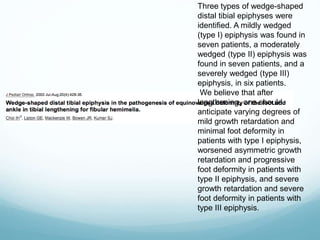
Three types of wedge-shaped
distal tibial epiphyses were
identified. A mildly wedged
(type I) epiphysis was found in
seven patients, a moderately
wedged (type II) epiphysis was
found in seven patients, and a
severely wedged (type III)
epiphysis, in six patients.
We believe that after
lengthening, one should
anticipate varying degrees of
mild growth retardation and
minimal foot deformity in
patients with type I epiphysis,
worsened asymmetric growth
retardation and progressive
foot deformity in patients with
type II epiphysis, and severe
growth retardation and severe
foot deformity in patients with
type III epiphysis.
Tibial deformity
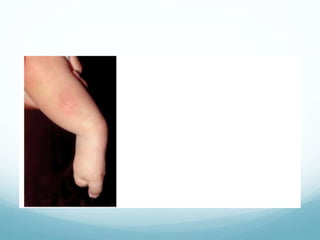
 There is often a mild to severe dia- physeal tibial
deformity of the valgus-procurvatum. A skin dimple is
usually present over the apex of this angulation. The
fibular anlage is located like the string of a bow in a
straight line opposite the concavity of this deformity.
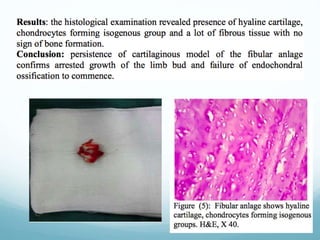
 This thick fibro-cartilagenous remnant may contribute to
this angulation by tethering the growth of the tibia on its
posterior-lateral side.
Fibular anlage
Knee joint deformities
 The knee joint frequently has a valgus deformity. This
valgus is related both to the distal femur and the
proximal tibia. The lateral epiphysis of the proximal tibia
may be delayed in its ossification compared to the
normal opposite side.
Knee instability
 Many patients with FH have hypoplasia or aplasia of
the anterior and or posterior cruciate ligaments. The
tibia may be subluxed anteriorly relative to the femur.
The ligament deficiency and subluxation are often not
symptomatic at a young age, but these become a
bigger problem when the child becomes taller and
heavier.
Treatment
 The goals of managing fibular hemimelia cases
include, managing the limb deficiency, correcting bone
angulations, and achieving a well, plantigrade, and
painless foot.
Treatment
 Partial fibular Hemimelia—
The decision to treat patients with partial fibular hemimelia
by amputation or limb lengthening depends on the degree
of predicted shortening at maturity and the condition of
affected limb foot and ankle.
 If the predicted discrepancy at maturity is 25 cm or
more and there is severe valgus of the ankle with a
deformed foot the patient should be treated with Syme
or Boyd amputation and prosthetic management.
 If the patient has a predicted shortening of 8
cm or less,a functional plantigrade foot with
four or more rays and a stable mobile ankle he
is a good candidate for lengthening procedure
with or without epiphysiodesis.
 Realignment of obliquity of distal tibial
epiphysis may be needed in this group of
patients.
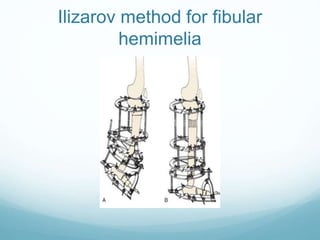
Ilizarov method for fibular
hemimelia
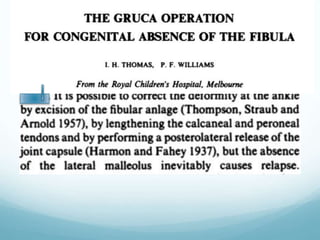
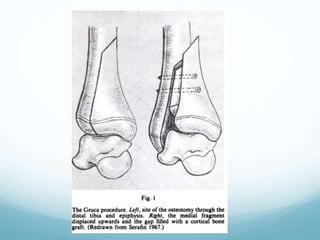
Gruca operation
 The choice of amputation or lengthening for children
the criteria identified must be made on an individual
basis.
 For the patients who qualify , single or staged
lengthening with repositioning of the foot may be
successful and the short fibula may be differentially
lengthened relative to the tibia to establish a more
normal tibio fibular relation.
 Most of these patients however have a tarsal coalition
and an abnormal talotibial articulation and its difficult to
predict long term functional out come of retained foot
and ankle.
 Regardless of the treatment method used ,some
patients develop gradually progressive valgus of the
knee.This condition is best treated 1 to 2 years before
the patient reaches skeletal maturity at which time
partial growth arrest may be done.
Complete Fibular hemimelia
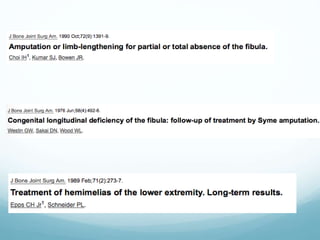
 Amputation –
 In the past different procedures were done in an
attempt to centralize the patients foot and lengthen the
limb.Today,there is consensus that ankle disarticulation
is the best treatment for complete fibular hemimelia.
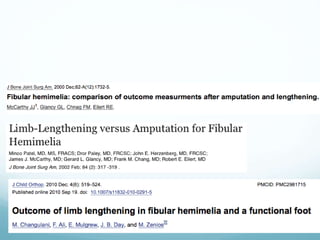
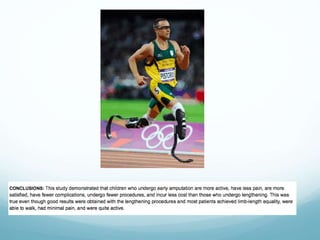
 The procedure should be done in early childhood and
the patient should be fitted with Syme prosthesis
afterward.
 Some surgeons prefer the Boyds amputation,in which
the retained calcaneus can be used to stabilise the
heel pad,especially for older boys.
 The optimal time to perform the amputation is when the
child is just starting to pull up to stand(9-10 months
age).If the operation is done at this time the child will
be able to ambulate in a prosthesis at approximately 1
year of age and will be able to function at near normal
level in all sports.
 Mild tibial bowing is usually well tolerated and
corrective osteotomy is not necessary.However if the
bowing is marked and there is too great an anterior
prominence tibial osteotomy can be done.
Bilateral FH
 Have a very little length discrepancy but major problem
is disproportin between lenghts of legs and rest of the
body.
 Treated either by amputation or lengthening.
Conclusion
 FH is rare.
 Etology is unknown,and probably related to
abnormalities in forming limb bud.
 Encompasses a spectrum of deformities rather than
absence of fibula alone.
 Prognosis depends on expected LLD and number of
rays and degree of deformity of foot.
 Severe deformites with expected LLD >25 cm are
managed best by Symes or Boyd amputation.
 Mild deformities with a functional foot can be treated by
foot reconstruction and lengthening procedures.
 Treatment must be individualised and surgical options
and prognosis must be explained to parents in detail
and involve them in the decision making process.
Thank you !!

Fibular Hemimelia

  • 1.
  • 2.
     The termFibular deficiency is congenital absence of all or a part of fibula and is the most common long bone deficiency.  The syndrome of fibular deficiency encompasses a spectrum of abnormalities affecting the femur,knee,tibia,ankle and foot.
  • 3.
    Aetiology--  It isa rare disorder occuring in only 1 in 40,000 births. Bilateral fibular hemimelia is even rarer.  The precise cause of fibular hemimelia is unknown in most of the cases and the deformity normally occurs sporadically.
  • 4.
     Although geneticabnormalities are linked to FH, the condition is not heritable. The gene mutations and abnormalities are occurring only in the forming limb and not anywhere else, and thus cannot be transmitted to the next generation.
  • 5.
     Graham 1993suggested that vascular or mechanical interference with embryonicapical ectodermic ridge might lead to fibular hemimelia.  Angiographic study has detected vasculature abnormalities including persistence embryonic vascular pattern, failure of plantar arch formation, absence of anterior tibial artery or absence of normal trifurcation of the popliteal artery at the level of the knee, and presence of one large posterior artery in the leg
  • 6.
    Classification  Achtermann andKalamchi classification—  Classifies fibular hemimelia based on the degree of fibular deficiency present.  Type 1—If any portion of fibula is present it is classified as type 1 In type 1A the epiphysis of the proximal fibula is distal to the level of tibial growth plate and physis of distal fibula is proximal to the dome of talus
  • 8.
    Fibular hemimelia  Achterman–Kalamchiclassification Type IA Type IB Type II
  • 9.
     In type1B,the fibula is shorter by 30% to 50%,and distally the fibula does not provide any support at the ankle joint.
  • 10.
     The reportedtotal limb length discrepancy at maturity was 12% in type 1A and 18% in type 1B.  If the fibula is completely absent,the deformity is classified as type 2.  Limb length discrepancy was 20% in type 2.
  • 11.
    Birch classification  Amajor short coming of other classifications is that they do not deal with shortening of the total limb which is one of the most important factor.  A functional foot was defined as one that was or could be made plantigrade and had 3 or more rays.A direct corelation was found between the number of rays and chances of preserving the foot.
  • 12.
     It waspossible to preserve all 5 rayed feet whereas no foot with 2 or fewer rays was salvageable. Classification Treatment Type 1 functional foot 1A=0% to 5% inequality 1B=6% to 10% inequality Orthosis,epiphysiodesis Epiphysiodesis+/-linb lengthening 1C= 11% to 30% inequality One or 2 limb lengthening/Amputation 1D = >30% inequality More than 2 limb lengthening/Amputation
  • 13.
    Type 2 nonfunctional foot 2A=Functional upper limb Early amputation 2B Non functional Upper limb Consider limb salvage Other classifications== Stanitski Classification Frantz and O`Rahilly Classification Coventry and Johnson classification
  • 14.
    Clinical features  Childrenwith fibular hemimelia present with three major complaints:  Limb length discrepancy  Foot and ankle deformities  Knee deformity  Other deformities—ACL deficiency,absence of tibial spine and tarsal coalition.
  • 15.
    Limb length problems-- Unilateral fibular hemimelia leads to length discrepancy due to inhibition of growth of the tibia and foot. In addition, many children with FH have some femoral growth inhibition (congenital femoral deficiency).  The foot grows shorter in height, contributing to limb length discrepancy, but it is also shorter in length.
  • 16.
     This limblength discrepancy follows a Shapiro 1a curve, meaning its growth inhibition remains constant . This characteristic makes the leg length discrepancy of FH predictable using the Anderson and Green , Moseley straight line graph , Amstutz method or Paley Mul- tiplier method .
  • 17.
     The limblength discrepancy with FH ranges from very mild to very severe inhibition, ranging at maturity of the patient from 2 to 25 cm in the absence of femoral deficiency discrepancy. With combined inhibition of the femur and tibia the magnitude of leg length dis- crepancy at maturity can be [30 cm].
  • 18.
    Foot and ankleproblems--  Foot and ankle deformities have been the most challenging and disabling problems with FH. FH foot deformity has many components. At the ankle there is a dysplasia of the distal tibia and of the talus, which ranges from mild valgus of the distal tibia to severe dysplasia with flat malformed, maloriented joint surfaces.
  • 19.
     The distaltibial physis is more affected then the proximal tibial physis, with the former being often wedge shaped.  The talus too ranges in its articular shape from normal to ball shaped in the frontal plane and from round to nearly flat in the sagittal plane.
  • 20.
     The fibulanormally contributes to the lateral stability of the ankle. If the fibula is absent or deficient, then the ankle will sublux or roll into valgus.  The subtalar joint pathology ranges from a normal subtalar joint to a subtalar joint with subtalar coalition.
  • 22.
    Three types ofwedge-shaped distal tibial epiphyses were identified. A mildly wedged (type I) epiphysis was found in seven patients, a moderately wedged (type II) epiphysis was found in seven patients, and a severely wedged (type III) epiphysis, in six patients. We believe that after lengthening, one should anticipate varying degrees of mild growth retardation and minimal foot deformity in patients with type I epiphysis, worsened asymmetric growth retardation and progressive foot deformity in patients with type II epiphysis, and severe growth retardation and severe foot deformity in patients with type III epiphysis.
  • 24.
    Tibial deformity  Thereis often a mild to severe dia- physeal tibial deformity of the valgus-procurvatum. A skin dimple is usually present over the apex of this angulation. The fibular anlage is located like the string of a bow in a straight line opposite the concavity of this deformity.
  • 25.
     This thickfibro-cartilagenous remnant may contribute to this angulation by tethering the growth of the tibia on its posterior-lateral side.
  • 27.
  • 29.
    Knee joint deformities The knee joint frequently has a valgus deformity. This valgus is related both to the distal femur and the proximal tibia. The lateral epiphysis of the proximal tibia may be delayed in its ossification compared to the normal opposite side.
  • 30.
    Knee instability  Manypatients with FH have hypoplasia or aplasia of the anterior and or posterior cruciate ligaments. The tibia may be subluxed anteriorly relative to the femur. The ligament deficiency and subluxation are often not symptomatic at a young age, but these become a bigger problem when the child becomes taller and heavier.
  • 31.
    Treatment  The goalsof managing fibular hemimelia cases include, managing the limb deficiency, correcting bone angulations, and achieving a well, plantigrade, and painless foot.
  • 32.
    Treatment  Partial fibularHemimelia— The decision to treat patients with partial fibular hemimelia by amputation or limb lengthening depends on the degree of predicted shortening at maturity and the condition of affected limb foot and ankle.
  • 33.
     If thepredicted discrepancy at maturity is 25 cm or more and there is severe valgus of the ankle with a deformed foot the patient should be treated with Syme or Boyd amputation and prosthetic management.
  • 34.
     If thepatient has a predicted shortening of 8 cm or less,a functional plantigrade foot with four or more rays and a stable mobile ankle he is a good candidate for lengthening procedure with or without epiphysiodesis.  Realignment of obliquity of distal tibial epiphysis may be needed in this group of patients.
  • 35.
    Ilizarov method forfibular hemimelia
  • 36.
  • 38.
     The choiceof amputation or lengthening for children the criteria identified must be made on an individual basis.  For the patients who qualify , single or staged lengthening with repositioning of the foot may be successful and the short fibula may be differentially lengthened relative to the tibia to establish a more normal tibio fibular relation.
  • 39.
     Most ofthese patients however have a tarsal coalition and an abnormal talotibial articulation and its difficult to predict long term functional out come of retained foot and ankle.
  • 40.
     Regardless ofthe treatment method used ,some patients develop gradually progressive valgus of the knee.This condition is best treated 1 to 2 years before the patient reaches skeletal maturity at which time partial growth arrest may be done.
  • 41.
    Complete Fibular hemimelia Amputation –  In the past different procedures were done in an attempt to centralize the patients foot and lengthen the limb.Today,there is consensus that ankle disarticulation is the best treatment for complete fibular hemimelia.
  • 45.
     The procedureshould be done in early childhood and the patient should be fitted with Syme prosthesis afterward.  Some surgeons prefer the Boyds amputation,in which the retained calcaneus can be used to stabilise the heel pad,especially for older boys.
  • 46.
     The optimaltime to perform the amputation is when the child is just starting to pull up to stand(9-10 months age).If the operation is done at this time the child will be able to ambulate in a prosthesis at approximately 1 year of age and will be able to function at near normal level in all sports.
  • 47.
     Mild tibialbowing is usually well tolerated and corrective osteotomy is not necessary.However if the bowing is marked and there is too great an anterior prominence tibial osteotomy can be done.
  • 48.
    Bilateral FH  Havea very little length discrepancy but major problem is disproportin between lenghts of legs and rest of the body.  Treated either by amputation or lengthening.
  • 49.
    Conclusion  FH israre.  Etology is unknown,and probably related to abnormalities in forming limb bud.  Encompasses a spectrum of deformities rather than absence of fibula alone.  Prognosis depends on expected LLD and number of rays and degree of deformity of foot.
  • 50.
     Severe deformiteswith expected LLD >25 cm are managed best by Symes or Boyd amputation.  Mild deformities with a functional foot can be treated by foot reconstruction and lengthening procedures.  Treatment must be individualised and surgical options and prognosis must be explained to parents in detail and involve them in the decision making process.
  • 51.