LIMB-LENGTH DISCREPANCY
By Ayalew.
Moderator: DR. Berhe (ORTHO-TRAUMA SURGEON)
Contents
 Introduction
 Classification
 Etiology
 Evaluation
 Treatment
Introduction
 Limb length discrepancy is defined as a condition in
which the paired lower extremity limbs have a noticeably
unequal length
 LLD of 0.5 to 2.0 cm are common in the normal,
asymptomatic population
 LLD of more than 2.5 cm is significant
Classification
Structural (SLLD) or anatomical:
 Differences in leg length resulting from inequalities
in bony structure.
Functional (FLLD) or apparent:
 factors other than actual bone shortening or
lengthening make one leg shorter or longer than the
other, a functional inequality occurs
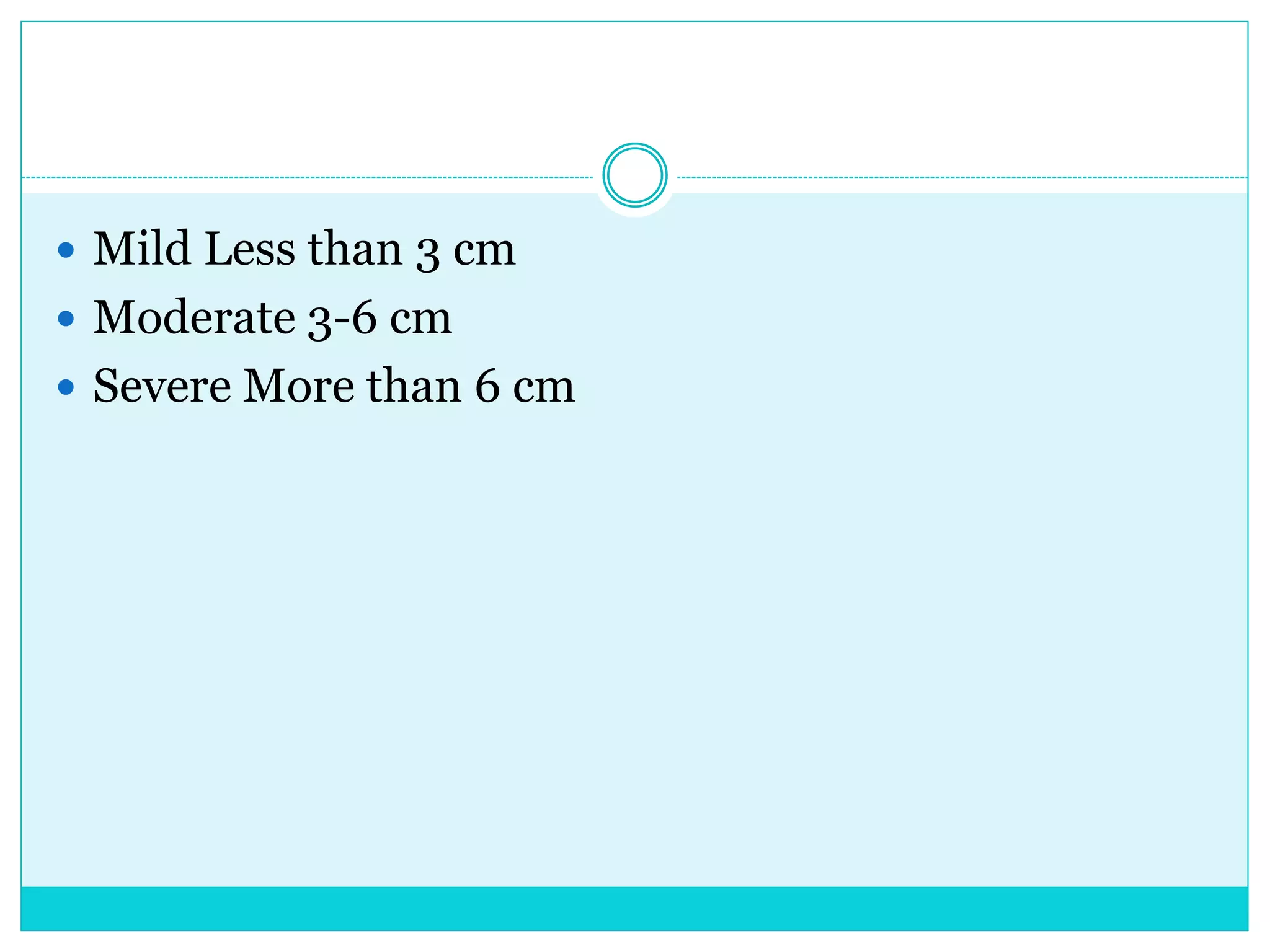
 Mild Less than 3 cm
 Moderate 3-6 cm
 Severe More than 6 cm
6
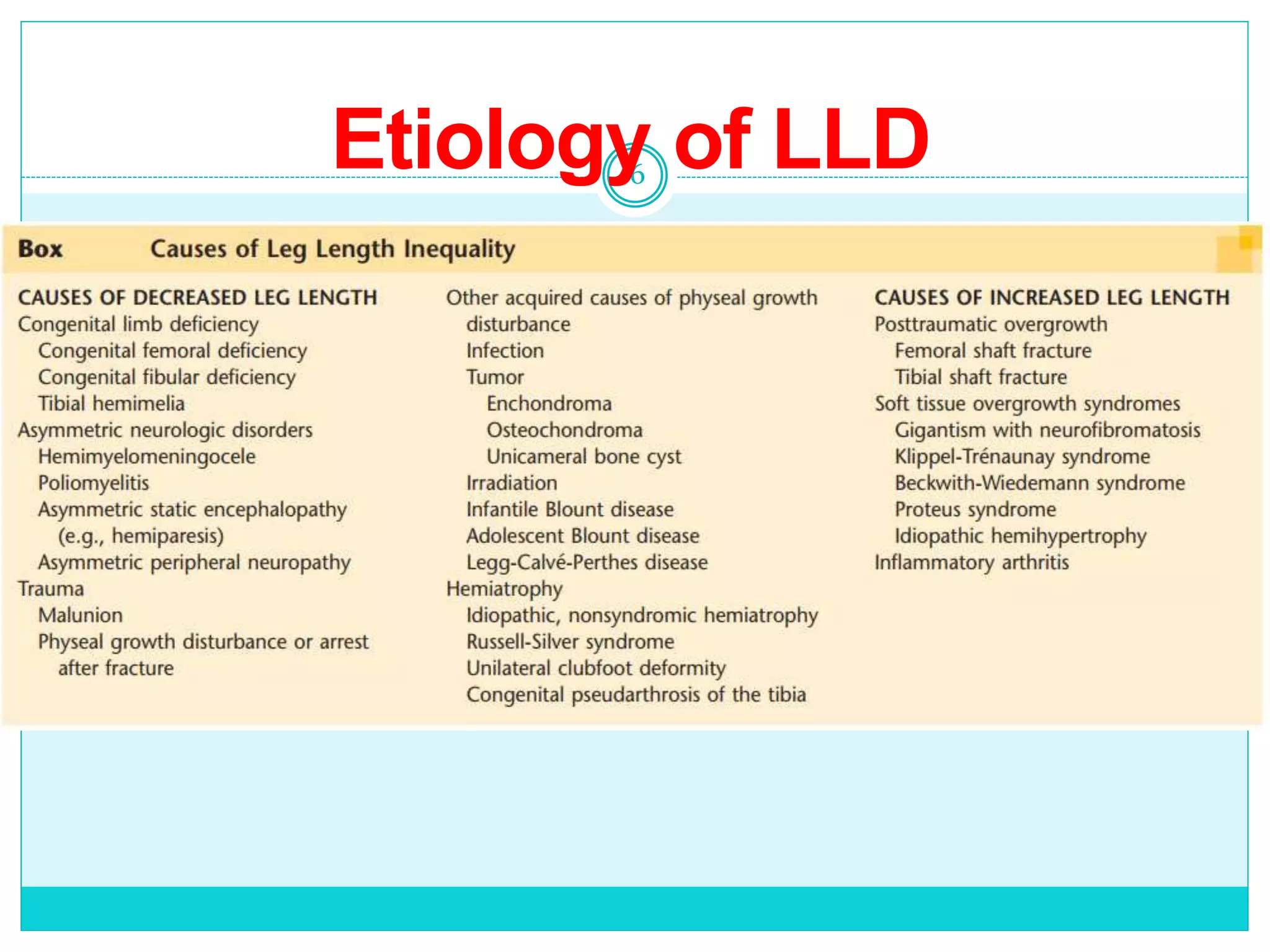
Etiology of LLD
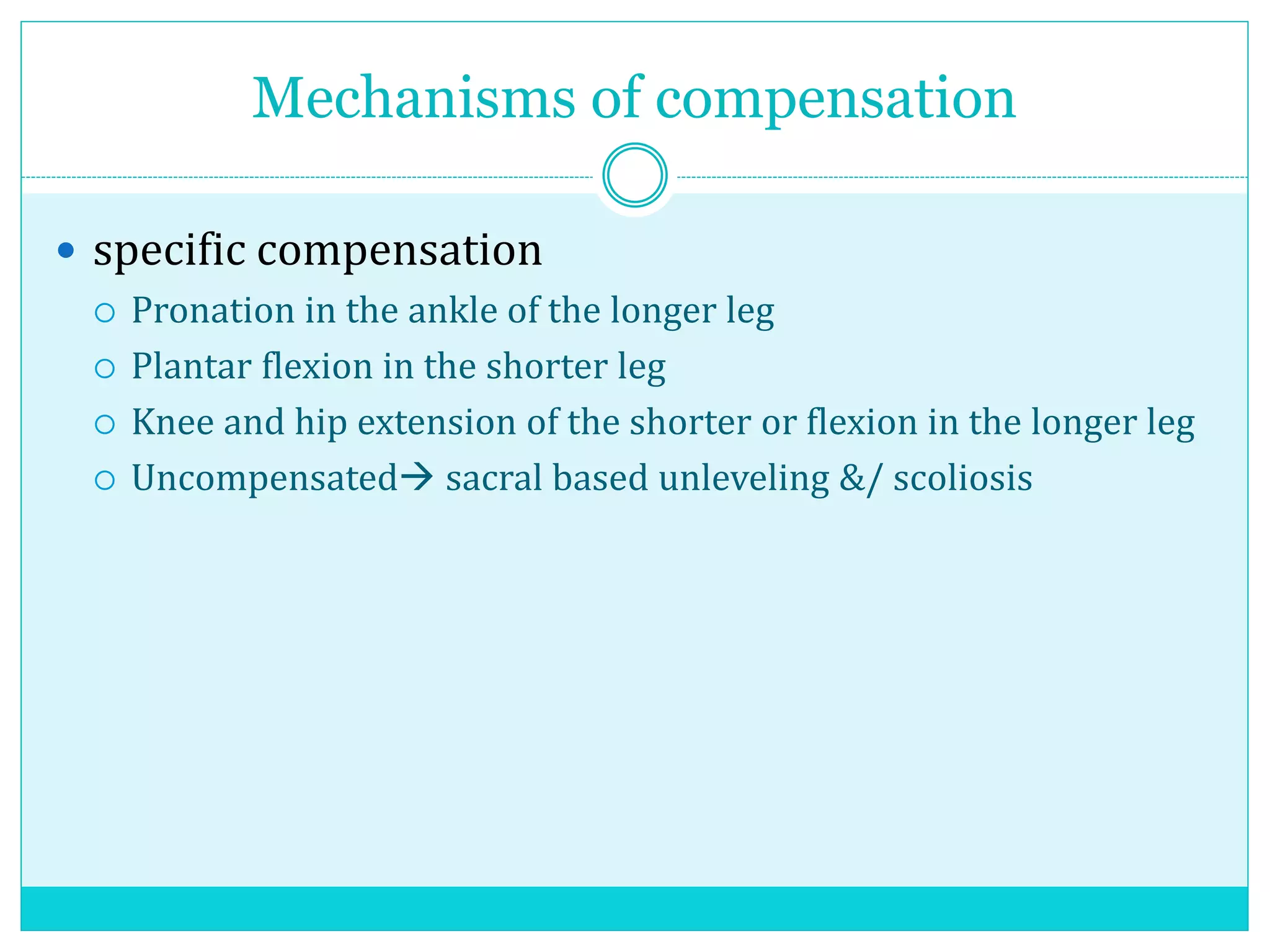
Mechanisms of compensation
 specific compensation
 Pronation in the ankle of the longer leg
 Plantar flexion in the shorter leg
 Knee and hip extension of the shorter or flexion in the longer leg
 Uncompensated sacral based unleveling &/ scoliosis
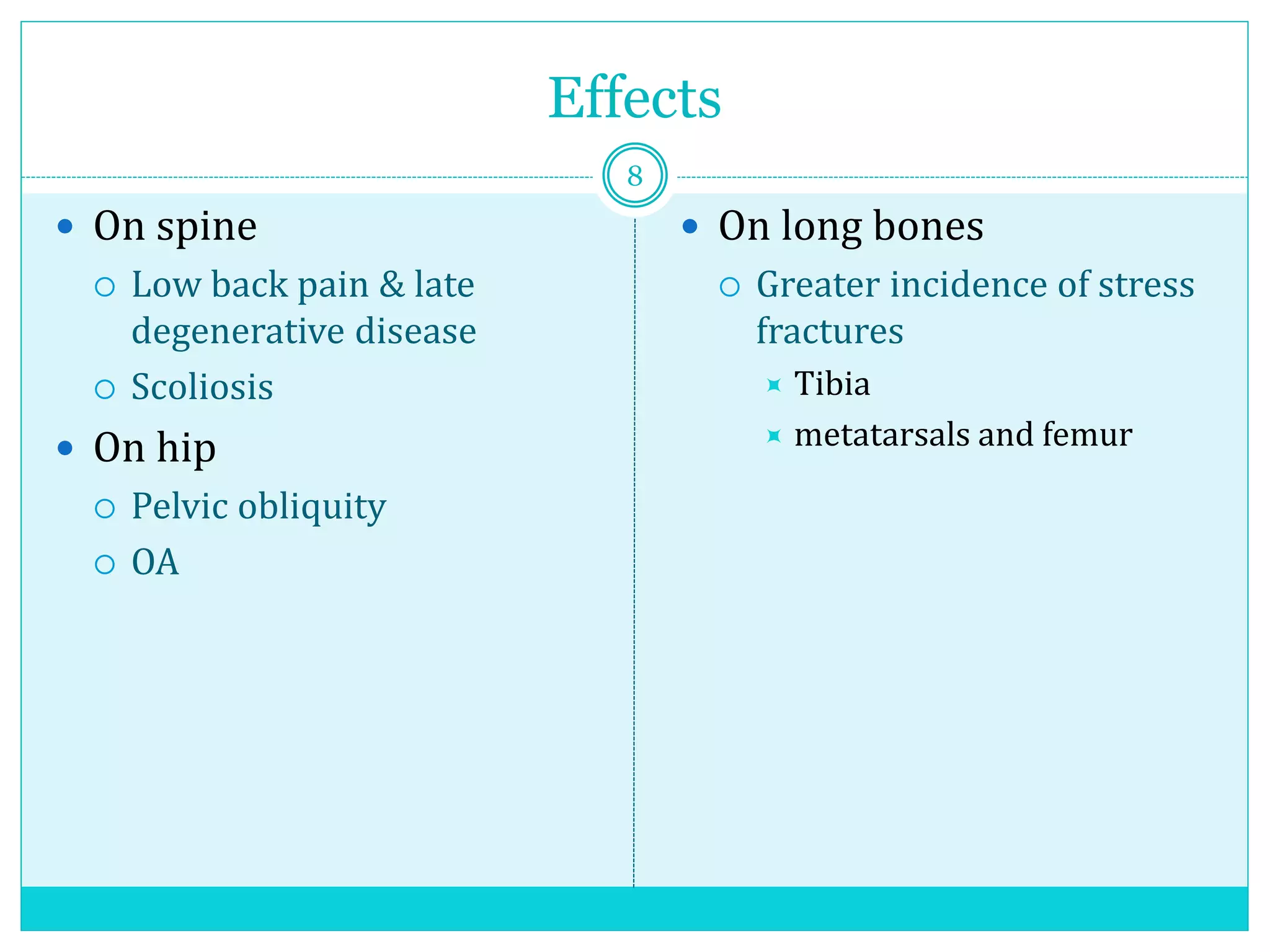
Effects
 On spine
 Low back pain & late
degenerative disease
 Scoliosis
 On hip
 Pelvic obliquity
 OA
 On long bones
 Greater incidence of stress
fractures
 Tibia
 metatarsals and femur
8
Evaluation
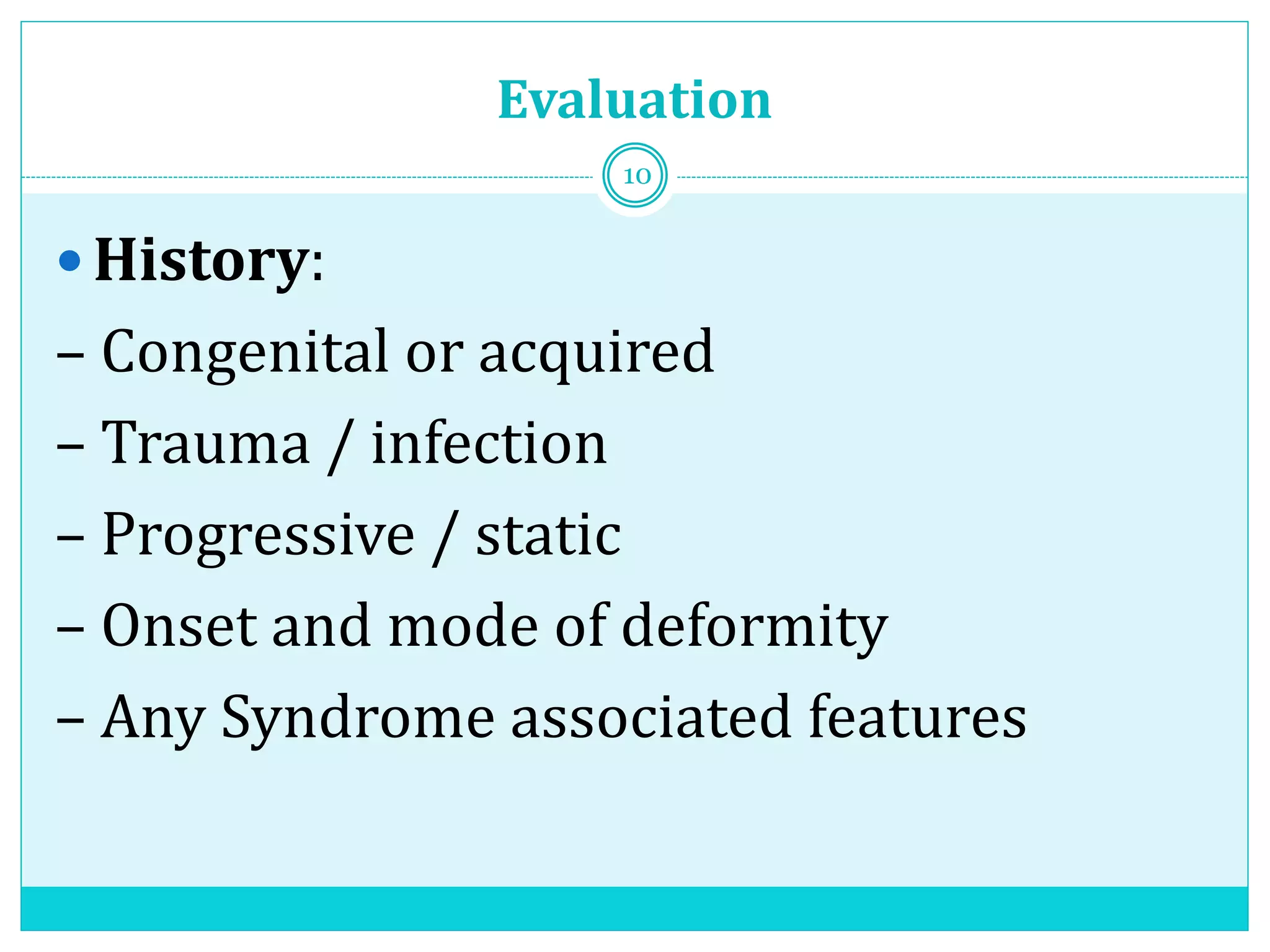
Evaluation
 History:
– Congenital or acquired
– Trauma / infection
– Progressive / static
– Onset and mode of deformity
– Any Syndrome associated features
10
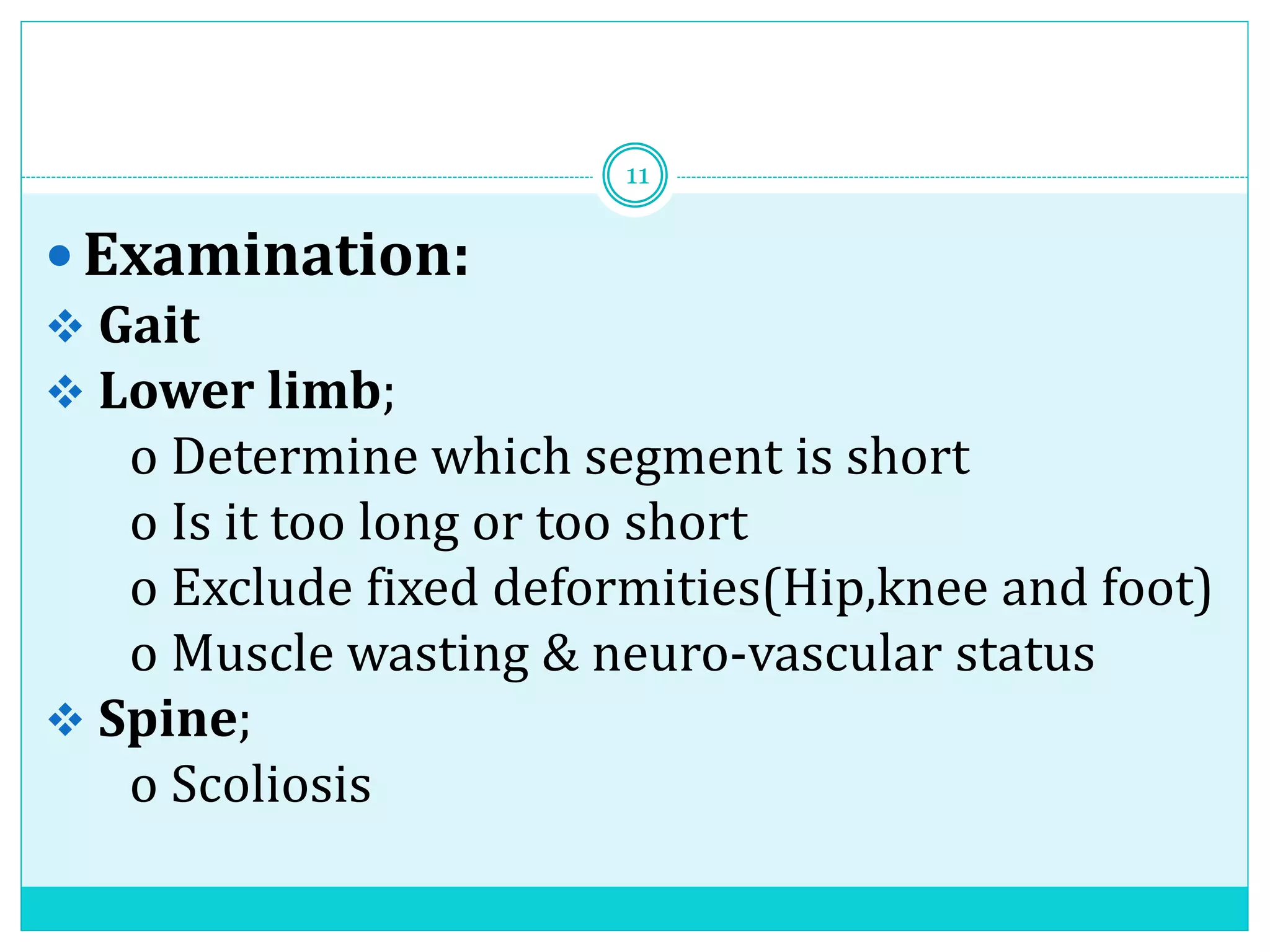
 Examination:
 Gait
 Lower limb;
o Determine which segment is short
o Is it too long or too short
o Exclude fixed deformities(Hip,knee and foot)
o Muscle wasting & neuro-vascular status
 Spine;
o Scoliosis
11
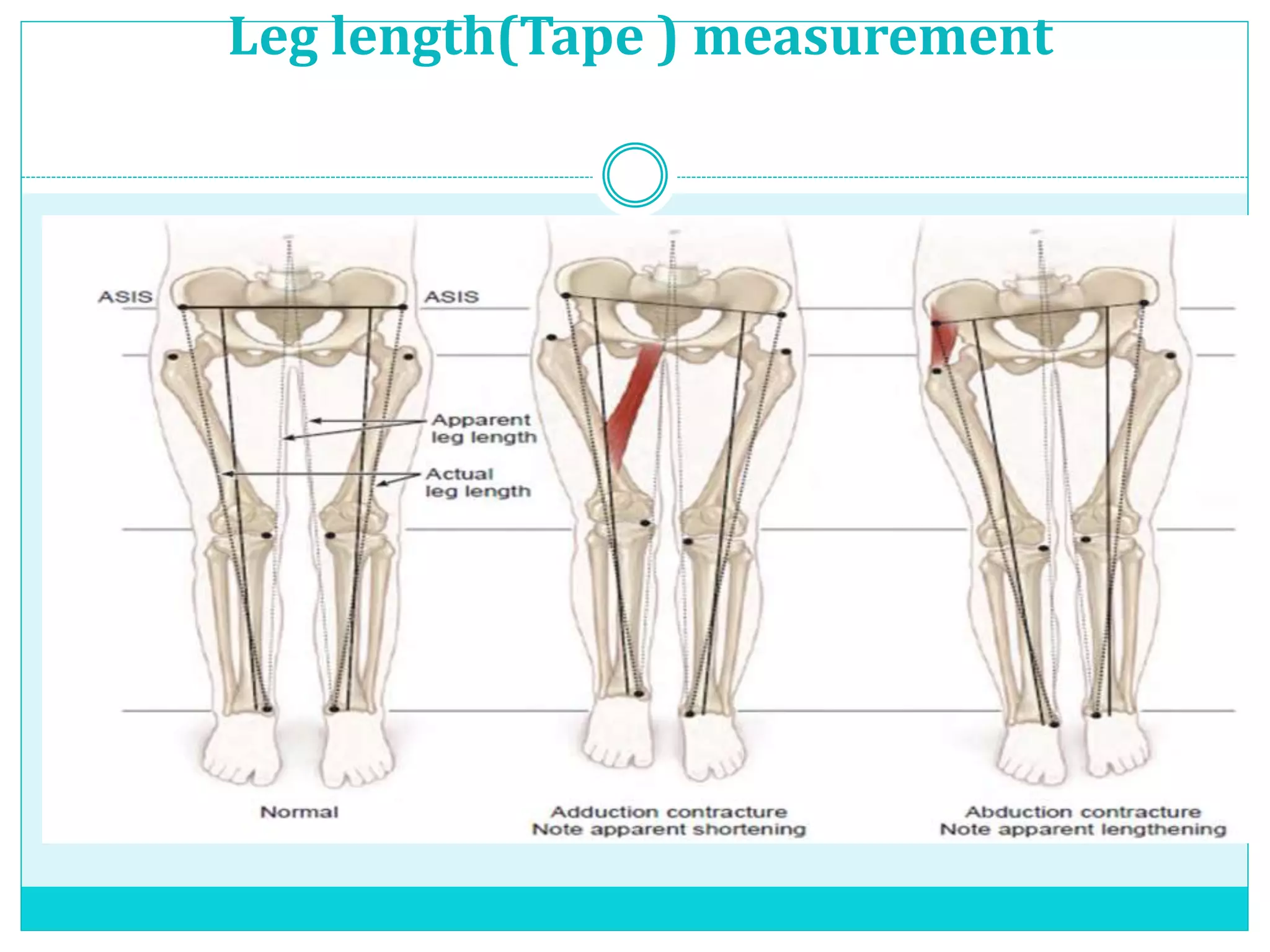
Leg length(Tape ) measurement
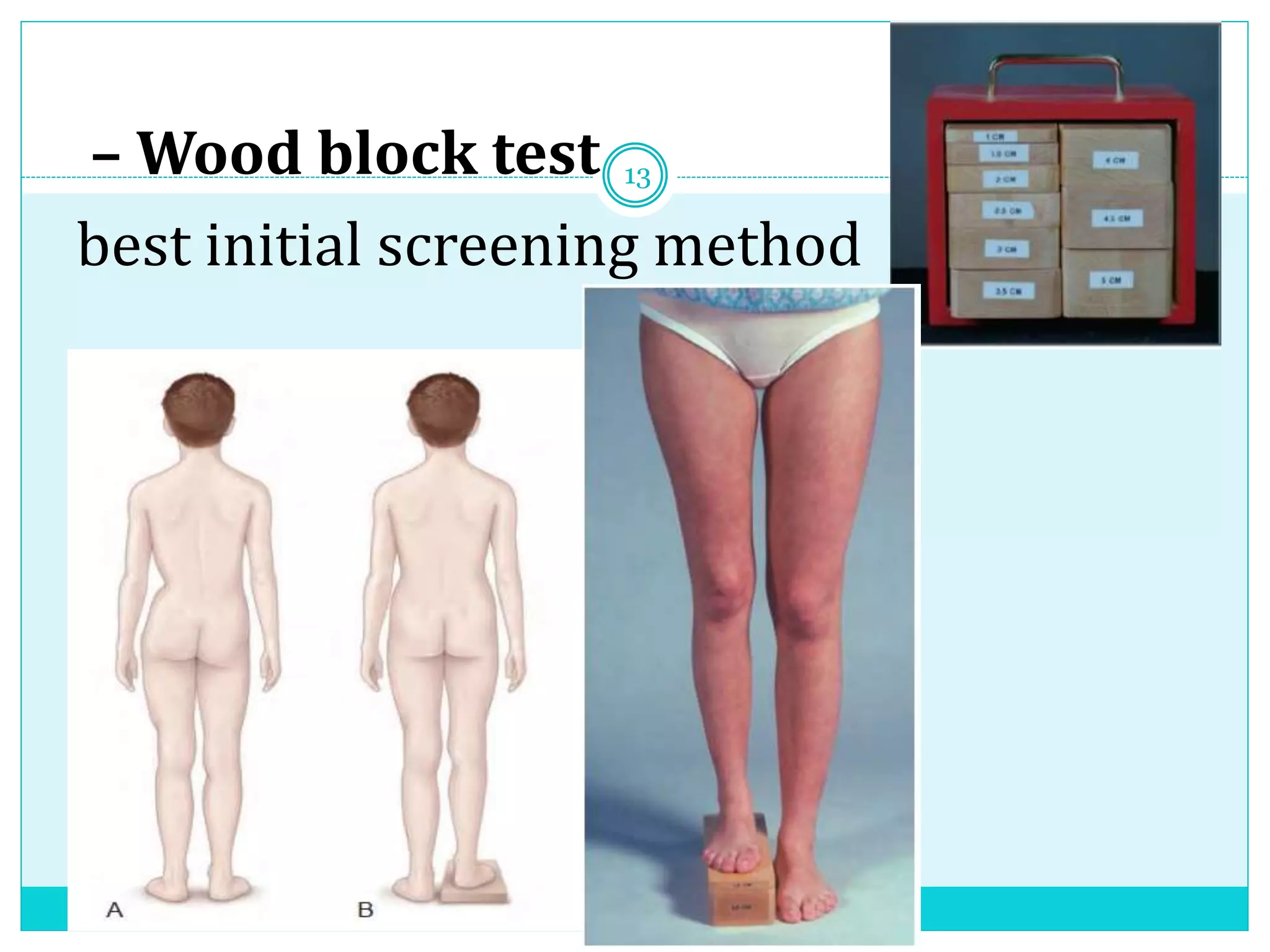
– Wood block test
best initial screening method
13
Imaging
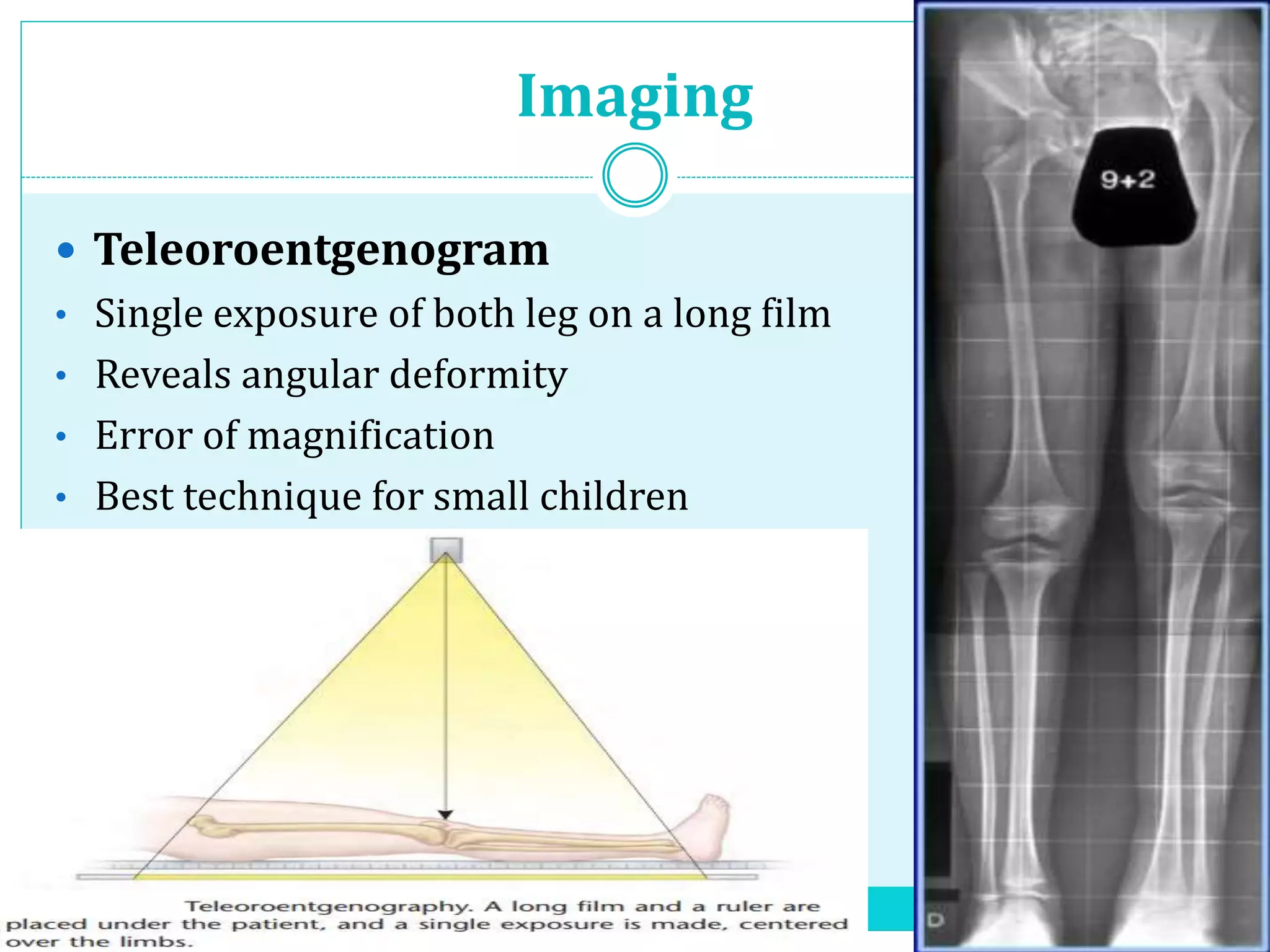
 Teleoroentgenogram
• Single exposure of both leg on a long film
• Reveals angular deformity
• Error of magnification
• Best technique for small children
•
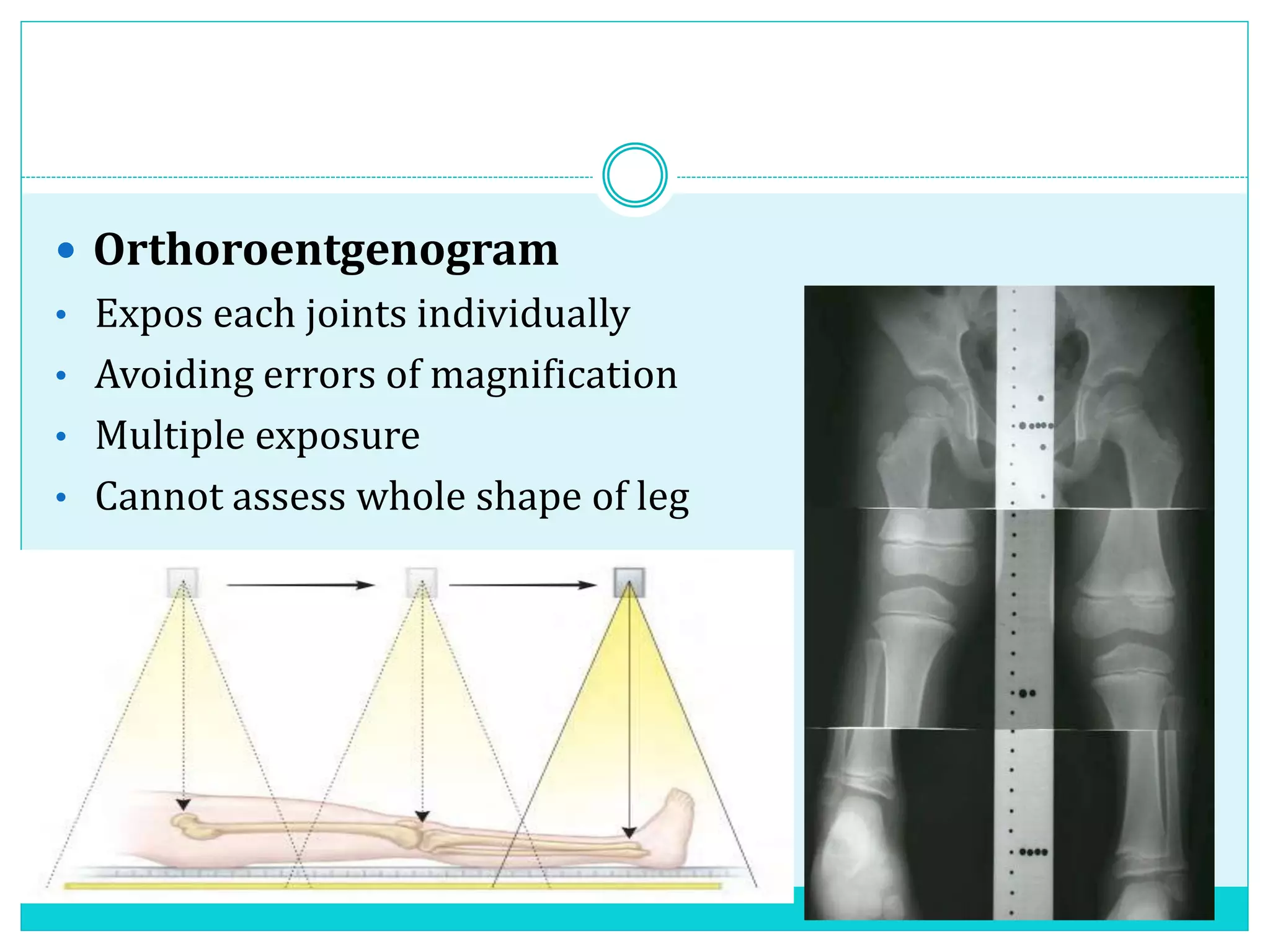
 Orthoroentgenogram
• Expos each joints individually
• Avoiding errors of magnification
• Multiple exposure
• Cannot assess whole shape of leg
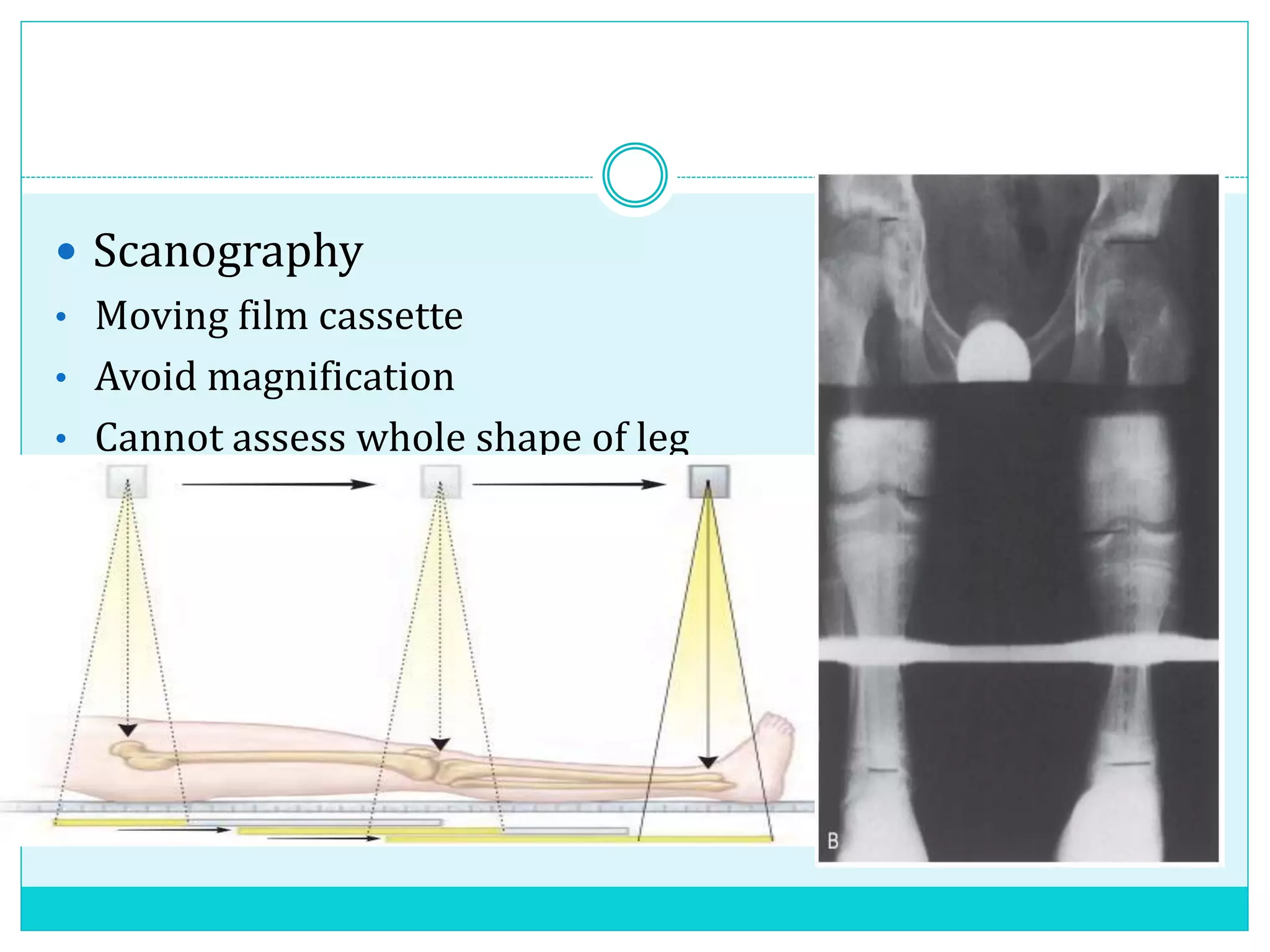
 Scanography
• Moving film cassette
• Avoid magnification
• Cannot assess whole shape of leg
 CT scan
 Advantages of CT
• lower radiation exposure
• greater accuracy,
• less susceptibility to error if the patient is poorly
positioned,
• specifically indicated when the patient has a knee
flexion contracture or is in a circular external fixator
Prediction of Discrepancy
 There are various methods of
assessment of patient and predicting the
LLD
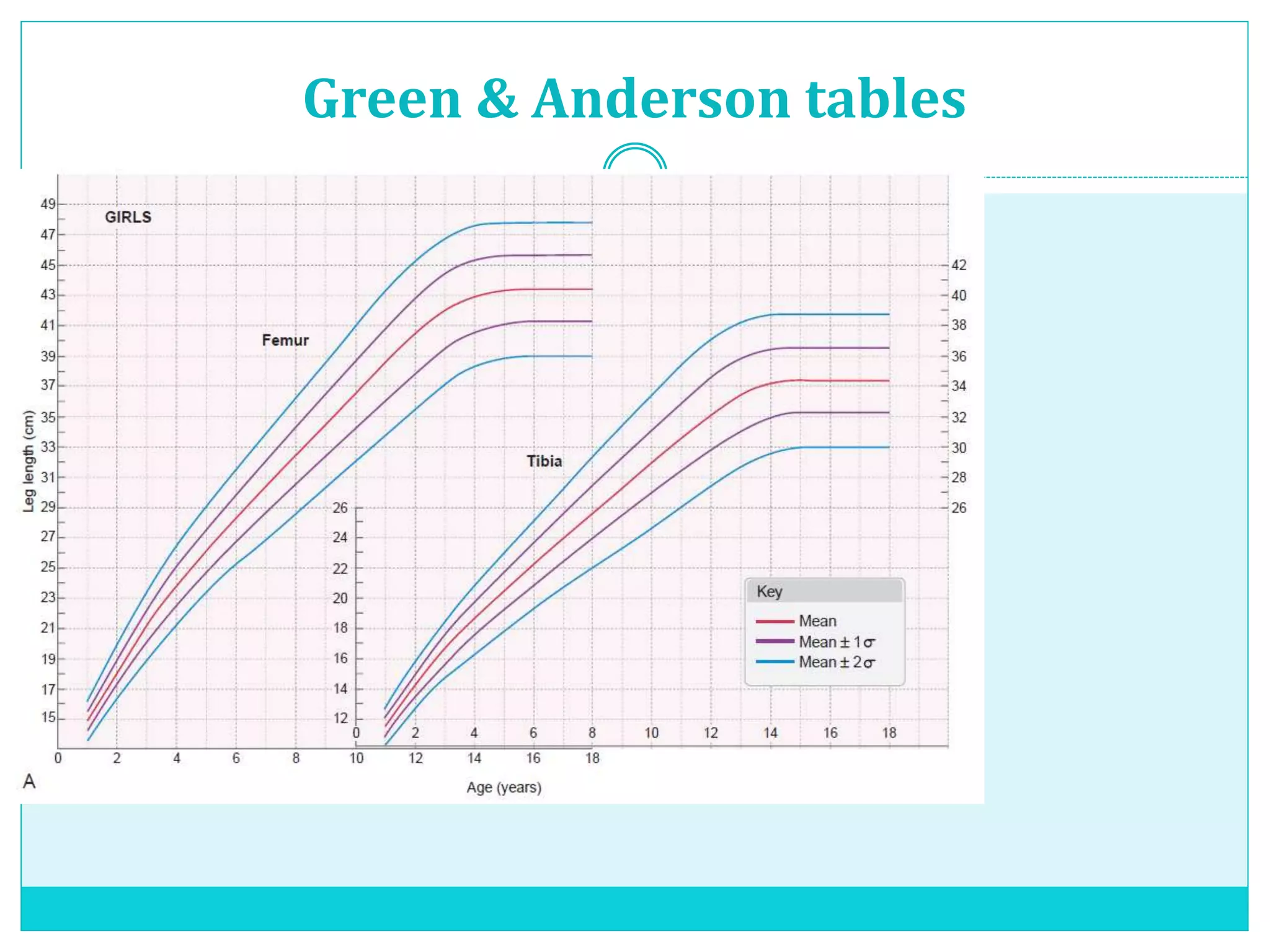
 Growth remaining method — by Green & Anderson
 Arithmetic method — by White Menelaus
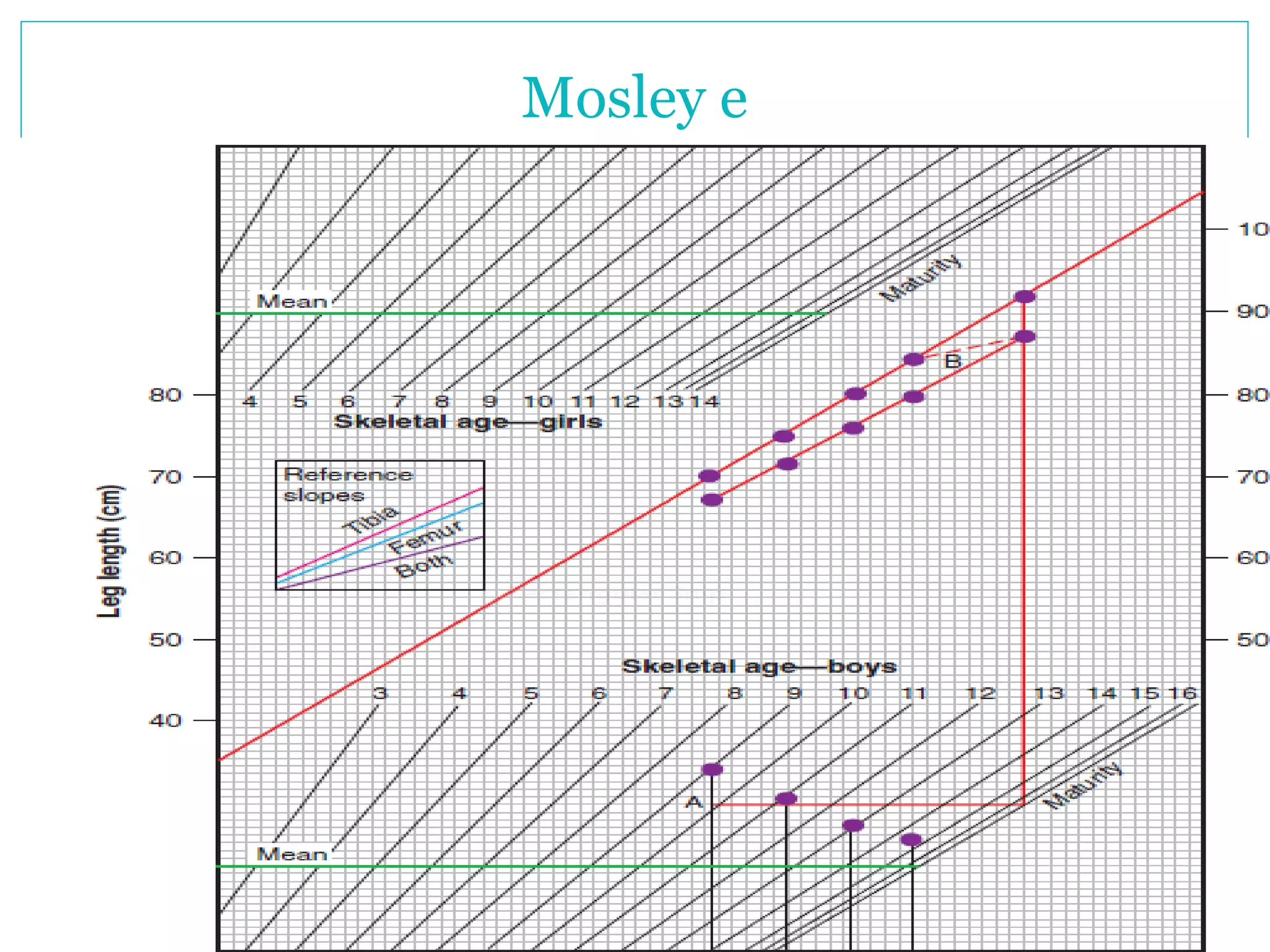
 Straight line graph method — by Moseley
 Multiplier method — by Paley et al.
Green & Anderson tables
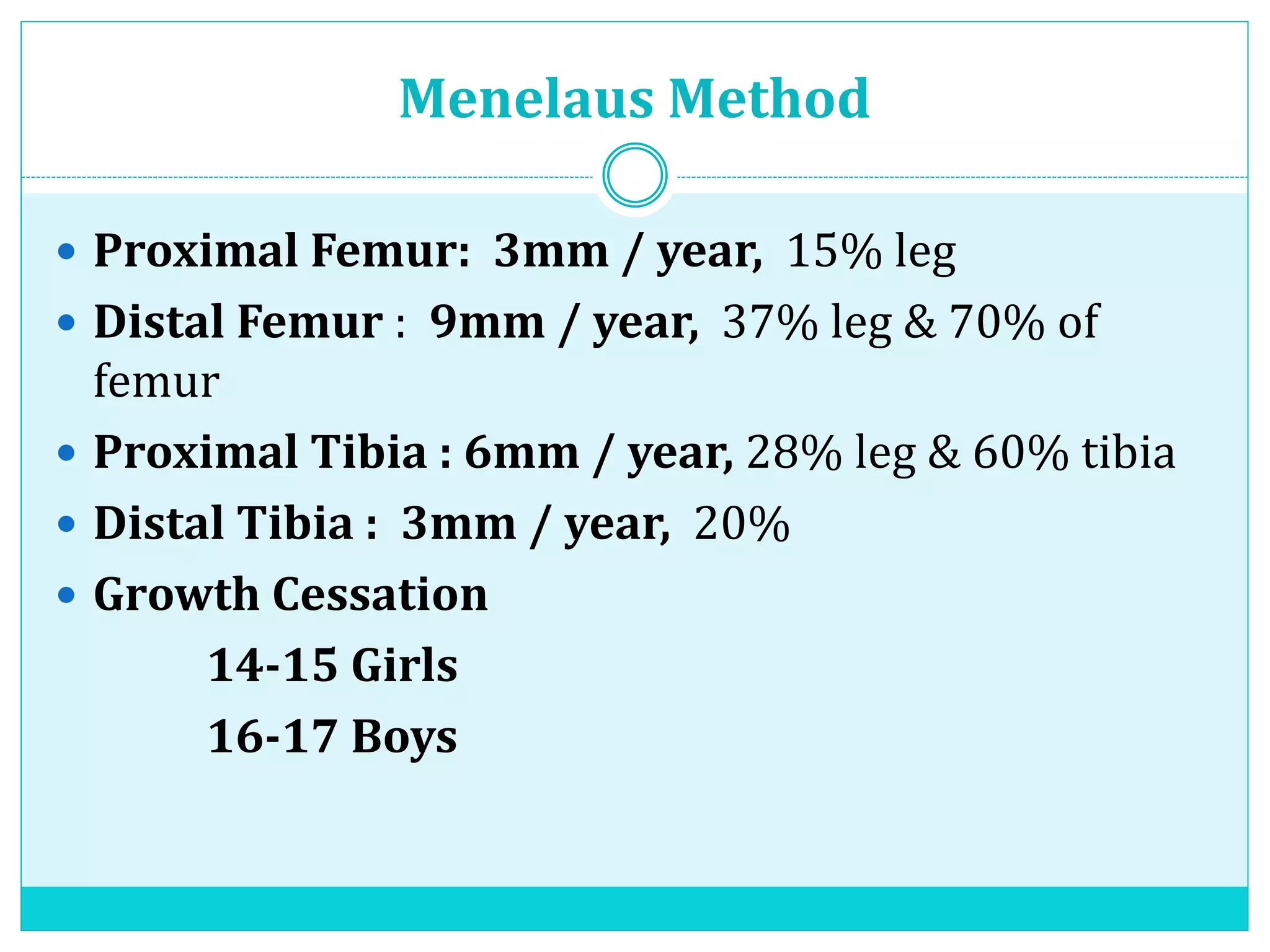
Menelaus Method
 Proximal Femur: 3mm / year, 15% leg
 Distal Femur : 9mm / year, 37% leg & 70% of
femur
 Proximal Tibia : 6mm / year, 28% leg & 60% tibia
 Distal Tibia : 3mm / year, 20%
 Growth Cessation
14-15 Girls
16-17 Boys
Mosley e
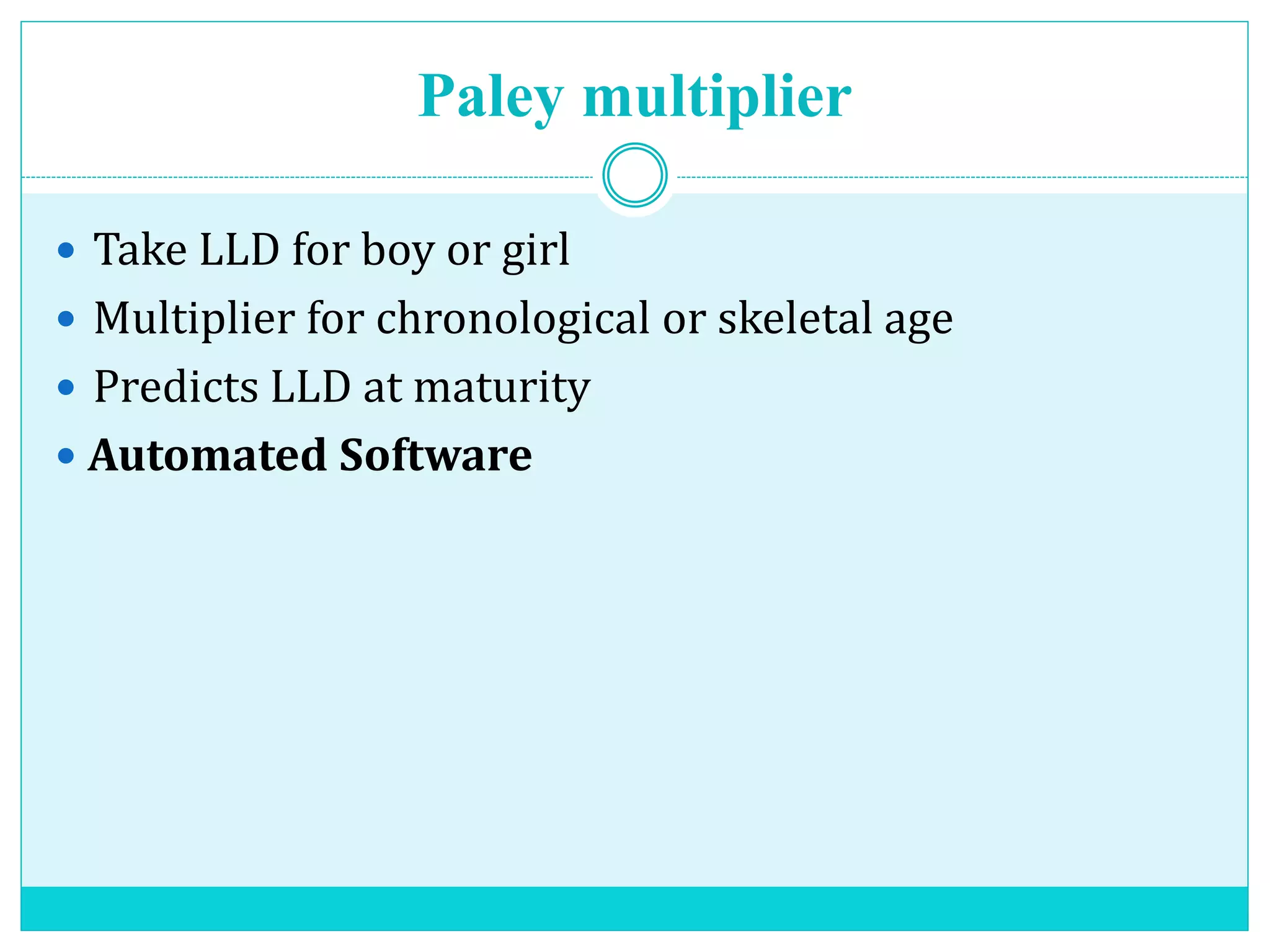
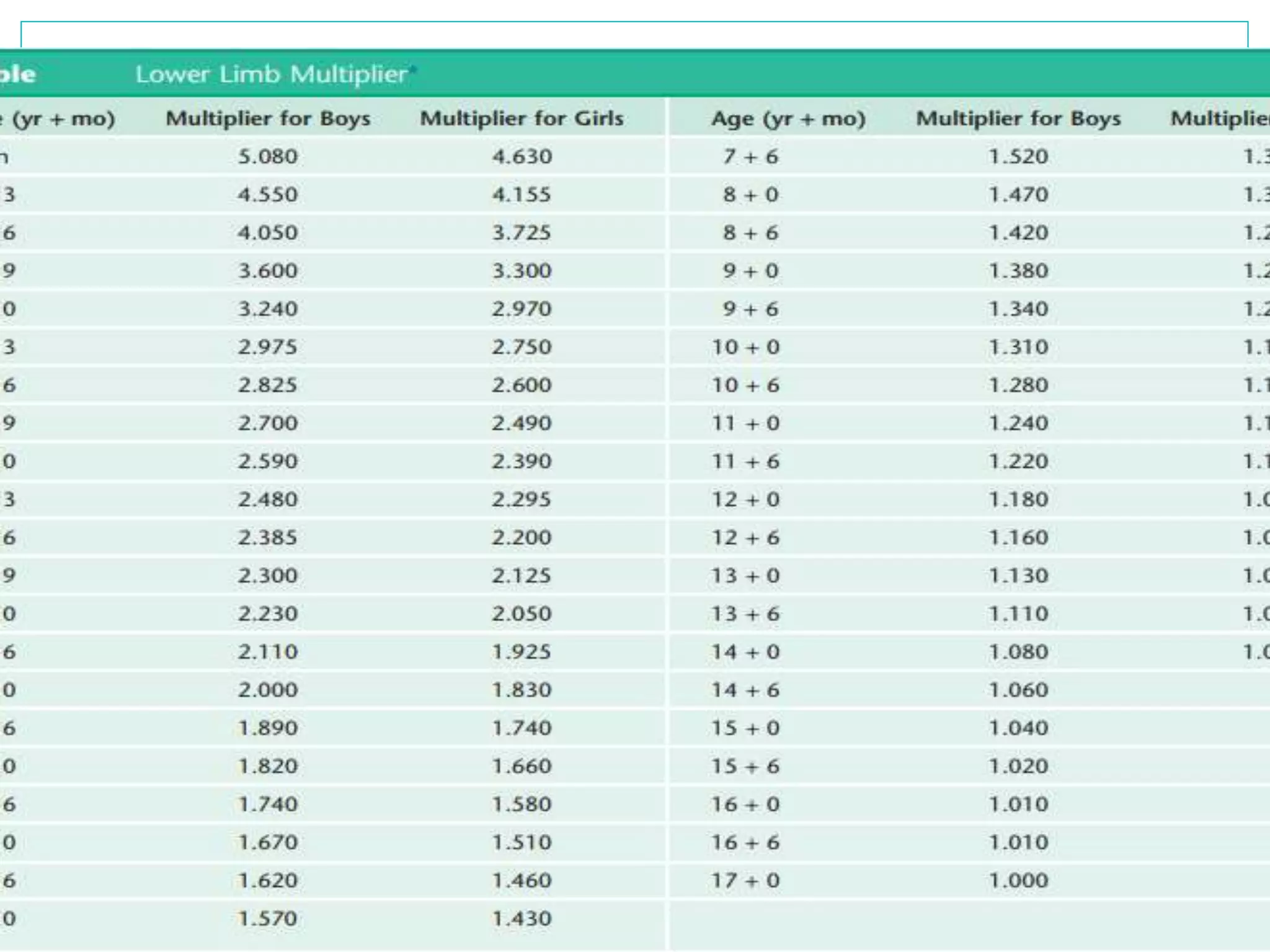
Paley multiplier
 Take LLD for boy or girl
 Multiplier for chronological or skeletal age
 Predicts LLD at maturity
 Automated Software
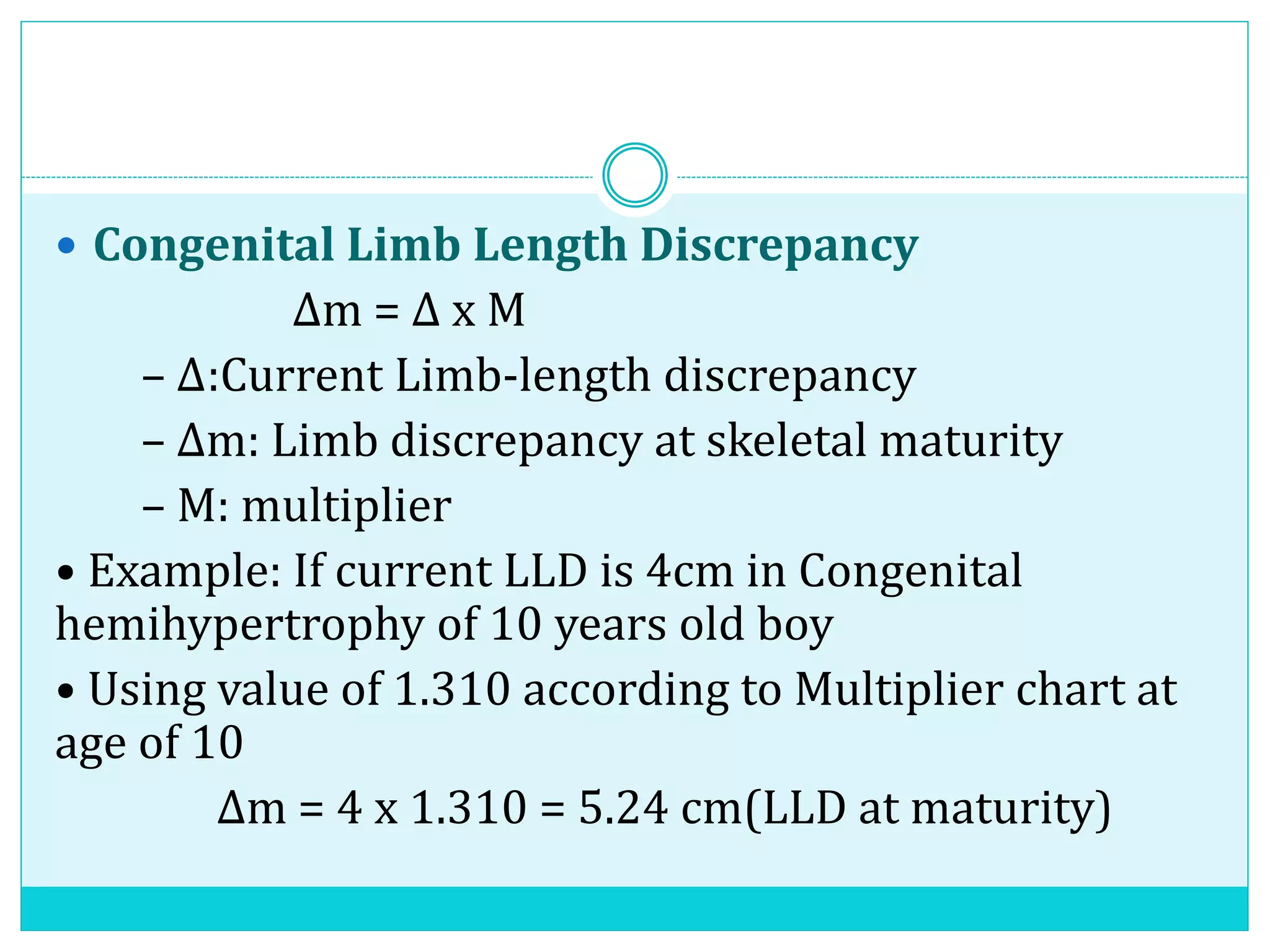
 Congenital Limb Length Discrepancy
Δm = Δ x M
– Δ:Current Limb-length discrepancy
– Δm: Limb discrepancy at skeletal maturity
– M: multiplier
• Example: If current LLD is 4cm in Congenital
hemihypertrophy of 10 years old boy
• Using value of 1.310 according to Multiplier chart at
age of 10
Δm = 4 x 1.310 = 5.24 cm(LLD at maturity)
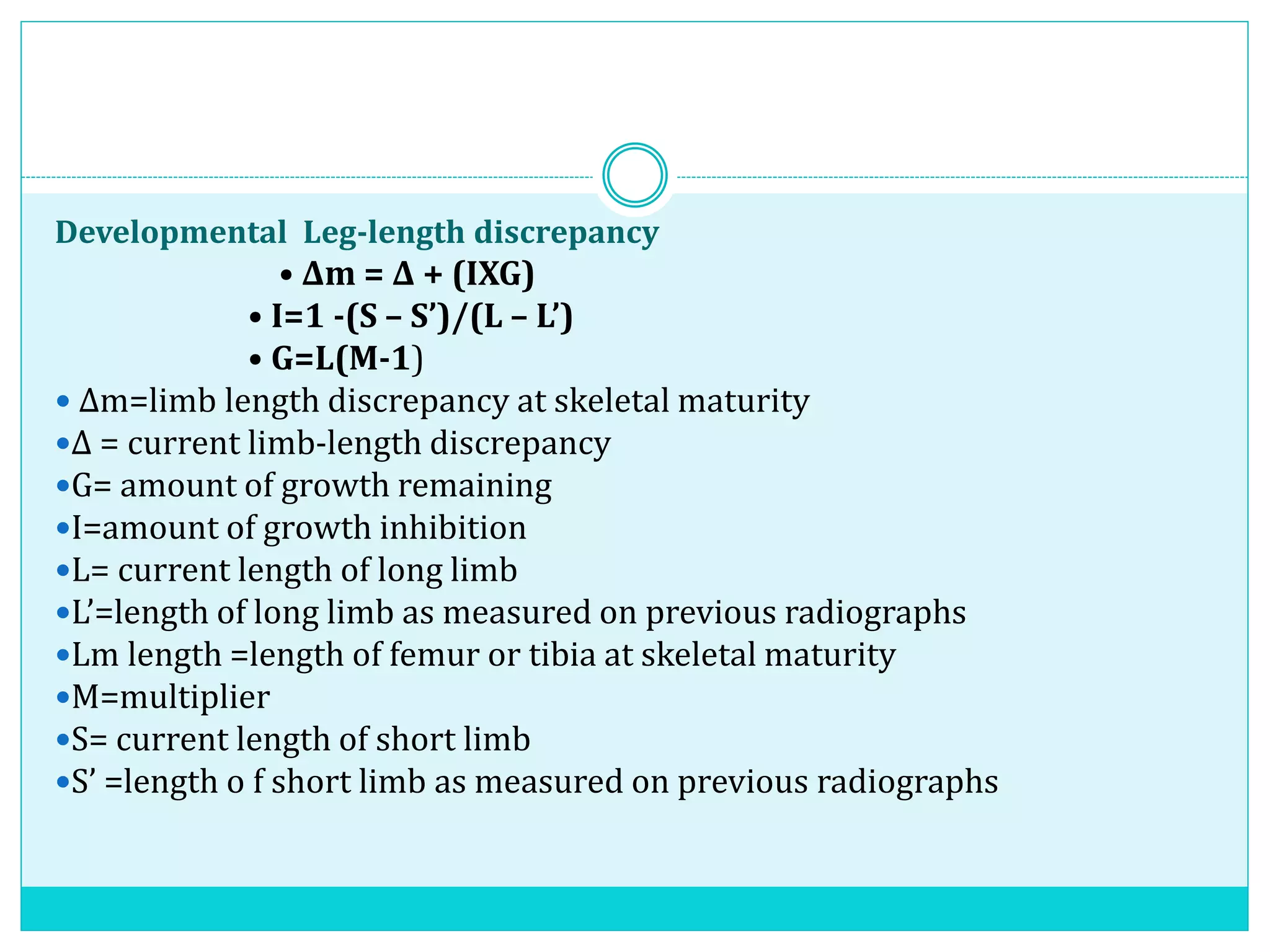
Developmental Leg-length discrepancy
• Δm = Δ + (IXG)
• I=1 -(S – S’)/(L – L’)
• G=L(M-1)
 Δm=limb length discrepancy at skeletal maturity
Δ = current limb-length discrepancy
G= amount of growth remaining
I=amount of growth inhibition
L= current length of long limb
L’=length of long limb as measured on previous radiographs
Lm length =length of femur or tibia at skeletal maturity
M=multiplier
S= current length of short limb
S’ =length o f short limb as measured on previous radiographs
Cont..
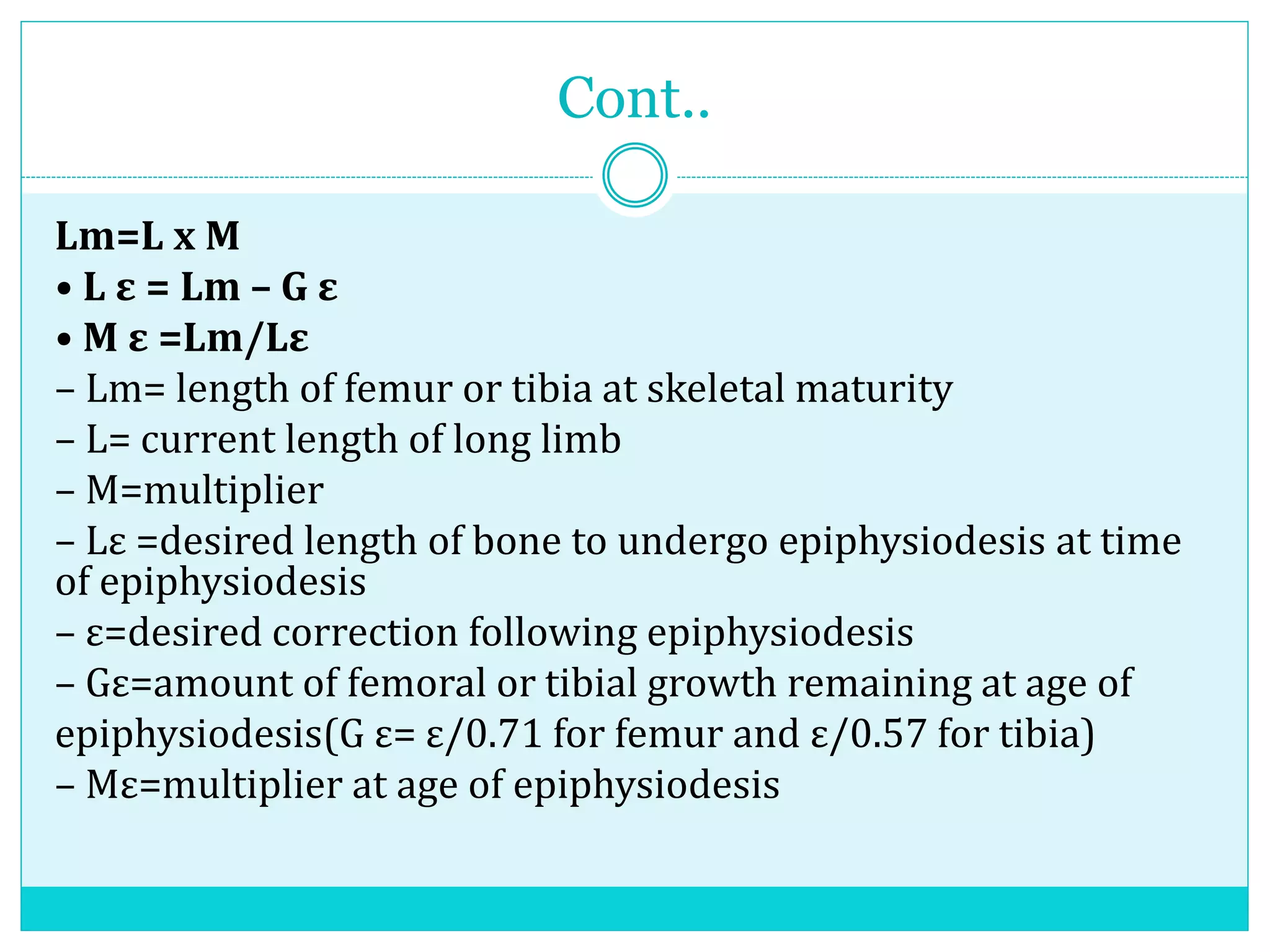
Lm=L x M
• L ε = Lm – G ε
• M ε =Lm/Lε
– Lm= length of femur or tibia at skeletal maturity
– L= current length of long limb
– M=multiplier
– Lε =desired length of bone to undergo epiphysiodesis at time
of epiphysiodesis
– ε=desired correction following epiphysiodesis
– Gε=amount of femoral or tibial growth remaining at age of
epiphysiodesis(G ε= ε/0.71 for femur and ε/0.57 for tibia)
– Mε=multiplier at age of epiphysiodesis
Management
 The goals of treatment are
 balanced spine and pelvis,
 equal limb lengths, and
 correct mechanical weight-bearing axis.
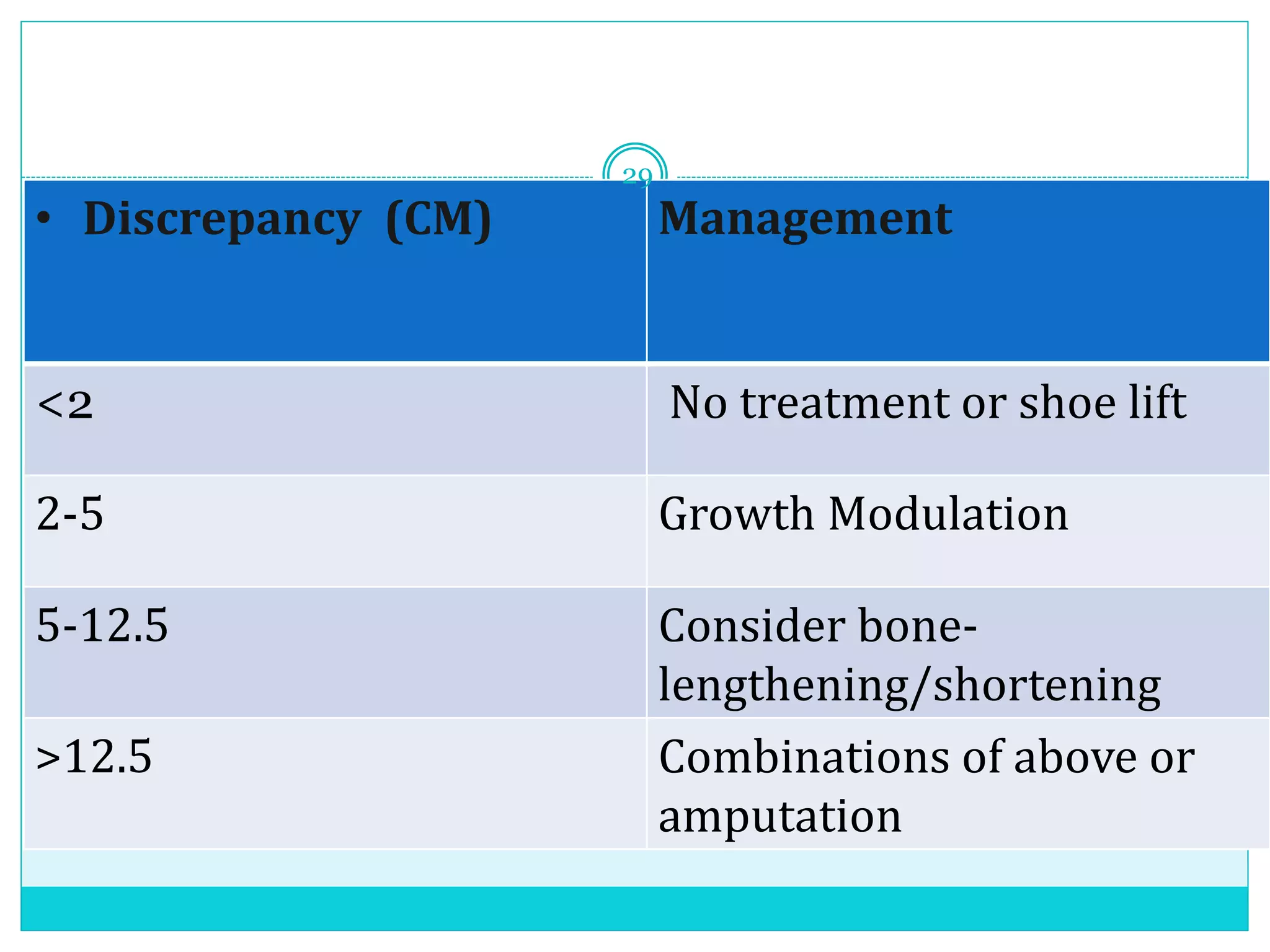
• Discrepancy (CM) Management
<2 No treatment or shoe lift
2-5 Growth Modulation
5-12.5 Consider bone-
lengthening/shortening
>12.5 Combinations of above or
amputation
29
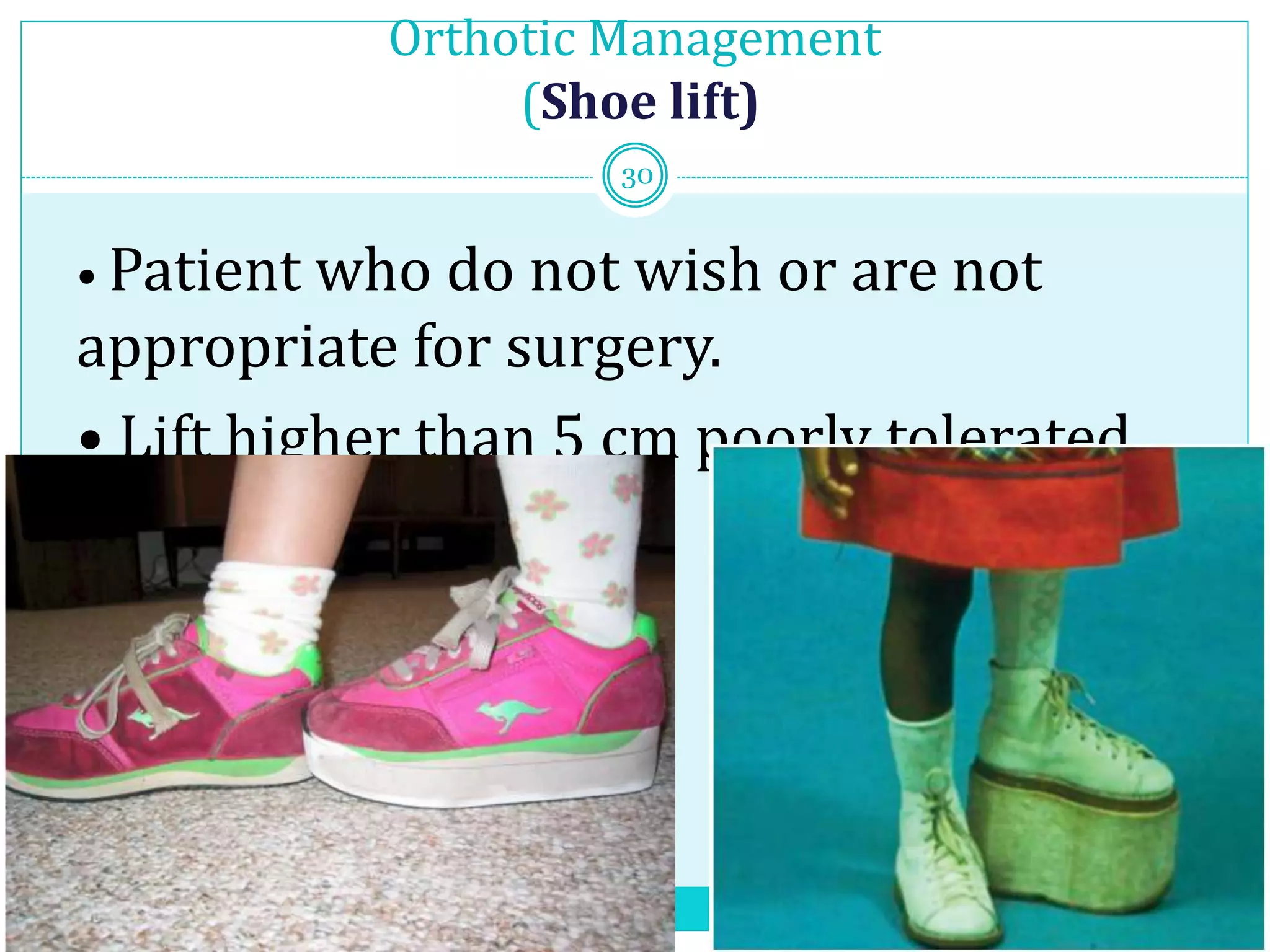
Orthotic Management
(Shoe lift)
• Patient who do not wish or are not
appropriate for surgery.
• Lift higher than 5 cm poorly tolerated
30
Prosthetic fitting
 Significant discrepancies,
 Deformed functionally useless feet
 Discrepancies greater than 15-20cm
 Femoral length less than 50%
 Fibular hemimelia with unstable ankle
31
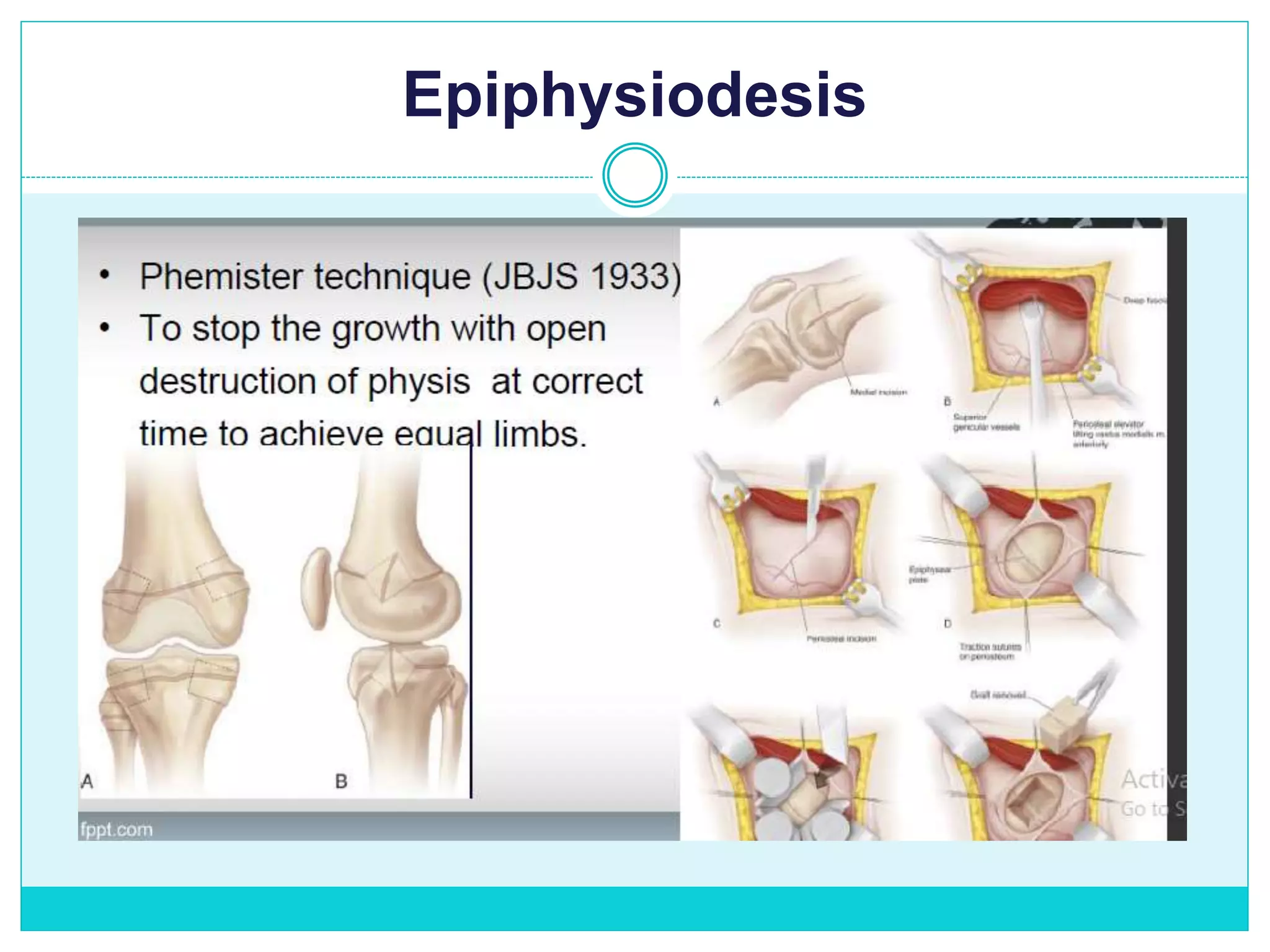
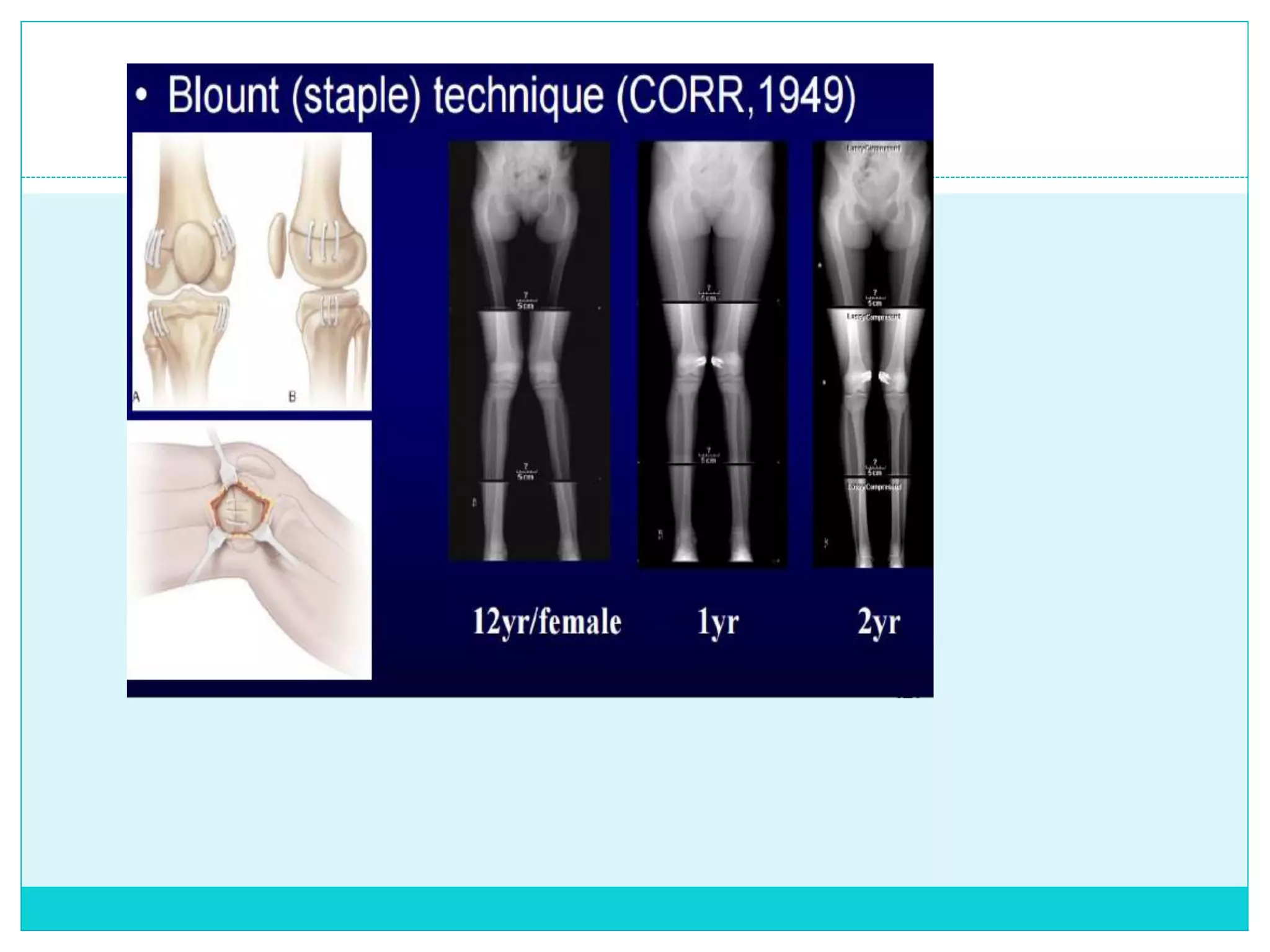
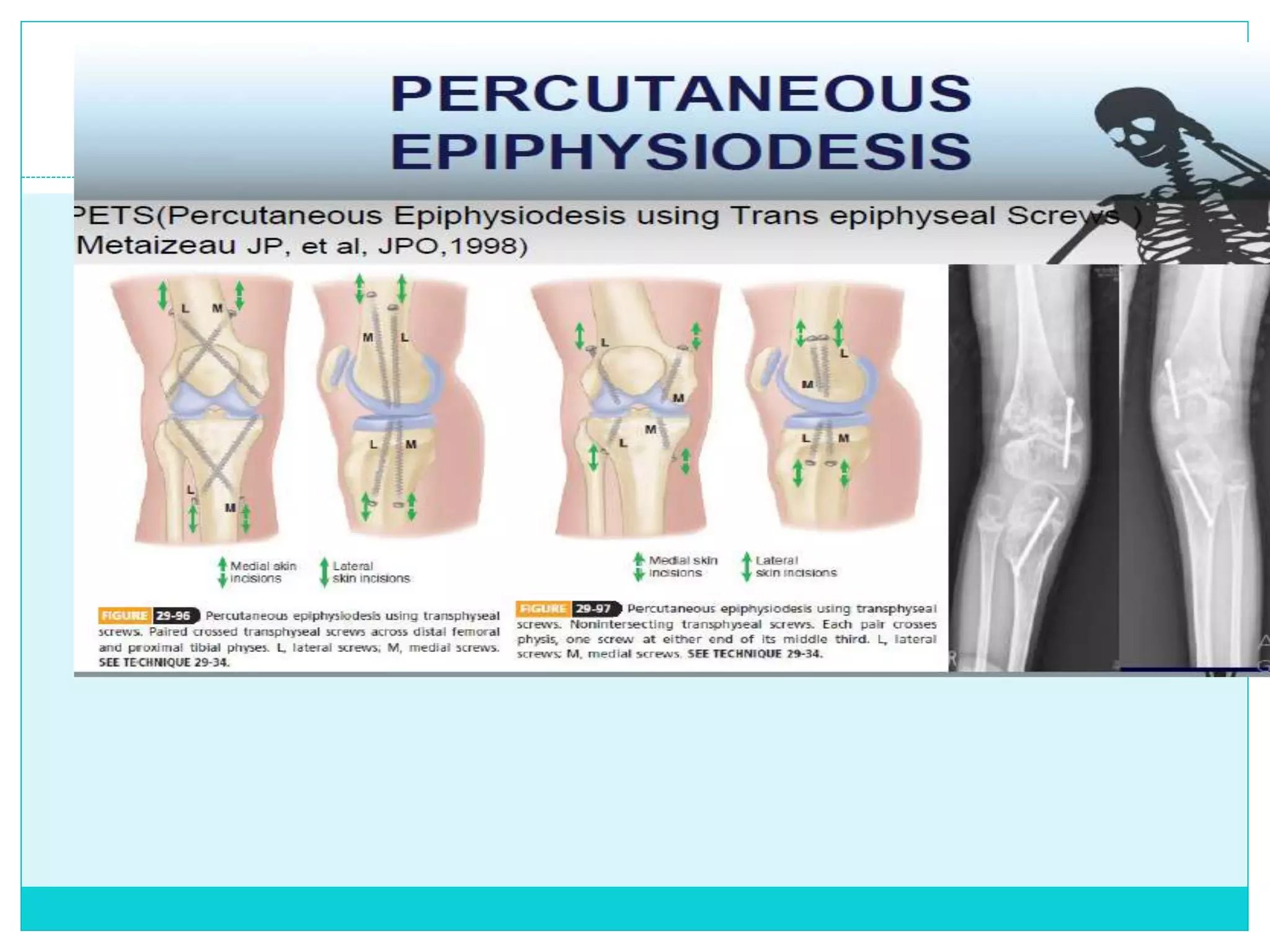
Shortening of the Long Leg
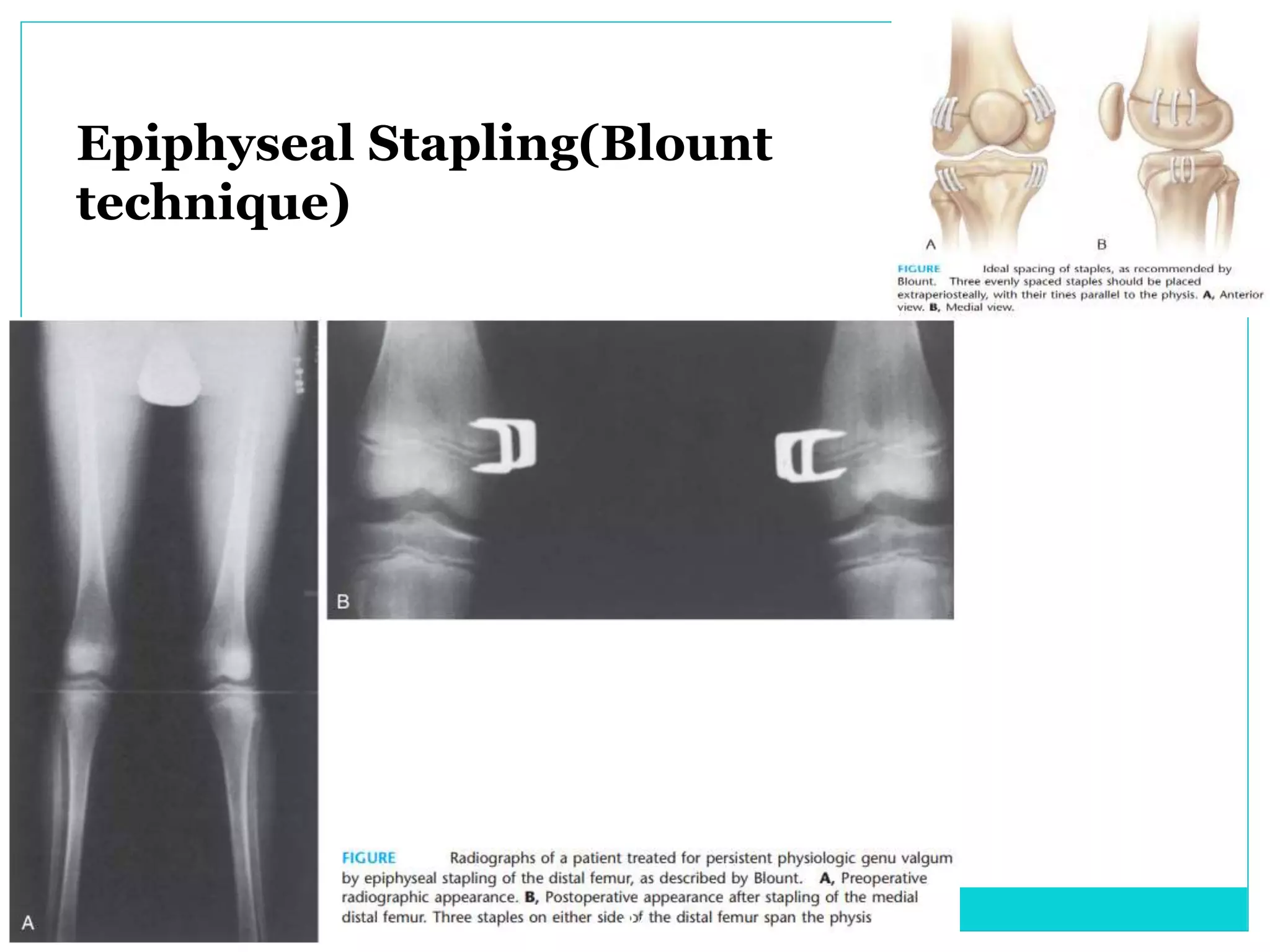
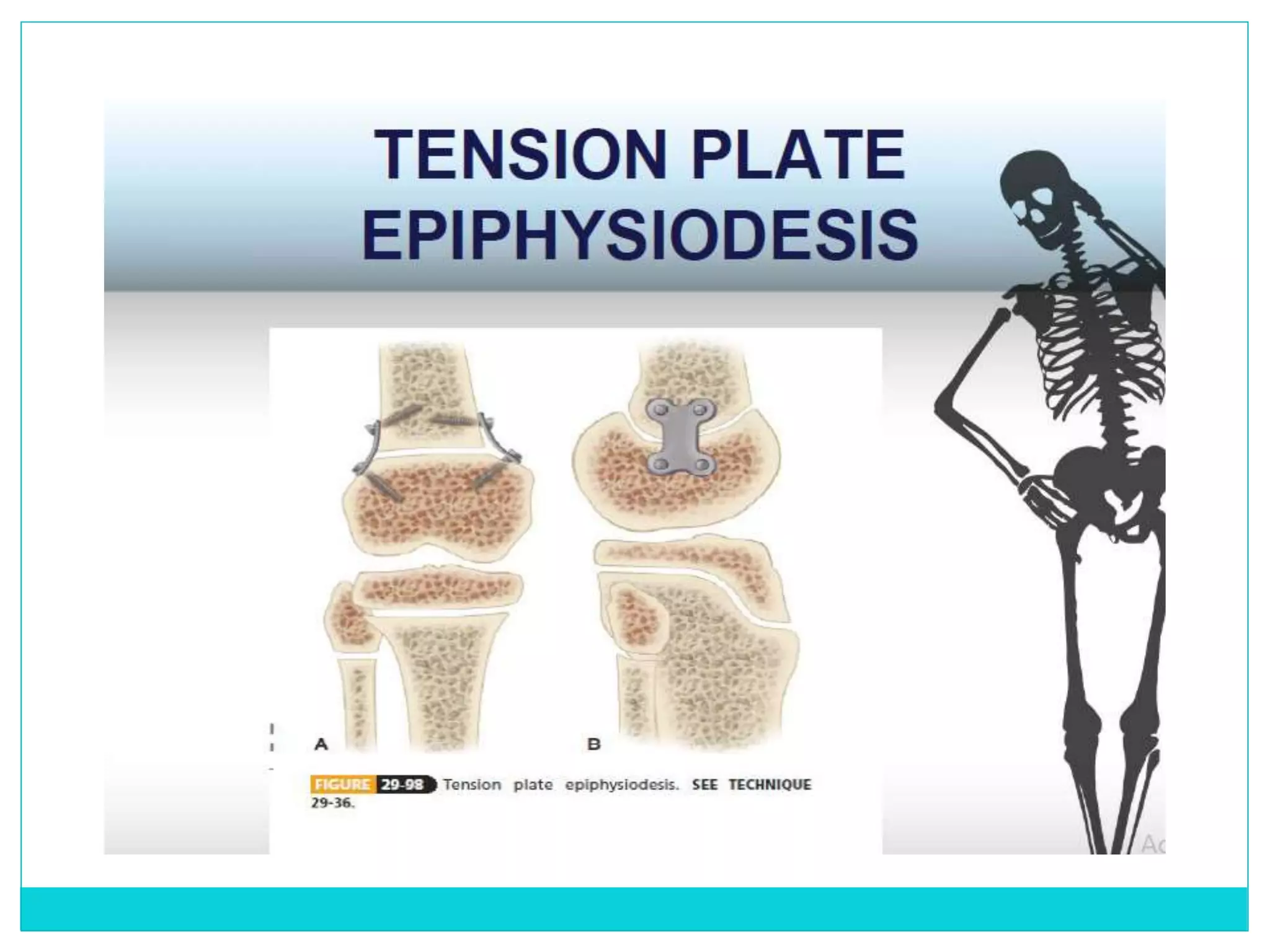
Epiphysiodesis
 Percutaneous Methods
Epiphyseal Stapling(Blount
technique)
37
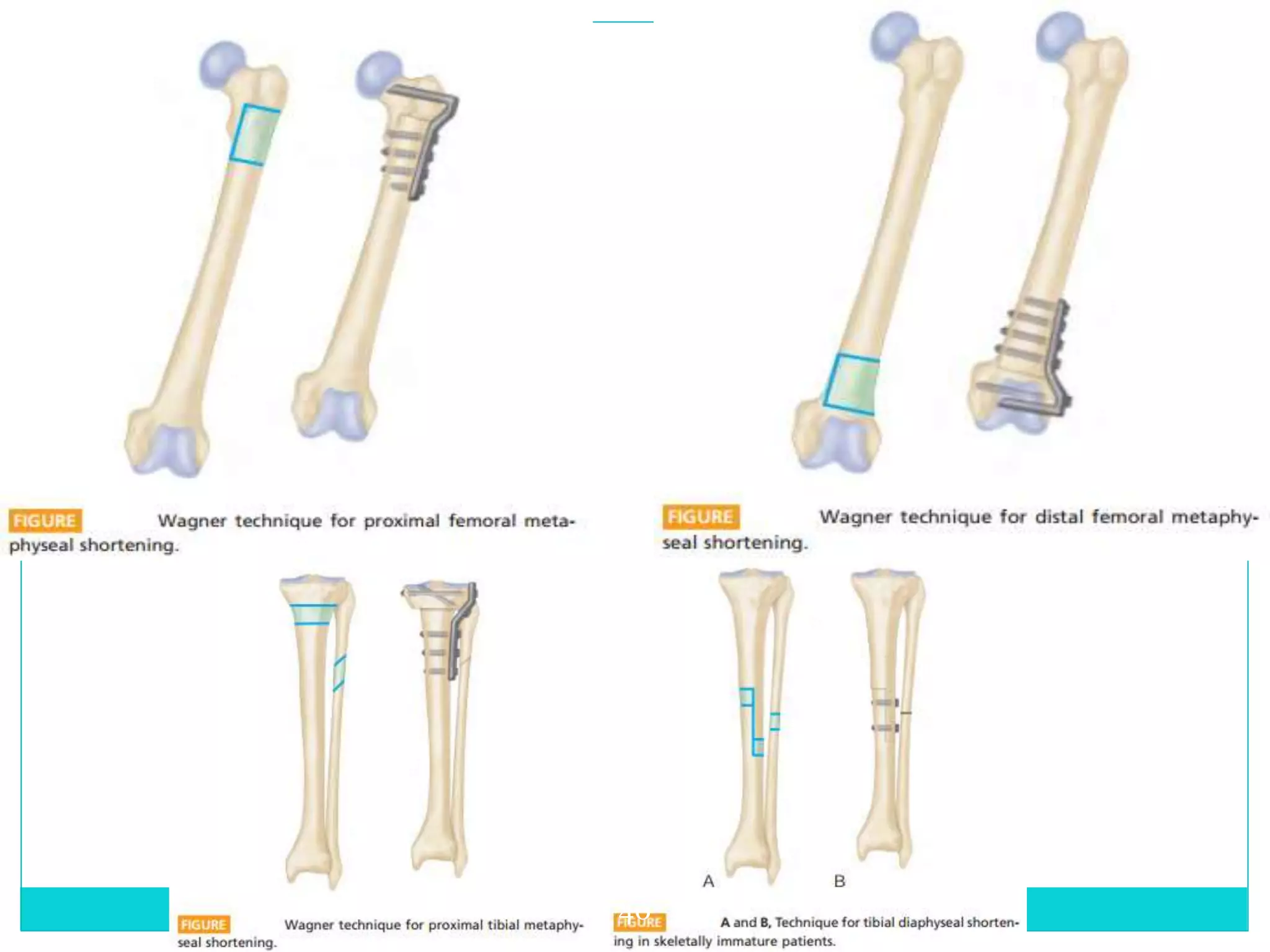
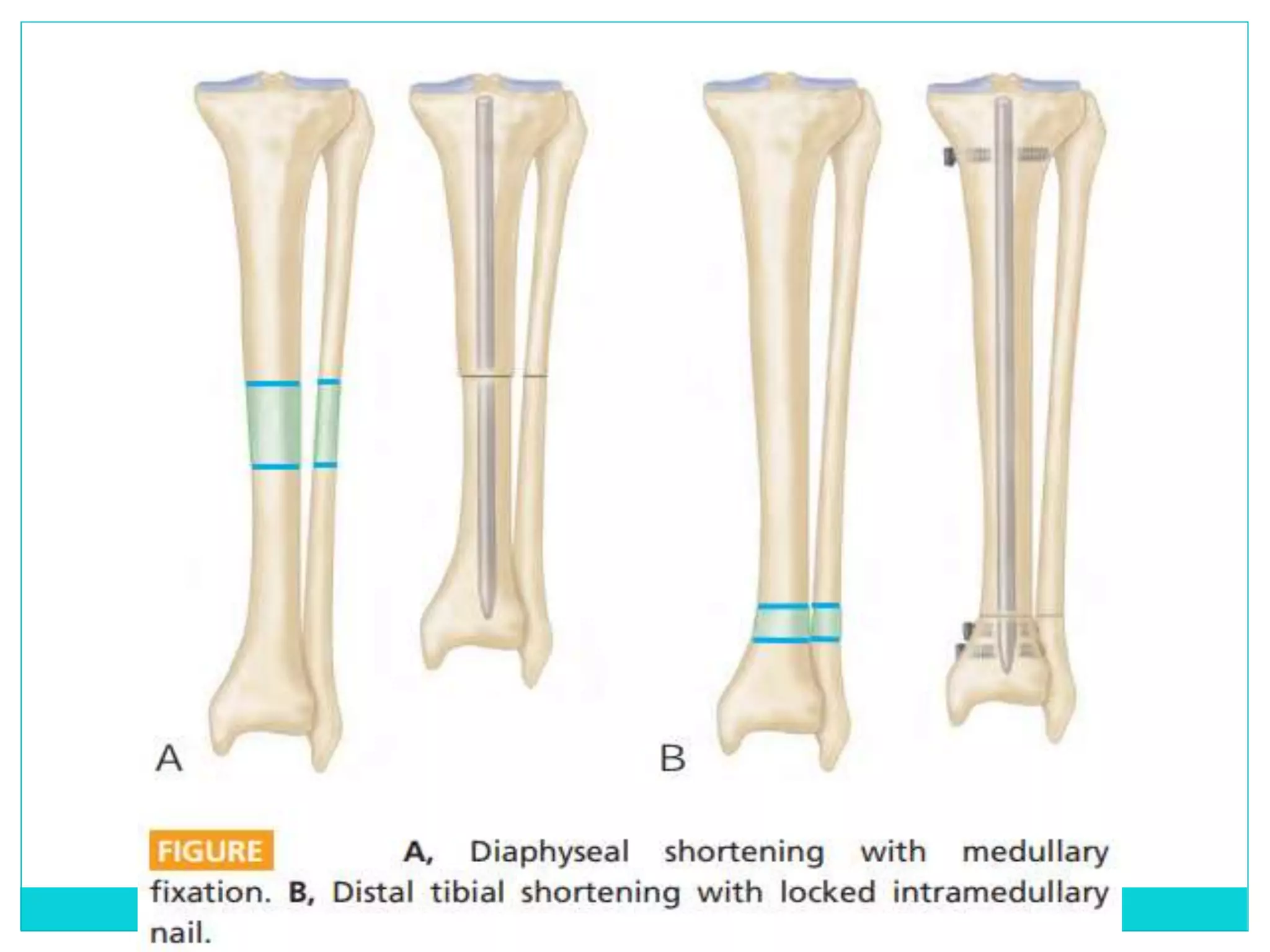
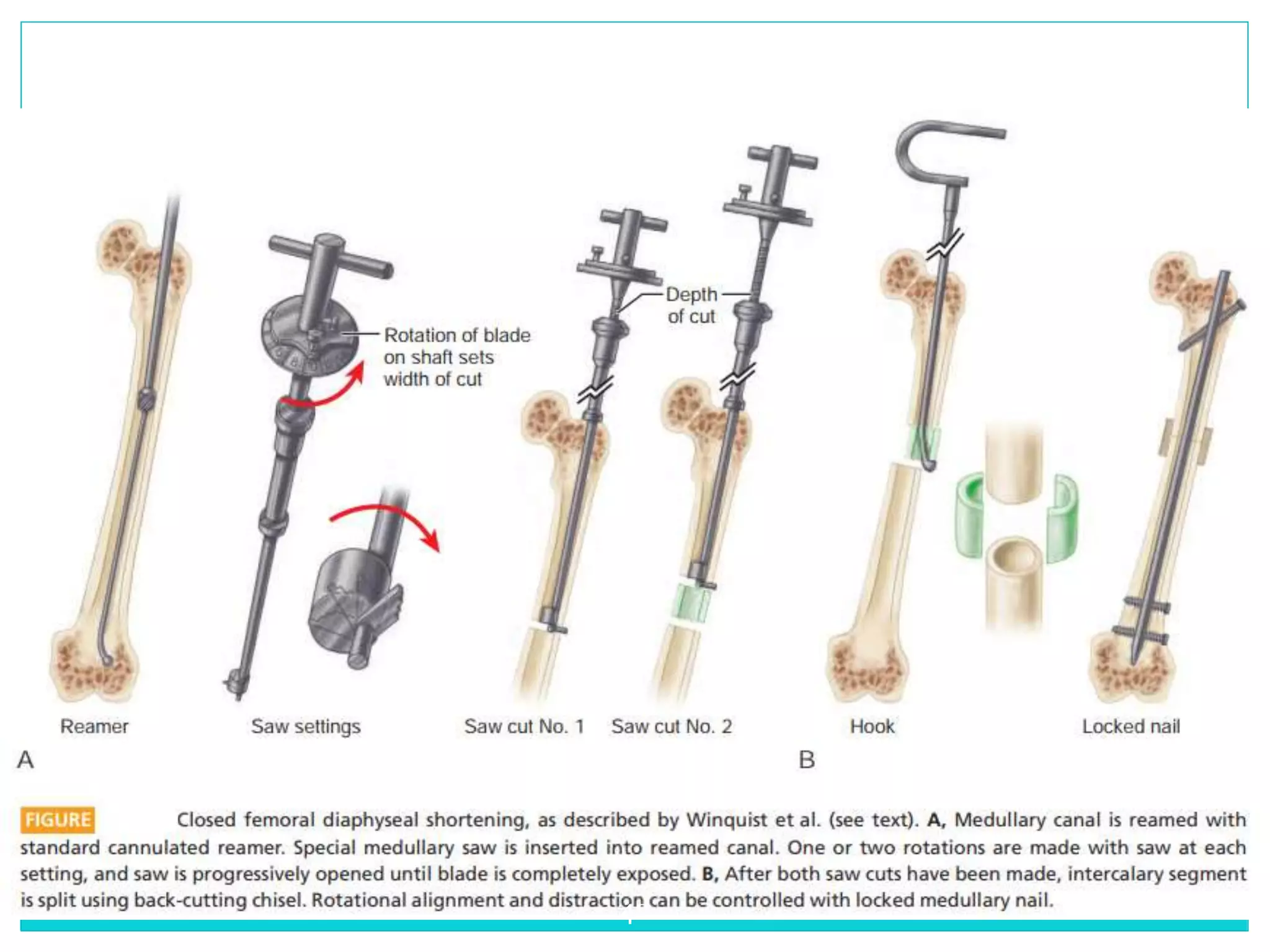
Shortening operation
 Skeletaly Mature patient
Tibia< 4cm, Femur< 5cm
Neurovascular complication is higher in tibia,
fasciotomy is advisable.
40
41
42
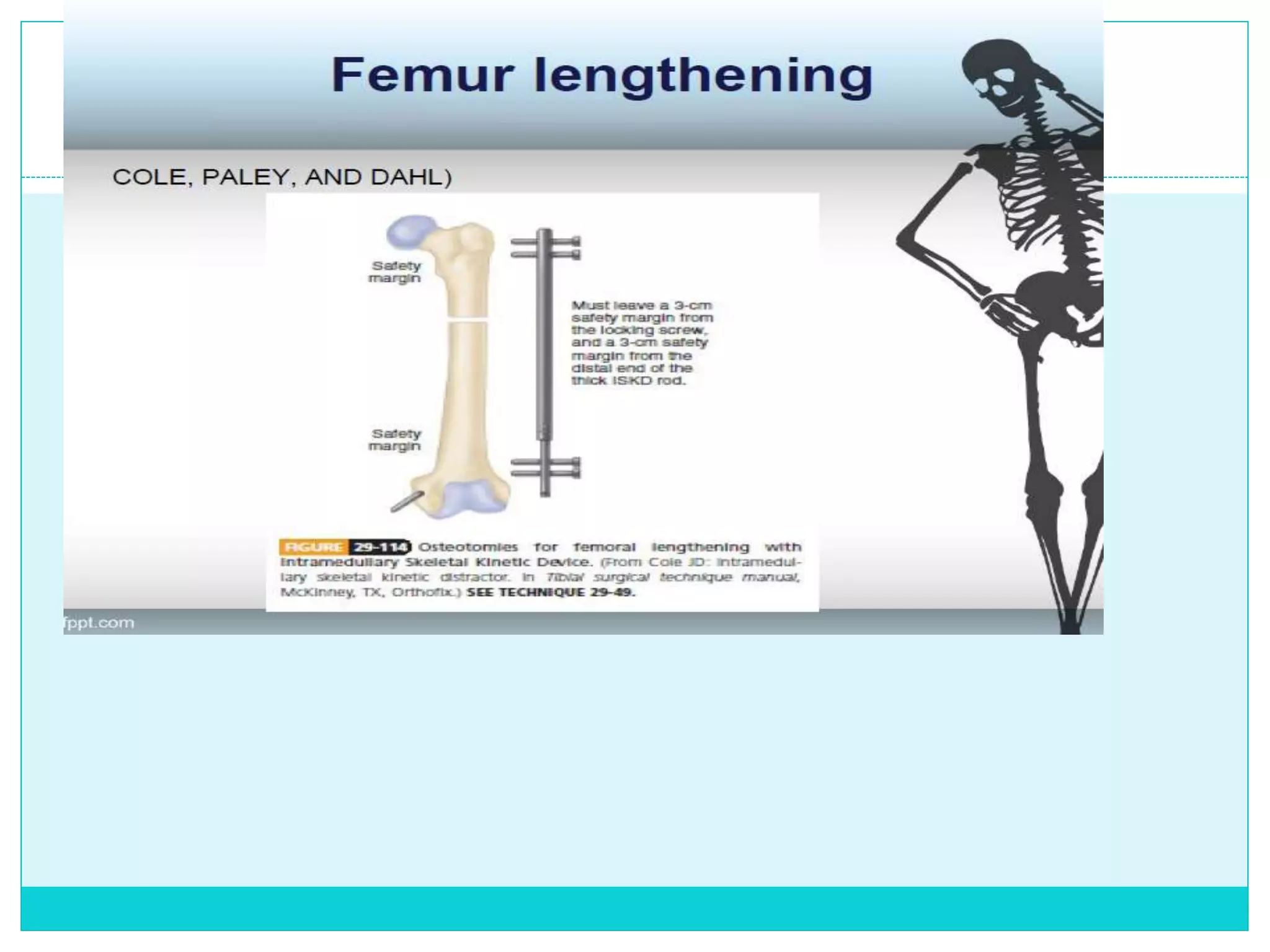
Limb lengthening operation
 Limb lengthening procedures (LLP) are used to
 replace missing bones
 straighten deformed bones.
children and adults with limb length discrepancies
(< 6cm)
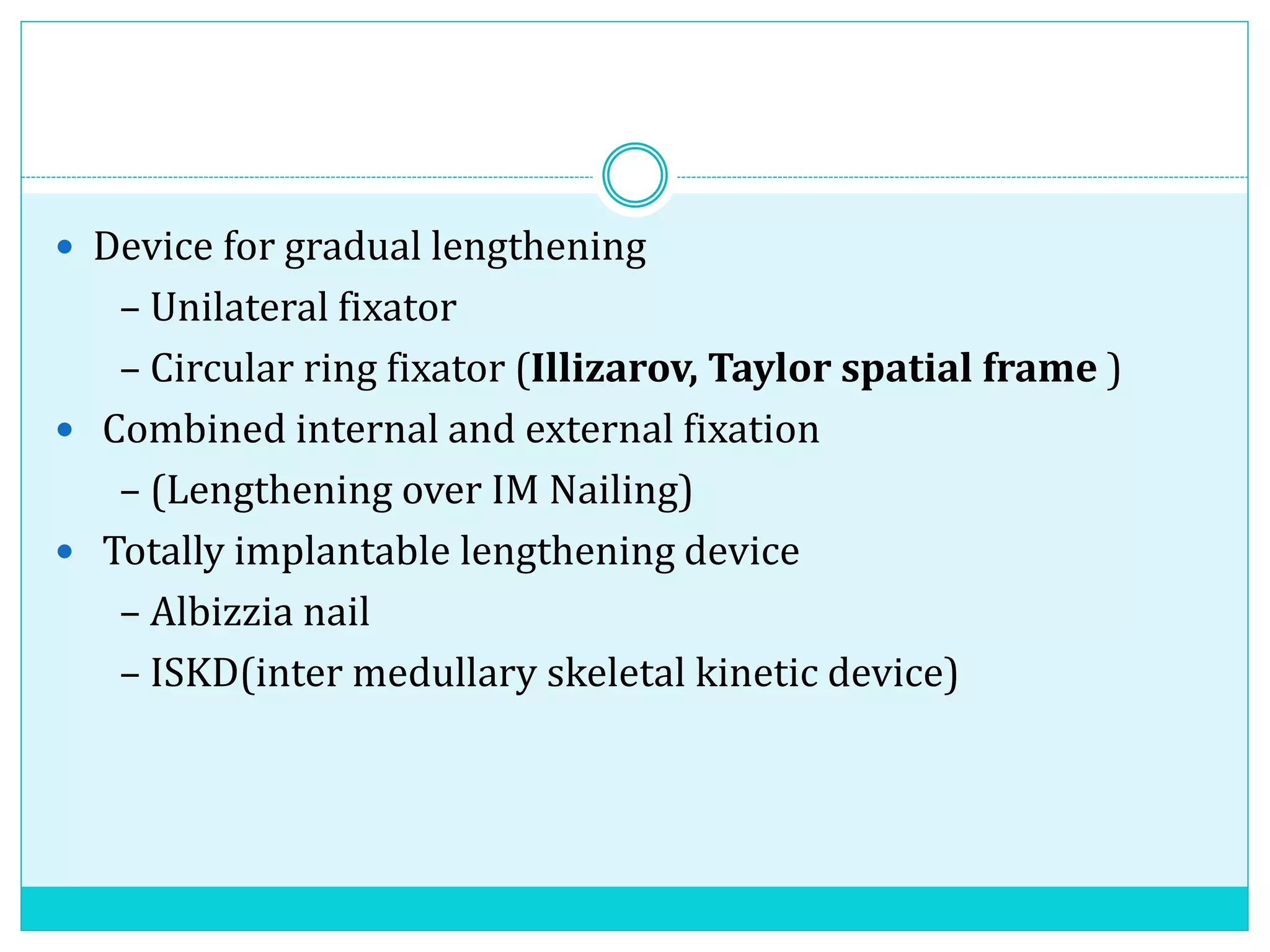
 Device for gradual lengthening
– Unilateral fixator
– Circular ring fixator (Illizarov, Taylor spatial frame )
 Combined internal and external fixation
– (Lengthening over IM Nailing)
 Totally implantable lengthening device
– Albizzia nail
– ISKD(inter medullary skeletal kinetic device)
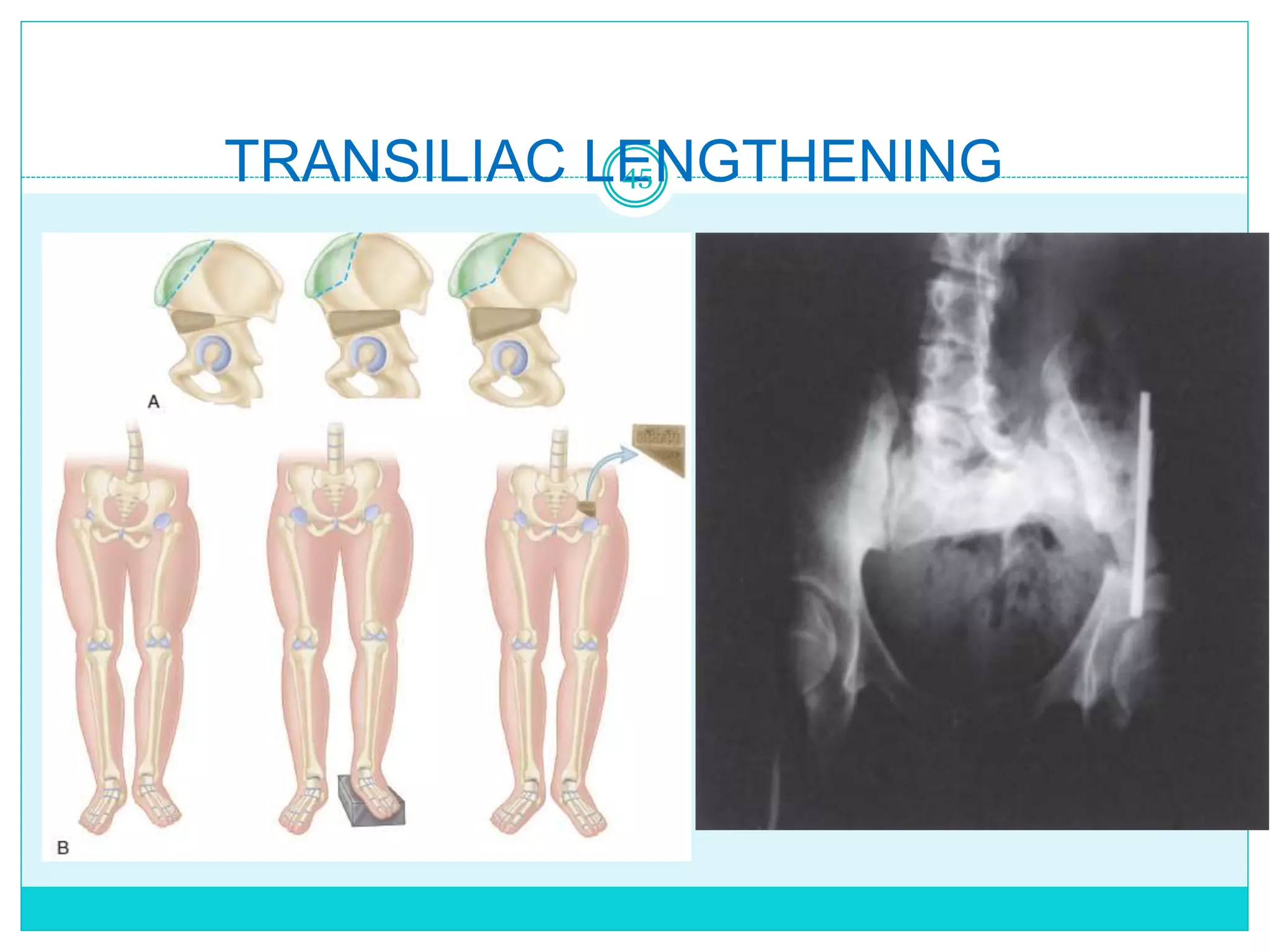
TRANSILIAC LENGTHENING
45
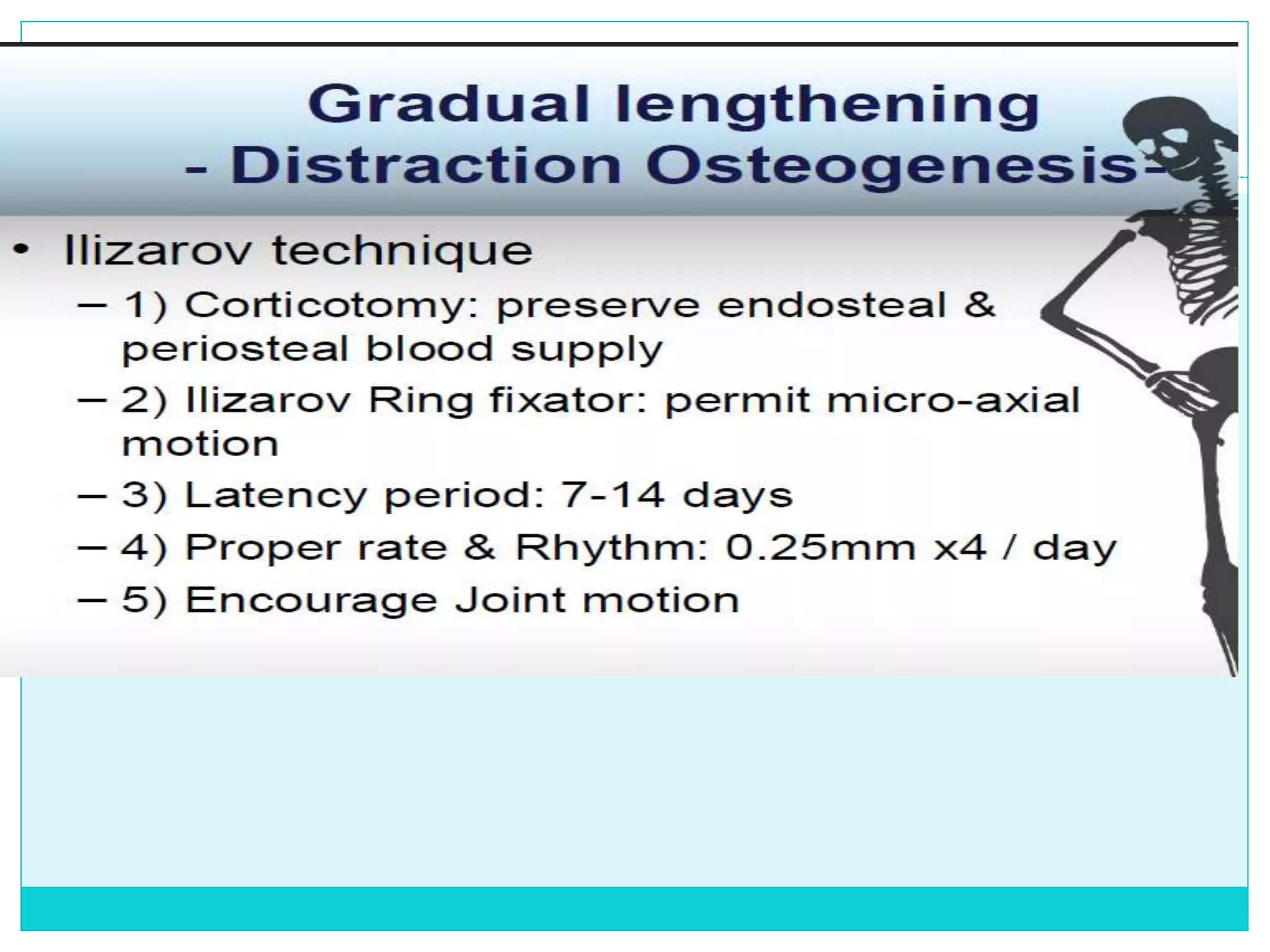
Tibia Lengthening
 Principle:
– It is based on the principle of distraction
osteogenesis.
– A bone that has been cut during surgery are
gradually pulled apart (distraction)
– Leads to new bone formation (osteogenesis) at the
site of lengthening
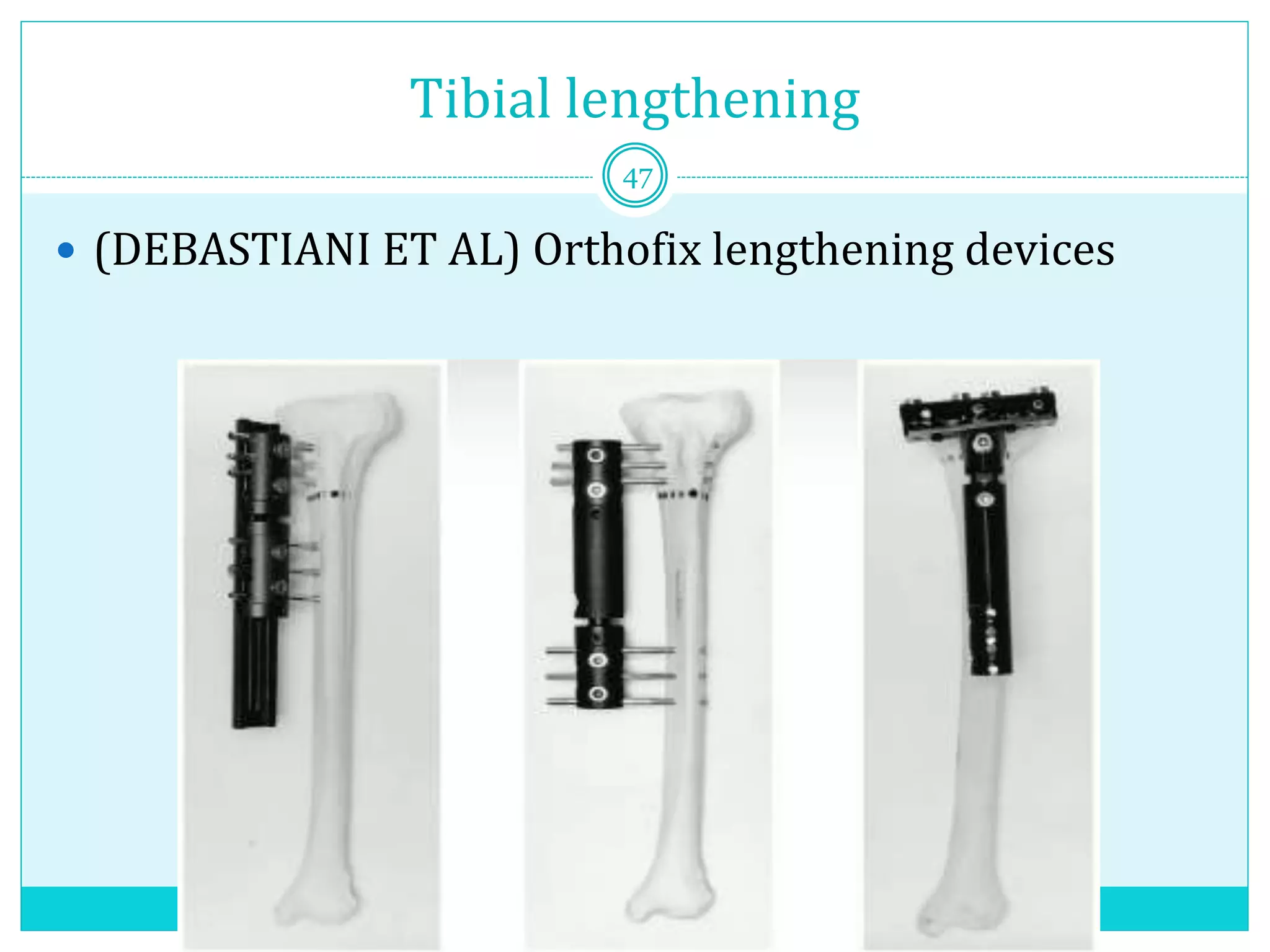
Tibial lengthening
 (DEBASTIANI ET AL) Orthofix lengthening devices
47
Complications of Lengthening
• Muscle contractures
• Joint subluxations or stiffness
• Axial deviations
• Neurological or vascular insult
• Premature or delayed consolidation
• Re- fracture ,non union & malunion
• Pin- site infections
• Psychological stress
50
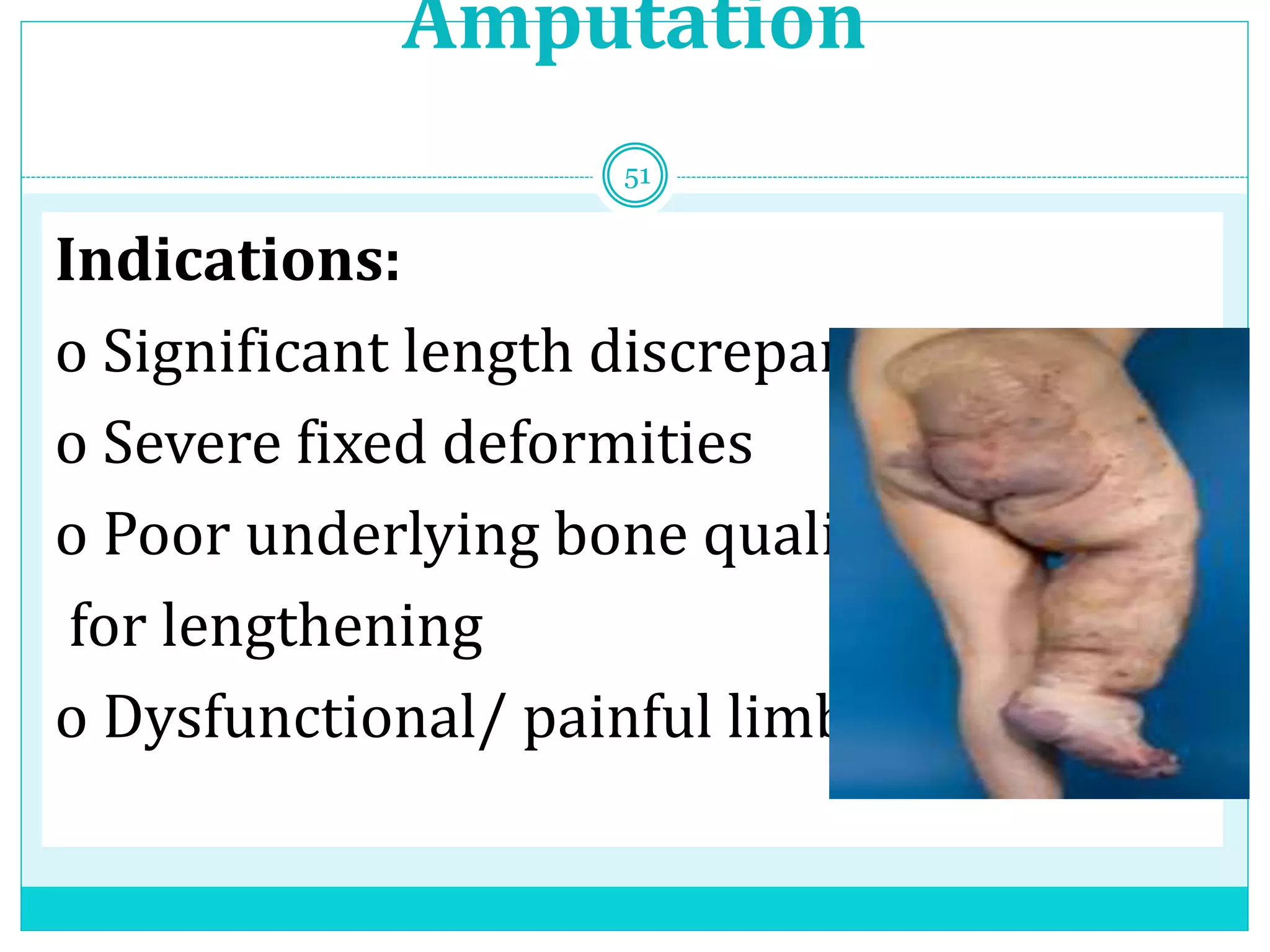
Amputation
Indications:
o Significant length discrepancy
o Severe fixed deformities
o Poor underlying bone quality
for lengthening
o Dysfunctional/ painful limb
51
 THANKS

LIMB-LENGTH DISCREPANCY.pptx

  • 1.
    LIMB-LENGTH DISCREPANCY By Ayalew. Moderator:DR. Berhe (ORTHO-TRAUMA SURGEON)
  • 2.
    Contents  Introduction  Classification Etiology  Evaluation  Treatment
  • 3.
    Introduction  Limb lengthdiscrepancy is defined as a condition in which the paired lower extremity limbs have a noticeably unequal length  LLD of 0.5 to 2.0 cm are common in the normal, asymptomatic population  LLD of more than 2.5 cm is significant
  • 4.
    Classification Structural (SLLD) oranatomical:  Differences in leg length resulting from inequalities in bony structure. Functional (FLLD) or apparent:  factors other than actual bone shortening or lengthening make one leg shorter or longer than the other, a functional inequality occurs
  • 5.
     Mild Lessthan 3 cm  Moderate 3-6 cm  Severe More than 6 cm
  • 6.
  • 7.
    Mechanisms of compensation specific compensation  Pronation in the ankle of the longer leg  Plantar flexion in the shorter leg  Knee and hip extension of the shorter or flexion in the longer leg  Uncompensated sacral based unleveling &/ scoliosis
  • 8.
    Effects  On spine Low back pain & late degenerative disease  Scoliosis  On hip  Pelvic obliquity  OA  On long bones  Greater incidence of stress fractures  Tibia  metatarsals and femur 8
  • 9.
  • 10.
    Evaluation  History: – Congenitalor acquired – Trauma / infection – Progressive / static – Onset and mode of deformity – Any Syndrome associated features 10
  • 11.
     Examination:  Gait Lower limb; o Determine which segment is short o Is it too long or too short o Exclude fixed deformities(Hip,knee and foot) o Muscle wasting & neuro-vascular status  Spine; o Scoliosis 11
  • 12.
    Leg length(Tape )measurement
  • 13.
    – Wood blocktest best initial screening method 13
  • 15.
    Imaging  Teleoroentgenogram • Singleexposure of both leg on a long film • Reveals angular deformity • Error of magnification • Best technique for small children •
  • 16.
     Orthoroentgenogram • Exposeach joints individually • Avoiding errors of magnification • Multiple exposure • Cannot assess whole shape of leg
  • 17.
     Scanography • Movingfilm cassette • Avoid magnification • Cannot assess whole shape of leg
  • 18.
     CT scan Advantages of CT • lower radiation exposure • greater accuracy, • less susceptibility to error if the patient is poorly positioned, • specifically indicated when the patient has a knee flexion contracture or is in a circular external fixator
  • 19.
    Prediction of Discrepancy There are various methods of assessment of patient and predicting the LLD  Growth remaining method — by Green & Anderson  Arithmetic method — by White Menelaus  Straight line graph method — by Moseley  Multiplier method — by Paley et al.
  • 20.
  • 21.
    Menelaus Method  ProximalFemur: 3mm / year, 15% leg  Distal Femur : 9mm / year, 37% leg & 70% of femur  Proximal Tibia : 6mm / year, 28% leg & 60% tibia  Distal Tibia : 3mm / year, 20%  Growth Cessation 14-15 Girls 16-17 Boys
  • 22.
  • 23.
    Paley multiplier  TakeLLD for boy or girl  Multiplier for chronological or skeletal age  Predicts LLD at maturity  Automated Software
  • 25.
     Congenital LimbLength Discrepancy Δm = Δ x M – Δ:Current Limb-length discrepancy – Δm: Limb discrepancy at skeletal maturity – M: multiplier • Example: If current LLD is 4cm in Congenital hemihypertrophy of 10 years old boy • Using value of 1.310 according to Multiplier chart at age of 10 Δm = 4 x 1.310 = 5.24 cm(LLD at maturity)
  • 26.
    Developmental Leg-length discrepancy •Δm = Δ + (IXG) • I=1 -(S – S’)/(L – L’) • G=L(M-1)  Δm=limb length discrepancy at skeletal maturity Δ = current limb-length discrepancy G= amount of growth remaining I=amount of growth inhibition L= current length of long limb L’=length of long limb as measured on previous radiographs Lm length =length of femur or tibia at skeletal maturity M=multiplier S= current length of short limb S’ =length o f short limb as measured on previous radiographs
  • 27.
    Cont.. Lm=L x M •L ε = Lm – G ε • M ε =Lm/Lε – Lm= length of femur or tibia at skeletal maturity – L= current length of long limb – M=multiplier – Lε =desired length of bone to undergo epiphysiodesis at time of epiphysiodesis – ε=desired correction following epiphysiodesis – Gε=amount of femoral or tibial growth remaining at age of epiphysiodesis(G ε= ε/0.71 for femur and ε/0.57 for tibia) – Mε=multiplier at age of epiphysiodesis
  • 28.
    Management  The goalsof treatment are  balanced spine and pelvis,  equal limb lengths, and  correct mechanical weight-bearing axis.
  • 29.
    • Discrepancy (CM)Management <2 No treatment or shoe lift 2-5 Growth Modulation 5-12.5 Consider bone- lengthening/shortening >12.5 Combinations of above or amputation 29
  • 30.
    Orthotic Management (Shoe lift) •Patient who do not wish or are not appropriate for surgery. • Lift higher than 5 cm poorly tolerated 30
  • 31.
    Prosthetic fitting  Significantdiscrepancies,  Deformed functionally useless feet  Discrepancies greater than 15-20cm  Femoral length less than 50%  Fibular hemimelia with unstable ankle 31
  • 32.
  • 33.
  • 35.
  • 37.
  • 39.
    Shortening operation  SkeletalyMature patient Tibia< 4cm, Femur< 5cm Neurovascular complication is higher in tibia, fasciotomy is advisable.
  • 40.
  • 41.
  • 42.
  • 43.
    Limb lengthening operation Limb lengthening procedures (LLP) are used to  replace missing bones  straighten deformed bones. children and adults with limb length discrepancies (< 6cm)
  • 44.
     Device forgradual lengthening – Unilateral fixator – Circular ring fixator (Illizarov, Taylor spatial frame )  Combined internal and external fixation – (Lengthening over IM Nailing)  Totally implantable lengthening device – Albizzia nail – ISKD(inter medullary skeletal kinetic device)
  • 45.
  • 46.
    Tibia Lengthening  Principle: –It is based on the principle of distraction osteogenesis. – A bone that has been cut during surgery are gradually pulled apart (distraction) – Leads to new bone formation (osteogenesis) at the site of lengthening
  • 47.
    Tibial lengthening  (DEBASTIANIET AL) Orthofix lengthening devices 47
  • 50.
    Complications of Lengthening •Muscle contractures • Joint subluxations or stiffness • Axial deviations • Neurological or vascular insult • Premature or delayed consolidation • Re- fracture ,non union & malunion • Pin- site infections • Psychological stress 50
  • 51.
    Amputation Indications: o Significant lengthdiscrepancy o Severe fixed deformities o Poor underlying bone quality for lengthening o Dysfunctional/ painful limb 51
  • 52.

Editor's Notes

  • #4  LLD of more than 2.5 cm is significant, with an increased likelihood of knee, hip, and lumbar spine pain
  • #5 An acutal shortening or lengthening of the skeletal system occurs between the head of the femur and the ankle joint mortise, which may have a congenital or acquired cause. – Unilateral asymmetry of the lower extremity without any concomitant shortening of the osseous components of the lower limb
  • #6 LLD has been classified according to the magnitude of the inequality, generally expressed in cm or mm,
  • #7 Etiology ;due to undergrowth or over growth Most common inequality is seen in ;Perthes disease ,Slipped capital femoral epiphysis,Cerebral palsy. While the most severe discrepancy is found in,; PFFD (proximal focal femoral deficiency) ,Enchondromatosis,Poliomyelitis ,Multiple infective epiphyseal damage **BWS manifest with omphalocele (exomphalos), macroglossia, and macrosomia (gigantism) . ***Blount disease is a pathologic varus deformity that results from disruption of normal cartilage growth at the medial aspect of the proximal tibial physis 
  • #8 The child compensates better than the adult by walking on the toes of shot leg Adult seldom compensate that manner tend to heel - toe gait: vaulting gait & excessive pelvic motion and tilt Knee and hip extension of the shorter or flexion in the longer leg *****If the leg is left uncompensated, the anterior and posterior iliac spine on the side of the short leg can be lower which may result in a sacral base unleveling and/or scoliosis. Increased muscle activity in several muscle groups
  • #9 ***Pelvic obliquity • Relatively uncovered hip of long leg and increased coverage of the hip of the short leg. • A longer leg might be a predisposing factor in Osteoarthritis (OA). • With length increasing, femoral head contact/ weight bearing area is decreasing. • Combined with an increased tone in hip abductors caused by elongated distance between origin andinsertion and an increased ground reaction force puts the longer leg at risk. *****centra l edge angle: • Decreased in CE angle on the long leg side • decreased in the load bearing area • causes late degenerative arthritis ** #of tibia, metatarsals and femur (consistent with the greater forces emitted through the longer leg)
  • #14 **Wood block test: – with the patient standing, add blocks under the short leg until the pelvis is level, then measure the blocks to determine the discrepancy. – block testing is considered the best initial screening method. – Add blocks (known height) until the pelvis is level
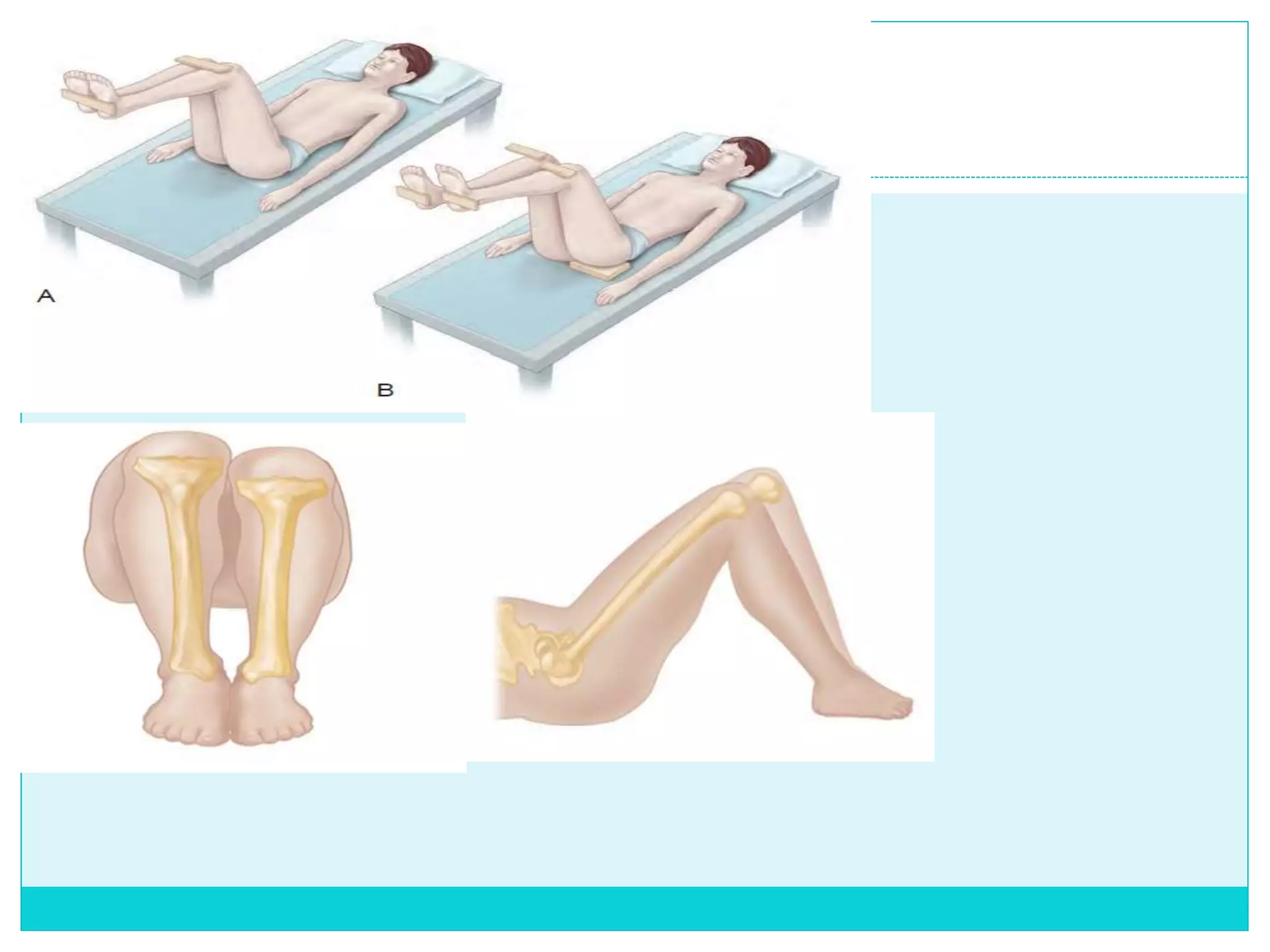
  • #15 Galeazzi (Allis) test **FIGURE :Apparent limb length inequality in a patient with hemiparesis. A, Clinical examination of the patient supine, with the hips flexed, suggests limb length inequality, with the hemiparetic side shorter than the unaffected side. This apparent shortening is caused by adduction of the hemiparetic leg.
  • #16 Plain radiography Teloroentgenogram Orthoroentgenogram Scanogram CT Teleoroentgenography. Teleoroentgenography is the simplest whole-leg radiographic technique for the assessment of leg length inequality. A radiograph of the entire lower extremity is obtained with the patient supine on the radiography table, with a long film and radiographic ruler beneath the patient. This technique is also the most susceptible to magnification error because a single exposure is made from a midpoint on the patient’s lower extremities. It is useful, however, if the patient is unlikely or unwilling to hold still for multiple-exposure techniques. ********An X-ray photograph taken at a distance of usually six feet with resultant practical parallelism of the rays and production of shadows of natural size. taken with a single exposure at a distance of 2 m centered on the knee joint Recent one has magnificafion facror of 5%
  • #17 Orthoroentgenography. Orthoroentgenography is a radiographic technique described by Green and colleagues in 1946. The purpose is to minimize measurement error resulting from magnification by making three separate exposures of the lower extremities centered over the hips, knees, and ankles. One long film with a radiographic ruler is obtained, similar to in the teleoroentgenogram. In patients with significant leg length inequality, separate exposures for each leg may be made, with the x-ray beam centered over each joint. It is important that the patient not move between exposures (Green and colleagues ensured this immobility by strapping the patient to the table after positioning) and that the limbs be aligned neutrally. Saleh and Milne described the use of this technique in a weight bearing position so that angular deformities, mechanical axis deviations, and limb length can be assessed simultaneously in that position. Weight bearing is not important to the accurate measurement of leg length inequality.
  • #18 Scanography. A, A 14 × 17-inch film and a ruler are placed under the patient. Three (or six) exposures are made, centered over the hips, knees, and ankles. The film is advanced under the joint to be radiographed and is exposed sequentially. B, Scanogram. A smaller film is used than in orthoroentgenography, thus making storage and handling easier. Only a portion of the bone segment is visible on the radiograph the x-ray source and the film are both adjusted to reduce parallax error
  • #19 • Software measures distances – accurate to 0.2mm – legs must be in same position – fast
  • #22 It was developed to help predict the timing of epiphysiodesis and not to describe growth. it only be used when skeletal and chronologic age are within 1 year off each other and clinical used leg-length differences as determined by blocks and not radiographic length measurements. This method is best suited for those patients during the last few years of growth whose skeletal age correlates well with their chronologic age. The results of this technique for timing epiphysiodesis have found that 80% of patients were within a ½ in. when compared with the 90% obtained by using the Green and Anderson technique
  • #23 At least 3 measurements each time Length of long leg Length of short leg Skeletal age Do so 3 times separated by 3-6 months accuracy improves with increased plotting.
  • #27 Example Femur length(cm) right (abnormal) left (normal) • previous 24 26 at age of 8yrs • Current 26 29 at age of 10 yrs • I=1 -(S – S’)/(L – L’) I =1-(26-24/29-26) = 1-2/3=0.33(amount of growth inhibition) • G=L(M-1) G=29(1.310-1)=29 x 0.310=8.99(amount of growth remaining) • Δm = Δ + (IXG) Δm = 3 +(0.33 x 8.99)=3 + 2.97 = 5.97 cm(LLD at skeletal maturity)
  • #28 Time of Epiphysiodesis for the above pt Lm = L(29) X M(1.31) = 37.99(length at maturity) • Lε = Lm(37.99 ) – Gε(3/0.71) =37.99-4.22 = 33.77 (desired length of bone to undergo epiphysiodesis at time of epiphysiodesis) • Mε=Lm(37.99)/Lε(33 .77) =1.125(multiplier at age of epiphysiodesis)
  • #31 ****child is compensating for leg length inequality by toe-walking and other strategies such as vaulting, circumducting, or increased flexion of the long leg, we consider not only a lift but an orthosis as well. Lifts greater than 8 cm are not easy for patients to manage and may cause them to fall over or sprain their ankles. The addition of an ankle-foot orthosis can be helpful in such circumstances ****Lifs of 5 to 10 cm are unsightly and unstable, however, and may require additional uprights or an ankle-foot orthosis to help support the ankle.
  • #47 , monolateral fxator, DeBastiani’s Orthofx (McKinney, TX), the Ilizarov device, and the Taylor Spatial Frame (Smith and Nephew, Memphis, TN), all of which have undergone numerous modifcations. Te original Wagner device is adjustable in only two planes, and the Hoffman modifcation is adjustable in one additional plane. DeBastiani’s device (Orthofx) has modular components that allow certain simple angular corrections. Te Ilizarov device is extremely modular and can be adapted with extensions and hinges to lengthen and correct angular and translational deformities simultaneously. Rotational deformities can be corrected either at the time of fxator application or later by applying outriggers to the rings. ***
  • #48 **• The reconstruction system with three screws in each segment • The telescopic device with three screws in each segment. • The Garches device with three screws in each segment.