
L I M B L E N G T H
D I S C R E P A N C Y
P R E S E N T E D B Y - D R . S I B A S I S
G A R N A Y A K
M O D E R A T O R S R - D R . Y O G E S H
P A T E L
C O N S U L T A N T - D R . R E H A N U L H A Q
C O N T E N T
• Introduction
• Classification
• Etiology of LLD
• Mechanism of compensation
• Evaluation of LLD
• Predictor of growth
• Guideline for management
• Epiphysiodesis
• Limb Shortening procedures
• Limb Lengthening procedures
• Questions and discussions
D E F I N I T I O N
• Limb length discrepancy is defined as a condition in which the paired
extremity limbs have a noticeably unequal length.
I N T R O D U C T I O N
• Frequent parental concern.
• Incidentally during screening examinations.
• Cosmetic and functional concern
• 0.5-2.0 cm are usually asymptomatic.
• >2.5 cm – significant
• Increasing likelihood of hip, knee and lumbar spine pain
I N T R O D U C T I O N
• Short leg gait- awkward
• excessive vertical rise and fall of pelvis.
• Changes in facet joint orientation- back pain
• Compensatory scoliosis and decreased spinal mobility.
• Compensatory ankle movement
• Management-complex
• Cause of the discrepancy, associated conditions, pain, and patient/family
expectations.
C L A S S I F I C AT I O N
• Structural
• Anatomical
• Actual shortening of skeletal
system.
• Congenital or acquired.
mild<3 cm
moderate 3-6 cm
severe >6 cm
• Functional
• Apparent
• Functional inequality occurs.
• Without concomitant shortening of
osseous component.
• Usually acquired.
E T I O L O G Y O F S H O R T L I M B
• Congenital limb deficiency- congenital femoral deficiency, congenital fibular
deficiency, tibia hemimelia
• Asymmetrical neurological disorders- poliomyelitis, hemiplegic cp, hemi
myelomeningocele
• Traumatic- malunion, growth plate arrest
• Hemi atrophy- idiopathic, Russel-Silver syndrome
• Other- infection, tumor, post irradiation, Blounts disease, unilateral club foot,
congenital pseudoarthrosis of tibia.
E T I O L O G Y O F L O N G L I M B
• Post traumatic- femur shaft # (why?), tibia shaft #
• Soft tissue overgrowth- Beckwith-Wiedemann syndrome, Klippel-
Trenaunary syndrome, proteus syndrome, gigantism
• Chronic inflammatory arthritis- Rheumatoid arthritis
• Idiopathic hemihypertrophy
M E C H A N I S M O F C O M P E N S AT I O N
Compensatory mechanisms-
• Excessive pelvic motion and tilt
• Persistent flexion of the longer limb
• Circumduction of the longer limb
• Toe-walking on the shorter limb (minor LLD)
• More mechanical work by longer limb
• Vertical displacement of centre of gravity
E VA L U AT I O N O F L L D
• History
• Examination
• Imaging
Radiograph
Bone age
Scanogram
H I S T O R Y A N D E VA L U AT I O N
• Congenital or developmental
• Age of onset
• Determine cause
• Determine deformity- rotational or angular, joint mobility
• Functional status of joints
• Foot height differences
• Current and predicted discrepancy in limb length
E X A M I N AT I O N
• Wood block test:
• Blocks under short leg until pelvis level
• Simplest method
• Best initial screening method.
• Error in pelvic asymmetry or obliquity
• Leg length measurement:
• Apparent length: umbilicus to medial malleolus
• True length: ASIS to medial malleolus
S TA N D I N G O R T H O R A D I O G R A P H
A N D S C A N O G R A M
C T S C A N O G R A M
• Software measures distance.
• Accurate up to 0.2 mm.
• Fast method
• Legs must be in same position
• No magnification error
• knee flexion contracture or is
in a circular external fixator.
S K E L E TA L A G E
1. Greulich Pyle atlas
• X ray left hand
• Corelates with Green Anderson
table
• Less accurate <6
• Improved accuracy by focusing on
hand bones rather than carpal
bones
• Tanner Whitehouse atlas
• More refined
• 20 landmarks graded left hand
• More accurate
• Cant us as not correlated with LL
P R E D I C T I O N O F G R O W T H
R E M A I N I N G
• Time of limb equalization.
• Green Anderson growth
remaining chart
• Moseley chart
• Menelaus method
• Multiplier app
• Paley multiplier
P R O B L E M S W I T H G R E E N
A N D E R S O N A N D M O S L E Y M E T H O D
• Do not estimate foot height.
• Not applicable to modern children.
• Growth not always mathematically predictable.
• Role of nutritional, metabolic, hormonal, and
socioeconomic factors.
• LLD in Juvenile rheumatoid arthritis and Perthes
disease- discrepancy corrects itself
G R O W T H I N L O W E R L I M B
( M E N E L A U S M E T H O D )
• Proximal femur
3 mm/year
• Distal femur
9mm/year
• Growth cessation
14 year in girls
16 year in boys
• Proximal tibia
6mm/year
• Distal tibia
3mm/year
Q U E S T I O N 1
• A 9-year-old male sustains the fracture seen in the figure. If a complete growth
arrests occurs, his expected leg length discrepancy at skeletal maturity would
be?
• A. 2 cm
• B. 3 cm
• C. 4 cm
• D. 6 cm
• E. none
PA L E Y M U LT I P L I E R
• Take LLD for boy or girl
• Multiplier for skeletal or chronological age
• Predicts LLD at maturity.
• Limb length discrepancy at skeletal
maturity= current limb length discrepancy
x multiplier.
• Can help predict timing of epiphysiodesis.
Current LLD in a 10 year old boy with
congenital hemihypertrophy is 4 cm.
What will be the approximated limb
length discrepancy at maturity?
G O A L O F T R E AT M E N T
• Balanced spine and pelvis
• Equal limb lengths
• Correct mechanical weight-bearing axis
• Methods :
• Shoe lift or prosthetic conversion
• Epiphysiodesis of the long leg
• Shortening of the long leg
• Lengthening of the short leg
• Lengthening+ contralateral
epiphysiodesis
S H O E L I F T
• Patients who do not wish or are not
appropriate for surgery.
• Small discrepancy- heel lift, large
difference- full shoe lift
• >5 mm – poorly tolerated, unstable
P R O S T H E T I C F I T T I N G
• Significant discrepancy, functionally useless foot
• Discrepancy more than 15-20 cm and femoral length less than 50 %
• Fibula hemimelia with unstable ankle
• PFFD : A/K prosthesis or B/K prosthesis with van nes rotation plasty.
• Optimal age- Syme amputation – end of 1 year
• Rotation plasty- 3 years
P R O S T H E T I C F I T T I N G
E P I P H Y S I O D E S I S
• Arrest of growth of a particular physis.
• Physeal, rather than epiphyseal, growth is
halted.
• Phemister - 1933
• For growing children, small discrepancy (2-5 cm)
• Slowing growth rate of long leg, allowing short
leg to catch up.
• Very low morbidity and complication rate.
P E R C U TA N E O U S E P I P H Y S I O D E S I S
Q U E S T I O N 2
• Lateral tibial physeal stapling is a treatment option for adolescent Blount’s
disease. How is the staple an example of the Hueter-Volkmann principle?
• A. Increased compression along the growth plate slows longitudinal growth
• B. Decreased compression along the growth plate slows longitudinal growth
• C. Increased tension along the growth plate slows longitudinal growth
• D. Decreased tension along the growth plate slows longitudinal growth
• E. Increased compression along the plate increases longitudinal growth
E P I P H Y S E A L S TA P L I N G
• Blount and Clark
• Growth stops immediately.
• Three staples should span physis.
• Position verified on both AP and lateral
• Vitallium staples >stainless steel.
T E N S I O N P L AT E E P I P H Y S I O D E S I S
P R O B L E M S O F E P I P H Y S I O D E S I S
• Under correction
• Over correction
• Rebound phenomenon
• Failure of growth restoration
• Breakage or bending
Q U E S T I O N 3
• A 14-year-old male patient with a leg-length discrepancy undergoes a distal femoral
and proximal tibial epiphysiodesis on the longer leg. What is the anticipated amount
of correction achieved with this procedure in this child?
• A. 1.6 cm
• B. 2 cm
• C. 3.2 cm
• D. 4 cm
• E. 6.4 cm
S H O R T E N I N G P R O C E D U R E S
• Skeletally mature patients.
• Ultimate length and alignment should be considered.
• Femur-5 to 6 cm, tibia- 2 to 3 cm.
• Femoral shortening is tolerated better than tibial shortening (why?)
• Wagner-metaphyseal osteotomy for angular correction, diaphyseal if
shortening alone.
• Complications :
fat embolism
AVN of the femoral head
muscle weakness
S H O R T E N I N G P R O C E D U R E - F E M U R
S H O R T E N I N G P R O C E D U R E T I B I A
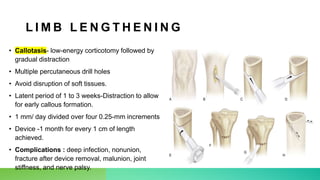
L I M B L E N G T H E N I N G
• Callotasis- low-energy corticotomy followed by
gradual distraction
• Multiple percutaneous drill holes
• Avoid disruption of soft tissues.
• Latent period of 1 to 3 weeks-Distraction to allow
for early callous formation.
• 1 mm/ day divided over four 0.25-mm increments
• Device -1 month for every 1 cm of length
achieved.
• Complications : deep infection, nonunion,
fracture after device removal, malunion, joint
stiffness, and nerve palsy.
D E V I C E S F O R L E N G T H E N I N G
• Wagner’s low profile mono lateral
fixator
• DeBastiani’s Orthofix
• The Ilizarov device
• Taylor Spatial Frame- six-axis
deformity analysis incorporated in
a computer program.
D E V I C E S F O R L E N G T H E N I N G
• Lengthening initiated by rotation
of the involved limb (Albizzia nail)
• Controlled rotation, ambulation,
and weight bearing
(Intramedullary Skeletal Kinetic
Device)
• Electrically activated motorized
drive (Fitbone)
• Externally applied magnetic field
(PRECICE Nail),
• Frame applied
perpendicular to
mechanical axis.
• Distal reference wire-
parallel to femoral condyles.
• Proximal reference pin-
perpendicular to
mechanical axis.
• Middle ring is larger than
distal two rings to
accommodate conical
shape of thigh.
• In skeletally immature child with intact
physes,
• Single ring distal to proximal tibial
epiphysis is used with drop wire for
additional segmental stabilization of
proximal segment.
• For significant amount of lengthening,
third ring can be placed more distally
to allow greater mass of soft tissue for
recruitment into lengthening process.
C O M P L I C AT I O N S O F
L E N G T H E N I N G
• Pin site infection
• Muscular problems- Tricep surae and quadriceps
• Joint subluxation or dislocation
• Neurovascular problems
• Premature or delayed consolidation
• Malunion and axis deviation
R O L E O F A M P U TAT I O N
• Significant length discrepancy
• Poor underlying bone quality for lengthening
• Dysfunctional of painful limb
Q U E S T I O N 4
• A 4-year-old boy sustains a midshaft femur fracture with less than 2 cm of
shortening that was treated with immediate closed reduction and hip-spica
casting. Of the following listed potential complications, which is the most
common requiring early surgical intervention in this age group?
• A. delayed union
• B. Non union
• C. cosmetic deformity
• D. leg-length discrepancy
• E. loss of reduction
Q U E S T I O N 5
• A 15-year-old male presents with pain and progressive deformity
about his left knee. A standing AP radiograph is seen in figure A,
with the tibial growth plate nearly closed. Physical examination
reveals significant varus and a leg-length discrepancy of 2.5cm
right greater than left. Which of the following is the most
appropriate method of management at this time?
• A. Orthotics
• B. Hemi epiphysiodesis of the left proximal tibia, medial side only
• C. Epiphysiodesis of the left proximal tibia
• D. Left proximal tibia osteotomy with placement of lengthening
external fixator
• E. Left proximal tibia osteotomy with plate fixation
R E F E R E N C E S
• Campbells operative orthopaedics, 13/e
• Tachdjians pediatric orthopaedics 5/e
THANK
YOU

Limb Length Discrepancy.pptx

  • 1.
    L I MB L E N G T H D I S C R E P A N C Y P R E S E N T E D B Y - D R . S I B A S I S G A R N A Y A K M O D E R A T O R S R - D R . Y O G E S H P A T E L C O N S U L T A N T - D R . R E H A N U L H A Q
  • 2.
    C O NT E N T • Introduction • Classification • Etiology of LLD • Mechanism of compensation • Evaluation of LLD • Predictor of growth • Guideline for management • Epiphysiodesis • Limb Shortening procedures • Limb Lengthening procedures • Questions and discussions
  • 3.
    D E FI N I T I O N • Limb length discrepancy is defined as a condition in which the paired extremity limbs have a noticeably unequal length.
  • 4.
    I N TR O D U C T I O N • Frequent parental concern. • Incidentally during screening examinations. • Cosmetic and functional concern • 0.5-2.0 cm are usually asymptomatic. • >2.5 cm – significant • Increasing likelihood of hip, knee and lumbar spine pain
  • 5.
    I N TR O D U C T I O N • Short leg gait- awkward • excessive vertical rise and fall of pelvis. • Changes in facet joint orientation- back pain • Compensatory scoliosis and decreased spinal mobility. • Compensatory ankle movement • Management-complex • Cause of the discrepancy, associated conditions, pain, and patient/family expectations.
  • 6.
    C L AS S I F I C AT I O N • Structural • Anatomical • Actual shortening of skeletal system. • Congenital or acquired. mild<3 cm moderate 3-6 cm severe >6 cm • Functional • Apparent • Functional inequality occurs. • Without concomitant shortening of osseous component. • Usually acquired.
  • 7.
    E T IO L O G Y O F S H O R T L I M B • Congenital limb deficiency- congenital femoral deficiency, congenital fibular deficiency, tibia hemimelia • Asymmetrical neurological disorders- poliomyelitis, hemiplegic cp, hemi myelomeningocele • Traumatic- malunion, growth plate arrest • Hemi atrophy- idiopathic, Russel-Silver syndrome • Other- infection, tumor, post irradiation, Blounts disease, unilateral club foot, congenital pseudoarthrosis of tibia.
  • 8.
    E T IO L O G Y O F L O N G L I M B • Post traumatic- femur shaft # (why?), tibia shaft # • Soft tissue overgrowth- Beckwith-Wiedemann syndrome, Klippel- Trenaunary syndrome, proteus syndrome, gigantism • Chronic inflammatory arthritis- Rheumatoid arthritis • Idiopathic hemihypertrophy
  • 9.
    M E CH A N I S M O F C O M P E N S AT I O N Compensatory mechanisms- • Excessive pelvic motion and tilt • Persistent flexion of the longer limb • Circumduction of the longer limb • Toe-walking on the shorter limb (minor LLD) • More mechanical work by longer limb • Vertical displacement of centre of gravity
  • 10.
    E VA LU AT I O N O F L L D • History • Examination • Imaging Radiograph Bone age Scanogram
  • 11.
    H I ST O R Y A N D E VA L U AT I O N • Congenital or developmental • Age of onset • Determine cause • Determine deformity- rotational or angular, joint mobility • Functional status of joints • Foot height differences • Current and predicted discrepancy in limb length
  • 12.
    E X AM I N AT I O N • Wood block test: • Blocks under short leg until pelvis level • Simplest method • Best initial screening method. • Error in pelvic asymmetry or obliquity • Leg length measurement: • Apparent length: umbilicus to medial malleolus • True length: ASIS to medial malleolus
  • 13.
    S TA ND I N G O R T H O R A D I O G R A P H A N D S C A N O G R A M
  • 14.
    C T SC A N O G R A M • Software measures distance. • Accurate up to 0.2 mm. • Fast method • Legs must be in same position • No magnification error • knee flexion contracture or is in a circular external fixator.
  • 15.
    S K EL E TA L A G E 1. Greulich Pyle atlas • X ray left hand • Corelates with Green Anderson table • Less accurate <6 • Improved accuracy by focusing on hand bones rather than carpal bones • Tanner Whitehouse atlas • More refined • 20 landmarks graded left hand • More accurate • Cant us as not correlated with LL
  • 16.
    P R ED I C T I O N O F G R O W T H R E M A I N I N G • Time of limb equalization. • Green Anderson growth remaining chart • Moseley chart • Menelaus method • Multiplier app • Paley multiplier
  • 17.
    P R OB L E M S W I T H G R E E N A N D E R S O N A N D M O S L E Y M E T H O D • Do not estimate foot height. • Not applicable to modern children. • Growth not always mathematically predictable. • Role of nutritional, metabolic, hormonal, and socioeconomic factors. • LLD in Juvenile rheumatoid arthritis and Perthes disease- discrepancy corrects itself
  • 18.
    G R OW T H I N L O W E R L I M B ( M E N E L A U S M E T H O D ) • Proximal femur 3 mm/year • Distal femur 9mm/year • Growth cessation 14 year in girls 16 year in boys • Proximal tibia 6mm/year • Distal tibia 3mm/year
  • 19.
    Q U ES T I O N 1 • A 9-year-old male sustains the fracture seen in the figure. If a complete growth arrests occurs, his expected leg length discrepancy at skeletal maturity would be? • A. 2 cm • B. 3 cm • C. 4 cm • D. 6 cm • E. none
  • 20.
    PA L EY M U LT I P L I E R • Take LLD for boy or girl • Multiplier for skeletal or chronological age • Predicts LLD at maturity. • Limb length discrepancy at skeletal maturity= current limb length discrepancy x multiplier. • Can help predict timing of epiphysiodesis. Current LLD in a 10 year old boy with congenital hemihypertrophy is 4 cm. What will be the approximated limb length discrepancy at maturity?
  • 21.
    G O AL O F T R E AT M E N T • Balanced spine and pelvis • Equal limb lengths • Correct mechanical weight-bearing axis • Methods : • Shoe lift or prosthetic conversion • Epiphysiodesis of the long leg • Shortening of the long leg • Lengthening of the short leg • Lengthening+ contralateral epiphysiodesis
  • 22.
    S H OE L I F T • Patients who do not wish or are not appropriate for surgery. • Small discrepancy- heel lift, large difference- full shoe lift • >5 mm – poorly tolerated, unstable
  • 23.
    P R OS T H E T I C F I T T I N G • Significant discrepancy, functionally useless foot • Discrepancy more than 15-20 cm and femoral length less than 50 % • Fibula hemimelia with unstable ankle • PFFD : A/K prosthesis or B/K prosthesis with van nes rotation plasty. • Optimal age- Syme amputation – end of 1 year • Rotation plasty- 3 years
  • 24.
    P R OS T H E T I C F I T T I N G
  • 25.
    E P IP H Y S I O D E S I S • Arrest of growth of a particular physis. • Physeal, rather than epiphyseal, growth is halted. • Phemister - 1933 • For growing children, small discrepancy (2-5 cm) • Slowing growth rate of long leg, allowing short leg to catch up. • Very low morbidity and complication rate.
  • 26.
    P E RC U TA N E O U S E P I P H Y S I O D E S I S
  • 27.
    Q U ES T I O N 2 • Lateral tibial physeal stapling is a treatment option for adolescent Blount’s disease. How is the staple an example of the Hueter-Volkmann principle? • A. Increased compression along the growth plate slows longitudinal growth • B. Decreased compression along the growth plate slows longitudinal growth • C. Increased tension along the growth plate slows longitudinal growth • D. Decreased tension along the growth plate slows longitudinal growth • E. Increased compression along the plate increases longitudinal growth
  • 28.
    E P IP H Y S E A L S TA P L I N G • Blount and Clark • Growth stops immediately. • Three staples should span physis. • Position verified on both AP and lateral • Vitallium staples >stainless steel.
  • 29.
    T E NS I O N P L AT E E P I P H Y S I O D E S I S
  • 30.
    P R OB L E M S O F E P I P H Y S I O D E S I S • Under correction • Over correction • Rebound phenomenon • Failure of growth restoration • Breakage or bending
  • 31.
    Q U ES T I O N 3 • A 14-year-old male patient with a leg-length discrepancy undergoes a distal femoral and proximal tibial epiphysiodesis on the longer leg. What is the anticipated amount of correction achieved with this procedure in this child? • A. 1.6 cm • B. 2 cm • C. 3.2 cm • D. 4 cm • E. 6.4 cm
  • 32.
    S H OR T E N I N G P R O C E D U R E S • Skeletally mature patients. • Ultimate length and alignment should be considered. • Femur-5 to 6 cm, tibia- 2 to 3 cm. • Femoral shortening is tolerated better than tibial shortening (why?) • Wagner-metaphyseal osteotomy for angular correction, diaphyseal if shortening alone. • Complications : fat embolism AVN of the femoral head muscle weakness
  • 33.
    S H OR T E N I N G P R O C E D U R E - F E M U R
  • 34.
    S H OR T E N I N G P R O C E D U R E T I B I A
  • 35.
    L I MB L E N G T H E N I N G • Callotasis- low-energy corticotomy followed by gradual distraction • Multiple percutaneous drill holes • Avoid disruption of soft tissues. • Latent period of 1 to 3 weeks-Distraction to allow for early callous formation. • 1 mm/ day divided over four 0.25-mm increments • Device -1 month for every 1 cm of length achieved. • Complications : deep infection, nonunion, fracture after device removal, malunion, joint stiffness, and nerve palsy.
  • 36.
    D E VI C E S F O R L E N G T H E N I N G • Wagner’s low profile mono lateral fixator • DeBastiani’s Orthofix • The Ilizarov device • Taylor Spatial Frame- six-axis deformity analysis incorporated in a computer program.
  • 37.
    D E VI C E S F O R L E N G T H E N I N G • Lengthening initiated by rotation of the involved limb (Albizzia nail) • Controlled rotation, ambulation, and weight bearing (Intramedullary Skeletal Kinetic Device) • Electrically activated motorized drive (Fitbone) • Externally applied magnetic field (PRECICE Nail),
  • 38.
    • Frame applied perpendicularto mechanical axis. • Distal reference wire- parallel to femoral condyles. • Proximal reference pin- perpendicular to mechanical axis. • Middle ring is larger than distal two rings to accommodate conical shape of thigh.
  • 39.
    • In skeletallyimmature child with intact physes, • Single ring distal to proximal tibial epiphysis is used with drop wire for additional segmental stabilization of proximal segment. • For significant amount of lengthening, third ring can be placed more distally to allow greater mass of soft tissue for recruitment into lengthening process.
  • 40.
    C O MP L I C AT I O N S O F L E N G T H E N I N G • Pin site infection • Muscular problems- Tricep surae and quadriceps • Joint subluxation or dislocation • Neurovascular problems • Premature or delayed consolidation • Malunion and axis deviation
  • 42.
    R O LE O F A M P U TAT I O N • Significant length discrepancy • Poor underlying bone quality for lengthening • Dysfunctional of painful limb
  • 43.
    Q U ES T I O N 4 • A 4-year-old boy sustains a midshaft femur fracture with less than 2 cm of shortening that was treated with immediate closed reduction and hip-spica casting. Of the following listed potential complications, which is the most common requiring early surgical intervention in this age group? • A. delayed union • B. Non union • C. cosmetic deformity • D. leg-length discrepancy • E. loss of reduction
  • 44.
    Q U ES T I O N 5 • A 15-year-old male presents with pain and progressive deformity about his left knee. A standing AP radiograph is seen in figure A, with the tibial growth plate nearly closed. Physical examination reveals significant varus and a leg-length discrepancy of 2.5cm right greater than left. Which of the following is the most appropriate method of management at this time? • A. Orthotics • B. Hemi epiphysiodesis of the left proximal tibia, medial side only • C. Epiphysiodesis of the left proximal tibia • D. Left proximal tibia osteotomy with placement of lengthening external fixator • E. Left proximal tibia osteotomy with plate fixation
  • 45.
    R E FE R E N C E S • Campbells operative orthopaedics, 13/e • Tachdjians pediatric orthopaedics 5/e
  • 46.