CHANGES IN GAIT DURING
ORTHOPAEDICS CONDITION
• DR. AKSHITA (PT)
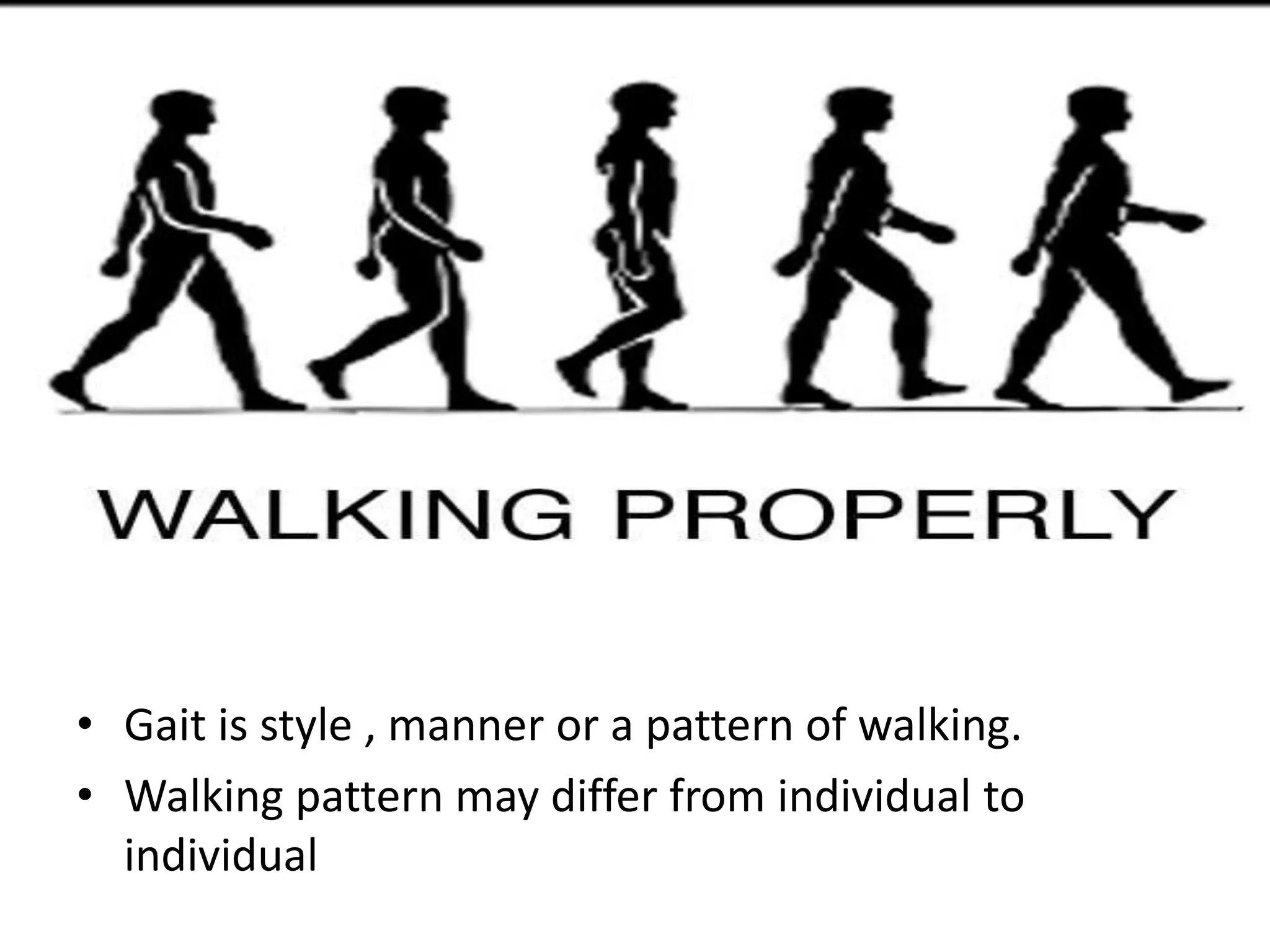
• Gait is style , manner or a pattern of walking.
• Walking pattern may differ from individual to
individual
Definition
• Locomotion or Gait – It is defined as a
translatory progression of the body as a whole
produce by coordinated, rotatory movements
of body segments.
• Normal Gait – It is a rhythmic & characterized
by alternating propulsive & retropulsive
motions of the lower extremities.
Aim of Walking
 To move the body forward and backward. It is
towards a desired location speed and direction.
To use energy. The body does this by moving in
straight line. Sufficient energy is generated
through up and down movement
To cause least amount of pain for people with
painful foot conditions. Our brains have a variety
of strategies for achieving this goal, including
putting less pressure on a painful foot, or
alternating the foot's position when we walk to
limit discomfort.
The foot itself act as a shock absorber for
dispersing the force of the body as it lands.
To form a rigid lever toward the end of the
phase of gait where the foot is on the ground,
in order to provide a way to propel the body
forward.
KINEMATICS
• Gait is extremely complex activity to analyze.
Therefore , it has been divide in number of
segments thatbmakes it possible to identify
the events that are occurring.
• Generally , gait is described by using the
activities of one lower extremity from
beginning to the end of one gait cycle.
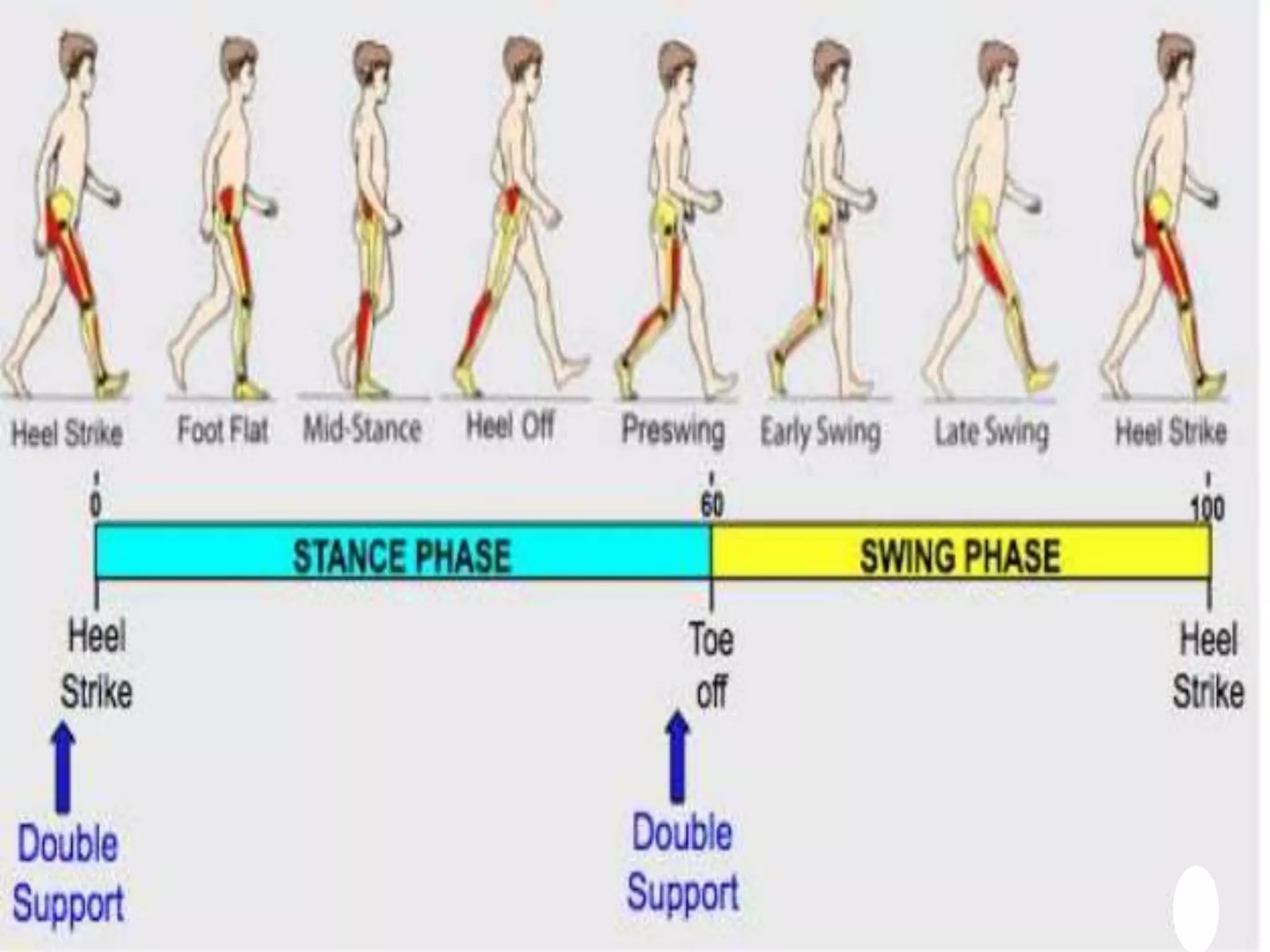
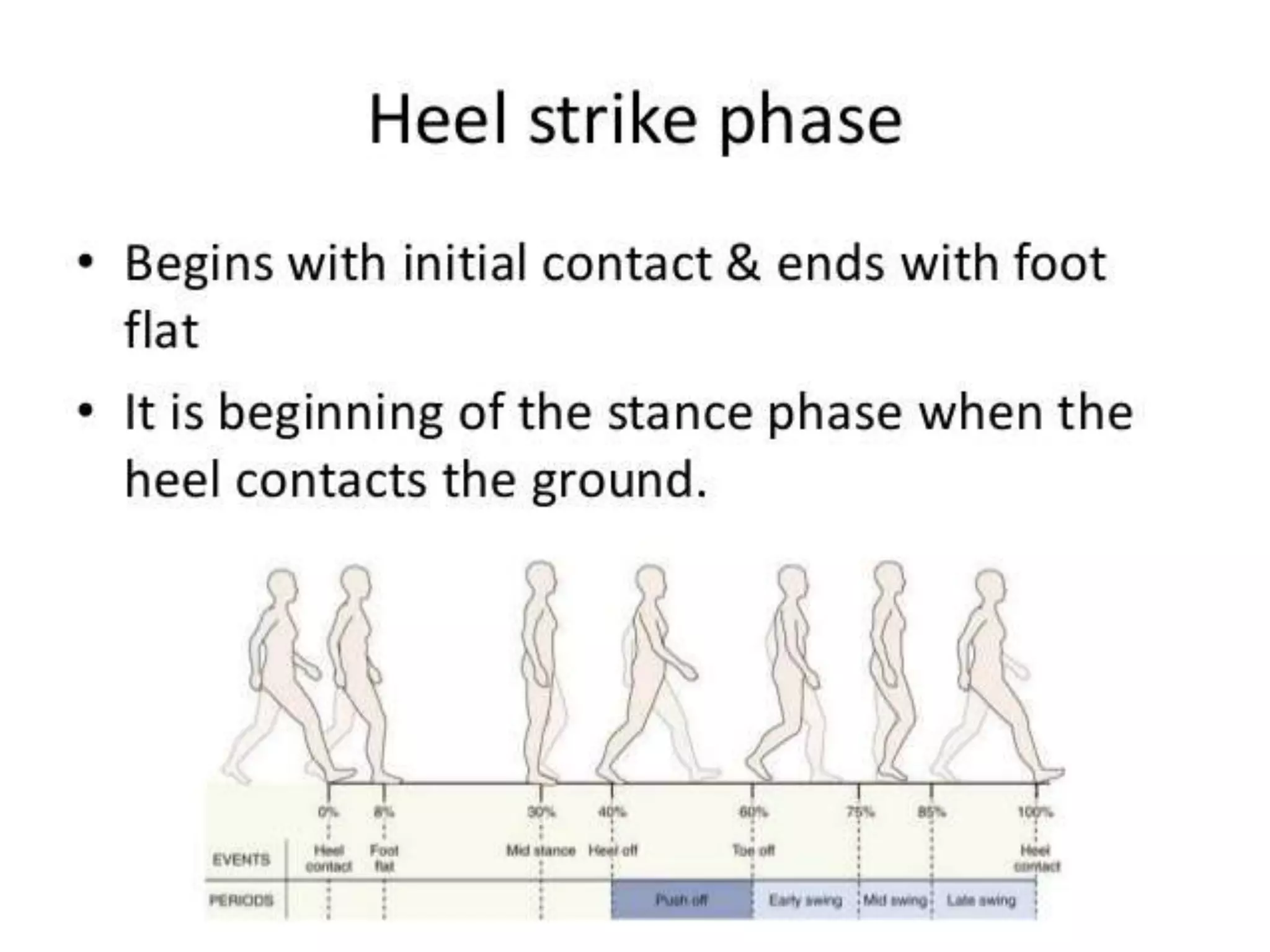
Phases of gait cycle
• The gait cycle includes the activities that occur
from one point of initial contact of one lower
extremity to the point at which the same
extremity contacts the ground again.
Subdivision of phases
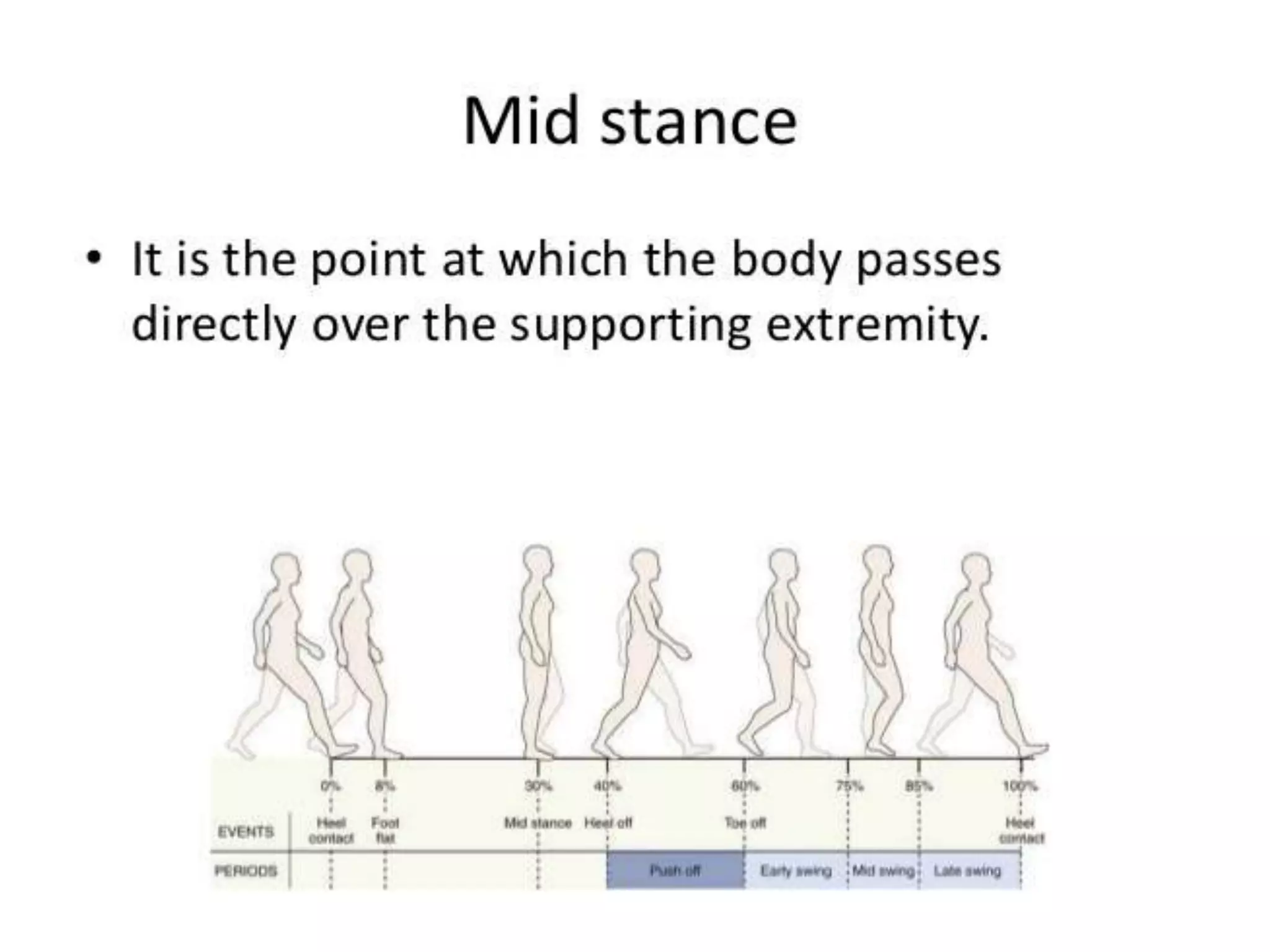
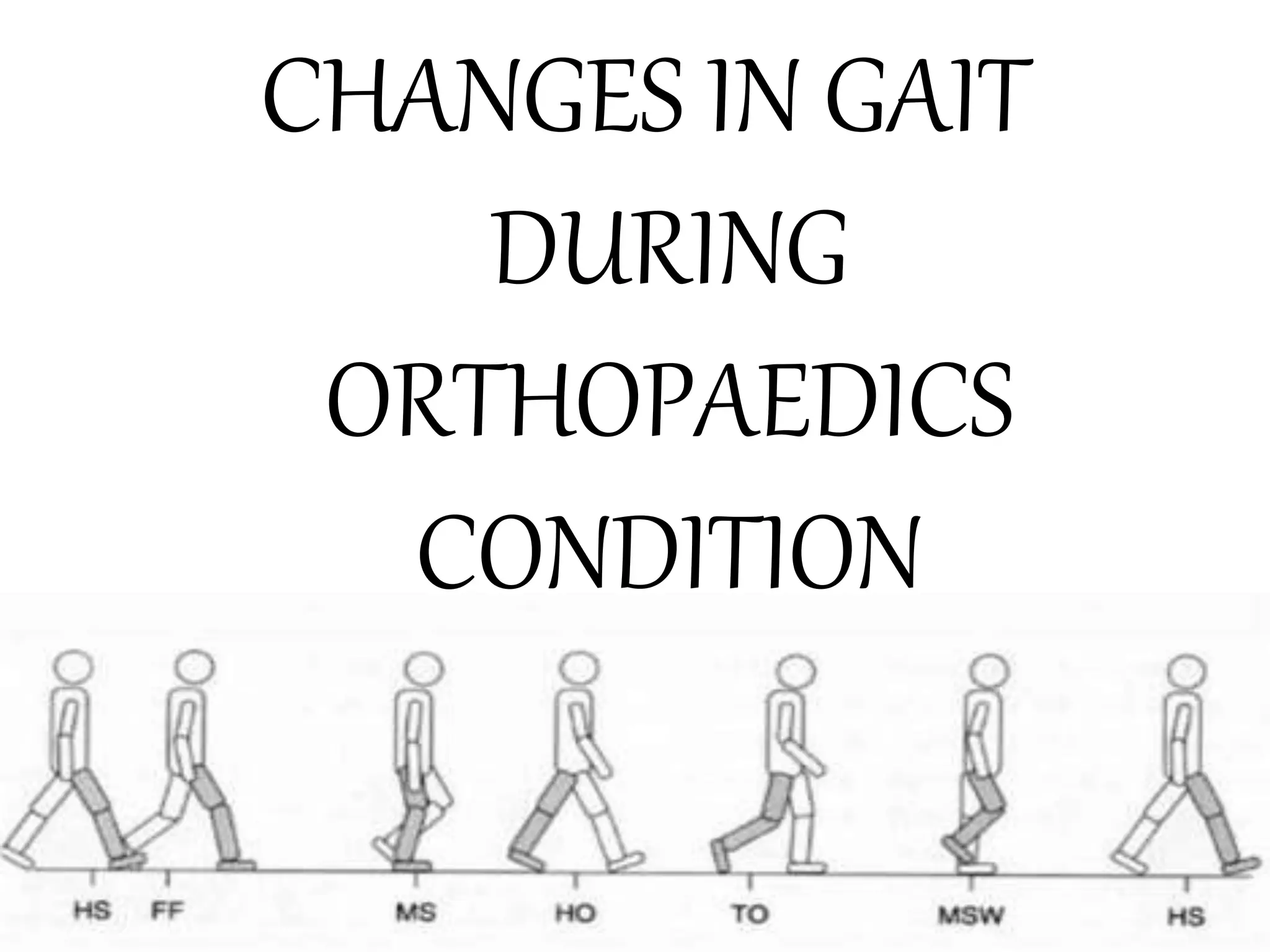
• Stance phase
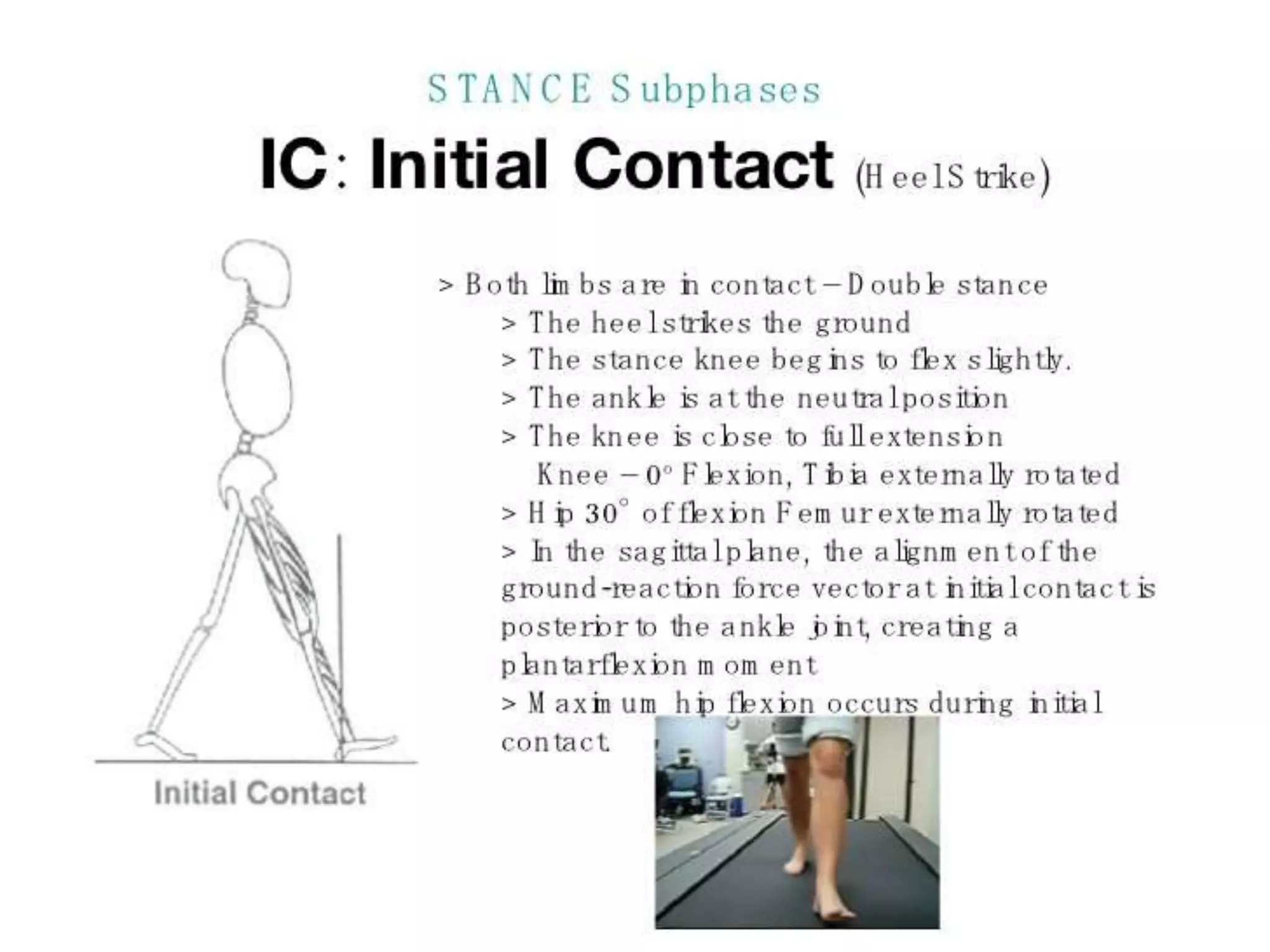
– Heel strike
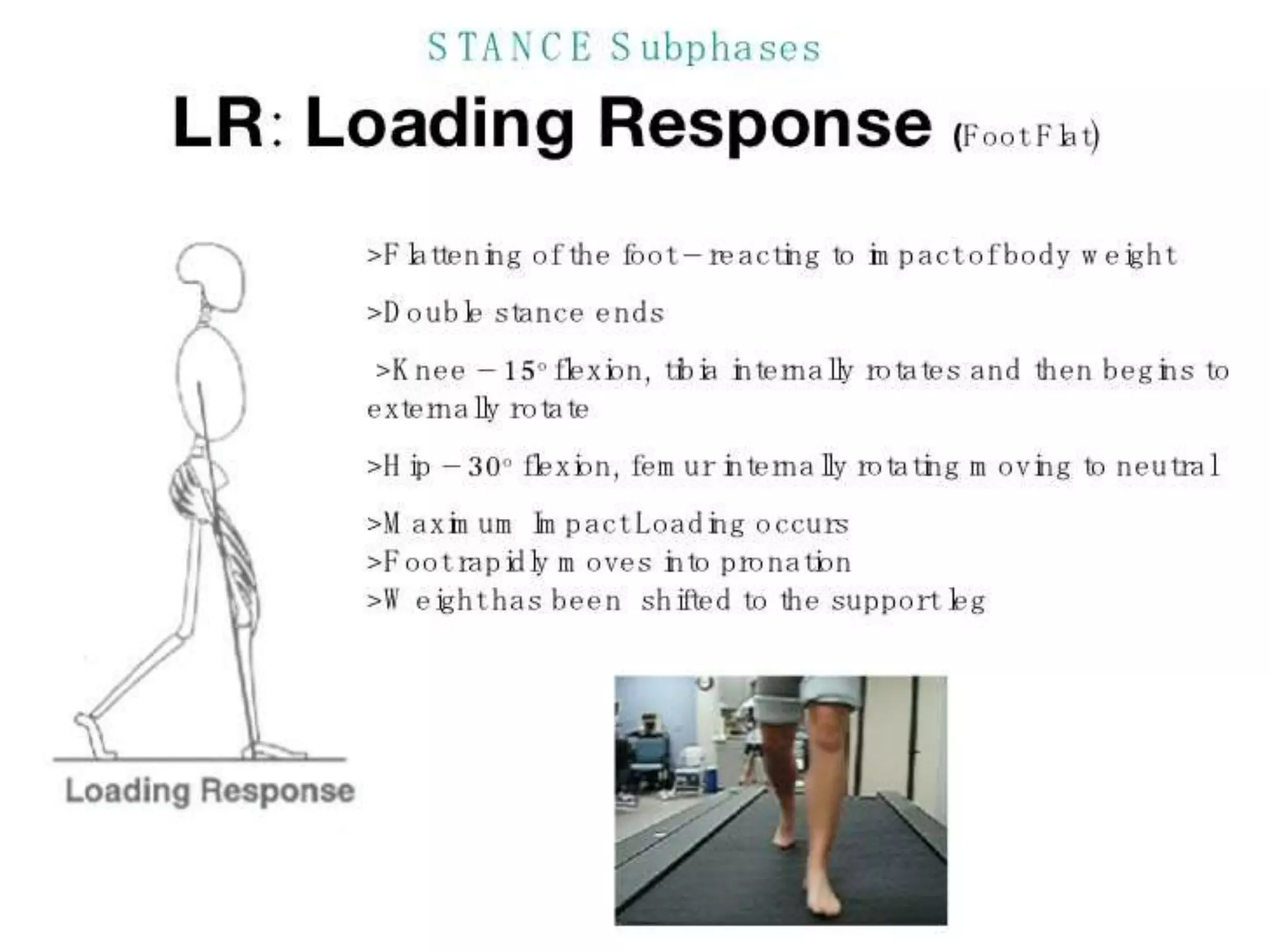
– Foot flat
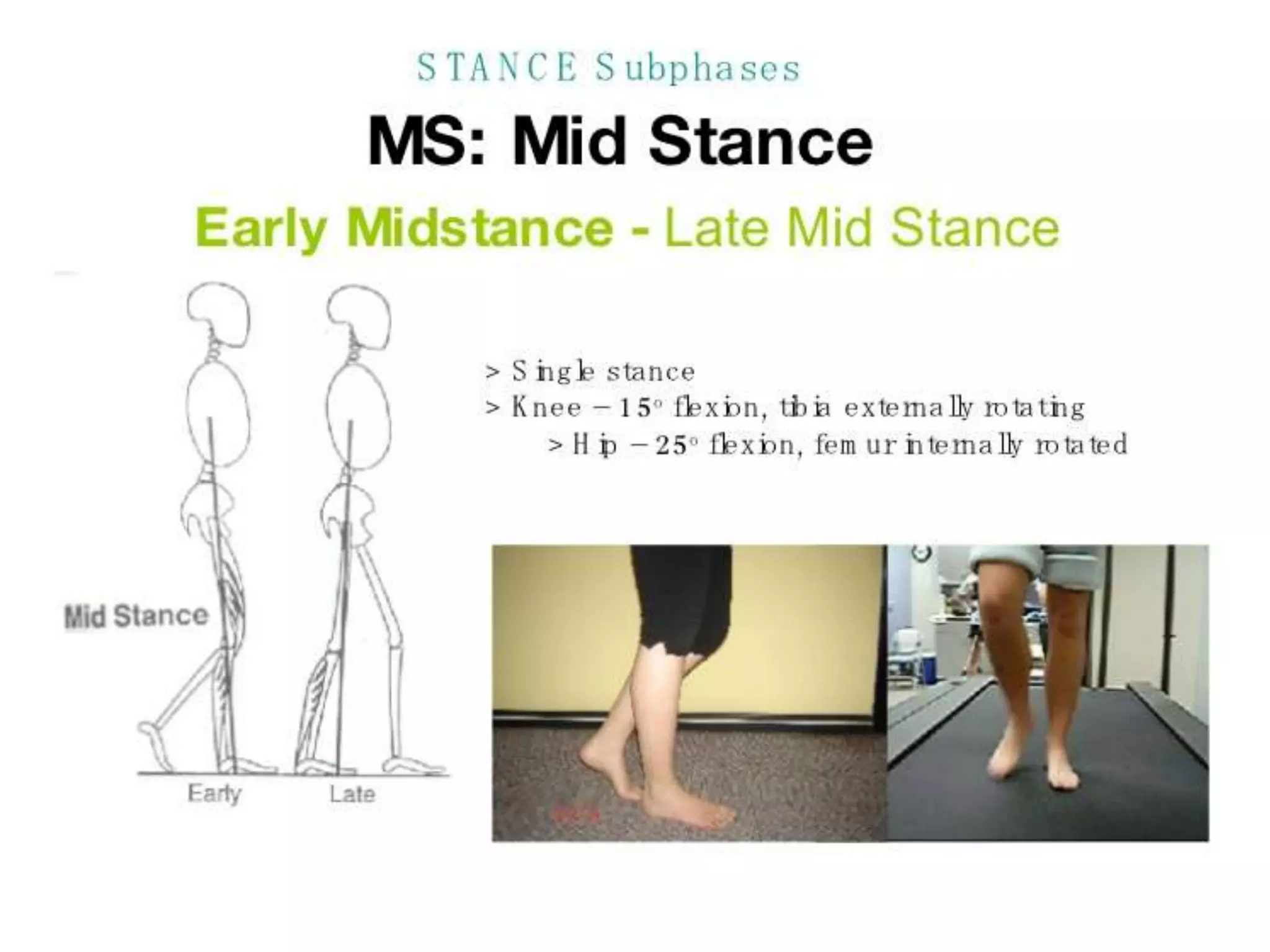
– Mid-stance
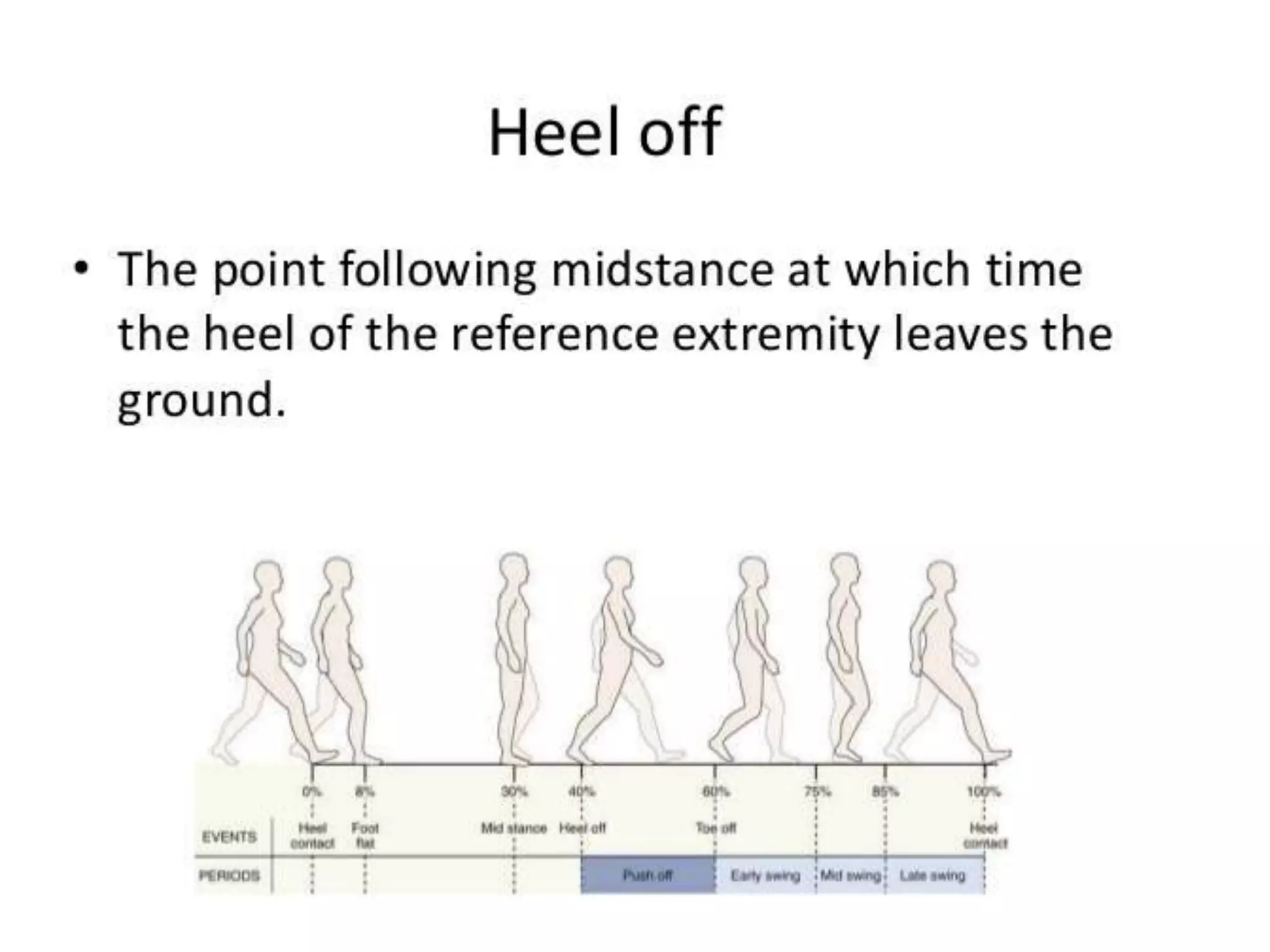
– Heel off
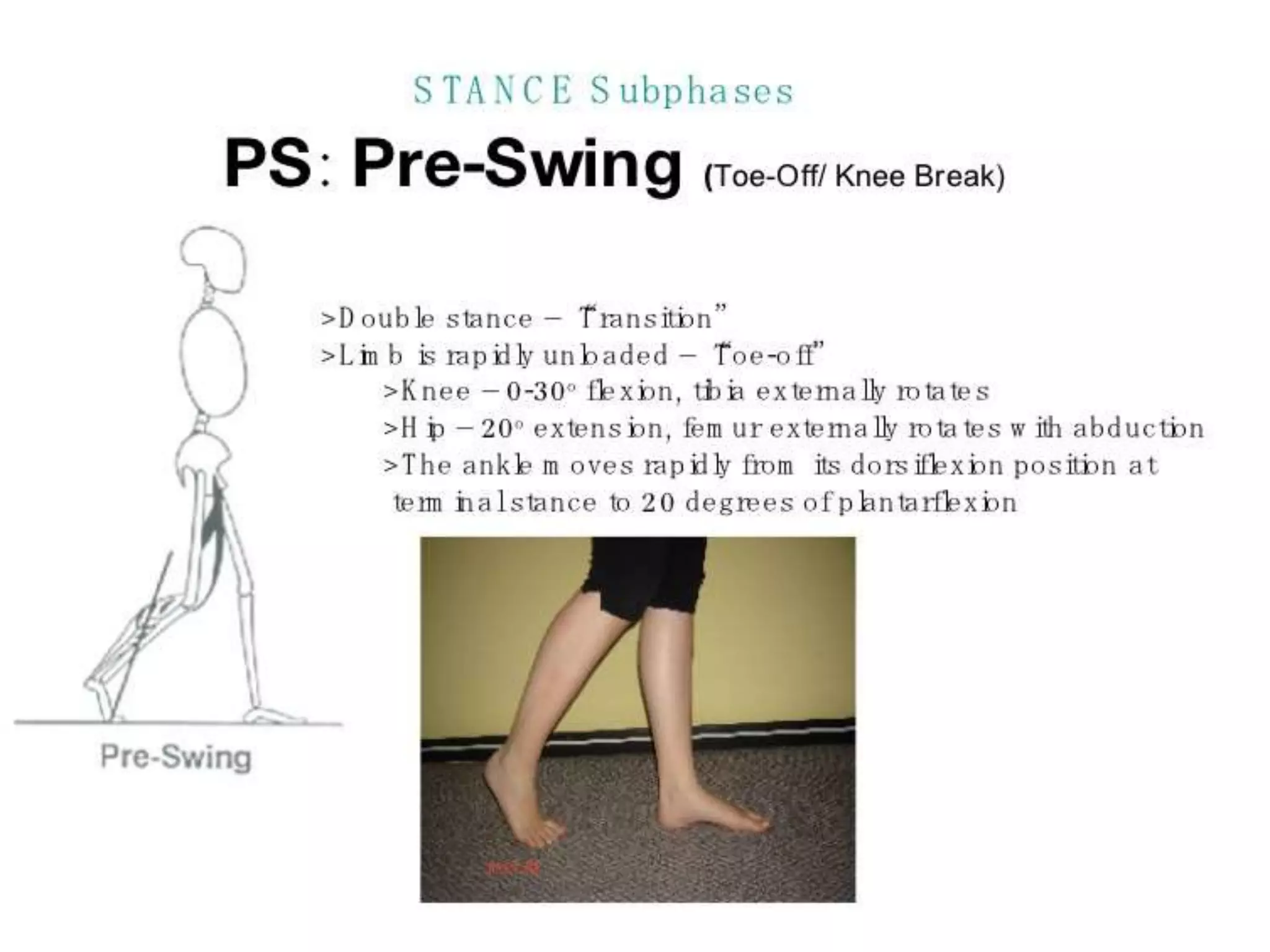
– Toe off
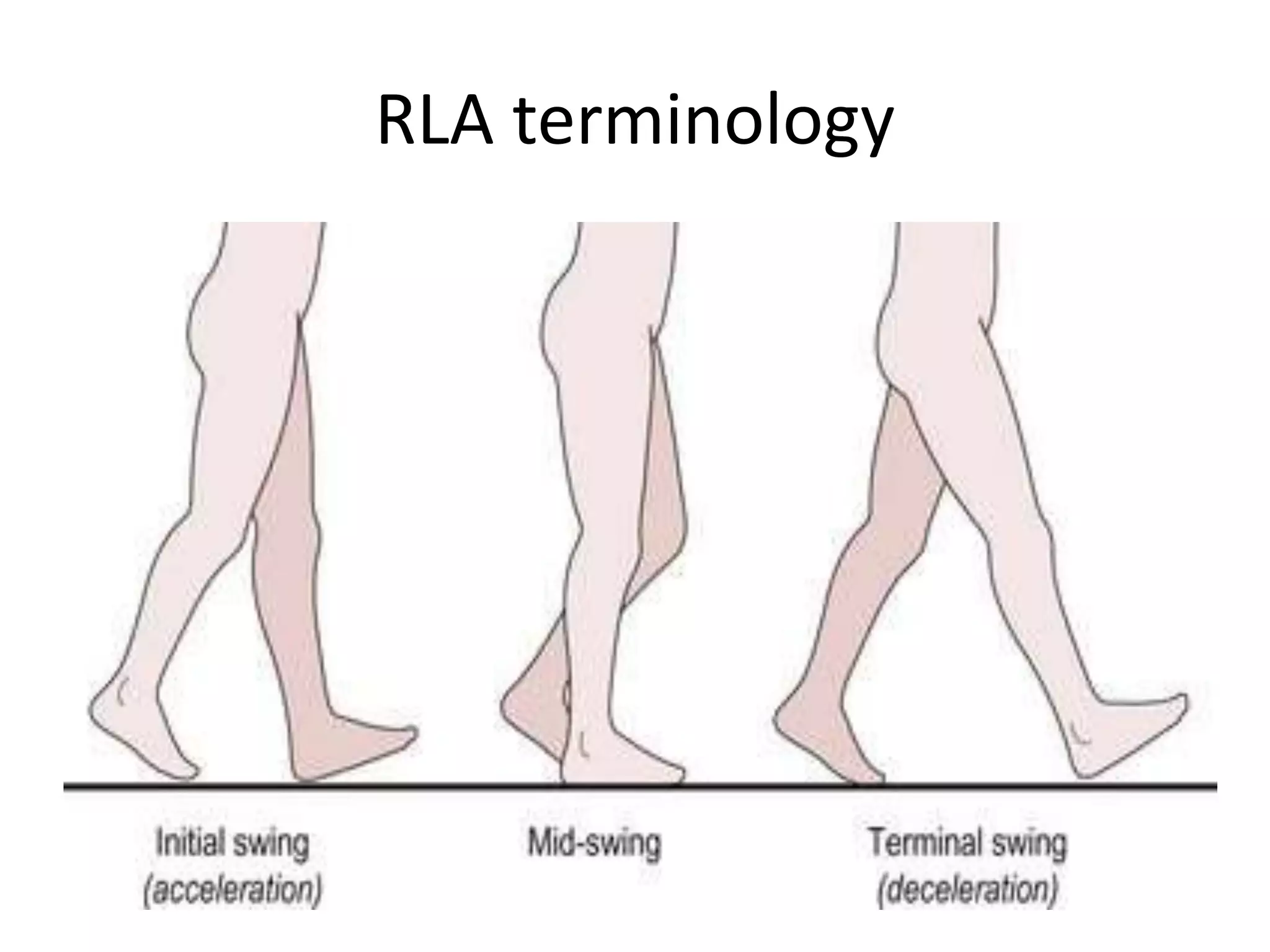
• Swing phase
– Acceleration
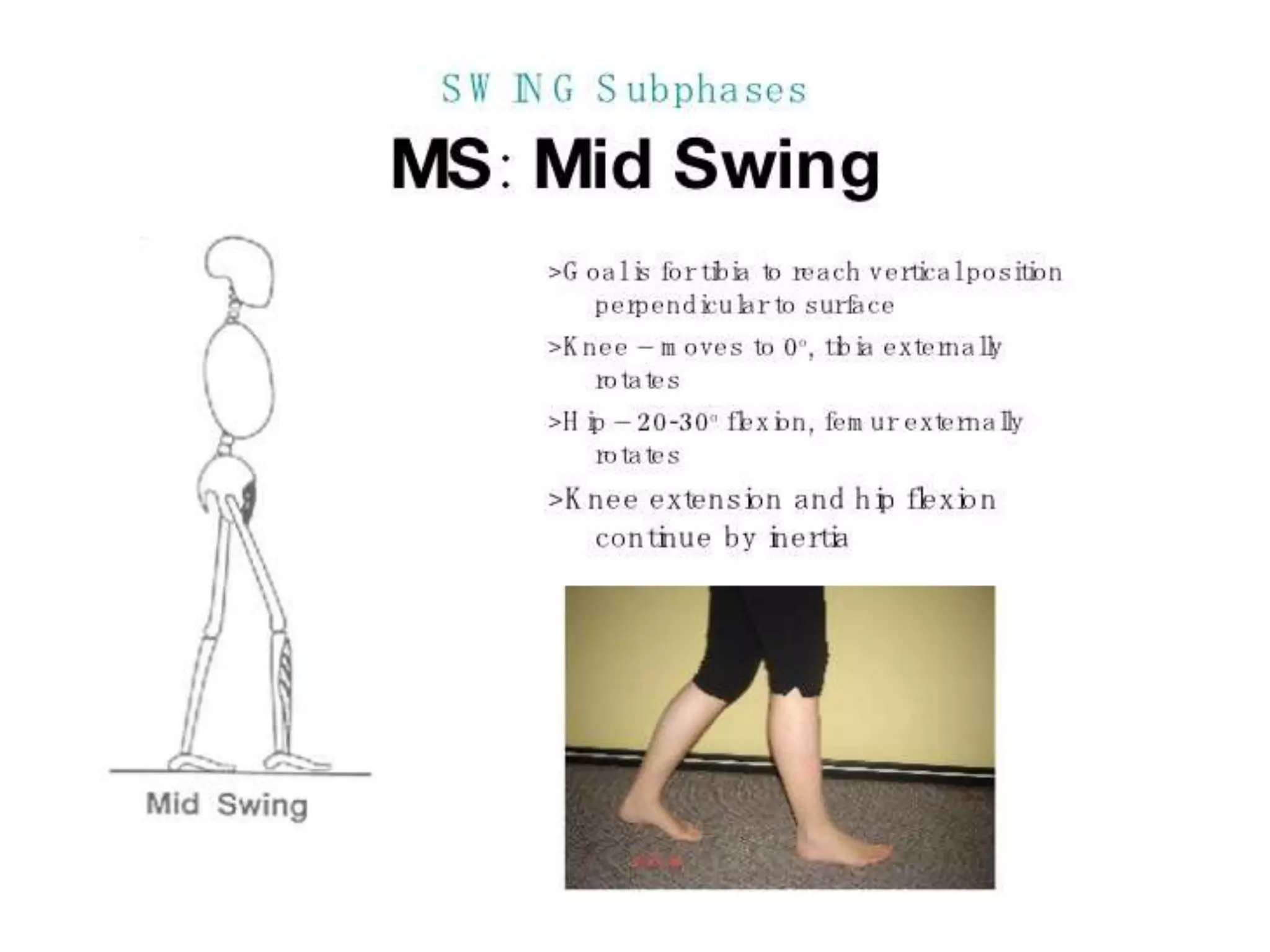
– Mid-swing
– Deceleration
Stance phase
• The phase begins at instant that one lower
extremity contacts the ground (HEEL STRIKE)
and continues only as long as some portion of
foot is in contact with the ground (TOE OFF).
• It makes up approx 60% of gait cycle during
normal walking.
Traditional terminology
RLA Terminology
Swing phase
• The swing phase begins as soon as the toe of
one extremity leaves the ground and ceases
just before heel strike or contact of same
extremity.
RLA terminology
Pathologic Gait
• Pathologic gait results from impaired strength,
range of motion, proprioception, pain, or
balance combined with mechanical
compensations, and can have musculoskeletal
and neuromuscular etiologies.
CHANGES IN GAIT
DURING
ORTHOPAEDICS
CONDITION
1.Antalgic gait
• Causes:
Pain with weight bearing.
• Pathomechanism:
Weight bearing avoided on painful limb.
Decreased step length of uninvolved side.
• Treatment:
treat underlying cause, analgesia, assistive device
(AD) in contralateral hand.
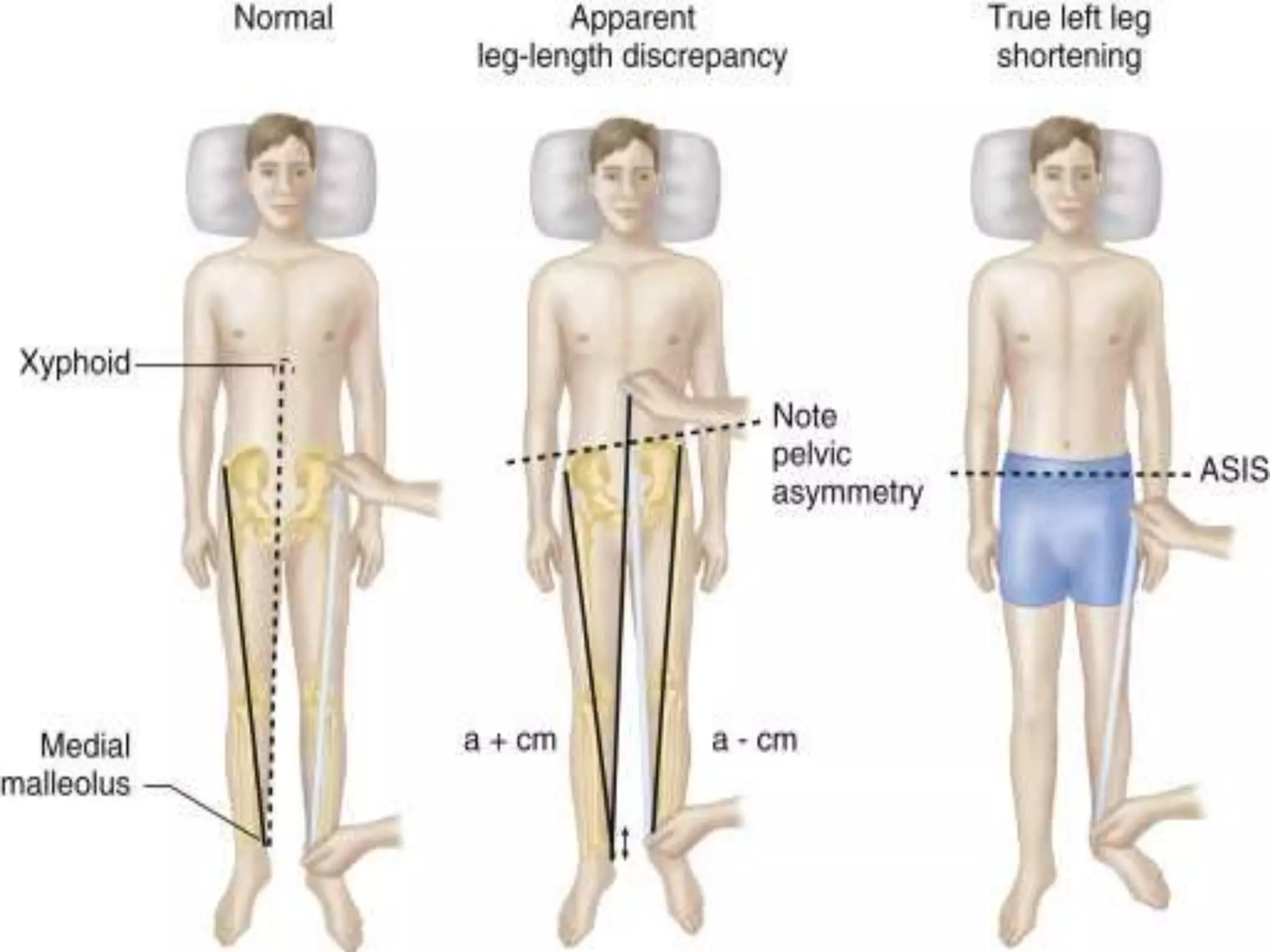
2.Leg length discrepancy (LLD)
• Causes: True or apparent leg length discrepancy.
• Pathomechanism: Shortened side: pelvic drop,
decreased hip and knee flexion, ankle plantar
flexion (vaulting, toe walking).
• Lengthened side: hip hiking, circumduction,
excessive hip and knee flexion (steppage gait), foot
hyperpronation.
• Treatment: For <2cm: no treatment. For
>2cm: shoe lift or consider surgery. Lift <2cm
inside shoe, >2cm outside shoe. Surgical
options: shortening surgery (epiphysiodesis or
femoral shortening), lengthening surgery
(femur/tibia), correction muscle or joint
contracture.
Hip
Pathologies
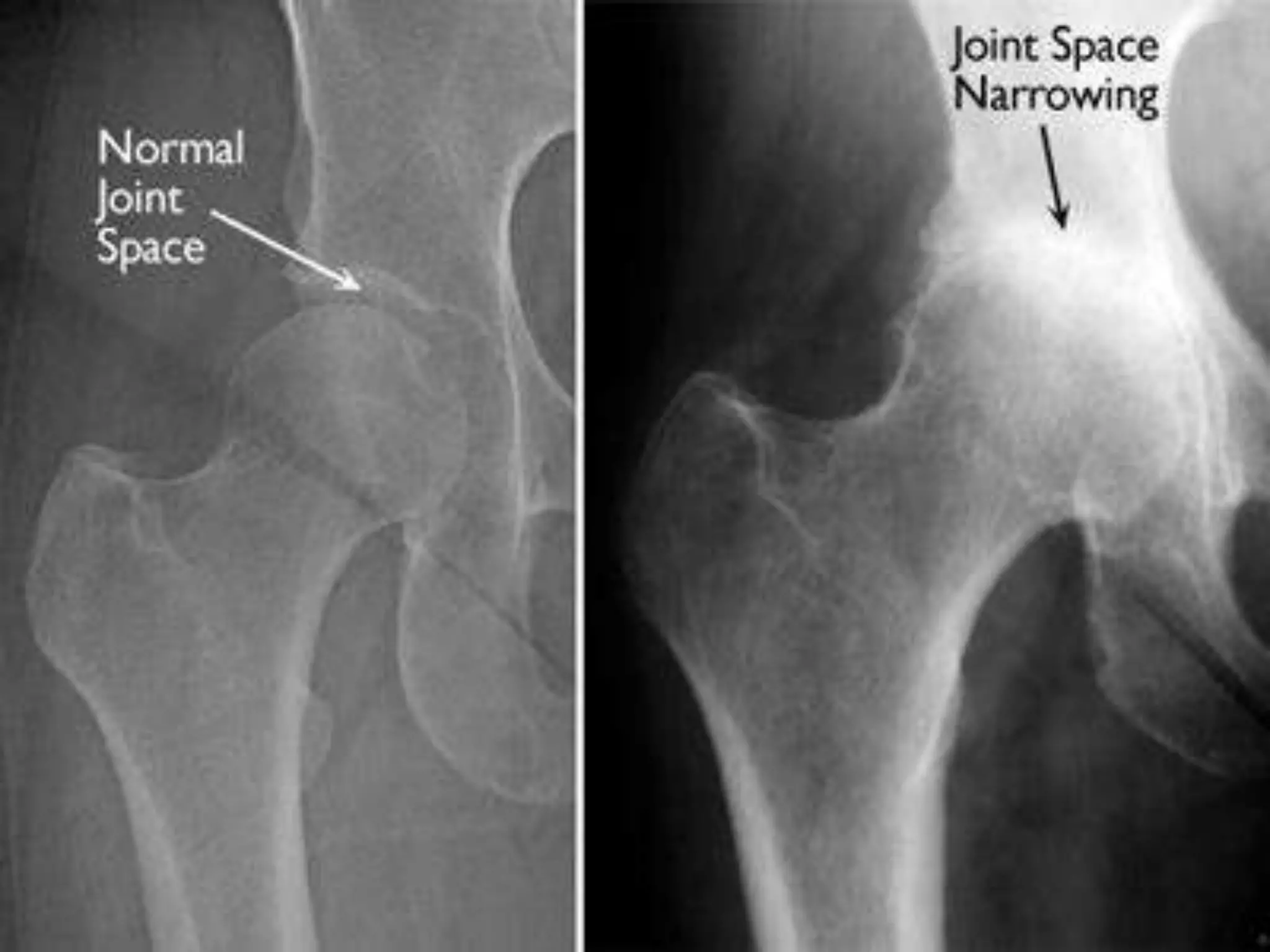
3.Arthritis
• Arthritis is a common cause of pathological
gait. An arthritic hip has reduced range of
movement during swing phase which causes
an exaggeration of movement in the opposite
limb ‘hip hiking’.
4.Excessive Hip Flexion
Excessive Hip Flexion can significantly alter gait pattern.
Cause :
• Hip flexion contractures
• IT band contractures,
• Hip flexor spasticity, •
• Compensation for excessive knee flexion and ankle DF,
• Hip pain
• Compensation for excess ankle plantar flexion in mid
swing.
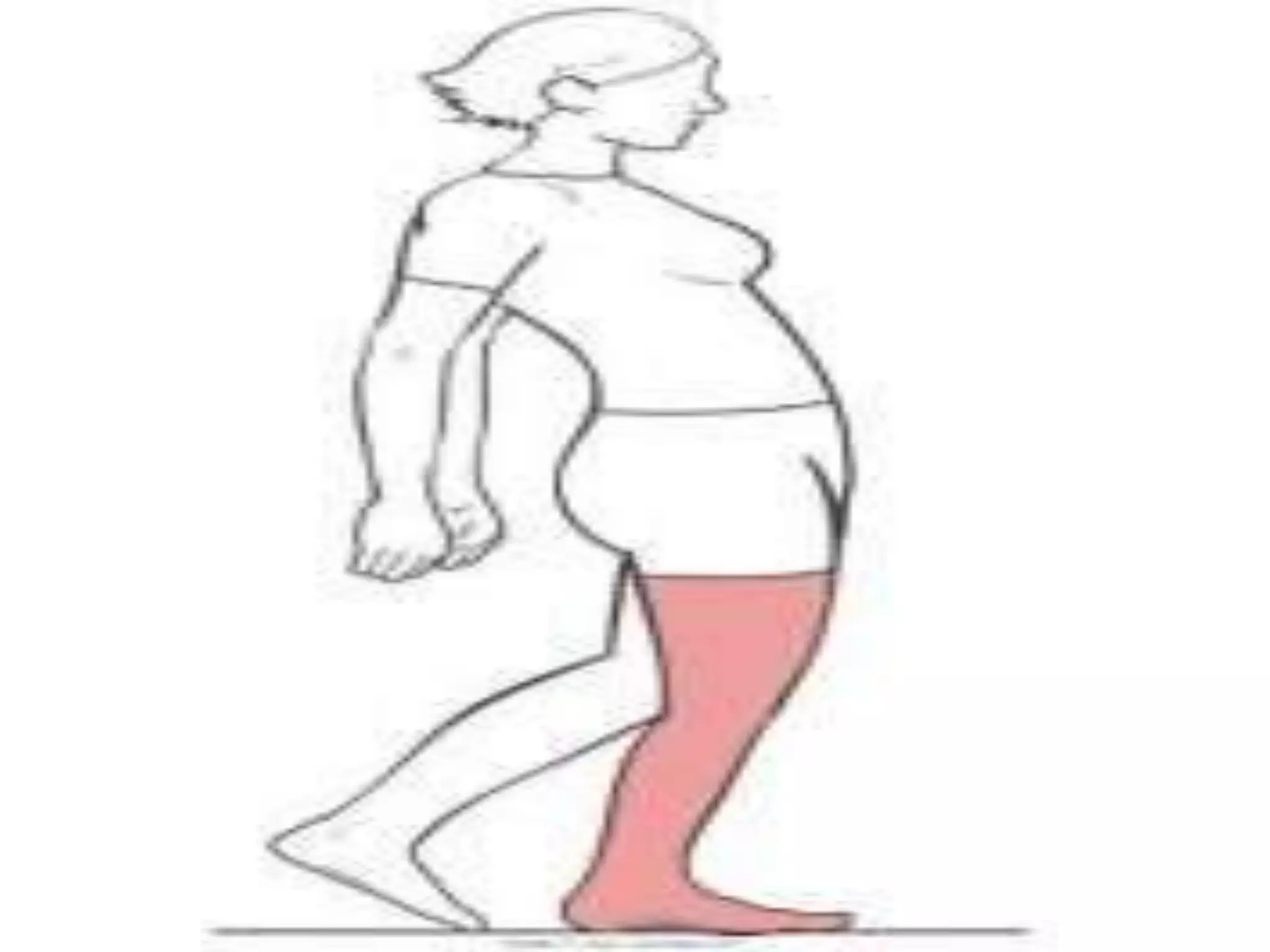
• The deviation of stance phase will occur
mainly on the affected side. The result is
forward tilt of the trunk and increased
demand on the hip extensors or increased
lordosis of the spine with anterior pelvic tilt. A
person with reduced spinal mobility will adopt
a forward flexion position in order to alter
their centre of gravity permanently during
gait.
5.Hip Adductor Contracture
• During swing phase the leg crosses mid line
due to the weak adductor muscles, this is
known as ‘scissor gait’
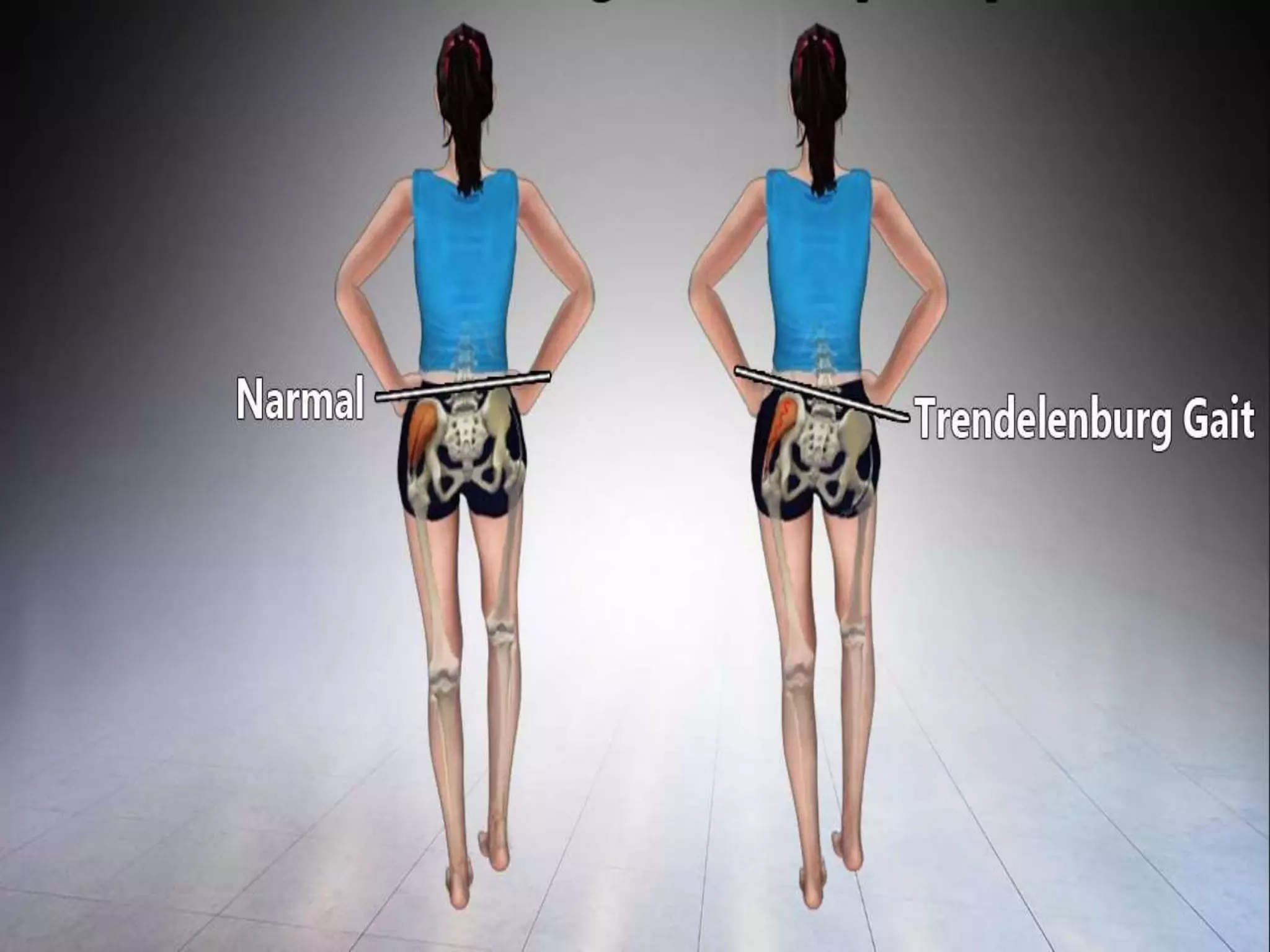
6.Hip abductor weakness
(Trendelenburg gait)
• Drop of pelvis on the unaffected side.
• Pathomechanism: Compensated gait causes
the trunk to leans toward the affected side.
• Treatment: AD in contralateral hand, gluteus
medius strengthening.
7.Hip extensor weakness (Posterior
lurch gait)
• Backward trunk lean with hyperextended hip during
stance phase of affected limb.
• Pathomechanism: Use of iliofemoral ligament to
lock hip in extension to prevent trunk falling
forward.
• Treatment: Strengthen gluteus maximus. Keep
compensatory mechanism, do not fix lumbar
hyperlordosis
Knee Pathologies
8.Weak Quadriceps.
• The quadriceps role is to eccentrically control the
knee during flexion through the stance phase.
• If these muscles are weak the hip extensors will
compensate by bringing the limb back into a
more extended position, reducing the amount of
flexion at the knee during stance phase.
• Alternatively heel strike will occur earlier
increasing the ankle of plantar flexion at the
ankle,
preventing the forward movement of the tibia, to
help stabilise the knee joint.
• Normally, during early stance as weight is being
shifted onto the stance leg, the line of force falls
behind the knee requiring quad contraction to
prevent buckling of knee.
• With quad weakness, patient leans forward at
hip, causing COG to be shifted forward so line of
force falls anterior to knee, forcing it into
extension
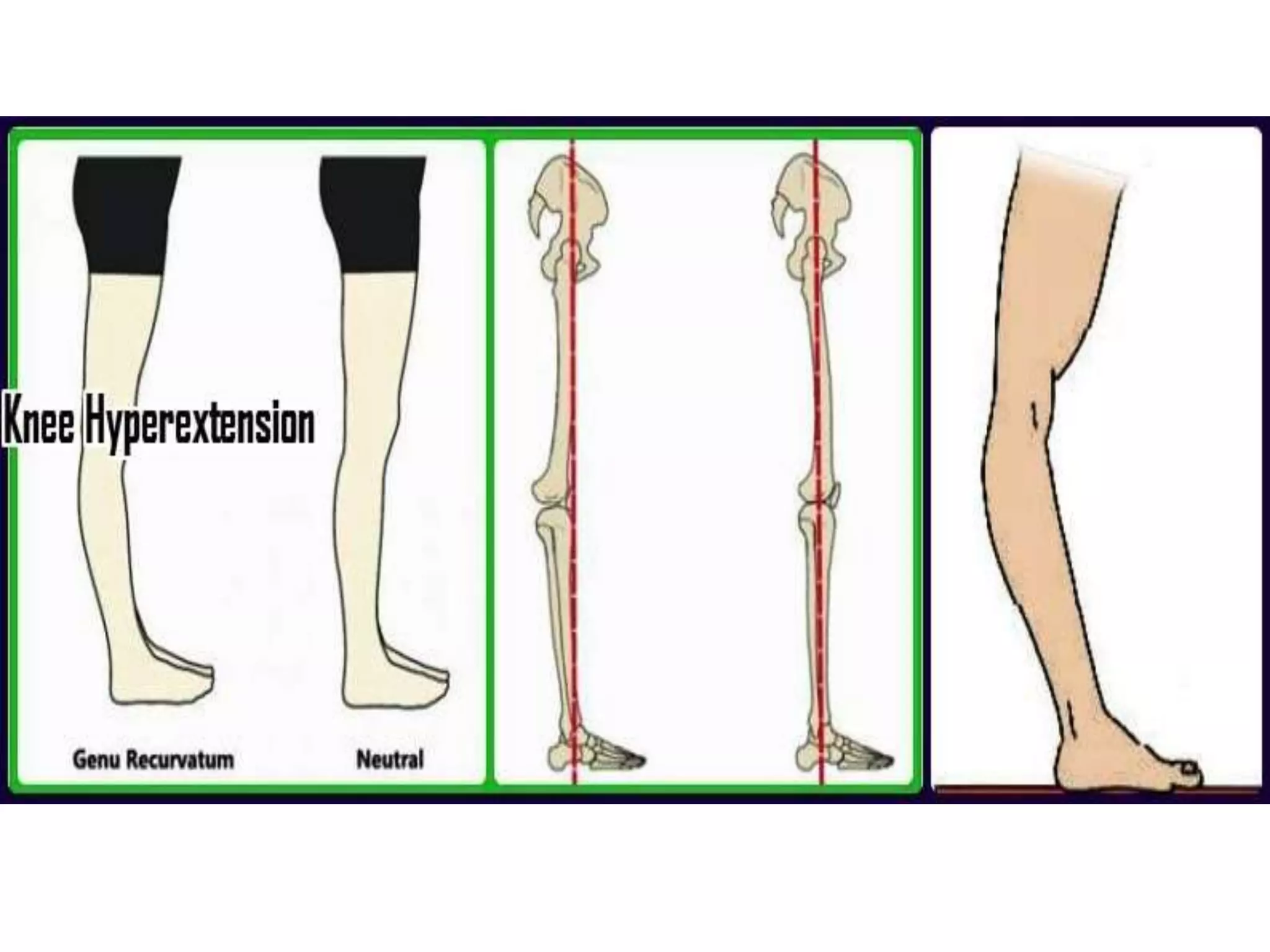
9.Knee extensor tightness
• Knee buckling (uncompensated), genu
recurvatum (compensated).
• Pathomechanism: Posterior capsule locks
affected knee joint, hyperextending knee by
forward trunk leaning.
Excessive knee extension in stance
• Causes: – Weak, short, or spastic quadriceps –
Compensated hamstring weakness – Plantar-
flexor spasticity – Achilles tendon contracture
• Treatment (examples): – Manage plantar-
flexor tone, bracing, stretching, strengthening
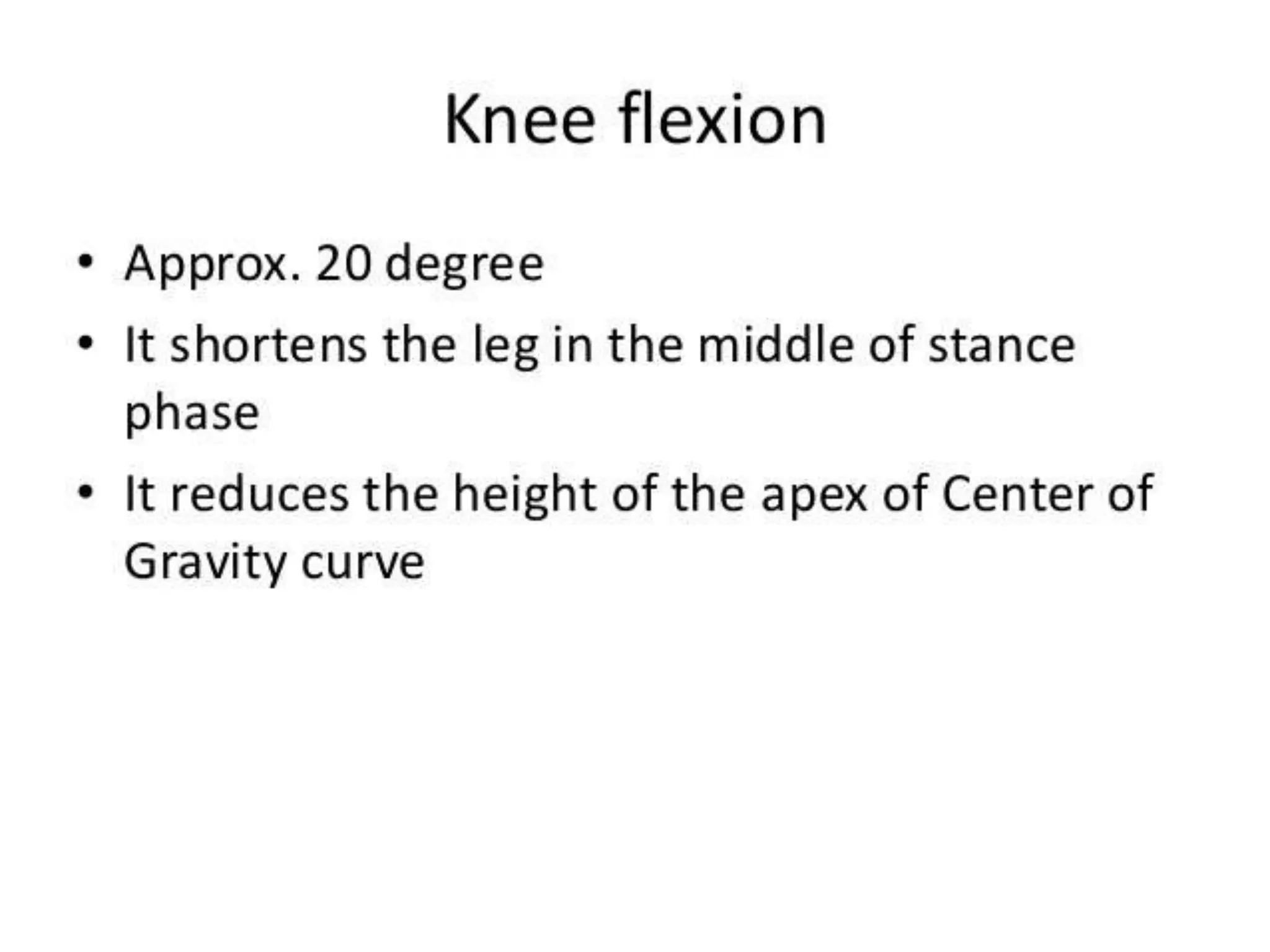
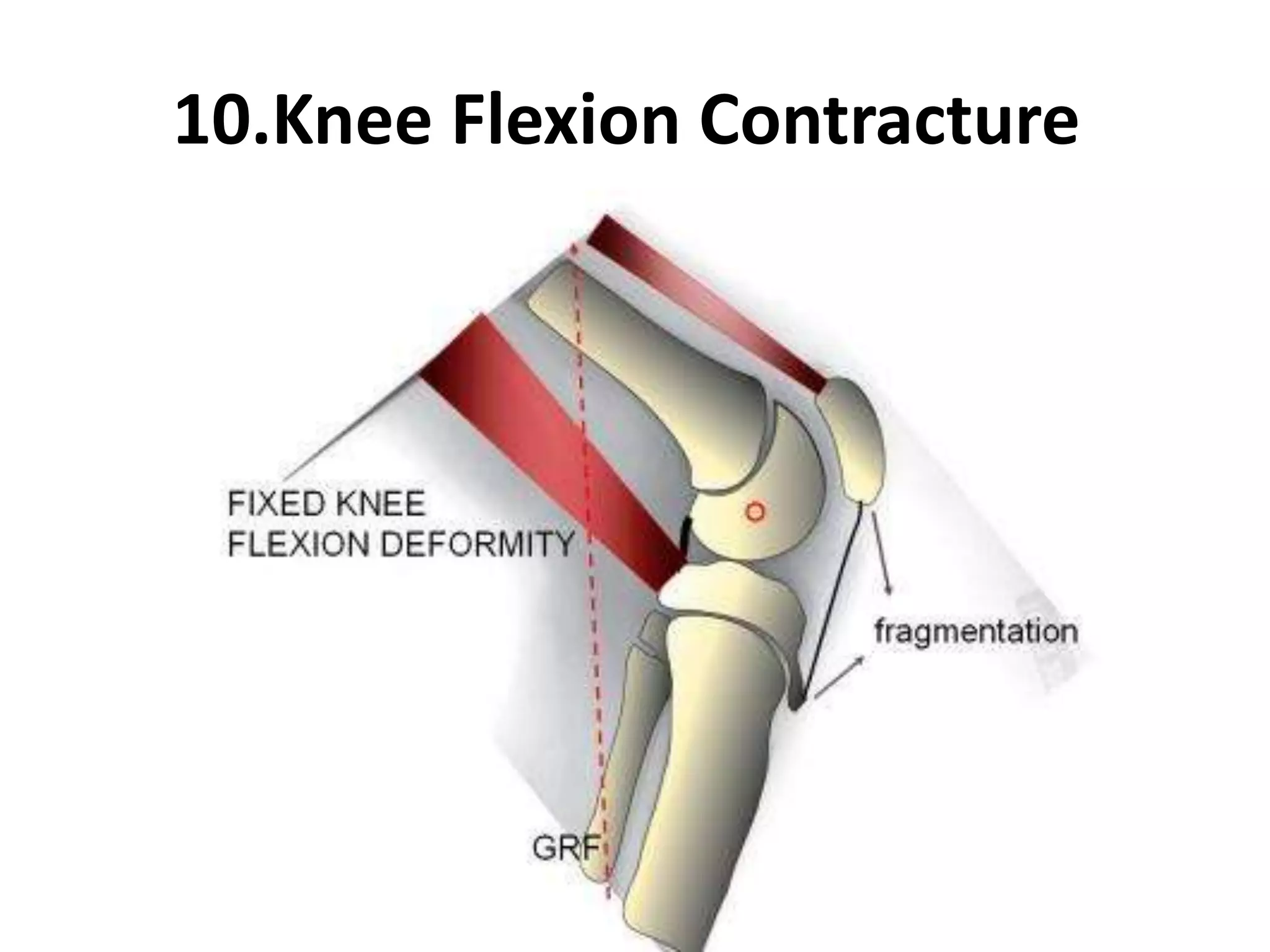
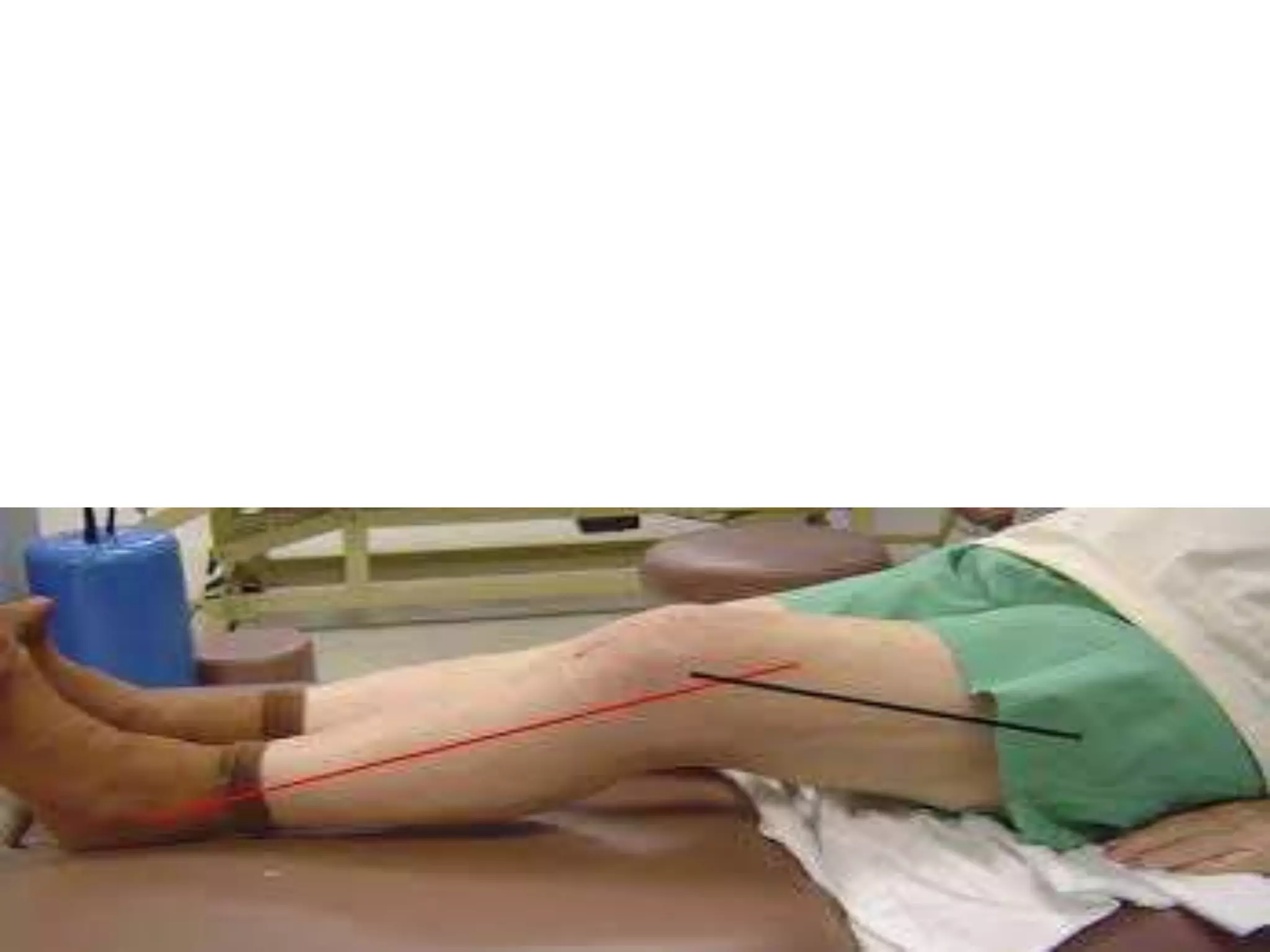
10.Knee Flexion Contracture
• Knee Flexion Contraction will cause a limping
type gait pattern. The knee is restricted in
extension, meaning heel strike is limited and
step length reduced. To compensate the
person is likely to ‘toe walk’ during stance
phase. Knee flexion contractures of more than
30 degrees will be obvious during normal
paced gait. Contractures less then this will be
more evident with increased speeds
Ankle Pathologies
11.Ankle dorsiflexion weakness/foot
drop (high Steppage gait)
• Pathomechanism: Unable to heel strike,
leading to initial contact with toes. Incomplete
lesion still has heel strike but unable to control
transition to foot flat causing “foot slap.”
During the swing phase, toes may drag/catch.
Compensatory is “steppage gait” with
excessive hip and knee flexion or body shift to
clear foot.
• Treatment: Posterior leaf spring AFO or
hinged AFO with dorsiflexion assist or plantar
flexion stop for mediolateral instability. Role of
electrical stimulation (ES) to prevent atrophy
of anterior tibialis and/or functional ES (FES)
to activate ankle dorsiflexor.
12.Ankle Plantar Flexor Weakness
(Calcaneal gait):
• Pathomechanism: Lack of eccentric
contraction of ankle plantar flexor causes GRF
to pass behind knee, creating knee flexion
moment with excess tibial motion over ankle
during mid to late stance. Increased
quadriceps contraction needed to prevent
knee buckling. Contralateral leg step length
(swing duration) reduced by unstable stance
of affected limb. Heel off delayed and push off
phase decreased.
• Treatment: Hinged AFO with dorsiflexion stop
or solid AFO set at few degrees plantar flexion
to pass GRF anterior to knee to prevent
buckling.
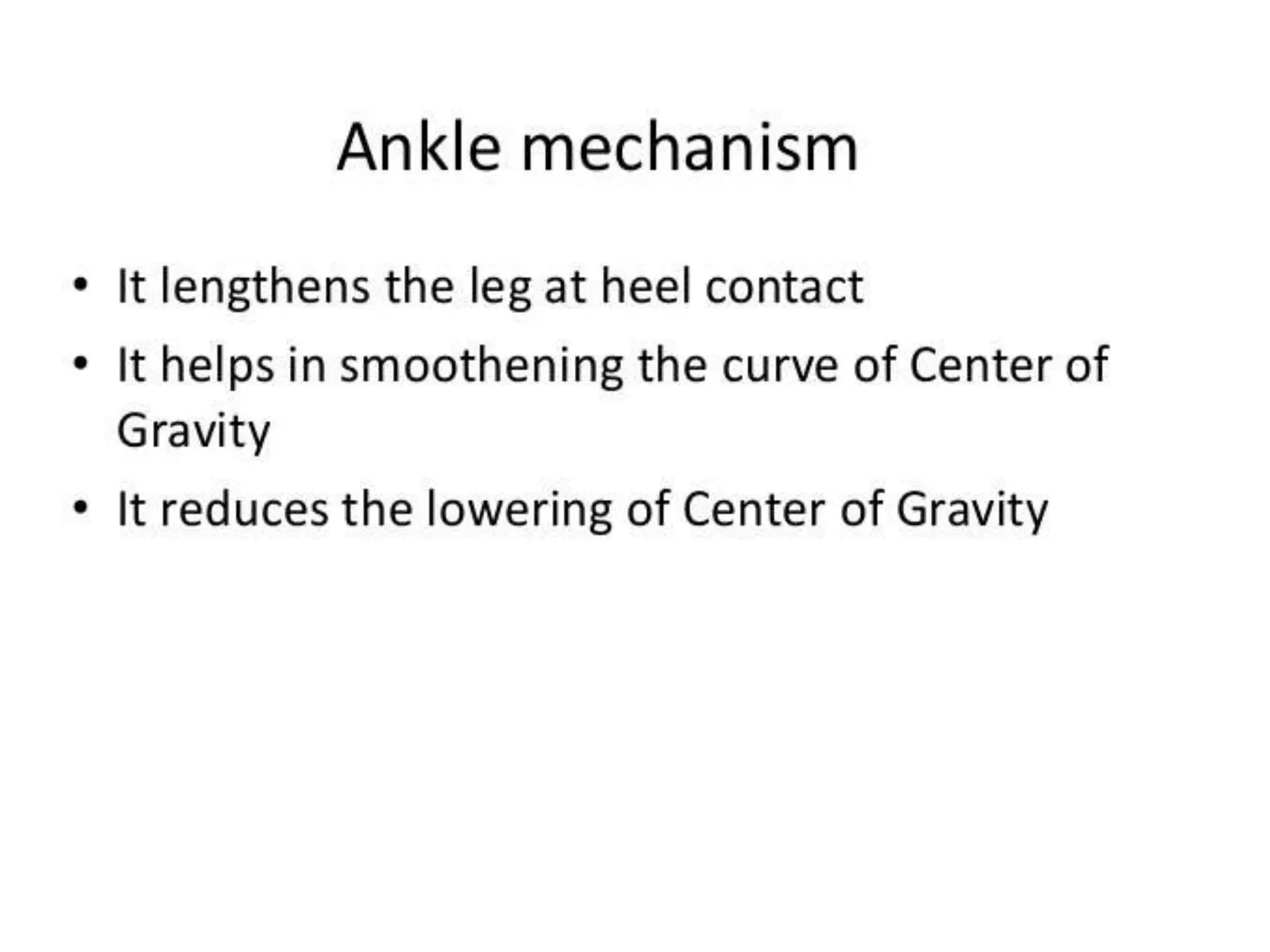
13.Calf Tightening or Contractures
• Calf Tightening or Contractures due to a
period of immobilisation or trauma will cause
reduced heel strike due to restricted
dorsiflexion. The compensated gait result will
be ‘toe walking’ on stance phase, reduced
step length and excessive knee and hip flexion
during swing phase to ensure floor clearance
14.Hallux Rigidus
• Hallux Rigidus results in a lack of dorsiflexion
of the great toe. The MPJ uses the windlass
effect to raise the arch and stiffen the foot
during dorsiflexion of the hallux. This stiffness
increases the efficiency of the propulsion
portion of the gait cycle. To be efficient in
creating stiffness, the hallux should be able to
dorsiflex at least 65 degrees.
Gait
Gait

Gait

  • 1.
    CHANGES IN GAITDURING ORTHOPAEDICS CONDITION • DR. AKSHITA (PT)
  • 2.
    • Gait isstyle , manner or a pattern of walking. • Walking pattern may differ from individual to individual
  • 3.
    Definition • Locomotion orGait – It is defined as a translatory progression of the body as a whole produce by coordinated, rotatory movements of body segments. • Normal Gait – It is a rhythmic & characterized by alternating propulsive & retropulsive motions of the lower extremities.
  • 4.
    Aim of Walking To move the body forward and backward. It is towards a desired location speed and direction. To use energy. The body does this by moving in straight line. Sufficient energy is generated through up and down movement To cause least amount of pain for people with painful foot conditions. Our brains have a variety of strategies for achieving this goal, including putting less pressure on a painful foot, or alternating the foot's position when we walk to limit discomfort.
  • 5.
    The foot itselfact as a shock absorber for dispersing the force of the body as it lands. To form a rigid lever toward the end of the phase of gait where the foot is on the ground, in order to provide a way to propel the body forward.
  • 6.
    KINEMATICS • Gait isextremely complex activity to analyze. Therefore , it has been divide in number of segments thatbmakes it possible to identify the events that are occurring. • Generally , gait is described by using the activities of one lower extremity from beginning to the end of one gait cycle.
  • 7.
    Phases of gaitcycle • The gait cycle includes the activities that occur from one point of initial contact of one lower extremity to the point at which the same extremity contacts the ground again.
  • 12.
    Subdivision of phases •Stance phase – Heel strike – Foot flat – Mid-stance – Heel off – Toe off • Swing phase – Acceleration – Mid-swing – Deceleration
  • 14.
    Stance phase • Thephase begins at instant that one lower extremity contacts the ground (HEEL STRIKE) and continues only as long as some portion of foot is in contact with the ground (TOE OFF). • It makes up approx 60% of gait cycle during normal walking.
  • 16.
  • 17.
  • 28.
    Swing phase • Theswing phase begins as soon as the toe of one extremity leaves the ground and ceases just before heel strike or contact of same extremity.
  • 30.
  • 60.
    Pathologic Gait • Pathologicgait results from impaired strength, range of motion, proprioception, pain, or balance combined with mechanical compensations, and can have musculoskeletal and neuromuscular etiologies.
  • 61.
  • 62.
    1.Antalgic gait • Causes: Painwith weight bearing. • Pathomechanism: Weight bearing avoided on painful limb. Decreased step length of uninvolved side. • Treatment: treat underlying cause, analgesia, assistive device (AD) in contralateral hand.
  • 63.
    2.Leg length discrepancy(LLD) • Causes: True or apparent leg length discrepancy. • Pathomechanism: Shortened side: pelvic drop, decreased hip and knee flexion, ankle plantar flexion (vaulting, toe walking). • Lengthened side: hip hiking, circumduction, excessive hip and knee flexion (steppage gait), foot hyperpronation.
  • 64.
    • Treatment: For<2cm: no treatment. For >2cm: shoe lift or consider surgery. Lift <2cm inside shoe, >2cm outside shoe. Surgical options: shortening surgery (epiphysiodesis or femoral shortening), lengthening surgery (femur/tibia), correction muscle or joint contracture.
  • 67.
  • 68.
    3.Arthritis • Arthritis isa common cause of pathological gait. An arthritic hip has reduced range of movement during swing phase which causes an exaggeration of movement in the opposite limb ‘hip hiking’.
  • 72.
    4.Excessive Hip Flexion ExcessiveHip Flexion can significantly alter gait pattern. Cause : • Hip flexion contractures • IT band contractures, • Hip flexor spasticity, • • Compensation for excessive knee flexion and ankle DF, • Hip pain • Compensation for excess ankle plantar flexion in mid swing.
  • 73.
    • The deviationof stance phase will occur mainly on the affected side. The result is forward tilt of the trunk and increased demand on the hip extensors or increased lordosis of the spine with anterior pelvic tilt. A person with reduced spinal mobility will adopt a forward flexion position in order to alter their centre of gravity permanently during gait.
  • 74.
    5.Hip Adductor Contracture •During swing phase the leg crosses mid line due to the weak adductor muscles, this is known as ‘scissor gait’
  • 76.
  • 77.
    • Drop ofpelvis on the unaffected side. • Pathomechanism: Compensated gait causes the trunk to leans toward the affected side. • Treatment: AD in contralateral hand, gluteus medius strengthening.
  • 79.
    7.Hip extensor weakness(Posterior lurch gait) • Backward trunk lean with hyperextended hip during stance phase of affected limb. • Pathomechanism: Use of iliofemoral ligament to lock hip in extension to prevent trunk falling forward. • Treatment: Strengthen gluteus maximus. Keep compensatory mechanism, do not fix lumbar hyperlordosis
  • 81.
  • 82.
    8.Weak Quadriceps. • Thequadriceps role is to eccentrically control the knee during flexion through the stance phase. • If these muscles are weak the hip extensors will compensate by bringing the limb back into a more extended position, reducing the amount of flexion at the knee during stance phase. • Alternatively heel strike will occur earlier increasing the ankle of plantar flexion at the ankle,
  • 83.
    preventing the forwardmovement of the tibia, to help stabilise the knee joint. • Normally, during early stance as weight is being shifted onto the stance leg, the line of force falls behind the knee requiring quad contraction to prevent buckling of knee. • With quad weakness, patient leans forward at hip, causing COG to be shifted forward so line of force falls anterior to knee, forcing it into extension
  • 85.
    9.Knee extensor tightness •Knee buckling (uncompensated), genu recurvatum (compensated).
  • 87.
    • Pathomechanism: Posteriorcapsule locks affected knee joint, hyperextending knee by forward trunk leaning.
  • 88.
    Excessive knee extensionin stance • Causes: – Weak, short, or spastic quadriceps – Compensated hamstring weakness – Plantar- flexor spasticity – Achilles tendon contracture • Treatment (examples): – Manage plantar- flexor tone, bracing, stretching, strengthening
  • 90.
  • 91.
    • Knee FlexionContraction will cause a limping type gait pattern. The knee is restricted in extension, meaning heel strike is limited and step length reduced. To compensate the person is likely to ‘toe walk’ during stance phase. Knee flexion contractures of more than 30 degrees will be obvious during normal paced gait. Contractures less then this will be more evident with increased speeds
  • 93.
  • 94.
  • 95.
    • Pathomechanism: Unableto heel strike, leading to initial contact with toes. Incomplete lesion still has heel strike but unable to control transition to foot flat causing “foot slap.” During the swing phase, toes may drag/catch. Compensatory is “steppage gait” with excessive hip and knee flexion or body shift to clear foot.
  • 96.
    • Treatment: Posteriorleaf spring AFO or hinged AFO with dorsiflexion assist or plantar flexion stop for mediolateral instability. Role of electrical stimulation (ES) to prevent atrophy of anterior tibialis and/or functional ES (FES) to activate ankle dorsiflexor.
  • 98.
    12.Ankle Plantar FlexorWeakness (Calcaneal gait):
  • 99.
    • Pathomechanism: Lackof eccentric contraction of ankle plantar flexor causes GRF to pass behind knee, creating knee flexion moment with excess tibial motion over ankle during mid to late stance. Increased quadriceps contraction needed to prevent knee buckling. Contralateral leg step length (swing duration) reduced by unstable stance of affected limb. Heel off delayed and push off phase decreased.
  • 100.
    • Treatment: HingedAFO with dorsiflexion stop or solid AFO set at few degrees plantar flexion to pass GRF anterior to knee to prevent buckling.
  • 101.
  • 102.
    • Calf Tighteningor Contractures due to a period of immobilisation or trauma will cause reduced heel strike due to restricted dorsiflexion. The compensated gait result will be ‘toe walking’ on stance phase, reduced step length and excessive knee and hip flexion during swing phase to ensure floor clearance
  • 103.
  • 104.
    • Hallux Rigidusresults in a lack of dorsiflexion of the great toe. The MPJ uses the windlass effect to raise the arch and stiffen the foot during dorsiflexion of the hallux. This stiffness increases the efficiency of the propulsion portion of the gait cycle. To be efficient in creating stiffness, the hallux should be able to dorsiflex at least 65 degrees.