VOLKMANN¶S
ISCHEMICCONTRACTURECONTRACT
UR
VOLKMANN’S ISCHEMIC CONTRACTURE
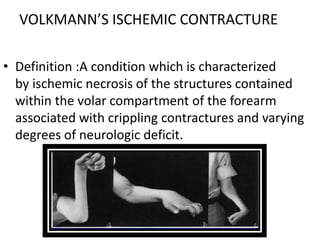
• Definition :A condition which is characterized
by ischemic necrosis of the structures contained
within the volar compartment of the forearm
associated with crippling contractures and varying
degrees of neurologic deficit.
• HISTORY
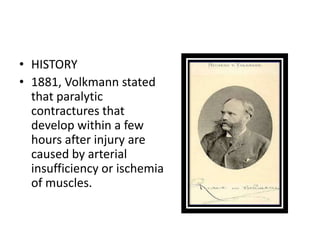
• 1881, Volkmann stated
that paralytic
contractures that
develop within a few
hours after injury are
caused by arterial
insufficiency or ischemia
of muscles.
• HISTORY
• 1906,Hildebrand first used the term
"Volkmann ischemic contracture“ to describe the final
result of any untreated compartment syndrome.
• 1909, Thomas found that paralytic contractures
followed severe contusions of the forearm without
fractures.
• 1914, Murphy reported that increased internal
pressures in the deep compartments of the forearm
and effusion in the muscles resulted in ischemia.
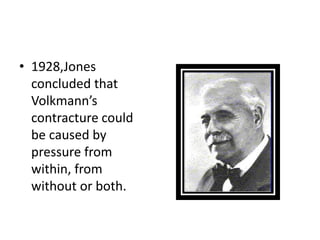
• 1928,Jones
concluded that
Volkmann’s
contracture could
be caused by
pressure from
within, from
without or both.
• Volkmann’s ischemic
contracture is a late
sequelae of untreated
or inadequately
treated compartment
syndrome in which
necrotic muscle and
nerve tissue are
replaced with fibrous
tissue .
ANATOMY
• At the entrance to the
flexor compartment of
the forearm , lacertus
fibrosus fans medially
from the biceps tendon.
• Beneath the lacertus
fibrosus the brachial
artery and median
nerve pass to enter the
flexor compartment.
ANATOMY
• The brachial artery divides into
radialand ulnar arteries.
• The radial artery courses
superficially and is not crossed by
any structure in the forearm.
• The ulnar artery passes beneath
the pronator teres where it gives
a branch, the common
interosseus artery.
• The common interosseus artery
further divides into volar and
dosal interosseus arteries.
ANATOMY
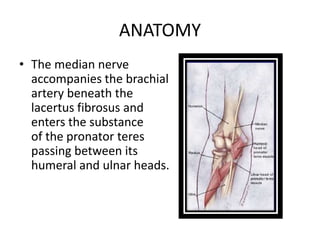
• The median nerve
accompanies the brachial
artery beneath the
lacertus fibrosus and
enters the substance
of the pronator teres
passing between its
humeral and ulnar heads.
ANATOMY
• Compartments of the
forearm.
• 1. Superficial
volar compartment.
• 2. Deep volar
compartment.
• 3. Dorsal compartment.
• 4. Mobile wad of Henry.
ETIOLOGY
• Supracondylar
fractures of the
humerus in children is
the most common
precipitating injury.
• The brachial artery may
get impinged on the
sharp proximal
fragment against which
it is held by lacertus
fibrosus.
ETIOLOGY
• Hemorrhage and
edema may further
compress the brachial
artery and the median
nerve in this region.
ETIOLOGY
• Ischemia ±± Edema cycle as depicted by Eaton
and Green
ETIOLOGY
• 1. Crush injuries.
• 2. Prolonged external
compression.
• 3. Internal bleeding
(Hemophilia).
• 4. Burns.
• 5. Snake bites.
• 6. Intravenous regional
anesthesia
TOLERANCE OF TISSUE
• 1. Muscle :-
• Functional impairment after
2-4 hours of ischemia.
• Irreversible functional loss
after 4-12 hours.
• 2. Nerves :-
• Functional impairment after
30 mins of ischemia.
• Irreversible function loss
after 12-24 hrs.
CLINICAL PICTURE
• Acute compartment syndrome
(Impending Volkmann’s
ischemic contracture)
• 1. If local compression is the
cause :
• Pulses intact ( in early stages)
• Paresis
• Stretch pain
• Parasthesia (median nerve
sensory zone commonly)
• Good capillary filling.
CLINICAL PICTURE
• Acute
compartmentsyndrome
(Impending
Volkmann’s ischemic
contracture)
• 2. If arterial injury is the
cause :
• Stretch pain
• Parasthesia
• Pulselessness
• Pallor ( or Cyanosis)
• Paresis
CLINICAL PICTURE
• Two point
discrimination is more
than 1 cm in in the
sensory zone of the
median nerve.
• Diminished perception
of vibratory sense of
256cycles/sec
stimulus.
CLINICAL PICTURE
• Measurement
of intracompatmental
pressure :
• 1. White sides
handheld pressure
monitoring system.
• 2. Wick catheter.
• 3. Slit catheter.
CLINICAL PICTURE
• Evaluating the intracompartmental pressure.
• Range between 10 ± 20 mmHg below the
diastolic pressure - cessation of blood flow is
eminent.
• 40± 50 mmHg - muscle threatening compression
and ischemia are present.
• Pressure of 30 mmHg or greater - criterion
for fasciotomy.
Deformities in Volkmann’s ischemic
contracture
• Mild type :
• Deep flexors are partially
involved particularly,
Flexor digitorum profundus.
• Flexion contractures of one
or more fingers which can be
extended on hyperflexing
the wrist.
• Resistant pronation
contracture involving either
the pronator teres or
pronator quadratus.
Deformities in Volkmann’s ischemic
contracture
• Moderate type :
• Involves most of the
flexor digitorum profundus,
flexor pollicis longus and part
of flexor digitorum superficialis.
• Neurological deficit involving
median nerve more than
ulnar nerve is present.
• Deformity is intrinsic minus
hand.
• Diminished sensations in
median and ulnar nerve zones.
Deformities in Volkmann’s ischemic
contracture
• Severe type :
• All the flexor muscles are
involved.
• Neurological deficit is
severe.
• Joint contractures are
marked.
• Wasting of forearm
muscles .
MANAGEMENT - ACUTE COMPARTMENT
SYNDROME (IMPENDING VIC)
MANAGEMENT - ACUTE COMPARTMENT
SYNDROME (IMPENDING VIC)
• Forearm fasciotomy
• Incision :A volar
curvilinear liberal
incision medial to the
biceps tendon, crossing
the elbow flexion
crease at an angle
carring it distally to the
palm to release the
carpal tunnel.
MANAGEMENT - ACUTE COMPARTMENT
SYNDROME (IMPENDING VIC)
• Exploration must extend deeply
to the FDPand FPL.
• Necrotic muscle tissue is excised.
• Median nerve freed beneath the
lacertus fibrosus.
• Ulnar nerve is freed and
transplanted anteriorly .
• Brachial artery must be inspected
and decompressed .
• Surgical wound is left open
for secondary closure later when
swelling subsibes.
• Extremity supported with splint in
funtional position.
CONSERVATIVE MANAGEMENT
ESTABLISED DEFORMITIES
• Robert Jones
method(1930s).(1930s).
• Wooden tongue
depressors were used to
correct established
deformities gradually
from distal to proximal
over a prolonged period
of time .
CONSERVATIVE MANAGEMENT
ESTABLISED DEFORMITIES
• Banjo splint :
• Banjo splint used
with rubber bands
fastened to adhesive
tape on the fingers
permits the fingers to
be exercised at all
times and is most
efficient.
ESTABLISHED VOLKMANN’S ISCHEMIC
CONTRACTURE- MANAGEMENT
• Muscle sliding operation of flexors of forearm.
• Inglis & Cooper
• Williams & Haddad
INGLIS & COOPER
• Incision on the medial aspect of volar side of
the arm 5 cm proximal to medial
epicondyle and distally to midpoint of forearm
over the ulna.
INGLIS & COOPER
• Ulnar nerve is identified, released from the cubital tunnel and
protected.
• Tendinous origins of muscles on the medial epicondyle are cut.
• Flexor carpi ulnaris and Flexor digitorum profundus are completely
released from the medial epicondyle and ulna.
INGLIS & COOPER
• Lacertus fibrosus is divided along with any
remaining portions of the flexor muscle origin.
• Ulnar nerve is trasposed anteriorly.
WILLIAMS & HADDAD
• Medial aspect of arm and forearm anterior to the medial
epicondyle of the humerus, beginning 5 cm proximal to the
elbow extending distally to 5cm proximal to the elbow
extending distally to 5cm proximal to the wrist.
WILLIAMS & HADDAD
• Structures anterior and medial to the elbow
are exposed.
WILLIAMS & HADDAD
• Lacertus fibrosus is divided.
• Origins of the superficial flexors are released from the
medial epicondyle.
• Origin of flexor digitorum superficialis is released from
radius.
WILLIAMS & HADDAD
• Origin of Flexor carpi ulnaris is released from
olecronon.
• Common origin of flexor carpi ulnaris and
flexor digitorum profundus are released from ulna.
WILLIAMS & HADDAD
• Origin of flexor digitorum profundus is
released from volar aspect of ulna and
interosseous membrane.
WILLIAMS & HADDAD
• Origin of flexor digitorum profundus to the
index finger is released from radius.
WILLIAMS & HADDAD
• Ulnar nerve is transplanted anteriorly into
brachialis muscle.
AFTER SURGERY
• Sutures are removed after 3 weeks.
• Extension hand splint should be worn for 3
months.
• Occupation and physiotherapy should be
continued until desirable function is attained.
Volkmann¶s ischemic contracture

Volkmann¶s ischemic contracture

  • 1.
  • 2.
    VOLKMANN’S ISCHEMIC CONTRACTURE •Definition :A condition which is characterized by ischemic necrosis of the structures contained within the volar compartment of the forearm associated with crippling contractures and varying degrees of neurologic deficit.
  • 3.
    • HISTORY • 1881,Volkmann stated that paralytic contractures that develop within a few hours after injury are caused by arterial insufficiency or ischemia of muscles.
  • 4.
    • HISTORY • 1906,Hildebrandfirst used the term "Volkmann ischemic contracture“ to describe the final result of any untreated compartment syndrome. • 1909, Thomas found that paralytic contractures followed severe contusions of the forearm without fractures. • 1914, Murphy reported that increased internal pressures in the deep compartments of the forearm and effusion in the muscles resulted in ischemia.
  • 5.
    • 1928,Jones concluded that Volkmann’s contracturecould be caused by pressure from within, from without or both.
  • 6.
    • Volkmann’s ischemic contractureis a late sequelae of untreated or inadequately treated compartment syndrome in which necrotic muscle and nerve tissue are replaced with fibrous tissue .
  • 7.
    ANATOMY • At theentrance to the flexor compartment of the forearm , lacertus fibrosus fans medially from the biceps tendon. • Beneath the lacertus fibrosus the brachial artery and median nerve pass to enter the flexor compartment.
  • 8.
    ANATOMY • The brachialartery divides into radialand ulnar arteries. • The radial artery courses superficially and is not crossed by any structure in the forearm. • The ulnar artery passes beneath the pronator teres where it gives a branch, the common interosseus artery. • The common interosseus artery further divides into volar and dosal interosseus arteries.
  • 9.
    ANATOMY • The mediannerve accompanies the brachial artery beneath the lacertus fibrosus and enters the substance of the pronator teres passing between its humeral and ulnar heads.
  • 10.
    ANATOMY • Compartments ofthe forearm. • 1. Superficial volar compartment. • 2. Deep volar compartment. • 3. Dorsal compartment. • 4. Mobile wad of Henry.
  • 11.
    ETIOLOGY • Supracondylar fractures ofthe humerus in children is the most common precipitating injury. • The brachial artery may get impinged on the sharp proximal fragment against which it is held by lacertus fibrosus.
  • 12.
    ETIOLOGY • Hemorrhage and edemamay further compress the brachial artery and the median nerve in this region.
  • 13.
    ETIOLOGY • Ischemia ±±Edema cycle as depicted by Eaton and Green
  • 14.
    ETIOLOGY • 1. Crushinjuries. • 2. Prolonged external compression. • 3. Internal bleeding (Hemophilia). • 4. Burns. • 5. Snake bites. • 6. Intravenous regional anesthesia
  • 15.
    TOLERANCE OF TISSUE •1. Muscle :- • Functional impairment after 2-4 hours of ischemia. • Irreversible functional loss after 4-12 hours. • 2. Nerves :- • Functional impairment after 30 mins of ischemia. • Irreversible function loss after 12-24 hrs.
  • 16.
    CLINICAL PICTURE • Acutecompartment syndrome (Impending Volkmann’s ischemic contracture) • 1. If local compression is the cause : • Pulses intact ( in early stages) • Paresis • Stretch pain • Parasthesia (median nerve sensory zone commonly) • Good capillary filling.
  • 17.
    CLINICAL PICTURE • Acute compartmentsyndrome (Impending Volkmann’sischemic contracture) • 2. If arterial injury is the cause : • Stretch pain • Parasthesia • Pulselessness • Pallor ( or Cyanosis) • Paresis
  • 18.
    CLINICAL PICTURE • Twopoint discrimination is more than 1 cm in in the sensory zone of the median nerve. • Diminished perception of vibratory sense of 256cycles/sec stimulus.
  • 19.
    CLINICAL PICTURE • Measurement ofintracompatmental pressure : • 1. White sides handheld pressure monitoring system. • 2. Wick catheter. • 3. Slit catheter.
  • 20.
    CLINICAL PICTURE • Evaluatingthe intracompartmental pressure. • Range between 10 ± 20 mmHg below the diastolic pressure - cessation of blood flow is eminent. • 40± 50 mmHg - muscle threatening compression and ischemia are present. • Pressure of 30 mmHg or greater - criterion for fasciotomy.
  • 21.
    Deformities in Volkmann’sischemic contracture • Mild type : • Deep flexors are partially involved particularly, Flexor digitorum profundus. • Flexion contractures of one or more fingers which can be extended on hyperflexing the wrist. • Resistant pronation contracture involving either the pronator teres or pronator quadratus.
  • 22.
    Deformities in Volkmann’sischemic contracture • Moderate type : • Involves most of the flexor digitorum profundus, flexor pollicis longus and part of flexor digitorum superficialis. • Neurological deficit involving median nerve more than ulnar nerve is present. • Deformity is intrinsic minus hand. • Diminished sensations in median and ulnar nerve zones.
  • 23.
    Deformities in Volkmann’sischemic contracture • Severe type : • All the flexor muscles are involved. • Neurological deficit is severe. • Joint contractures are marked. • Wasting of forearm muscles .
  • 24.
    MANAGEMENT - ACUTECOMPARTMENT SYNDROME (IMPENDING VIC)
  • 25.
    MANAGEMENT - ACUTECOMPARTMENT SYNDROME (IMPENDING VIC) • Forearm fasciotomy • Incision :A volar curvilinear liberal incision medial to the biceps tendon, crossing the elbow flexion crease at an angle carring it distally to the palm to release the carpal tunnel.
  • 26.
    MANAGEMENT - ACUTECOMPARTMENT SYNDROME (IMPENDING VIC) • Exploration must extend deeply to the FDPand FPL. • Necrotic muscle tissue is excised. • Median nerve freed beneath the lacertus fibrosus. • Ulnar nerve is freed and transplanted anteriorly . • Brachial artery must be inspected and decompressed . • Surgical wound is left open for secondary closure later when swelling subsibes. • Extremity supported with splint in funtional position.
  • 27.
    CONSERVATIVE MANAGEMENT ESTABLISED DEFORMITIES •Robert Jones method(1930s).(1930s). • Wooden tongue depressors were used to correct established deformities gradually from distal to proximal over a prolonged period of time .
  • 28.
    CONSERVATIVE MANAGEMENT ESTABLISED DEFORMITIES •Banjo splint : • Banjo splint used with rubber bands fastened to adhesive tape on the fingers permits the fingers to be exercised at all times and is most efficient.
  • 29.
    ESTABLISHED VOLKMANN’S ISCHEMIC CONTRACTURE-MANAGEMENT • Muscle sliding operation of flexors of forearm. • Inglis & Cooper • Williams & Haddad
  • 30.
    INGLIS & COOPER •Incision on the medial aspect of volar side of the arm 5 cm proximal to medial epicondyle and distally to midpoint of forearm over the ulna.
  • 31.
    INGLIS & COOPER •Ulnar nerve is identified, released from the cubital tunnel and protected. • Tendinous origins of muscles on the medial epicondyle are cut. • Flexor carpi ulnaris and Flexor digitorum profundus are completely released from the medial epicondyle and ulna.
  • 32.
    INGLIS & COOPER •Lacertus fibrosus is divided along with any remaining portions of the flexor muscle origin. • Ulnar nerve is trasposed anteriorly.
  • 33.
    WILLIAMS & HADDAD •Medial aspect of arm and forearm anterior to the medial epicondyle of the humerus, beginning 5 cm proximal to the elbow extending distally to 5cm proximal to the elbow extending distally to 5cm proximal to the wrist.
  • 34.
    WILLIAMS & HADDAD •Structures anterior and medial to the elbow are exposed.
  • 35.
    WILLIAMS & HADDAD •Lacertus fibrosus is divided. • Origins of the superficial flexors are released from the medial epicondyle. • Origin of flexor digitorum superficialis is released from radius.
  • 36.
    WILLIAMS & HADDAD •Origin of Flexor carpi ulnaris is released from olecronon. • Common origin of flexor carpi ulnaris and flexor digitorum profundus are released from ulna.
  • 37.
    WILLIAMS & HADDAD •Origin of flexor digitorum profundus is released from volar aspect of ulna and interosseous membrane.
  • 38.
    WILLIAMS & HADDAD •Origin of flexor digitorum profundus to the index finger is released from radius.
  • 39.
    WILLIAMS & HADDAD •Ulnar nerve is transplanted anteriorly into brachialis muscle.
  • 40.
    AFTER SURGERY • Suturesare removed after 3 weeks. • Extension hand splint should be worn for 3 months. • Occupation and physiotherapy should be continued until desirable function is attained.