Name - Alwin M Reji
Class – X
Roll - 8
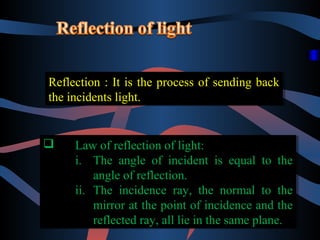
Reflection :: It is the process of sending back
Reflection It is the process of sending back
the incidents light.




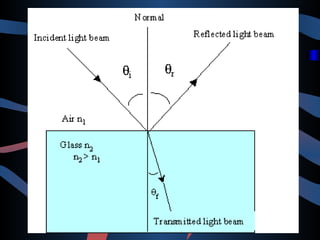
Law of reflection of light:
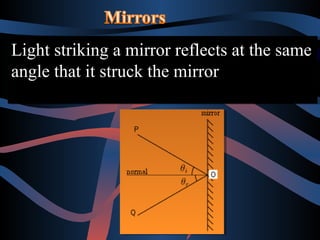
i. The angle of incident is equal to the
angle of reflection.
ii. The incidence ray, the normal to the
mirror at the point of incidence and the
reflected ray, all lie in the same plane.
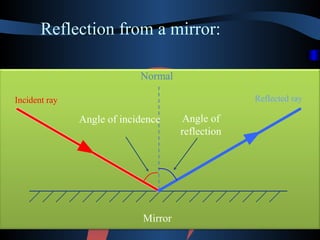
Reflection from a mirror:
Normal
Reflected ray

Incident ray

Angle of incidence

Mirror

Angle of
reflection
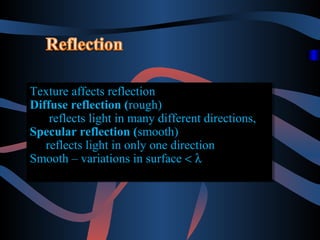
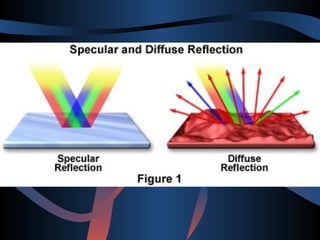
Texture affects reflection
Diffuse reflection (rough)
reflects light in many different directions,
Specular reflection (smooth)
reflects light in only one direction
Smooth – variations in surface < λ
Light striking a mirror reflects at the same
angle that it struck the mirror
 These law of reflection are applicable to all type of
reflecting surfaces including spherical surface.
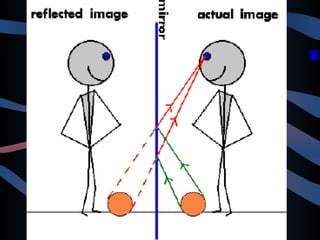
 Image formed by a plane mirror is always virtual and
erect. The size of the image is equal to that of the
object. The image formed is as far behind the mirror as
the object is in front of it. It is laterally inverted, i.e.,
the image is inverted sideways
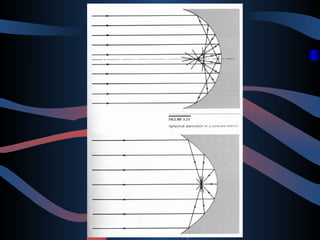
A spherical mirror, whose reflection surface is
curved inwards is called a concave mirror and the
one whose reflecting surface is curved outwards is
called a convex mirror.
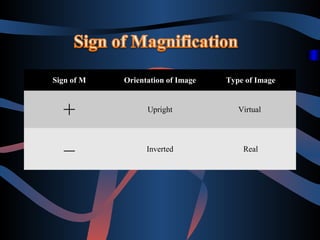
Sign of M

Orientation of Image

Type of Image

+

Upright

Virtual

–

Inverted

Real
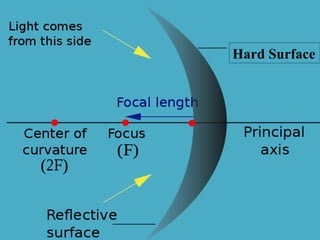
•• A ray traveling through C will reflect back
A ray traveling through C will reflect back
through C
through C
•• A ray traveling through (f) will reflect parallel to
A ray traveling through (f) will reflect parallel to
the PA
the PA
•• A ray traveling to the intersection of the PA and
A ray traveling to the intersection of the PA and
the mirror will reflect at the same angle below the
PA.
PA.
•• A ray traveling parallel to PA will reflect through
A ray traveling parallel to PA will reflect through
the focal point
the focal point
Hard Surface
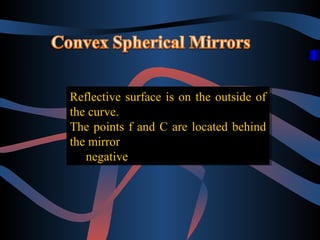
Reflective surface is on the outside of
the curve.
the curve.
The points ff and C are located behind
The points and C are located behind
the mirror
the mirror
negative
negative
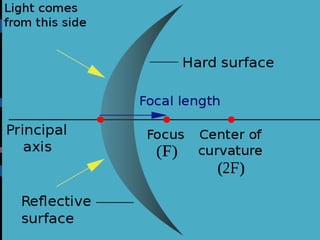
A ray parallel to the PA will reflect directly away
from f.
from f.
A ray towards ff will reflect parallel to the PA
A ray towards will reflect parallel to the PA
A ray towards C will reflect directly away from C.
A ray to the intersection of PA and mirror will
reflect at the same angle below the OA.
Trace the 3 diverging lines back through the mirror
to reveal the location of the image which is always
virtual
virtual
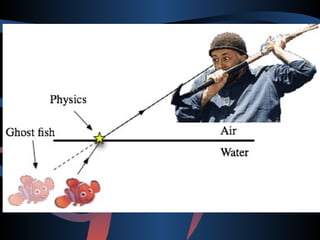
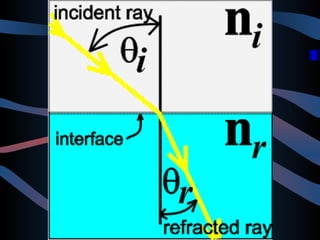
When a ray of light travels obliquely one medium to
another, the direction of propagation of light in the
second medium changes. This phenomenon is
known as refraction of light.
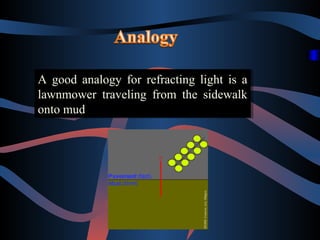
A good analogy for refracting light is a
lawnmower traveling from the sidewalk
onto mud
onto mud
The speed of light is different in different media.
i.e., refraction is due to change in the speed of light
on going from one medium to another.
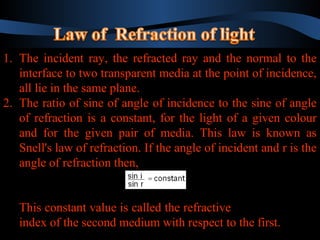
1. The incident ray, the refracted ray and the normal to the
interface to two transparent media at the point of incidence,
all lie in the same plane.
2. The ratio of sine of angle of incidence to the sine of angle
of refraction is a constant, for the light of a given colour
and for the given pair of media. This law is known as
Snell's law of refraction. If the angle of incident and rr is the
Snell's law of refraction. If the angle of incident and is the
angle of refraction then,
This constant value is called the refractive
index of the second medium with respect to the first.
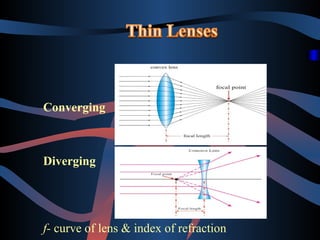
Converging

Diverging

f- curve of lens & index of refraction
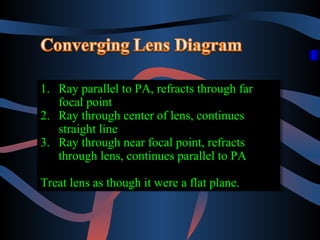
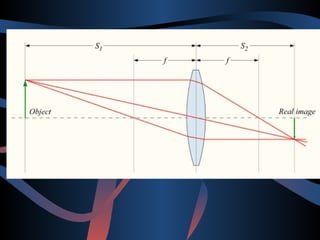
1. Ray parallel to PA, refracts through far
focal point
focal point
2. Ray through center of lens, continues
straight line
straight line
3. Ray through near focal point, refracts
through lens, continues parallel to PA
Treat lens as though it were a flat plane.
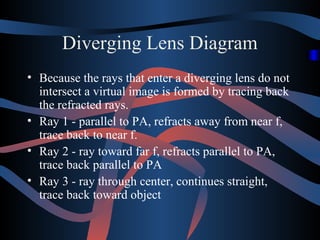
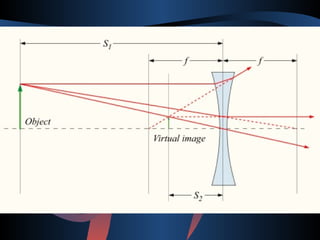
Diverging Lens Diagram
• Because the rays that enter a diverging lens do not
intersect a virtual image is formed by tracing back
the refracted rays.
• Ray 1 - parallel to PA, refracts away from near f,
trace back to near f.
• Ray 2 - ray toward far f, refracts parallel to PA,
trace back parallel to PA
• Ray 3 - ray through center, continues straight,
trace back toward object
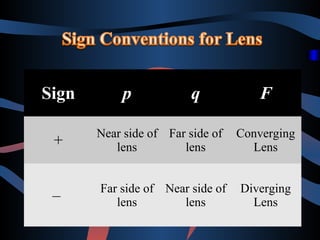
Sign
+
–

p

q

Near side of Far side of
lens
lens
Far side of Near side of
lens
lens

F
Converging
Lens
Diverging
Lens
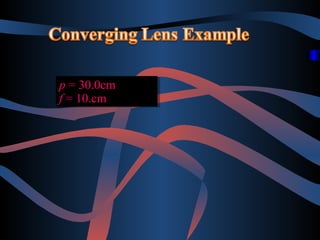
p = 30.0cm
p = 30.0cm
ff = 10.cm
= 10.cm
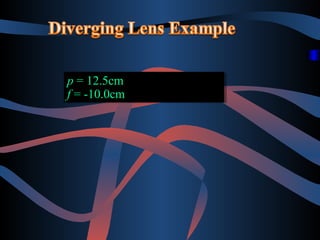
p = 12.5cm
p = 12.5cm
ff = -10.0cm
= -10.0cm
Ligth reflection and refraction

Ligth reflection and refraction

  • 1.
    Name - AlwinM Reji Class – X Roll - 8
  • 2.
    Reflection :: Itis the process of sending back Reflection It is the process of sending back the incidents light. the incidents light.   Law of reflection of light: Law of reflection of light: i. The angle of incident is equal to the i. The angle of incident is equal to the angle of reflection. angle of reflection. ii. The incidence ray, the normal to the ii. The incidence ray, the normal to the mirror at the point of incidence and the mirror at the point of incidence and the reflected ray, all lie in the same plane. reflected ray, all lie in the same plane.
  • 3.
    Reflection from amirror: Normal Reflected ray Incident ray Angle of incidence Mirror Angle of reflection
  • 4.
    Texture affects reflection Textureaffects reflection Diffuse reflection (rough) Diffuse reflection (rough) reflects light in many different directions, reflects light in many different directions, Specular reflection (smooth) Specular reflection (smooth) reflects light in only one direction reflects light in only one direction Smooth – variations in surface < λ Smooth – variations in surface < λ
  • 6.
    Light striking amirror reflects at the same Light striking a mirror reflects at the same angle that it struck the mirror angle that it struck the mirror
  • 8.
     These lawof reflection are applicable to all type of  These law of reflection are applicable to all type of reflecting surfaces including spherical surface. reflecting surfaces including spherical surface.  Image formed by a plane mirror is always virtual and  Image formed by a plane mirror is always virtual and erect. The size of the image is equal to that of the erect. The size of the image is equal to that of the object. The image formed is as far behind the mirror as object. The image formed is as far behind the mirror as the object is in front of it. It is laterally inverted, i.e., the object is in front of it. It is laterally inverted, i.e., the image is inverted sideways the image is inverted sideways
  • 9.
    A spherical mirror,whose reflection surface is A spherical mirror, whose reflection surface is curved inwards is called a concave mirror and the curved inwards is called a concave mirror and the one whose reflecting surface is curved outwards is one whose reflecting surface is curved outwards is called a convex mirror. called a convex mirror.
  • 10.
    Sign of M Orientationof Image Type of Image + Upright Virtual – Inverted Real
  • 11.
    •• A raytraveling through C will reflect back A ray traveling through C will reflect back through C through C •• A ray traveling through (f) will reflect parallel to A ray traveling through (f) will reflect parallel to the PA the PA •• A ray traveling to the intersection of the PA and A ray traveling to the intersection of the PA and the mirror will reflect at the same angle below the the mirror will reflect at the same angle below the PA. PA. •• A ray traveling parallel to PA will reflect through A ray traveling parallel to PA will reflect through the focal point the focal point
  • 13.
  • 14.
    Reflective surface ison the outside of Reflective surface is on the outside of the curve. the curve. The points ff and C are located behind The points and C are located behind the mirror the mirror negative negative
  • 16.
    A ray parallelto the PA will reflect directly away A ray parallel to the PA will reflect directly away from f. from f. A ray towards ff will reflect parallel to the PA A ray towards will reflect parallel to the PA A ray towards C will reflect directly away from C. A ray towards C will reflect directly away from C. A ray to the intersection of PA and mirror will A ray to the intersection of PA and mirror will reflect at the same angle below the OA. reflect at the same angle below the OA. Trace the 3 diverging lines back through the mirror Trace the 3 diverging lines back through the mirror to reveal the location of the image which is always to reveal the location of the image which is always virtual virtual
  • 17.
    When a rayof light travels obliquely one medium to When a ray of light travels obliquely one medium to another, the direction of propagation of light in the another, the direction of propagation of light in the second medium changes. This phenomenon is second medium changes. This phenomenon is known as refraction of light. known as refraction of light.
  • 18.
    A good analogyfor refracting light is a A good analogy for refracting light is a lawnmower traveling from the sidewalk lawnmower traveling from the sidewalk onto mud onto mud
  • 19.
    The speed oflight is different in different media. The speed of light is different in different media. i.e., refraction is due to change in the speed of light i.e., refraction is due to change in the speed of light on going from one medium to another. on going from one medium to another.
  • 22.
    1. The incidentray, the refracted ray and the normal to the 1. The incident ray, the refracted ray and the normal to the interface to two transparent media at the point of incidence, interface to two transparent media at the point of incidence, all lie in the same plane. all lie in the same plane. 2. The ratio of sine of angle of incidence to the sine of angle 2. The ratio of sine of angle of incidence to the sine of angle of refraction is a constant, for the light of a given colour of refraction is a constant, for the light of a given colour and for the given pair of media. This law is known as and for the given pair of media. This law is known as Snell's law of refraction. If the angle of incident and rr is the Snell's law of refraction. If the angle of incident and is the angle of refraction then, angle of refraction then, This constant value is called the refractive This constant value is called the refractive index of the second medium with respect to the first. index of the second medium with respect to the first.
  • 24.
    Converging Diverging f- curve oflens & index of refraction
  • 25.
    1. Ray parallelto PA, refracts through far 1. Ray parallel to PA, refracts through far focal point focal point 2. Ray through center of lens, continues 2. Ray through center of lens, continues straight line straight line 3. Ray through near focal point, refracts 3. Ray through near focal point, refracts through lens, continues parallel to PA through lens, continues parallel to PA Treat lens as though it were a flat plane. Treat lens as though it were a flat plane.
  • 27.
    Diverging Lens Diagram •Because the rays that enter a diverging lens do not intersect a virtual image is formed by tracing back the refracted rays. • Ray 1 - parallel to PA, refracts away from near f, trace back to near f. • Ray 2 - ray toward far f, refracts parallel to PA, trace back parallel to PA • Ray 3 - ray through center, continues straight, trace back toward object
  • 29.
    Sign + – p q Near side ofFar side of lens lens Far side of Near side of lens lens F Converging Lens Diverging Lens
  • 30.
    p = 30.0cm p= 30.0cm ff = 10.cm = 10.cm
  • 31.
    p = 12.5cm p= 12.5cm ff = -10.0cm = -10.0cm