CRITICAL ANGLE
AND TOTAL
INTERNAL
REFLECTION
CONCEPTS UNDER THIS TOPIC
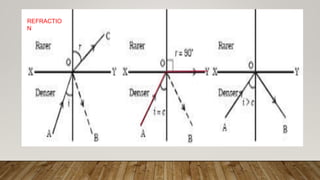
 Transmission of light from a denser medium to a rarer medium at different angles of incidence .
 Critical angle .
 Relation between the critical angle and the refractive index .
 Factors affecting the critical angle .
 Total internal reflection
 Total internal reflection in a prism .
 Consequences of total internal reflection .
REFRACTIO
N
CRITICAL ANGLE
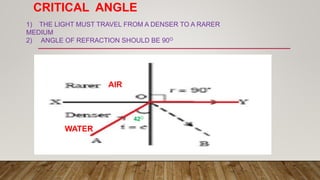
1) THE LIGHT MUST TRAVEL FROM A DENSER TO A RARER
MEDIUM
2) ANGLE OF REFRACTION SHOULD BE 90O
WATER
AIR
42O
FACTORS AFFECTING THE CRITICAL
ANGLE
1) Dependence on colour of light : Critical angle increases with increase in wavelength
of light.
red light have more critical angle
violet light have less critical angle
2) Dependence on temperature : Critical angle increases with increase in temperature.
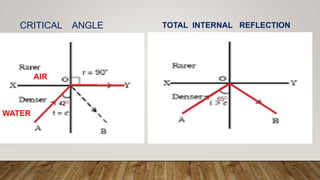
AIR
WATER
42O
65O
CRITICAL ANGLE TOTAL INTERNAL REFLECTION
TOTAL INTERNAL REFLECTION
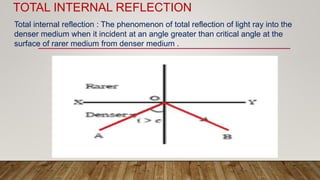
Total internal reflection : The phenomenon of total reflection of light ray into the
denser medium when it incident at an angle greater than critical angle at the
surface of rarer medium from denser medium .
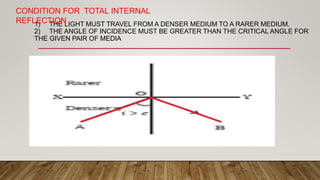
1) THE LIGHT MUST TRAVEL FROM A DENSER MEDIUM TO A RARER MEDIUM.
2) THE ANGLE OF INCIDENCE MUST BE GREATER THAN THE CRITICAL ANGLE FOR
THE GIVEN PAIR OF MEDIA
CONDITION FOR TOTAL INTERNAL
REFLECTION
.
• NOTE: In the process of total internal reflection 100% energy is reflected back.
No other device such as plane mirror produces 100% reflection due to absorption
and refraction of some part of light. Due to this property the phenomenon of total
internal reflection is used in the construction of periscope, binocular, and certain
types of camera in which a total reflecting prism replaces a plane mirror for the
reflection of light.
TOTAL INTERNAL REFLECTION IN A PRISM
1) Total internal reflection through a 45º, 90º, 45º prism(right angled isosceles
prism)
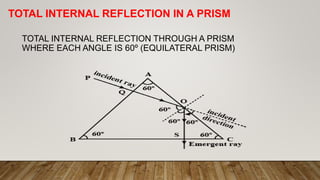
2) TOTAL INTERNAL REFLECTION THROUGH A PRISM WHERE EACH ANGLE IS 60º
(EQUILATERAL PRISM)
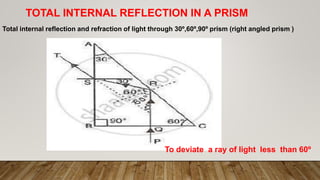
3) Total internal reflection and refraction of light through 30º,60º,90º prism (right
angled prism )
TOTAL INTERNAL REFLECTION IN A PRISM
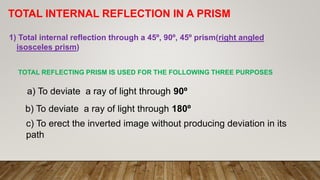
1) Total internal reflection through a 45º, 90º, 45º prism(right angled
isosceles prism)
TOTAL REFLECTING PRISM IS USED FOR THE FOLLOWING THREE PURPOSES
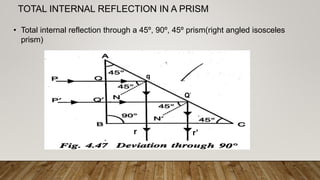
a) To deviate a ray of light through 90º
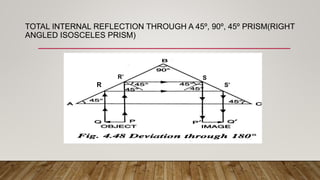
b) To deviate a ray of light through 180º
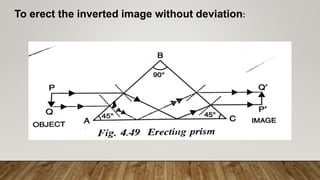
c) To erect the inverted image without producing deviation in its
path
TOTAL INTERNAL REFLECTION IN A PRISM
• Total internal reflection through a 45º, 90º, 45º prism(right angled isosceles
prism)
’
q
Q’
r r’
TOTAL INTERNAL REFLECTION THROUGH A 45º, 90º, 45º PRISM(RIGHT
ANGLED ISOSCELES PRISM)
R
R’ S
S’
To erect the inverted image without deviation:
TOTAL INTERNAL REFLECTION THROUGH A PRISM
WHERE EACH ANGLE IS 60º (EQUILATERAL PRISM)
TOTAL INTERNAL REFLECTION IN A PRISM
Total internal reflection and refraction of light through 30º,60º,90º prism (right angled prism )
TOTAL INTERNAL REFLECTION IN A PRISM
To deviate a ray of light less than 60º
critical angle and total internal reflection

critical angle and total internal reflection

  • 1.
  • 2.
    CONCEPTS UNDER THISTOPIC  Transmission of light from a denser medium to a rarer medium at different angles of incidence .  Critical angle .  Relation between the critical angle and the refractive index .  Factors affecting the critical angle .  Total internal reflection  Total internal reflection in a prism .  Consequences of total internal reflection .
  • 3.
  • 4.
    CRITICAL ANGLE 1) THELIGHT MUST TRAVEL FROM A DENSER TO A RARER MEDIUM 2) ANGLE OF REFRACTION SHOULD BE 90O WATER AIR 42O
  • 5.
    FACTORS AFFECTING THECRITICAL ANGLE 1) Dependence on colour of light : Critical angle increases with increase in wavelength of light. red light have more critical angle violet light have less critical angle 2) Dependence on temperature : Critical angle increases with increase in temperature.
  • 7.
  • 8.
    TOTAL INTERNAL REFLECTION Totalinternal reflection : The phenomenon of total reflection of light ray into the denser medium when it incident at an angle greater than critical angle at the surface of rarer medium from denser medium .
  • 9.
    1) THE LIGHTMUST TRAVEL FROM A DENSER MEDIUM TO A RARER MEDIUM. 2) THE ANGLE OF INCIDENCE MUST BE GREATER THAN THE CRITICAL ANGLE FOR THE GIVEN PAIR OF MEDIA CONDITION FOR TOTAL INTERNAL REFLECTION
  • 10.
    . • NOTE: Inthe process of total internal reflection 100% energy is reflected back. No other device such as plane mirror produces 100% reflection due to absorption and refraction of some part of light. Due to this property the phenomenon of total internal reflection is used in the construction of periscope, binocular, and certain types of camera in which a total reflecting prism replaces a plane mirror for the reflection of light.
  • 11.
    TOTAL INTERNAL REFLECTIONIN A PRISM 1) Total internal reflection through a 45º, 90º, 45º prism(right angled isosceles prism) 2) TOTAL INTERNAL REFLECTION THROUGH A PRISM WHERE EACH ANGLE IS 60º (EQUILATERAL PRISM) 3) Total internal reflection and refraction of light through 30º,60º,90º prism (right angled prism )
  • 12.
    TOTAL INTERNAL REFLECTIONIN A PRISM 1) Total internal reflection through a 45º, 90º, 45º prism(right angled isosceles prism) TOTAL REFLECTING PRISM IS USED FOR THE FOLLOWING THREE PURPOSES a) To deviate a ray of light through 90º b) To deviate a ray of light through 180º c) To erect the inverted image without producing deviation in its path
  • 13.
    TOTAL INTERNAL REFLECTIONIN A PRISM • Total internal reflection through a 45º, 90º, 45º prism(right angled isosceles prism) ’ q Q’ r r’
  • 14.
    TOTAL INTERNAL REFLECTIONTHROUGH A 45º, 90º, 45º PRISM(RIGHT ANGLED ISOSCELES PRISM) R R’ S S’
  • 15.
    To erect theinverted image without deviation:
  • 16.
    TOTAL INTERNAL REFLECTIONTHROUGH A PRISM WHERE EACH ANGLE IS 60º (EQUILATERAL PRISM) TOTAL INTERNAL REFLECTION IN A PRISM
  • 17.
    Total internal reflectionand refraction of light through 30º,60º,90º prism (right angled prism ) TOTAL INTERNAL REFLECTION IN A PRISM To deviate a ray of light less than 60º