1
LIGHT – REFLECTION
AND REFRACTION
Made by:
SHREYAANS M. NAHATA
PODAR INTERNATIONAL SCHOOL,
JALGAON
[10TH
RUBY 29]
Copyright © Abhay Pratap Singh
Roll No.1(One)
10th A1
2
 “Light is an electromagnetic ray that travels in a straight
line”
 Reflection of Light:
◦ When light falls on a surface and is reflected back into
the same medium, we say reflection has taken place
 Refraction of Light:
◦ When light travels from one medium to another it bends
from its original path
◦ This phenomenon is called refraction
LIGHT: REFLECTION AND REFRACTION
3
 Incident Ray: The ray of light that falls on the
reflecting surface
 Reflected Ray: The ray of light that is sent back by
the reflecting surface
 Normal: The normal is a line at right angle to the
reflecting surface to the point of incidence
 Angle of Incidence: It is the angle made by the
incident ray and the normal
TERMS RELATED TO REFRACTION OF LIGHT
4
 Angle of Reflection: It is the angle made by the reflected ray
and the normal
 Object: It is the “thing” that forms an image on the screen
 Image: It is the reflection of the object on the screen
 Virtual Image: The image that cannot be obtained on a screen
(a surface where image is formed)
 Real Image: The image that is formed directly on the screen
TERMS RELATED TO REFRACTION OF LIGHT
5
 Laws of Reflection of light are:
◦ The angle of incidence is equal to the angle of reflection
◦ The incident ray, the reflected ray and the normal to the
mirror at the point of incidence all lie in the same plane
◦ The incident ray and the reflected ray lie on either side of the
normal
LAWS OF REFLECTION OF
LIGHT
6
 The image formed in a plane is mirror is…
1. Virtual and Erect
2. Of the same size as of the object
3. At the same distance from the mirror as the object is in front of it
4. Laterally inverted
PROPERTIES OF IMAGE FORMED BY A PLANE MIRROR
Copyright © Shreyaans Nahata [10t
h Ruby 29]
7
 Concave Mirror: A spherical mirror that has its reflecting surface
curved inwards
 Convex Mirror: A spherical mirror that has its reflecting surface curved
outwards
 There are some important terms to be explained first in terms of
Spherical mirrors. They are:
◦ Centre of Curvature
◦ Focus
◦ Principal Axis
◦ Pole
◦ Focal length
◦ Radius of Curvature
SPHERICAL MIRRORS: CONCAVE AND CONVEX
Copyright © Shreyaans Nahata [10t
h Ruby 29]
8
 Center of curvature (C): It is the centre of the
sphere of which the mirror is a part
 Radius of curvature (CP): It is the radius of the
sphere of which the mirror is a part
 Pole (P): It is the centre of the spherical mirror
 Principal axis (X-Y): It is the straight line passing
through the centre of curvature and the pole
TERMS USED TO EXPLAIN SPHERICAL
MIRRORS
9
10
 Principal Focus:
◦ Focus of Concave Mirror: It is a point
on the principal axis, where all the rays
parallel to the principal axis converge
◦ Focus of Convex Mirror: It is a point
on the principal axis, where the reflected
rays appear to converge
 Focal length of Spherical Mirrors:
◦ The distance between the pole and the principal focus is called the focal
length of the spherical mirror
 The Radius of Curvature is two times the Focal Length of any spherical mirror
FOCUS AND FOCAL LENGTH OF SPHERICAL MIRRORS
11
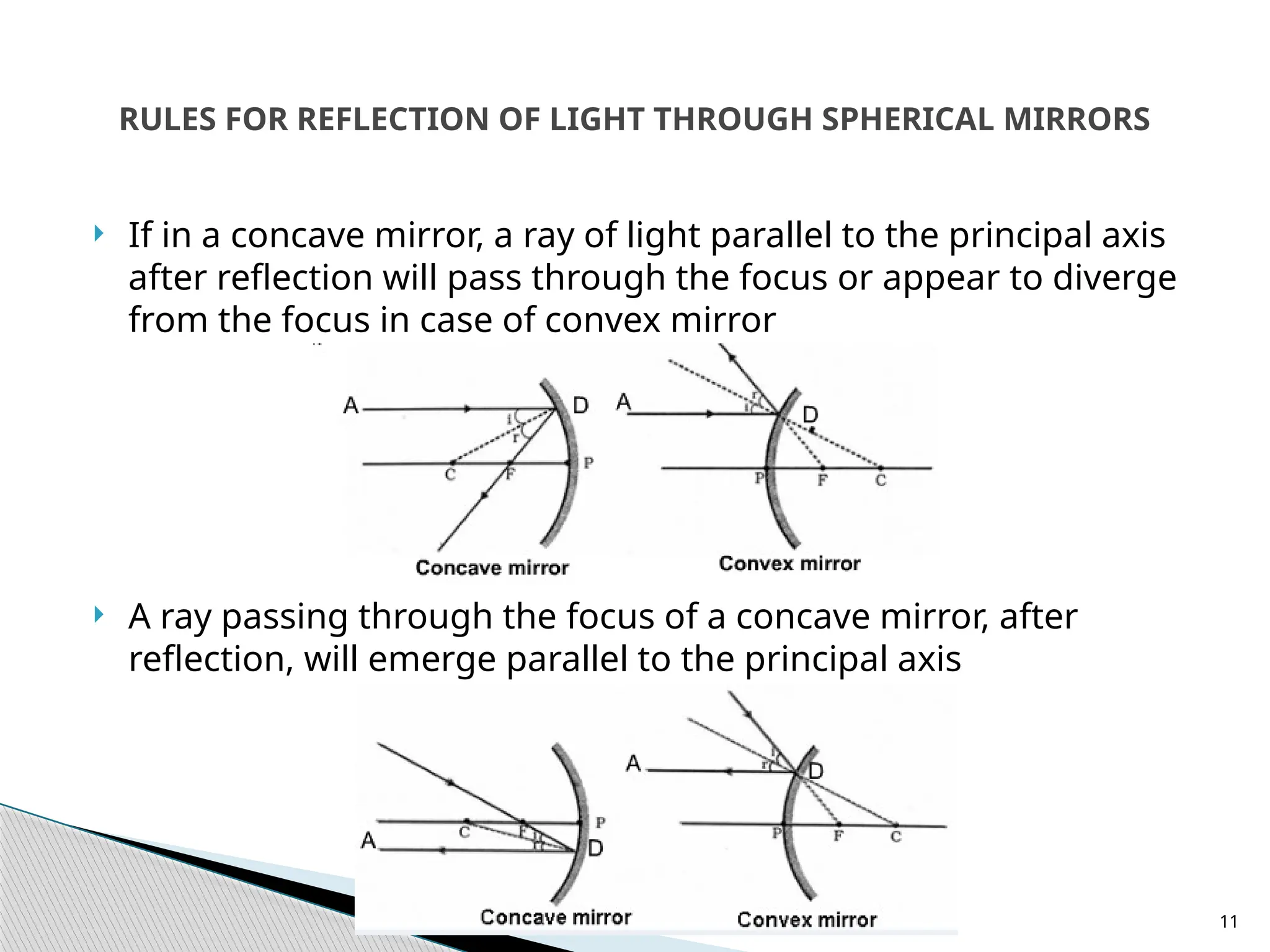
 If in a concave mirror, a ray of light parallel to the principal axis
after reflection will pass through the focus or appear to diverge
from the focus in case of convex mirror
 A ray passing through the focus of a concave mirror, after
reflection, will emerge parallel to the principal axis
RULES FOR REFLECTION OF LIGHT THROUGH SPHERICAL MIRRORS
12
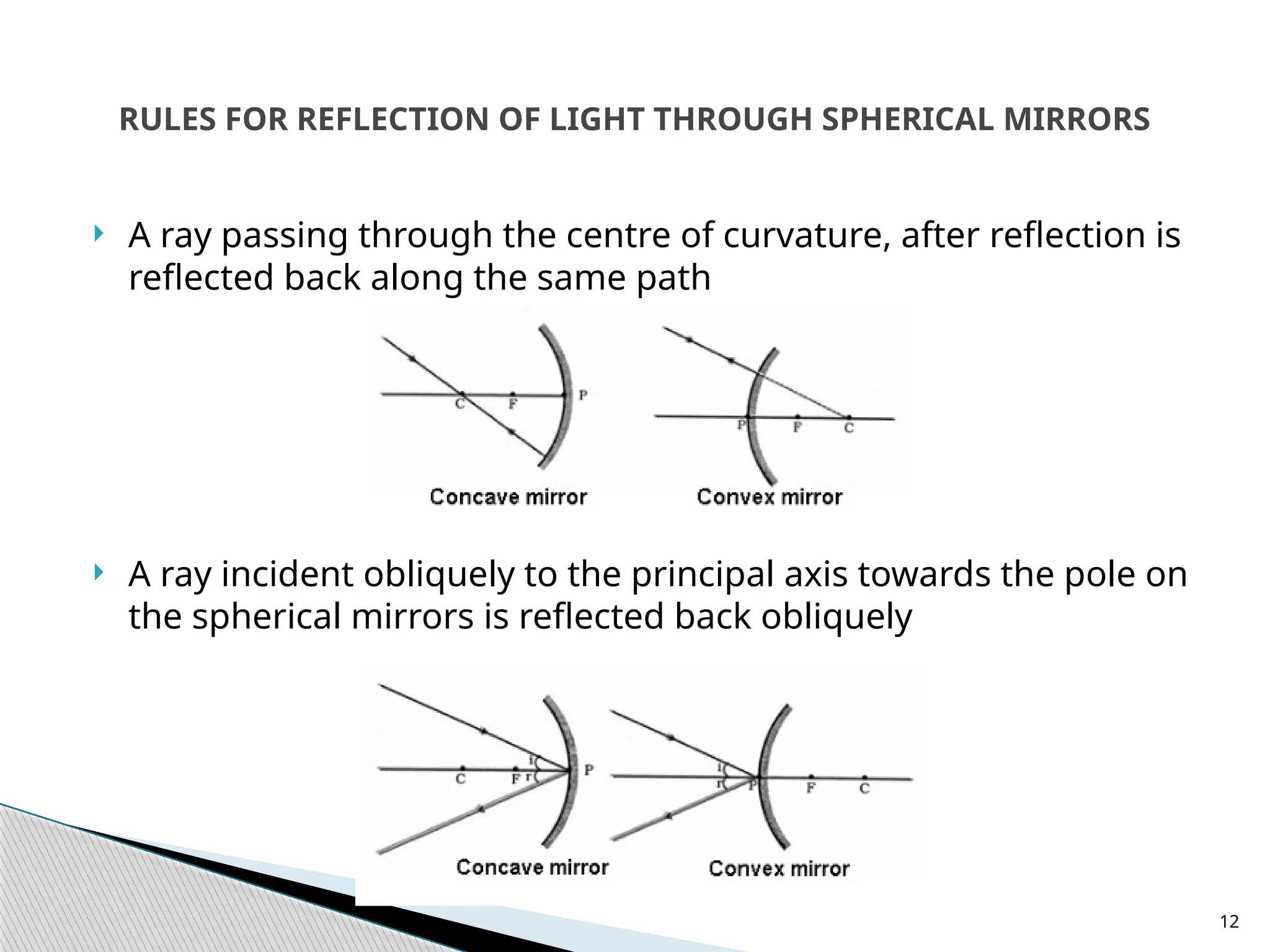
 A ray passing through the centre of curvature, after reflection is
reflected back along the same path
 A ray incident obliquely to the principal axis towards the pole on
the spherical mirrors is reflected back obliquely
RULES FOR REFLECTION OF LIGHT THROUGH SPHERICAL MIRRORS
13
 We can place the object at six positions from
the mirror:
◦ At infinity
◦ Beyond C
◦ At C
◦ Between C and F
◦ At F
◦ Between F and P
FORMATION OF DIFFERENT TYPES OF IMAGES BY CONCAVE MIRRORS
14
1. At infinity:
 The image formed is:
◦ Real and Inverted
◦ Highly diminished, Point-sized
◦ Formed at F
2. Beyond C:
 The image formed is:
◦ Real and Inverted
◦ Between F and C
◦ Diminished
FORMATION OF DIFFERENT TYPES OF IMAGES BY CONCAVE MIRRORS
15
3. At C:
 The image formed is:
◦ Real and Inverted
◦ At C
◦ Of the same size as the object
4. Between F and C:
 The image formed is
◦ Real and Inverted
◦ Beyond C
◦ Magnified
FORMATION OF DIFFERENT TYPES OF IMAGES BY CONCAVE MIRRORS
16
5. At F:
 The image formed is:
◦ Real and Inverted
◦ At infinity
◦ Highly magnified
6. Between F and P:
◦ Virtual and Erect
◦ Behind the mirror
◦ Magnified
FORMATION OF DIFFERENT TYPES OF IMAGES BY CONCAVE MIRRORS
17
FORMATION OF DIFFERENT TYPES OF IMAGES BY CONCAVE MIRRORS
18
 Concave mirrors are used as:
◦ Shaving mirrors
◦ Torches, search lights, and vehicle headlights
◦ Used by dentist to get large images of patient’s teeth
◦ In solar furnaces to concentrate heat
USES OF CONCAVE MIRRORS
19
1. At Infinity:
 The image formed is
◦ Virtual and Erect
◦ Behind the mirror (at F)
◦ Highly diminished
2. Between Infinity and P:
 The image formed is:
◦ Virtual and Erect
◦ Behind the mirror (between P and F)
◦ Diminished
IMAGE FORMATION BY CONVEX
MIRROR
20
 Convex mirrors are used in:
◦ Vehicles as rear-view mirrors to see traffic at the
rear-side
◦ Used as a device to check thefts in shops
USES OF CONVEX MIRRORS
21
 Object is placed left to the mirror and the pole is taken as the origin
 Distance to the right of origin (+ve X-axis) is positive while that to its
left (-ve X-axis) is negative
 Distances above the principal axis (+ve Y-axis) are positive while those
below it (-ve Y-axis) are negative
NEW CARTESIAN SIGN CONVENTION
Copyright © Shreyaans Nahata
[10th Ruby 29]
22
 The mirror formula is:
Where, u= Object distance
v= Image distance
f= Focal length
MIRROR FORMULA FOR SPHERICAL MIRRORS
Copyright © Shreyaans Nahata [10t
h Ruby 29]
23
 For Virtual image, m is positive
Real image, m is negative
 If m>1, image is bigger than the object
 If m=1, image is of the same size as of the object
 If m<1, image is smaller than the object
 If m is positive, then the image is virtual and erect
 If m is negative, then the image is real and inverted
MAGNIFICATION
24
 The phenomenon of bending of light when it travels
from one medium to another is called as ‘refraction’
 Laws of refraction of light:
◦ The incident ray, the normal and the refracted ray, all
lie in the same plane
◦ where, i= Angle of incidence
r= Angle of reflection
constant= Refractive index
REFRACTION OF LIGHT
Copyright © Shreyaans Nahata [10t
h Ruby 29]
25
 The refractive index of a medium gives an indication of light
bending ability of that medium
 Where n21 is the refractive index of medium 2 with respect to
medium 1
REFRACTIVE INDEX
Copyright © Shreyaans Nahata [10t
h Ruby 29]
26
REFRACTIVE INDEX
27
 There are two types of lenses:
◦ Convex Lens:
◦ Concave Lens:
REFRACTION BY SPHERICAL LENSES
Copyright © Shreyaans Nahata
[10th Ruby 29]
Copyright © Shreyaans Nahata [10t
h Ruby 29]
28
 The centre point of a lens is known as its Optical Focus
 A line passing through the optical centre is the Principal Axis
 Focus is the point where rays converge (or appear to) after
refraction in lens
OPTICAL FOCUS, PRINCIPAL AXIS,
FOCUS
Copyright © Shreyaans Nahata [10t
h Ruby 29]
29
1. A ray of light parallel to the principal axis
passes through the focus after refraction
2. A ray of light passing through the focus
becomes parallel to the principal axis after
refraction
3. A ray of light passing through the optical
centre goes straight without changing its path
RULES FOR DRAWING RAY
DIAGRAMS
RULES FOR DRAWING RAY
DIAGRAMS
Copyright © Shreyaans Nahata [10t
h Ruby 29]
31
1. Between O and F:
 Image formed is:
◦ Virtual and Erect
◦ Behind the object (on the left side)
◦ Magnified
2. Between F and 2F:
 Image formed is:
◦ Real and Inverted
◦ Beyond 2F
◦ Magnified
IMAGE FORMED BY CONVEX LENS
Copyright © Shreyaans Nahata [10t
h Ruby 29]
32
IMAGE FORMED BY CONVEX LENS
Copyright © Shreyaans Nahata [10t
h Ruby 29]
33
IMAGE FORMED BY CONCAVE LENS
Copyright © Shreyaans Nahata [10t
h Ruby 29]
34
 The sign conventions for lenses are same as those
for spherical mirrors except all the distances are
measured from the optical centre
 Distance to the right of origin (+ve X-axis) is positive
while that to its left (-ve X-axis) is negative
 Distances above the principal axis (+ve Y-axis) are
positive while those below it (-ve Y-axis) are negative
SIGN CONVENTIONS FOR LENSES
Copyright © Shreyaans Nahata [10t
h Ruby 29]
35
LENS FORMULA AND MAGNIFICATION
Copyright © Shreyaans Nahata [10t
h Ruby 29]
36
 The power of a lens is the reciprocal of its
focal length, i.e.
 S.I. unit for power of lens is called Dioptre (D)
POWER OF A LENS
37
That’s it folks…
38

light-reflectionandrefraction-161109184736.pptx

  • 1.
    1 LIGHT – REFLECTION ANDREFRACTION Made by: SHREYAANS M. NAHATA PODAR INTERNATIONAL SCHOOL, JALGAON [10TH RUBY 29] Copyright © Abhay Pratap Singh Roll No.1(One) 10th A1
  • 2.
    2  “Light isan electromagnetic ray that travels in a straight line”  Reflection of Light: ◦ When light falls on a surface and is reflected back into the same medium, we say reflection has taken place  Refraction of Light: ◦ When light travels from one medium to another it bends from its original path ◦ This phenomenon is called refraction LIGHT: REFLECTION AND REFRACTION
  • 3.
    3  Incident Ray:The ray of light that falls on the reflecting surface  Reflected Ray: The ray of light that is sent back by the reflecting surface  Normal: The normal is a line at right angle to the reflecting surface to the point of incidence  Angle of Incidence: It is the angle made by the incident ray and the normal TERMS RELATED TO REFRACTION OF LIGHT
  • 4.
    4  Angle ofReflection: It is the angle made by the reflected ray and the normal  Object: It is the “thing” that forms an image on the screen  Image: It is the reflection of the object on the screen  Virtual Image: The image that cannot be obtained on a screen (a surface where image is formed)  Real Image: The image that is formed directly on the screen TERMS RELATED TO REFRACTION OF LIGHT
  • 5.
    5  Laws ofReflection of light are: ◦ The angle of incidence is equal to the angle of reflection ◦ The incident ray, the reflected ray and the normal to the mirror at the point of incidence all lie in the same plane ◦ The incident ray and the reflected ray lie on either side of the normal LAWS OF REFLECTION OF LIGHT
  • 6.
    6  The imageformed in a plane is mirror is… 1. Virtual and Erect 2. Of the same size as of the object 3. At the same distance from the mirror as the object is in front of it 4. Laterally inverted PROPERTIES OF IMAGE FORMED BY A PLANE MIRROR
  • 7.
    Copyright © ShreyaansNahata [10t h Ruby 29] 7  Concave Mirror: A spherical mirror that has its reflecting surface curved inwards  Convex Mirror: A spherical mirror that has its reflecting surface curved outwards  There are some important terms to be explained first in terms of Spherical mirrors. They are: ◦ Centre of Curvature ◦ Focus ◦ Principal Axis ◦ Pole ◦ Focal length ◦ Radius of Curvature SPHERICAL MIRRORS: CONCAVE AND CONVEX
  • 8.
    Copyright © ShreyaansNahata [10t h Ruby 29] 8  Center of curvature (C): It is the centre of the sphere of which the mirror is a part  Radius of curvature (CP): It is the radius of the sphere of which the mirror is a part  Pole (P): It is the centre of the spherical mirror  Principal axis (X-Y): It is the straight line passing through the centre of curvature and the pole TERMS USED TO EXPLAIN SPHERICAL MIRRORS
  • 9.
  • 10.
    10  Principal Focus: ◦Focus of Concave Mirror: It is a point on the principal axis, where all the rays parallel to the principal axis converge ◦ Focus of Convex Mirror: It is a point on the principal axis, where the reflected rays appear to converge  Focal length of Spherical Mirrors: ◦ The distance between the pole and the principal focus is called the focal length of the spherical mirror  The Radius of Curvature is two times the Focal Length of any spherical mirror FOCUS AND FOCAL LENGTH OF SPHERICAL MIRRORS
  • 11.
    11  If ina concave mirror, a ray of light parallel to the principal axis after reflection will pass through the focus or appear to diverge from the focus in case of convex mirror  A ray passing through the focus of a concave mirror, after reflection, will emerge parallel to the principal axis RULES FOR REFLECTION OF LIGHT THROUGH SPHERICAL MIRRORS
  • 12.
    12  A raypassing through the centre of curvature, after reflection is reflected back along the same path  A ray incident obliquely to the principal axis towards the pole on the spherical mirrors is reflected back obliquely RULES FOR REFLECTION OF LIGHT THROUGH SPHERICAL MIRRORS
  • 13.
    13  We canplace the object at six positions from the mirror: ◦ At infinity ◦ Beyond C ◦ At C ◦ Between C and F ◦ At F ◦ Between F and P FORMATION OF DIFFERENT TYPES OF IMAGES BY CONCAVE MIRRORS
  • 14.
    14 1. At infinity: The image formed is: ◦ Real and Inverted ◦ Highly diminished, Point-sized ◦ Formed at F 2. Beyond C:  The image formed is: ◦ Real and Inverted ◦ Between F and C ◦ Diminished FORMATION OF DIFFERENT TYPES OF IMAGES BY CONCAVE MIRRORS
  • 15.
    15 3. At C: The image formed is: ◦ Real and Inverted ◦ At C ◦ Of the same size as the object 4. Between F and C:  The image formed is ◦ Real and Inverted ◦ Beyond C ◦ Magnified FORMATION OF DIFFERENT TYPES OF IMAGES BY CONCAVE MIRRORS
  • 16.
    16 5. At F: The image formed is: ◦ Real and Inverted ◦ At infinity ◦ Highly magnified 6. Between F and P: ◦ Virtual and Erect ◦ Behind the mirror ◦ Magnified FORMATION OF DIFFERENT TYPES OF IMAGES BY CONCAVE MIRRORS
  • 17.
    17 FORMATION OF DIFFERENTTYPES OF IMAGES BY CONCAVE MIRRORS
  • 18.
    18  Concave mirrorsare used as: ◦ Shaving mirrors ◦ Torches, search lights, and vehicle headlights ◦ Used by dentist to get large images of patient’s teeth ◦ In solar furnaces to concentrate heat USES OF CONCAVE MIRRORS
  • 19.
    19 1. At Infinity: The image formed is ◦ Virtual and Erect ◦ Behind the mirror (at F) ◦ Highly diminished 2. Between Infinity and P:  The image formed is: ◦ Virtual and Erect ◦ Behind the mirror (between P and F) ◦ Diminished IMAGE FORMATION BY CONVEX MIRROR
  • 20.
    20  Convex mirrorsare used in: ◦ Vehicles as rear-view mirrors to see traffic at the rear-side ◦ Used as a device to check thefts in shops USES OF CONVEX MIRRORS
  • 21.
    21  Object isplaced left to the mirror and the pole is taken as the origin  Distance to the right of origin (+ve X-axis) is positive while that to its left (-ve X-axis) is negative  Distances above the principal axis (+ve Y-axis) are positive while those below it (-ve Y-axis) are negative NEW CARTESIAN SIGN CONVENTION Copyright © Shreyaans Nahata [10th Ruby 29]
  • 22.
    22  The mirrorformula is: Where, u= Object distance v= Image distance f= Focal length MIRROR FORMULA FOR SPHERICAL MIRRORS
  • 23.
    Copyright © ShreyaansNahata [10t h Ruby 29] 23  For Virtual image, m is positive Real image, m is negative  If m>1, image is bigger than the object  If m=1, image is of the same size as of the object  If m<1, image is smaller than the object  If m is positive, then the image is virtual and erect  If m is negative, then the image is real and inverted MAGNIFICATION
  • 24.
    24  The phenomenonof bending of light when it travels from one medium to another is called as ‘refraction’  Laws of refraction of light: ◦ The incident ray, the normal and the refracted ray, all lie in the same plane ◦ where, i= Angle of incidence r= Angle of reflection constant= Refractive index REFRACTION OF LIGHT
  • 25.
    Copyright © ShreyaansNahata [10t h Ruby 29] 25  The refractive index of a medium gives an indication of light bending ability of that medium  Where n21 is the refractive index of medium 2 with respect to medium 1 REFRACTIVE INDEX
  • 26.
    Copyright © ShreyaansNahata [10t h Ruby 29] 26 REFRACTIVE INDEX
  • 27.
    27  There aretwo types of lenses: ◦ Convex Lens: ◦ Concave Lens: REFRACTION BY SPHERICAL LENSES Copyright © Shreyaans Nahata [10th Ruby 29]
  • 28.
    Copyright © ShreyaansNahata [10t h Ruby 29] 28  The centre point of a lens is known as its Optical Focus  A line passing through the optical centre is the Principal Axis  Focus is the point where rays converge (or appear to) after refraction in lens OPTICAL FOCUS, PRINCIPAL AXIS, FOCUS
  • 29.
    Copyright © ShreyaansNahata [10t h Ruby 29] 29 1. A ray of light parallel to the principal axis passes through the focus after refraction 2. A ray of light passing through the focus becomes parallel to the principal axis after refraction 3. A ray of light passing through the optical centre goes straight without changing its path RULES FOR DRAWING RAY DIAGRAMS
  • 30.
    RULES FOR DRAWINGRAY DIAGRAMS
  • 31.
    Copyright © ShreyaansNahata [10t h Ruby 29] 31 1. Between O and F:  Image formed is: ◦ Virtual and Erect ◦ Behind the object (on the left side) ◦ Magnified 2. Between F and 2F:  Image formed is: ◦ Real and Inverted ◦ Beyond 2F ◦ Magnified IMAGE FORMED BY CONVEX LENS
  • 32.
    Copyright © ShreyaansNahata [10t h Ruby 29] 32 IMAGE FORMED BY CONVEX LENS
  • 33.
    Copyright © ShreyaansNahata [10t h Ruby 29] 33 IMAGE FORMED BY CONCAVE LENS
  • 34.
    Copyright © ShreyaansNahata [10t h Ruby 29] 34  The sign conventions for lenses are same as those for spherical mirrors except all the distances are measured from the optical centre  Distance to the right of origin (+ve X-axis) is positive while that to its left (-ve X-axis) is negative  Distances above the principal axis (+ve Y-axis) are positive while those below it (-ve Y-axis) are negative SIGN CONVENTIONS FOR LENSES
  • 35.
    Copyright © ShreyaansNahata [10t h Ruby 29] 35 LENS FORMULA AND MAGNIFICATION
  • 36.
    Copyright © ShreyaansNahata [10t h Ruby 29] 36  The power of a lens is the reciprocal of its focal length, i.e.  S.I. unit for power of lens is called Dioptre (D) POWER OF A LENS
  • 37.
  • 38.