
LIGHT  General Properties


By: Alex S. Marce BSEd III-B
INTRODUCTION
  Much of the information we get in astronomy
  is carried by “light”.
1. Location of light in the sky- gives position
   of a planet, moon or star.
2. Color- gives temperature, speed and
   direction of motion, chemical composition.
3. Brightness-                            gives
   distance, composition, periods of motion.
4. Size of light- gives size and distance
   information.
  *Adopted from Astronomy Chapter 2 handouts, Page 15
DEFINITION
•        The common term for electromagnetic
    radiation, usually referring to that portion visible to
    the human eye. However, other bands of the e-m
    spectrum are also often referred to as different forms
    of light. *(space.about.com)

•         Electromagnetic radiation that can be perceived
    by the human eye. It is made up of electromagnetic
    waves with wavelengths between 4              10-7and
    7 10-7 meters. Light, and all other electromagnetic
    radiation, travels at a speed of about 299,728 km
    (185,831 mi) per second in a vacuum.
    *(http://science.yourdictionary.com/light)
SPEED OF LIGHT

- The speed of light in empty space is
  constant.
- C = 3x10⁸ m/s = 670 billion mph
- This finite speed has a real effect on
  information carried by light.
   it takes 11/4 seconds for light to reach us from
   the moon.
   it takes 81/3 minutes for light to reach us from
   the sun.
   it takes 41/3 years for light to reach us from the
   nearest star.
 *Adopted from Astronomy Chapter 2 handouts, Page 15
PROPERTIES OF LIGHT
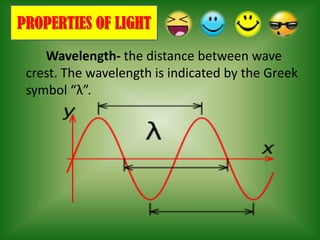
    Wavelength- the distance between wave
 crest. The wavelength is indicated by the Greek
 symbol “λ”.
PROPERTIES OF LIGHT

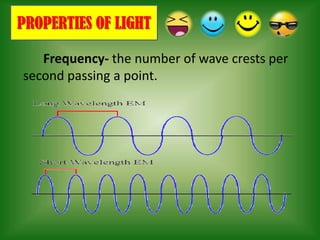
   Frequency- the number of wave crests per
second passing a point.
PROPERTIES OF LIGHT

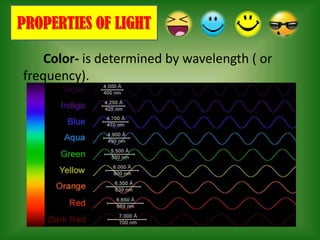
    Color- is determined by wavelength ( or
frequency).
SPECTRUM AND MORE
PROPERTIES OF LIGHT
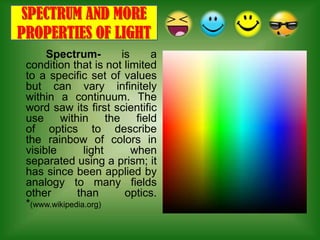
      Spectrum-       is     a
 condition that is not limited
 to a specific set of values
 but can vary infinitely
 within a continuum. The
 word saw its first scientific
 use within the field
 of optics to describe
 the rainbow of colors in
 visible        light    when
 separated using a prism; it
 has since been applied by
 analogy to many fields
 other        than     optics.
 *(www.wikipedia.org)
SPECTRUM AND MORE
PROPERTIES OF LIGHT
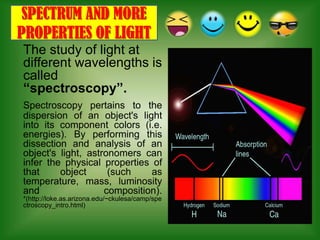
The study of light at
different wavelengths is
called
“spectroscopy”.
Spectroscopy pertains to the
dispersion of an object's light
into its component colors (i.e.
energies). By performing this
dissection and analysis of an
object's light, astronomers can
infer the physical properties of
that     object      (such    as
temperature, mass, luminosity
and                 composition).
*(http://loke.as.arizona.edu/~ckulesa/camp/spe
ctroscopy_intro.html)
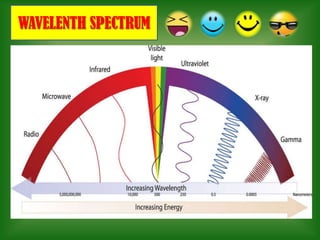
WAVELENTH SPECTRUM
QEUSTIONS ABOUT LIGHT

Why do we see “visible” light?

1. Sun emits most strongly at these
   wavelengths.
2. Earth’s atmosphere blocks many other
   wavelengths.
3. Human eye efficiency detects available
   light.
QUESTION ABOUT LIGHT

Is light really a wave?

1. Sometimes light acts like a particle “photon”.
2. Sometimes light acts like a wave.
3. It is really both –or neither- we just don’t have
   the right words to describe it completely.
Energy carried by light depends on
    wavelength (color, frequency):
• Short wavelength- have more energy.
• Long wavelength- have less energy.
Example:
1. Blue light carries more energy than red light.
2. X-rays carry more energy than radio waves.
Formula: E=hc/λ
   where E is the energy, λ is the wavelength, and
   h and c are constant numbers.
Light- General Properties

Light- General Properties

  • 1.
    LIGHT GeneralProperties By: Alex S. Marce BSEd III-B
  • 2.
    INTRODUCTION Muchof the information we get in astronomy is carried by “light”. 1. Location of light in the sky- gives position of a planet, moon or star. 2. Color- gives temperature, speed and direction of motion, chemical composition. 3. Brightness- gives distance, composition, periods of motion. 4. Size of light- gives size and distance information. *Adopted from Astronomy Chapter 2 handouts, Page 15
  • 3.
    DEFINITION • The common term for electromagnetic radiation, usually referring to that portion visible to the human eye. However, other bands of the e-m spectrum are also often referred to as different forms of light. *(space.about.com) • Electromagnetic radiation that can be perceived by the human eye. It is made up of electromagnetic waves with wavelengths between 4 10-7and 7 10-7 meters. Light, and all other electromagnetic radiation, travels at a speed of about 299,728 km (185,831 mi) per second in a vacuum. *(http://science.yourdictionary.com/light)
  • 4.
    SPEED OF LIGHT -The speed of light in empty space is constant. - C = 3x10⁸ m/s = 670 billion mph - This finite speed has a real effect on information carried by light.  it takes 11/4 seconds for light to reach us from the moon.  it takes 81/3 minutes for light to reach us from the sun.  it takes 41/3 years for light to reach us from the nearest star. *Adopted from Astronomy Chapter 2 handouts, Page 15
  • 5.
    PROPERTIES OF LIGHT Wavelength- the distance between wave crest. The wavelength is indicated by the Greek symbol “λ”.
  • 6.
    PROPERTIES OF LIGHT Frequency- the number of wave crests per second passing a point.
  • 7.
    PROPERTIES OF LIGHT Color- is determined by wavelength ( or frequency).
  • 8.
    SPECTRUM AND MORE PROPERTIESOF LIGHT Spectrum- is a condition that is not limited to a specific set of values but can vary infinitely within a continuum. The word saw its first scientific use within the field of optics to describe the rainbow of colors in visible light when separated using a prism; it has since been applied by analogy to many fields other than optics. *(www.wikipedia.org)
  • 9.
    SPECTRUM AND MORE PROPERTIESOF LIGHT The study of light at different wavelengths is called “spectroscopy”. Spectroscopy pertains to the dispersion of an object's light into its component colors (i.e. energies). By performing this dissection and analysis of an object's light, astronomers can infer the physical properties of that object (such as temperature, mass, luminosity and composition). *(http://loke.as.arizona.edu/~ckulesa/camp/spe ctroscopy_intro.html)
  • 10.
  • 11.
    QEUSTIONS ABOUT LIGHT Whydo we see “visible” light? 1. Sun emits most strongly at these wavelengths. 2. Earth’s atmosphere blocks many other wavelengths. 3. Human eye efficiency detects available light.
  • 12.
    QUESTION ABOUT LIGHT Islight really a wave? 1. Sometimes light acts like a particle “photon”. 2. Sometimes light acts like a wave. 3. It is really both –or neither- we just don’t have the right words to describe it completely.
  • 13.
    Energy carried bylight depends on wavelength (color, frequency): • Short wavelength- have more energy. • Long wavelength- have less energy. Example: 1. Blue light carries more energy than red light. 2. X-rays carry more energy than radio waves. Formula: E=hc/λ where E is the energy, λ is the wavelength, and h and c are constant numbers.