
201201797
TN
MBHAMALI

PHYSICAL SCIENCE GRADE: 10
FORCES AND NEWTON’S LAWS OF MOTION
Physical science
PHYSICAL SCIENCE
4.1 The Concepts of Force and Mass

A force is a push or a pull.
Contact forces arise from physical
contact .
Action-at-a-distance forces do not
require contact and include gravity
and electrical forces.
4.1 The Concepts of Force and Mass

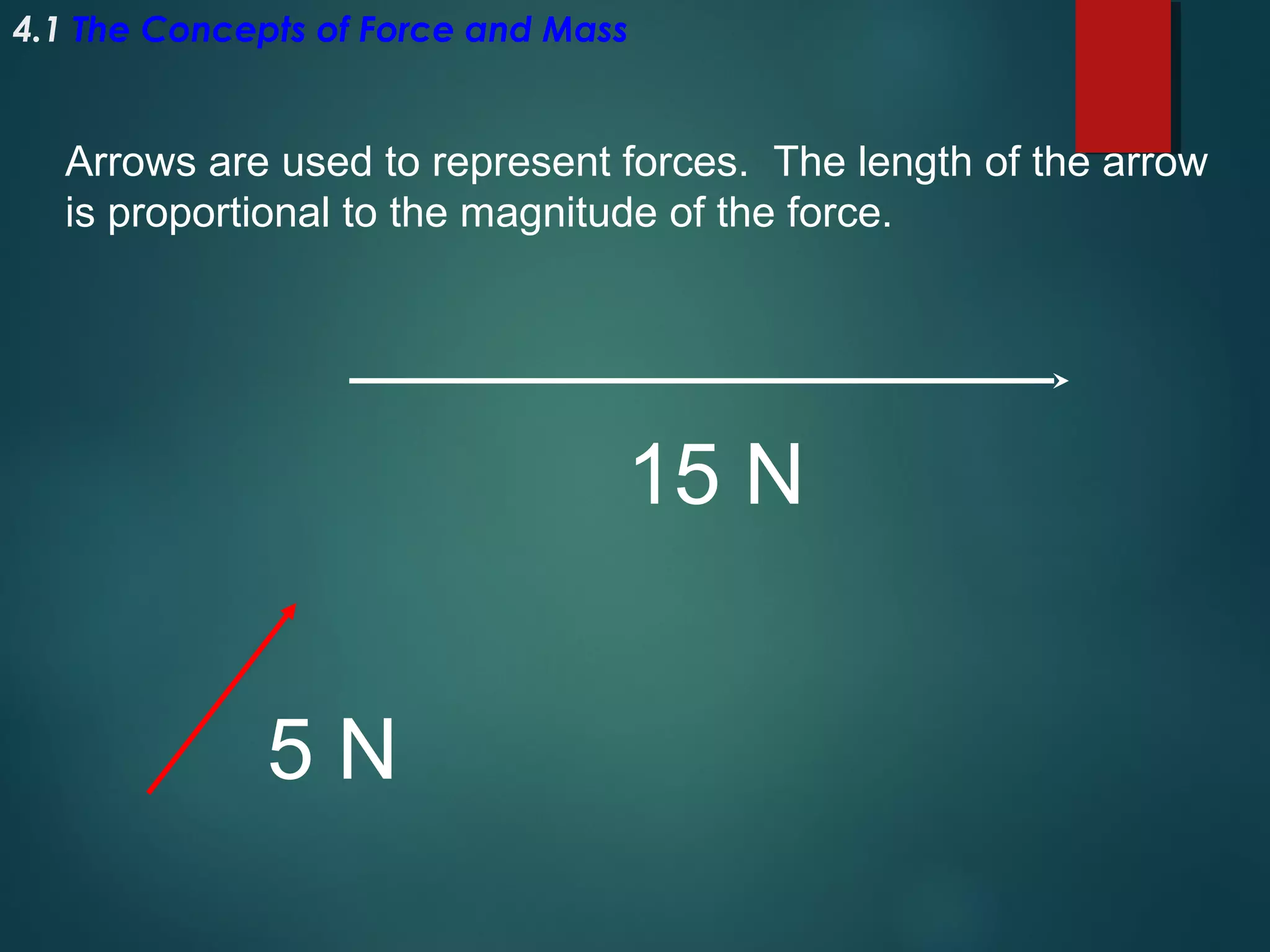
Arrows are used to represent forces. The length of the arrow
is proportional to the magnitude of the force.

15 N
5N
4.1 The Concepts of Force and Mass

Mass is a measure of the amount
of “stuff” contained in an object.
4.2 Newton’s First Law of Motion

Newton’s First Law
An object continues in a state of rest
or in a state of motion at a constant
speed along a straight line, unless
compelled to change that state by a
net force.
The net force is the vector sum of all
of the forces acting on an object.
4.2 Newton’s First Law of Motion

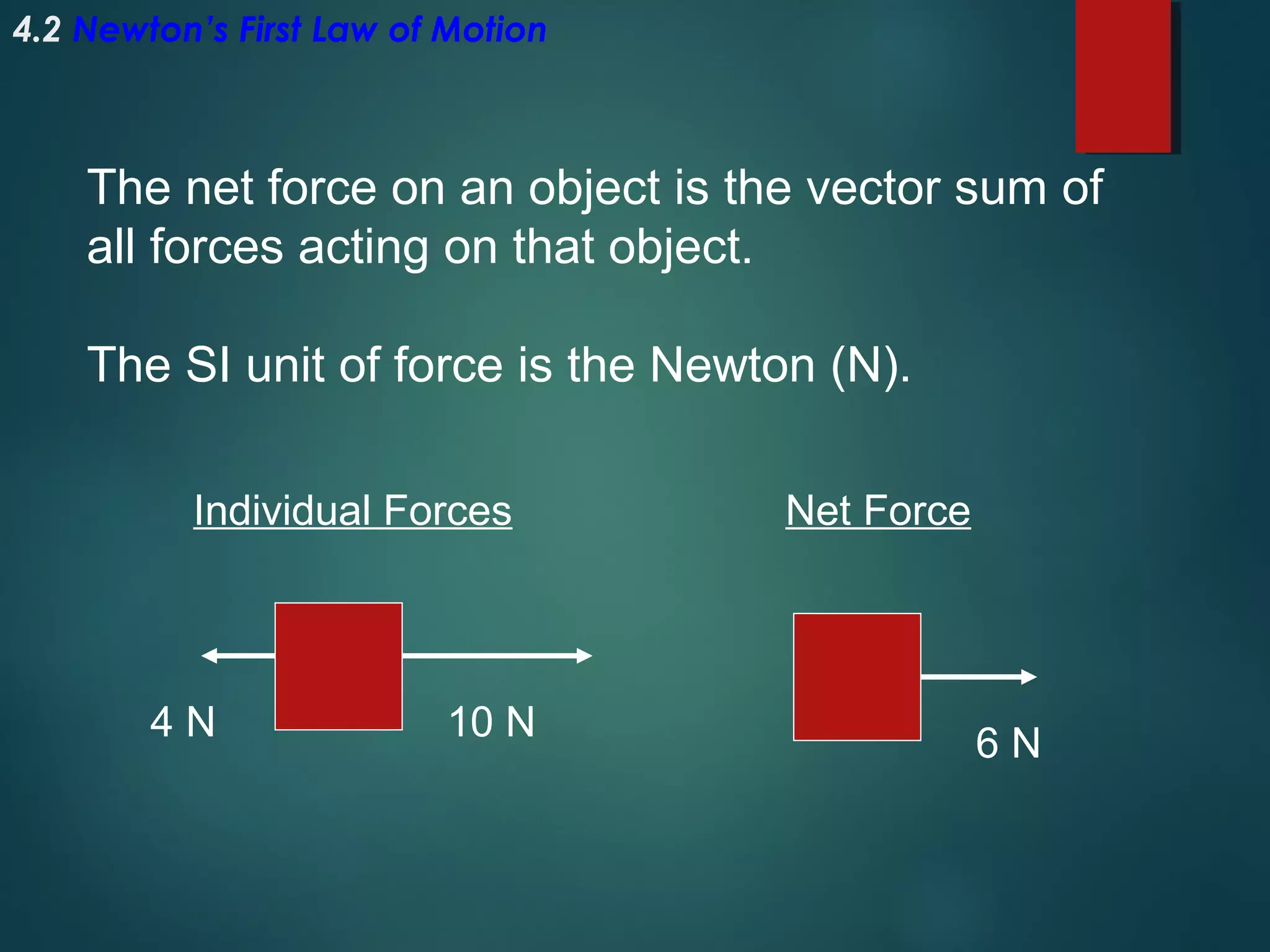
The net force on an object is the vector sum of
all forces acting on that object.
The SI unit of force is the Newton (N).
Individual Forces

4N

10 N

Net Force

6N
4.2 Newton’s First Law of Motion

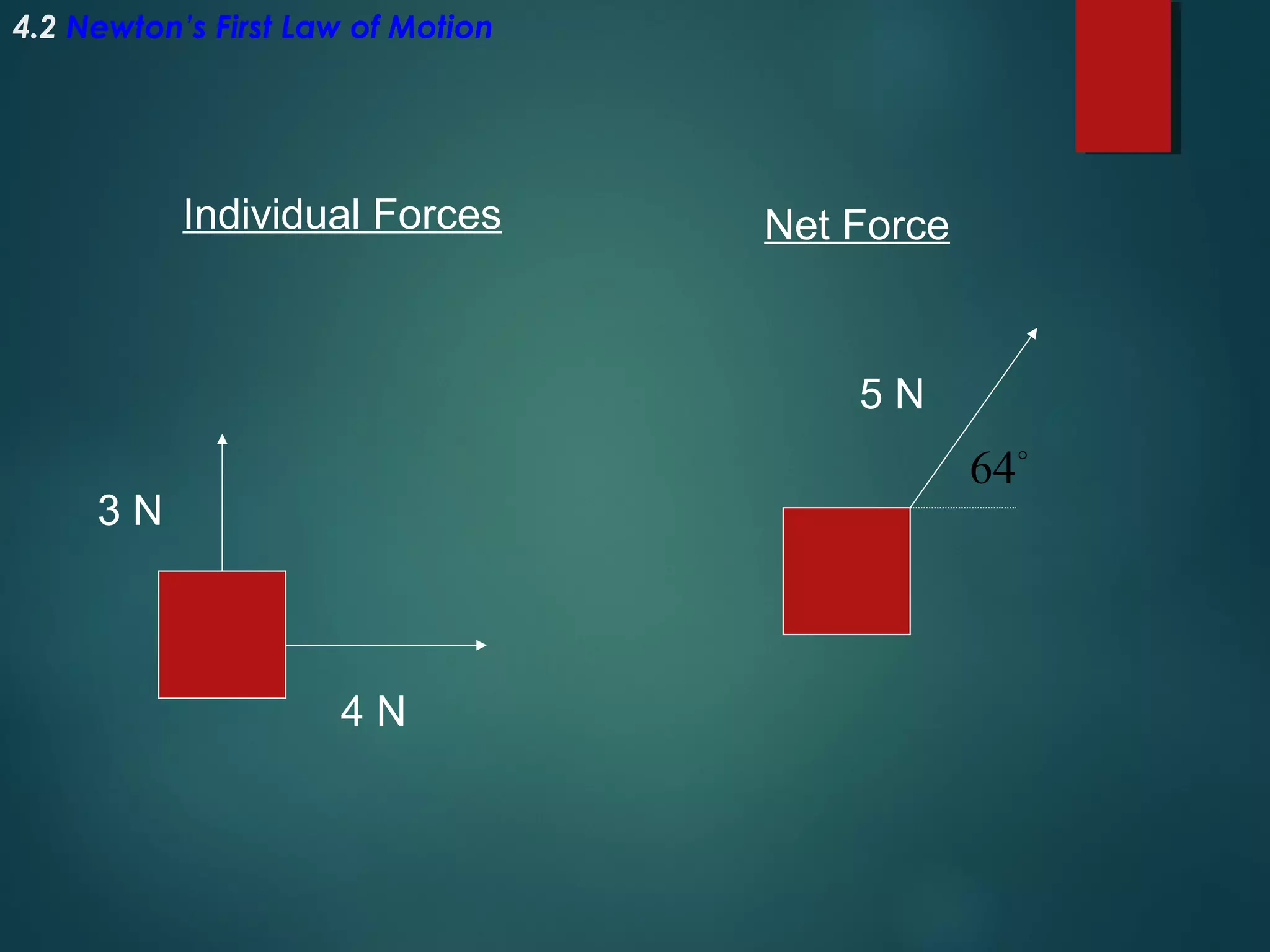
Individual Forces

Net Force

5N

64

3N

4N
4.2 Newton’s First Law of Motion

Inertia is the natural tendency of an
object to remain at rest in motion at
a constant speed along a straight line.
The mass of an object is a quantitative
measure of inertia.
SI Unit of Mass: kilogram (kg)
4.2 Newton’s First Law of Motion

An inertial reference frame is one in
which Newton’s law of inertia is valid.
All accelerating reference frames are
noninertial.
4.3 Newton’s Second Law of Motion

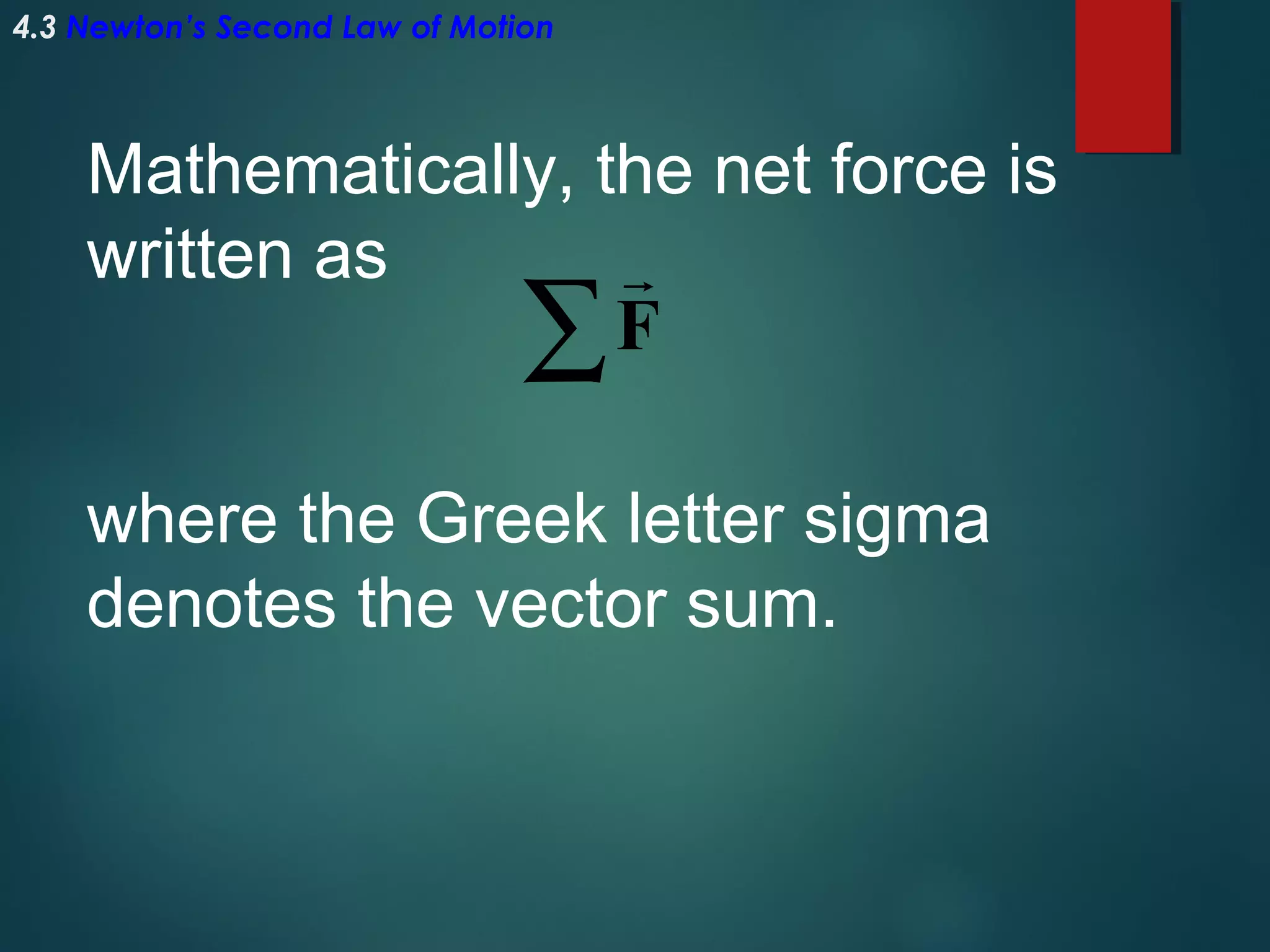
Mathematically, the net force is
written as

F

∑

where the Greek letter sigma
denotes the vector sum.
4.3 Newton’s Second Law of Motion

Newton’s Second Law
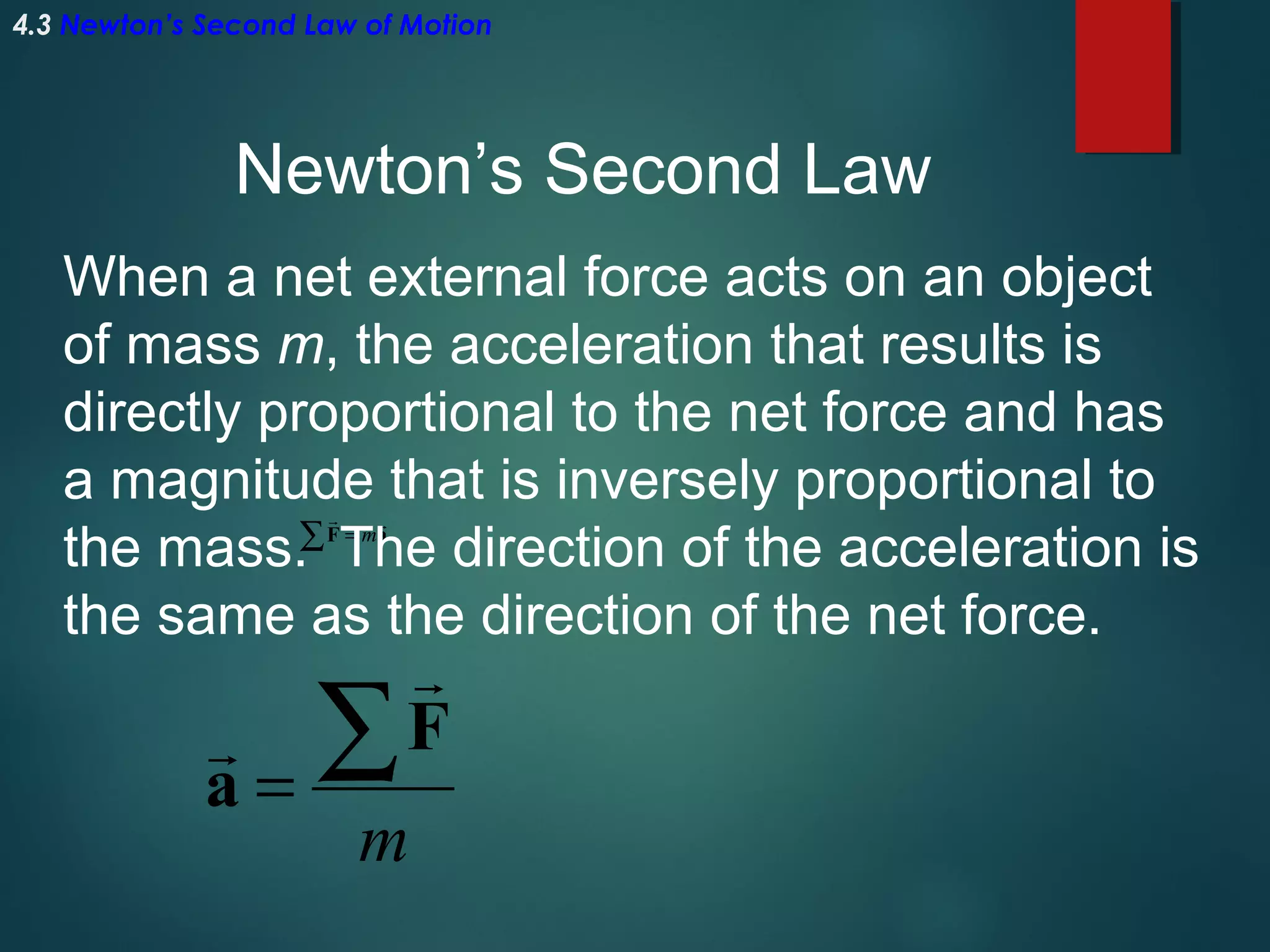
When a net external force acts on an object
of mass m, the acceleration that results is
directly proportional to the net force and has
a magnitude that is inversely proportional to
the mass.∑ The direction of the acceleration is
the same as the direction of the net force.


F = ma


a=

∑


F

m
4.3 Newton’s Second Law of Motion

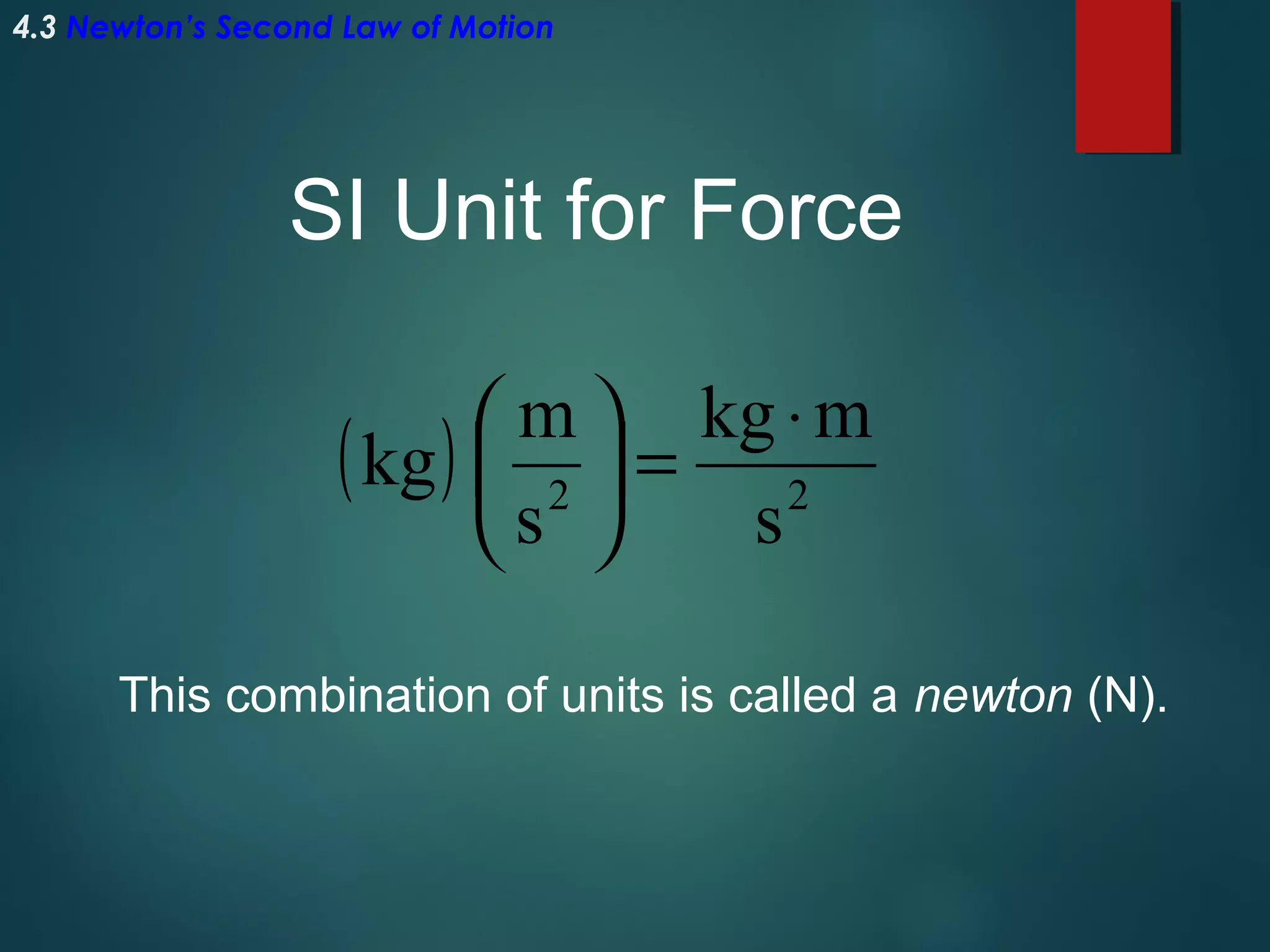
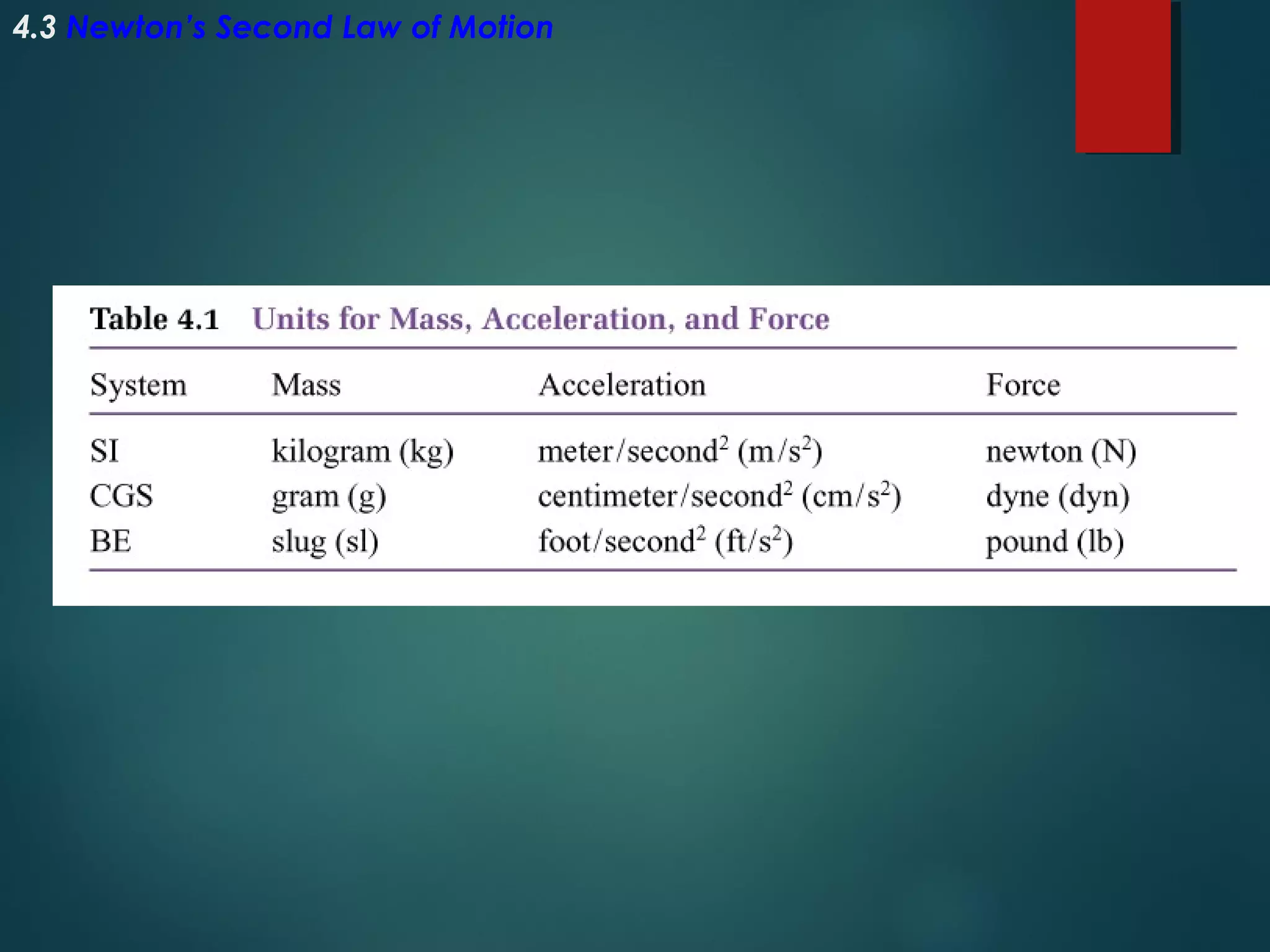
SI Unit for Force
 m  kg ⋅ m
( kg )  2  = 2
s
s 
This combination of units is called a newton (N).
4.3 Newton’s Second Law of Motion

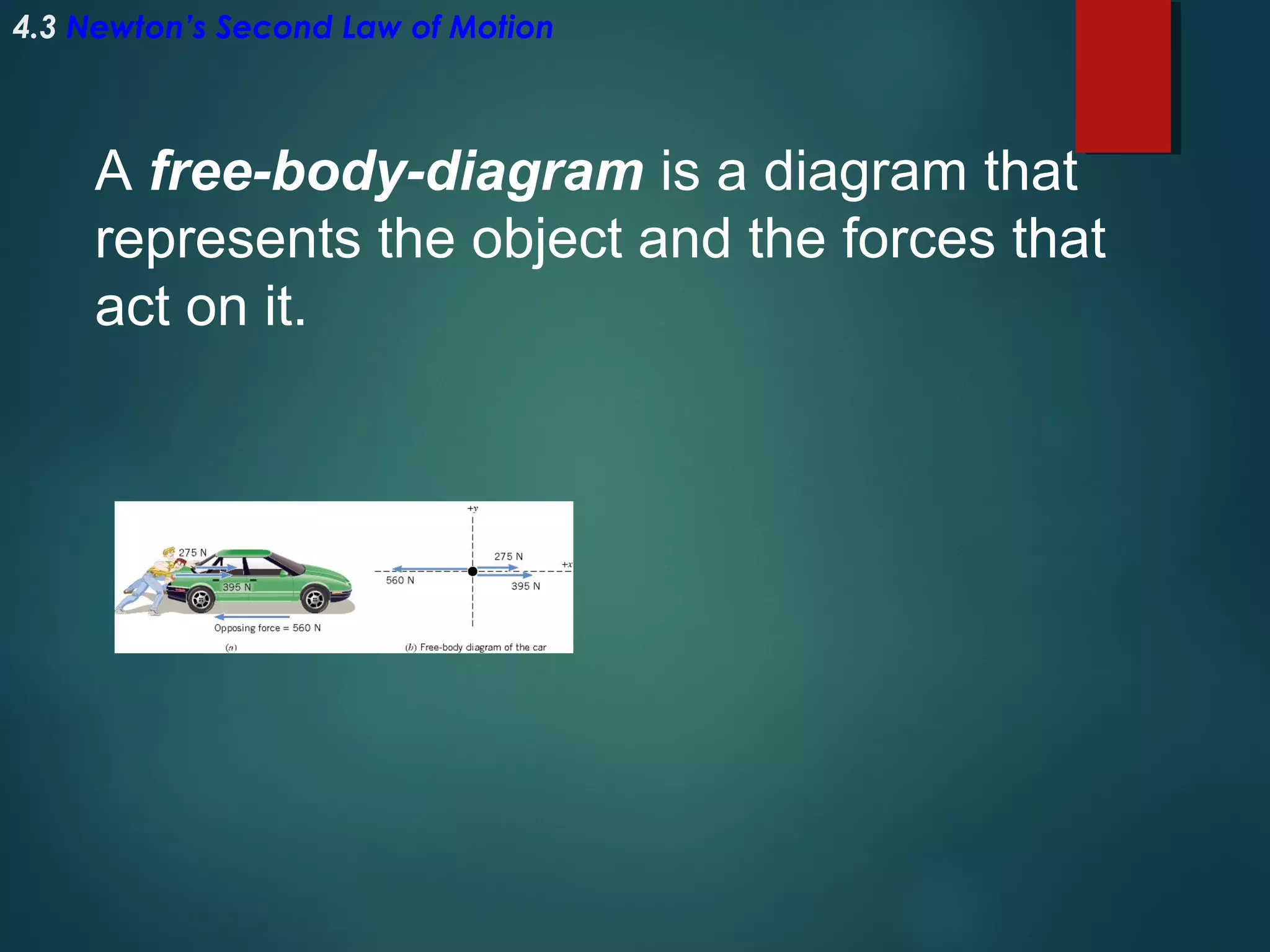
A free-body-diagram is a diagram that
represents the object and the forces that
act on it.

Physical Science for Grade:10

  • 1.
    201201797 TN MBHAMALI PHYSICAL SCIENCE GRADE:10 FORCES AND NEWTON’S LAWS OF MOTION
  • 2.
  • 3.
    4.1 The Conceptsof Force and Mass A force is a push or a pull. Contact forces arise from physical contact . Action-at-a-distance forces do not require contact and include gravity and electrical forces.
  • 4.
    4.1 The Conceptsof Force and Mass Arrows are used to represent forces. The length of the arrow is proportional to the magnitude of the force. 15 N 5N
  • 5.
    4.1 The Conceptsof Force and Mass Mass is a measure of the amount of “stuff” contained in an object.
  • 6.
    4.2 Newton’s FirstLaw of Motion Newton’s First Law An object continues in a state of rest or in a state of motion at a constant speed along a straight line, unless compelled to change that state by a net force. The net force is the vector sum of all of the forces acting on an object.
  • 7.
    4.2 Newton’s FirstLaw of Motion The net force on an object is the vector sum of all forces acting on that object. The SI unit of force is the Newton (N). Individual Forces 4N 10 N Net Force 6N
  • 8.
    4.2 Newton’s FirstLaw of Motion Individual Forces Net Force 5N 64 3N 4N
  • 9.
    4.2 Newton’s FirstLaw of Motion Inertia is the natural tendency of an object to remain at rest in motion at a constant speed along a straight line. The mass of an object is a quantitative measure of inertia. SI Unit of Mass: kilogram (kg)
  • 10.
    4.2 Newton’s FirstLaw of Motion An inertial reference frame is one in which Newton’s law of inertia is valid. All accelerating reference frames are noninertial.
  • 11.
    4.3 Newton’s SecondLaw of Motion Mathematically, the net force is written as  F ∑ where the Greek letter sigma denotes the vector sum.
  • 12.
    4.3 Newton’s SecondLaw of Motion Newton’s Second Law When a net external force acts on an object of mass m, the acceleration that results is directly proportional to the net force and has a magnitude that is inversely proportional to the mass.∑ The direction of the acceleration is the same as the direction of the net force.   F = ma  a= ∑  F m
  • 13.
    4.3 Newton’s SecondLaw of Motion SI Unit for Force  m  kg ⋅ m ( kg )  2  = 2 s s  This combination of units is called a newton (N).
  • 14.
    4.3 Newton’s SecondLaw of Motion
  • 15.
    4.3 Newton’s SecondLaw of Motion A free-body-diagram is a diagram that represents the object and the forces that act on it.