Management Basics for Information Professionals
4th Edition G. Edward Evans install download
https://ebookmeta.com/product/management-basics-for-information-
professionals-4th-edition-g-edward-evans/
Download more ebook from https://ebookmeta.com
Instructors adopting this textbook for a course may request
supplementary case studies by emailing
editionsmarketing@ala.org.
© 2020 by G. Edward Evans and Stacey Greenwell
Extensive effort has gone into ensuring the reliability of the information in this
book; however, the publisher makes no warranty, express or implied, with
respect to the material contained herein.
ISBNs
978-0-8389-1873-9 (paper)
978-0-8389-4637-4 (PDF)
978-0-8389-4635-0 (ePub)
978-0-8389-4636-7 (Kindle)
Library of Congress Cataloging-in-Publication Data
Names: Evans, G. Edward, 1937– author. | Greenwell, Stacey, author.
Title: Management basics for information professionals / G. Edward Evans,
Stacey Greenwell.
Description: 4th edition. | Chicago : ALA Neal-Schuman, 2020. | Includes
bibliographical references and index.
Identifiers: LCCN 2019025745 (print) | LCCN 2019025746 (ebook) | ISBN
9780838946374 (pdf) | ISBN 9780838946350 (epub) | ISBN 9780838946367
(kindle edition) | ISBN 9780838918739 (paperback)
Subjects: LCSH: Library administration—United States. | Information services—
United States—Management.
Classification: LCC Z678 (ebook) | LCC Z678 .E9 2019 (print) | DDC 025.1—dc23
LC record available at https://​
lccn.loc.gov/​
2019025745
Cover design by Kimberly Thornton; imagery © Adobe Stock.
ALA Neal-Schuman purchases fund advocacy, awareness, and accreditation
programs for library professionals worldwide.
CONTENTS
LIST OF ILLUSTRATIONS
PREFACE
PART I. Background
1. Introduction
What Is Management?
Organizational Skill Sets
You as a Future Manager
Public and Nonprofit Sectors
Key Points to Remember
References
2. Organizational Issues
Formal Organizations
Public and Nonprofit Sector Organizations
Environment and the Organization
Environmental Scanning
Forecasting
Organizational Culture
People Friendly Organizations
Key Points to Remember
References
3. Legal Issues
Establishing a Library
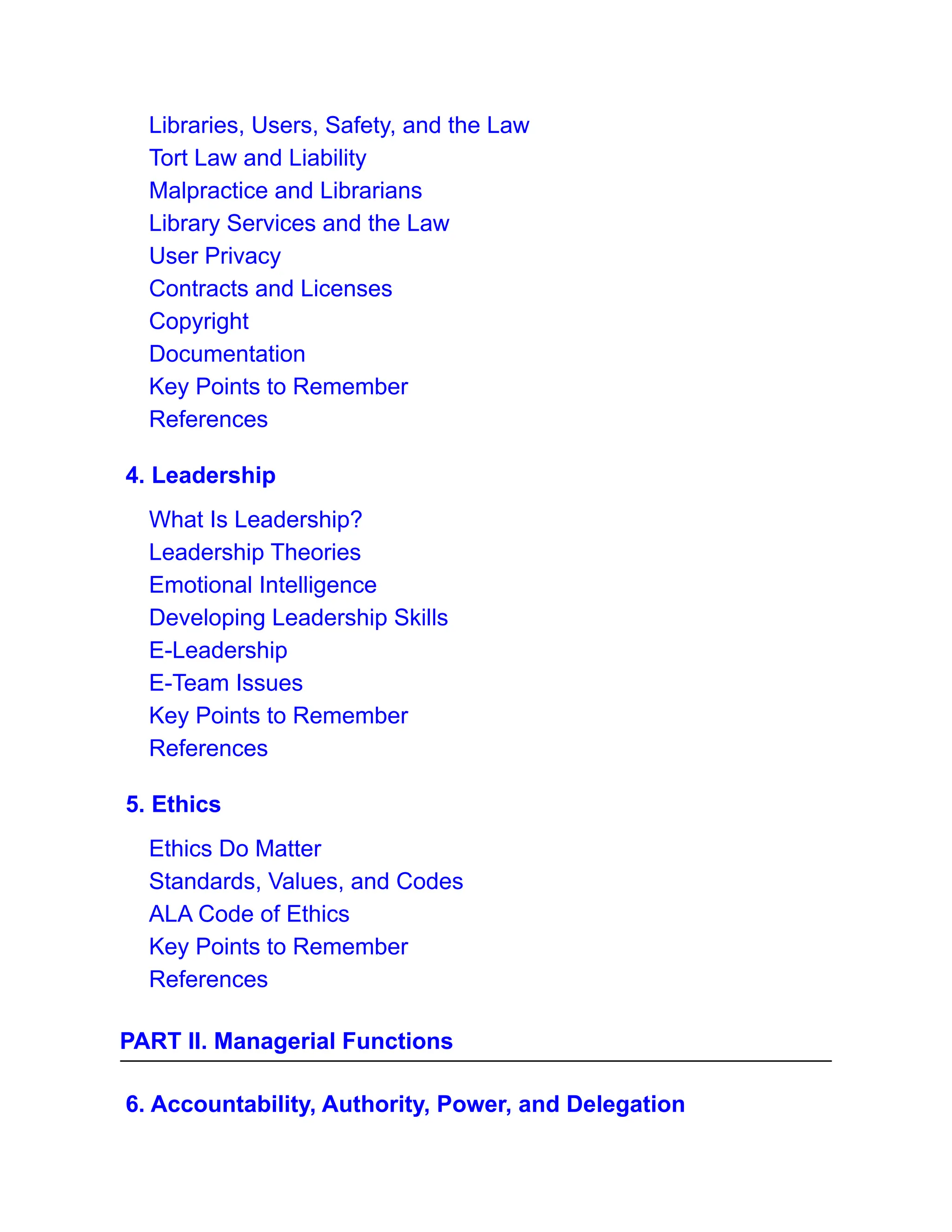
Libraries, Users, Safety, and the Law
Tort Law and Liability
Malpractice and Librarians
Library Services and the Law
User Privacy
Contracts and Licenses
Copyright
Documentation
Key Points to Remember
References
4. Leadership
What Is Leadership?
Leadership Theories
Emotional Intelligence
Developing Leadership Skills
E-Leadership
E-Team Issues
Key Points to Remember
References
5. Ethics
Ethics Do Matter
Standards, Values, and Codes
ALA Code of Ethics
Key Points to Remember
References
PART II. Managerial Functions
6. Accountability, Authority, Power, and Delegation
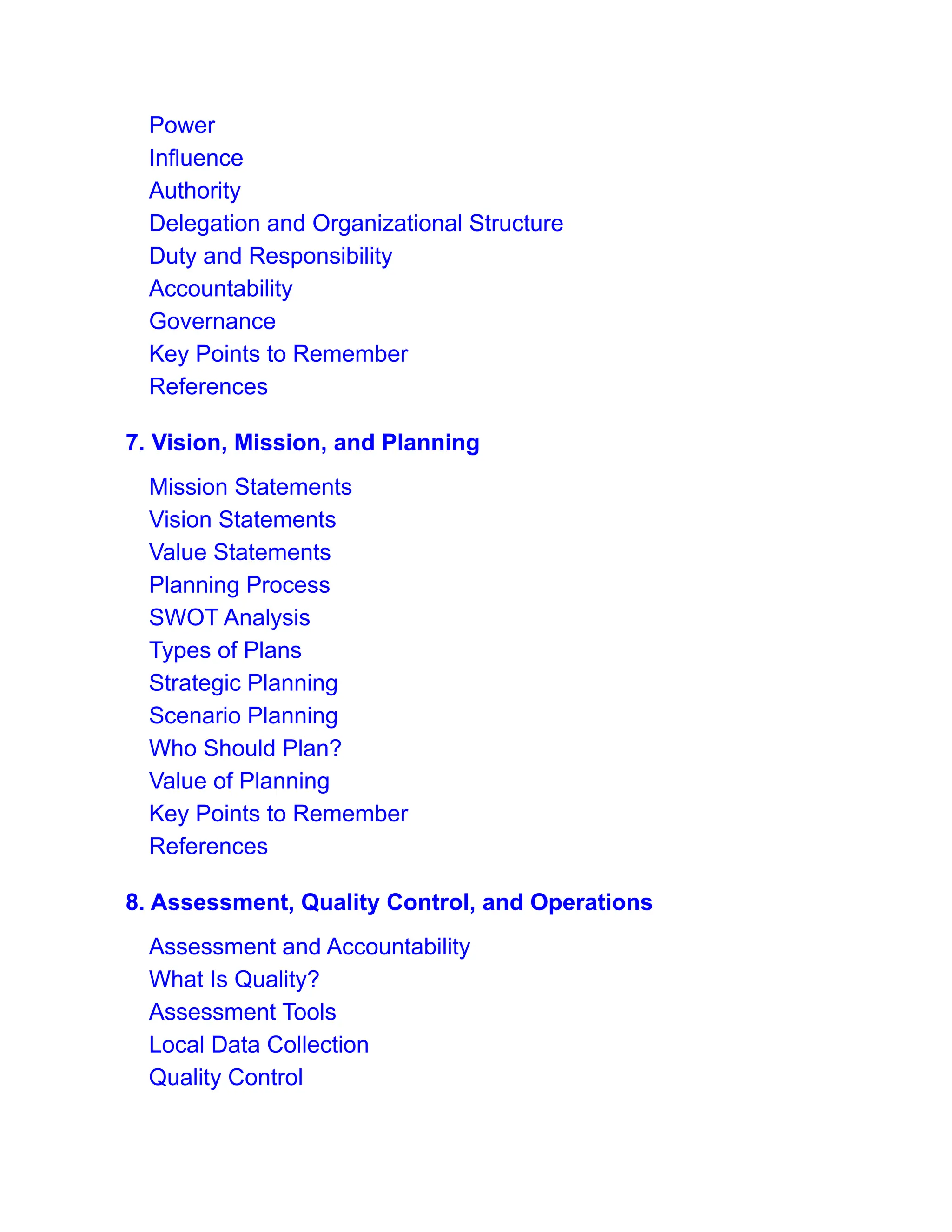
Power
Influence
Authority
Delegation and Organizational Structure
Duty and Responsibility
Accountability
Governance
Key Points to Remember
References
7. Vision, Mission, and Planning
Mission Statements
Vision Statements
Value Statements
Planning Process
SWOT Analysis
Types of Plans
Strategic Planning
Scenario Planning
Who Should Plan?
Value of Planning
Key Points to Remember
References
8. Assessment, Quality Control, and Operations
Assessment and Accountability
What Is Quality?
Assessment Tools
Local Data Collection
Quality Control
Project Management
Key Points to Remember
References
9. Decision Making
Decision Making Environment
Types of Decisions
Rational Decision Making
Problem Solving and Rational Decision Making
Group Decision Making and Accountability
Decision Aids
Key Points to Remember
References
10. Change Management
Nature of Change
Change Process Models
Resistance to Change
Implementing Change
Stress and the Organization
Innovation and Libraries
Key Points to Remember
References
11. Communication
Communication Process
Organizational Communication
Written and Oral Communication
Listening
Nonverbal Communication
Legitimacy of Communication
Key Points to Remember
References
12. Advocacy and Marketing
Marketing
Marketing Process
Branding
Public Relations
Advocacy
Key Points to Remember
References
PART III. Managing People
13. Staffing
Staffing and the Law
Staffing Process
The New Hire
Developing and Retaining Staff
Performance Appraisal
Corrective Action
Grievances
Collective Bargaining and Merit Systems
Volunteers
Key Points to Remember
References
14. Enhancing Performance
Organizational Development
Learning Organizations
Training and Development
Staff Development Day
Team Building
Libraries and Teams
Key Points to Remember
References
15. Managing Diversity
Defining Diversity
How Do You View Cultural Diversity?
Managerial Responsibility
Individual Responsibility
Role of Professional Associations
Planning for Diversity
Library Governance and Diversity
Diversity Program and Staff
Social Justice and Diversity
Providing Service to a Diverse Community
Key Points to Remember
References
16. Motivating Staff
Motivation Theories
Motivation in Practice
Encouragement and Recognition
Key Points to Remember
References
PART IV. Managing Things
17. Managing Money
Budget as a Control Device
Budget Cycle
Preparation
Defending the Request
Budget Types
Accounting Systems
Fund Accounting
Audits and Auditors
Budget Reports
Key Points to Remember
References
18. Generating Income
Revenue Sources
Fundraising Process
Seeking Grants
Key Points to Remember
References
19. Managing Technology
Staff and User Training
Technology Planning
Controlling Technology Costs
Physical Security
Intellectual Security
Cloud Computing
Social Media
Collaboration
Key Points to Remember
References
20. Managing Facilities
Library as Place
Managing the Facility
Housekeeping Matters
Risk Management
Health, Safety, and Security
Emergency and Disaster Management
Sustainability
Planning for New Space
Key Points to Remember
References
PART V. Managing Yourself and Your Career
21. Other Managerial Skills
Collaborating, Conflict Management, and Negotiation
Meeting Management
Time Management
Self-Management Skills
Professional Presentations and Publications
References
22. Creating Your Career
Career Planning Process
Marketing Yourself
Flexible Ways of Working
Career Breaks
Moving Forward
References
ABOUT THE AUTHORS
INDEX
ILLUSTRATIONS
TABLES
TABLE 1.1. Major Management Approaches
TABLE 1.2. Profit and Nonprofit Differences
TABLE 4.1. Characteristics of Managers Compared to Leaders
TABLE 5.1. Common Organization Approaches to Ethical Decision
Making
TABLE 5.2. Interpretation Challenges
TABLE 6.1. Common Methods for Structuring an Organization
TABLE 6.2. Division of Roles and Responsibilities
TABLE 7.1. Sub-Tactical and Operational Plans
TABLE 8.1. Common Work Analysis/Control Techniques
TABLE 9.1. Voting Paradoxes
TABLE 10.1. Common Resistance-to-Change Variables
TABLE 14.1. T&D Resources
TABLE 16.1. Motivation Theories
TABLE 22.1. Factors Leading to a Successful Career
FIGURE
FIGURE 1.1. Organizational Skill Sets
T
PREFACE
his edition has a three-fold purpose. The first is to introduce a
new coauthor, Stacey Greenwell, who was a great collaborator in
preparing the second edition of Academic Librarianship, another ALA
Neal-Schuman publication. The second purpose is to make clear that
an organization’s operational sector—for-profit, nonprofit, or public—
plays a determining role in how you carry out basic management
functions. The final purpose is to be more concise while adding new
ideas and examples.
The second purpose is perhaps the most significant. As with many
introductory texts, prior editions of this book failed to seriously
address the critical role that the library’s context plays in how basic
management functions operate. Almost all libraries, with the
exception of corporate libraries, are in either the public or nonprofit
sectors (and some are in both). Those sectors have a major
influence on what the basic elements of management will be and
how they can be applied and remain within the law. (Indeed, as
chapter 3 will explore, laws play a significant role in library
operations.) Chapter 1 outlines, in broad strokes, the sector
differences. The later chapters provide details of how those
differences impact the application of basic management concepts.
More often than not, when you read something in the library
literature about a new idea related to managerial practice, it arose
from work done in the for-profit sector. To be sure, there is research
done on public and nonprofit organizations; however, it is not as
extensive and often only applies to a narrow segment of the sector
being investigated.
In this edition, the book’s chapters have been restructured into
five broad sections. Part I, the opening section, looks at general
issues in managing a library—background, leadership, environment,
legal, and ethical issues. Part II discusses seven of the basic
managerial functions—accountability; vision, mission, and planning;
assessment; decision making; change management; communication;
and advocacy and marketing. Part III looks at “people”
considerations—staffing; staff development and team building;
diversity; and motivation. Part IV discusses “things”—money,
technology, and facilities. Finally, Part V focuses on managing
yourself and your career.
Although this edition has substantially reduced the number of
printed pages, there is new material in all of the chapters. The page
count reduction was achieved through tighter, more concise
language. The use of sidebars that present real work experiences,
suggestions for further reading, and things to think about have been
retained and updated.
As was true with prior editions, we were lucky to have several
seasoned managers and teachers who provided essential guidance
and thinking regarding the content of this edition. Special thanks go
to:
Holland Christie is Manager of the Battle Ground Community
Library, one of the libraries in the Fort Vancouver Regional Library
District in Vancouver, Washington. She has worked in a multitude of
roles within public libraries, including Programming Librarian, Youth
Services Librarian, Public Services Manager, and Deputy Director. She
received her MLS from the University of Arizona and a bachelor’s
degree in English from Northern Arizona University. She has worked
as a contributing editor and coauthor on several fiction and
nonfiction titles; her most recent book project was as coauthor of
Managerial Leadership for Librarians (Libraries Unlimited, 2017).
Maggie Farrell is Dean of Libraries at the University of Nevada, Las
Vegas. She previously served as Dean of Libraries at Clemson
University and the University of Wyoming. She writes the quarterly
column “Leadership Reflections” for the Journal of Library
Administration. She also is active in the American Library
Association, serving in various leadership roles. She received a BA
from the University of Missouri-Kansas City, an MLS from the
University of Arizona, and a Master’s in Public Administration from
Arizona State University.
Patricia Layzell Ward is semi-retired. Currently she is Hon. Archivist
Modern Collections to the Ffestiniog Railway Company. She has
worked in public and special libraries and enjoyed a long-time
involvement in teaching and research. This included posts at North-
Western Polytechnic, Loughborough University, Curtin University
Western Australia, and the University of Wales Aberystwyth. She is
Emeritus Editor of Library Management; author of conference
papers, journal articles, and reports; examiner to a number of
universities; a consultant in Europe, South America, South-East Asia,
and Australia; and formerly active in IFLA. She is a Fellow of the
Chartered Institute of Library and Information Professionals and
holds a master’s degree and PhD in Library, Archives and
Information Studies from University College London.
Joseph Mika is Professor Emeritus at the School of Information
Sciences, Wayne State University, Detroit, where he twice served as
Director of the School during his twenty-five-year tenure at the
University. He was also Assistant Dean at the School of Library and
Information Science at the University of Southern Mississippi,
Hattiesburg; Assistant Library Director at Johnson State College,
Vermont; and Assistant Library Director at the Ohio State University,
Mansfield Campus. His teaching areas included administration,
customer service, personnel management, and collection
development. He was co-owner of Hartzell-Mika Consulting, a firm in
operation from 1999 to 2019, which provided assistance with library
director searches, strategic planning facilitation, facility development
and planning, and staff and board training sessions. Mika is a retired
Colonel in the U.S. Army, having served twenty-nine years in the
Army Reserves.
Maggie Saponaro is Director of Collection Development Strategies
at the University of Maryland Libraries, where she is responsible for
the leadership and vision for the content of purchased and licensed
collections across all disciplinary areas and formats. In this position,
she directs the collection development work of the Libraries’ subject
specialist liaison librarians, with primary responsibility for content
and budgeting of the UMD Libraries’ general collections. She also
serves on the Collection Strategies and Services administrative team
for policy creation and strategic planning across the entire division.
She was formerly Associate Director of Learning Resources at the
Alexandria Campus of Northern Virginia Community College and a
librarian for the College of Human Resources at Virginia Polytechnic
Institute and State University. She is currently interim chair of the
NorthEast Regional Library (NERL) Program Council Executive
Committee and is a member of the Nexis Uni Advisory Committee.
She holds a master’s degree in library science from the University of
California, Los Angeles, with postgraduate work in the areas of
personnel programs and public administration.
A special acknowledgement is due for Camila Alire, coauthor of
the prior edition, for allowing the use of some of her managerial
experiences that were part of the last edition.
G. Edward Evans, Flagstaff, Arizona
Stacey Greenwell, Lexington, Kentucky
PART I
Background
S
CHAPTER 1
Introduction
Management is a role more and more librarians are finding themselves
in with little preparation or guidance. . . . Preparing librarians for
management roles enhances skills that may be applied in any area
throughout their careers.
Mary Ann Venner, 2017
Public libraries have acquiesced to public and government criticism in
some ways. . . . As a result of pressure to become more businesslike,
public libraries have adopted a “new managerialism.”
Masanori Koizumi and Michael M. Widdersheim, 2016
Whether you work in an academic or public library (or another type of
library altogether), you will be familiar with the management model of a
librarian supervising paraprofessional staff. . . . But does that
assumption still hold true when a relatively inexperienced librarian is
supervising paraprofessional staff of long tenure?
Autumn Faulkner, 2016
I would argue that it should be required of all students. Instead I
propose being more honest about the introductory nature of such
courses. No claims should be made that this course will provide
students with the skills needed to be successful managers or provide
absolute answers.
Robert Holley, 2015
ome of you who are reading this as part of a required
management course may be thinking something like, “I do not
expect, nor do I want, to be a manager. All I want to do is be a good
__________ librarian.” You fill in the blank. You are the not the first
to have such thoughts, nor are you likely to be the last. Many of us
do not think about, or recognize, the pervasiveness of basic
management elements (planning, budgeting, and decision making,
for example) in our daily lives. And, it is surprising how fast we
begin to have to manage when we become librarians.
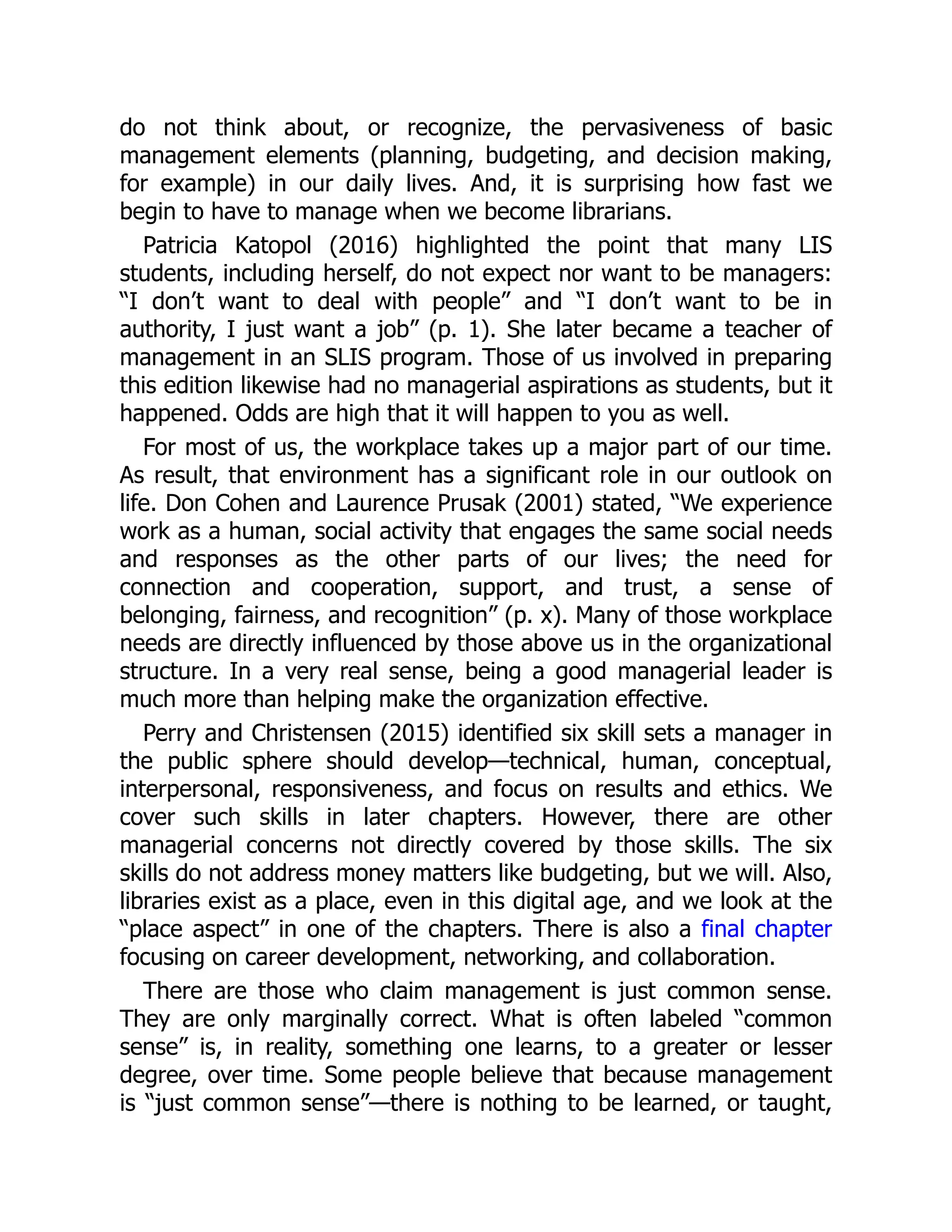
Patricia Katopol (2016) highlighted the point that many LIS
students, including herself, do not expect nor want to be managers:
“I don’t want to deal with people” and “I don’t want to be in
authority, I just want a job” (p. 1). She later became a teacher of
management in an SLIS program. Those of us involved in preparing
this edition likewise had no managerial aspirations as students, but it
happened. Odds are high that it will happen to you as well.
For most of us, the workplace takes up a major part of our time.
As result, that environment has a significant role in our outlook on
life. Don Cohen and Laurence Prusak (2001) stated, “We experience
work as a human, social activity that engages the same social needs
and responses as the other parts of our lives; the need for
connection and cooperation, support, and trust, a sense of
belonging, fairness, and recognition” (p. x). Many of those workplace
needs are directly influenced by those above us in the organizational
structure. In a very real sense, being a good managerial leader is
much more than helping make the organization effective.
Perry and Christensen (2015) identified six skill sets a manager in
the public sphere should develop—technical, human, conceptual,
interpersonal, responsiveness, and focus on results and ethics. We
cover such skills in later chapters. However, there are other
managerial concerns not directly covered by those skills. The six
skills do not address money matters like budgeting, but we will. Also,
libraries exist as a place, even in this digital age, and we look at the
“place aspect” in one of the chapters. There is also a final chapter
focusing on career development, networking, and collaboration.
There are those who claim management is just common sense.
They are only marginally correct. What is often labeled “common
sense” is, in reality, something one learns, to a greater or lesser
degree, over time. Some people believe that because management
is “just common sense”—there is nothing to be learned, or taught,
about the activity. However, even those who have such beliefs do
receive an education of sorts, largely achieved through trial and
error, while they try to employ common sense. Also, it is safe to
assume that these are the individuals who engage in the most
muddling managerial styles and generally cause the most grief for
their colleagues because they seem not to employ a system for their
“managing.”
AUTHOR AND ADVISORY BOARD EXPERIENCE
AUTHORS
On Evans’s first day as a full-time librarian he was given an assistant. Had he
not had some undergraduate coursework in public administration he probably
would have made a mess of that responsibility. The library school program he
graduated from had no management and administration course requirement.
He had taken the academic library course, which had a very modest emphasis
on basic management knowledge and much less on skills.
Greenwell should have known that management would be in her future. At
seventeen years old, she was left “in charge” of a public library for an hour each
Saturday while the librarian took a lunch break. Thankfully, no harm ensued. In
her first full-time librarian position, within a few short months she found herself
supervising a department of four seasoned librarians. While in library school
she grumbled frequently about the required management course, but she
became grateful for it not long after graduation.
ADVISORY BOARD
Joe Mika, who taught the basic management course at Wayne State University
in Detroit, also points out that students should take the management and
administration course because they themselves will have managers. Such
coursework will help them to understand their managers and directors and how
different administrative styles will affect their careers.
Reading about management, taking a course, or attending some
workshops on the subject improves your chances of being a better
manager. Poor managers hurt their organizations and the people
they work with, as well as themselves. Coursework and workshops
will not ensure you will be a good manager, but these tools can
improve your skills. There is no magic bullet in terms of managerial
success; what was effective yesterday may not be tomorrow.
Management, at its most basic level, is about people (those you
work with as well as yourself), and people are unpredictable.
Everyone engages in a little “muddling” regardless of training;
however, the amount of muddling decreases as the amount of
training and experience increases.
CHECK THIS OUT
An interesting article that looks at what library directors do is Douglas Crane’s
2015 report on interviews he conducted after he thought he might like to
become a director. He undertook the sixteen interviews because he had little
idea about what a director actually did. The article, “May I Ask You a Question?
Lesson Learned from Interviewing Public Library Leaders,” appeared in Public
Libraries 54, no. 6: 34–38, 2015.
You will have at least some supervisory or managerial
responsibilities at least once during your career. Such duties will
arise much sooner than you might imagine, if not from day one. The
Faulkner quotation at the beginning of this chapter is from an article
in which she describes how, within a few months of getting her MLS,
she was assigned some project management duties (p. 2). Both the
authors and Advisory Board members experienced a similar rapid
move into managerial responsibilities (see the sidebar on page 4).
For some individuals, management is a negative concept—
manipulative, coercive, anti-employee, and authoritarian are a few
words that may come to mind. These thoughts can be accurate at
times, especially when managers have little background in basic
management methods. Julian Birkinshaw (2010) wrote, “I think that
the corruption of management as a word is partly the result of a
100-year period of trying to make sense of the big, industrial,
hierarchical, bureaucratic company. All of the words we use around
management now are essentially words about how you manage
dehumanized, standardized machines that pump out millions and
millions of identical products.” In the case of libraries, his thoughts
are doubly on target. There is the size factor and for-profit nature of
the organizations, and then there is the fact that most libraries are in
the public and nonprofit sectors, further skewing the application of
managerial concepts.
WHAT IS MANAGEMENT?
Perhaps the shortest definition of management is one attributed to
Mary Parker Follett (1941): “management is the art of getting things
done through people.” This definition belies the complexity of
management yet concisely sums up management. A longer and
more complex definition is Daniel Wren’s: “management is an
activity essential to organized endeavors that perform certain
functions to obtain the effective acquisition, allocation, and
utilization of human efforts and physical resources for the purpose of
accomplishing some goal” (1979, p. 3). There are literally hundreds
of other definitions of the term. All contain two essential elements—
people and activities.
There is generally something of a pyramid shape to any
organization, with more people involved in working directly with
“customers” than in performing solely managerial duties. Most
organizations consist of a “top” (few people), a “middle” (several
people), and a “bottom” (many people). Certainly, there has been
significant flattening of this structure, but a person would be hard-
pressed to identify an organization with fewer than three levels.
Even in a fully team-based organization there will be some type of
team supervisor(s), team leader(s), and team members.
Just what do managers do? There are many answers to this
question, and the question actually deals with two issues: function
and behavior. Some managerial functions are planning, directing,
and budgeting, while the behavioral aspects involve roles such as
negotiator or group spokesperson. Management writers tend to
emphasize one side or the other. This book is organized according to
functions; however, we also explore behavioral aspects and place
great emphasis on user needs.
The standard concepts of a manager’s functional activities are
outlined in a classic management paper by Gulick and Urwick
(1937), in which they coined the acronym POSDCoRB, which stands
for the following functions:
• Planning
• Organizing
• Staffing
• Directing
• Coordinating
• Reporting
• Budgeting
POSDCoRB functions underlie, in one form or another, all
management behavior; however, they do not describe the work of a
manager. They merely identify the objectives of a manager’s work.
Henry Mintzberg (1973) suggested that because the functions fail
to describe managerial behavior they are of little use. We believe
this is too harsh a judgment, for if we do not know where we are
going (that is, if we do not have objectives), how will we know when
we get there? By studying POSDCoRB concepts, a person can gain
an understanding of what good management attempts to
accomplish.
A reasonable question to ask is, “Do all organizational levels
engage in the same activities?” A short answer is “yes,” but such an
answer obscures many important differences, especially in terms of
the skills employed (see figure 1.1). Senior managers tend to devote
more time to planning than do other managers, and planning calls
for a major use of conceptual skills. They also tend to devote more
time to interacting with a variety of people, both internal and
external, to the library. Such interaction calls for strong interpersonal
relations skills. Finally, they typically engage in very little direct user
service work, and thus they make limited use of the technical skills
they once employed when they became librarians.
Mahoney, Jardee, and Carroll (1964) discuss the concept of time
spent on various activities by “bottoms,” “middles,” and “tops.” For
bottoms, the emphasis is almost a mirror opposite of the tops: great
emphasis on technical skills, a strong component of human-relations
skills, and only limited use of conceptual skills. As always, middles
are in between: less use of technical skills than bottoms but more
than tops and a greater need for conceptual skills but less than for
tops. You can envision these differences in terms of percentages. For
bottoms, perhaps 60 to 70 percent of the emphasis is on technical
skills, 20 to 30 percent on human relations, and the balance on
conceptual abilities. Middles would perhaps be 20 to 30 percent
technical, 10 to 50 percent human relations, and the balance
conceptual. Conceptual abilities would be 40 to 50 percent for tops,
with technical skills at 10 percent or less, and the balance involving
human relations.
FIGURE 1.1 Organizational Skill Sets
ORGANIZATIONAL SKILL SETS
Henry Mintzberg (1971, 1973, 1975) has had the greatest general
influence in the area of how managers behave and how knowledge
of behavior should change how management is taught. His critique
of the functions approach led him to suggest that looking at the
roles played would be more effective. He identified ten roles divided
among three categories: interpersonal, informational, and decisional.
Under interpersonal are three roles: figurehead, leader, and liaison.
The informational category contains the roles of nerve center,
disseminator, and spokesperson. Decisional activities include the
roles of entrepreneur, disturbance handler, resource allocator, and
negotiator. We suggest that there is a fourth role in the information
category: politician. To some extent such a role is part of being a
figurehead, leader, negotiator, and spokesperson. However, given the
social and political changes that have occurred since Mintzberg
carried out his research in the 1970s, the political role has become
ever more important.
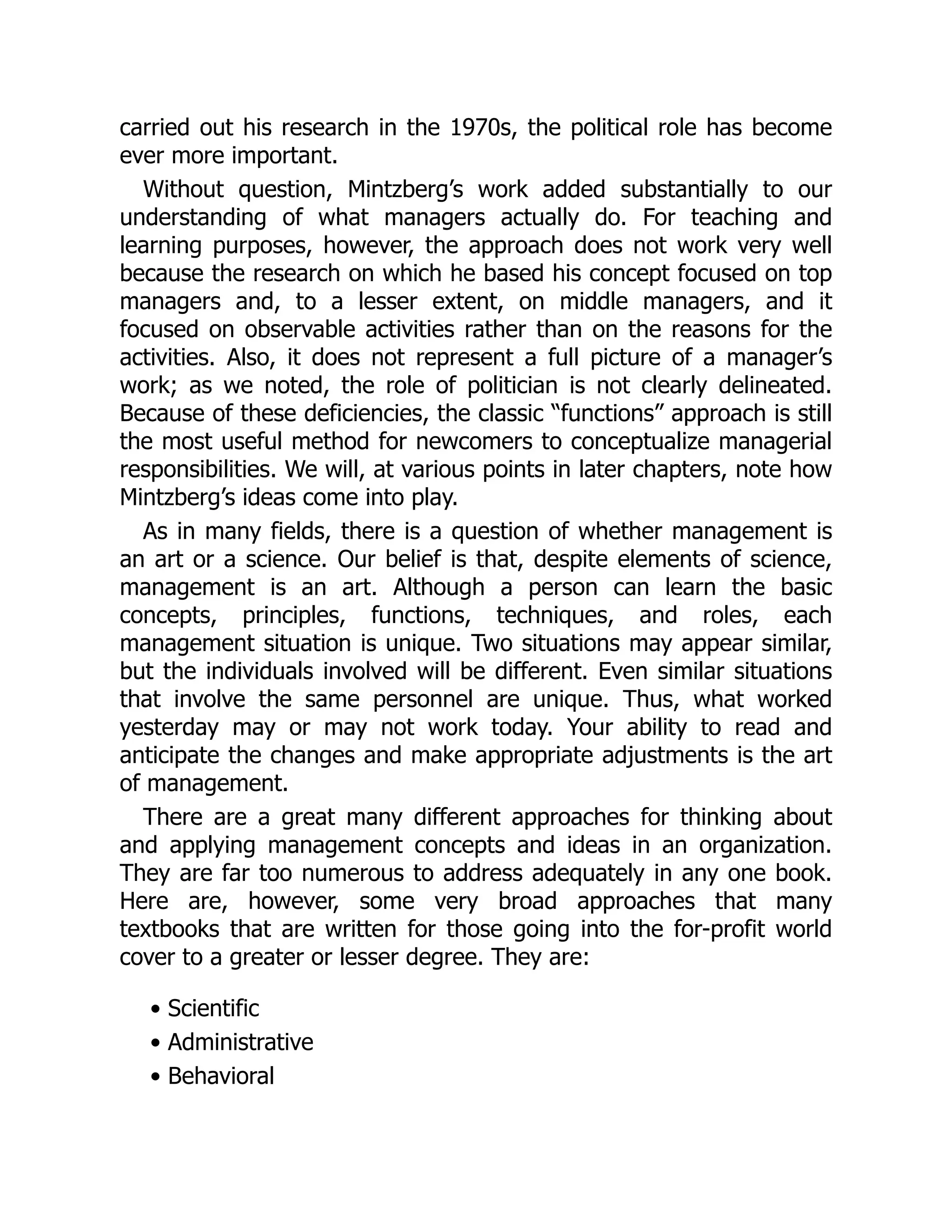
Without question, Mintzberg’s work added substantially to our
understanding of what managers actually do. For teaching and
learning purposes, however, the approach does not work very well
because the research on which he based his concept focused on top
managers and, to a lesser extent, on middle managers, and it
focused on observable activities rather than on the reasons for the
activities. Also, it does not represent a full picture of a manager’s
work; as we noted, the role of politician is not clearly delineated.
Because of these deficiencies, the classic “functions” approach is still
the most useful method for newcomers to conceptualize managerial
responsibilities. We will, at various points in later chapters, note how
Mintzberg’s ideas come into play.
As in many fields, there is a question of whether management is
an art or a science. Our belief is that, despite elements of science,
management is an art. Although a person can learn the basic
concepts, principles, functions, techniques, and roles, each
management situation is unique. Two situations may appear similar,
but the individuals involved will be different. Even similar situations
that involve the same personnel are unique. Thus, what worked
yesterday may or may not work today. Your ability to read and
anticipate the changes and make appropriate adjustments is the art
of management.
There are a great many different approaches for thinking about
and applying management concepts and ideas in an organization.
They are far too numerous to address adequately in any one book.
Here are, however, some very broad approaches that many
textbooks that are written for those going into the for-profit world
cover to a greater or lesser degree. They are:
• Scientific
• Administrative
• Behavioral
• Management science
• Systems
• Contingency
• Quality
• Composite
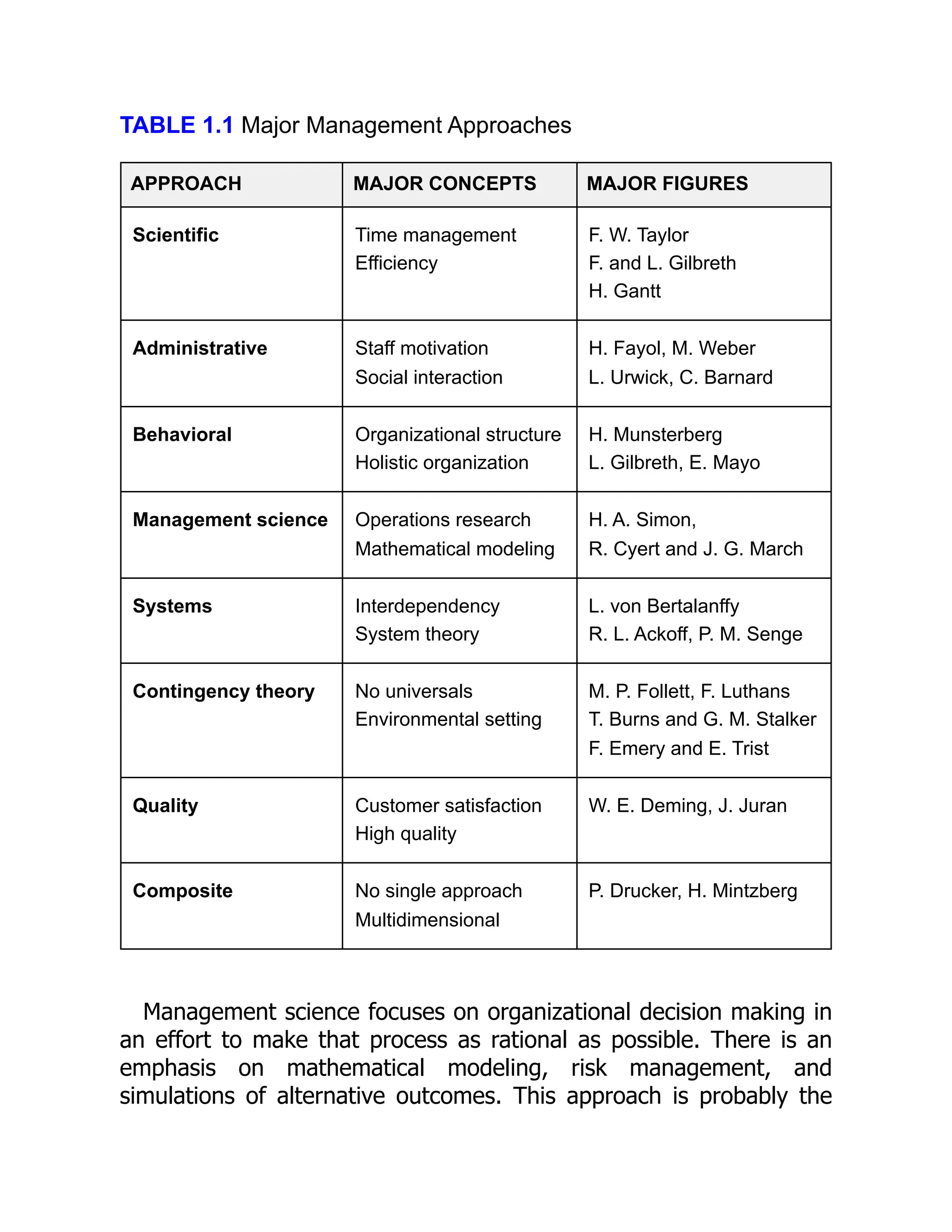
Table 1.1 provides an overview of these approaches and looks at
some of the proponents. From a library management perspective,
today’s approach is a composite of the first seven approaches. In
many ways the approach used by managers in any organization is a
personal version of the composite style.
The scientific approach, which arose early in the Industrial
Revolution, focuses on operational efficiency. Time and motion
studies that identify the best way to do a task are the hallmark of
this approach. A great book that applies this approach to the library
is Richard Dougherty’s (2008) Streamlining Library Services: What
We Do, How Much Time It Takes, What It Costs, and How We Can
Do It Better.
The administrative approach is reflected in almost every
organization regardless of sector. This is the common foundation for
almost all introductory management textbooks, including this one.
Even when there is an emphasis on organizational leadership the
basic management functions (planning, decision making, fiscal
management, and the like) must take place.
The behavioral approach is reflected in a concern with employees
(their existing skills, interpersonal relations, etc.) and the “social
side” of the workplace. Team building draws on the ideas found in
this style of management. As we will discuss in later chapters, teams
are an important component in many libraries’ operational practices.
Organizational morale, as you may guess, is another element in the
behavioral approach. A book related to libraries and the behavioral
approach is Peter Hernon, Joan Giesecke, and Camila Alire’s
Academic Librarians as Emotionally Intelligent Leaders (Westport,
CT: Libraries Unlimited, 2007).
TABLE 1.1 Major Management Approaches
APPROACH MAJOR CONCEPTS MAJOR FIGURES
Scientific Time management
Efficiency
F. W. Taylor
F. and L. Gilbreth
H. Gantt
Administrative Staff motivation
Social interaction
H. Fayol, M. Weber
L. Urwick, C. Barnard
Behavioral Organizational structure
Holistic organization
H. Munsterberg
L. Gilbreth, E. Mayo
Management science Operations research
Mathematical modeling
H. A. Simon,
R. Cyert and J. G. March
Systems Interdependency
System theory
L. von Bertalanffy
R. L. Ackoff, P. M. Senge
Contingency theory No universals
Environmental setting
M. P. Follett, F. Luthans
T. Burns and G. M. Stalker
F. Emery and E. Trist
Quality Customer satisfaction
High quality
W. E. Deming, J. Juran
Composite No single approach
Multidimensional
P. Drucker, H. Mintzberg
Management science focuses on organizational decision making in
an effort to make that process as rational as possible. There is an
emphasis on mathematical modeling, risk management, and
simulations of alternative outcomes. This approach is probably the
least drawn upon by libraries. It takes time and effort to do properly
and the level of risk for the majority of library decisions is generally
modest. It might be beneficial when thinking about starting a new
service for a new segment of the service population, locating a new
branch, or remodeling, renovating, or building a new physical facility.
A systems approach views everything as interlinked and any
change will have some impact elsewhere in the system. Perhaps the
most significant aspect of this approach is that the organization’s
external environment will affect how the organization should go
about its activities. For libraries, the environmental focus is central.
The external environment is the determining factor in what type of
library it is—academic, public, school, or special. Further, a library’s
primary purpose is to serve the needs of a specific service
population. Understanding the current and changing needs of that
population is critical to successful operations. (We explore the
environmental factor in more depth in the next chapter.)
Contingency theory’s primary tenet is there are no universals for
managerial practice. This approach does not disregard the basic
functions; rather, it acknowledges that their application will vary. It
suggests that no two managerial situations are identical, no matter
how similar they appear. In a way, the approach is a reflection of the
notion that managing things is very much easier than managing
people. People are unpredictable, are in a constant state of change,
have good days and bad days, have good moods or bad moods,
which makes managing them a challenging activity. Essentially, the
approach says, “What worked yesterday may not work the same way
today.” For libraries, situational awareness internally and externally
plays a surprisingly large role in managerial activities. Quality
concerns are an obvious part of library operations. Poor quality
services will, in time, have a negative effect on library support.
There are many useful ideas in contingency theory that can help you
achieve the best quality possible given the available resources.
The above are the major approaches to management; however,
there is a veritable alphabet soup of spinoffs and various
combinations with other labels. There are some that are “flashes in
the pan” offered by one consultant or another, while others are a
little more long-lasting. The point to keep in mind is they draw on
elements from the approaches described above. We are not
suggesting such ideas do not have their merits; they frequently
spotlight an aspect of organizational activity that requires more
attention. However, they are rarely the factor in organizational
success. The real secrets to success lie in understanding the
fundamentals and applying them thoughtfully.
YOU AS A FUTURE MANAGER
Earlier we mentioned that many library school students do not see
themselves ever becoming managers. However, the fact is that you,
more often than not, will quickly find yourself being a “manager.” In
today’s tight economic conditions, libraries face staffing shortages
and other financial concerns that result in such things as vacant
positions going unfilled and new positions being impossible to
secure. These in turn often mean newcomers are asked early on to
assume some managerial duties. You are better served, as are those
you supervise, if you have already thought about what to do when
called upon to assume some supervisory duties before it actually
happens.
Today’s effective managers employ the full range of options in the
management tool kit, choosing which to use at any given time
depending on the circumstances—a mix of the contingency and
composite approaches. Almost everyone has a preferred managerial
style; good managers are flexible and make changes when
necessary. Doing so is the art of management—drawing on the
basics, developing the skills to assess situations quickly and
accurately, and having a finely-honed set of people skills.
If you accept the idea that management is an art, it goes without
saying that there is a need to develop a personal style. Furthermore,
in moving from one management role to another, slight variations
will emerge in that style. Individuals do not respond to everyone in
the same way. A management style must change as situations, the
organizational culture, and the persons involved change. A corollary
of the statement that management is an art is that there is no such
thing as a “correct” style. Many of us have had the opportunity to
observe two persons of differing personalities and styles effectively
manage the same organization. Such an experience is the clearest
demonstration that a variety of management styles can be effective
in the same work situation.
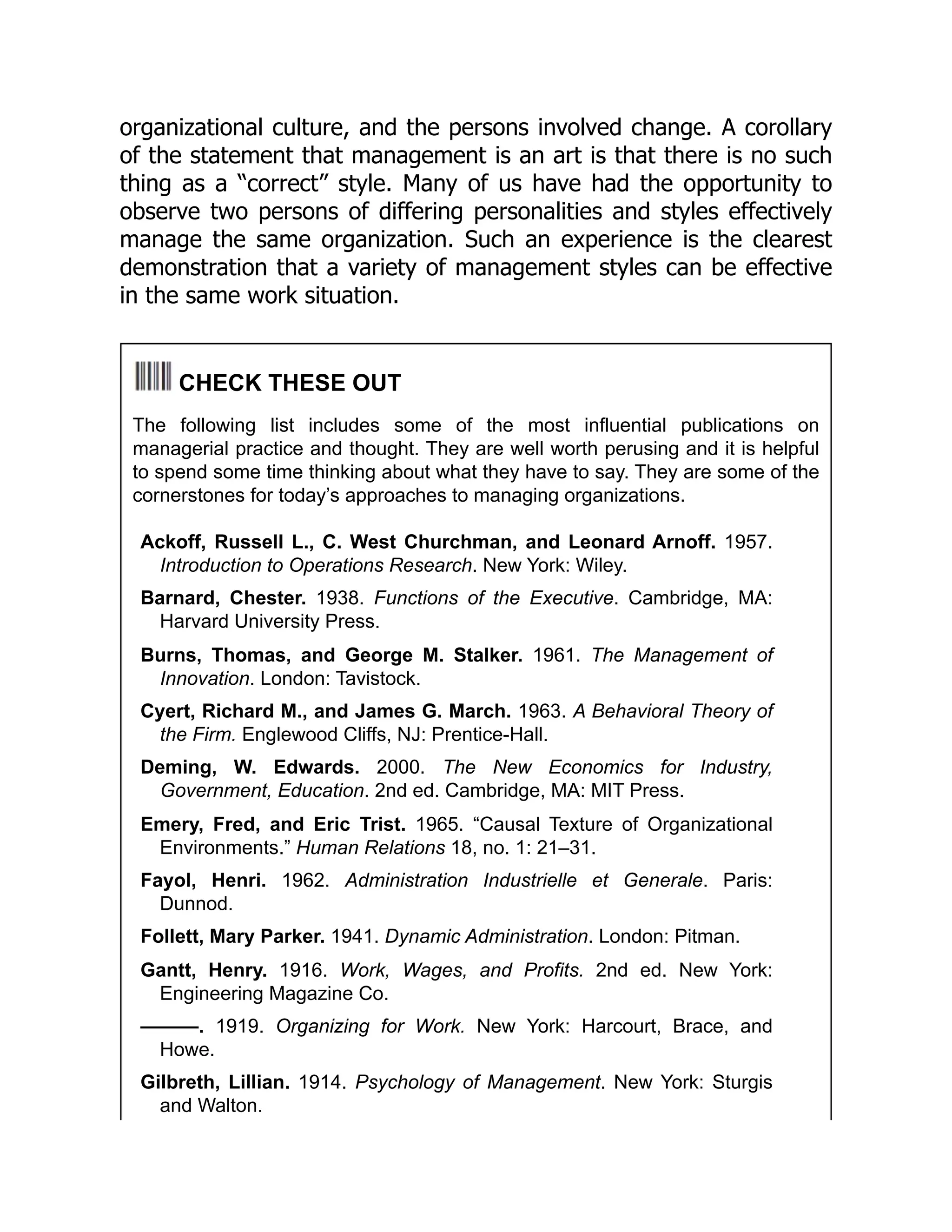
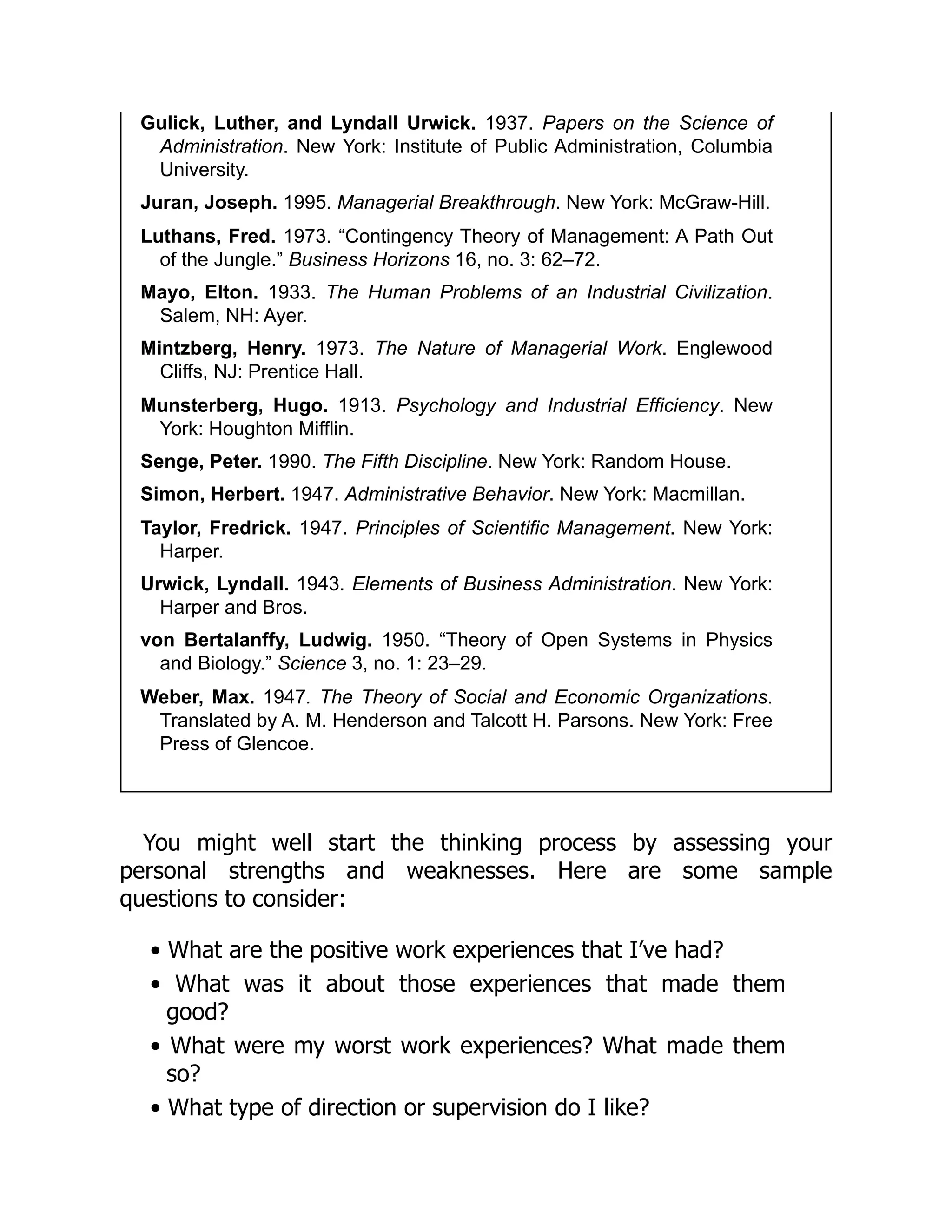
CHECK THESE OUT
The following list includes some of the most influential publications on
managerial practice and thought. They are well worth perusing and it is helpful
to spend some time thinking about what they have to say. They are some of the
cornerstones for today’s approaches to managing organizations.
Ackoff, Russell L., C. West Churchman, and Leonard Arnoff. 1957.
Introduction to Operations Research. New York: Wiley.
Barnard, Chester. 1938. Functions of the Executive. Cambridge, MA:
Harvard University Press.
Burns, Thomas, and George M. Stalker. 1961. The Management of
Innovation. London: Tavistock.
Cyert, Richard M., and James G. March. 1963. A Behavioral Theory of
the Firm. Englewood Cliffs, NJ: Prentice-Hall.
Deming, W. Edwards. 2000. The New Economics for Industry,
Government, Education. 2nd ed. Cambridge, MA: MIT Press.
Emery, Fred, and Eric Trist. 1965. “Causal Texture of Organizational
Environments.” Human Relations 18, no. 1: 21–31.
Fayol, Henri. 1962. Administration Industrielle et Generale. Paris:
Dunnod.
Follett, Mary Parker. 1941. Dynamic Administration. London: Pitman.
Gantt, Henry. 1916. Work, Wages, and Profits. 2nd ed. New York:
Engineering Magazine Co.
———. 1919. Organizing for Work. New York: Harcourt, Brace, and
Howe.
Gilbreth, Lillian. 1914. Psychology of Management. New York: Sturgis
and Walton.
Gulick, Luther, and Lyndall Urwick. 1937. Papers on the Science of
Administration. New York: Institute of Public Administration, Columbia
University.
Juran, Joseph. 1995. Managerial Breakthrough. New York: McGraw-Hill.
Luthans, Fred. 1973. “Contingency Theory of Management: A Path Out
of the Jungle.” Business Horizons 16, no. 3: 62–72.
Mayo, Elton. 1933. The Human Problems of an Industrial Civilization.
Salem, NH: Ayer.
Mintzberg, Henry. 1973. The Nature of Managerial Work. Englewood
Cliffs, NJ: Prentice Hall.
Munsterberg, Hugo. 1913. Psychology and Industrial Efficiency. New
York: Houghton Mifflin.
Senge, Peter. 1990. The Fifth Discipline. New York: Random House.
Simon, Herbert. 1947. Administrative Behavior. New York: Macmillan.
Taylor, Fredrick. 1947. Principles of Scientific Management. New York:
Harper.
Urwick, Lyndall. 1943. Elements of Business Administration. New York:
Harper and Bros.
von Bertalanffy, Ludwig. 1950. “Theory of Open Systems in Physics
and Biology.” Science 3, no. 1: 23–29.
Weber, Max. 1947. The Theory of Social and Economic Organizations.
Translated by A. M. Henderson and Talcott H. Parsons. New York: Free
Press of Glencoe.
You might well start the thinking process by assessing your
personal strengths and weaknesses. Here are some sample
questions to consider:
• What are the positive work experiences that I’ve had?
• What was it about those experiences that made them
good?
• What were my worst work experiences? What made them
so?
• What type of direction or supervision do I like?
• What type of directions am I comfortable giving?
• Can I, and how do I, tell someone that he or she has done
a good or a bad job?
• What management approaches do I find most comfortable?
As you develop answers to such questions, you are drafting your
own management style.
One of our professional mottos is “Everyone must get their hands
dirty from time to time.” This means that when a major task comes
up, the entire staff does the work—from the top down. Having the
entire organization shelf reading, shifting materials in the stacks, or
doing whatever else needs to be done results in everyone feeling like
part of a team and that there will be mutual support when needed.
FOR FURTHER THOUGHT
Regularly scanning recent issues of general and library-specific management
journals is one easy method to keep current with trends and new approaches.
On the general side we like the Harvard Business Review, Public Administration
Review, and MIT Sloan Management Review. On the library side we like
Bottom Line, Library Management, Library Leadership and Management,
Journal of Library Administration, and Evidence Based Library and Information
Practice.
PUBLIC AND NONPROFIT SECTORS
If you even briefly scanned the books listed in the sidebar
suggesting resources about the major approaches to management,
you probably noticed they all are focused on the for-profit
organization. That might cause you to think, “Wait a minute, this is
all about organizations making money. Libraries are different; how
can any of this apply?” This is a good question to ask. The answer
is, “they do when it is modified to fit the sector(s).”
What “sectors” are we talking about? Looking broadly at
organizations, the common approach is to place an organization into
one of three categories: private/for-profit, nonprofit, and public.
There is some cross-over as a public sector organization may have
non-profit status—libraries generally have dual status. We explore
the non-profit status in the chapter on legal concerns (having such
status is a function of Internal Revenue Service regulations). Do
sector differences really matter? Yes, they do indeed. As we will
discuss in the next chapter, an organization’s environment and sector
more or less determines how it goes about its business. Even
libraries in for-profit organizations are nonprofit in the sense that
they are not expected to directly increase the “bottom line.” Libraries
are, to use a common for-profit label, “cost centers” rather than
revenue centers.
One of the major sector differences is how the organization
determines success. There is one common success measure that all
for-profit organizations share—profit. The other two sectors lack
such a common measure, which means there are challenges in
assessing performance, even among libraries of the same type. It
can also make accountability more complex. The closest thing to a
common measure of success is providing a social good or value, an
underlying purpose of organizations in the two sectors.
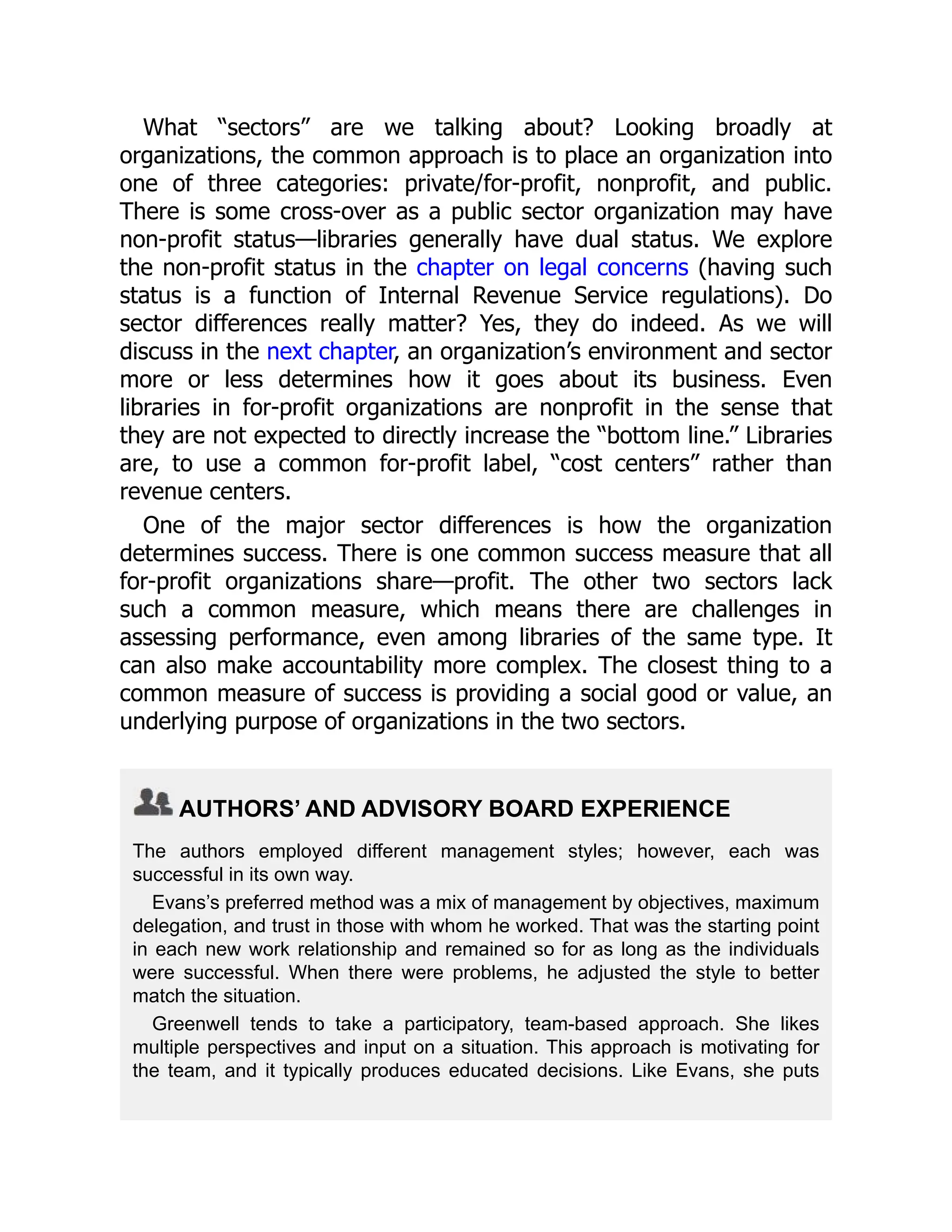
AUTHORS’ AND ADVISORY BOARD EXPERIENCE
The authors employed different management styles; however, each was
successful in its own way.
Evans’s preferred method was a mix of management by objectives, maximum
delegation, and trust in those with whom he worked. That was the starting point
in each new work relationship and remained so for as long as the individuals
were successful. When there were problems, he adjusted the style to better
match the situation.
Greenwell tends to take a participatory, team-based approach. She likes
multiple perspectives and input on a situation. This approach is motivating for
the team, and it typically produces educated decisions. Like Evans, she puts
trust in colleagues through frequent delegation—as long as that continues to
work.
Patricia Layzell-Ward identified her management style as situational, having
worked in different types of information and library settings, small and large,
and in three different countries. All had their own cultures and understanding
each culture and how the parent organization operated was a major challenge.
Each work setting was different and to be “successful” it was essential to
quickly understand the challenges and how people responded to the setting.
Moving between situations means that the manager needs to be a good listener
and quickly adapt to changing circumstances. Without this it is difficult for team
members to adapt to each other.
Joseph Mika’s preferred administrative style is based on contingency theory,
and he refers to it as “situational.” He has been a library administrator, library
consultant, and active in library and information science (LIS) programs for over
forty years, and he has also been influenced by education in management
courses from business schools, LIS classes, and U.S. Army programs. Over the
years what developed was a participative management style that considers the
individual who is being managed and that determines actions taken. As he put
it, “my style was influenced by the U.S. Army, which had an approach much like
that of Follett—get results through people—but over time the approach
mellowed to get results with people.”
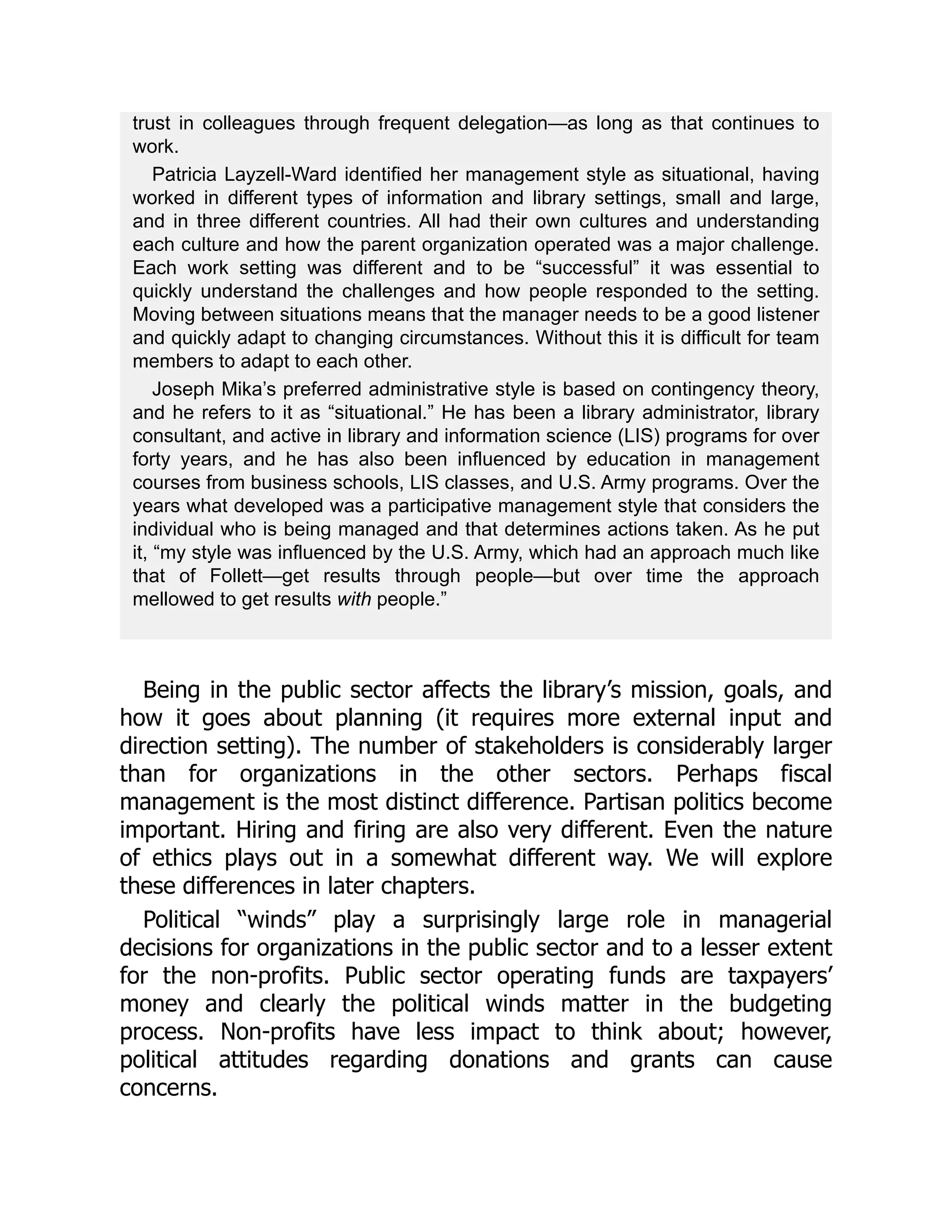
Being in the public sector affects the library’s mission, goals, and
how it goes about planning (it requires more external input and
direction setting). The number of stakeholders is considerably larger
than for organizations in the other sectors. Perhaps fiscal
management is the most distinct difference. Partisan politics become
important. Hiring and firing are also very different. Even the nature
of ethics plays out in a somewhat different way. We will explore
these differences in later chapters.
Political “winds” play a surprisingly large role in managerial
decisions for organizations in the public sector and to a lesser extent
for the non-profits. Public sector operating funds are taxpayers’
money and clearly the political winds matter in the budgeting
process. Non-profits have less impact to think about; however,
political attitudes regarding donations and grants can cause
concerns.
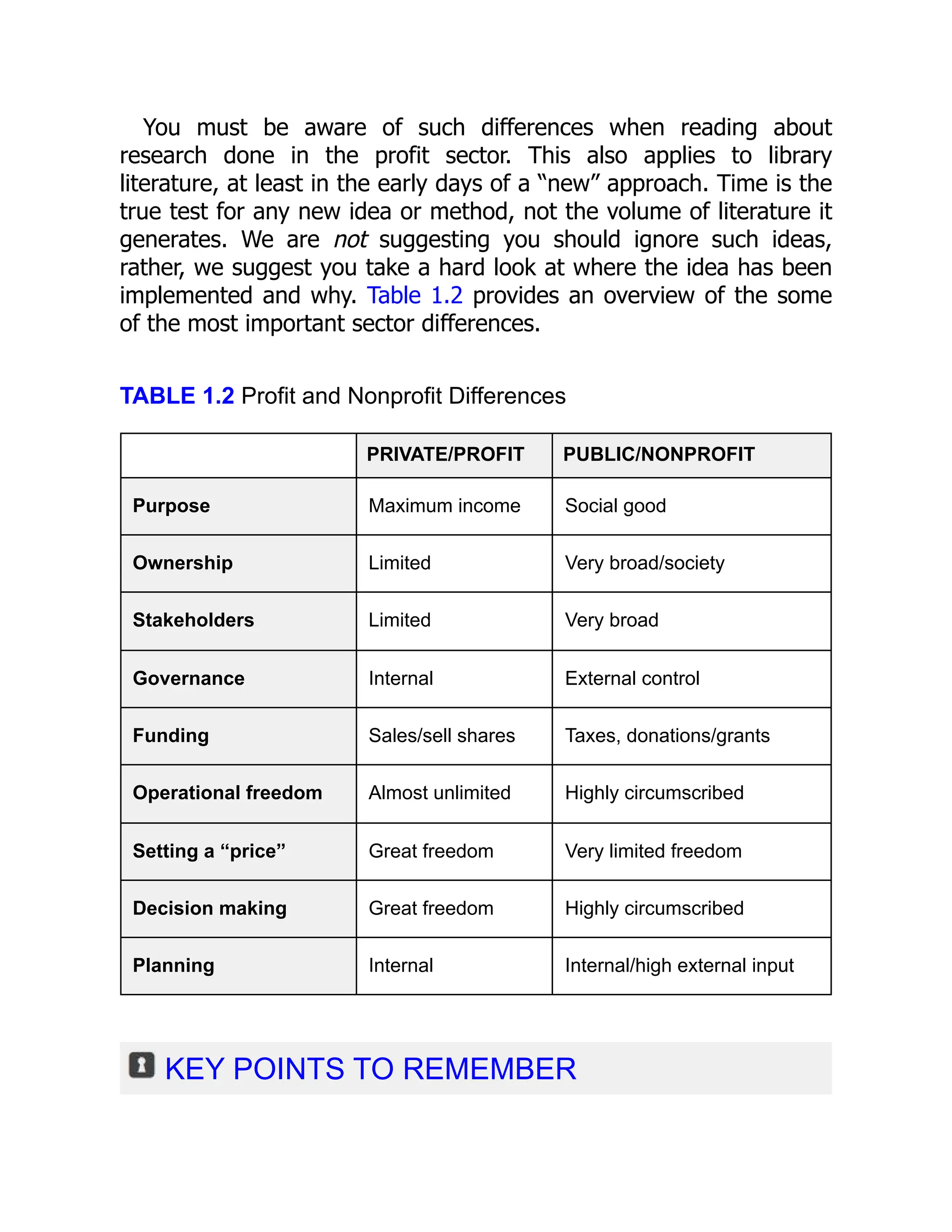
You must be aware of such differences when reading about
research done in the profit sector. This also applies to library
literature, at least in the early days of a “new” approach. Time is the
true test for any new idea or method, not the volume of literature it
generates. We are not suggesting you should ignore such ideas,
rather, we suggest you take a hard look at where the idea has been
implemented and why. Table 1.2 provides an overview of the some
of the most important sector differences.
TABLE 1.2 Profit and Nonprofit Differences
PRIVATE/PROFIT PUBLIC/NONPROFIT
Purpose Maximum income Social good
Ownership Limited Very broad/society
Stakeholders Limited Very broad
Governance Internal External control
Funding Sales/sell shares Taxes, donations/grants
Operational freedom Almost unlimited Highly circumscribed
Setting a “price” Great freedom Very limited freedom
Decision making Great freedom Highly circumscribed
Planning Internal Internal/high external input
KEY POINTS TO REMEMBER
• Managing is a pervasive activity, and it has been part of humankind’s
environment for as long as people have lived together.
• Thinking you will never become a “manager” as a librarian is
counterproductive, as almost all of us do manage to some degree and
much sooner than expected.
• Learning about management concepts and practices does not ensure
success, but that knowledge can assist in avoiding mistakes that hurt
everyone involved.
• Studying the major approaches to management and some of the major
thinkers is part of the learning process for successful managers.
• Understanding the options available as well as understanding yourself is
important in developing your own style.
• Locking into a single style is not wise, as different people require different
approaches.
• Being flexible is one of the cornerstones to being a successful manager.
REFERENCES
Birkinshaw, Julian. 2010. “Rethinking Management.” MIT Sloan Management
Review 51, no. 4: 14–15.
Cohen, Don, and Laurence Prusak. 2001. In Good Company: How Social Capital
Makes Organizations Work. Cambridge, MA: Harvard Business School Press.
Dougherty, Richard M. 2008. Streamlining Library Services: What We Do, How
Much Time It Takes, What It Costs, and How We Can Do It Better. Lanham,
MD: Scarecrow Press.
Faulkner, Autumn. 2016. “Teaching a New Dog Old Tricks: Supervising Veteran
Staff as an Early Career Librarian.” Library Leadership and Management 31, no.
1: 1–15. https://​
journals.tdl.org/​
llm/​
index.php/​
llm/​
issue/​
view/​
378.
Follett, Mary Parker. 1941. Dynamic Administration. London: Pitman.
Gulick, Luther, and Lyndall Urwick. 1937. Papers on the Science of Administration.
New York: Institute of Public Administration, Columbia University.
Holley, Robert P. 2015. “Education and Training for Library Management.” Journal
of Library Administration 55, no. 7: 595–603.
Katopol. Patricia. 2016. “Putting Up Road Blocks on Your Path Toward
Management.” Library Leadership and Management 30, no. 4: 1–5. https://​
journals.tdl.org/​
llm/​
index.php/​
llm/​
issue/​
view/​
377.
Koizumi, Masanori, and Michael M. Widdersheim. 2016. “Surpassing the Business
Model: A Public Sphere Approach to Public Library Management.” Library Review
65, nos.6/7: 404–19.
Mahoney, Thomas, Thomas Jardee, and Stephen Carroll. 1964. “The Job(s) of
Management.” Industrial Management 4, no. 2: 97–110.
Mintzberg, Henry. 1971. “Managerial Work: Analysis from Observation.”
Management Science 18, no. 2: B97–B110.
———. 1973. The Nature of Managerial Work. Englewood Cliffs, NJ: Prentice Hall.
———. 1975. “The Manager’s Job: Folklore and Fact.” Harvard Business Review
53, no. 5: 49–61.
Perry, James L., and Robert K. Christensen. 2015. Handbook of Public
Administration. 3rd ed. New York: Wiley.
Venner, Mary Ann. 2017. Mentoring Librarians for Management Roles in Academic
Libraries. https://​
www.informedlibrarian.com/​
guestForum.cfm?
FILE=gf1710.htm.
Wren, Daniel. 1979. The Evolution of Management Thought. 2nd ed. New York:
Wiley.
S
CHAPTER 2
Organizational Issues
Environment scanning is not only a tool for business. Every
organization, whether it is a for-profit or a nonprofit, needs to be aware
of its environment if it wants to be competitive—and you must be
competitive if you are going to survive.
Patricia Katopol, 2014
Organizational survival depends upon satisfactorily executing a plan
and achieving a set of conscious or subconscious, predetermined
objectives amidst calculated chaos and controlled disorder.
Michael Meeks, 2015
Each organization has its own unique culture, created over time through
the shared attitudes, values, beliefs, perceptions, and customs of its
members.
Jill Mierke and Vicki Williamson, 2017
uccessful managers operate on the basis of the precept
“adaptability is essential for survival,” even if they are not aware of
it. It is a precept that has a very long history—billions of years when
you think of the geological and biological record. To adapt effectively
managers must understand their current operating environment as
well as ponder possible changes in that environment.
Organizations have a life and, like people, change over time. They
are created and affected by outside factors, have a life span, and,
often, eventually die. Someone suggested there are no more than 63
organizations still in existence that were established before the
fifteenth century—most of which are religious organizations or
universities. Organizations die because of several factors, one of
which is a failure to adjust to a changing environment. A Harvard
Business Review (2016) article reporting on recent research noted in
a study of 29,688 publicly traded companies in existence between
1960 and 2009 that the life span of firms has been decreasing. The
article went on to note that the researchers suggested that firms
that don’t monitor or understand the rapidly changing digital
environment were the least likely to survive.
Organizations face challenges over which they have little control.
However, just like us, they can develop plans for how to address
potential challenges. Such planning may well reduce the negative
consequences and, in some circumstances, even benefit
organizations by anticipating these events. (We explore planning in
some depth in chapter 7.)
There are two broad organizational categories—formal (voluntary
and involuntary membership) and informal. Beyond these broad
types there are variations, such as formal for-profit, formal non-
profit, open/public membership, and restricted/private membership.
Libraries fall into what Eleanor Glor (2008) labeled public service
organizations (PSO), which are agencies that work directly with the
public.
Like people, organizations grow and change, and so do their
goals. Those goals may change over time to such an extent that the
founders would have difficulty recognizing “their” organization. Goals
expand and contract as a result of successes and failures as well as
from changes in the environment. In time, an organization can
change so much that some individuals leave because their personal
goals or values no longer match the organization’s goals.
FORMAL ORGANIZATIONS
Chester Barnard (1956), whom we mentioned in chapter 1, studied
how organizations develop, function, and change through time.
Human organizations, according to Barnard, consist of five basic
elements: size, interdependence, input, throughput, and output.
Organizations vary in size from one as large as the U.S. federal
government to one as small as two people. Sometimes people forget
that two- and three-person operations, such as small school and
public libraries, are, in fact, organizations. As such, they share most
of the same organizational issues as large ones.
Interdependence means there is a recognition of shared common
goals as well as an understanding that by working together it will be
easier to achieve these goals. Disagreement and tension will
inevitably arise over how to achieve the goals, but the value of the
shared benefits maintains organizational cohesion.
Established goals require a list of the inputs to achieve them, such
as people, materials, money, and information. After acquiring the
resources, the organization uses the resources (throughput)
effectively to achieve the desired results. The end product of that
processing is the output. Output can be as tangible as an automobile
or as intangible as the answer to a reference question.
As an organization becomes more complex, its goals and
objectives may conflict with one another, with other organizations,
and even with some of its staff. Handling such conflicts becomes a
normal fact of managerial life.
One major source of organizational conflict is competition for
resources. No matter how “well off” others may think an
organization is, within the organization there is a finite pool of
resources to distribute. During any given period, some resources
may be more available than others. In the 1950s, libraries worried
about material resources, physical facilities, and funds to support
intellectual freedom. During the 1960s, the big resource problem
was personnel. In the 1970s and 1980s, it was financial support. In
the 1990s, libraries faced the burden of having adequate funding for
information communication technology (ICT) equipment and
electronic resources. In the first two decades of this century, libraries
became concerned about competitors such as Google, a very difficult
economic environment, and the public’s view about the value of
library services. While the specifics vary, the conflict over resources
remains a constant. We explore this type of competition in several
later chapters, especially in chapter 17, “Managing Money.”
Random documents with unrelated
content Scribd suggests to you:
back
back
back
back
back
back
back
back
back
back
back
back
back
back
back
Management Basics for Information Professionals 4th Edition G. Edward Evans

Management Basics for Information Professionals 4th Edition G. Edward Evans

  • 1.
    Management Basics forInformation Professionals 4th Edition G. Edward Evans install download https://ebookmeta.com/product/management-basics-for-information- professionals-4th-edition-g-edward-evans/ Download more ebook from https://ebookmeta.com
  • 5.
    Instructors adopting thistextbook for a course may request supplementary case studies by emailing editionsmarketing@ala.org.
  • 7.
    © 2020 byG. Edward Evans and Stacey Greenwell Extensive effort has gone into ensuring the reliability of the information in this book; however, the publisher makes no warranty, express or implied, with respect to the material contained herein. ISBNs 978-0-8389-1873-9 (paper) 978-0-8389-4637-4 (PDF) 978-0-8389-4635-0 (ePub) 978-0-8389-4636-7 (Kindle) Library of Congress Cataloging-in-Publication Data Names: Evans, G. Edward, 1937– author. | Greenwell, Stacey, author. Title: Management basics for information professionals / G. Edward Evans, Stacey Greenwell. Description: 4th edition. | Chicago : ALA Neal-Schuman, 2020. | Includes bibliographical references and index. Identifiers: LCCN 2019025745 (print) | LCCN 2019025746 (ebook) | ISBN 9780838946374 (pdf) | ISBN 9780838946350 (epub) | ISBN 9780838946367 (kindle edition) | ISBN 9780838918739 (paperback) Subjects: LCSH: Library administration—United States. | Information services— United States—Management. Classification: LCC Z678 (ebook) | LCC Z678 .E9 2019 (print) | DDC 025.1—dc23 LC record available at https://​ lccn.loc.gov/​ 2019025745 Cover design by Kimberly Thornton; imagery © Adobe Stock. ALA Neal-Schuman purchases fund advocacy, awareness, and accreditation programs for library professionals worldwide.
  • 8.
    CONTENTS LIST OF ILLUSTRATIONS PREFACE PARTI. Background 1. Introduction What Is Management? Organizational Skill Sets You as a Future Manager Public and Nonprofit Sectors Key Points to Remember References 2. Organizational Issues Formal Organizations Public and Nonprofit Sector Organizations Environment and the Organization Environmental Scanning Forecasting Organizational Culture People Friendly Organizations Key Points to Remember References 3. Legal Issues Establishing a Library
  • 9.
    Libraries, Users, Safety,and the Law Tort Law and Liability Malpractice and Librarians Library Services and the Law User Privacy Contracts and Licenses Copyright Documentation Key Points to Remember References 4. Leadership What Is Leadership? Leadership Theories Emotional Intelligence Developing Leadership Skills E-Leadership E-Team Issues Key Points to Remember References 5. Ethics Ethics Do Matter Standards, Values, and Codes ALA Code of Ethics Key Points to Remember References PART II. Managerial Functions 6. Accountability, Authority, Power, and Delegation
  • 10.
    Power Influence Authority Delegation and OrganizationalStructure Duty and Responsibility Accountability Governance Key Points to Remember References 7. Vision, Mission, and Planning Mission Statements Vision Statements Value Statements Planning Process SWOT Analysis Types of Plans Strategic Planning Scenario Planning Who Should Plan? Value of Planning Key Points to Remember References 8. Assessment, Quality Control, and Operations Assessment and Accountability What Is Quality? Assessment Tools Local Data Collection Quality Control
  • 11.
    Project Management Key Pointsto Remember References 9. Decision Making Decision Making Environment Types of Decisions Rational Decision Making Problem Solving and Rational Decision Making Group Decision Making and Accountability Decision Aids Key Points to Remember References 10. Change Management Nature of Change Change Process Models Resistance to Change Implementing Change Stress and the Organization Innovation and Libraries Key Points to Remember References 11. Communication Communication Process Organizational Communication Written and Oral Communication Listening Nonverbal Communication
  • 12.
    Legitimacy of Communication KeyPoints to Remember References 12. Advocacy and Marketing Marketing Marketing Process Branding Public Relations Advocacy Key Points to Remember References PART III. Managing People 13. Staffing Staffing and the Law Staffing Process The New Hire Developing and Retaining Staff Performance Appraisal Corrective Action Grievances Collective Bargaining and Merit Systems Volunteers Key Points to Remember References 14. Enhancing Performance Organizational Development
  • 13.
    Learning Organizations Training andDevelopment Staff Development Day Team Building Libraries and Teams Key Points to Remember References 15. Managing Diversity Defining Diversity How Do You View Cultural Diversity? Managerial Responsibility Individual Responsibility Role of Professional Associations Planning for Diversity Library Governance and Diversity Diversity Program and Staff Social Justice and Diversity Providing Service to a Diverse Community Key Points to Remember References 16. Motivating Staff Motivation Theories Motivation in Practice Encouragement and Recognition Key Points to Remember References PART IV. Managing Things
  • 14.
    17. Managing Money Budgetas a Control Device Budget Cycle Preparation Defending the Request Budget Types Accounting Systems Fund Accounting Audits and Auditors Budget Reports Key Points to Remember References 18. Generating Income Revenue Sources Fundraising Process Seeking Grants Key Points to Remember References 19. Managing Technology Staff and User Training Technology Planning Controlling Technology Costs Physical Security Intellectual Security Cloud Computing Social Media Collaboration Key Points to Remember
  • 15.
    References 20. Managing Facilities Libraryas Place Managing the Facility Housekeeping Matters Risk Management Health, Safety, and Security Emergency and Disaster Management Sustainability Planning for New Space Key Points to Remember References PART V. Managing Yourself and Your Career 21. Other Managerial Skills Collaborating, Conflict Management, and Negotiation Meeting Management Time Management Self-Management Skills Professional Presentations and Publications References 22. Creating Your Career Career Planning Process Marketing Yourself Flexible Ways of Working Career Breaks Moving Forward
  • 16.
  • 17.
    ILLUSTRATIONS TABLES TABLE 1.1. MajorManagement Approaches TABLE 1.2. Profit and Nonprofit Differences TABLE 4.1. Characteristics of Managers Compared to Leaders TABLE 5.1. Common Organization Approaches to Ethical Decision Making TABLE 5.2. Interpretation Challenges TABLE 6.1. Common Methods for Structuring an Organization TABLE 6.2. Division of Roles and Responsibilities TABLE 7.1. Sub-Tactical and Operational Plans TABLE 8.1. Common Work Analysis/Control Techniques TABLE 9.1. Voting Paradoxes TABLE 10.1. Common Resistance-to-Change Variables TABLE 14.1. T&D Resources TABLE 16.1. Motivation Theories TABLE 22.1. Factors Leading to a Successful Career FIGURE FIGURE 1.1. Organizational Skill Sets
  • 18.
    T PREFACE his edition hasa three-fold purpose. The first is to introduce a new coauthor, Stacey Greenwell, who was a great collaborator in preparing the second edition of Academic Librarianship, another ALA Neal-Schuman publication. The second purpose is to make clear that an organization’s operational sector—for-profit, nonprofit, or public— plays a determining role in how you carry out basic management functions. The final purpose is to be more concise while adding new ideas and examples. The second purpose is perhaps the most significant. As with many introductory texts, prior editions of this book failed to seriously address the critical role that the library’s context plays in how basic management functions operate. Almost all libraries, with the exception of corporate libraries, are in either the public or nonprofit sectors (and some are in both). Those sectors have a major influence on what the basic elements of management will be and how they can be applied and remain within the law. (Indeed, as chapter 3 will explore, laws play a significant role in library operations.) Chapter 1 outlines, in broad strokes, the sector differences. The later chapters provide details of how those differences impact the application of basic management concepts. More often than not, when you read something in the library literature about a new idea related to managerial practice, it arose from work done in the for-profit sector. To be sure, there is research done on public and nonprofit organizations; however, it is not as extensive and often only applies to a narrow segment of the sector being investigated. In this edition, the book’s chapters have been restructured into five broad sections. Part I, the opening section, looks at general issues in managing a library—background, leadership, environment, legal, and ethical issues. Part II discusses seven of the basic
  • 19.
    managerial functions—accountability; vision,mission, and planning; assessment; decision making; change management; communication; and advocacy and marketing. Part III looks at “people” considerations—staffing; staff development and team building; diversity; and motivation. Part IV discusses “things”—money, technology, and facilities. Finally, Part V focuses on managing yourself and your career. Although this edition has substantially reduced the number of printed pages, there is new material in all of the chapters. The page count reduction was achieved through tighter, more concise language. The use of sidebars that present real work experiences, suggestions for further reading, and things to think about have been retained and updated. As was true with prior editions, we were lucky to have several seasoned managers and teachers who provided essential guidance and thinking regarding the content of this edition. Special thanks go to: Holland Christie is Manager of the Battle Ground Community Library, one of the libraries in the Fort Vancouver Regional Library District in Vancouver, Washington. She has worked in a multitude of roles within public libraries, including Programming Librarian, Youth Services Librarian, Public Services Manager, and Deputy Director. She received her MLS from the University of Arizona and a bachelor’s degree in English from Northern Arizona University. She has worked as a contributing editor and coauthor on several fiction and nonfiction titles; her most recent book project was as coauthor of Managerial Leadership for Librarians (Libraries Unlimited, 2017). Maggie Farrell is Dean of Libraries at the University of Nevada, Las Vegas. She previously served as Dean of Libraries at Clemson University and the University of Wyoming. She writes the quarterly column “Leadership Reflections” for the Journal of Library Administration. She also is active in the American Library Association, serving in various leadership roles. She received a BA from the University of Missouri-Kansas City, an MLS from the
  • 20.
    University of Arizona,and a Master’s in Public Administration from Arizona State University. Patricia Layzell Ward is semi-retired. Currently she is Hon. Archivist Modern Collections to the Ffestiniog Railway Company. She has worked in public and special libraries and enjoyed a long-time involvement in teaching and research. This included posts at North- Western Polytechnic, Loughborough University, Curtin University Western Australia, and the University of Wales Aberystwyth. She is Emeritus Editor of Library Management; author of conference papers, journal articles, and reports; examiner to a number of universities; a consultant in Europe, South America, South-East Asia, and Australia; and formerly active in IFLA. She is a Fellow of the Chartered Institute of Library and Information Professionals and holds a master’s degree and PhD in Library, Archives and Information Studies from University College London. Joseph Mika is Professor Emeritus at the School of Information Sciences, Wayne State University, Detroit, where he twice served as Director of the School during his twenty-five-year tenure at the University. He was also Assistant Dean at the School of Library and Information Science at the University of Southern Mississippi, Hattiesburg; Assistant Library Director at Johnson State College, Vermont; and Assistant Library Director at the Ohio State University, Mansfield Campus. His teaching areas included administration, customer service, personnel management, and collection development. He was co-owner of Hartzell-Mika Consulting, a firm in operation from 1999 to 2019, which provided assistance with library director searches, strategic planning facilitation, facility development and planning, and staff and board training sessions. Mika is a retired Colonel in the U.S. Army, having served twenty-nine years in the Army Reserves. Maggie Saponaro is Director of Collection Development Strategies at the University of Maryland Libraries, where she is responsible for the leadership and vision for the content of purchased and licensed collections across all disciplinary areas and formats. In this position, she directs the collection development work of the Libraries’ subject
  • 21.
    specialist liaison librarians,with primary responsibility for content and budgeting of the UMD Libraries’ general collections. She also serves on the Collection Strategies and Services administrative team for policy creation and strategic planning across the entire division. She was formerly Associate Director of Learning Resources at the Alexandria Campus of Northern Virginia Community College and a librarian for the College of Human Resources at Virginia Polytechnic Institute and State University. She is currently interim chair of the NorthEast Regional Library (NERL) Program Council Executive Committee and is a member of the Nexis Uni Advisory Committee. She holds a master’s degree in library science from the University of California, Los Angeles, with postgraduate work in the areas of personnel programs and public administration. A special acknowledgement is due for Camila Alire, coauthor of the prior edition, for allowing the use of some of her managerial experiences that were part of the last edition. G. Edward Evans, Flagstaff, Arizona Stacey Greenwell, Lexington, Kentucky
  • 22.
  • 23.
    S CHAPTER 1 Introduction Management isa role more and more librarians are finding themselves in with little preparation or guidance. . . . Preparing librarians for management roles enhances skills that may be applied in any area throughout their careers. Mary Ann Venner, 2017 Public libraries have acquiesced to public and government criticism in some ways. . . . As a result of pressure to become more businesslike, public libraries have adopted a “new managerialism.” Masanori Koizumi and Michael M. Widdersheim, 2016 Whether you work in an academic or public library (or another type of library altogether), you will be familiar with the management model of a librarian supervising paraprofessional staff. . . . But does that assumption still hold true when a relatively inexperienced librarian is supervising paraprofessional staff of long tenure? Autumn Faulkner, 2016 I would argue that it should be required of all students. Instead I propose being more honest about the introductory nature of such courses. No claims should be made that this course will provide students with the skills needed to be successful managers or provide absolute answers. Robert Holley, 2015 ome of you who are reading this as part of a required management course may be thinking something like, “I do not expect, nor do I want, to be a manager. All I want to do is be a good __________ librarian.” You fill in the blank. You are the not the first to have such thoughts, nor are you likely to be the last. Many of us
  • 24.
    do not thinkabout, or recognize, the pervasiveness of basic management elements (planning, budgeting, and decision making, for example) in our daily lives. And, it is surprising how fast we begin to have to manage when we become librarians. Patricia Katopol (2016) highlighted the point that many LIS students, including herself, do not expect nor want to be managers: “I don’t want to deal with people” and “I don’t want to be in authority, I just want a job” (p. 1). She later became a teacher of management in an SLIS program. Those of us involved in preparing this edition likewise had no managerial aspirations as students, but it happened. Odds are high that it will happen to you as well. For most of us, the workplace takes up a major part of our time. As result, that environment has a significant role in our outlook on life. Don Cohen and Laurence Prusak (2001) stated, “We experience work as a human, social activity that engages the same social needs and responses as the other parts of our lives; the need for connection and cooperation, support, and trust, a sense of belonging, fairness, and recognition” (p. x). Many of those workplace needs are directly influenced by those above us in the organizational structure. In a very real sense, being a good managerial leader is much more than helping make the organization effective. Perry and Christensen (2015) identified six skill sets a manager in the public sphere should develop—technical, human, conceptual, interpersonal, responsiveness, and focus on results and ethics. We cover such skills in later chapters. However, there are other managerial concerns not directly covered by those skills. The six skills do not address money matters like budgeting, but we will. Also, libraries exist as a place, even in this digital age, and we look at the “place aspect” in one of the chapters. There is also a final chapter focusing on career development, networking, and collaboration. There are those who claim management is just common sense. They are only marginally correct. What is often labeled “common sense” is, in reality, something one learns, to a greater or lesser degree, over time. Some people believe that because management is “just common sense”—there is nothing to be learned, or taught,
  • 25.
    about the activity.However, even those who have such beliefs do receive an education of sorts, largely achieved through trial and error, while they try to employ common sense. Also, it is safe to assume that these are the individuals who engage in the most muddling managerial styles and generally cause the most grief for their colleagues because they seem not to employ a system for their “managing.” AUTHOR AND ADVISORY BOARD EXPERIENCE AUTHORS On Evans’s first day as a full-time librarian he was given an assistant. Had he not had some undergraduate coursework in public administration he probably would have made a mess of that responsibility. The library school program he graduated from had no management and administration course requirement. He had taken the academic library course, which had a very modest emphasis on basic management knowledge and much less on skills. Greenwell should have known that management would be in her future. At seventeen years old, she was left “in charge” of a public library for an hour each Saturday while the librarian took a lunch break. Thankfully, no harm ensued. In her first full-time librarian position, within a few short months she found herself supervising a department of four seasoned librarians. While in library school she grumbled frequently about the required management course, but she became grateful for it not long after graduation. ADVISORY BOARD Joe Mika, who taught the basic management course at Wayne State University in Detroit, also points out that students should take the management and administration course because they themselves will have managers. Such coursework will help them to understand their managers and directors and how different administrative styles will affect their careers. Reading about management, taking a course, or attending some workshops on the subject improves your chances of being a better manager. Poor managers hurt their organizations and the people they work with, as well as themselves. Coursework and workshops
  • 26.
    will not ensureyou will be a good manager, but these tools can improve your skills. There is no magic bullet in terms of managerial success; what was effective yesterday may not be tomorrow. Management, at its most basic level, is about people (those you work with as well as yourself), and people are unpredictable. Everyone engages in a little “muddling” regardless of training; however, the amount of muddling decreases as the amount of training and experience increases. CHECK THIS OUT An interesting article that looks at what library directors do is Douglas Crane’s 2015 report on interviews he conducted after he thought he might like to become a director. He undertook the sixteen interviews because he had little idea about what a director actually did. The article, “May I Ask You a Question? Lesson Learned from Interviewing Public Library Leaders,” appeared in Public Libraries 54, no. 6: 34–38, 2015. You will have at least some supervisory or managerial responsibilities at least once during your career. Such duties will arise much sooner than you might imagine, if not from day one. The Faulkner quotation at the beginning of this chapter is from an article in which she describes how, within a few months of getting her MLS, she was assigned some project management duties (p. 2). Both the authors and Advisory Board members experienced a similar rapid move into managerial responsibilities (see the sidebar on page 4). For some individuals, management is a negative concept— manipulative, coercive, anti-employee, and authoritarian are a few words that may come to mind. These thoughts can be accurate at times, especially when managers have little background in basic management methods. Julian Birkinshaw (2010) wrote, “I think that the corruption of management as a word is partly the result of a 100-year period of trying to make sense of the big, industrial, hierarchical, bureaucratic company. All of the words we use around
  • 27.
    management now areessentially words about how you manage dehumanized, standardized machines that pump out millions and millions of identical products.” In the case of libraries, his thoughts are doubly on target. There is the size factor and for-profit nature of the organizations, and then there is the fact that most libraries are in the public and nonprofit sectors, further skewing the application of managerial concepts. WHAT IS MANAGEMENT? Perhaps the shortest definition of management is one attributed to Mary Parker Follett (1941): “management is the art of getting things done through people.” This definition belies the complexity of management yet concisely sums up management. A longer and more complex definition is Daniel Wren’s: “management is an activity essential to organized endeavors that perform certain functions to obtain the effective acquisition, allocation, and utilization of human efforts and physical resources for the purpose of accomplishing some goal” (1979, p. 3). There are literally hundreds of other definitions of the term. All contain two essential elements— people and activities. There is generally something of a pyramid shape to any organization, with more people involved in working directly with “customers” than in performing solely managerial duties. Most organizations consist of a “top” (few people), a “middle” (several people), and a “bottom” (many people). Certainly, there has been significant flattening of this structure, but a person would be hard- pressed to identify an organization with fewer than three levels. Even in a fully team-based organization there will be some type of team supervisor(s), team leader(s), and team members. Just what do managers do? There are many answers to this question, and the question actually deals with two issues: function and behavior. Some managerial functions are planning, directing, and budgeting, while the behavioral aspects involve roles such as negotiator or group spokesperson. Management writers tend to
  • 28.
    emphasize one sideor the other. This book is organized according to functions; however, we also explore behavioral aspects and place great emphasis on user needs. The standard concepts of a manager’s functional activities are outlined in a classic management paper by Gulick and Urwick (1937), in which they coined the acronym POSDCoRB, which stands for the following functions: • Planning • Organizing • Staffing • Directing • Coordinating • Reporting • Budgeting POSDCoRB functions underlie, in one form or another, all management behavior; however, they do not describe the work of a manager. They merely identify the objectives of a manager’s work. Henry Mintzberg (1973) suggested that because the functions fail to describe managerial behavior they are of little use. We believe this is too harsh a judgment, for if we do not know where we are going (that is, if we do not have objectives), how will we know when we get there? By studying POSDCoRB concepts, a person can gain an understanding of what good management attempts to accomplish. A reasonable question to ask is, “Do all organizational levels engage in the same activities?” A short answer is “yes,” but such an answer obscures many important differences, especially in terms of the skills employed (see figure 1.1). Senior managers tend to devote more time to planning than do other managers, and planning calls for a major use of conceptual skills. They also tend to devote more time to interacting with a variety of people, both internal and external, to the library. Such interaction calls for strong interpersonal
  • 29.
    relations skills. Finally,they typically engage in very little direct user service work, and thus they make limited use of the technical skills they once employed when they became librarians. Mahoney, Jardee, and Carroll (1964) discuss the concept of time spent on various activities by “bottoms,” “middles,” and “tops.” For bottoms, the emphasis is almost a mirror opposite of the tops: great emphasis on technical skills, a strong component of human-relations skills, and only limited use of conceptual skills. As always, middles are in between: less use of technical skills than bottoms but more than tops and a greater need for conceptual skills but less than for tops. You can envision these differences in terms of percentages. For bottoms, perhaps 60 to 70 percent of the emphasis is on technical skills, 20 to 30 percent on human relations, and the balance on conceptual abilities. Middles would perhaps be 20 to 30 percent technical, 10 to 50 percent human relations, and the balance conceptual. Conceptual abilities would be 40 to 50 percent for tops, with technical skills at 10 percent or less, and the balance involving human relations.
  • 30.
    FIGURE 1.1 OrganizationalSkill Sets ORGANIZATIONAL SKILL SETS Henry Mintzberg (1971, 1973, 1975) has had the greatest general influence in the area of how managers behave and how knowledge of behavior should change how management is taught. His critique of the functions approach led him to suggest that looking at the roles played would be more effective. He identified ten roles divided among three categories: interpersonal, informational, and decisional. Under interpersonal are three roles: figurehead, leader, and liaison. The informational category contains the roles of nerve center, disseminator, and spokesperson. Decisional activities include the roles of entrepreneur, disturbance handler, resource allocator, and negotiator. We suggest that there is a fourth role in the information category: politician. To some extent such a role is part of being a figurehead, leader, negotiator, and spokesperson. However, given the social and political changes that have occurred since Mintzberg
  • 31.
    carried out hisresearch in the 1970s, the political role has become ever more important. Without question, Mintzberg’s work added substantially to our understanding of what managers actually do. For teaching and learning purposes, however, the approach does not work very well because the research on which he based his concept focused on top managers and, to a lesser extent, on middle managers, and it focused on observable activities rather than on the reasons for the activities. Also, it does not represent a full picture of a manager’s work; as we noted, the role of politician is not clearly delineated. Because of these deficiencies, the classic “functions” approach is still the most useful method for newcomers to conceptualize managerial responsibilities. We will, at various points in later chapters, note how Mintzberg’s ideas come into play. As in many fields, there is a question of whether management is an art or a science. Our belief is that, despite elements of science, management is an art. Although a person can learn the basic concepts, principles, functions, techniques, and roles, each management situation is unique. Two situations may appear similar, but the individuals involved will be different. Even similar situations that involve the same personnel are unique. Thus, what worked yesterday may or may not work today. Your ability to read and anticipate the changes and make appropriate adjustments is the art of management. There are a great many different approaches for thinking about and applying management concepts and ideas in an organization. They are far too numerous to address adequately in any one book. Here are, however, some very broad approaches that many textbooks that are written for those going into the for-profit world cover to a greater or lesser degree. They are: • Scientific • Administrative • Behavioral
  • 32.
    • Management science •Systems • Contingency • Quality • Composite Table 1.1 provides an overview of these approaches and looks at some of the proponents. From a library management perspective, today’s approach is a composite of the first seven approaches. In many ways the approach used by managers in any organization is a personal version of the composite style. The scientific approach, which arose early in the Industrial Revolution, focuses on operational efficiency. Time and motion studies that identify the best way to do a task are the hallmark of this approach. A great book that applies this approach to the library is Richard Dougherty’s (2008) Streamlining Library Services: What We Do, How Much Time It Takes, What It Costs, and How We Can Do It Better. The administrative approach is reflected in almost every organization regardless of sector. This is the common foundation for almost all introductory management textbooks, including this one. Even when there is an emphasis on organizational leadership the basic management functions (planning, decision making, fiscal management, and the like) must take place. The behavioral approach is reflected in a concern with employees (their existing skills, interpersonal relations, etc.) and the “social side” of the workplace. Team building draws on the ideas found in this style of management. As we will discuss in later chapters, teams are an important component in many libraries’ operational practices. Organizational morale, as you may guess, is another element in the behavioral approach. A book related to libraries and the behavioral approach is Peter Hernon, Joan Giesecke, and Camila Alire’s Academic Librarians as Emotionally Intelligent Leaders (Westport, CT: Libraries Unlimited, 2007).
  • 33.
    TABLE 1.1 MajorManagement Approaches APPROACH MAJOR CONCEPTS MAJOR FIGURES Scientific Time management Efficiency F. W. Taylor F. and L. Gilbreth H. Gantt Administrative Staff motivation Social interaction H. Fayol, M. Weber L. Urwick, C. Barnard Behavioral Organizational structure Holistic organization H. Munsterberg L. Gilbreth, E. Mayo Management science Operations research Mathematical modeling H. A. Simon, R. Cyert and J. G. March Systems Interdependency System theory L. von Bertalanffy R. L. Ackoff, P. M. Senge Contingency theory No universals Environmental setting M. P. Follett, F. Luthans T. Burns and G. M. Stalker F. Emery and E. Trist Quality Customer satisfaction High quality W. E. Deming, J. Juran Composite No single approach Multidimensional P. Drucker, H. Mintzberg Management science focuses on organizational decision making in an effort to make that process as rational as possible. There is an emphasis on mathematical modeling, risk management, and simulations of alternative outcomes. This approach is probably the
  • 34.
    least drawn uponby libraries. It takes time and effort to do properly and the level of risk for the majority of library decisions is generally modest. It might be beneficial when thinking about starting a new service for a new segment of the service population, locating a new branch, or remodeling, renovating, or building a new physical facility. A systems approach views everything as interlinked and any change will have some impact elsewhere in the system. Perhaps the most significant aspect of this approach is that the organization’s external environment will affect how the organization should go about its activities. For libraries, the environmental focus is central. The external environment is the determining factor in what type of library it is—academic, public, school, or special. Further, a library’s primary purpose is to serve the needs of a specific service population. Understanding the current and changing needs of that population is critical to successful operations. (We explore the environmental factor in more depth in the next chapter.) Contingency theory’s primary tenet is there are no universals for managerial practice. This approach does not disregard the basic functions; rather, it acknowledges that their application will vary. It suggests that no two managerial situations are identical, no matter how similar they appear. In a way, the approach is a reflection of the notion that managing things is very much easier than managing people. People are unpredictable, are in a constant state of change, have good days and bad days, have good moods or bad moods, which makes managing them a challenging activity. Essentially, the approach says, “What worked yesterday may not work the same way today.” For libraries, situational awareness internally and externally plays a surprisingly large role in managerial activities. Quality concerns are an obvious part of library operations. Poor quality services will, in time, have a negative effect on library support. There are many useful ideas in contingency theory that can help you achieve the best quality possible given the available resources. The above are the major approaches to management; however, there is a veritable alphabet soup of spinoffs and various combinations with other labels. There are some that are “flashes in
  • 35.
    the pan” offeredby one consultant or another, while others are a little more long-lasting. The point to keep in mind is they draw on elements from the approaches described above. We are not suggesting such ideas do not have their merits; they frequently spotlight an aspect of organizational activity that requires more attention. However, they are rarely the factor in organizational success. The real secrets to success lie in understanding the fundamentals and applying them thoughtfully. YOU AS A FUTURE MANAGER Earlier we mentioned that many library school students do not see themselves ever becoming managers. However, the fact is that you, more often than not, will quickly find yourself being a “manager.” In today’s tight economic conditions, libraries face staffing shortages and other financial concerns that result in such things as vacant positions going unfilled and new positions being impossible to secure. These in turn often mean newcomers are asked early on to assume some managerial duties. You are better served, as are those you supervise, if you have already thought about what to do when called upon to assume some supervisory duties before it actually happens. Today’s effective managers employ the full range of options in the management tool kit, choosing which to use at any given time depending on the circumstances—a mix of the contingency and composite approaches. Almost everyone has a preferred managerial style; good managers are flexible and make changes when necessary. Doing so is the art of management—drawing on the basics, developing the skills to assess situations quickly and accurately, and having a finely-honed set of people skills. If you accept the idea that management is an art, it goes without saying that there is a need to develop a personal style. Furthermore, in moving from one management role to another, slight variations will emerge in that style. Individuals do not respond to everyone in the same way. A management style must change as situations, the
  • 36.
    organizational culture, andthe persons involved change. A corollary of the statement that management is an art is that there is no such thing as a “correct” style. Many of us have had the opportunity to observe two persons of differing personalities and styles effectively manage the same organization. Such an experience is the clearest demonstration that a variety of management styles can be effective in the same work situation. CHECK THESE OUT The following list includes some of the most influential publications on managerial practice and thought. They are well worth perusing and it is helpful to spend some time thinking about what they have to say. They are some of the cornerstones for today’s approaches to managing organizations. Ackoff, Russell L., C. West Churchman, and Leonard Arnoff. 1957. Introduction to Operations Research. New York: Wiley. Barnard, Chester. 1938. Functions of the Executive. Cambridge, MA: Harvard University Press. Burns, Thomas, and George M. Stalker. 1961. The Management of Innovation. London: Tavistock. Cyert, Richard M., and James G. March. 1963. A Behavioral Theory of the Firm. Englewood Cliffs, NJ: Prentice-Hall. Deming, W. Edwards. 2000. The New Economics for Industry, Government, Education. 2nd ed. Cambridge, MA: MIT Press. Emery, Fred, and Eric Trist. 1965. “Causal Texture of Organizational Environments.” Human Relations 18, no. 1: 21–31. Fayol, Henri. 1962. Administration Industrielle et Generale. Paris: Dunnod. Follett, Mary Parker. 1941. Dynamic Administration. London: Pitman. Gantt, Henry. 1916. Work, Wages, and Profits. 2nd ed. New York: Engineering Magazine Co. ———. 1919. Organizing for Work. New York: Harcourt, Brace, and Howe. Gilbreth, Lillian. 1914. Psychology of Management. New York: Sturgis and Walton.
  • 37.
    Gulick, Luther, andLyndall Urwick. 1937. Papers on the Science of Administration. New York: Institute of Public Administration, Columbia University. Juran, Joseph. 1995. Managerial Breakthrough. New York: McGraw-Hill. Luthans, Fred. 1973. “Contingency Theory of Management: A Path Out of the Jungle.” Business Horizons 16, no. 3: 62–72. Mayo, Elton. 1933. The Human Problems of an Industrial Civilization. Salem, NH: Ayer. Mintzberg, Henry. 1973. The Nature of Managerial Work. Englewood Cliffs, NJ: Prentice Hall. Munsterberg, Hugo. 1913. Psychology and Industrial Efficiency. New York: Houghton Mifflin. Senge, Peter. 1990. The Fifth Discipline. New York: Random House. Simon, Herbert. 1947. Administrative Behavior. New York: Macmillan. Taylor, Fredrick. 1947. Principles of Scientific Management. New York: Harper. Urwick, Lyndall. 1943. Elements of Business Administration. New York: Harper and Bros. von Bertalanffy, Ludwig. 1950. “Theory of Open Systems in Physics and Biology.” Science 3, no. 1: 23–29. Weber, Max. 1947. The Theory of Social and Economic Organizations. Translated by A. M. Henderson and Talcott H. Parsons. New York: Free Press of Glencoe. You might well start the thinking process by assessing your personal strengths and weaknesses. Here are some sample questions to consider: • What are the positive work experiences that I’ve had? • What was it about those experiences that made them good? • What were my worst work experiences? What made them so? • What type of direction or supervision do I like?
  • 38.
    • What typeof directions am I comfortable giving? • Can I, and how do I, tell someone that he or she has done a good or a bad job? • What management approaches do I find most comfortable? As you develop answers to such questions, you are drafting your own management style. One of our professional mottos is “Everyone must get their hands dirty from time to time.” This means that when a major task comes up, the entire staff does the work—from the top down. Having the entire organization shelf reading, shifting materials in the stacks, or doing whatever else needs to be done results in everyone feeling like part of a team and that there will be mutual support when needed. FOR FURTHER THOUGHT Regularly scanning recent issues of general and library-specific management journals is one easy method to keep current with trends and new approaches. On the general side we like the Harvard Business Review, Public Administration Review, and MIT Sloan Management Review. On the library side we like Bottom Line, Library Management, Library Leadership and Management, Journal of Library Administration, and Evidence Based Library and Information Practice. PUBLIC AND NONPROFIT SECTORS If you even briefly scanned the books listed in the sidebar suggesting resources about the major approaches to management, you probably noticed they all are focused on the for-profit organization. That might cause you to think, “Wait a minute, this is all about organizations making money. Libraries are different; how can any of this apply?” This is a good question to ask. The answer is, “they do when it is modified to fit the sector(s).”
  • 39.
    What “sectors” arewe talking about? Looking broadly at organizations, the common approach is to place an organization into one of three categories: private/for-profit, nonprofit, and public. There is some cross-over as a public sector organization may have non-profit status—libraries generally have dual status. We explore the non-profit status in the chapter on legal concerns (having such status is a function of Internal Revenue Service regulations). Do sector differences really matter? Yes, they do indeed. As we will discuss in the next chapter, an organization’s environment and sector more or less determines how it goes about its business. Even libraries in for-profit organizations are nonprofit in the sense that they are not expected to directly increase the “bottom line.” Libraries are, to use a common for-profit label, “cost centers” rather than revenue centers. One of the major sector differences is how the organization determines success. There is one common success measure that all for-profit organizations share—profit. The other two sectors lack such a common measure, which means there are challenges in assessing performance, even among libraries of the same type. It can also make accountability more complex. The closest thing to a common measure of success is providing a social good or value, an underlying purpose of organizations in the two sectors. AUTHORS’ AND ADVISORY BOARD EXPERIENCE The authors employed different management styles; however, each was successful in its own way. Evans’s preferred method was a mix of management by objectives, maximum delegation, and trust in those with whom he worked. That was the starting point in each new work relationship and remained so for as long as the individuals were successful. When there were problems, he adjusted the style to better match the situation. Greenwell tends to take a participatory, team-based approach. She likes multiple perspectives and input on a situation. This approach is motivating for the team, and it typically produces educated decisions. Like Evans, she puts
  • 40.
    trust in colleaguesthrough frequent delegation—as long as that continues to work. Patricia Layzell-Ward identified her management style as situational, having worked in different types of information and library settings, small and large, and in three different countries. All had their own cultures and understanding each culture and how the parent organization operated was a major challenge. Each work setting was different and to be “successful” it was essential to quickly understand the challenges and how people responded to the setting. Moving between situations means that the manager needs to be a good listener and quickly adapt to changing circumstances. Without this it is difficult for team members to adapt to each other. Joseph Mika’s preferred administrative style is based on contingency theory, and he refers to it as “situational.” He has been a library administrator, library consultant, and active in library and information science (LIS) programs for over forty years, and he has also been influenced by education in management courses from business schools, LIS classes, and U.S. Army programs. Over the years what developed was a participative management style that considers the individual who is being managed and that determines actions taken. As he put it, “my style was influenced by the U.S. Army, which had an approach much like that of Follett—get results through people—but over time the approach mellowed to get results with people.” Being in the public sector affects the library’s mission, goals, and how it goes about planning (it requires more external input and direction setting). The number of stakeholders is considerably larger than for organizations in the other sectors. Perhaps fiscal management is the most distinct difference. Partisan politics become important. Hiring and firing are also very different. Even the nature of ethics plays out in a somewhat different way. We will explore these differences in later chapters. Political “winds” play a surprisingly large role in managerial decisions for organizations in the public sector and to a lesser extent for the non-profits. Public sector operating funds are taxpayers’ money and clearly the political winds matter in the budgeting process. Non-profits have less impact to think about; however, political attitudes regarding donations and grants can cause concerns.
  • 41.
    You must beaware of such differences when reading about research done in the profit sector. This also applies to library literature, at least in the early days of a “new” approach. Time is the true test for any new idea or method, not the volume of literature it generates. We are not suggesting you should ignore such ideas, rather, we suggest you take a hard look at where the idea has been implemented and why. Table 1.2 provides an overview of the some of the most important sector differences. TABLE 1.2 Profit and Nonprofit Differences PRIVATE/PROFIT PUBLIC/NONPROFIT Purpose Maximum income Social good Ownership Limited Very broad/society Stakeholders Limited Very broad Governance Internal External control Funding Sales/sell shares Taxes, donations/grants Operational freedom Almost unlimited Highly circumscribed Setting a “price” Great freedom Very limited freedom Decision making Great freedom Highly circumscribed Planning Internal Internal/high external input KEY POINTS TO REMEMBER
  • 42.
    • Managing isa pervasive activity, and it has been part of humankind’s environment for as long as people have lived together. • Thinking you will never become a “manager” as a librarian is counterproductive, as almost all of us do manage to some degree and much sooner than expected. • Learning about management concepts and practices does not ensure success, but that knowledge can assist in avoiding mistakes that hurt everyone involved. • Studying the major approaches to management and some of the major thinkers is part of the learning process for successful managers. • Understanding the options available as well as understanding yourself is important in developing your own style. • Locking into a single style is not wise, as different people require different approaches. • Being flexible is one of the cornerstones to being a successful manager. REFERENCES Birkinshaw, Julian. 2010. “Rethinking Management.” MIT Sloan Management Review 51, no. 4: 14–15. Cohen, Don, and Laurence Prusak. 2001. In Good Company: How Social Capital Makes Organizations Work. Cambridge, MA: Harvard Business School Press. Dougherty, Richard M. 2008. Streamlining Library Services: What We Do, How Much Time It Takes, What It Costs, and How We Can Do It Better. Lanham, MD: Scarecrow Press. Faulkner, Autumn. 2016. “Teaching a New Dog Old Tricks: Supervising Veteran Staff as an Early Career Librarian.” Library Leadership and Management 31, no. 1: 1–15. https://​ journals.tdl.org/​ llm/​ index.php/​ llm/​ issue/​ view/​ 378. Follett, Mary Parker. 1941. Dynamic Administration. London: Pitman. Gulick, Luther, and Lyndall Urwick. 1937. Papers on the Science of Administration. New York: Institute of Public Administration, Columbia University. Holley, Robert P. 2015. “Education and Training for Library Management.” Journal of Library Administration 55, no. 7: 595–603. Katopol. Patricia. 2016. “Putting Up Road Blocks on Your Path Toward Management.” Library Leadership and Management 30, no. 4: 1–5. https://​ journals.tdl.org/​ llm/​ index.php/​ llm/​ issue/​ view/​ 377.
  • 43.
    Koizumi, Masanori, andMichael M. Widdersheim. 2016. “Surpassing the Business Model: A Public Sphere Approach to Public Library Management.” Library Review 65, nos.6/7: 404–19. Mahoney, Thomas, Thomas Jardee, and Stephen Carroll. 1964. “The Job(s) of Management.” Industrial Management 4, no. 2: 97–110. Mintzberg, Henry. 1971. “Managerial Work: Analysis from Observation.” Management Science 18, no. 2: B97–B110. ———. 1973. The Nature of Managerial Work. Englewood Cliffs, NJ: Prentice Hall. ———. 1975. “The Manager’s Job: Folklore and Fact.” Harvard Business Review 53, no. 5: 49–61. Perry, James L., and Robert K. Christensen. 2015. Handbook of Public Administration. 3rd ed. New York: Wiley. Venner, Mary Ann. 2017. Mentoring Librarians for Management Roles in Academic Libraries. https://​ www.informedlibrarian.com/​ guestForum.cfm? FILE=gf1710.htm. Wren, Daniel. 1979. The Evolution of Management Thought. 2nd ed. New York: Wiley.
  • 44.
    S CHAPTER 2 Organizational Issues Environmentscanning is not only a tool for business. Every organization, whether it is a for-profit or a nonprofit, needs to be aware of its environment if it wants to be competitive—and you must be competitive if you are going to survive. Patricia Katopol, 2014 Organizational survival depends upon satisfactorily executing a plan and achieving a set of conscious or subconscious, predetermined objectives amidst calculated chaos and controlled disorder. Michael Meeks, 2015 Each organization has its own unique culture, created over time through the shared attitudes, values, beliefs, perceptions, and customs of its members. Jill Mierke and Vicki Williamson, 2017 uccessful managers operate on the basis of the precept “adaptability is essential for survival,” even if they are not aware of it. It is a precept that has a very long history—billions of years when you think of the geological and biological record. To adapt effectively managers must understand their current operating environment as well as ponder possible changes in that environment. Organizations have a life and, like people, change over time. They are created and affected by outside factors, have a life span, and, often, eventually die. Someone suggested there are no more than 63 organizations still in existence that were established before the fifteenth century—most of which are religious organizations or universities. Organizations die because of several factors, one of which is a failure to adjust to a changing environment. A Harvard
  • 45.
    Business Review (2016)article reporting on recent research noted in a study of 29,688 publicly traded companies in existence between 1960 and 2009 that the life span of firms has been decreasing. The article went on to note that the researchers suggested that firms that don’t monitor or understand the rapidly changing digital environment were the least likely to survive. Organizations face challenges over which they have little control. However, just like us, they can develop plans for how to address potential challenges. Such planning may well reduce the negative consequences and, in some circumstances, even benefit organizations by anticipating these events. (We explore planning in some depth in chapter 7.) There are two broad organizational categories—formal (voluntary and involuntary membership) and informal. Beyond these broad types there are variations, such as formal for-profit, formal non- profit, open/public membership, and restricted/private membership. Libraries fall into what Eleanor Glor (2008) labeled public service organizations (PSO), which are agencies that work directly with the public. Like people, organizations grow and change, and so do their goals. Those goals may change over time to such an extent that the founders would have difficulty recognizing “their” organization. Goals expand and contract as a result of successes and failures as well as from changes in the environment. In time, an organization can change so much that some individuals leave because their personal goals or values no longer match the organization’s goals. FORMAL ORGANIZATIONS Chester Barnard (1956), whom we mentioned in chapter 1, studied how organizations develop, function, and change through time. Human organizations, according to Barnard, consist of five basic elements: size, interdependence, input, throughput, and output. Organizations vary in size from one as large as the U.S. federal
  • 46.
    government to oneas small as two people. Sometimes people forget that two- and three-person operations, such as small school and public libraries, are, in fact, organizations. As such, they share most of the same organizational issues as large ones. Interdependence means there is a recognition of shared common goals as well as an understanding that by working together it will be easier to achieve these goals. Disagreement and tension will inevitably arise over how to achieve the goals, but the value of the shared benefits maintains organizational cohesion. Established goals require a list of the inputs to achieve them, such as people, materials, money, and information. After acquiring the resources, the organization uses the resources (throughput) effectively to achieve the desired results. The end product of that processing is the output. Output can be as tangible as an automobile or as intangible as the answer to a reference question. As an organization becomes more complex, its goals and objectives may conflict with one another, with other organizations, and even with some of its staff. Handling such conflicts becomes a normal fact of managerial life. One major source of organizational conflict is competition for resources. No matter how “well off” others may think an organization is, within the organization there is a finite pool of resources to distribute. During any given period, some resources may be more available than others. In the 1950s, libraries worried about material resources, physical facilities, and funds to support intellectual freedom. During the 1960s, the big resource problem was personnel. In the 1970s and 1980s, it was financial support. In the 1990s, libraries faced the burden of having adequate funding for information communication technology (ICT) equipment and electronic resources. In the first two decades of this century, libraries became concerned about competitors such as Google, a very difficult economic environment, and the public’s view about the value of library services. While the specifics vary, the conflict over resources remains a constant. We explore this type of competition in several later chapters, especially in chapter 17, “Managing Money.”
  • 47.
    Random documents withunrelated content Scribd suggests to you:
  • 48.
  • 49.
  • 50.
  • 51.
  • 52.
  • 54.
  • 56.
  • 58.
  • 60.
  • 62.
  • 64.
  • 66.
  • 68.
  • 70.
  • 72.