ADMNISTRATION
process and activities
Introduction
 Libraries have to operative within the framework etc. of the
parent body.
 Library Manager might be a member of executive committees
and directly participate in decision making.
 Librarian design policies and proposals for approval .
 Librarian carry out dual responsibilities as a administrator and
manager
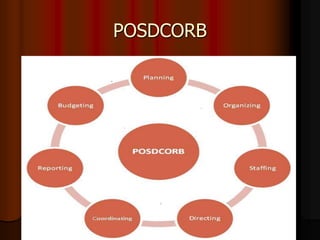
POSDCORB
 POSDCORB is an acronym widely used in the field
of Management and Public Administration.
 It first appeared in a 1937 staff paper by Luther
Gulick and Lyndall Urwick.
POSDCORB
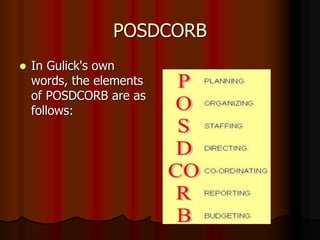
 In Gulick's own
words, the elements
of POSDCORB are as
follows:
POSDCORB
Planning
► The word ‘plan’ used in the meaning of ‘to forecast’, and ‘to
plan’.
► Planning also called forethought
► It is a process of thinking about activities required to achieve a
desired goal.
► Deciding about all the aspects of activities is called
planning.
► A process of taking decisions and way outs to perform
work or works.
Definition of planning
 According ot koontz and O’donnell,”
Planning is deciding in advance What to
do , how to do it, when to do it, and who
is to do it.” It gives courses of action for
the organization.
Areas of Planning
► (1) Objectives
► (2) Policies
► (3) Procedures
► (4) Rules
► (5) Programmes
► (6) Strategies
Characteristics of planning…
►Planning focuses on achieving the
objectives: Management begins with
planning and planning begins with the
determining of objectives. In the absence
of objectives no organization can ever be
thought about.
Characteristics of planning…
►Planning is the basic, primary, first and
important managerial function at all
executive levels. The other functions come
later. In the absence of planning no other
function of management can be
performed.
Characteristics of planning…
►planning is continuous process which
begins with the beginning of business
itself and ends with the ending of the
business. It means that as long a business
exists, the planning process is continuous.
Characteristics of planning…
►Planning is a mental exercise. It is related
to thinking before doing something.
►It decides the plan of action:
► (1) What to do?
►(2) how to do it?
►(3)When to do it?
►(4) Who is to do it?
►Under the planning, answer to these
questions are found out.
Importance…
►Planning increases the efficiency of an
organization.
►It reduces the risks of uncertainty involved
in modern business activities.
► It utilizes with maximum efficiency the
available time and resources.
►Planning provides direction
Importance…
►Reduce overlapping and wasteful activities
►Facilitate decision making
►Standard for controlling
►It is needed at every level of the
management.
►In the absence of planning all the business
activities of the organization will become
meaningless.
Importance…
► The first and most important function of an
administrator and manager.
► Planning is preparing a sequence of action steps
to achieve some specific goal.
► A plan is like a map. When following a plan, you
can always see how much you have progressed
towards your project goal and how far you are
from your destination.
► remove the basic defects and their future
implications.
Planning Process
►identifies the goals or objectives to be
achieved,
►formulates strategies to achieve them,
►arranges or creates the means required,
and implements, directs, and monitors all
steps in their proper sequence
Limitations of planning
Planning is needed both in the business and non business
organizations. Following are the limitations of planning.
► Planning does not work in Dynamic Environment.
► Planning reduce creativity.
► Planning takes a lot of time.
► Planning does not guarantee of success rather more
efforts have to be made for it.
Organizing
 Organizing is the process of identifying,
grouping and structuring the
work/tasks/goals/activities to be
performed in order to attain objectives.
 Organizational structure is established and
subdivisions are arranged for achieving
the set goals.
Meaning and Definition…
 Gulick's explaining that if an executive's
workload becomes too overwhelming, some of
the elements of the basic functions can be
organized as subdivisions of the executive,
depending on the size and complexity of the
enterprise.
 Under Organizing, Gulick emphasized the
division and specialization. Work specialization
is the degree to which organizational tasks are
sub-divided into individual jobs.
Importance
 To perform work smoothly and efficiently.
 To avoid confusion and overwhelming
 To Save time and labour
 To provide services efficiently
 To help in controlling
 To help in accountability
 To share powers and make them responsible
 To help in job description
 To make easy to decide about training to staff
Steps in organization
(1) Identification of activities.
(2) Organizing the activities.
(3) Classifying the authority. Classify the powers
(4) Coordination between authority and
responsibility. Smooth interaction.
Purpose…
1. Helps to achieve organizational goals.
Organization is employed to achieve the overall
objectives.
2. Optimum use of resources. To make optimum use of
resources such as men, material, money, machine and
method, it is necessary to design an organization
properly.
Purpose…
3. To perform managerial function.
Planning, Organizing, Staffing, Directing and
Controlling cannot be implemented without proper
organization.
4. Facilitates growth and diversification.
A good organization structure is essential for
expanding business activity.
 Efficient work totally depend upon proper staff
and recruitment policies.
 Staffing, that is the whole personnel function of
bringing in and training the staff and maintaining
favorable conditions of work;
 Staffing is the process of hiring, positioning and
overseeing employees in a library.
Staffing
Directing
 DIRECTING is said to be a process in which the
managers instruct, guide and oversee the performance
of the workers to achieve predetermined goals.
 Directing is the continuous task of making decisions and
drive in general and specific orders and instruction and
continuously monitoring and look after.
 Directing initiates action and it is from here actual work
starts.
 In simple words, it can be described as providing
guidance to workers is doing work.
Directing…
 In field of management, direction is said to be all those
activities which are designed to encourage the
subordinates to work effectively and efficiently.
 Directing consists of process or technique by which
instruction can be issued and operations can be carried
out as originally planned.
 Directing is the function of guiding, inspiring, overseeing
and instructing people towards accomplishment of
organizational goals.
Coordinating
 Coordinating, that is the all important duty of
interrelating the various parts of the work;
 Leader can properly inter-relate various parts of an
organization in a harmonious way.
 In coordination the role of the leader is crucial.
Coordination will be successful only if leader know each
and every work of library and interact properly.
Coordinating…
 Successful coordination if the power are shared or
vested to all the subdivisions and make them responsible
and accountable them for their works.
 integration of activities, responsibilities, and command
and control structures to ensure that the resources of
an organization are used most efficiently in pursuit of
the specified objectives.
Reporting
 Means keeping authorities informed about the progress of his work.
 It is a sound practical of organization that a periodical report is
asked from a head of an enterprise.
 Such reports should be factual one based upon actual and faithful
statistical data.
 Annual report to the executive authority concerned.
 The librarian has to ask various section heads of to maintain proper
records and statistics.

Budgeting
 Budgeting is the process of planning for future financial
requirements to achieve goals and objectives.
 The budget can be stated in terms of income and
expenses.
 Budget is defined as an estimate often itemized of
expected income and expense or operating results for a
given period in the future. Thus a library budget is an
estimate of expected income and expenditure of the
library for the coming year.
Budgeting…
 As budget is an estimate, therefore, it can be altered, if
the circumstances change. It needs to be flexible
enough to meet the changing needs. However, any
alteration should be carried out very carefully.
 Budgeting in libraries is usually done on yearly basis. On
the other hand an annual financial report or statement
tell us as to what was achieved as what could be done
last year.
THE END

Lec-2Administrative process and functions.ppt

  • 1.
  • 2.
    Introduction  Libraries haveto operative within the framework etc. of the parent body.  Library Manager might be a member of executive committees and directly participate in decision making.  Librarian design policies and proposals for approval .  Librarian carry out dual responsibilities as a administrator and manager
  • 3.
    POSDCORB  POSDCORB isan acronym widely used in the field of Management and Public Administration.  It first appeared in a 1937 staff paper by Luther Gulick and Lyndall Urwick.
  • 4.
    POSDCORB  In Gulick'sown words, the elements of POSDCORB are as follows:
  • 5.
  • 6.
    Planning ► The word‘plan’ used in the meaning of ‘to forecast’, and ‘to plan’. ► Planning also called forethought ► It is a process of thinking about activities required to achieve a desired goal. ► Deciding about all the aspects of activities is called planning. ► A process of taking decisions and way outs to perform work or works.
  • 7.
    Definition of planning According ot koontz and O’donnell,” Planning is deciding in advance What to do , how to do it, when to do it, and who is to do it.” It gives courses of action for the organization.
  • 8.
    Areas of Planning ►(1) Objectives ► (2) Policies ► (3) Procedures ► (4) Rules ► (5) Programmes ► (6) Strategies
  • 9.
    Characteristics of planning… ►Planningfocuses on achieving the objectives: Management begins with planning and planning begins with the determining of objectives. In the absence of objectives no organization can ever be thought about.
  • 10.
    Characteristics of planning… ►Planningis the basic, primary, first and important managerial function at all executive levels. The other functions come later. In the absence of planning no other function of management can be performed.
  • 11.
    Characteristics of planning… ►planningis continuous process which begins with the beginning of business itself and ends with the ending of the business. It means that as long a business exists, the planning process is continuous.
  • 12.
    Characteristics of planning… ►Planningis a mental exercise. It is related to thinking before doing something. ►It decides the plan of action: ► (1) What to do? ►(2) how to do it? ►(3)When to do it? ►(4) Who is to do it? ►Under the planning, answer to these questions are found out.
  • 13.
    Importance… ►Planning increases theefficiency of an organization. ►It reduces the risks of uncertainty involved in modern business activities. ► It utilizes with maximum efficiency the available time and resources. ►Planning provides direction
  • 14.
    Importance… ►Reduce overlapping andwasteful activities ►Facilitate decision making ►Standard for controlling ►It is needed at every level of the management. ►In the absence of planning all the business activities of the organization will become meaningless.
  • 15.
    Importance… ► The firstand most important function of an administrator and manager. ► Planning is preparing a sequence of action steps to achieve some specific goal. ► A plan is like a map. When following a plan, you can always see how much you have progressed towards your project goal and how far you are from your destination. ► remove the basic defects and their future implications.
  • 16.
    Planning Process ►identifies thegoals or objectives to be achieved, ►formulates strategies to achieve them, ►arranges or creates the means required, and implements, directs, and monitors all steps in their proper sequence
  • 17.
    Limitations of planning Planningis needed both in the business and non business organizations. Following are the limitations of planning. ► Planning does not work in Dynamic Environment. ► Planning reduce creativity. ► Planning takes a lot of time. ► Planning does not guarantee of success rather more efforts have to be made for it.
  • 18.
    Organizing  Organizing isthe process of identifying, grouping and structuring the work/tasks/goals/activities to be performed in order to attain objectives.  Organizational structure is established and subdivisions are arranged for achieving the set goals.
  • 19.
    Meaning and Definition… Gulick's explaining that if an executive's workload becomes too overwhelming, some of the elements of the basic functions can be organized as subdivisions of the executive, depending on the size and complexity of the enterprise.  Under Organizing, Gulick emphasized the division and specialization. Work specialization is the degree to which organizational tasks are sub-divided into individual jobs.
  • 20.
    Importance  To performwork smoothly and efficiently.  To avoid confusion and overwhelming  To Save time and labour  To provide services efficiently  To help in controlling  To help in accountability  To share powers and make them responsible  To help in job description  To make easy to decide about training to staff
  • 21.
    Steps in organization (1)Identification of activities. (2) Organizing the activities. (3) Classifying the authority. Classify the powers (4) Coordination between authority and responsibility. Smooth interaction.
  • 22.
    Purpose… 1. Helps toachieve organizational goals. Organization is employed to achieve the overall objectives. 2. Optimum use of resources. To make optimum use of resources such as men, material, money, machine and method, it is necessary to design an organization properly.
  • 23.
    Purpose… 3. To performmanagerial function. Planning, Organizing, Staffing, Directing and Controlling cannot be implemented without proper organization. 4. Facilitates growth and diversification. A good organization structure is essential for expanding business activity.
  • 24.
     Efficient worktotally depend upon proper staff and recruitment policies.  Staffing, that is the whole personnel function of bringing in and training the staff and maintaining favorable conditions of work;  Staffing is the process of hiring, positioning and overseeing employees in a library. Staffing
  • 25.
    Directing  DIRECTING issaid to be a process in which the managers instruct, guide and oversee the performance of the workers to achieve predetermined goals.  Directing is the continuous task of making decisions and drive in general and specific orders and instruction and continuously monitoring and look after.  Directing initiates action and it is from here actual work starts.  In simple words, it can be described as providing guidance to workers is doing work.
  • 26.
    Directing…  In fieldof management, direction is said to be all those activities which are designed to encourage the subordinates to work effectively and efficiently.  Directing consists of process or technique by which instruction can be issued and operations can be carried out as originally planned.  Directing is the function of guiding, inspiring, overseeing and instructing people towards accomplishment of organizational goals.
  • 27.
    Coordinating  Coordinating, thatis the all important duty of interrelating the various parts of the work;  Leader can properly inter-relate various parts of an organization in a harmonious way.  In coordination the role of the leader is crucial. Coordination will be successful only if leader know each and every work of library and interact properly.
  • 28.
    Coordinating…  Successful coordinationif the power are shared or vested to all the subdivisions and make them responsible and accountable them for their works.  integration of activities, responsibilities, and command and control structures to ensure that the resources of an organization are used most efficiently in pursuit of the specified objectives.
  • 29.
    Reporting  Means keepingauthorities informed about the progress of his work.  It is a sound practical of organization that a periodical report is asked from a head of an enterprise.  Such reports should be factual one based upon actual and faithful statistical data.  Annual report to the executive authority concerned.  The librarian has to ask various section heads of to maintain proper records and statistics. 
  • 30.
    Budgeting  Budgeting isthe process of planning for future financial requirements to achieve goals and objectives.  The budget can be stated in terms of income and expenses.  Budget is defined as an estimate often itemized of expected income and expense or operating results for a given period in the future. Thus a library budget is an estimate of expected income and expenditure of the library for the coming year.
  • 31.
    Budgeting…  As budgetis an estimate, therefore, it can be altered, if the circumstances change. It needs to be flexible enough to meet the changing needs. However, any alteration should be carried out very carefully.  Budgeting in libraries is usually done on yearly basis. On the other hand an annual financial report or statement tell us as to what was achieved as what could be done last year.
  • 32.