Ms. Gia Rodriguez dela Cruz
St. Paul University Iloilo
Basic Management
Functions
Planning and Organizing
preparing now for
tomorrow
bridges the gap from
where we are to
where we want to go
Planning
Nature of Planning
1. goal oriented
business purposes
and objectives
2. the first basic function
performed before
the execution of all
other managerial
functions
3. a function of managers
4. ensures efficiency in
organizations
Reduces costsMinimizes risks
Importance of Planning
1. offsets uncertainty and
change
• allows organization to
determine the constraints
• select a number of options
for anticipated events in the
future
2. focuses attention on
objectives
unifies different
activities to act as one
party
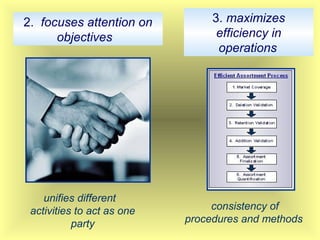
3. maximizes
efficiency in
operations
consistency of
procedures and methods
3. facilitates control
checks on
accomplishments or
failures
Basic Steps in Planning
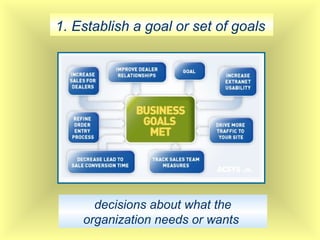
1. Establish a goal or set of goals
decisions about what the
organization needs or wants
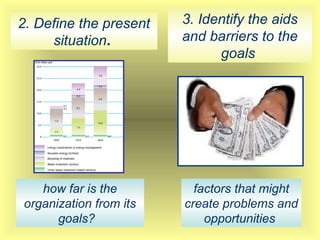
2. Define the present
situation.
how far is the
organization from its
goals?
3. Identify the aids
and barriers to the
goals
factors that might
create problems and
opportunities
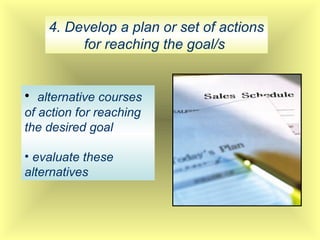
4. Develop a plan or set of actions
for reaching the goal/s
• alternative courses
of action for reaching
the desired goal
• evaluate these
alternatives
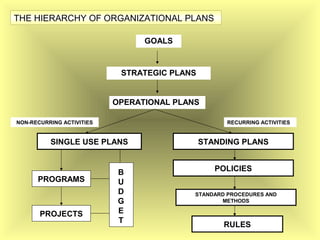
GOALS
STRATEGIC PLANS
THE HIERARCHY OF ORGANIZATIONAL PLANS
OPERATIONAL PLANS
SINGLE USE PLANS
NON-RECURRING ACTIVITIES RECURRING ACTIVITIES
STANDING PLANS
PROGRAMS
PROJECTS
B
U
D
G
E
T
POLICIES
STANDARD PROCEDURES AND
METHODS
RULES
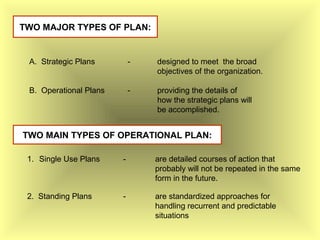
TWO MAJOR TYPES OF PLAN:
A. Strategic Plans - designed to meet the broad
objectives of the organization.
B. Operational Plans - providing the details of
how the strategic plans will
be accomplished.
TWO MAIN TYPES OF OPERATIONAL PLAN:
1. Single Use Plans - are detailed courses of action that
probably will not be repeated in the same
form in the future.
2. Standing Plans - are standardized approaches for
handling recurrent and predictable
situations
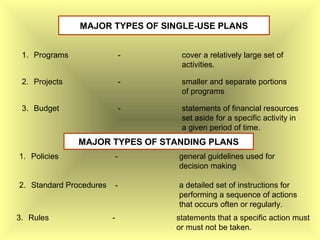
MAJOR TYPES OF SINGLE-USE PLANS
1. Programs - cover a relatively large set of
activities.
2. Projects - smaller and separate portions
of programs
3. Budget - statements of financial resources
set aside for a specific activity in
a given period of time.
MAJOR TYPES OF STANDING PLANS
1. Policies - general guidelines used for
decision making
2. Standard Procedures - a detailed set of instructions for
performing a sequence of actions
that occurs often or regularly.
3. Rules - statements that a specific action must
or must not be taken.
Organizing
determines the activities to
be performed to achieve
organizational objectives
clarifies the types of
work and groups into
manageable work units
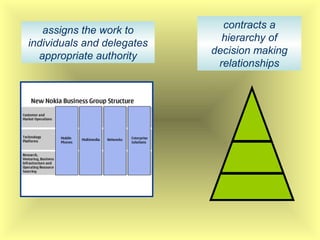
assigns the work to
individuals and delegates
appropriate authority
contracts a
hierarchy of
decision making
relationships
Importance of Organizing
1. Clear and
specific job
description
2. Existence of
coordination
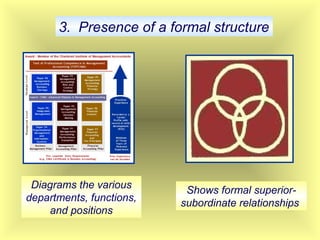
3. Presence of a formal structure
Diagrams the various
departments, functions,
and positions
Shows formal superior-
subordinate relationships
Steps in Organizing
1. Evaluate plans
and objectives
2. Identify the
various activities
3. Group related/similar activities
4. Assign activities with appropriate authority
5. Design the hierarchy of relationships
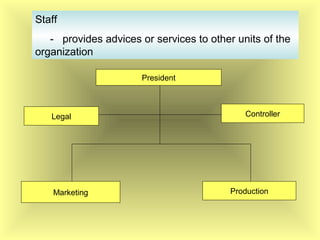
FORMAL RELATIONSHIPS IN
ORGANIZATIONS
Line Relationship
- when two organizational units are related to each other by a
relationship of direct command.
President
Vice President
Factory Manager
Assembly Supervisor
Staff
- provides advices or services to other units of the
organization
President
Legal Controller
Marketing Production
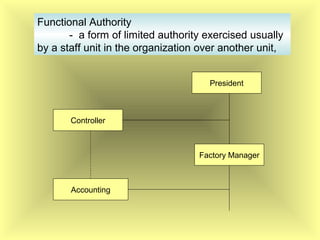
Functional Authority
- a form of limited authority exercised usually
by a staff unit in the organization over another unit,
President
Controller
Accounting
Factory Manager
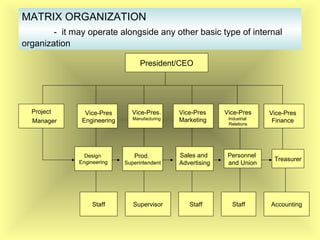
MATRIX ORGANIZATION
- it may operate alongside any other basic type of internal
organization
President/CEO
Project
Manager
Design
Engineering
Prod.
Superintendent
Personnel
and Union
Sales and
Advertising
Treasurer
Staff StaffSupervisor Accounting
Vice-Pres
Engineering
Vice-Pres.
Manufacturing
Vice-Pres
Marketing
Vice-Pres
Industrial
Relations
Vice-Pres
Finance
Staff
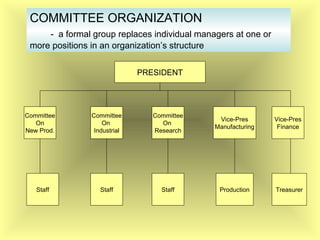
COMMITTEE ORGANIZATION
- a formal group replaces individual managers at one or
more positions in an organization’s structure
PRESIDENT
Committee
On
New Prod.
Committee
On
Industrial
Committee
On
Research
Vice-Pres
Finance
Vice-Pres
Manufacturing
Staff Staff Staff Production Treasurer
CLASSICAL PRINCIPLES
OF ORGANIZATION
• Unity of Command
• Parity of Authority and
Responsibility
• Absoluteness of Responsibility
• Check and Balance
• Principle of Specialization
• Exception Principle
• Span of Control
• Scalar Principle
• Departmentation
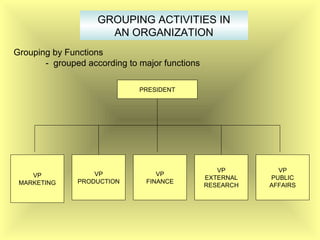
GROUPING ACTIVITIES IN
AN ORGANIZATION
Grouping by Functions
- grouped according to major functions
PRESIDENT
VP
MARKETING
VP
PRODUCTION
VP
FINANCE
VP
PUBLIC
AFFAIRS
VP
EXTERNAL
RESEARCH
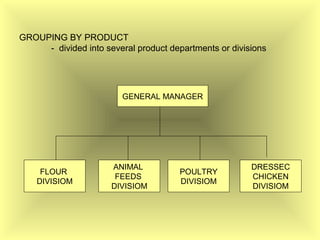
GROUPING BY PRODUCT
- divided into several product departments or divisions
GENERAL MANAGER
FLOUR
DIVISIOM
POULTRY
DIVISIOM
ANIMAL
FEEDS
DIVISIOM
DRESSEC
CHICKEN
DIVISIOM
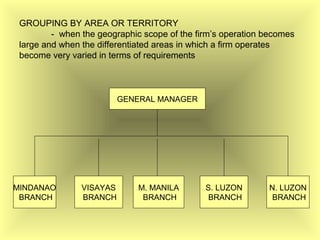
GROUPING BY AREA OR TERRITORY
- when the geographic scope of the firm’s operation becomes
large and when the differentiated areas in which a firm operates
become very varied in terms of requirements
GENERAL MANAGER
MINDANAO
BRANCH
M. MANILA
BRANCH
S. LUZON
BRANCH
VISAYAS
BRANCH
N. LUZON
BRANCH
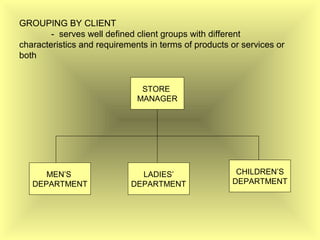
GROUPING BY CLIENT
- serves well defined client groups with different
characteristics and requirements in terms of products or services or
both
STORE
MANAGER
MEN’S
DEPARTMENT
LADIES’
DEPARTMENT
CHILDREN’S
DEPARTMENT
DELEGATION
-The process of entrusting and transferring responsibility and
-Authority by the top management to the lowest level.
ELEMENTS OF DELEGATION:
• Authority
• Responsibility
• Accountability
CENTRALIZED
- decision making
rests only in a few hands and
made by a few
DECENTRALIZED
- represents a
systematic effort to delegate
to lower levels alll authority,
except that which can only be
exercised at the highest
level.
Relationship between
Planning and Organizing
organizing as a basic
management function
needs planning
to place it in the right
direction
both planning and
organizing are
dynamic processes
Failing to plan is planning to fail.
Do the right things well.
Focus on strategy,implementation and success
Failing to plan is planning to fail.
Do the right things well.
Focus on strategy,implementation and success
Thank youThank you

Management Functions

  • 1.
    Ms. Gia Rodriguezdela Cruz St. Paul University Iloilo Basic Management Functions Planning and Organizing
  • 2.
    preparing now for tomorrow bridgesthe gap from where we are to where we want to go Planning
  • 3.
    Nature of Planning 1.goal oriented business purposes and objectives 2. the first basic function performed before the execution of all other managerial functions
  • 4.
    3. a functionof managers
  • 5.
    4. ensures efficiencyin organizations Reduces costsMinimizes risks
  • 6.
    Importance of Planning 1.offsets uncertainty and change • allows organization to determine the constraints • select a number of options for anticipated events in the future
  • 7.
    2. focuses attentionon objectives unifies different activities to act as one party 3. maximizes efficiency in operations consistency of procedures and methods
  • 8.
    3. facilitates control checkson accomplishments or failures
  • 9.
  • 10.
    1. Establish agoal or set of goals decisions about what the organization needs or wants
  • 11.
    2. Define thepresent situation. how far is the organization from its goals? 3. Identify the aids and barriers to the goals factors that might create problems and opportunities
  • 12.
    4. Develop aplan or set of actions for reaching the goal/s • alternative courses of action for reaching the desired goal • evaluate these alternatives
  • 13.
    GOALS STRATEGIC PLANS THE HIERARCHYOF ORGANIZATIONAL PLANS OPERATIONAL PLANS SINGLE USE PLANS NON-RECURRING ACTIVITIES RECURRING ACTIVITIES STANDING PLANS PROGRAMS PROJECTS B U D G E T POLICIES STANDARD PROCEDURES AND METHODS RULES
  • 14.
    TWO MAJOR TYPESOF PLAN: A. Strategic Plans - designed to meet the broad objectives of the organization. B. Operational Plans - providing the details of how the strategic plans will be accomplished. TWO MAIN TYPES OF OPERATIONAL PLAN: 1. Single Use Plans - are detailed courses of action that probably will not be repeated in the same form in the future. 2. Standing Plans - are standardized approaches for handling recurrent and predictable situations
  • 15.
    MAJOR TYPES OFSINGLE-USE PLANS 1. Programs - cover a relatively large set of activities. 2. Projects - smaller and separate portions of programs 3. Budget - statements of financial resources set aside for a specific activity in a given period of time. MAJOR TYPES OF STANDING PLANS 1. Policies - general guidelines used for decision making 2. Standard Procedures - a detailed set of instructions for performing a sequence of actions that occurs often or regularly. 3. Rules - statements that a specific action must or must not be taken.
  • 16.
    Organizing determines the activitiesto be performed to achieve organizational objectives clarifies the types of work and groups into manageable work units
  • 17.
    assigns the workto individuals and delegates appropriate authority contracts a hierarchy of decision making relationships
  • 18.
    Importance of Organizing 1.Clear and specific job description 2. Existence of coordination
  • 19.
    3. Presence ofa formal structure Diagrams the various departments, functions, and positions Shows formal superior- subordinate relationships
  • 20.
    Steps in Organizing 1.Evaluate plans and objectives 2. Identify the various activities
  • 21.
    3. Group related/similaractivities 4. Assign activities with appropriate authority 5. Design the hierarchy of relationships
  • 22.
    FORMAL RELATIONSHIPS IN ORGANIZATIONS LineRelationship - when two organizational units are related to each other by a relationship of direct command. President Vice President Factory Manager Assembly Supervisor
  • 23.
    Staff - provides advicesor services to other units of the organization President Legal Controller Marketing Production
  • 24.
    Functional Authority - aform of limited authority exercised usually by a staff unit in the organization over another unit, President Controller Accounting Factory Manager
  • 25.
    MATRIX ORGANIZATION - itmay operate alongside any other basic type of internal organization President/CEO Project Manager Design Engineering Prod. Superintendent Personnel and Union Sales and Advertising Treasurer Staff StaffSupervisor Accounting Vice-Pres Engineering Vice-Pres. Manufacturing Vice-Pres Marketing Vice-Pres Industrial Relations Vice-Pres Finance Staff
  • 26.
    COMMITTEE ORGANIZATION - aformal group replaces individual managers at one or more positions in an organization’s structure PRESIDENT Committee On New Prod. Committee On Industrial Committee On Research Vice-Pres Finance Vice-Pres Manufacturing Staff Staff Staff Production Treasurer
  • 27.
    CLASSICAL PRINCIPLES OF ORGANIZATION •Unity of Command • Parity of Authority and Responsibility • Absoluteness of Responsibility • Check and Balance • Principle of Specialization • Exception Principle • Span of Control • Scalar Principle • Departmentation
  • 28.
    GROUPING ACTIVITIES IN ANORGANIZATION Grouping by Functions - grouped according to major functions PRESIDENT VP MARKETING VP PRODUCTION VP FINANCE VP PUBLIC AFFAIRS VP EXTERNAL RESEARCH
  • 29.
    GROUPING BY PRODUCT -divided into several product departments or divisions GENERAL MANAGER FLOUR DIVISIOM POULTRY DIVISIOM ANIMAL FEEDS DIVISIOM DRESSEC CHICKEN DIVISIOM
  • 30.
    GROUPING BY AREAOR TERRITORY - when the geographic scope of the firm’s operation becomes large and when the differentiated areas in which a firm operates become very varied in terms of requirements GENERAL MANAGER MINDANAO BRANCH M. MANILA BRANCH S. LUZON BRANCH VISAYAS BRANCH N. LUZON BRANCH
  • 31.
    GROUPING BY CLIENT -serves well defined client groups with different characteristics and requirements in terms of products or services or both STORE MANAGER MEN’S DEPARTMENT LADIES’ DEPARTMENT CHILDREN’S DEPARTMENT
  • 32.
    DELEGATION -The process ofentrusting and transferring responsibility and -Authority by the top management to the lowest level. ELEMENTS OF DELEGATION: • Authority • Responsibility • Accountability
  • 33.
    CENTRALIZED - decision making restsonly in a few hands and made by a few DECENTRALIZED - represents a systematic effort to delegate to lower levels alll authority, except that which can only be exercised at the highest level.
  • 34.
    Relationship between Planning andOrganizing organizing as a basic management function needs planning to place it in the right direction both planning and organizing are dynamic processes
  • 35.
    Failing to planis planning to fail. Do the right things well. Focus on strategy,implementation and success Failing to plan is planning to fail. Do the right things well. Focus on strategy,implementation and success Thank youThank you