BY: ALLANA DELGADO, MLIS-1
PROJECT
DATE CLIENT
JANUARY 17, 2017
THE PLANNING PROCESS
MLIS 607: ADVANCE MANAGEMENT FOR
What is planning?
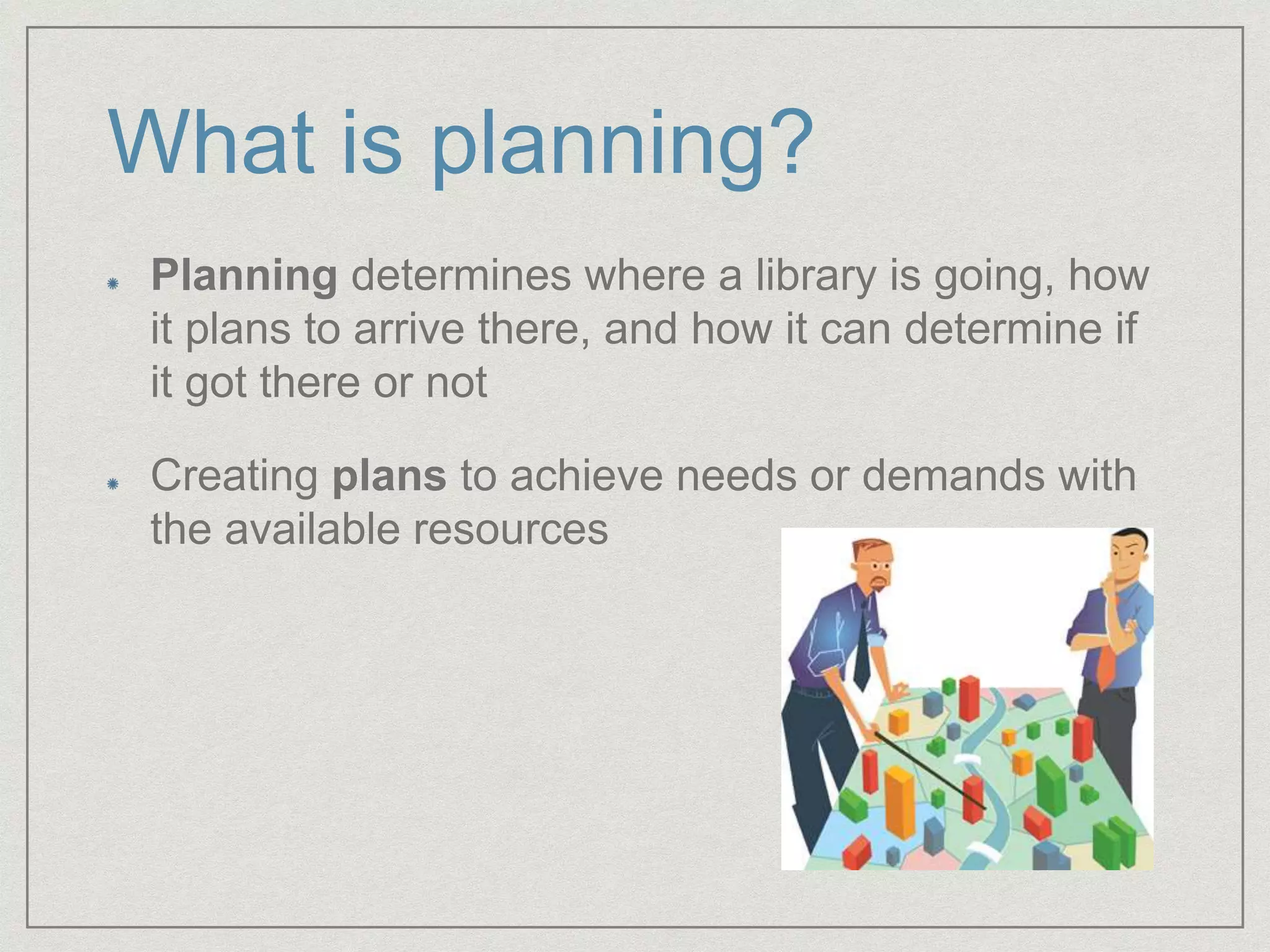
Planning determines where a library is going, how
it plans to arrive there, and how it can determine if
it got there or not
Creating plans to achieve needs or demands with
the available resources
Planning Process
1. identifies the goals or
objectives to be achieved
2. formulates strategies to achieve
them
3. arranges or creates the means
required
4. implements, directs, and
monitors all steps in their proper
sequence.
RISK
UNCERTAINTY
DOUBT
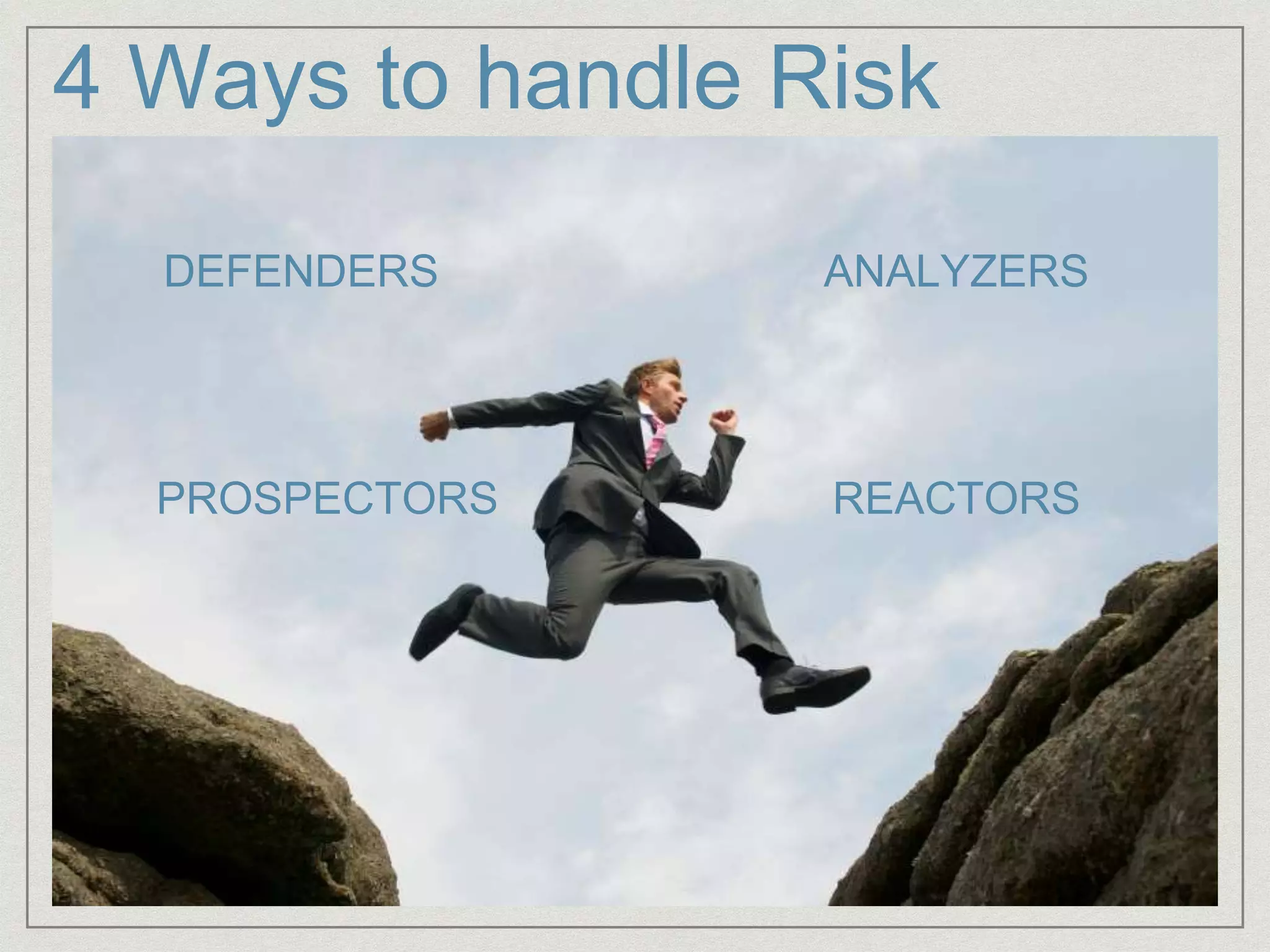
4 Ways to handle Risk
DEFENDERS
REACTORSPROSPECTORS
ANALYZERS
3 Categories of
Plans
Strategic plans or long-term plans (2-5 years)
Tactical plans are to achieve strategic plans (6
months-2 years)
Operational plans are short term (1 day-1 year),
to guide staff in daily activities
Strategic Planning
Strategy identifies and sets
the overall direction of an
organization.
Strategic planning is the
process of creating action
steps to achieve the strategy
Strategic management
involves all staff in formulating
and implementing activities to
achieve the goals of the
strategy and strategic plan
5 Models of Strategic
Plans
Basic is what people think of as strategic planning
Issue-based is a more detailed methodology, assess the
environment
Alignment is further fine-tuning with focus in an organization’s
issues
Scenario plans develop alternative possibilities to deal with
uncertainty
Organic are plans on an ongoing basis (example, once a month)
NEXT: 3 KEY
ELEMENTS IN
STRATEGIC PLANS
MISSION
VISION
VALUE STATEMENTS
MISSION
identifies the organization’s
long-term strategy (what do we
want to accomplish? Where do
we want to go?)
The statement should be short
and general, yet detailed and
specific enough to identify the
unique goals and culture of the
organization.
Mission Example
The mission of the City Public Library is to promote
the development of independent, self-confident,
literate citizens through the provision of open
access to cultural, intellectual, and information
resources.
Central Philippine
University Mission
The mission of Central Philippine University is to
carry out a program of spiritual, intellectual, moral,
scientific, technological and cultural training and
allied studies under influences which strengthen
Christian faith, build up character and promote
scholarship, research and community service.
Fo Guang
College Library
Mission
The Fo Guang College Library’s
main thrust is to provide information
services to the academic community
to foster the advancement of
education, research, scholarship. Its
service is designed to promote and
facilitate efficient and effective use of
recorded information in all formats
imbibing clientele-centered service.
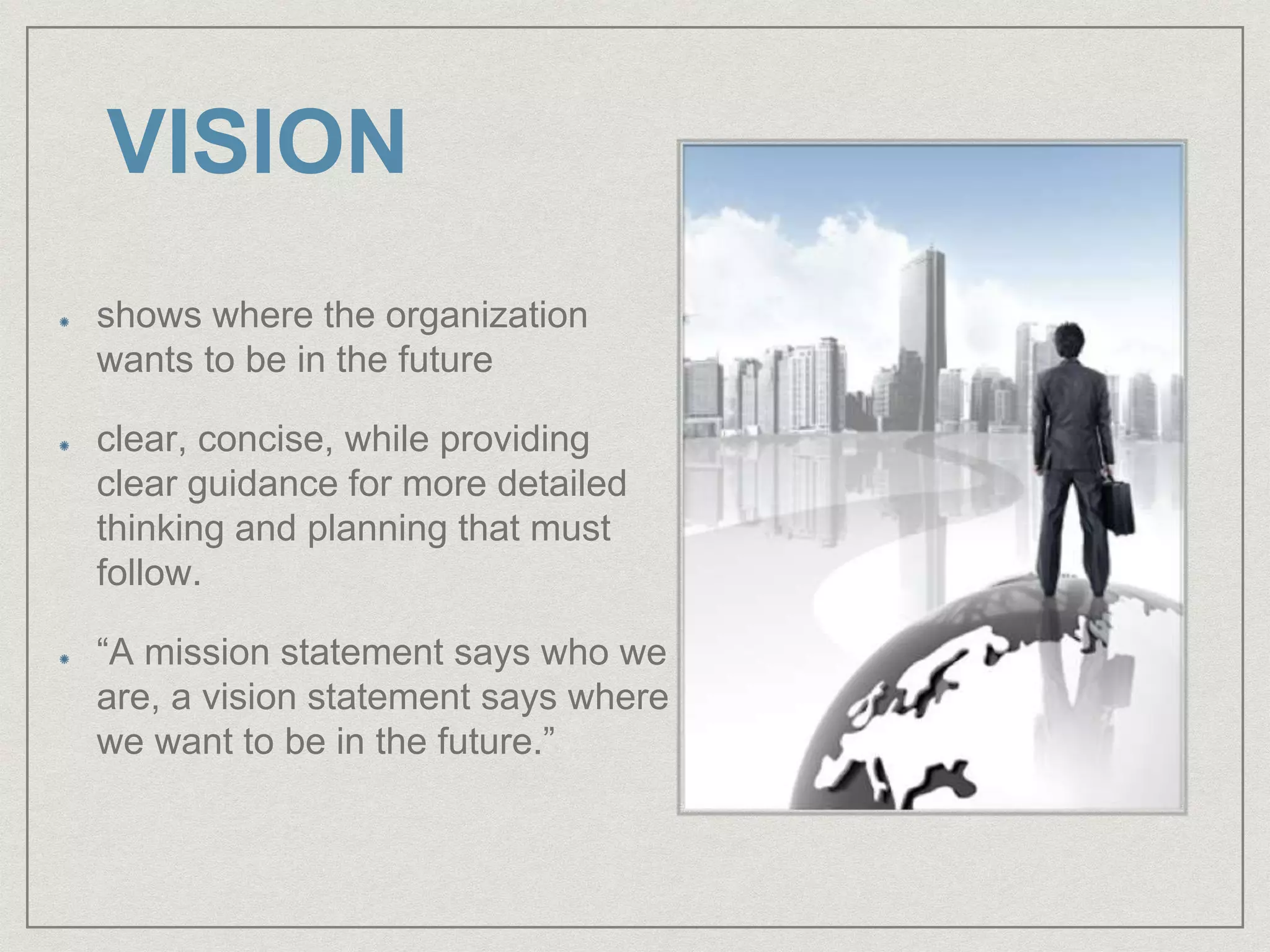
VISION
shows where the organization
wants to be in the future
clear, concise, while providing
clear guidance for more detailed
thinking and planning that must
follow.
“A mission statement says who we
are, a vision statement says where
we want to be in the future.”
Vision Example
The City Public Library envisions a future in which the library’s
collections, programs, and leadership help ensure:
• That every city resident has the opportunity to enjoy an
intellectually and culturally rich life
• That every child enters school with the requisite development skills
• That every child experiences the pleasure of reading and the joy of
learning
• That our community celebrates and appreciates diversity
• That those in need find assistance and information with ease
Central Philippine
University Library
Vision
The Central Philippine University Library is a
modern library committed to the achievement of
the institution's vision of Exemplary Christian
Education for Life (EXCEL) through its user-
oriented service and the state-of-the-art library
technologies.
Fo Guang
College Library
Vision
The Fo Guang College Library is a
sanctuary of learning with
comprehensive collection on
humanistic education promoting love
for reading and passion for truth-
seeking through research, facilitating
self-directed education for holistic
development and life-long learning of
the academic community.
VALUE STATEMENTS
concise expression of the
organization’s priorities and
values
Values are the
organization's guiding
principles for human
conduct.
Value Statements
Examples
Customer Service: ensuring high quality and
excellence in responding to the needs of
customers and staff.
Literacy and Lifelong learning: enriching lives
through the joy of reading and continuous learning.
SWOT Analysis
can facilitate thinking
through the implications of
environmental data and the
organization’s capabilities
helps identify what went
right, what went wrong, or
changed since the last major
planning effort.
SWOT Analysis example:
Social Media in Libraries
Strengths
• Social media sites are usually free
• They are easy to set up and ready to use
• Libraries can reach out to their clientele in
the most efficient manner.
• Users are able to contribute their own
ideas about services and resources for
libraries to consider.
• Allow librarians to think outside the box
Weaknesses
• Social media tools have design constraints.
• Some social media have limitations on the
amount of information you can input.
• Libraries may be exposing themselves to
criticism.
• Some social media require downloading, which
can be a problem in some organizations
Opportunities
• Social media are excellent opportunities for
librarians to market their services and
collections to their clientele
• Enable libraries to reach a wide range of their
users and to attract new users
• Libraries have the opportunity to hear from their
users about the kind of services they want
Threats
• Social media may be open to unsavory
elements that can sabotage social websites in
many ways
• These sites are usually beyond the control of
the librarians who manage them
• Social media users can easily unsubscribe at
the click of a button
Goals & Objectives
Goals are accomplishments that will aid in
achieving a strategy. Useful goals are SMARTER -
Specific, measurable, acceptable, realistic, time-
framed, extending, rewarding.
Objective is specific achievable outcome of
actions taken to achieve a stated goal, usually
expressed in measurable terms and subject to a
time limit.
Policies
Statements that guide staff in making decisions and
handling work processes. They ensure the consistency
of decisions in relation to objectives.
• Originated policy
• Appealed policy
• Implied policy
• Imposed policy
Procedures
guides to action and provide steps that staff use to
carry out the activities
Procedure planning includes keeping simple and
minimum procedures
Basic procedures for all library activities is
important as they are the basis of training staff and
for evaluating outputs.
Programs
complex activities that involves many types of plans
combination of tasks, assignments, and projects.
consist of policies, procedures, rules, job allocations,
resource requirements to carry out its objectives
should outline actions to take (when, where, by
whom) indicate the actions’ purpose and how they fit
in the library’s objectives.
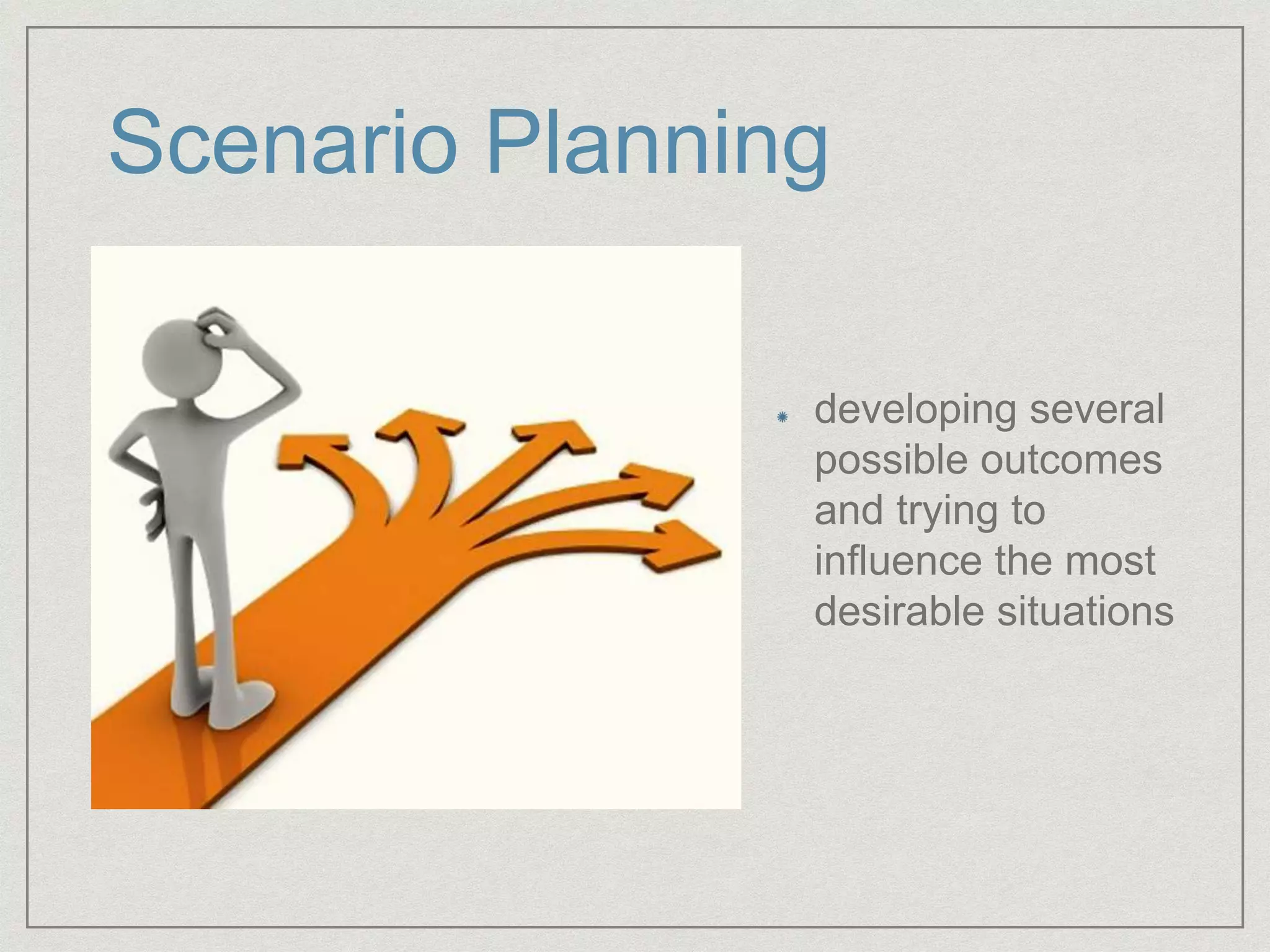
Scenario Planning
developing several
possible outcomes
and trying to
influence the most
desirable situations
Projects
Projects can be an assignment or task. They are single-
purpose plans with a number of tasks to accomplish a work
assignment.
4-stage Life Cycle of Projects:
• Definition
• Planning
• Execution
• Closing
Who should plan?
Effective planning draws on input from all affected
and interested parties
Staff involvement is a key element in achieving a
successful strategic plan.
“Commit to the Lord whatever you do,
and he will establish your plans.”
–Proverbs 16:3

The Planning Process

  • 1.
    BY: ALLANA DELGADO,MLIS-1 PROJECT DATE CLIENT JANUARY 17, 2017 THE PLANNING PROCESS MLIS 607: ADVANCE MANAGEMENT FOR
  • 2.
    What is planning? Planningdetermines where a library is going, how it plans to arrive there, and how it can determine if it got there or not Creating plans to achieve needs or demands with the available resources
  • 3.
    Planning Process 1. identifiesthe goals or objectives to be achieved 2. formulates strategies to achieve them 3. arranges or creates the means required 4. implements, directs, and monitors all steps in their proper sequence.
  • 4.
  • 5.
    4 Ways tohandle Risk DEFENDERS REACTORSPROSPECTORS ANALYZERS
  • 6.
    3 Categories of Plans Strategicplans or long-term plans (2-5 years) Tactical plans are to achieve strategic plans (6 months-2 years) Operational plans are short term (1 day-1 year), to guide staff in daily activities
  • 7.
    Strategic Planning Strategy identifiesand sets the overall direction of an organization. Strategic planning is the process of creating action steps to achieve the strategy Strategic management involves all staff in formulating and implementing activities to achieve the goals of the strategy and strategic plan
  • 8.
    5 Models ofStrategic Plans Basic is what people think of as strategic planning Issue-based is a more detailed methodology, assess the environment Alignment is further fine-tuning with focus in an organization’s issues Scenario plans develop alternative possibilities to deal with uncertainty Organic are plans on an ongoing basis (example, once a month)
  • 9.
    NEXT: 3 KEY ELEMENTSIN STRATEGIC PLANS MISSION VISION VALUE STATEMENTS
  • 10.
    MISSION identifies the organization’s long-termstrategy (what do we want to accomplish? Where do we want to go?) The statement should be short and general, yet detailed and specific enough to identify the unique goals and culture of the organization.
  • 11.
    Mission Example The missionof the City Public Library is to promote the development of independent, self-confident, literate citizens through the provision of open access to cultural, intellectual, and information resources.
  • 12.
    Central Philippine University Mission Themission of Central Philippine University is to carry out a program of spiritual, intellectual, moral, scientific, technological and cultural training and allied studies under influences which strengthen Christian faith, build up character and promote scholarship, research and community service.
  • 13.
    Fo Guang College Library Mission TheFo Guang College Library’s main thrust is to provide information services to the academic community to foster the advancement of education, research, scholarship. Its service is designed to promote and facilitate efficient and effective use of recorded information in all formats imbibing clientele-centered service.
  • 14.
    VISION shows where theorganization wants to be in the future clear, concise, while providing clear guidance for more detailed thinking and planning that must follow. “A mission statement says who we are, a vision statement says where we want to be in the future.”
  • 15.
    Vision Example The CityPublic Library envisions a future in which the library’s collections, programs, and leadership help ensure: • That every city resident has the opportunity to enjoy an intellectually and culturally rich life • That every child enters school with the requisite development skills • That every child experiences the pleasure of reading and the joy of learning • That our community celebrates and appreciates diversity • That those in need find assistance and information with ease
  • 16.
    Central Philippine University Library Vision TheCentral Philippine University Library is a modern library committed to the achievement of the institution's vision of Exemplary Christian Education for Life (EXCEL) through its user- oriented service and the state-of-the-art library technologies.
  • 17.
    Fo Guang College Library Vision TheFo Guang College Library is a sanctuary of learning with comprehensive collection on humanistic education promoting love for reading and passion for truth- seeking through research, facilitating self-directed education for holistic development and life-long learning of the academic community.
  • 18.
    VALUE STATEMENTS concise expressionof the organization’s priorities and values Values are the organization's guiding principles for human conduct.
  • 19.
    Value Statements Examples Customer Service:ensuring high quality and excellence in responding to the needs of customers and staff. Literacy and Lifelong learning: enriching lives through the joy of reading and continuous learning.
  • 20.
    SWOT Analysis can facilitatethinking through the implications of environmental data and the organization’s capabilities helps identify what went right, what went wrong, or changed since the last major planning effort.
  • 21.
    SWOT Analysis example: SocialMedia in Libraries Strengths • Social media sites are usually free • They are easy to set up and ready to use • Libraries can reach out to their clientele in the most efficient manner. • Users are able to contribute their own ideas about services and resources for libraries to consider. • Allow librarians to think outside the box Weaknesses • Social media tools have design constraints. • Some social media have limitations on the amount of information you can input. • Libraries may be exposing themselves to criticism. • Some social media require downloading, which can be a problem in some organizations Opportunities • Social media are excellent opportunities for librarians to market their services and collections to their clientele • Enable libraries to reach a wide range of their users and to attract new users • Libraries have the opportunity to hear from their users about the kind of services they want Threats • Social media may be open to unsavory elements that can sabotage social websites in many ways • These sites are usually beyond the control of the librarians who manage them • Social media users can easily unsubscribe at the click of a button
  • 22.
    Goals & Objectives Goalsare accomplishments that will aid in achieving a strategy. Useful goals are SMARTER - Specific, measurable, acceptable, realistic, time- framed, extending, rewarding. Objective is specific achievable outcome of actions taken to achieve a stated goal, usually expressed in measurable terms and subject to a time limit.
  • 23.
    Policies Statements that guidestaff in making decisions and handling work processes. They ensure the consistency of decisions in relation to objectives. • Originated policy • Appealed policy • Implied policy • Imposed policy
  • 24.
    Procedures guides to actionand provide steps that staff use to carry out the activities Procedure planning includes keeping simple and minimum procedures Basic procedures for all library activities is important as they are the basis of training staff and for evaluating outputs.
  • 25.
    Programs complex activities thatinvolves many types of plans combination of tasks, assignments, and projects. consist of policies, procedures, rules, job allocations, resource requirements to carry out its objectives should outline actions to take (when, where, by whom) indicate the actions’ purpose and how they fit in the library’s objectives.
  • 26.
    Scenario Planning developing several possibleoutcomes and trying to influence the most desirable situations
  • 27.
    Projects Projects can bean assignment or task. They are single- purpose plans with a number of tasks to accomplish a work assignment. 4-stage Life Cycle of Projects: • Definition • Planning • Execution • Closing
  • 28.
    Who should plan? Effectiveplanning draws on input from all affected and interested parties Staff involvement is a key element in achieving a successful strategic plan.
  • 29.
    “Commit to theLord whatever you do, and he will establish your plans.” –Proverbs 16:3