STRATEGIC PLANNING
GLADYS K. WAKAT
MLIS 1
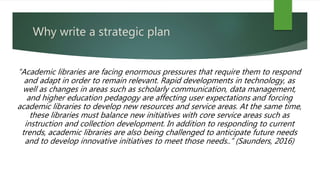
Why write a strategic plan
“Academic libraries are facing enormous pressures that require them to respond
and adapt in order to remain relevant. Rapid developments in technology, as
well as changes in areas such as scholarly communication, data management,
and higher education pedagogy are affecting user expectations and forcing
academic libraries to develop new resources and service areas. At the same time,
these libraries must balance new initiatives with core service areas such as
instruction and collection development. In addition to responding to current
trends, academic libraries are also being challenged to anticipate future needs
and to develop innovative initiatives to meet those needs..” (Saunders, 2016)
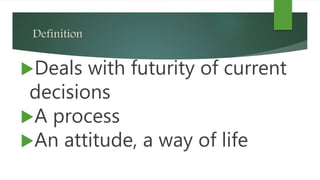
Definition
Deals with futurity of current
decisions
A process
An attitude, a way of life
ENVIRONMENTAL SCAN
The Community
The Library
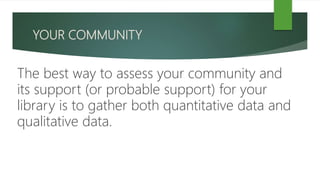
YOUR COMMUNITY
The best way to assess your community and
its support (or probable support) for your
library is to gather both quantitative data and
qualitative data.
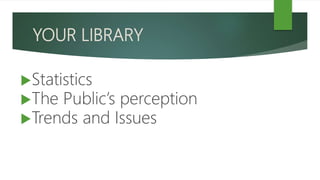
YOUR LIBRARY
Statistics
The Public’s perception
Trends and Issues
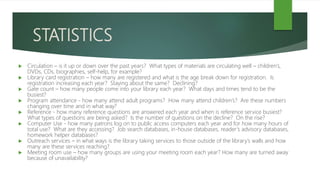
STATISTICS
 Circulation – is it up or down over the past years? What types of materials are circulating well – children’s,
DVDs, CDs, biographies, self-help, for example?
 Library card registration – how many are registered and what is the age break down for registration. Is
registration increasing each year? Staying about the same? Declining?
 Gate count – how many people come into your library each year? What days and times tend to be the
busiest?
 Program attendance - how many attend adult programs? How many attend children’s? Are these numbers
changing over time and in what way?
 Reference - how many reference questions are answered each year and when is reference service busiest?
What types of questions are being asked? Is the number of questions on the decline? On the rise?
 Computer Use - how many patrons log on to public access computers each year and for how many hours of
total use? What are they accessing? Job search databases, in-house databases, reader’s advisory databases,
homework helper databases?
 Outreach services – in what ways is the library taking services to those outside of the library’s walls and how
many are these services reaching?
 Meeting room use – how many groups are using your meeting room each year? How many are turned away
because of unavailability?
THE PUBLIC’S PERCEPTION
The best way to try to get a handle on how the public sees your
library and its services is to communicate with them. There are a
variety of ways to do this including:
 Focus groups. Focus groups are an excellent way to
become a “fly on the wall” and to hear what people
really think about the library.
Surveys. Conducting surveys of your library users and
nonusers is a good way to get the opinions of a lot of
people in your community.
TRENDS and ISSUES
“A good director will keep the board
informed of these issues on an ongoing
basis, but it’s also important to look a
little more closely during the planning
process.”
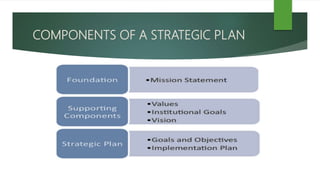
COMPONENTS OF A STRATEGIC PLAN
Institutional Mission and Values
Mission
The foundation of any strategic plan is the
institutional mission statement. This statement
delineates, in concise language, why the institution
exists and what its operations are intended to
achieve.
Institutional Mission and Values
Values
Values have been removed from the mission
to their own Values Statement component.
There, they explain what the institution stands
for and the way in which it intends to conduct
its activities.
Strategic Goals and Objectives
 Goal. The word goal connotes specific achievement; a
target reached and “checked off”. The word objective is
slightly more general in connotation.
 Objective. An objective helps set a course by giving a
general direction, but an objective does not usually
contain the specifics of its own completion
When doing a strategic plan, consider
the following:
 Timing - There is one final caution about the goals and
objectives of a strategic plan—timing. Most colleges and
universities use either a five or ten-year cycle for their plans.
 Front loading - Front loading usually occurs because
enthusiasm is high and everyone would like to see the plan
successfully completed. Another reason front loading occurs
is those who are determining the deadlines are used to
thinking in short one or two year timeframes.
When doing a strategic plan, consider
the following:
 Backloading - Back loading usually occurs when members of
the institutional community are not committed to the plan or
are unsure about the resources needed to implement.
 Phasing - There are several reasons phasing is necessary. One of
the most obvious is, in many cases, before one action can be
taken, another has to be completed. A second reason, where
resources are concerned, is any need to accrue the personnel,
facilities, or funding necessary for the action.
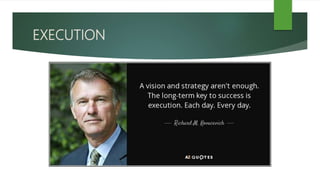
EXECUTION
References
 O-Neill, M. (2018). Writing a Strategic Plan and Strategizing Generally: Tips for all
Library Types and Roles. Dublin Business School Library Annual Seminar, June 2018.
Retrieved from https://libguides.dbs.ie/seminar/2018
 Reed, S. (2016). A Library Board’s Practical Guide To Strategic Planning. Bryn Mawr,
PA. : Uunited for Libraries. ALA.org (). Retrieved
http://www.ala.org/united/sites/ala.org.united/files/content/trusteezone/practical-
guides/strategic-planning.pdf
 Steiner, G. (1979). Stategic planning. Michagan: Free Press. Retrieved March 02,
2019 from
https://books.google.com.ph/books?hl=en&lr=&id=EXoPC22vb4oC&oi=fnd&pg=
PR7&dq=strategic+planning&ots=5-
2MDRQrAK&sig=oGhTYZvyGiC38addHPOBMIcfG7Y&redir_esc=y#v=onepage&q=s
trategic%20planning&f=false

Strategic Planning in Libraries

  • 2.
  • 3.
    Why write astrategic plan “Academic libraries are facing enormous pressures that require them to respond and adapt in order to remain relevant. Rapid developments in technology, as well as changes in areas such as scholarly communication, data management, and higher education pedagogy are affecting user expectations and forcing academic libraries to develop new resources and service areas. At the same time, these libraries must balance new initiatives with core service areas such as instruction and collection development. In addition to responding to current trends, academic libraries are also being challenged to anticipate future needs and to develop innovative initiatives to meet those needs..” (Saunders, 2016)
  • 6.
    Definition Deals with futurityof current decisions A process An attitude, a way of life
  • 7.
  • 8.
    YOUR COMMUNITY The bestway to assess your community and its support (or probable support) for your library is to gather both quantitative data and qualitative data.
  • 9.
    YOUR LIBRARY Statistics The Public’sperception Trends and Issues
  • 10.
    STATISTICS  Circulation –is it up or down over the past years? What types of materials are circulating well – children’s, DVDs, CDs, biographies, self-help, for example?  Library card registration – how many are registered and what is the age break down for registration. Is registration increasing each year? Staying about the same? Declining?  Gate count – how many people come into your library each year? What days and times tend to be the busiest?  Program attendance - how many attend adult programs? How many attend children’s? Are these numbers changing over time and in what way?  Reference - how many reference questions are answered each year and when is reference service busiest? What types of questions are being asked? Is the number of questions on the decline? On the rise?  Computer Use - how many patrons log on to public access computers each year and for how many hours of total use? What are they accessing? Job search databases, in-house databases, reader’s advisory databases, homework helper databases?  Outreach services – in what ways is the library taking services to those outside of the library’s walls and how many are these services reaching?  Meeting room use – how many groups are using your meeting room each year? How many are turned away because of unavailability?
  • 11.
    THE PUBLIC’S PERCEPTION Thebest way to try to get a handle on how the public sees your library and its services is to communicate with them. There are a variety of ways to do this including:  Focus groups. Focus groups are an excellent way to become a “fly on the wall” and to hear what people really think about the library. Surveys. Conducting surveys of your library users and nonusers is a good way to get the opinions of a lot of people in your community.
  • 12.
    TRENDS and ISSUES “Agood director will keep the board informed of these issues on an ongoing basis, but it’s also important to look a little more closely during the planning process.”
  • 13.
    COMPONENTS OF ASTRATEGIC PLAN
  • 14.
    Institutional Mission andValues Mission The foundation of any strategic plan is the institutional mission statement. This statement delineates, in concise language, why the institution exists and what its operations are intended to achieve.
  • 15.
    Institutional Mission andValues Values Values have been removed from the mission to their own Values Statement component. There, they explain what the institution stands for and the way in which it intends to conduct its activities.
  • 16.
    Strategic Goals andObjectives  Goal. The word goal connotes specific achievement; a target reached and “checked off”. The word objective is slightly more general in connotation.  Objective. An objective helps set a course by giving a general direction, but an objective does not usually contain the specifics of its own completion
  • 19.
    When doing astrategic plan, consider the following:  Timing - There is one final caution about the goals and objectives of a strategic plan—timing. Most colleges and universities use either a five or ten-year cycle for their plans.  Front loading - Front loading usually occurs because enthusiasm is high and everyone would like to see the plan successfully completed. Another reason front loading occurs is those who are determining the deadlines are used to thinking in short one or two year timeframes.
  • 20.
    When doing astrategic plan, consider the following:  Backloading - Back loading usually occurs when members of the institutional community are not committed to the plan or are unsure about the resources needed to implement.  Phasing - There are several reasons phasing is necessary. One of the most obvious is, in many cases, before one action can be taken, another has to be completed. A second reason, where resources are concerned, is any need to accrue the personnel, facilities, or funding necessary for the action.
  • 21.
  • 23.
    References  O-Neill, M.(2018). Writing a Strategic Plan and Strategizing Generally: Tips for all Library Types and Roles. Dublin Business School Library Annual Seminar, June 2018. Retrieved from https://libguides.dbs.ie/seminar/2018  Reed, S. (2016). A Library Board’s Practical Guide To Strategic Planning. Bryn Mawr, PA. : Uunited for Libraries. ALA.org (). Retrieved http://www.ala.org/united/sites/ala.org.united/files/content/trusteezone/practical- guides/strategic-planning.pdf  Steiner, G. (1979). Stategic planning. Michagan: Free Press. Retrieved March 02, 2019 from https://books.google.com.ph/books?hl=en&lr=&id=EXoPC22vb4oC&oi=fnd&pg= PR7&dq=strategic+planning&ots=5- 2MDRQrAK&sig=oGhTYZvyGiC38addHPOBMIcfG7Y&redir_esc=y#v=onepage&q=s trategic%20planning&f=false