Lexical Analysis
A lexical analyser, or lexer for short, will as its input take a string of individual letters and divide this string
into tokens. Additionally, it will filter out whatever separates the tokens (the so-called white-space), i.e., lay-
out characters (spaces, newlines etc.) and comments.
The main purpose of lexical analysis is to make life easier for the subsequent syntax analysis phase. In
theory, the work that is done during lexical analysis can be made an integral part of syntax analysis, and in
simple systems this is indeed often done.
Why separate Lexical and Parser?
 The simplicity of design: It eases the process of lexical analysis and the syntax analysis by
eliminating unwanted tokens.
 To improve compiler efficiency: Helps you to improve compiler efficiency.
 Specialization: specialized techniques can be applied to improves the lexical analysis process.
 Portability: only the scanner requires to communicate with the outside world.
 Higher portability: input-device-specific peculiarities restricted to the lexer.
The Role of the Lexical Analyzer
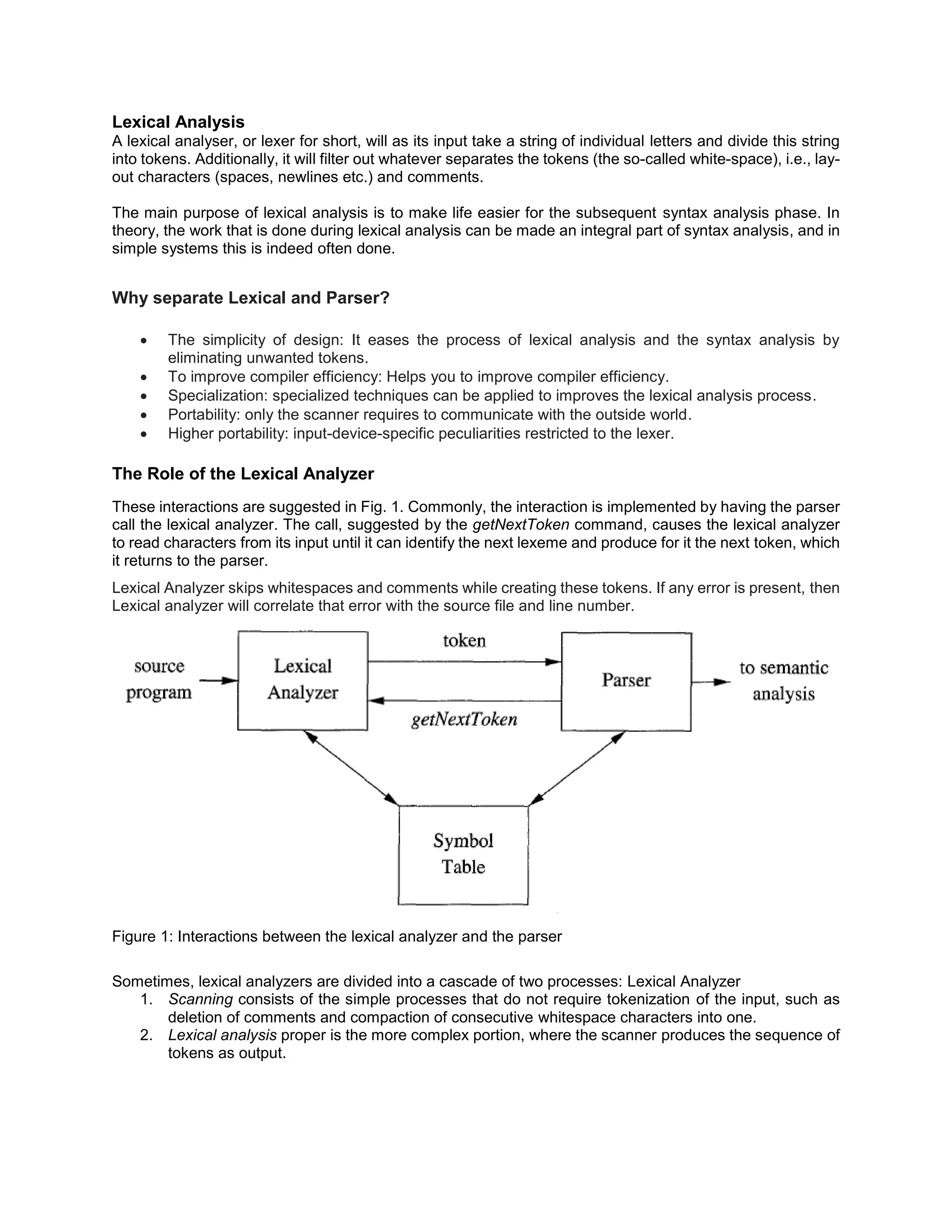
These interactions are suggested in Fig. 1. Commonly, the interaction is implemented by having the parser
call the lexical analyzer. The call, suggested by the getNextToken command, causes the lexical analyzer
to read characters from its input until it can identify the next lexeme and produce for it the next token, which
it returns to the parser.
Lexical Analyzer skips whitespaces and comments while creating these tokens. If any error is present, then
Lexical analyzer will correlate that error with the source file and line number.
Figure 1: Interactions between the lexical analyzer and the parser
Sometimes, lexical analyzers are divided into a cascade of two processes: Lexical Analyzer
1. Scanning consists of the simple processes that do not require tokenization of the input, such as
deletion of comments and compaction of consecutive whitespace characters into one.
2. Lexical analysis proper is the more complex portion, where the scanner produces the sequence of
tokens as output.
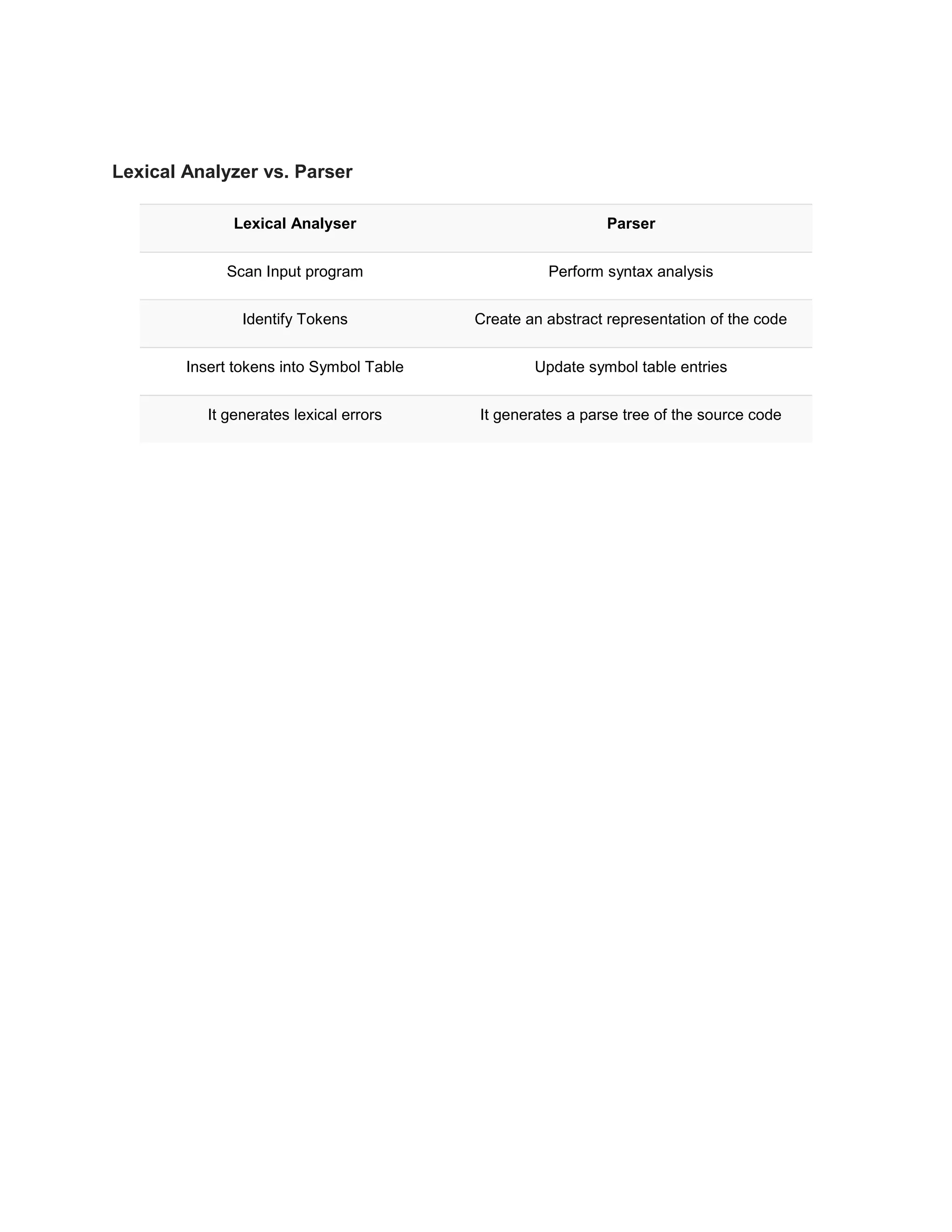
Lexical Analyzer vs. Parser
Lexical Analyser Parser
Scan Input program Perform syntax analysis
Identify Tokens Create an abstract representation of the code
Insert tokens into Symbol Table Update symbol table entries
It generates lexical errors It generates a parse tree of the source code

Lexical Analysis

  • 1.
    Lexical Analysis A lexicalanalyser, or lexer for short, will as its input take a string of individual letters and divide this string into tokens. Additionally, it will filter out whatever separates the tokens (the so-called white-space), i.e., lay- out characters (spaces, newlines etc.) and comments. The main purpose of lexical analysis is to make life easier for the subsequent syntax analysis phase. In theory, the work that is done during lexical analysis can be made an integral part of syntax analysis, and in simple systems this is indeed often done. Why separate Lexical and Parser?  The simplicity of design: It eases the process of lexical analysis and the syntax analysis by eliminating unwanted tokens.  To improve compiler efficiency: Helps you to improve compiler efficiency.  Specialization: specialized techniques can be applied to improves the lexical analysis process.  Portability: only the scanner requires to communicate with the outside world.  Higher portability: input-device-specific peculiarities restricted to the lexer. The Role of the Lexical Analyzer These interactions are suggested in Fig. 1. Commonly, the interaction is implemented by having the parser call the lexical analyzer. The call, suggested by the getNextToken command, causes the lexical analyzer to read characters from its input until it can identify the next lexeme and produce for it the next token, which it returns to the parser. Lexical Analyzer skips whitespaces and comments while creating these tokens. If any error is present, then Lexical analyzer will correlate that error with the source file and line number. Figure 1: Interactions between the lexical analyzer and the parser Sometimes, lexical analyzers are divided into a cascade of two processes: Lexical Analyzer 1. Scanning consists of the simple processes that do not require tokenization of the input, such as deletion of comments and compaction of consecutive whitespace characters into one. 2. Lexical analysis proper is the more complex portion, where the scanner produces the sequence of tokens as output.
  • 2.
    Lexical Analyzer vs.Parser Lexical Analyser Parser Scan Input program Perform syntax analysis Identify Tokens Create an abstract representation of the code Insert tokens into Symbol Table Update symbol table entries It generates lexical errors It generates a parse tree of the source code