Subject: Automata Theory And Compiler Design
Topic: Lexical Analysis Phase Of Compiler
Guided By: Presented By:
Sindhu G Yashaswini S(1KT21IS046)
Dept of ISE.
INTRODUCTION:
 The scanning/lexical analysis phase of a
compiler performs the task of reading the source
program as a file of characters and dividing up
into tokens.
 Usually implemented as subroutine or co-routine of
parser.
 Front end of compiler.
 Each token is a sequence of characters that represents a
unit of information in the source program.
EXAMPLES OF TOKENS:
 Keywords which are fixed string of letters .eg: “if”,
“while”.
 Identifiers which are user-defined strings composed of
letters and numbers.
 Special symbols like arithmetic symbols.
APPLICATIONS:
 Scanners perform pattern matching process.
 The techniques used to implement lexical analyzers can
also be applied to other areas such as query languages
and information retrieval systems.
 Since pattern directed programming is widely useful,
pattern action language called Lex for specifying lexical
analyzers.
 In lex , patterns are specified by regular expressions, and
a compiler for lex can generate an efficient finite-
automaton recognizer for the regular expression
THE ROLE OF LEXICALANALYZER:
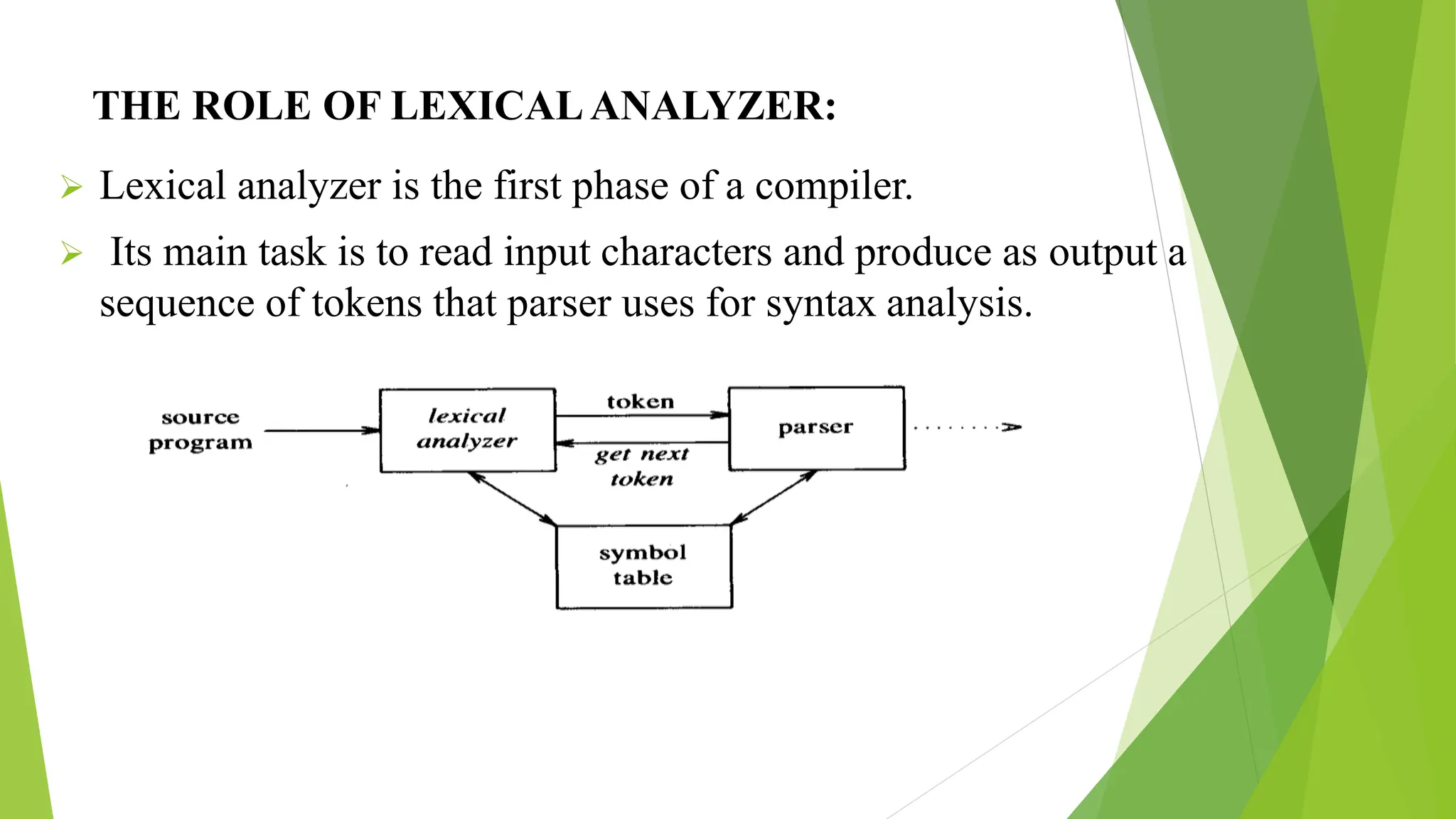
 Lexical analyzer is the first phase of a compiler.
 Its main task is to read input characters and produce as output a
sequence of tokens that parser uses for syntax analysis.
 If the lexical analyzer is located as a separate pass in the compiler it can
need an intermediate file to locate its output, from which the parser
would then takes its input.
 The lexical analyzer also interacts with the symbol table while passing
tokens to the parser. Whenever a token is discovered, the lexical
analyzer returns a representation for that token to the parser.
 If the token is a simple construct including parenthesis, comma, or a
colon, then it returns an integer program. If the token is a more complex
items including an identifier or another token with a value, the value is
also passed to the parser.
ISSUES IN LEXICALANALYSIS:
 There are several reasons for separating the analysis
phase of compiling into lexical analysis and parsing:
 It leads to simpler design of the parser as the unnecessary
tokens can be eliminated by scanner.
 Efficiency of the process of compilation is improved.
The lexical analysis phase is most time consuming phase
in compilation.
 buffering to improve the speed of compilation.
automata theroy and compiler designc.pptx

automata theroy and compiler designc.pptx

  • 1.
    Subject: Automata TheoryAnd Compiler Design Topic: Lexical Analysis Phase Of Compiler Guided By: Presented By: Sindhu G Yashaswini S(1KT21IS046) Dept of ISE.
  • 2.
    INTRODUCTION:  The scanning/lexicalanalysis phase of a compiler performs the task of reading the source program as a file of characters and dividing up into tokens.  Usually implemented as subroutine or co-routine of parser.  Front end of compiler.  Each token is a sequence of characters that represents a unit of information in the source program.
  • 3.
    EXAMPLES OF TOKENS: Keywords which are fixed string of letters .eg: “if”, “while”.  Identifiers which are user-defined strings composed of letters and numbers.  Special symbols like arithmetic symbols.
  • 4.
    APPLICATIONS:  Scanners performpattern matching process.  The techniques used to implement lexical analyzers can also be applied to other areas such as query languages and information retrieval systems.  Since pattern directed programming is widely useful, pattern action language called Lex for specifying lexical analyzers.  In lex , patterns are specified by regular expressions, and a compiler for lex can generate an efficient finite- automaton recognizer for the regular expression
  • 5.
    THE ROLE OFLEXICALANALYZER:  Lexical analyzer is the first phase of a compiler.  Its main task is to read input characters and produce as output a sequence of tokens that parser uses for syntax analysis.
  • 6.
     If thelexical analyzer is located as a separate pass in the compiler it can need an intermediate file to locate its output, from which the parser would then takes its input.  The lexical analyzer also interacts with the symbol table while passing tokens to the parser. Whenever a token is discovered, the lexical analyzer returns a representation for that token to the parser.  If the token is a simple construct including parenthesis, comma, or a colon, then it returns an integer program. If the token is a more complex items including an identifier or another token with a value, the value is also passed to the parser.
  • 7.
    ISSUES IN LEXICALANALYSIS: There are several reasons for separating the analysis phase of compiling into lexical analysis and parsing:  It leads to simpler design of the parser as the unnecessary tokens can be eliminated by scanner.  Efficiency of the process of compilation is improved. The lexical analysis phase is most time consuming phase in compilation.  buffering to improve the speed of compilation.