Acceptance &
Commitment Therapy
- an introduction
Abergavenny
July 2015
Dr Ray Owen
Clinical Psychologist
drrayowen@gmail.com
Aims for the day
► Awareness of what Acceptance & Commitment
Therapy (ACT) is
 If being discussed
 Make informed choice about whether interested to
pursue further
► Awareness of
 Principles underlying model
 Core processes of ACT
 Some examples of how used
► By means of
 Presentation
 Experience
 Reflection
 With head, heart and hands..
To begin with…
3 people
► Peter feels sad and hopeless, and drinks
too much since his wife left him
►Alina has given up on her career goals and
her social life since developing a chronic
pain condition
►Steve feels so stressed and anxious before
difficult meetings or giving talks that he
can’t face his job as a clinical psychologist
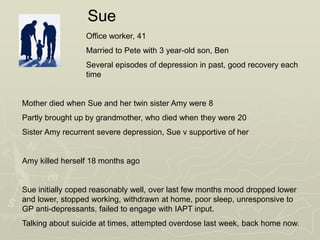
Office worker, 41
Married to Pete with 3 year-old son, Ben
Several episodes of depression in past, good recovery each
time
Mother died when Sue and her twin sister Amy were 8
Partly brought up by grandmother, who died when they were 20
Sister Amy recurrent severe depression, Sue v supportive of her
Amy killed herself 18 months ago
Sue initially coped reasonably well, over last few months mood dropped lower
and lower, stopped working, withdrawn at home, poor sleep, unresponsive to
GP anti-depressants, failed to engage with IAPT input.
Talking about suicide at times, attempted overdose last week, back home now.
Sue
► Pete just irritates me – doesn’t get why all these losses
matter to me so much. Really unsympathetic after
overdose. I have angry outbursts. Don’t know how much
longer he’ll stay around
► Everyone I love dies; I miss them so much
► I get overwhelmed when I’m with Ben – what if he’s next?
 Keep imagining awful things happening to him
 Hurts so much I just let Pete look after him, and hide in bed all
day, thinking
► I used to be the stronger one, and look at me now; I let
everyone down, couldn’t save Amy, & I’m a lousy mother
► I can’t go on feeling like this
► Everyone – me included – would be better off if I was
dead
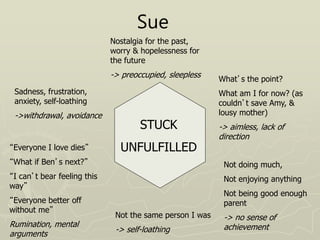
Sue
“Everyone I love dies”
“What if Ben’s next?”
“I can’t bear feeling this
way”
“Everyone better off
without me”
Rumination, mental
arguments
Sadness, frustration,
anxiety, self-loathing
->withdrawal, avoidance
Nostalgia for the past,
worry & hopelessness for
the future
-> preoccupied, sleepless
Not the same person I was
-> self-loathing
Not doing much,
Not enjoying anything
Not being good enough
parent
-> no sense of
achievement
What’s the point?
What am I for now? (as
couldn’t save Amy, &
lousy mother)
-> aimless, lack of
direction
STUCK
UNFULFILLED
►Pathological state?
►Psychological disorder?
►Mental illness?
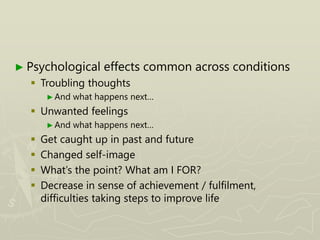
► Psychological effects common across conditions
 Troubling thoughts
►And what happens next…
 Unwanted feelings
►And what happens next…
 Get caught up in past and future
 Changed self-image
 What’s the point? What am I FOR?
 Decrease in sense of achievement / fulfilment,
difficulties taking steps to improve life
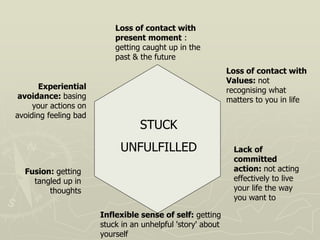
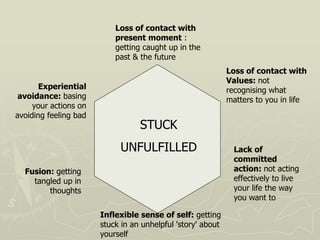
STUCK
UNFULFILLED
Experiential
avoidance: basing
your actions on
avoiding feeling bad
Fusion: getting
tangled up in
thoughts
Loss of contact with
present moment :
getting caught up in the
past & the future
Inflexible sense of self: getting
stuck in an unhelpful 'story' about
yourself
Loss of contact with
Values: not
recognising what
matters to you in life
Lack of
committed
action: not acting
effectively to live
your life the way
you want to
The Great Western Lie…….
►Our default state
Healthy, happy normality!
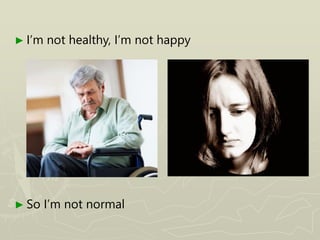
► I’m not healthy, I’m not happy
► So I’m not normal
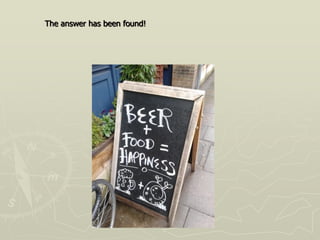
The answer has been found!
The Major Reason to
Suspect this is False
►The ubiquity of human suffering
Alternative Assumption:
Destructive Normality
►Normal psychological processes often
are destructive
►Normal mental representation &
processing
 Role of language (Relational Frame Theory)
►We need to understand these processes
and work within them to promote health
and well-being
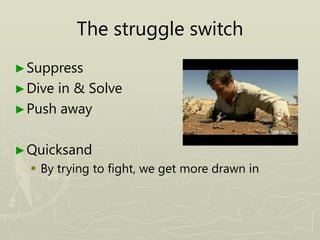
The struggle switch
►Suppress
►Dive in & Solve
►Push away
►Quicksand
 By trying to fight, we get more drawn in
In a nutshell…
One way..
Acceptance & Commitment
Therapy (ACT)
 a ‘3rd-wave’ Cognitive Behaviour
Therapy
Historical background
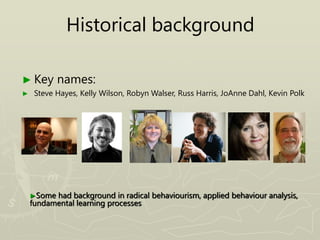
► Key names:
► Steve Hayes, Kelly Wilson, Robyn Walser, Russ Harris, JoAnne Dahl, Kevin Polk
►Some had background in radical behaviourism, applied behaviour analysis,
fundamental learning processes
►Development during the 90s, most work
since Hayes et al original book published
1999
►Since applied across huge range of
problems and settings, including:
 depression, anxiety, anger, substance abuse,
psychosis, pain, chronic health conditions,
workplace stress, epilepsy, stigma, cultural
awareness, learning new skills
Evidence
► Overall
 >125 RCTs, hundreds smaller studies
 Emphasis on mediational analyses
 Some problems from Ost meta-analysis (methodological
differences, non-diagnosis)
 Others show positive result
► A-Tjak J, G, L,. et al (2015), A Meta-Analysis of the Efficacy of Acceptance and
Commitment Therapy for Clinically Relevant Mental and Physical Health Problems.
Psychother Psychosom 84:30-36
 Almost all available at www.contextualscience.org
► Evidence-based practice (EBP) lists
 Accepted as EBP on US Dept of Health’s SAMSHA list
 APA Section 12 listings of EBP cites ‘strong research support’ for
use in chronic pain
► Many e.g.s with LTCs (e.g. Gregg et al 2007 JCCP)
Characteristics
► About building a fulfilling life, not about eliminating
distress
► Rejection of concept of ‘healthy happy normality’
 suffering is universal consequence of normal psychological function
 Exists in context – e.g. LTCs
► Interested in psychological processes, diagnosis not seen as
useful (or indeed valid)
► These processes are universal, not simply present in those
with ‘a problem’
► Hallmarks include:
 metaphor
 activity
► Linked to
 a particular stance / philosophical approach
► ‘functional contextualism’ – development of radical behaviourism
 A particular model of language, learning and behaviour
► Relational Frame Theory (RFT)
Functional contextualism
(remember your ABCs..)
► Interested in the action in context
 Think of a behaviour
 In what context?
 What consequence / function?
► We cannot understand, respond to or be helpful about a behaviour
without knowing something about its context and
function/consequence
► Easy to forget how fundamental this is
 Events (actions, thoughts, feelings) often treated as intrinscially good/bad
rather than considering them in context
 E.g. leaving a crowded room, thinking “I can’t do this”, feeling scared
Relational Frame Theory
►Underpinned by a fundamental theory of
 how learning occurs
 how the relationships between objects builds
up in human mind,
 symbolic mental representation ( = language)
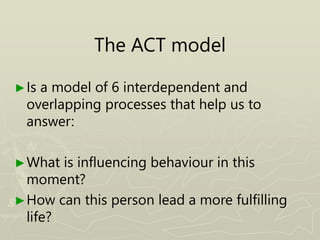
The ACT model
►Is a model of 6 interdependent and
overlapping processes that help us to
answer:
►What is influencing behaviour in this
moment?
►How can this person lead a more fulfilling
life?
STUCK
UNFULFILLED
Experiential
avoidance: basing
your actions on
avoiding feeling bad
Fusion: getting
tangled up in
thoughts
Loss of contact with
present moment :
getting caught up in the
past & the future
Inflexible sense of self: getting
stuck in an unhelpful 'story' about
yourself
Loss of contact with
Values: not
recognising what
matters to you in life
Lack of
committed
action: not acting
effectively to live
your life the way
you want to
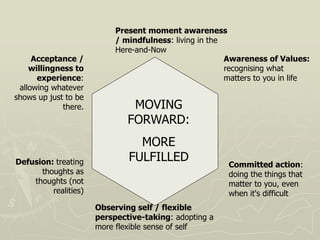
MOVING
FORWARD:
MORE
FULFILLED
Acceptance /
willingness to
experience:
allowing whatever
shows up just to be
there.
Defusion: treating
thoughts as
thoughts (not
realities)
Present moment awareness
/ mindfulness: living in the
Here-and-Now
Observing self / flexible
perspective-taking: adopting a
more flexible sense of self
Awareness of Values:
recognising what
matters to you in life
Committed action:
doing the things that
matter to you, even
when it's difficult
How?
►In a nutshell…
Acceptance / Willingness
to experience
“allowing whatever shows
up just to be there”
Defusion
“treating thoughts
as thoughts (not
realities)”
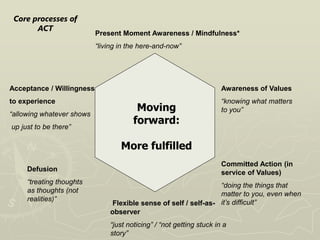
Present Moment Awareness / Mindfulness*
“living in the here-and-now”
Flexible sense of self / self-as-
observer
“just noticing” / “not getting stuck in a
story”
Awareness of Values
“knowing what matters
to you”
Committed Action (in
service of Values)
“doing the things that
matter to you, even when
it’s difficult”
Core processes of
ACT
Moving
forward:
More fulfilled
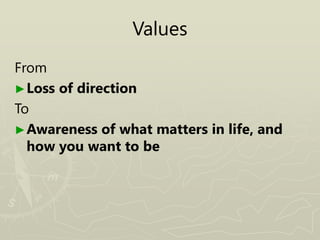
Values
From
►Loss of direction
To
►Awareness of what matters in life, and
how you want to be
“Show, don’t tell”
- universal process
- A health warning
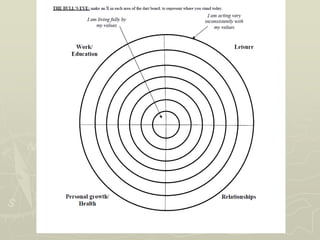
Who matters most to you
in the world?
How do you want to be
towards them?
(How do you want to act in
your dealings with them?)
Values
►‘what we want to stand for in life, how we
want to behave, what sort of person we
want to be, what sort of strengths and
qualities we want to develop’.
►
Russ Harris, (2009)
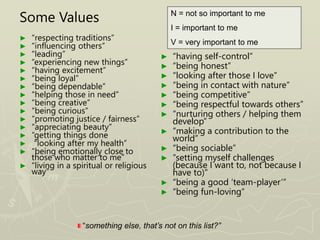
Some Values
► “respecting traditions”
► “influencing others”
► “leading”
► “experiencing new things”
► “having excitement”
► “being loyal”
► “being dependable”
► “helping those in need”
► “being creative”
► “being curious”
► “promoting justice / fairness”
► “appreciating beauty”
► “getting things done
► “looking after my health”
► “being emotionally close to
those who matter to me”
► “living in a spiritual or religious
way”
► “having self-control”
► “being honest”
► “looking after those I love”
► “being in contact with nature”
► “being competitive”
► “being respectful towards others”
► “nurturing others / helping them
develop”
► “making a contribution to the
world”
► “being sociable”
► “setting myself challenges
(because I want to, not because I
have to)”
► “being a good ‘team-player’”
► “being fun-loving”
“something else, that’s not on this list?”
N = not so important to me
I = important to me
V = very important to me
Values are…
► Ongoing
► Not the same as Goals (compass points, not destinations)
► Not the same as Actions (ways of acting)
► Chosen (the person I want to be, not what I’m stuck with)
► Not dependent on others’ approval (if no-one else ever
knew)
► Not right or wrong
► Ends in themselves, more or less… (intrinsically reinforcing)
► About fulfilment, not happiness:
 “a life well-lived is a life lived according to your
Values”
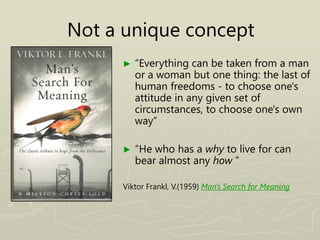
Not a unique concept
► “Everything can be taken from a man
or a woman but one thing: the last of
human freedoms - to choose one's
attitude in any given set of
circumstances, to choose one's own
way”
► “He who has a why to live for can
bear almost any how ”
Viktor Frankl, V.(1959) Man's Search for Meaning
So what’s stopping you?
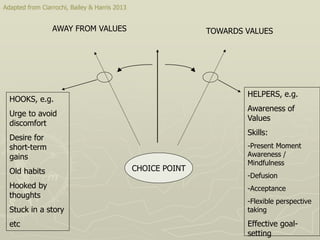
CHOICE POINT
AWAY FROM VALUES TOWARDS VALUES
HOOKS, e.g.
Urge to avoid
discomfort
Desire for
short-term
gains
Old habits
Hooked by
thoughts
Stuck in a story
etc
HELPERS, e.g.
Awareness of
Values
Skills:
-Present Moment
Awareness /
Mindfulness
-Defusion
-Acceptance
-Flexible perspective
taking
Effective goal-
setting
Adapted from Ciarrochi, Bailey & Harris 2013
From
►Fused; losing the distinction between
thought and reality
to
►Defused; noticing thoughts as
thoughts, and choosing your
response
A warning…
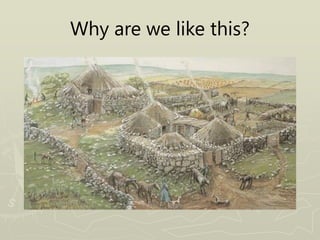
Why are we like this?
Go to YouTube & watch ‘Struggling with Internal Hijackers’
https://www.youtube.com/watch?v=NdaCEO4WtDU
Troubling thoughts…
►An exercise
‘SELF AS CONTEXT’ /
flexible perspective taking
from
►Stuck in a story about self
to
►Flexible perspective taking, observing
self
From
►experiential avoidance
 Basing your actions on avoiding
feeling bad
to
►acceptance / willingness to
experience
 Allowing whatever shows up just to be
there
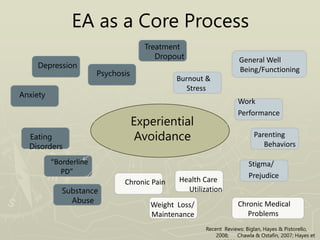
EA as a Core Process
Experiential
Avoidance
Depression
Anxiety
Chronic Pain
Eating
Disorders
Substance
Abuse
Psychosis
“Borderline
PD”
Treatment
Dropout
Burnout &
Stress
General Well
Being/Functioning
Work
Performance
Parenting
Behaviors
Stigma/
Prejudice
Health Care
Utilization
Weight Loss/
Maintenance
Chronic Medical
Problems
Recent Reviews: Biglan, Hayes & Pistorello,
2008; Chawla & Ostafin, 2007; Hayes et
Meet aunt Irma
An exercise in willingness…
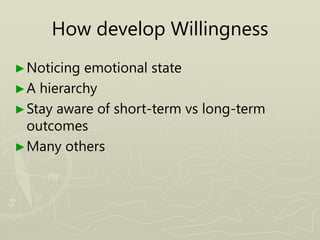
How develop Willingness
►Noticing emotional state
►A hierarchy
►Stay aware of short-term vs long-term
outcomes
►Many others
PRESENT MOMENT AWARENESS /
mindfulness*
From
►Dwelling in the past, the future,
elsewhere
To
►Staying present, here-and-now, noticing
what’s actually happening
Here & Now…
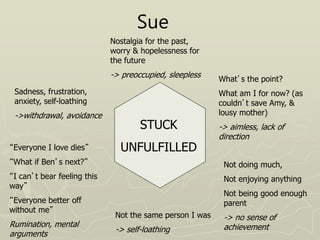
Sue
“Everyone I love dies”
“What if Ben’s next?”
“I can’t bear feeling this
way”
“Everyone better off
without me”
Rumination, mental
arguments
Sadness, frustration,
anxiety, self-loathing
->withdrawal, avoidance
Nostalgia for the past,
worry & hopelessness for
the future
-> preoccupied, sleepless
Not the same person I was
-> self-loathing
Not doing much,
Not enjoying anything
Not being good enough
parent
-> no sense of
achievement
What’s the point?
What am I for now? (as
couldn’t save Amy, &
lousy mother)
-> aimless, lack of
direction
STUCK
UNFULFILLED
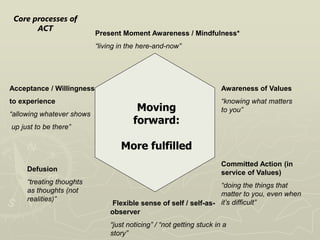
Acceptance / Willingness
to experience
“allowing whatever shows
up just to be there”
Defusion
“treating thoughts
as thoughts (not
realities)”
Present Moment Awareness / Mindfulness*
“living in the here-and-now”
Flexible sense of self / self-as-
observer
“just noticing” / “not getting stuck in a
story”
Awareness of Values
“knowing what matters
to you”
Committed Action (in
service of Values)
“doing the things that
matter to you, even when
it’s difficult”
Core processes of
ACT
Moving
forward:
More fulfilled
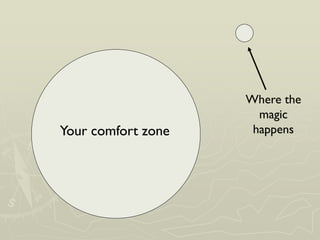
But why should I have to
experience all those unwanted
thought, unpleasant feelings and
physical discomfort?
Your comfort zone
Where the
magic
happens
To learn more…
► Formal courses
 E.g. Birmingham University ‘ACT week’ October 2015
► 2 day experiential Introductory
► 1 day clinical applications (intro)
► 2 day intermediate
► 1 day intermediate ACT for Long-term physical health conditions
 See shop.bham.ac.uk
► One website:
 www.contextualscience.org
► One book (to begin with):
 ‘ACT made Simple’ by Russ Harris
► Well, maybe two…
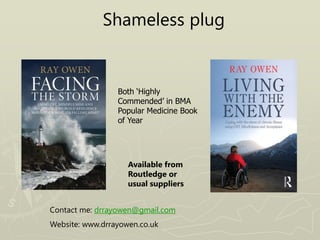
Shameless plug
Available from
Routledge or
usual suppliers
Contact me: drrayowen@gmail.com
Website: www.drrayowen.co.uk
Both ‘Highly
Commended’ in BMA
Popular Medicine Book
of Year

Act1 day

  • 1.
    Acceptance & Commitment Therapy -an introduction Abergavenny July 2015 Dr Ray Owen Clinical Psychologist drrayowen@gmail.com
  • 2.
    Aims for theday ► Awareness of what Acceptance & Commitment Therapy (ACT) is  If being discussed  Make informed choice about whether interested to pursue further ► Awareness of  Principles underlying model  Core processes of ACT  Some examples of how used ► By means of  Presentation  Experience  Reflection  With head, heart and hands..
  • 3.
  • 4.
    3 people ► Peterfeels sad and hopeless, and drinks too much since his wife left him ►Alina has given up on her career goals and her social life since developing a chronic pain condition ►Steve feels so stressed and anxious before difficult meetings or giving talks that he can’t face his job as a clinical psychologist
  • 5.
    Office worker, 41 Marriedto Pete with 3 year-old son, Ben Several episodes of depression in past, good recovery each time Mother died when Sue and her twin sister Amy were 8 Partly brought up by grandmother, who died when they were 20 Sister Amy recurrent severe depression, Sue v supportive of her Amy killed herself 18 months ago Sue initially coped reasonably well, over last few months mood dropped lower and lower, stopped working, withdrawn at home, poor sleep, unresponsive to GP anti-depressants, failed to engage with IAPT input. Talking about suicide at times, attempted overdose last week, back home now. Sue
  • 6.
    ► Pete justirritates me – doesn’t get why all these losses matter to me so much. Really unsympathetic after overdose. I have angry outbursts. Don’t know how much longer he’ll stay around ► Everyone I love dies; I miss them so much ► I get overwhelmed when I’m with Ben – what if he’s next?  Keep imagining awful things happening to him  Hurts so much I just let Pete look after him, and hide in bed all day, thinking ► I used to be the stronger one, and look at me now; I let everyone down, couldn’t save Amy, & I’m a lousy mother ► I can’t go on feeling like this ► Everyone – me included – would be better off if I was dead
  • 7.
    Sue “Everyone I lovedies” “What if Ben’s next?” “I can’t bear feeling this way” “Everyone better off without me” Rumination, mental arguments Sadness, frustration, anxiety, self-loathing ->withdrawal, avoidance Nostalgia for the past, worry & hopelessness for the future -> preoccupied, sleepless Not the same person I was -> self-loathing Not doing much, Not enjoying anything Not being good enough parent -> no sense of achievement What’s the point? What am I for now? (as couldn’t save Amy, & lousy mother) -> aimless, lack of direction STUCK UNFULFILLED
  • 8.
  • 9.
    ► Psychological effectscommon across conditions  Troubling thoughts ►And what happens next…  Unwanted feelings ►And what happens next…  Get caught up in past and future  Changed self-image  What’s the point? What am I FOR?  Decrease in sense of achievement / fulfilment, difficulties taking steps to improve life
  • 10.
    STUCK UNFULFILLED Experiential avoidance: basing your actionson avoiding feeling bad Fusion: getting tangled up in thoughts Loss of contact with present moment : getting caught up in the past & the future Inflexible sense of self: getting stuck in an unhelpful 'story' about yourself Loss of contact with Values: not recognising what matters to you in life Lack of committed action: not acting effectively to live your life the way you want to
  • 11.
    The Great WesternLie……. ►Our default state
  • 12.
  • 13.
    ► I’m nothealthy, I’m not happy ► So I’m not normal
  • 14.
    The answer hasbeen found!
  • 16.
    The Major Reasonto Suspect this is False ►The ubiquity of human suffering
  • 17.
    Alternative Assumption: Destructive Normality ►Normalpsychological processes often are destructive ►Normal mental representation & processing  Role of language (Relational Frame Theory) ►We need to understand these processes and work within them to promote health and well-being
  • 18.
    The struggle switch ►Suppress ►Divein & Solve ►Push away ►Quicksand  By trying to fight, we get more drawn in
  • 19.
  • 20.
    One way.. Acceptance &Commitment Therapy (ACT)  a ‘3rd-wave’ Cognitive Behaviour Therapy
  • 21.
    Historical background ► Keynames: ► Steve Hayes, Kelly Wilson, Robyn Walser, Russ Harris, JoAnne Dahl, Kevin Polk ►Some had background in radical behaviourism, applied behaviour analysis, fundamental learning processes
  • 22.
    ►Development during the90s, most work since Hayes et al original book published 1999 ►Since applied across huge range of problems and settings, including:  depression, anxiety, anger, substance abuse, psychosis, pain, chronic health conditions, workplace stress, epilepsy, stigma, cultural awareness, learning new skills
  • 23.
    Evidence ► Overall  >125RCTs, hundreds smaller studies  Emphasis on mediational analyses  Some problems from Ost meta-analysis (methodological differences, non-diagnosis)  Others show positive result ► A-Tjak J, G, L,. et al (2015), A Meta-Analysis of the Efficacy of Acceptance and Commitment Therapy for Clinically Relevant Mental and Physical Health Problems. Psychother Psychosom 84:30-36  Almost all available at www.contextualscience.org ► Evidence-based practice (EBP) lists  Accepted as EBP on US Dept of Health’s SAMSHA list  APA Section 12 listings of EBP cites ‘strong research support’ for use in chronic pain ► Many e.g.s with LTCs (e.g. Gregg et al 2007 JCCP)
  • 24.
    Characteristics ► About buildinga fulfilling life, not about eliminating distress ► Rejection of concept of ‘healthy happy normality’  suffering is universal consequence of normal psychological function  Exists in context – e.g. LTCs ► Interested in psychological processes, diagnosis not seen as useful (or indeed valid) ► These processes are universal, not simply present in those with ‘a problem’ ► Hallmarks include:  metaphor  activity ► Linked to  a particular stance / philosophical approach ► ‘functional contextualism’ – development of radical behaviourism  A particular model of language, learning and behaviour ► Relational Frame Theory (RFT)
  • 25.
    Functional contextualism (remember yourABCs..) ► Interested in the action in context  Think of a behaviour  In what context?  What consequence / function? ► We cannot understand, respond to or be helpful about a behaviour without knowing something about its context and function/consequence ► Easy to forget how fundamental this is  Events (actions, thoughts, feelings) often treated as intrinscially good/bad rather than considering them in context  E.g. leaving a crowded room, thinking “I can’t do this”, feeling scared
  • 26.
    Relational Frame Theory ►Underpinnedby a fundamental theory of  how learning occurs  how the relationships between objects builds up in human mind,  symbolic mental representation ( = language)
  • 27.
    The ACT model ►Isa model of 6 interdependent and overlapping processes that help us to answer: ►What is influencing behaviour in this moment? ►How can this person lead a more fulfilling life?
  • 28.
    STUCK UNFULFILLED Experiential avoidance: basing your actionson avoiding feeling bad Fusion: getting tangled up in thoughts Loss of contact with present moment : getting caught up in the past & the future Inflexible sense of self: getting stuck in an unhelpful 'story' about yourself Loss of contact with Values: not recognising what matters to you in life Lack of committed action: not acting effectively to live your life the way you want to
  • 29.
    MOVING FORWARD: MORE FULFILLED Acceptance / willingness to experience: allowingwhatever shows up just to be there. Defusion: treating thoughts as thoughts (not realities) Present moment awareness / mindfulness: living in the Here-and-Now Observing self / flexible perspective-taking: adopting a more flexible sense of self Awareness of Values: recognising what matters to you in life Committed action: doing the things that matter to you, even when it's difficult
  • 30.
  • 31.
    Acceptance / Willingness toexperience “allowing whatever shows up just to be there” Defusion “treating thoughts as thoughts (not realities)” Present Moment Awareness / Mindfulness* “living in the here-and-now” Flexible sense of self / self-as- observer “just noticing” / “not getting stuck in a story” Awareness of Values “knowing what matters to you” Committed Action (in service of Values) “doing the things that matter to you, even when it’s difficult” Core processes of ACT Moving forward: More fulfilled
  • 33.
    Values From ►Loss of direction To ►Awarenessof what matters in life, and how you want to be
  • 34.
    “Show, don’t tell” -universal process - A health warning
  • 35.
    Who matters mostto you in the world? How do you want to be towards them? (How do you want to act in your dealings with them?)
  • 36.
    Values ►‘what we wantto stand for in life, how we want to behave, what sort of person we want to be, what sort of strengths and qualities we want to develop’. ► Russ Harris, (2009)
  • 37.
    Some Values ► “respectingtraditions” ► “influencing others” ► “leading” ► “experiencing new things” ► “having excitement” ► “being loyal” ► “being dependable” ► “helping those in need” ► “being creative” ► “being curious” ► “promoting justice / fairness” ► “appreciating beauty” ► “getting things done ► “looking after my health” ► “being emotionally close to those who matter to me” ► “living in a spiritual or religious way” ► “having self-control” ► “being honest” ► “looking after those I love” ► “being in contact with nature” ► “being competitive” ► “being respectful towards others” ► “nurturing others / helping them develop” ► “making a contribution to the world” ► “being sociable” ► “setting myself challenges (because I want to, not because I have to)” ► “being a good ‘team-player’” ► “being fun-loving” “something else, that’s not on this list?” N = not so important to me I = important to me V = very important to me
  • 38.
    Values are… ► Ongoing ►Not the same as Goals (compass points, not destinations) ► Not the same as Actions (ways of acting) ► Chosen (the person I want to be, not what I’m stuck with) ► Not dependent on others’ approval (if no-one else ever knew) ► Not right or wrong ► Ends in themselves, more or less… (intrinsically reinforcing) ► About fulfilment, not happiness:  “a life well-lived is a life lived according to your Values”
  • 39.
    Not a uniqueconcept ► “Everything can be taken from a man or a woman but one thing: the last of human freedoms - to choose one's attitude in any given set of circumstances, to choose one's own way” ► “He who has a why to live for can bear almost any how ” Viktor Frankl, V.(1959) Man's Search for Meaning
  • 41.
  • 42.
    CHOICE POINT AWAY FROMVALUES TOWARDS VALUES HOOKS, e.g. Urge to avoid discomfort Desire for short-term gains Old habits Hooked by thoughts Stuck in a story etc HELPERS, e.g. Awareness of Values Skills: -Present Moment Awareness / Mindfulness -Defusion -Acceptance -Flexible perspective taking Effective goal- setting Adapted from Ciarrochi, Bailey & Harris 2013
  • 43.
    From ►Fused; losing thedistinction between thought and reality to ►Defused; noticing thoughts as thoughts, and choosing your response
  • 47.
  • 49.
    Why are welike this?
  • 50.
    Go to YouTube& watch ‘Struggling with Internal Hijackers’ https://www.youtube.com/watch?v=NdaCEO4WtDU
  • 51.
  • 52.
    ‘SELF AS CONTEXT’/ flexible perspective taking from ►Stuck in a story about self to ►Flexible perspective taking, observing self
  • 54.
    From ►experiential avoidance  Basingyour actions on avoiding feeling bad to ►acceptance / willingness to experience  Allowing whatever shows up just to be there
  • 55.
    EA as aCore Process Experiential Avoidance Depression Anxiety Chronic Pain Eating Disorders Substance Abuse Psychosis “Borderline PD” Treatment Dropout Burnout & Stress General Well Being/Functioning Work Performance Parenting Behaviors Stigma/ Prejudice Health Care Utilization Weight Loss/ Maintenance Chronic Medical Problems Recent Reviews: Biglan, Hayes & Pistorello, 2008; Chawla & Ostafin, 2007; Hayes et
  • 56.
  • 57.
    An exercise inwillingness…
  • 58.
    How develop Willingness ►Noticingemotional state ►A hierarchy ►Stay aware of short-term vs long-term outcomes ►Many others
  • 59.
    PRESENT MOMENT AWARENESS/ mindfulness* From ►Dwelling in the past, the future, elsewhere To ►Staying present, here-and-now, noticing what’s actually happening
  • 60.
  • 61.
    Sue “Everyone I lovedies” “What if Ben’s next?” “I can’t bear feeling this way” “Everyone better off without me” Rumination, mental arguments Sadness, frustration, anxiety, self-loathing ->withdrawal, avoidance Nostalgia for the past, worry & hopelessness for the future -> preoccupied, sleepless Not the same person I was -> self-loathing Not doing much, Not enjoying anything Not being good enough parent -> no sense of achievement What’s the point? What am I for now? (as couldn’t save Amy, & lousy mother) -> aimless, lack of direction STUCK UNFULFILLED
  • 62.
    Acceptance / Willingness toexperience “allowing whatever shows up just to be there” Defusion “treating thoughts as thoughts (not realities)” Present Moment Awareness / Mindfulness* “living in the here-and-now” Flexible sense of self / self-as- observer “just noticing” / “not getting stuck in a story” Awareness of Values “knowing what matters to you” Committed Action (in service of Values) “doing the things that matter to you, even when it’s difficult” Core processes of ACT Moving forward: More fulfilled
  • 63.
    But why shouldI have to experience all those unwanted thought, unpleasant feelings and physical discomfort?
  • 64.
    Your comfort zone Wherethe magic happens
  • 65.
    To learn more… ►Formal courses  E.g. Birmingham University ‘ACT week’ October 2015 ► 2 day experiential Introductory ► 1 day clinical applications (intro) ► 2 day intermediate ► 1 day intermediate ACT for Long-term physical health conditions  See shop.bham.ac.uk ► One website:  www.contextualscience.org ► One book (to begin with):  ‘ACT made Simple’ by Russ Harris ► Well, maybe two…
  • 66.
    Shameless plug Available from Routledgeor usual suppliers Contact me: drrayowen@gmail.com Website: www.drrayowen.co.uk Both ‘Highly Commended’ in BMA Popular Medicine Book of Year