Lesson Planning
TEFL-A-Lecture No.1, Code: 601
Dr Zafar Ullah, Assistant Professor,
zafarullah76@gmail.com
Definitions of Lesson Planning
• According to Monroe, “Lesson plan is the
name of a statement of the things a
teacher proposes to do during the period
he spends with his class”.
• A detailed description of the course
• A written guide to attain learning outcomes
2
Why
• To connect with previous knowledge
• To organize
• To create equilibrium
• To present information clearly
• To teach in an effective manner
3
Objectives of Lesson Planning
• To identify relevant standards
• To fulfil needs
• Higher level thinking
• Learner-centred
• Knowledge
• Comprehension
• Application
• Synthesis
• Evaluation
4
Pre-requisistes of Lesson Planning
i. Know your students
Ability,background, attention span, prior
knowledge, needs, learning preferences
ii. Know the content
Subject matter, school curriculum, national
curriculum
iii. Know instructional material
Technology, AV aids, library, equipment
5
Components of a Lesson Plan (V Imp)
• (Mnemonics) POMPA ‫پومپا‬
1. Profile
2. Objectives
3. Material/ Equipments
4. Procedure
5. Assessment
6
1. Profile
• Basic info about the lesson
i. Name of the lesson
ii. Contributor/ Teacher
iii. Subject
iv. Grade level
v. Small group/ whole class
vi. General Description of lesson
vii.Standards
viii. Class Time
ix. Date
7
2. Objectives
• What you want from students to learn
• Focus on concepts/ language skills
• Grammar
• Vocabulary
• structure
• Mentioned in the beginning of textbooks
8
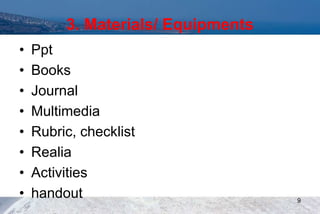
3. Materials/ Equipments
• Ppt
• Books
• Journal
• Multimedia
• Rubric, checklist
• Realia
• Activities
• handout 9
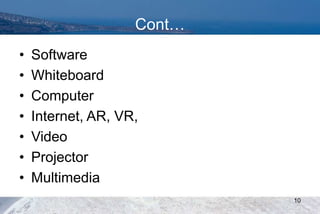
Cont…
• Software
• Whiteboard
• Computer
• Internet, AR, VR,
• Video
• Projector
• Multimedia
10
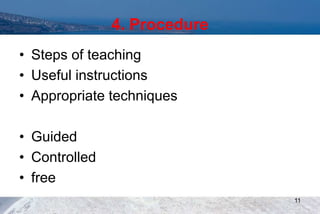
4. Procedure
• Steps of teaching
• Useful instructions
• Appropriate techniques
• Guided
• Controlled
• free
11
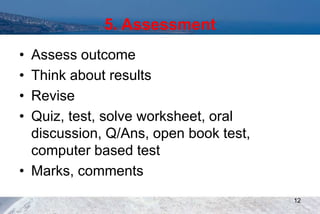
5. Assessment
• Assess outcome
• Think about results
• Revise
• Quiz, test, solve worksheet, oral
discussion, Q/Ans, open book test,
computer based test
• Marks, comments
12
Websites for Lesson Plans
Never copy paste. Just get idea. Write yourself)
1.https://www.teachingenglish.org.uk/teaching-
resources/teaching-secondary/lesson-plans
2.https://eslpals.com/free_lessons
3.https://www.off2class.com/lesson-plan-downloads/
4.https://www.tefl.net/esl-lesson-plans/worksheets-
topic.php
5.http://ielanguages.com/lessonplan.html
13
Cont..
http://www.eslkidstuff.com
Lesson plans etc http://www.edhelper.com/
https://www.nytimes.com/section/learning/le
sson-plans
• Esltower
• Esl galaxy
• Eslkidslab
• Esldepot, Eslgold 14
A. Gagne’s Nine Events of Instruction
i. Gain attention
ii. Inform about learning objective
iii. Prior knowledge
iv. Present
v. Provide guidance
vi. Practice
vii. Feedback
viii. Assess performance
ix. Enhance retention
15
B. Madeline Hunter’s Seven Step Model
i. Review
ii. Anticipatory set
iii. Objectives
iv. Input
v. Check Understanding
vi. Guided practice
vii. Independent Practice
16
C. 5E’s Model
i. Engage
ii. Explore
iii. Explain
iv. Elaborate
V. Evaluate
17
Technology in Language Classroom
• You can take my lecture slides from the
following link to get ideas of lesson plans
https://www.slideshare.net/zafarullah76/itech
nology-in-esl-classroom-
2017?from_action=save
18
Thanks
19
Question Answers
20

Lesson Planning.ppt

  • 1.
    Lesson Planning TEFL-A-Lecture No.1,Code: 601 Dr Zafar Ullah, Assistant Professor, zafarullah76@gmail.com
  • 2.
    Definitions of LessonPlanning • According to Monroe, “Lesson plan is the name of a statement of the things a teacher proposes to do during the period he spends with his class”. • A detailed description of the course • A written guide to attain learning outcomes 2
  • 3.
    Why • To connectwith previous knowledge • To organize • To create equilibrium • To present information clearly • To teach in an effective manner 3
  • 4.
    Objectives of LessonPlanning • To identify relevant standards • To fulfil needs • Higher level thinking • Learner-centred • Knowledge • Comprehension • Application • Synthesis • Evaluation 4
  • 5.
    Pre-requisistes of LessonPlanning i. Know your students Ability,background, attention span, prior knowledge, needs, learning preferences ii. Know the content Subject matter, school curriculum, national curriculum iii. Know instructional material Technology, AV aids, library, equipment 5
  • 6.
    Components of aLesson Plan (V Imp) • (Mnemonics) POMPA ‫پومپا‬ 1. Profile 2. Objectives 3. Material/ Equipments 4. Procedure 5. Assessment 6
  • 7.
    1. Profile • Basicinfo about the lesson i. Name of the lesson ii. Contributor/ Teacher iii. Subject iv. Grade level v. Small group/ whole class vi. General Description of lesson vii.Standards viii. Class Time ix. Date 7
  • 8.
    2. Objectives • Whatyou want from students to learn • Focus on concepts/ language skills • Grammar • Vocabulary • structure • Mentioned in the beginning of textbooks 8
  • 9.
    3. Materials/ Equipments •Ppt • Books • Journal • Multimedia • Rubric, checklist • Realia • Activities • handout 9
  • 10.
    Cont… • Software • Whiteboard •Computer • Internet, AR, VR, • Video • Projector • Multimedia 10
  • 11.
    4. Procedure • Stepsof teaching • Useful instructions • Appropriate techniques • Guided • Controlled • free 11
  • 12.
    5. Assessment • Assessoutcome • Think about results • Revise • Quiz, test, solve worksheet, oral discussion, Q/Ans, open book test, computer based test • Marks, comments 12
  • 13.
    Websites for LessonPlans Never copy paste. Just get idea. Write yourself) 1.https://www.teachingenglish.org.uk/teaching- resources/teaching-secondary/lesson-plans 2.https://eslpals.com/free_lessons 3.https://www.off2class.com/lesson-plan-downloads/ 4.https://www.tefl.net/esl-lesson-plans/worksheets- topic.php 5.http://ielanguages.com/lessonplan.html 13
  • 14.
    Cont.. http://www.eslkidstuff.com Lesson plans etchttp://www.edhelper.com/ https://www.nytimes.com/section/learning/le sson-plans • Esltower • Esl galaxy • Eslkidslab • Esldepot, Eslgold 14
  • 15.
    A. Gagne’s NineEvents of Instruction i. Gain attention ii. Inform about learning objective iii. Prior knowledge iv. Present v. Provide guidance vi. Practice vii. Feedback viii. Assess performance ix. Enhance retention 15
  • 16.
    B. Madeline Hunter’sSeven Step Model i. Review ii. Anticipatory set iii. Objectives iv. Input v. Check Understanding vi. Guided practice vii. Independent Practice 16
  • 17.
    C. 5E’s Model i.Engage ii. Explore iii. Explain iv. Elaborate V. Evaluate 17
  • 18.
    Technology in LanguageClassroom • You can take my lecture slides from the following link to get ideas of lesson plans https://www.slideshare.net/zafarullah76/itech nology-in-esl-classroom- 2017?from_action=save 18
  • 19.
  • 20.