Language Learning
and Acquisition
Theories
Dr Zafar Ullah
zafarullah76@gmail.com
1
Layout
• Theories and Mythological Scenario
• Theory Understanding Tips
• Theories about Origin of Language
• Brain and Cognitive Linguistics
• Theories of Language Acquisition and Learning
• Theorization
2
Theories; Benefits
• “Theory" is a well-confirmed type of explanation of
nature, …such theories are described in such a way
that scientific tests should be able to provide
empirical support for it, or empirical contradiction of
it” (Schafersman, 1997).
• Knowledge construction
• Why
3
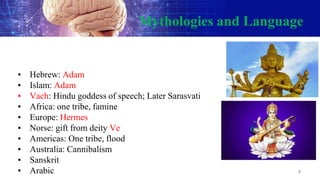
Mythologies and Language
▪ Hebrew: Adam
▪ Islam: Adam
▪ Vach: Hindu goddess of speech; Later Sarasvati
▪ Africa: one tribe, famine
▪ Europe: Hermes
▪ Norse: gift from deity Ve
▪ Americas: One tribe, flood
▪ Australia: Cannibalism
▪ Sanskrit
▪ Arabic 4
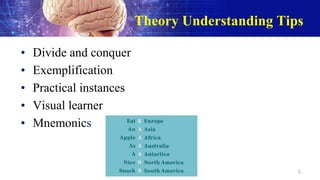
Theory Understanding Tips
• Divide and conquer
• Exemplification
• Practical instances
• Visual learner
• Mnemonics
5
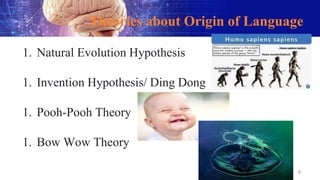
Theories about Origin of Language
1. Natural Evolution Hypothesis
1. Invention Hypothesis/ Ding Dong
1. Pooh-Pooh Theory
1. Bow Wow Theory
6
cont…
5. Natural Cries of Emotions
6. Ta-Ta Theory
7. Warning Hypothesis
8. The Lying Hypothesis
7
cont…
9. Yo-he-ho Theory
10. Appeal of Theory
11. Bipedalism
12. Physical Adaptation Source
8
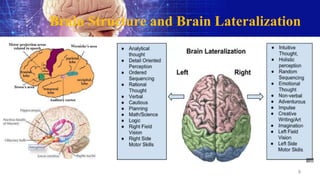
Brain Structure and Brain Lateralization
9
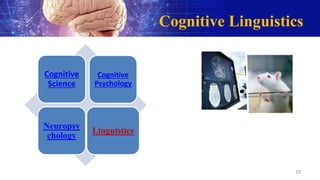
Cognitive Linguistics
Cognitive
Science
Cognitive
Psychology
Neuropsy
chology
Linguistics
10
Piaget’s Theory of Cognitive Development
1. Sensorimotor stage (0–2 years old)
2. Preoperational stage (2–7 years old)
3. Concrete operational stage (7–11 years old)
4. Formal operational stage (11 years old through adulthood)
11
Language Acquisition and Learning Theories
1. Plato and Innate Knowledge
2. Descartes and Cartesian Linguistics
3. Locke and Tabula Rasa
4. Skinner and the Theory of Behaviourism
5. Chomsky and Universal Grammar. ...
6. Schumann and The Acculturation Model
7. Krashen and the Monitor Model (Input Hypothesis)
12
1. Plato and Innate Knowledge
• Acquisition
• innateness
13
2. Descartes and Cartesian Linguistics
• “Cogito ergo sum” “I think, therefore I am.”
• Acquisition: Innateness
• Rational creatures needed language to interact
• Finding similarities between L1 and L2
• manipulating existing structures
14
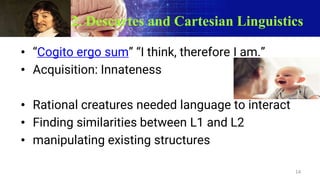
3. Locke and Tabula Rasa
• Counter argument of innateness
• Tabula rasa
• Learning through senses and experiences
15
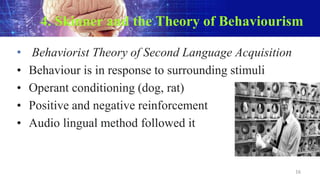
4. Skinner and the Theory of Behaviourism
• Behaviorist Theory of Second Language Acquisition
• Behaviour is in response to surrounding stimuli
• Operant conditioning (dog, rat)
• Positive and negative reinforcement
• Audio lingual method followed it
16
5. Chomsky’s Language Acquisition Theory
• Human nature lies in the human mind
• Innateness; the antithesis of Skinner
• Children construct grammar (Language and Mind, 1972)
• Theory of Universal Grammar; common features
17
6. Schumann and The Acculturation Model
• John Schumann Acculturation Model (1978)
• How immigrants learn a new language
• Attitude Factor Cohesiveness
• Cultural Congruence Enclosure
• Integration Pattern Intended residence Length
• Population Factor Social Dominance
18
7. Krashen and the Monitor Model
i. The Acquisition-learning Hypothesis:
listening to speaking
ii. The Input Hypothesis:
comprehensible input
iii. The Monitor Hypothesis:
internal filter to stop mistakes
19
Cont…
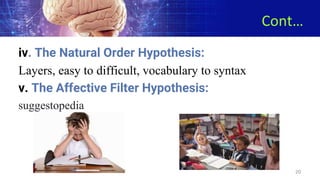
iv. The Natural Order Hypothesis:
Layers, easy to difficult, vocabulary to syntax
v. The Affective Filter Hypothesis:
suggestopedia
20
Theoretical Linguistics
i. Structuralism:
a sociological semiotic theory,
ii. Functionalism:
language as a tool for communication
iii. Formalism:
language as a mathematical–semiotic system comparison of structures of languages
Semantics Discourse
21
cont…
iv. Post-structuralism:
language as a societal tool, anthropology
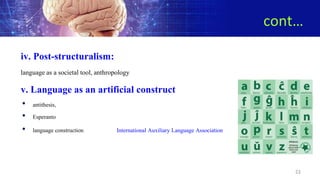
v. Language as an artificial construct
• antithesis,
• Esperanto
• language construction International Auxiliary Language Association
22
Theorization
• Challenge
• fill the gap
• Problem to solution
• Marriage of knowledge domains
• Universality
• Paradigm shift
23
Suggested Readings
24
Access Video and Slides
@drzafarullah76
• Slideshare.net/zafarullah76
25
Thanks and Questions
26

Scholarly Work 03. Language Acquisition and Learning Theories (Code 301).pptx

  • 1.
    Language Learning and Acquisition Theories DrZafar Ullah zafarullah76@gmail.com 1
  • 2.
    Layout • Theories andMythological Scenario • Theory Understanding Tips • Theories about Origin of Language • Brain and Cognitive Linguistics • Theories of Language Acquisition and Learning • Theorization 2
  • 3.
    Theories; Benefits • “Theory"is a well-confirmed type of explanation of nature, …such theories are described in such a way that scientific tests should be able to provide empirical support for it, or empirical contradiction of it” (Schafersman, 1997). • Knowledge construction • Why 3
  • 4.
    Mythologies and Language ▪Hebrew: Adam ▪ Islam: Adam ▪ Vach: Hindu goddess of speech; Later Sarasvati ▪ Africa: one tribe, famine ▪ Europe: Hermes ▪ Norse: gift from deity Ve ▪ Americas: One tribe, flood ▪ Australia: Cannibalism ▪ Sanskrit ▪ Arabic 4
  • 5.
    Theory Understanding Tips •Divide and conquer • Exemplification • Practical instances • Visual learner • Mnemonics 5
  • 6.
    Theories about Originof Language 1. Natural Evolution Hypothesis 1. Invention Hypothesis/ Ding Dong 1. Pooh-Pooh Theory 1. Bow Wow Theory 6
  • 7.
    cont… 5. Natural Criesof Emotions 6. Ta-Ta Theory 7. Warning Hypothesis 8. The Lying Hypothesis 7
  • 8.
    cont… 9. Yo-he-ho Theory 10.Appeal of Theory 11. Bipedalism 12. Physical Adaptation Source 8
  • 9.
    Brain Structure andBrain Lateralization 9
  • 10.
  • 11.
    Piaget’s Theory ofCognitive Development 1. Sensorimotor stage (0–2 years old) 2. Preoperational stage (2–7 years old) 3. Concrete operational stage (7–11 years old) 4. Formal operational stage (11 years old through adulthood) 11
  • 12.
    Language Acquisition andLearning Theories 1. Plato and Innate Knowledge 2. Descartes and Cartesian Linguistics 3. Locke and Tabula Rasa 4. Skinner and the Theory of Behaviourism 5. Chomsky and Universal Grammar. ... 6. Schumann and The Acculturation Model 7. Krashen and the Monitor Model (Input Hypothesis) 12
  • 13.
    1. Plato andInnate Knowledge • Acquisition • innateness 13
  • 14.
    2. Descartes andCartesian Linguistics • “Cogito ergo sum” “I think, therefore I am.” • Acquisition: Innateness • Rational creatures needed language to interact • Finding similarities between L1 and L2 • manipulating existing structures 14
  • 15.
    3. Locke andTabula Rasa • Counter argument of innateness • Tabula rasa • Learning through senses and experiences 15
  • 16.
    4. Skinner andthe Theory of Behaviourism • Behaviorist Theory of Second Language Acquisition • Behaviour is in response to surrounding stimuli • Operant conditioning (dog, rat) • Positive and negative reinforcement • Audio lingual method followed it 16
  • 17.
    5. Chomsky’s LanguageAcquisition Theory • Human nature lies in the human mind • Innateness; the antithesis of Skinner • Children construct grammar (Language and Mind, 1972) • Theory of Universal Grammar; common features 17
  • 18.
    6. Schumann andThe Acculturation Model • John Schumann Acculturation Model (1978) • How immigrants learn a new language • Attitude Factor Cohesiveness • Cultural Congruence Enclosure • Integration Pattern Intended residence Length • Population Factor Social Dominance 18
  • 19.
    7. Krashen andthe Monitor Model i. The Acquisition-learning Hypothesis: listening to speaking ii. The Input Hypothesis: comprehensible input iii. The Monitor Hypothesis: internal filter to stop mistakes 19
  • 20.
    Cont… iv. The NaturalOrder Hypothesis: Layers, easy to difficult, vocabulary to syntax v. The Affective Filter Hypothesis: suggestopedia 20
  • 21.
    Theoretical Linguistics i. Structuralism: asociological semiotic theory, ii. Functionalism: language as a tool for communication iii. Formalism: language as a mathematical–semiotic system comparison of structures of languages Semantics Discourse 21
  • 22.
    cont… iv. Post-structuralism: language asa societal tool, anthropology v. Language as an artificial construct • antithesis, • Esperanto • language construction International Auxiliary Language Association 22
  • 23.
    Theorization • Challenge • fillthe gap • Problem to solution • Marriage of knowledge domains • Universality • Paradigm shift 23
  • 24.
  • 25.
    Access Video andSlides @drzafarullah76 • Slideshare.net/zafarullah76 25
  • 26.