Presented by: Dr Zafar Ullah
zafarullah76@gmail.com
Scholarly Work 04
Cross Cultural Pragmatics
Outline
• Definitions of culture, cross culture
• Aspects of Cross cultural studies
• Leading Figures and their work
• Evolution of Culture
• Principal concepts in Cultural Studies
• Cross cultural variations in welcoming of
newborn baby
• Cross cultural variations in weddings
• Cross cultural variations in funerals
Culture and Cross Cultural Definitions
• Mental map
• “Culture is a set of shared assumptions, values, and
beliefs of a group of people by which they organize
their common life.” ~ Gary Wederspahan
• Comparison of cultures, cross culture, holoculture
• multiculturalism, cosmopolitanism,
transculturation, cultural diversity
• Why? Globalization
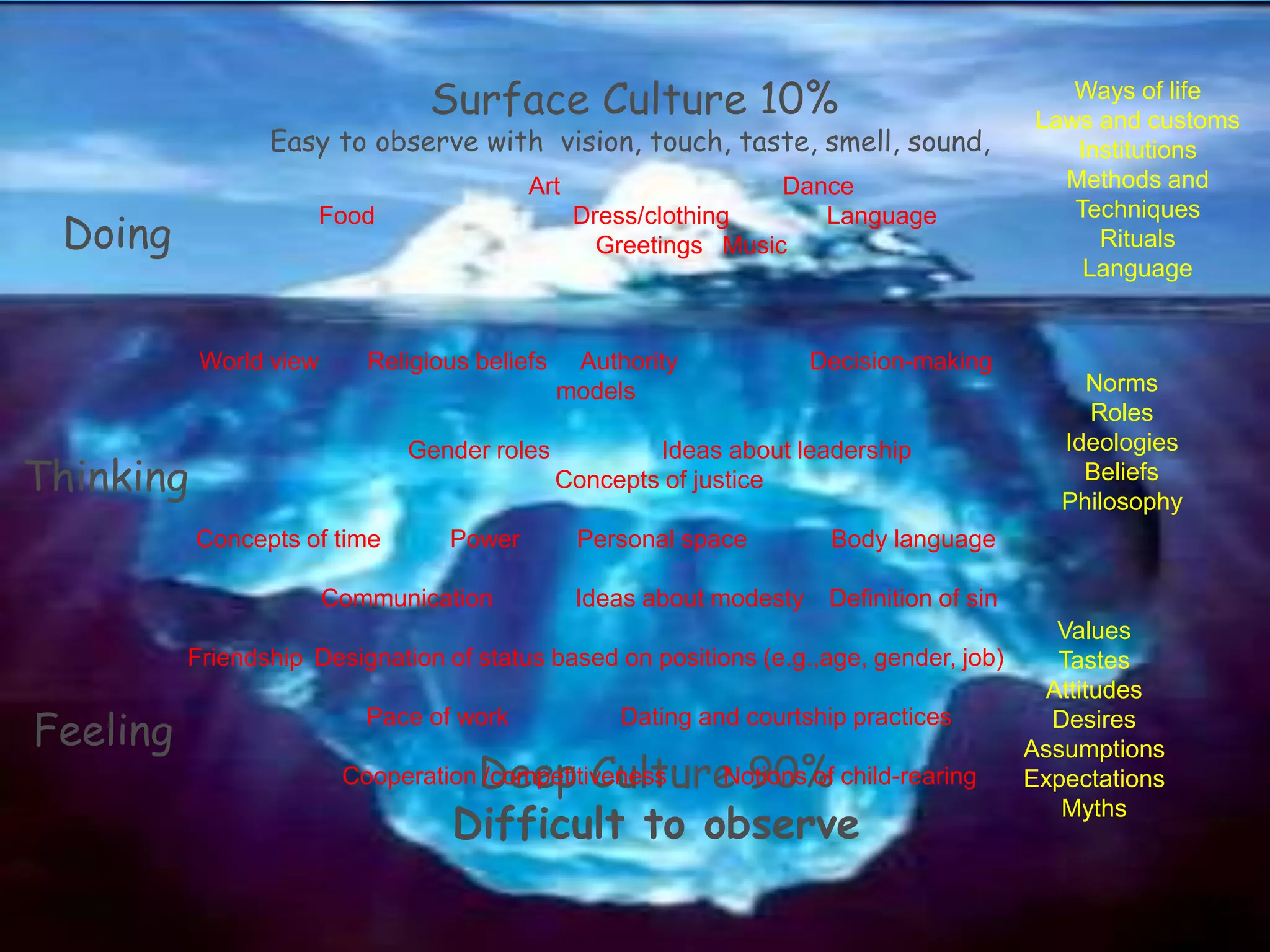
Doing
Thinking
Feeling
Ways of life
Laws and customs
Institutions
Methods and
Techniques
Rituals
Language
Norms
Roles
Ideologies
Beliefs
Philosophy
Values
Tastes
Attitudes
Desires
Assumptions
Expectations
Myths
Surface Culture 10%
Easy to observe with vision, touch, taste, smell, sound,
Deep Culture 90%
Difficult to observe
Art Dance
Food Dress/clothing Language
Greetings Music
World view Religious beliefs Authority Decision-making
models
Gender roles Ideas about leadership
Concepts of justice
Concepts of time Power Personal space Body language
Communication Ideas about modesty Definition of sin
Friendship Designation of status based on positions (e.g.,age, gender, job)
Pace of work Dating and courtship practices
Cooperation /competitiveness Notions of child-rearing
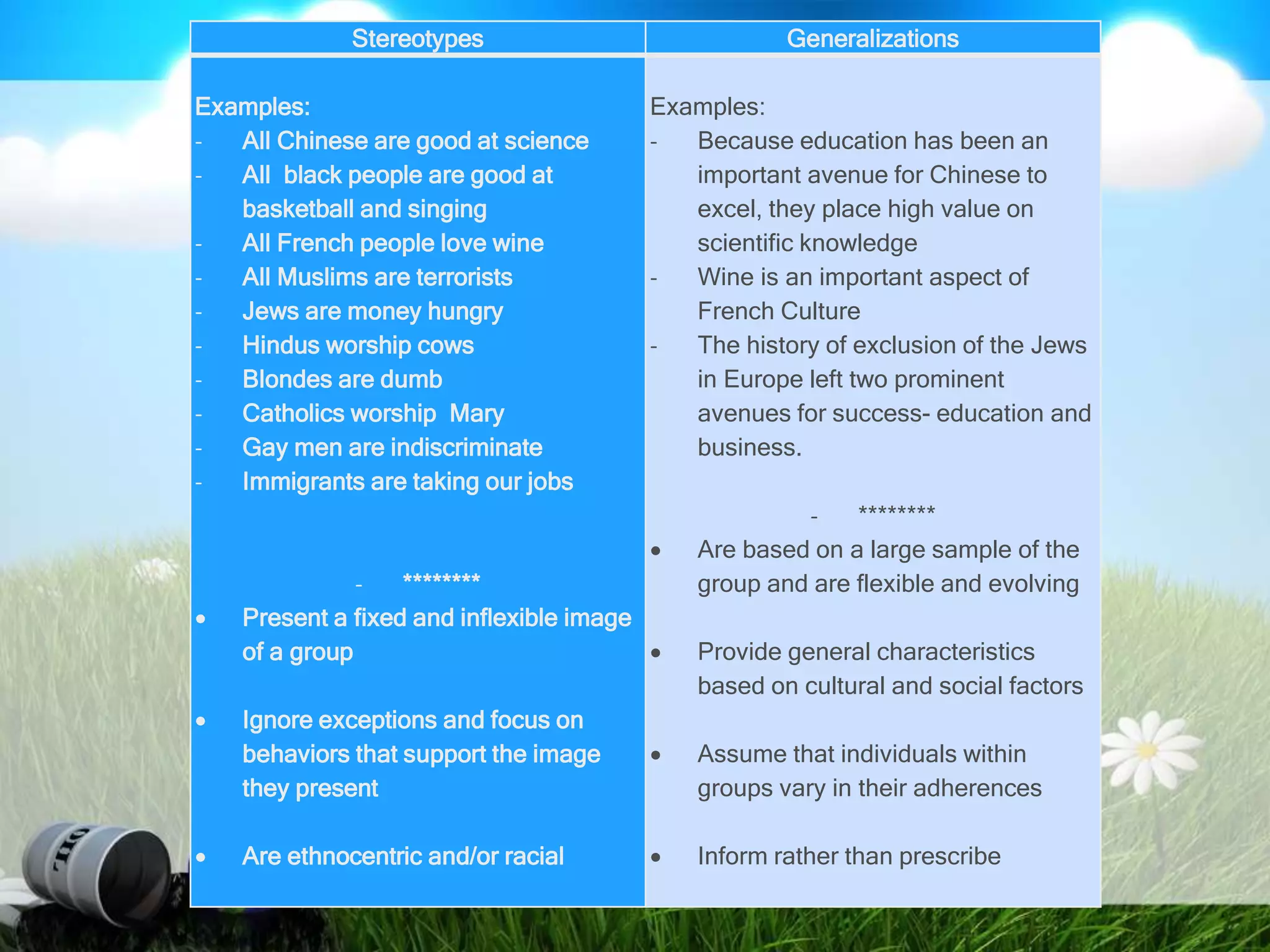
Stereotypes Generalizations
Examples:
- All Chinese are good at science
- All black people are good at
basketball and singing
- All French people love wine
- All Muslims are terrorists
- Jews are money hungry
- Hindus worship cows
- Blondes are dumb
- Catholics worship Mary
- Gay men are indiscriminate
- Immigrants are taking our jobs
- ********
 Present a fixed and inflexible image
of a group
 Ignore exceptions and focus on
behaviors that support the image
they present
 Are ethnocentric and/or racial
Examples:
- Because education has been an
important avenue for Chinese to
excel, they place high value on
scientific knowledge
- Wine is an important aspect of
French Culture
- The history of exclusion of the Jews
in Europe left two prominent
avenues for success- education and
business.
- ********
 Are based on a large sample of the
group and are flexible and evolving
 Provide general characteristics
based on cultural and social factors
 Assume that individuals within
groups vary in their adherences
 Inform rather than prescribe
High-context communication
patterns (implied)
Nonverbal messages/gestures are
important
Status and identity may be
communicated nonverbally
Face-saving and tact are important
Building a good relationship
Low-context
communication (literal meaning)
Statements may be taken at face value
Roles and functions
A sustained focus on tasks
Direct questions are not meant to offend
Indirect cues may be ineffectual
Context Differences
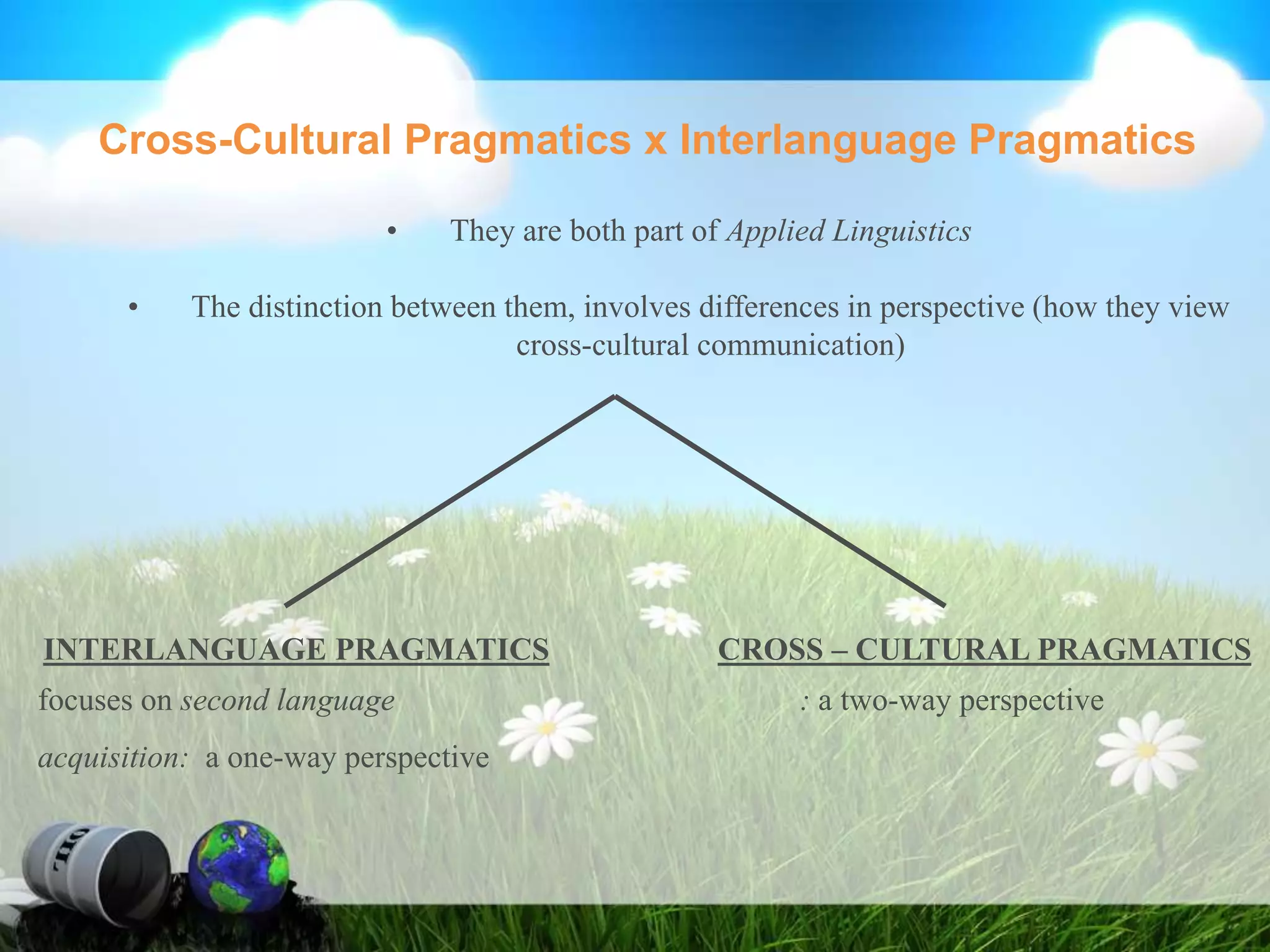
Cross-Cultural Pragmatics x Interlanguage Pragmatics
• They are both part of Applied Linguistics
• The distinction between them, involves differences in perspective (how they view
cross-cultural communication)
INTERLANGUAGE PRAGMATICS CROSS – CULTURAL PRAGMATICS
focuses on second language : a two-way perspective
acquisition: a one-way perspective
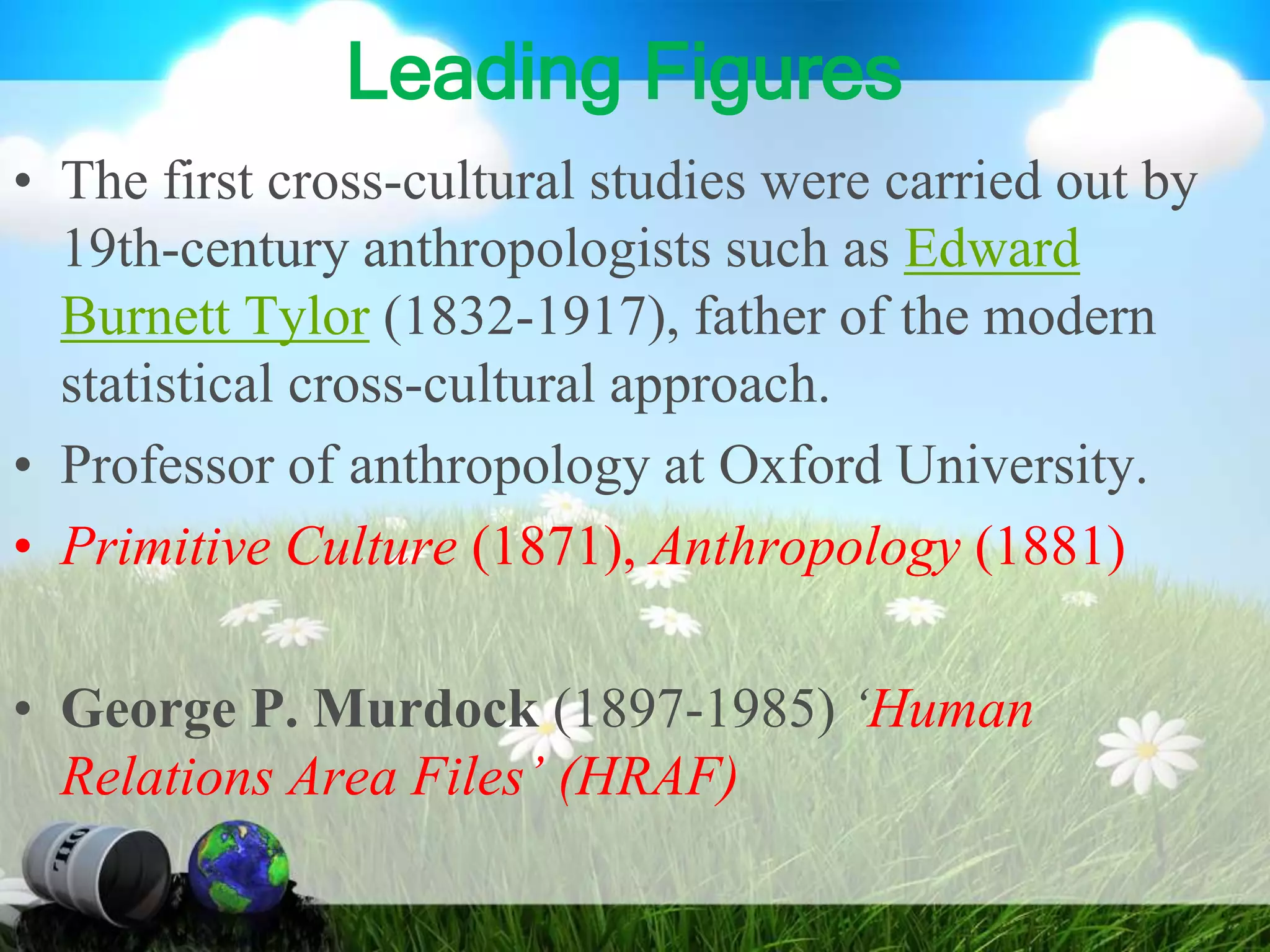
Leading Figures
• The first cross-cultural studies were carried out by
19th-century anthropologists such as Edward
Burnett Tylor (1832-1917), father of the modern
statistical cross-cultural approach.
• Professor of anthropology at Oxford University.
• Primitive Culture (1871), Anthropology (1881)
• George P. Murdock (1897-1985) ‘Human
Relations Area Files’ (HRAF)
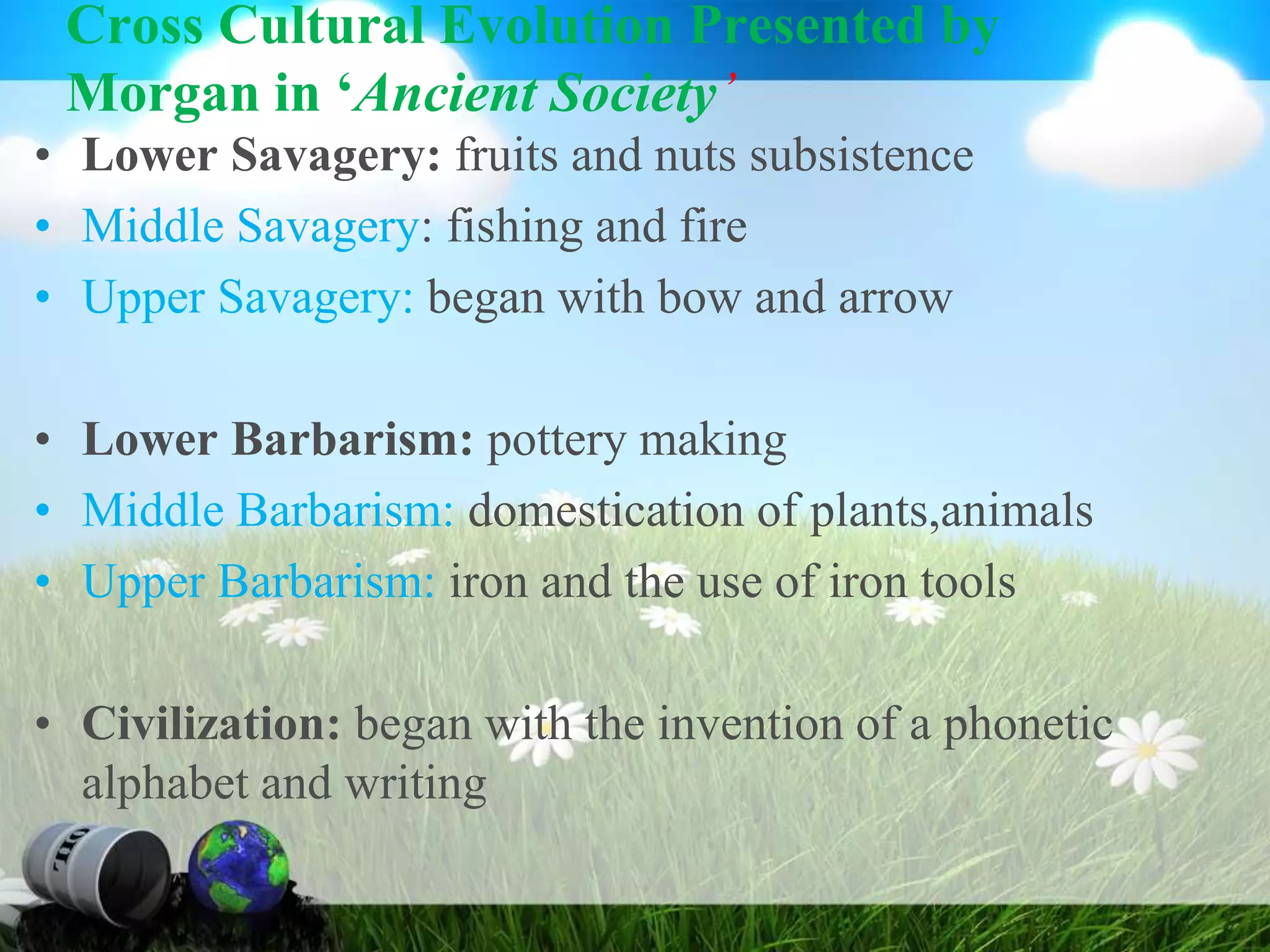
Cross Cultural Evolution Presented by
Morgan in ‘Ancient Society’
• Lower Savagery: fruits and nuts subsistence
• Middle Savagery: fishing and fire
• Upper Savagery: began with bow and arrow
• Lower Barbarism: pottery making
• Middle Barbarism: domestication of plants,animals
• Upper Barbarism: iron and the use of iron tools
• Civilization: began with the invention of a phonetic
alphabet and writing
Principal Concepts of Cultural Studies
• Regional comparison: Kroeber and Driver
• Holocultural analysis: Statistical test of 10 or more
illiterate societies, 3, 4 regions of world. from Tylor to
Sumner and Keller and then to Murdock.
• Holonational :Universal traits in a nation.
• Controlled Comparison : smaller scale comparison.
Customs on Child Birth
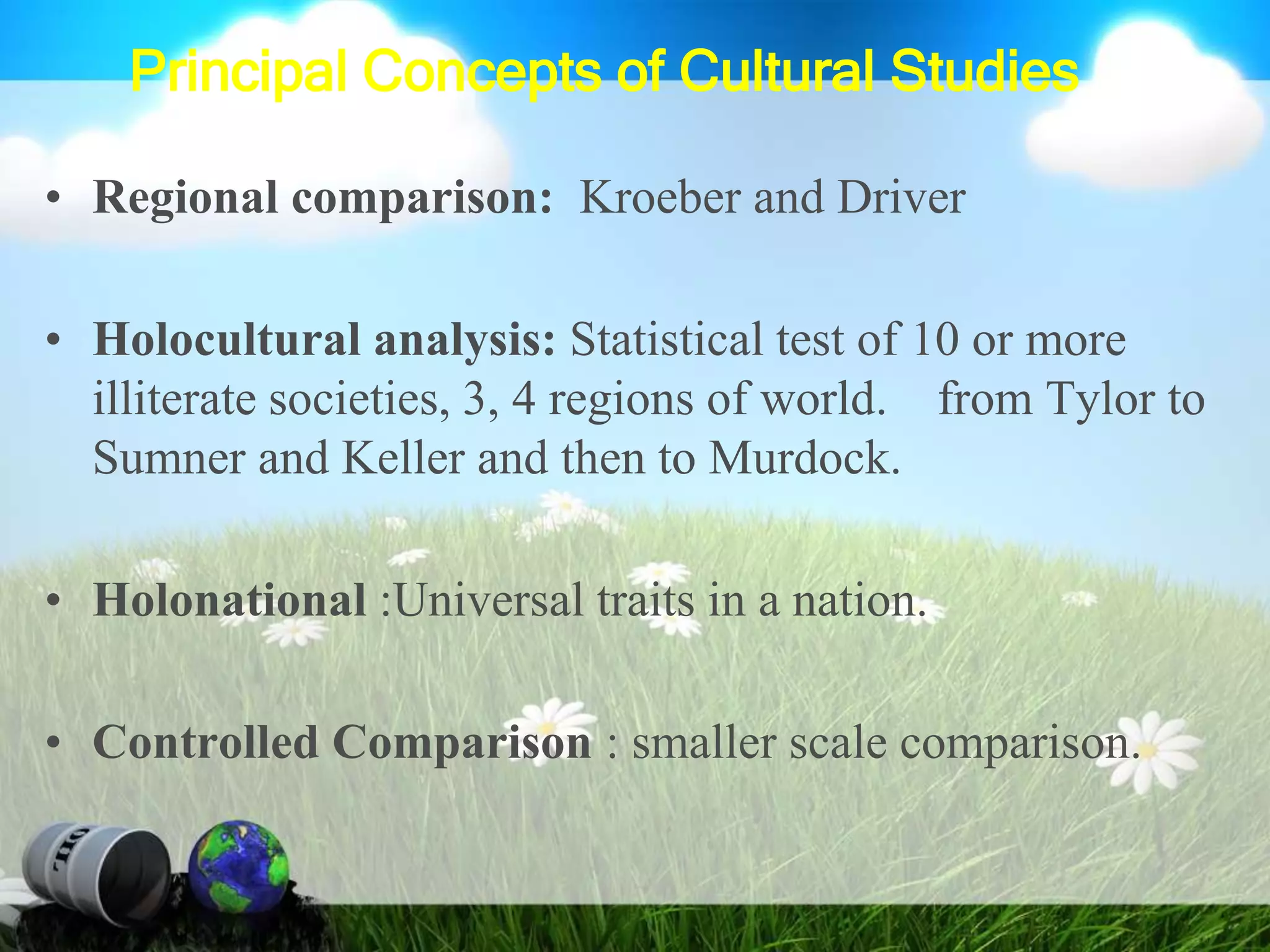
• Irish: Sprinkle wedding cake on the
baby’s forehead.
• Manchu( Chinese ethnicity) parents
fellatio and they will never kiss their
child’s face.
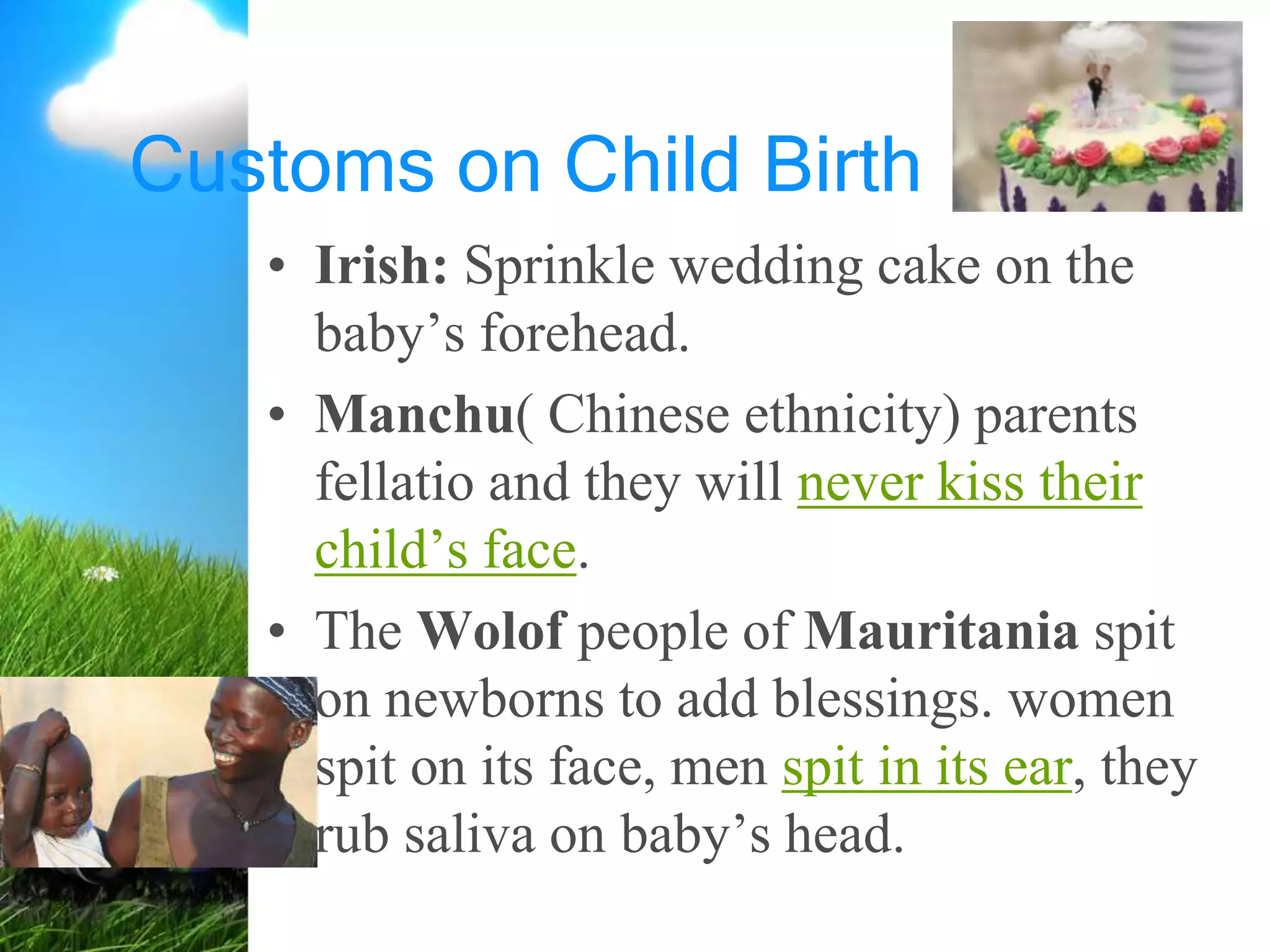
• The Wolof people of Mauritania spit
on newborns to add blessings. women
spit on its face, men spit in its ear, they
rub saliva on baby’s head.
Cont…
• In hot countries like Guatemala
Mayan mothers think ice baths are the best way to
fight the heat.
• Malaysia: Hot stone massages and full-body
exfoliation treatment to chase away postpartum
body changes
• Balinese (in Indonesia): Babies can’t touch the
ground.
• Jamaica: The Afterbirth and Cord are Buried in a
Special Location and a Tree is Planted on that
Spot.
Cont…
• Egypt: Place the baby in a large sieve and shake it
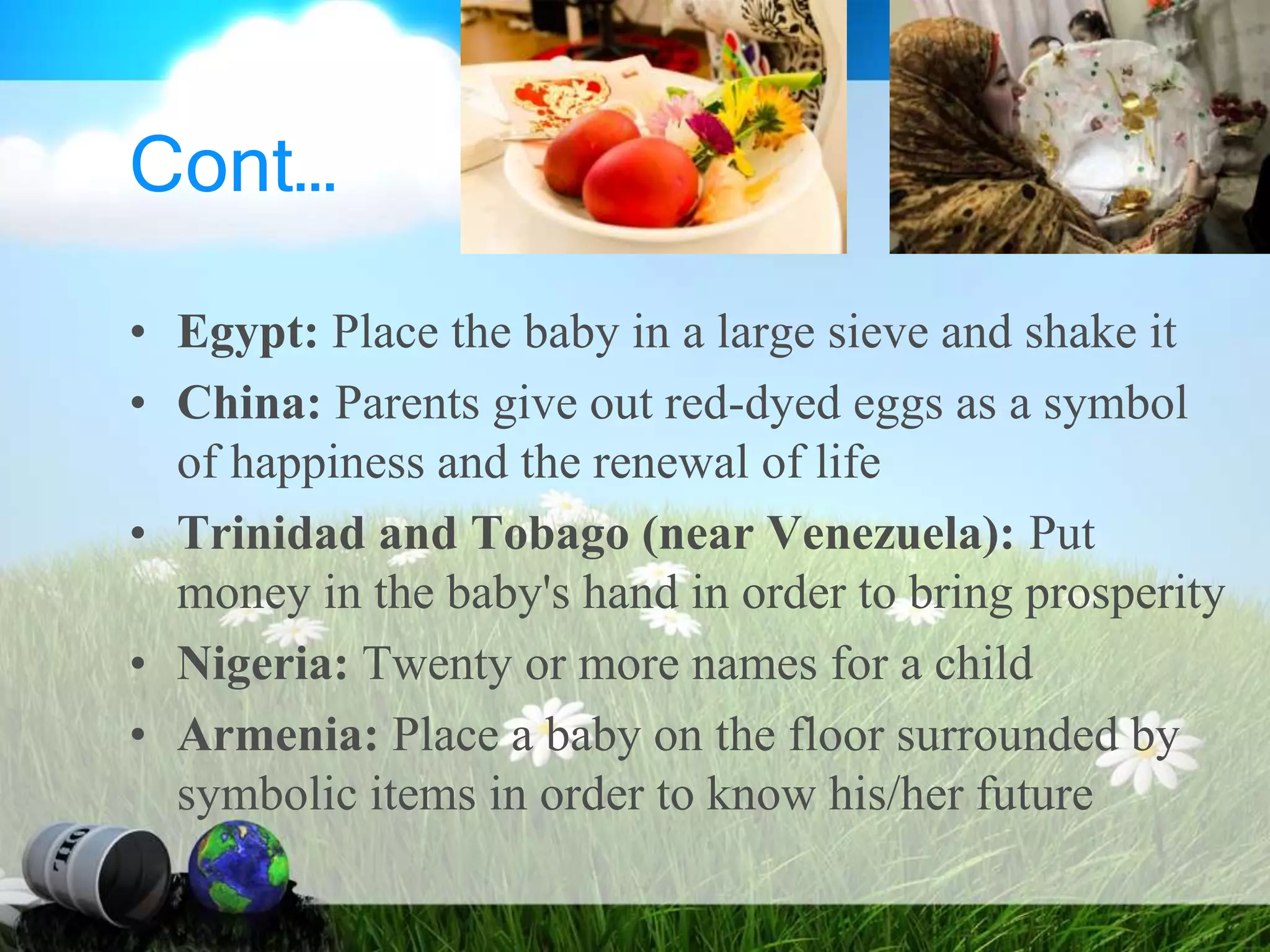
• China: Parents give out red-dyed eggs as a symbol
of happiness and the renewal of life
• Trinidad and Tobago (near Venezuela): Put
money in the baby's hand in order to bring prosperity
• Nigeria: Twenty or more names for a child
• Armenia: Place a baby on the floor surrounded by
symbolic items in order to know his/her future
Wedding Cross Cultural Customs
• Fiji. Gift of a whale’s tooth or some unique
thing to father of bride to seek match
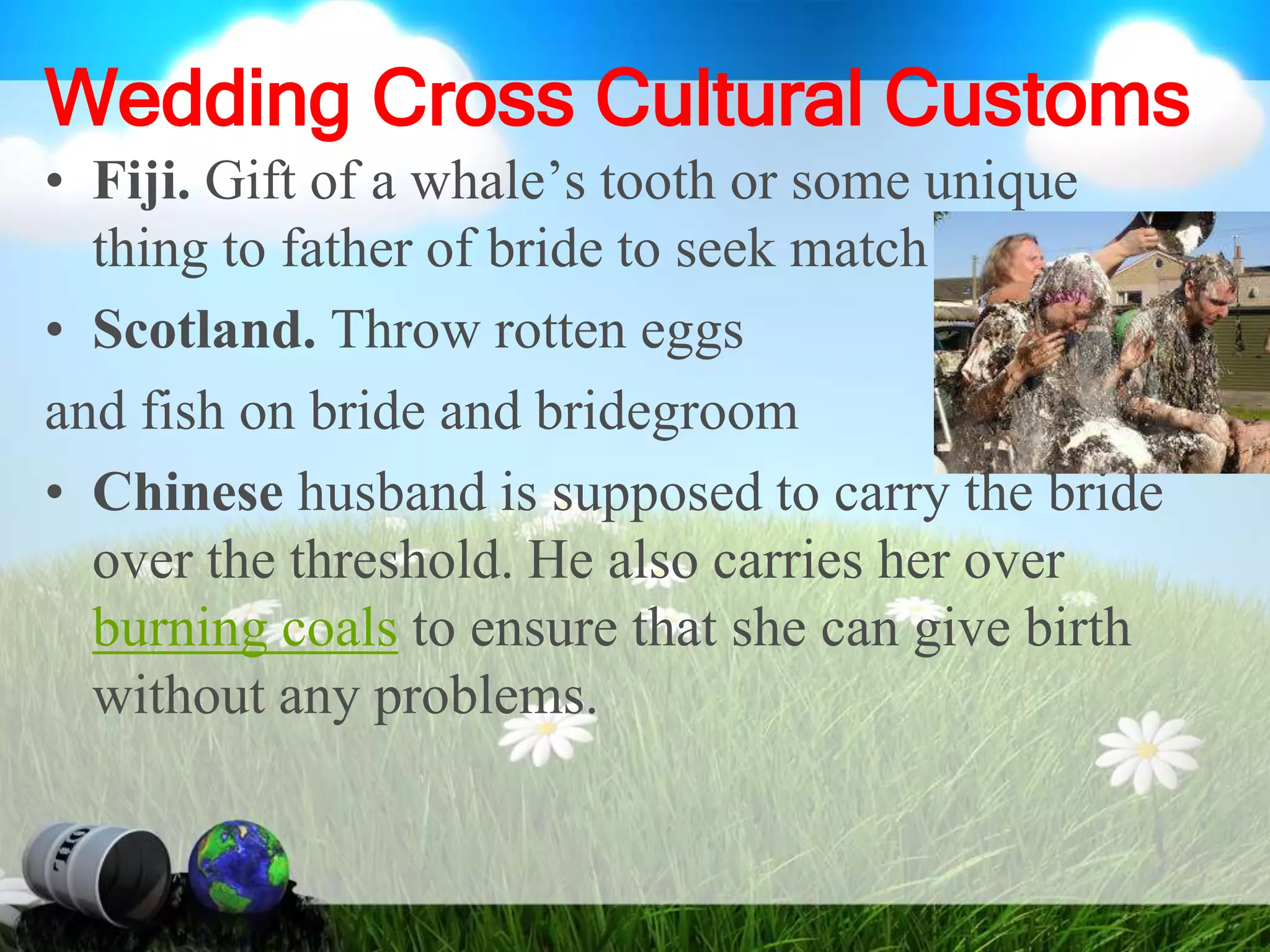
• Scotland. Throw rotten eggs
and fish on bride and bridegroom
• Chinese husband is supposed to carry the bride
over the threshold. He also carries her over
burning coals to ensure that she can give birth
without any problems.
Cont…
• Big, Fat Mauritanian bride is forced
to eat a lot before wedding.
• Krygyzstan. Bridal Kidnapping. Tears make happy
wedding.
• Many Russians choose to be married at the Tomb of the
Unknown Soldier in Moscow.
• India. Wedding with tree, dog, humans etc.
• Rome: The locked-down love bridge
• Wales: love spoons
• China's Tujia people: 1 hour weep daily for 1 month
before marriage.
Cont…
• Niger: Males dance and ladies
pick husband for them.
USA. Black couples jump the broom
Papua New Guinean: Males paint bodies
and behave like mating male birds
South Korea: Groom’s feet are beaten
Cross Cultural Customs on
Death
• Tibetan Buddhist Celestial Burials
• Endocannibalism in Africa
• Satee in India
• West Papua, New Guinea: To ampute
finger on death of relatives
• Taiwan: Funeral stripper
• Pakistan: Kalash dance, music, feast
• Tana Toraja in Eastern Indonesia: Music, dance,
feast, dance, music. Keep deadbody in a room, give
food and prepare family for funeral.
Cont…
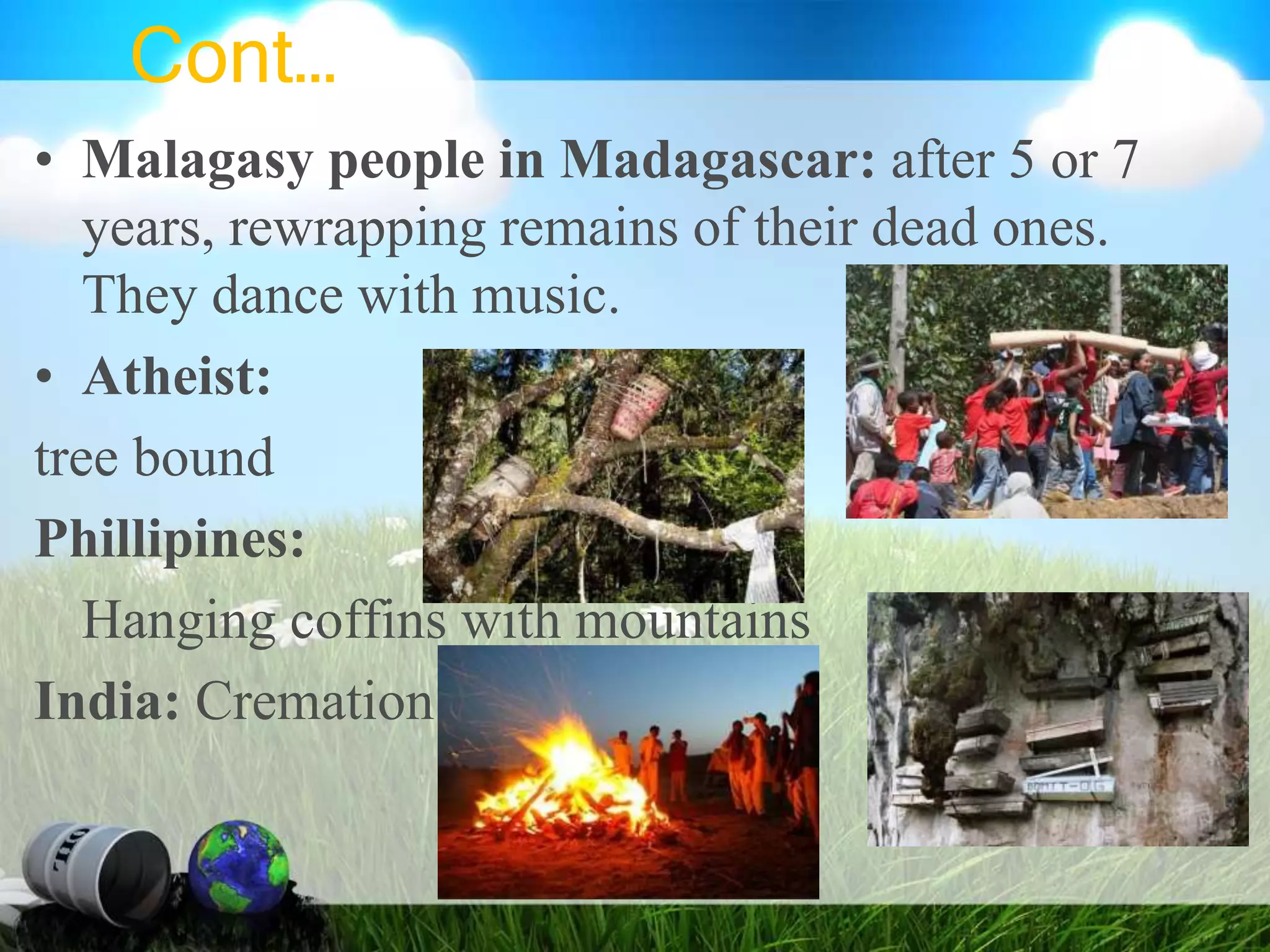
• Malagasy people in Madagascar: after 5 or 7
years, rewrapping remains of their dead ones.
They dance with music.
• Atheist:
tree bound
Phillipines:
Hanging coffins with mountains
India: Cremation
Cont…
• USA: 44 Green funerals
• Hawaii, burial caves
• USA sea staff: Burial at Sea
• British Columbia: Gwaii Haanas National Park:
Mortuary Totem Poles . The icons in these poles
were meant to act as guardians to guide the spirit
to the afterlife.
Thank You
20

Scholarly Work 04. Cross Cultural Pragmatics.ppt

  • 1.
    Presented by: DrZafar Ullah zafarullah76@gmail.com Scholarly Work 04 Cross Cultural Pragmatics
  • 2.
    Outline • Definitions ofculture, cross culture • Aspects of Cross cultural studies • Leading Figures and their work • Evolution of Culture • Principal concepts in Cultural Studies • Cross cultural variations in welcoming of newborn baby • Cross cultural variations in weddings • Cross cultural variations in funerals
  • 3.
    Culture and CrossCultural Definitions • Mental map • “Culture is a set of shared assumptions, values, and beliefs of a group of people by which they organize their common life.” ~ Gary Wederspahan • Comparison of cultures, cross culture, holoculture • multiculturalism, cosmopolitanism, transculturation, cultural diversity • Why? Globalization
  • 4.
    Doing Thinking Feeling Ways of life Lawsand customs Institutions Methods and Techniques Rituals Language Norms Roles Ideologies Beliefs Philosophy Values Tastes Attitudes Desires Assumptions Expectations Myths Surface Culture 10% Easy to observe with vision, touch, taste, smell, sound, Deep Culture 90% Difficult to observe Art Dance Food Dress/clothing Language Greetings Music World view Religious beliefs Authority Decision-making models Gender roles Ideas about leadership Concepts of justice Concepts of time Power Personal space Body language Communication Ideas about modesty Definition of sin Friendship Designation of status based on positions (e.g.,age, gender, job) Pace of work Dating and courtship practices Cooperation /competitiveness Notions of child-rearing
  • 5.
    Stereotypes Generalizations Examples: - AllChinese are good at science - All black people are good at basketball and singing - All French people love wine - All Muslims are terrorists - Jews are money hungry - Hindus worship cows - Blondes are dumb - Catholics worship Mary - Gay men are indiscriminate - Immigrants are taking our jobs - ********  Present a fixed and inflexible image of a group  Ignore exceptions and focus on behaviors that support the image they present  Are ethnocentric and/or racial Examples: - Because education has been an important avenue for Chinese to excel, they place high value on scientific knowledge - Wine is an important aspect of French Culture - The history of exclusion of the Jews in Europe left two prominent avenues for success- education and business. - ********  Are based on a large sample of the group and are flexible and evolving  Provide general characteristics based on cultural and social factors  Assume that individuals within groups vary in their adherences  Inform rather than prescribe
  • 6.
    High-context communication patterns (implied) Nonverbalmessages/gestures are important Status and identity may be communicated nonverbally Face-saving and tact are important Building a good relationship Low-context communication (literal meaning) Statements may be taken at face value Roles and functions A sustained focus on tasks Direct questions are not meant to offend Indirect cues may be ineffectual Context Differences
  • 7.
    Cross-Cultural Pragmatics xInterlanguage Pragmatics • They are both part of Applied Linguistics • The distinction between them, involves differences in perspective (how they view cross-cultural communication) INTERLANGUAGE PRAGMATICS CROSS – CULTURAL PRAGMATICS focuses on second language : a two-way perspective acquisition: a one-way perspective
  • 8.
    Leading Figures • Thefirst cross-cultural studies were carried out by 19th-century anthropologists such as Edward Burnett Tylor (1832-1917), father of the modern statistical cross-cultural approach. • Professor of anthropology at Oxford University. • Primitive Culture (1871), Anthropology (1881) • George P. Murdock (1897-1985) ‘Human Relations Area Files’ (HRAF)
  • 9.
    Cross Cultural EvolutionPresented by Morgan in ‘Ancient Society’ • Lower Savagery: fruits and nuts subsistence • Middle Savagery: fishing and fire • Upper Savagery: began with bow and arrow • Lower Barbarism: pottery making • Middle Barbarism: domestication of plants,animals • Upper Barbarism: iron and the use of iron tools • Civilization: began with the invention of a phonetic alphabet and writing
  • 10.
    Principal Concepts ofCultural Studies • Regional comparison: Kroeber and Driver • Holocultural analysis: Statistical test of 10 or more illiterate societies, 3, 4 regions of world. from Tylor to Sumner and Keller and then to Murdock. • Holonational :Universal traits in a nation. • Controlled Comparison : smaller scale comparison.
  • 11.
    Customs on ChildBirth • Irish: Sprinkle wedding cake on the baby’s forehead. • Manchu( Chinese ethnicity) parents fellatio and they will never kiss their child’s face. • The Wolof people of Mauritania spit on newborns to add blessings. women spit on its face, men spit in its ear, they rub saliva on baby’s head.
  • 12.
    Cont… • In hotcountries like Guatemala Mayan mothers think ice baths are the best way to fight the heat. • Malaysia: Hot stone massages and full-body exfoliation treatment to chase away postpartum body changes • Balinese (in Indonesia): Babies can’t touch the ground. • Jamaica: The Afterbirth and Cord are Buried in a Special Location and a Tree is Planted on that Spot.
  • 13.
    Cont… • Egypt: Placethe baby in a large sieve and shake it • China: Parents give out red-dyed eggs as a symbol of happiness and the renewal of life • Trinidad and Tobago (near Venezuela): Put money in the baby's hand in order to bring prosperity • Nigeria: Twenty or more names for a child • Armenia: Place a baby on the floor surrounded by symbolic items in order to know his/her future
  • 14.
    Wedding Cross CulturalCustoms • Fiji. Gift of a whale’s tooth or some unique thing to father of bride to seek match • Scotland. Throw rotten eggs and fish on bride and bridegroom • Chinese husband is supposed to carry the bride over the threshold. He also carries her over burning coals to ensure that she can give birth without any problems.
  • 15.
    Cont… • Big, FatMauritanian bride is forced to eat a lot before wedding. • Krygyzstan. Bridal Kidnapping. Tears make happy wedding. • Many Russians choose to be married at the Tomb of the Unknown Soldier in Moscow. • India. Wedding with tree, dog, humans etc. • Rome: The locked-down love bridge • Wales: love spoons • China's Tujia people: 1 hour weep daily for 1 month before marriage.
  • 16.
    Cont… • Niger: Malesdance and ladies pick husband for them. USA. Black couples jump the broom Papua New Guinean: Males paint bodies and behave like mating male birds South Korea: Groom’s feet are beaten
  • 17.
    Cross Cultural Customson Death • Tibetan Buddhist Celestial Burials • Endocannibalism in Africa • Satee in India • West Papua, New Guinea: To ampute finger on death of relatives • Taiwan: Funeral stripper • Pakistan: Kalash dance, music, feast • Tana Toraja in Eastern Indonesia: Music, dance, feast, dance, music. Keep deadbody in a room, give food and prepare family for funeral.
  • 18.
    Cont… • Malagasy peoplein Madagascar: after 5 or 7 years, rewrapping remains of their dead ones. They dance with music. • Atheist: tree bound Phillipines: Hanging coffins with mountains India: Cremation
  • 19.
    Cont… • USA: 44Green funerals • Hawaii, burial caves • USA sea staff: Burial at Sea • British Columbia: Gwaii Haanas National Park: Mortuary Totem Poles . The icons in these poles were meant to act as guardians to guide the spirit to the afterlife.
  • 20.