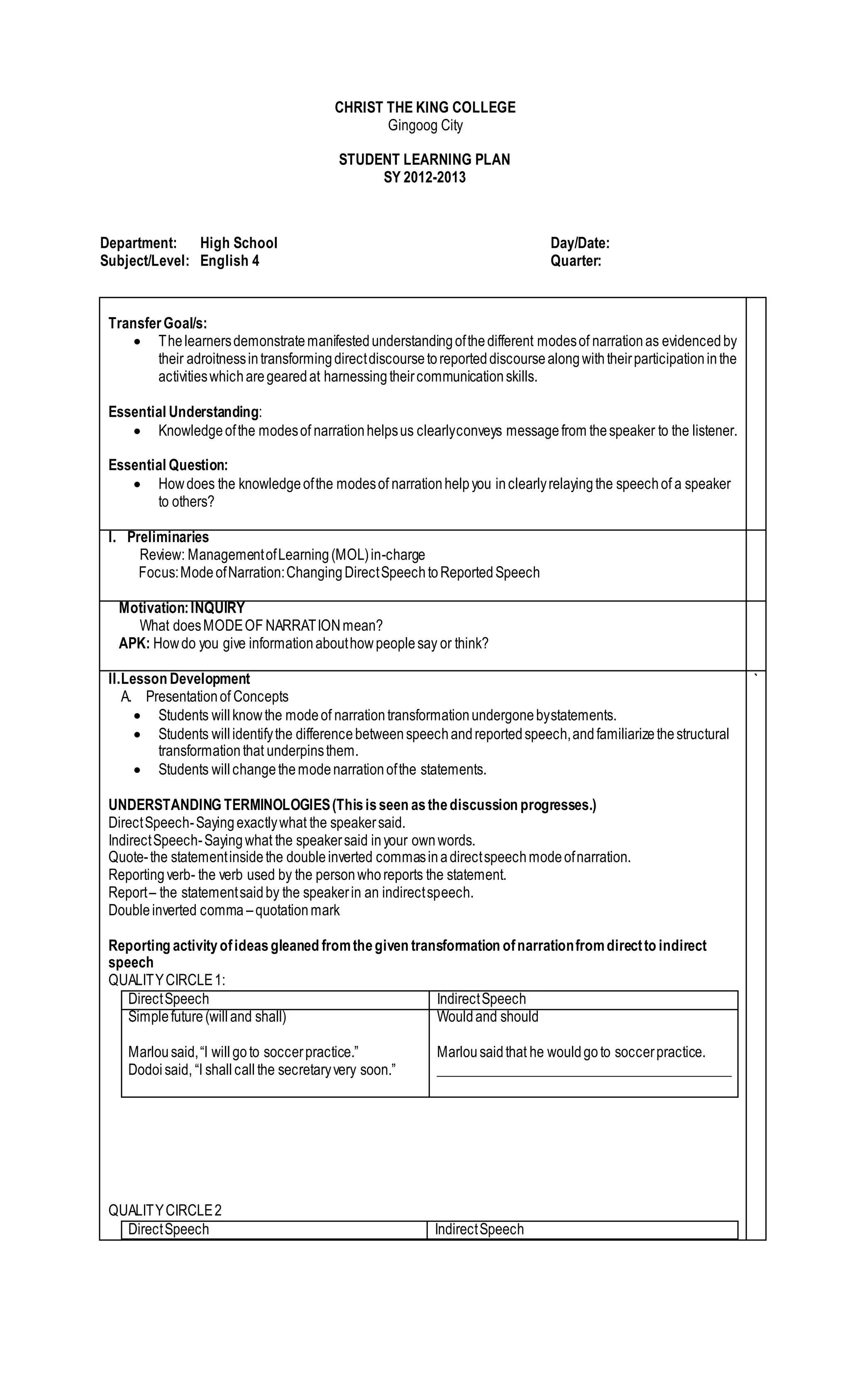
CHRIST THE KING COLLEGE
Gingoog City
STUDENT LEARNING PLAN
SY 2012-2013
Department: High School Day/Date:
Subject/Level: English 4 Quarter:
TransferGoal/s:
 Thelearnersdemonstratemanifestedunderstandingofthedifferent modesof narrationas evidencedby
their adroitnessintransformingdirectdiscoursetoreporteddiscoursealongwiththeirparticipationinthe
activitieswhicharegearedat harnessingtheircommunicationskills.
Essential Understanding:
 Knowledgeofthe modesof narrationhelpsus clearlyconveys messagefrom thespeaker to the listener.
Essential Question:
 Howdoes the knowledgeofthe modesof narrationhelpyou inclearlyrelayingthe speechof a speaker
to others?
I. Preliminaries
Review: ManagementofLearning(MOL)in-charge
Focus:ModeofNarration:ChangingDirectSpeechtoReportedSpeech
Motivation:INQUIRY
What doesMODEOF NARRATIONmean?
APK: Howdo you give informationabouthowpeoplesay or think?
II.Lesson Development
A. Presentationof Concepts
 Students willknowthe modeof narrationtransformationundergonebystatements.
 Students willidentifythe differencebetweenspeechandreportedspeech,andfamiliarizethestructural
transformationthat underpinsthem.
 Students willchangethemodenarrationofthe statements.
UNDERSTANDING TERMINOLOGIES(Thisisseen asthediscussion progresses.)
DirectSpeech-Sayingexactlywhat the speakersaid.
IndirectSpeech-Sayingwhat the speakersaid inyour ownwords.
Quote-the statementinsidethe doubleinverted commasinadirectspeechmodeofnarration.
Reportingverb- the verb used by the personwhoreports the statement.
Report– the statementsaidby the speakerin an indirectspeech.
Doubleinverted comma –quotationmark
Reporting activityofideasgleaned fromthegiven transformation ofnarrationfromdirectto indirect
speech
QUALITYCIRCLE1:
DirectSpeech IndirectSpeech
Simplefuture(willand shall)
Marlousaid,“I willgoto soccerpractice.”
Dodoisaid, “I shallcallthe secretaryvery soon.”
Wouldand should
Marlousaidthat he wouldgoto soccerpractice.
__________________________________________
QUALITYCIRCLE2
DirectSpeech IndirectSpeech
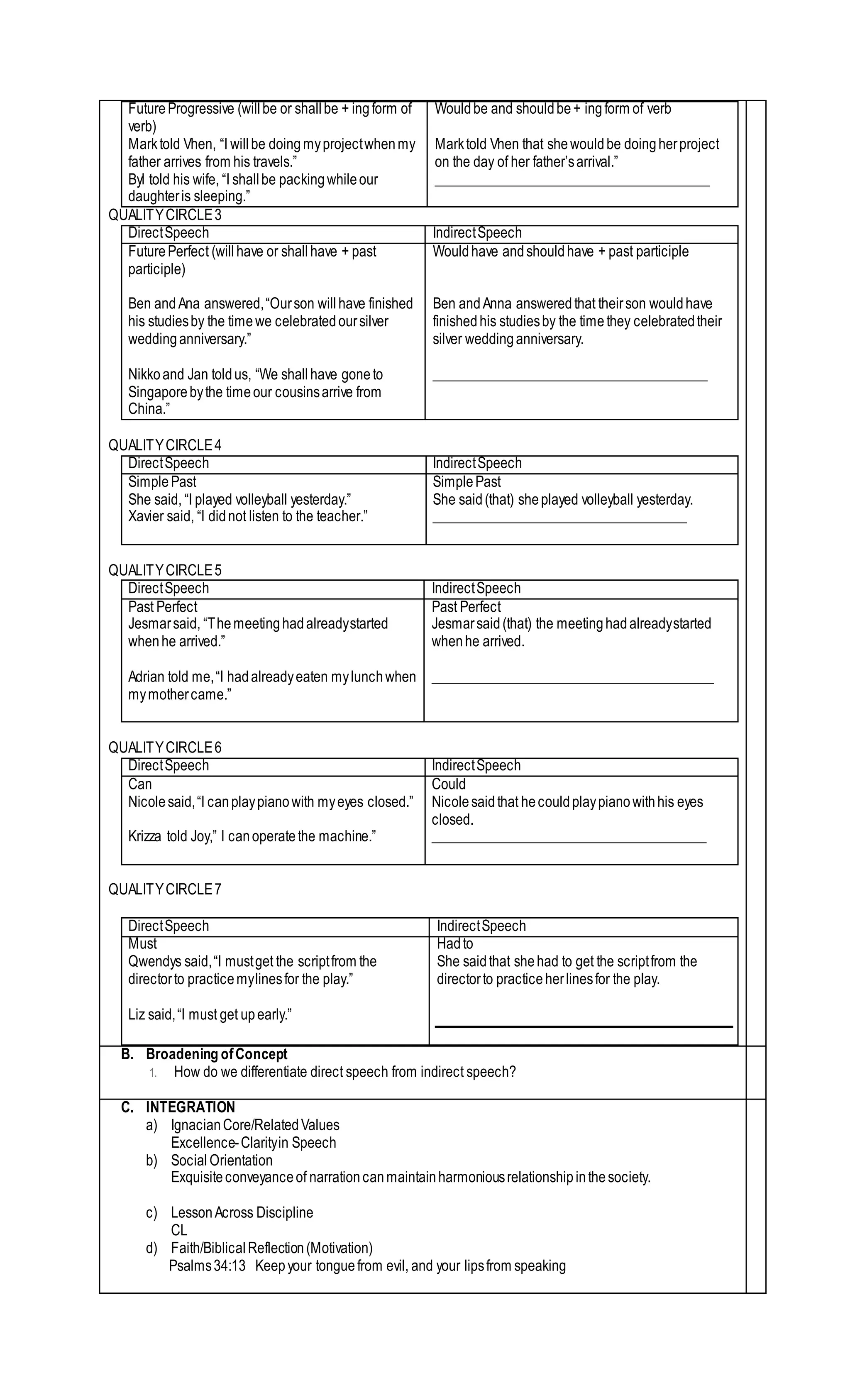
`
FutureProgressive (willbe or shallbe + ingform of
verb)
Marktold Vhen, “I willbe doingmyprojectwhenmy
father arrives from his travels.”
Byl told his wife, “I shallbe packingwhileour
daughteris sleeping.”
Wouldbe and shouldbe+ ingform of verb
Marktold Vhen that shewouldbe doingherproject
on the day of her father’sarrival.”
_______________________________________
QUALITYCIRCLE3
DirectSpeech IndirectSpeech
FuturePerfect (willhave or shallhave + past
participle)
Ben andAna answered,“Ourson willhave finished
his studiesby the timewe celebratedoursilver
weddinganniversary.”
Nikkoand Jan toldus, “We shallhave goneto
Singaporebythe timeour cousinsarrive from
China.”
Wouldhave andshouldhave + past participle
Ben andAnna answeredthat theirson wouldhave
finishedhis studiesby the timethey celebratedtheir
silver weddinganniversary.
_______________________________________
QUALITYCIRCLE4
DirectSpeech IndirectSpeech
SimplePast
She said, “I played volleyball yesterday.”
Xavier said, “I didnot listen to the teacher.”
SimplePast
She said(that) sheplayed volleyball yesterday.
____________________________________
QUALITYCIRCLE5
DirectSpeech IndirectSpeech
Past Perfect
Jesmarsaid, “Themeetinghadalreadystarted
whenhe arrived.”
Adrian told me,“I hadalreadyeaten mylunchwhen
mymothercame.”
Past Perfect
Jesmarsaid(that) the meetinghadalreadystarted
whenhe arrived.
________________________________________
QUALITYCIRCLE6
DirectSpeech IndirectSpeech
Can
Nicolesaid,“I canplaypianowith myeyes closed.”
Krizza told Joy,” I canoperatethe machine.”
Could
Nicolesaidthat hecouldplaypianowithhis eyes
closed.
_______________________________________
QUALITYCIRCLE7
DirectSpeech IndirectSpeech
Must
Qwendys said,“I mustget the scriptfrom the
directorto practicemylinesfor the play.”
Liz said,“I must get upearly.”
Hadto
She saidthat shehad to get the scriptfrom the
directorto practiceherlinesfor the play.
B. Broadening ofConcept
1. How do we differentiate direct speech from indirect speech?
C. INTEGRATION
a) IgnacianCore/RelatedValues
Excellence-Clarityin Speech
b) SocialOrientation
Exquisiteconveyanceof narrationcanmaintainharmoniousrelationshipinthesociety.
c) LessonAcross Discipline
CL
d) Faith/Biblical Reflection(Motivation)
Psalms34:13 Keepyour tonguefrom evil, and your lipsfrom speaking
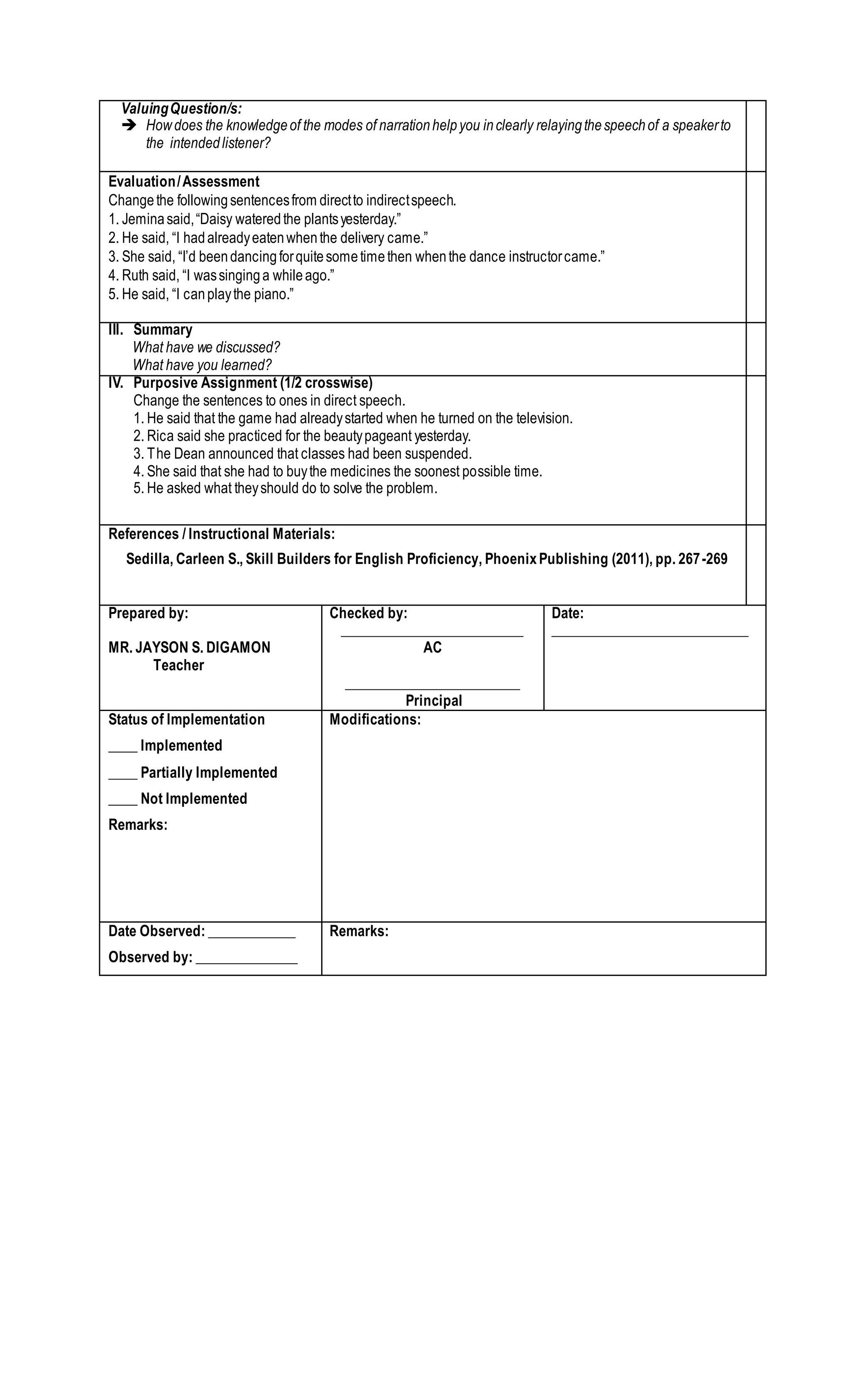
ValuingQuestion/s:
 Howdoes the knowledgeof the modes of narrationhelpyou inclearly relayingthespeechof a speakerto
the intendedlistener?
Evaluation/Assessment
Changethe followingsentencesfrom directto indirectspeech.
1. Jeminasaid,“Daisy wateredthe plantsyesterday.”
2. He said, “I hadalreadyeatenwhenthe delivery came.”
3. She said, “I’d beendancingforquitesometimethen whenthe dance instructorcame.”
4. Ruth said, “I wassinginga whileago.”
5. He said, “I canplaythe piano.”
III. Summary
What have we discussed?
What have you learned?
IV. Purposive Assignment (1/2 crosswise)
Change the sentences to ones in direct speech.
1. He said that the game had alreadystarted when he turned on the television.
2. Rica said she practiced for the beautypageant yesterday.
3. The Dean announced that classes had been suspended.
4. She said that she had to buythe medicines the soonest possible time.
5. He asked what theyshould do to solve the problem.
References / Instructional Materials:
Sedilla, Carleen S., Skill Builders for English Proficiency, PhoenixPublishing (2011), pp. 267-269
Prepared by:
MR. JAYSON S. DIGAMON
Teacher
Checked by:
_________________________
AC
________________________
Principal
Date:
___________________________
Status of Implementation
____ Implemented
____ Partially Implemented
____ Not Implemented
Remarks:
Modifications:
Date Observed: ____________
Observed by: ______________
Remarks:

Lesson plan on reported and direct speech

  • 1.
    CHRIST THE KINGCOLLEGE Gingoog City STUDENT LEARNING PLAN SY 2012-2013 Department: High School Day/Date: Subject/Level: English 4 Quarter: TransferGoal/s:  Thelearnersdemonstratemanifestedunderstandingofthedifferent modesof narrationas evidencedby their adroitnessintransformingdirectdiscoursetoreporteddiscoursealongwiththeirparticipationinthe activitieswhicharegearedat harnessingtheircommunicationskills. Essential Understanding:  Knowledgeofthe modesof narrationhelpsus clearlyconveys messagefrom thespeaker to the listener. Essential Question:  Howdoes the knowledgeofthe modesof narrationhelpyou inclearlyrelayingthe speechof a speaker to others? I. Preliminaries Review: ManagementofLearning(MOL)in-charge Focus:ModeofNarration:ChangingDirectSpeechtoReportedSpeech Motivation:INQUIRY What doesMODEOF NARRATIONmean? APK: Howdo you give informationabouthowpeoplesay or think? II.Lesson Development A. Presentationof Concepts  Students willknowthe modeof narrationtransformationundergonebystatements.  Students willidentifythe differencebetweenspeechandreportedspeech,andfamiliarizethestructural transformationthat underpinsthem.  Students willchangethemodenarrationofthe statements. UNDERSTANDING TERMINOLOGIES(Thisisseen asthediscussion progresses.) DirectSpeech-Sayingexactlywhat the speakersaid. IndirectSpeech-Sayingwhat the speakersaid inyour ownwords. Quote-the statementinsidethe doubleinverted commasinadirectspeechmodeofnarration. Reportingverb- the verb used by the personwhoreports the statement. Report– the statementsaidby the speakerin an indirectspeech. Doubleinverted comma –quotationmark Reporting activityofideasgleaned fromthegiven transformation ofnarrationfromdirectto indirect speech QUALITYCIRCLE1: DirectSpeech IndirectSpeech Simplefuture(willand shall) Marlousaid,“I willgoto soccerpractice.” Dodoisaid, “I shallcallthe secretaryvery soon.” Wouldand should Marlousaidthat he wouldgoto soccerpractice. __________________________________________ QUALITYCIRCLE2 DirectSpeech IndirectSpeech `
  • 2.
    FutureProgressive (willbe orshallbe + ingform of verb) Marktold Vhen, “I willbe doingmyprojectwhenmy father arrives from his travels.” Byl told his wife, “I shallbe packingwhileour daughteris sleeping.” Wouldbe and shouldbe+ ingform of verb Marktold Vhen that shewouldbe doingherproject on the day of her father’sarrival.” _______________________________________ QUALITYCIRCLE3 DirectSpeech IndirectSpeech FuturePerfect (willhave or shallhave + past participle) Ben andAna answered,“Ourson willhave finished his studiesby the timewe celebratedoursilver weddinganniversary.” Nikkoand Jan toldus, “We shallhave goneto Singaporebythe timeour cousinsarrive from China.” Wouldhave andshouldhave + past participle Ben andAnna answeredthat theirson wouldhave finishedhis studiesby the timethey celebratedtheir silver weddinganniversary. _______________________________________ QUALITYCIRCLE4 DirectSpeech IndirectSpeech SimplePast She said, “I played volleyball yesterday.” Xavier said, “I didnot listen to the teacher.” SimplePast She said(that) sheplayed volleyball yesterday. ____________________________________ QUALITYCIRCLE5 DirectSpeech IndirectSpeech Past Perfect Jesmarsaid, “Themeetinghadalreadystarted whenhe arrived.” Adrian told me,“I hadalreadyeaten mylunchwhen mymothercame.” Past Perfect Jesmarsaid(that) the meetinghadalreadystarted whenhe arrived. ________________________________________ QUALITYCIRCLE6 DirectSpeech IndirectSpeech Can Nicolesaid,“I canplaypianowith myeyes closed.” Krizza told Joy,” I canoperatethe machine.” Could Nicolesaidthat hecouldplaypianowithhis eyes closed. _______________________________________ QUALITYCIRCLE7 DirectSpeech IndirectSpeech Must Qwendys said,“I mustget the scriptfrom the directorto practicemylinesfor the play.” Liz said,“I must get upearly.” Hadto She saidthat shehad to get the scriptfrom the directorto practiceherlinesfor the play. B. Broadening ofConcept 1. How do we differentiate direct speech from indirect speech? C. INTEGRATION a) IgnacianCore/RelatedValues Excellence-Clarityin Speech b) SocialOrientation Exquisiteconveyanceof narrationcanmaintainharmoniousrelationshipinthesociety. c) LessonAcross Discipline CL d) Faith/Biblical Reflection(Motivation) Psalms34:13 Keepyour tonguefrom evil, and your lipsfrom speaking
  • 3.
    ValuingQuestion/s:  Howdoes theknowledgeof the modes of narrationhelpyou inclearly relayingthespeechof a speakerto the intendedlistener? Evaluation/Assessment Changethe followingsentencesfrom directto indirectspeech. 1. Jeminasaid,“Daisy wateredthe plantsyesterday.” 2. He said, “I hadalreadyeatenwhenthe delivery came.” 3. She said, “I’d beendancingforquitesometimethen whenthe dance instructorcame.” 4. Ruth said, “I wassinginga whileago.” 5. He said, “I canplaythe piano.” III. Summary What have we discussed? What have you learned? IV. Purposive Assignment (1/2 crosswise) Change the sentences to ones in direct speech. 1. He said that the game had alreadystarted when he turned on the television. 2. Rica said she practiced for the beautypageant yesterday. 3. The Dean announced that classes had been suspended. 4. She said that she had to buythe medicines the soonest possible time. 5. He asked what theyshould do to solve the problem. References / Instructional Materials: Sedilla, Carleen S., Skill Builders for English Proficiency, PhoenixPublishing (2011), pp. 267-269 Prepared by: MR. JAYSON S. DIGAMON Teacher Checked by: _________________________ AC ________________________ Principal Date: ___________________________ Status of Implementation ____ Implemented ____ Partially Implemented ____ Not Implemented Remarks: Modifications: Date Observed: ____________ Observed by: ______________ Remarks: