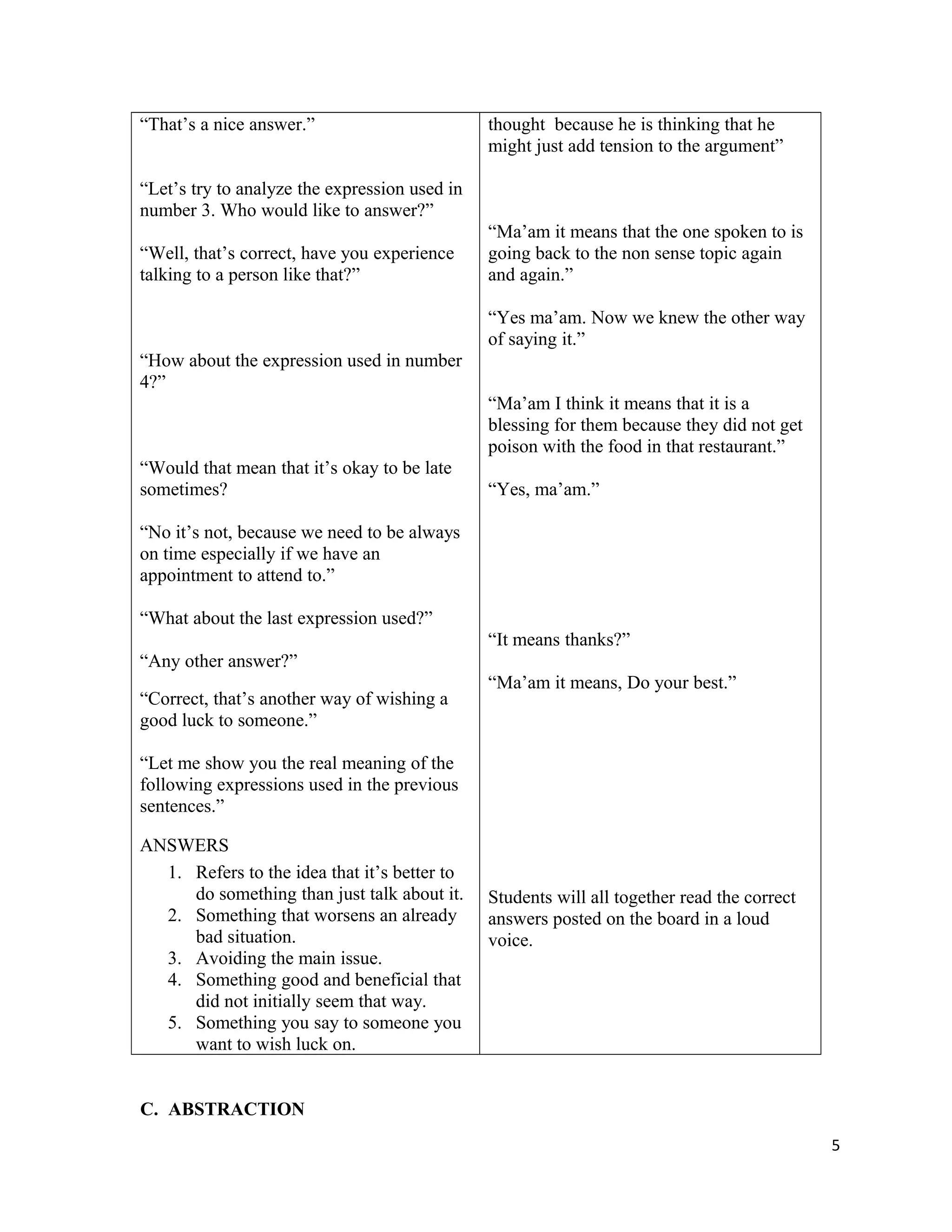
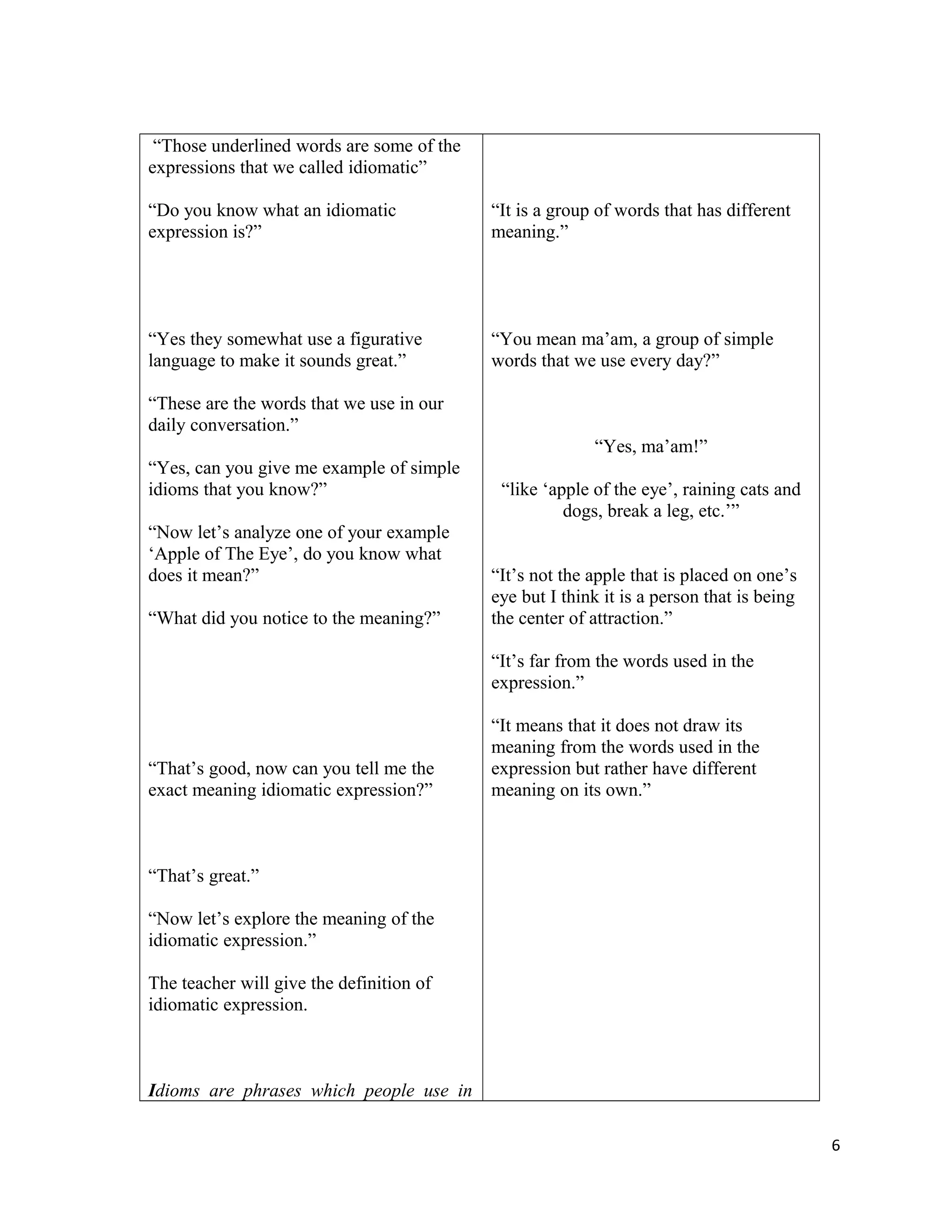
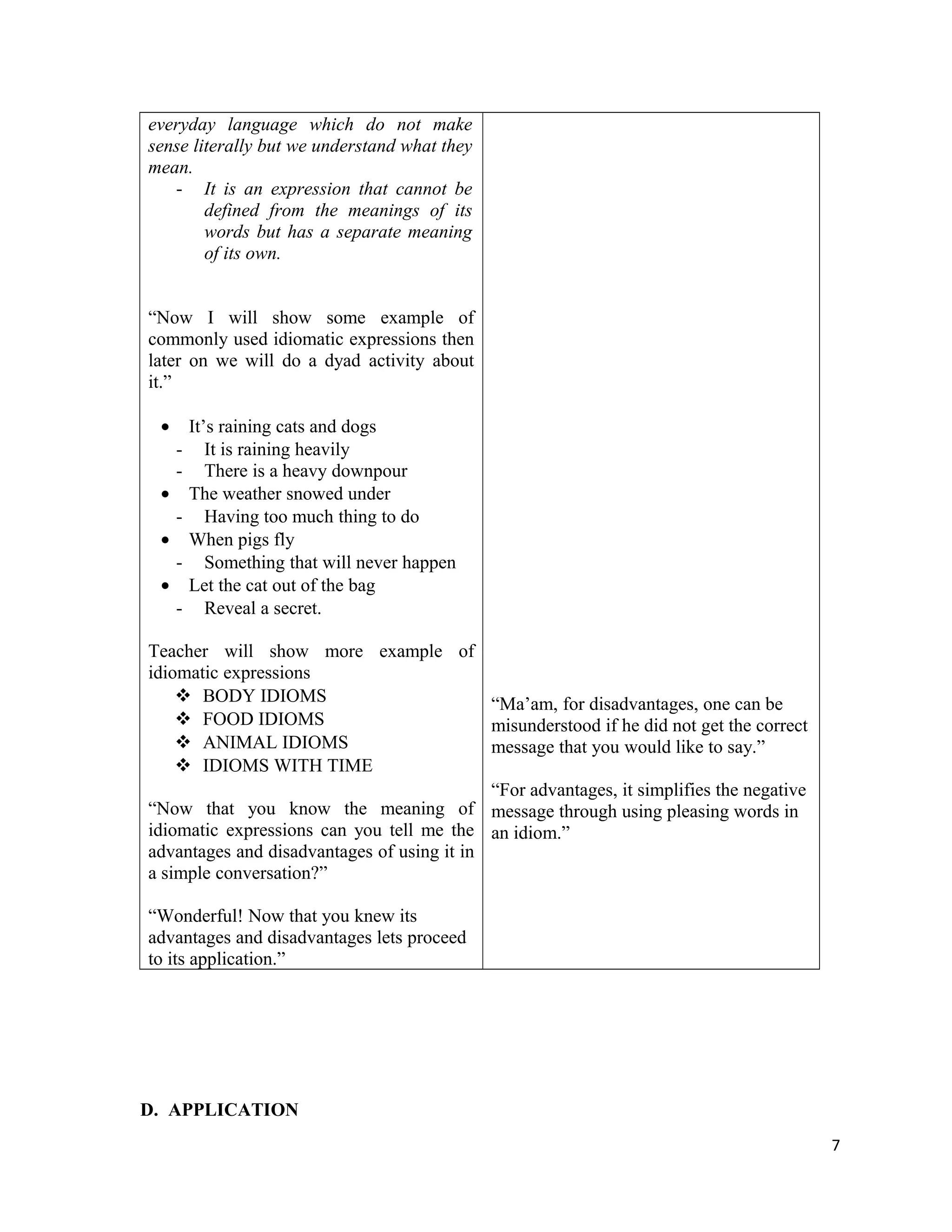
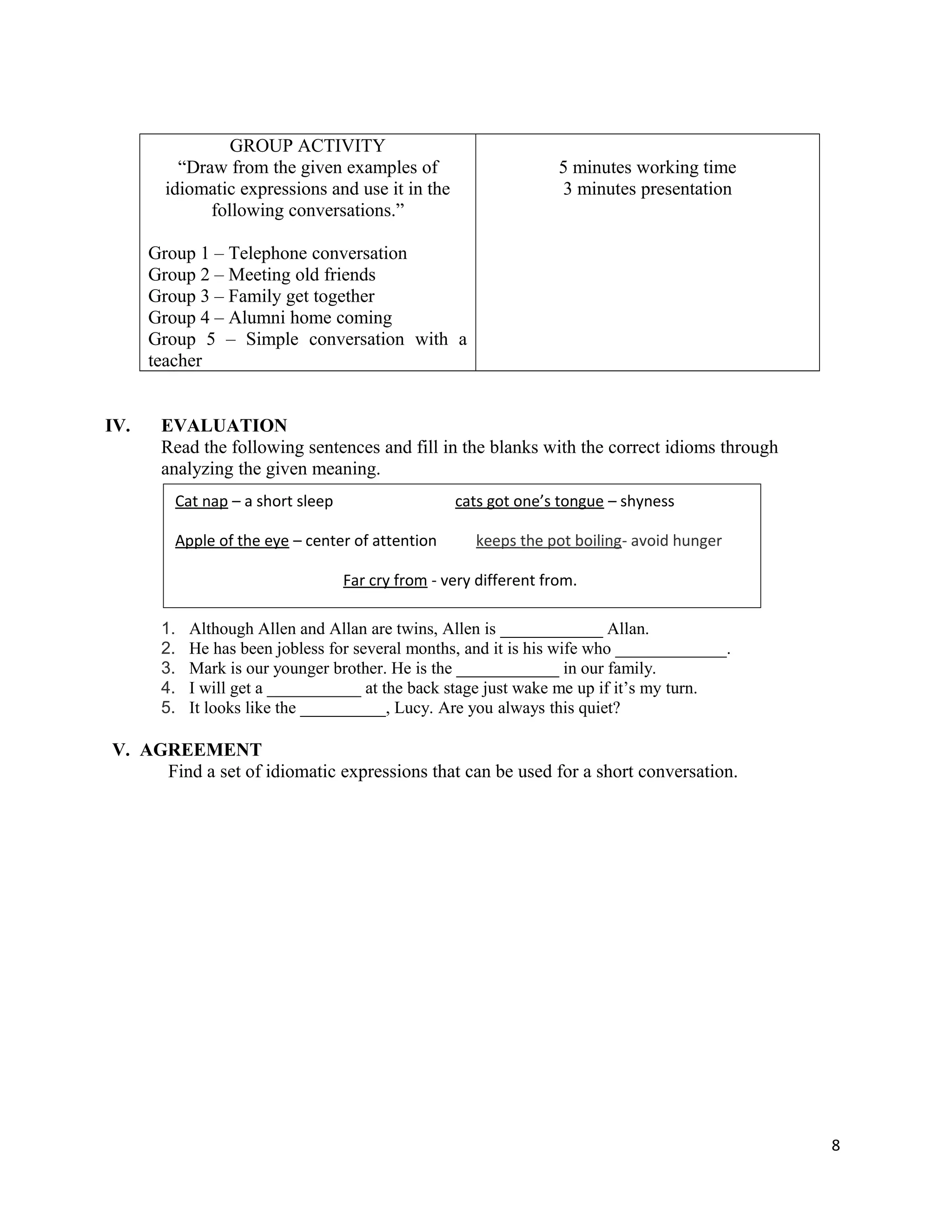
DETAILED LESSON PLAN
(IDIOMATIC EXPRESSIONS)
I. OBJECTIVES
1. Identify appropriate meaning of idiomatic expressions
2. Familiarize with commonly used idiomatic expressions
3. Use idiomatic expressions correctly
II. SUBJECT MATTER
A. Topic: Idiomatic Expression
B. Reference: English: Meaning, Forms And Functions
By: Alfonso D. Perez
www.google.com (for images)
C. Materials: Visual Aids
D. Values: Self reliance and Creativity in using idioms
III. PROCEDURE
A. Learning Activities
1
Teacher’s Activity
“Good Morning, Class…”
“Let us pray first…”
(Checking of Attendance)
…say present…
“Please pick up the pieces of paper under your
chair.”
“So, how was your week ends?”
“That’s good! Have you enjoyed your weekend
bonding with your family?”
Student’s Activity
“Good Good morning, Ma’am!”
(One student will lead the prayer)
(Students raise their hand and say
present as the teacher calls their
name)
(Students pick up the pieces of paper)
“It was great, ma’am!”
“Of course, Ma’am. It was a lot of
fun!”
A. ACTIVITY
2
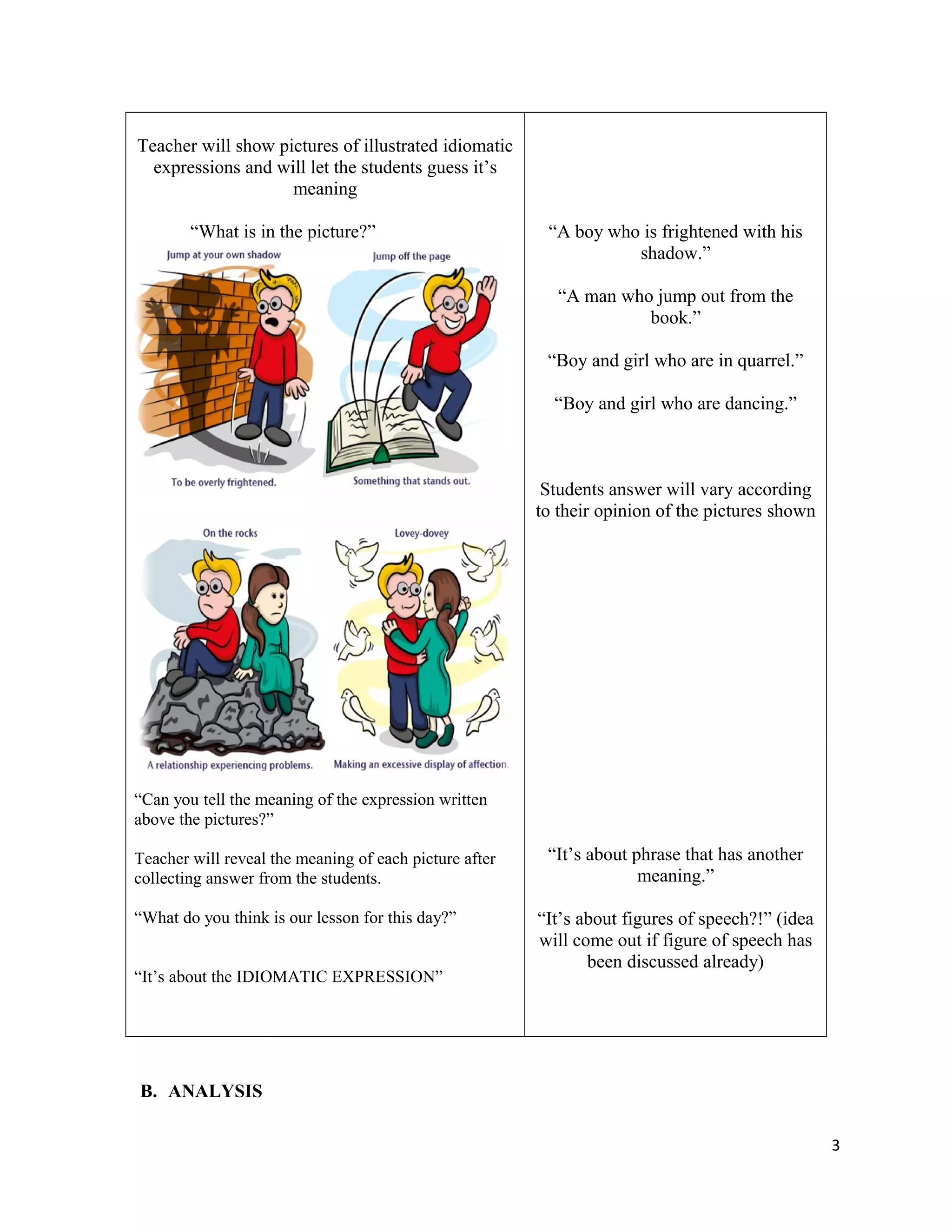
Teacher will show pictures of illustrated idiomatic
expressions and will let the students guess it’s
meaning
“What is in the picture?”
“Can you tell the meaning of the expression written
above the pictures?”
Teacher will reveal the meaning of each picture after
collecting answer from the students.
“What do you think is our lesson for this day?”
“It’s about the IDIOMATIC EXPRESSION”
“A boy who is frightened with his
shadow.”
“A man who jump out from the
book.”
“Boy and girl who are in quarrel.”
“Boy and girl who are dancing.”
Students answer will vary according
to their opinion of the pictures shown
“It’s about phrase that has another
meaning.”
“It’s about figures of speech?!” (idea
will come out if figure of speech has
been discussed already)
B. ANALYSIS
3
Teacher will show sentences with idiomatic
expression.
“Now I would like you to read and analyze
the following sentences."
1. He tells his girlfriend that he loves
her, but he never actually does
anything nice for her. Someone
should teach him that actions speak
louder than words.
2. I wanted to intervene when they
were yelling at each other, but that
would have just added fuel to the
fire.
3. I kept trying to steer the
conversation back to his alibi, but he
wouldn’t stop beating around the
bush, bringing up things totally off-
topic.
4. It was raining so hard that our cab
was late, and we were late to our
reservation at the restaurant. Turns
out everyone who ate there that
night got food poisoning. I guess the
bad weather was a blessing in
disguise!
5. Is tonight your big performance?
Break a leg!
“What do you mean by the underlined
expressions in each sentence?”
“That’s right!”
“What about in sentence number 2?”
“He tells his girlfriend that he loves her,
but he never actually does anything nice
for her. Someone should teach him that
actions speak louder than words.”
“I wanted to intervene when they were
yelling at each other, but that would have
just added fuel to the fire.”
“I kept trying to steer the conversation
back to his alibi, but he wouldn’t stop
beating around the bush, bringing up
things totally off-topic.”
“It was raining so hard that our cab was
late, and we were late to our reservation at
the restaurant. Turns out everyone who ate
there that night got food poisoning. I guess
the bad weather was a blessing in
disguise!”
“Is tonight your big performance? Break a
leg!”
(Students will read the following sentence)
“In sentence number 1 the underlined
expression means that the action can make
her girlfriend feel that he truly loves her
more than just saying it.”
“It means that the speaker is having second
4
“That’s a nice answer.”
“Let’s try to analyze the expression used in
number 3. Who would like to answer?”
“Well, that’s correct, have you experience
talking to a person like that?”
“How about the expression used in number
4?”
“Would that mean that it’s okay to be late
sometimes?
“No it’s not, because we need to be always
on time especially if we have an
appointment to attend to.”
“What about the last expression used?”
“Any other answer?”
“Correct, that’s another way of wishing a
good luck to someone.”
“Let me show you the real meaning of the
following expressions used in the previous
sentences.”
ANSWERS
1. Refers to the idea that it’s better to
do something than just talk about it.
2. Something that worsens an already
bad situation.
3. Avoiding the main issue.
4. Something good and beneficial that
did not initially seem that way.
5. Something you say to someone you
want to wish luck on.
thought because he is thinking that he
might just add tension to the argument”
“Ma’am it means that the one spoken to is
going back to the non sense topic again
and again.”
“Yes ma’am. Now we knew the other way
of saying it.”
“Ma’am I think it means that it is a
blessing for them because they did not get
poison with the food in that restaurant.”
“Yes, ma’am.”
“It means thanks?”
“Ma’am it means, Do your best.”
Students will all together read the correct
answers posted on the board in a loud
voice.
C. ABSTRACTION
5
“Those underlined words are some of the
expressions that we called idiomatic”
“Do you know what an idiomatic
expression is?”
“Yes they somewhat use a figurative
language to make it sounds great.”
“These are the words that we use in our
daily conversation.”
“Yes, can you give me example of simple
idioms that you know?”
“Now let’s analyze one of your example
‘Apple of The Eye’, do you know what
does it mean?”
“What did you notice to the meaning?”
“That’s good, now can you tell me the
exact meaning idiomatic expression?”
“That’s great.”
“Now let’s explore the meaning of the
idiomatic expression.”
The teacher will give the definition of
idiomatic expression.
Idioms are phrases which people use in
“It is a group of words that has different
meaning.”
“You mean ma’am, a group of simple
words that we use every day?”
“Yes, ma’am!”
“like ‘apple of the eye’, raining cats and
dogs, break a leg, etc.’”
“It’s not the apple that is placed on one’s
eye but I think it is a person that is being
the center of attraction.”
“It’s far from the words used in the
expression.”
“It means that it does not draw its
meaning from the words used in the
expression but rather have different
meaning on its own.”
6
everyday language which do not make
sense literally but we understand what they
mean.
- It is an expression that cannot be
defined from the meanings of its
words but has a separate meaning
of its own.
“Now I will show some example of
commonly used idiomatic expressions then
later on we will do a dyad activity about
it.”
• It’s raining cats and dogs
- It is raining heavily
- There is a heavy downpour
• The weather snowed under
- Having too much thing to do
• When pigs fly
- Something that will never happen
• Let the cat out of the bag
- Reveal a secret.
Teacher will show more example of
idiomatic expressions
 BODY IDIOMS
 FOOD IDIOMS
 ANIMAL IDIOMS
 IDIOMS WITH TIME
“Now that you know the meaning of
idiomatic expressions can you tell me the
advantages and disadvantages of using it in
a simple conversation?”
“Wonderful! Now that you knew its
advantages and disadvantages lets proceed
to its application.”
“Ma’am, for disadvantages, one can be
misunderstood if he did not get the correct
message that you would like to say.”
“For advantages, it simplifies the negative
message through using pleasing words in
an idiom.”
D. APPLICATION
7
GROUP ACTIVITY
“Draw from the given examples of
idiomatic expressions and use it in the
following conversations.”
Group 1 – Telephone conversation
Group 2 – Meeting old friends
Group 3 – Family get together
Group 4 – Alumni home coming
Group 5 – Simple conversation with a
teacher
5 minutes working time
3 minutes presentation
IV. EVALUATION
Read the following sentences and fill in the blanks with the correct idioms through
analyzing the given meaning.
1. Although Allen and Allan are twins, Allen is ____________ Allan.
2. He has been jobless for several months, and it is his wife who _____________.
3. Mark is our younger brother. He is the ____________ in our family.
4. I will get a ___________ at the back stage just wake me up if it’s my turn.
5. It looks like the __________, Lucy. Are you always this quiet?
V. AGREEMENT
Find a set of idiomatic expressions that can be used for a short conversation.
8
Cat nap – a short sleep cats got one’s tongue – shyness
Apple of the eye – center of attention keeps the pot boiling- avoid hunger
Far cry from - very different from.

Lesson plan idiomatic expression by Rosalie Capillo

  • 1.
    DETAILED LESSON PLAN (IDIOMATICEXPRESSIONS) I. OBJECTIVES 1. Identify appropriate meaning of idiomatic expressions 2. Familiarize with commonly used idiomatic expressions 3. Use idiomatic expressions correctly II. SUBJECT MATTER A. Topic: Idiomatic Expression B. Reference: English: Meaning, Forms And Functions By: Alfonso D. Perez www.google.com (for images) C. Materials: Visual Aids D. Values: Self reliance and Creativity in using idioms III. PROCEDURE A. Learning Activities 1
  • 2.
    Teacher’s Activity “Good Morning,Class…” “Let us pray first…” (Checking of Attendance) …say present… “Please pick up the pieces of paper under your chair.” “So, how was your week ends?” “That’s good! Have you enjoyed your weekend bonding with your family?” Student’s Activity “Good Good morning, Ma’am!” (One student will lead the prayer) (Students raise their hand and say present as the teacher calls their name) (Students pick up the pieces of paper) “It was great, ma’am!” “Of course, Ma’am. It was a lot of fun!” A. ACTIVITY 2
  • 3.
    Teacher will showpictures of illustrated idiomatic expressions and will let the students guess it’s meaning “What is in the picture?” “Can you tell the meaning of the expression written above the pictures?” Teacher will reveal the meaning of each picture after collecting answer from the students. “What do you think is our lesson for this day?” “It’s about the IDIOMATIC EXPRESSION” “A boy who is frightened with his shadow.” “A man who jump out from the book.” “Boy and girl who are in quarrel.” “Boy and girl who are dancing.” Students answer will vary according to their opinion of the pictures shown “It’s about phrase that has another meaning.” “It’s about figures of speech?!” (idea will come out if figure of speech has been discussed already) B. ANALYSIS 3
  • 4.
    Teacher will showsentences with idiomatic expression. “Now I would like you to read and analyze the following sentences." 1. He tells his girlfriend that he loves her, but he never actually does anything nice for her. Someone should teach him that actions speak louder than words. 2. I wanted to intervene when they were yelling at each other, but that would have just added fuel to the fire. 3. I kept trying to steer the conversation back to his alibi, but he wouldn’t stop beating around the bush, bringing up things totally off- topic. 4. It was raining so hard that our cab was late, and we were late to our reservation at the restaurant. Turns out everyone who ate there that night got food poisoning. I guess the bad weather was a blessing in disguise! 5. Is tonight your big performance? Break a leg! “What do you mean by the underlined expressions in each sentence?” “That’s right!” “What about in sentence number 2?” “He tells his girlfriend that he loves her, but he never actually does anything nice for her. Someone should teach him that actions speak louder than words.” “I wanted to intervene when they were yelling at each other, but that would have just added fuel to the fire.” “I kept trying to steer the conversation back to his alibi, but he wouldn’t stop beating around the bush, bringing up things totally off-topic.” “It was raining so hard that our cab was late, and we were late to our reservation at the restaurant. Turns out everyone who ate there that night got food poisoning. I guess the bad weather was a blessing in disguise!” “Is tonight your big performance? Break a leg!” (Students will read the following sentence) “In sentence number 1 the underlined expression means that the action can make her girlfriend feel that he truly loves her more than just saying it.” “It means that the speaker is having second 4
  • 5.
    “That’s a niceanswer.” “Let’s try to analyze the expression used in number 3. Who would like to answer?” “Well, that’s correct, have you experience talking to a person like that?” “How about the expression used in number 4?” “Would that mean that it’s okay to be late sometimes? “No it’s not, because we need to be always on time especially if we have an appointment to attend to.” “What about the last expression used?” “Any other answer?” “Correct, that’s another way of wishing a good luck to someone.” “Let me show you the real meaning of the following expressions used in the previous sentences.” ANSWERS 1. Refers to the idea that it’s better to do something than just talk about it. 2. Something that worsens an already bad situation. 3. Avoiding the main issue. 4. Something good and beneficial that did not initially seem that way. 5. Something you say to someone you want to wish luck on. thought because he is thinking that he might just add tension to the argument” “Ma’am it means that the one spoken to is going back to the non sense topic again and again.” “Yes ma’am. Now we knew the other way of saying it.” “Ma’am I think it means that it is a blessing for them because they did not get poison with the food in that restaurant.” “Yes, ma’am.” “It means thanks?” “Ma’am it means, Do your best.” Students will all together read the correct answers posted on the board in a loud voice. C. ABSTRACTION 5
  • 6.
    “Those underlined wordsare some of the expressions that we called idiomatic” “Do you know what an idiomatic expression is?” “Yes they somewhat use a figurative language to make it sounds great.” “These are the words that we use in our daily conversation.” “Yes, can you give me example of simple idioms that you know?” “Now let’s analyze one of your example ‘Apple of The Eye’, do you know what does it mean?” “What did you notice to the meaning?” “That’s good, now can you tell me the exact meaning idiomatic expression?” “That’s great.” “Now let’s explore the meaning of the idiomatic expression.” The teacher will give the definition of idiomatic expression. Idioms are phrases which people use in “It is a group of words that has different meaning.” “You mean ma’am, a group of simple words that we use every day?” “Yes, ma’am!” “like ‘apple of the eye’, raining cats and dogs, break a leg, etc.’” “It’s not the apple that is placed on one’s eye but I think it is a person that is being the center of attraction.” “It’s far from the words used in the expression.” “It means that it does not draw its meaning from the words used in the expression but rather have different meaning on its own.” 6
  • 7.
    everyday language whichdo not make sense literally but we understand what they mean. - It is an expression that cannot be defined from the meanings of its words but has a separate meaning of its own. “Now I will show some example of commonly used idiomatic expressions then later on we will do a dyad activity about it.” • It’s raining cats and dogs - It is raining heavily - There is a heavy downpour • The weather snowed under - Having too much thing to do • When pigs fly - Something that will never happen • Let the cat out of the bag - Reveal a secret. Teacher will show more example of idiomatic expressions  BODY IDIOMS  FOOD IDIOMS  ANIMAL IDIOMS  IDIOMS WITH TIME “Now that you know the meaning of idiomatic expressions can you tell me the advantages and disadvantages of using it in a simple conversation?” “Wonderful! Now that you knew its advantages and disadvantages lets proceed to its application.” “Ma’am, for disadvantages, one can be misunderstood if he did not get the correct message that you would like to say.” “For advantages, it simplifies the negative message through using pleasing words in an idiom.” D. APPLICATION 7
  • 8.
    GROUP ACTIVITY “Draw fromthe given examples of idiomatic expressions and use it in the following conversations.” Group 1 – Telephone conversation Group 2 – Meeting old friends Group 3 – Family get together Group 4 – Alumni home coming Group 5 – Simple conversation with a teacher 5 minutes working time 3 minutes presentation IV. EVALUATION Read the following sentences and fill in the blanks with the correct idioms through analyzing the given meaning. 1. Although Allen and Allan are twins, Allen is ____________ Allan. 2. He has been jobless for several months, and it is his wife who _____________. 3. Mark is our younger brother. He is the ____________ in our family. 4. I will get a ___________ at the back stage just wake me up if it’s my turn. 5. It looks like the __________, Lucy. Are you always this quiet? V. AGREEMENT Find a set of idiomatic expressions that can be used for a short conversation. 8 Cat nap – a short sleep cats got one’s tongue – shyness Apple of the eye – center of attention keeps the pot boiling- avoid hunger Far cry from - very different from.