DIRECT AND
REPORTED
SPEECH
OBJECTIVES
▹ Differentiate direct speech from
reported speech;
▹ Use direct and reported speech using
dialog in a given context or situation;
▹ Manifest collaboration and
cooperation in creating an dpresenting
their dialog;
▹ Express opinions in taking care of
their neighborhood.
2
WRITE IT UP!
GROUP ACTIVITY
3
STEPS:
1. Divide into 5 groups, then choose a LEADER,
SCRIBE and REPORTER.
2. Each group will have META CARDS and
Pentel Pens for writing.
3. You will watch a video then answer the
question that will be posted in the video in a
complete sentence
4. Write your answer in your META CARDS and
post them on the board.
4
ARE YOU READY?

5
WHAT’S THE
DIFFERENCE?
What’s the Difference?
7
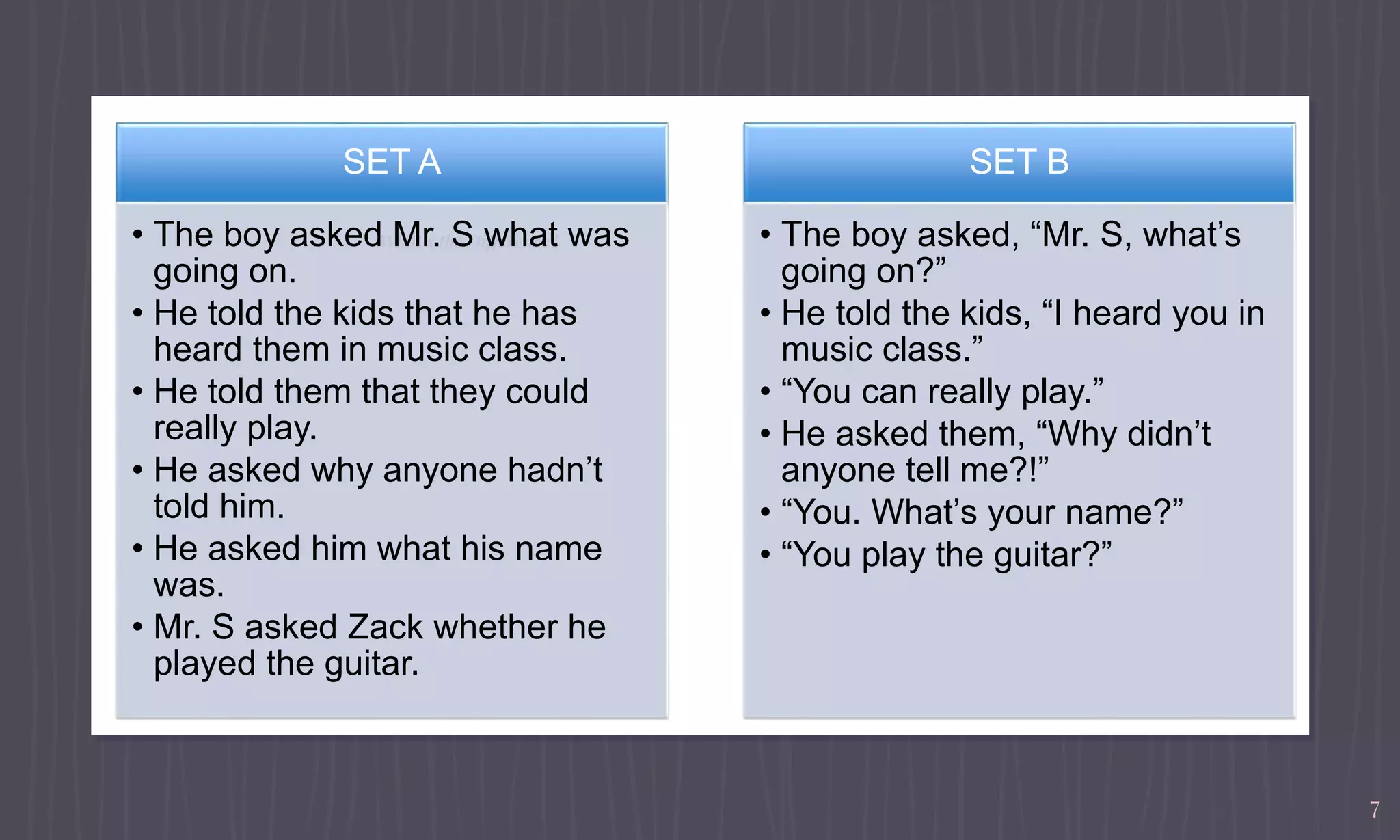
SET A
• The boy asked Mr. S what was
going on.
• He told the kids that he has
heard them in music class.
• He told them that they could
really play.
• He asked why anyone hadn’t
told him.
• He asked him what his name
was.
• Mr. S asked Zack whether he
played the guitar.
SET B
• The boy asked, “Mr. S, what’s
going on?”
• He told the kids, “I heard you in
music class.”
• “You can really play.”
• He asked them, “Why didn’t
anyone tell me?!”
• “You. What’s your name?”
• “You play the guitar?”
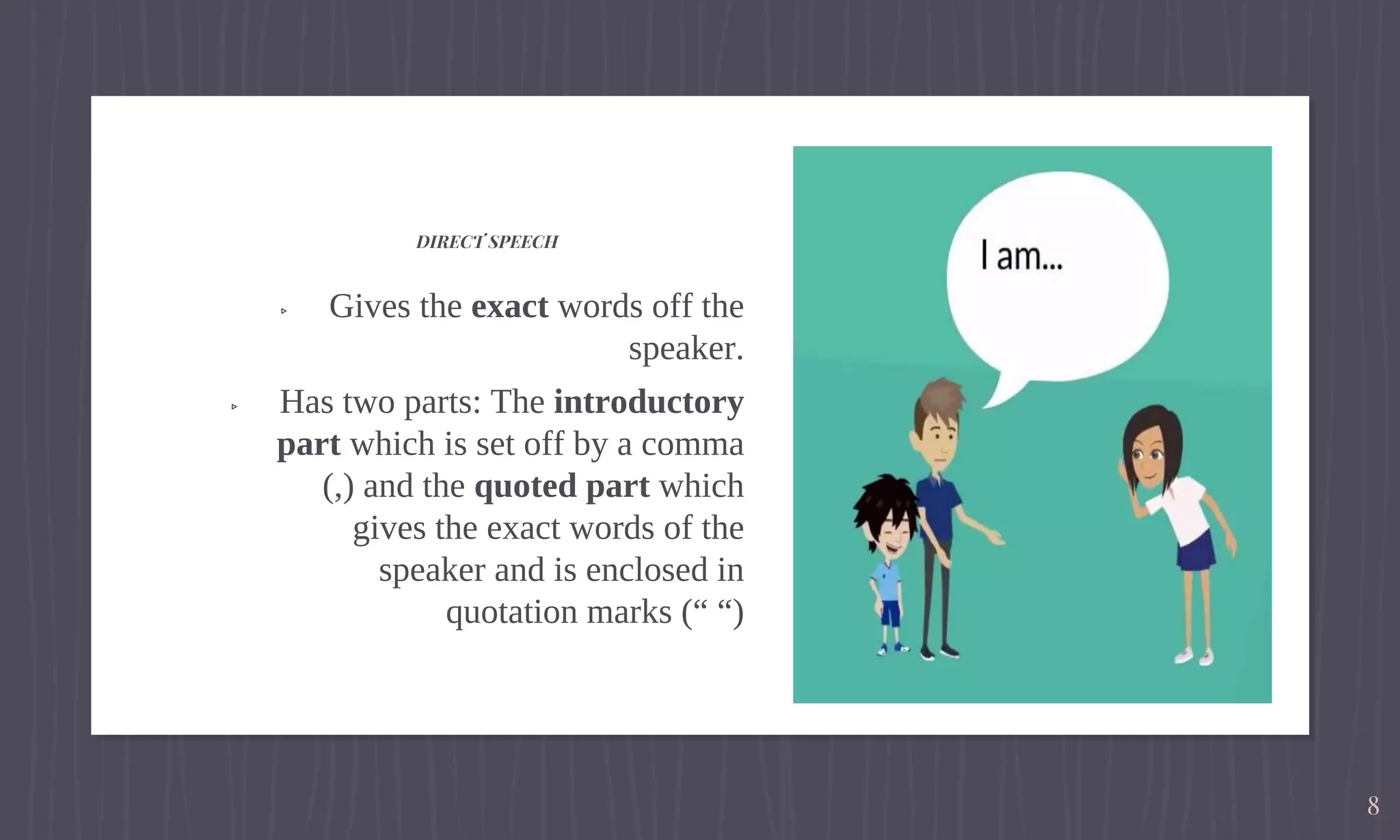
▹ Gives the exact words off the
speaker.
▹ Has two parts: The introductory
part which is set off by a comma
(,) and the quoted part which
gives the exact words of the
speaker and is enclosed in
quotation marks (“ “)
DIRECT SPEECH
8
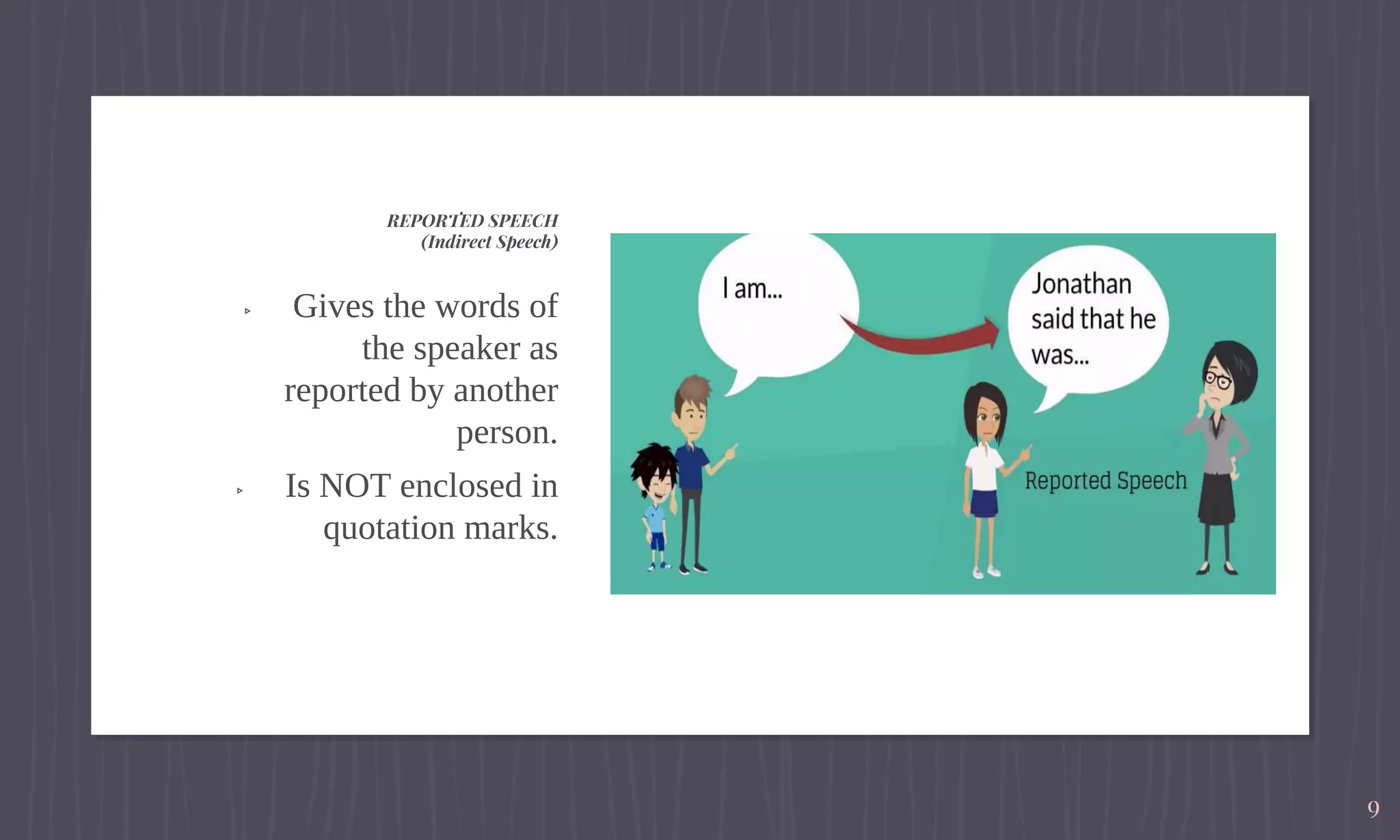
▹ Gives the words of
the speaker as
reported by another
person.
▹ Is NOT enclosed in
quotation marks.
REPORTED SPEECH
(Indirect Speech)
9
LET’S LEARN
MORE!
10
DIALOG
PRESENTATION
STEPS
Question: “How would you help your
neighborhood to make it a better place to
live in?”
1. Brainstorm with your groupmates.
2. Present a short dialog or interview to
answer the question. Use direct or
reported speech in your dialogs.
3. You have 10 minutes to prepare.
12
QUIZ
13
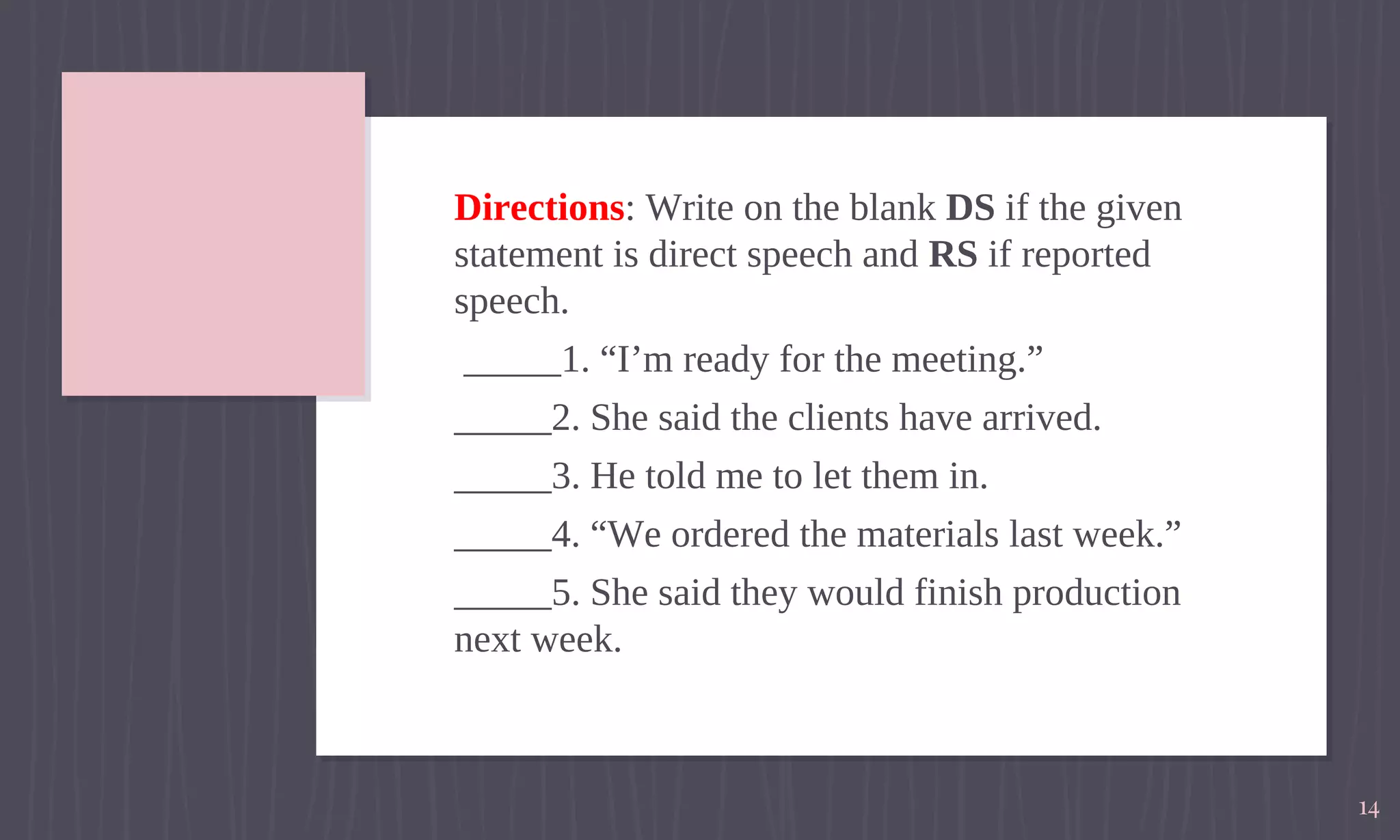
Directions: Write on the blank DS if the given
statement is direct speech and RS if reported
speech.
_____1. “I’m ready for the meeting.”
_____2. She said the clients have arrived.
_____3. He told me to let them in.
_____4. “We ordered the materials last week.”
_____5. She said they would finish production
next week.
14
Directions: Write on the blank DS if the given
statement is direct speech and RS if reported
speech.
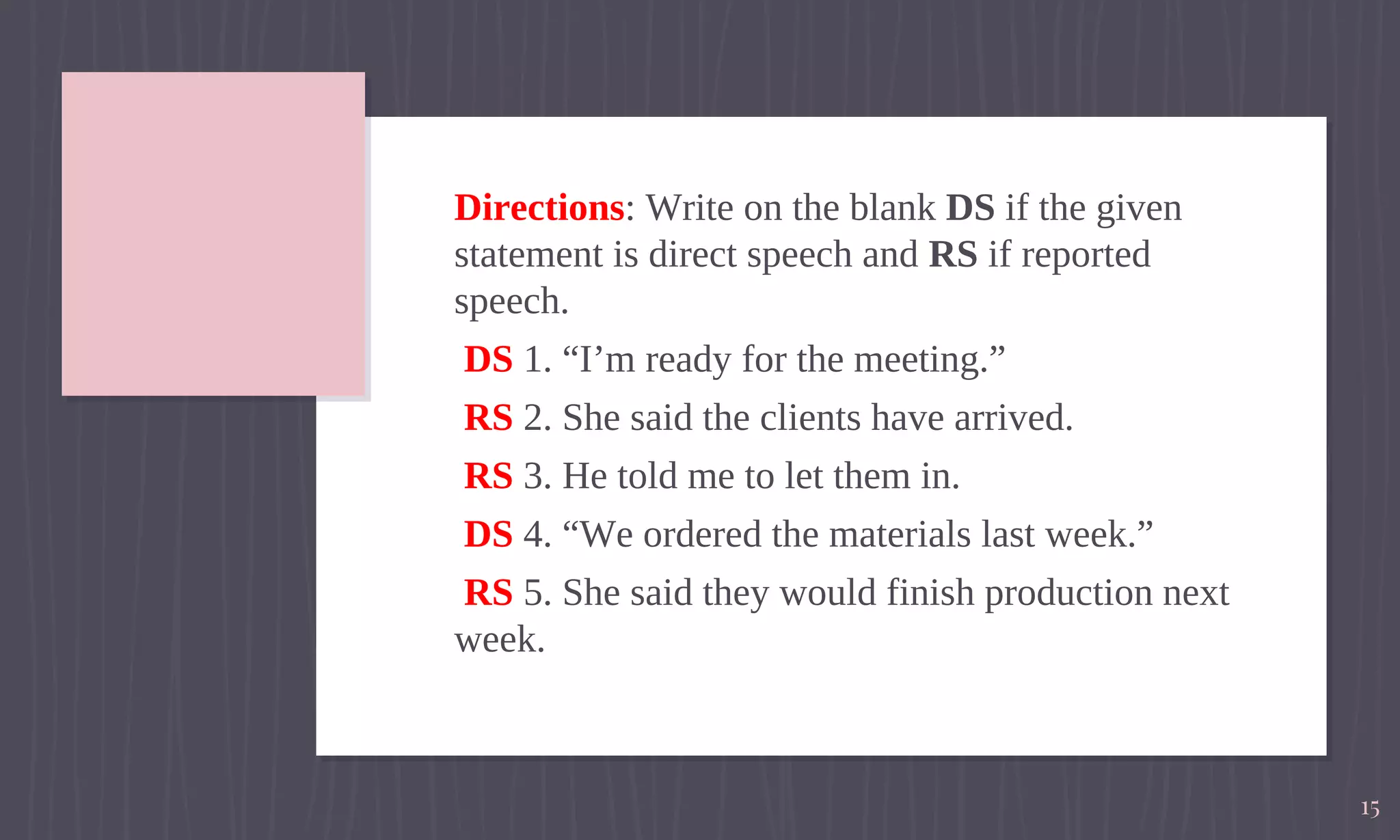
DS 1. “I’m ready for the meeting.”
RS 2. She said the clients have arrived.
RS 3. He told me to let them in.
DS 4. “We ordered the materials last week.”
RS 5. She said they would finish production next
week.
15
REAL WORLD
SCENARIO
INTERVIEW REPORT
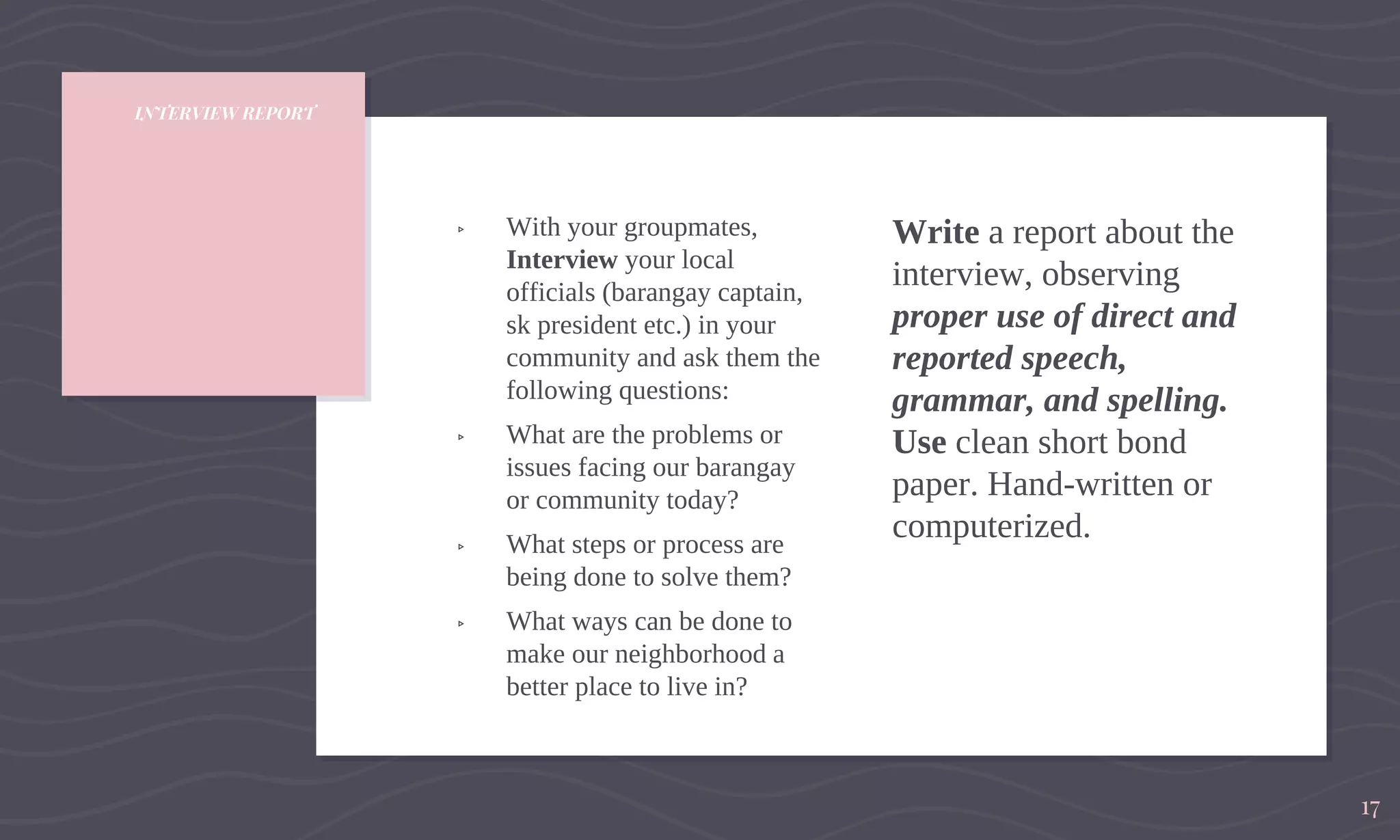
▹ With your groupmates,
Interview your local
officials (barangay captain,
sk president etc.) in your
community and ask them the
following questions:
▹ What are the problems or
issues facing our barangay
or community today?
▹ What steps or process are
being done to solve them?
▹ What ways can be done to
make our neighborhood a
better place to live in?
Write a report about the
interview, observing
proper use of direct and
reported speech,
grammar, and spelling.
Use clean short bond
paper. Hand-written or
computerized.
17
Changing Direct
Speech to
Indirect Speech
(and vice-versa)
RULES
TO
REMEMBER:
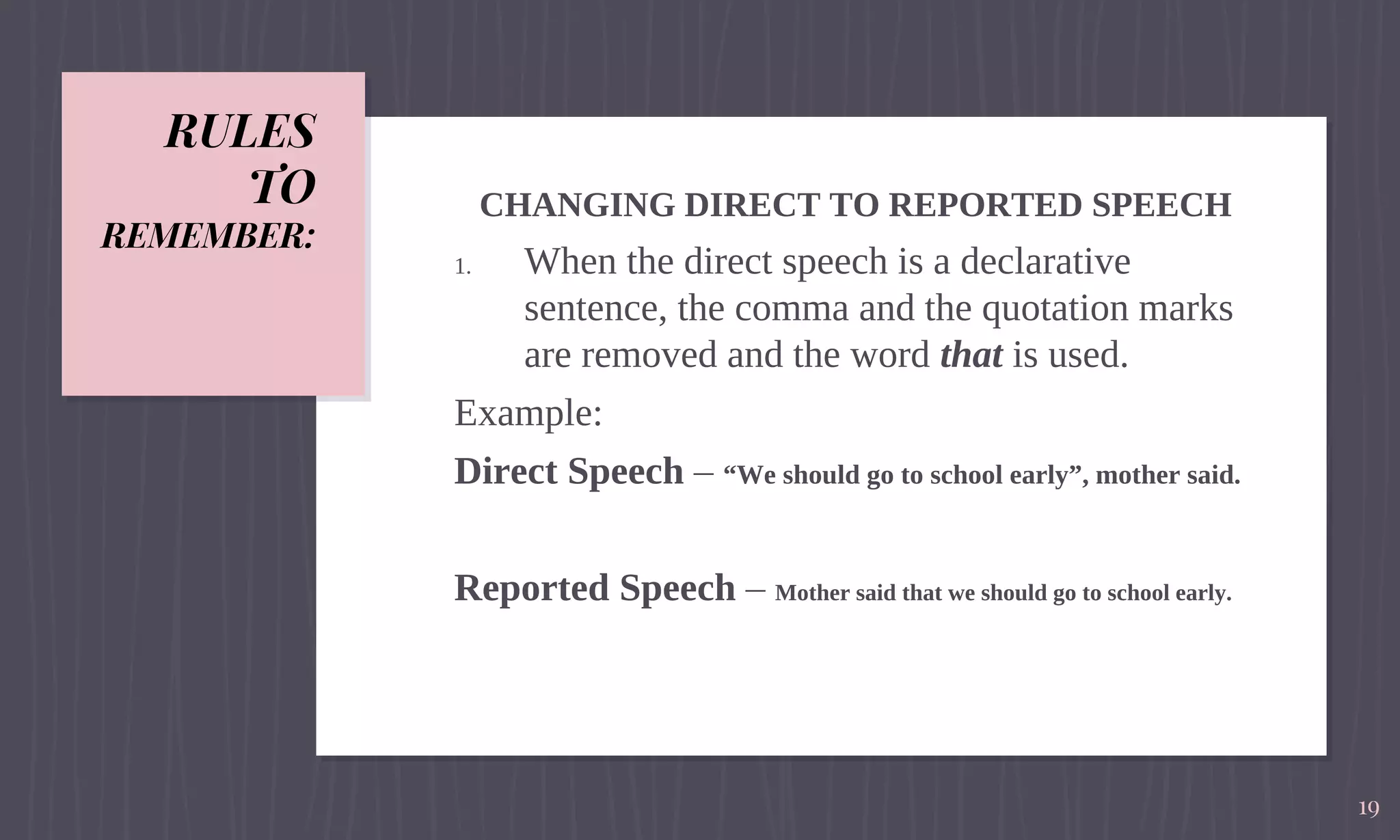
CHANGING DIRECT TO REPORTED SPEECH
1. When the direct speech is a declarative
sentence, the comma and the quotation marks
are removed and the word that is used.
Example:
Direct Speech – “We should go to school early”, mother said.
Reported Speech – Mother said that we should go to school early.
19
RULES
TO
REMEMBER:
CHANGING DIRECT TO REPORTED SPEECH
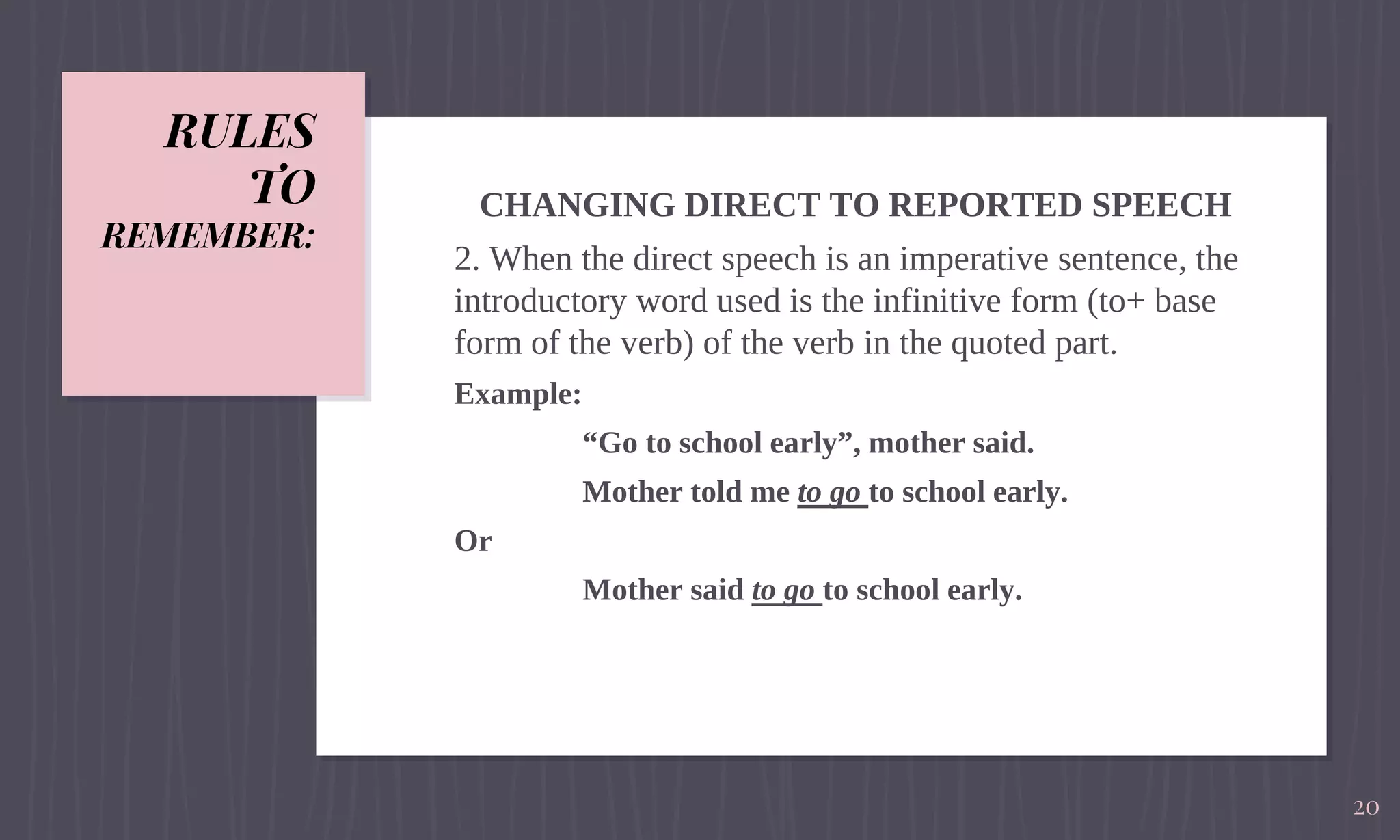
2. When the direct speech is an imperative sentence, the
introductory word used is the infinitive form (to+ base
form of the verb) of the verb in the quoted part.
Example:
“Go to school early”, mother said.
Mother told me to go to school early.
Or
Mother said to go to school early.
20
RULES
TO
REMEMBER:
CHANGING DIRECT TO REPORTED SPEECH
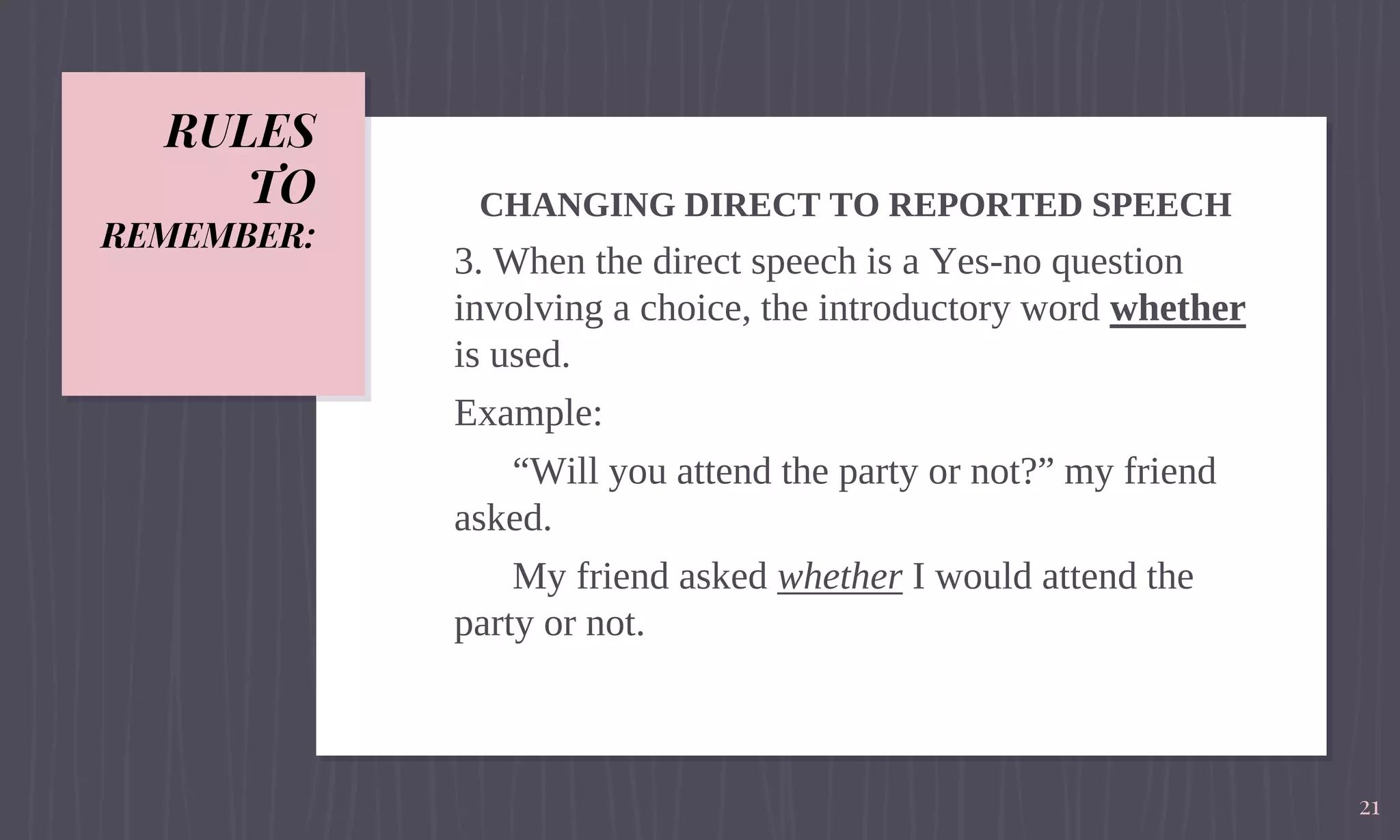
3. When the direct speech is a Yes-no question
involving a choice, the introductory word whether
is used.
Example:
“Will you attend the party or not?” my friend
asked.
My friend asked whether I would attend the
party or not.
21
RULES
TO
REMEMBER:
CHANGING DIRECT TO REPORTED SPEECH
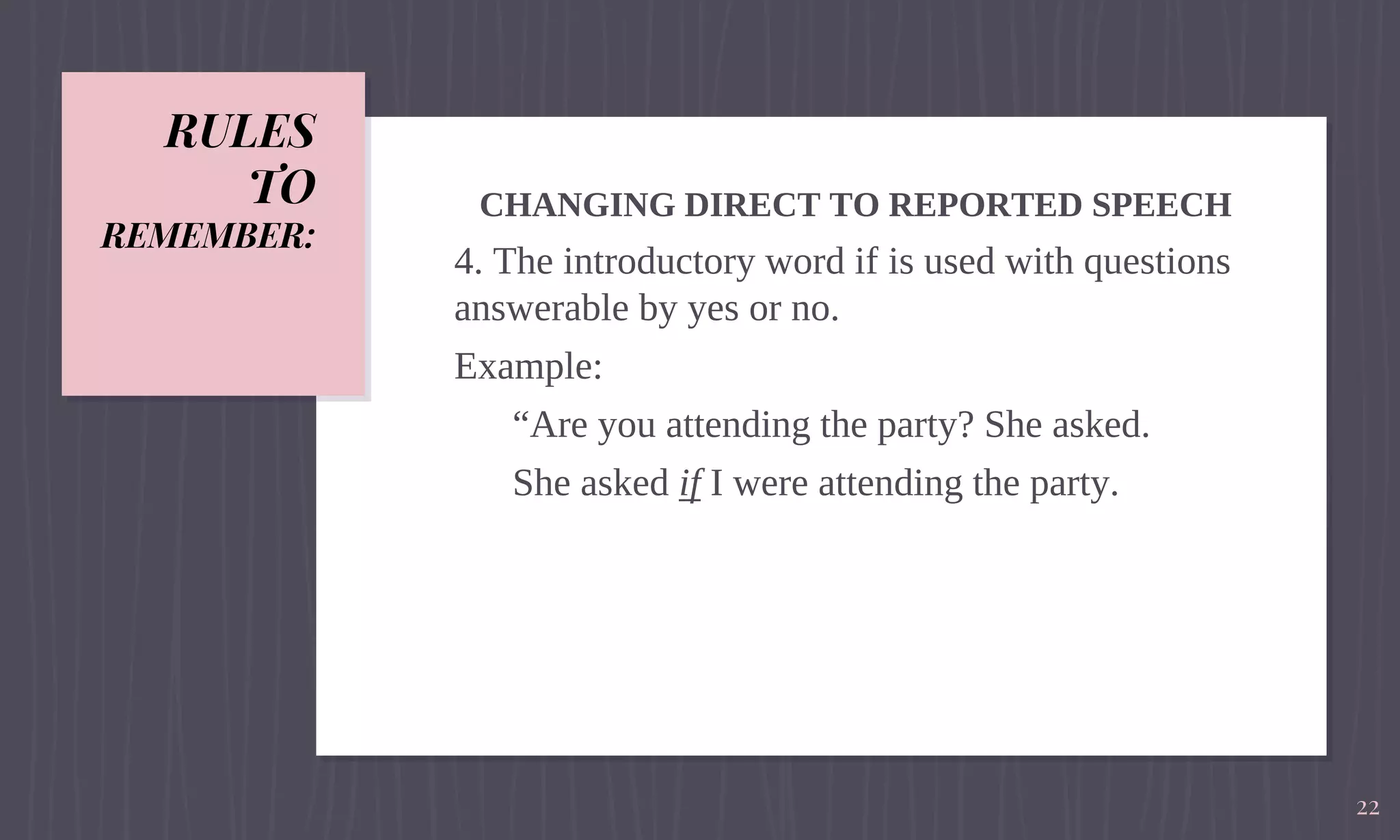
4. The introductory word if is used with questions
answerable by yes or no.
Example:
“Are you attending the party? She asked.
She asked if I were attending the party.
22
RULES
TO
REMEMBER:
CHANGING DIRECT TO REPORTED SPEECH
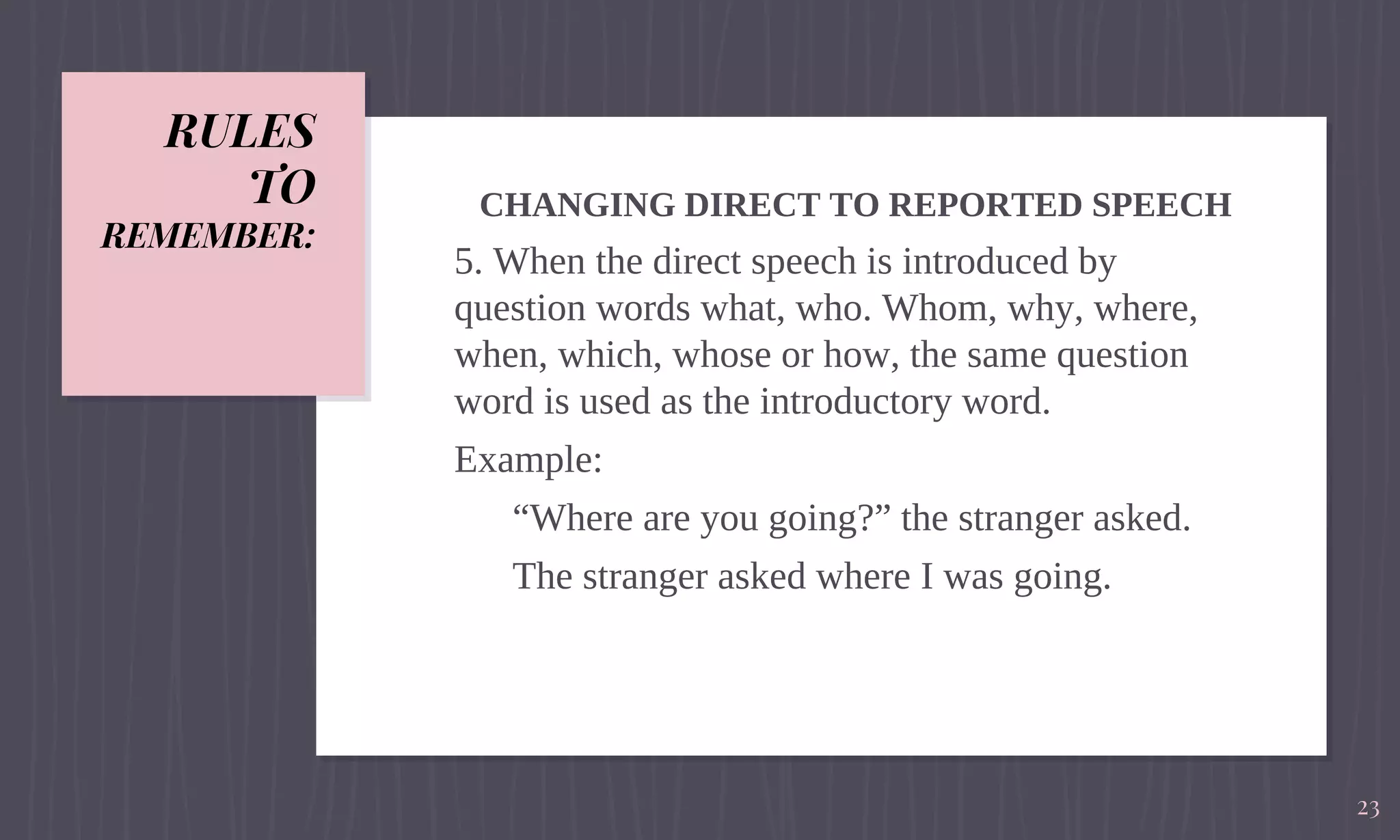
5. When the direct speech is introduced by
question words what, who. Whom, why, where,
when, which, whose or how, the same question
word is used as the introductory word.
Example:
“Where are you going?” the stranger asked.
The stranger asked where I was going.
23
RULES TO
REMEMBER:
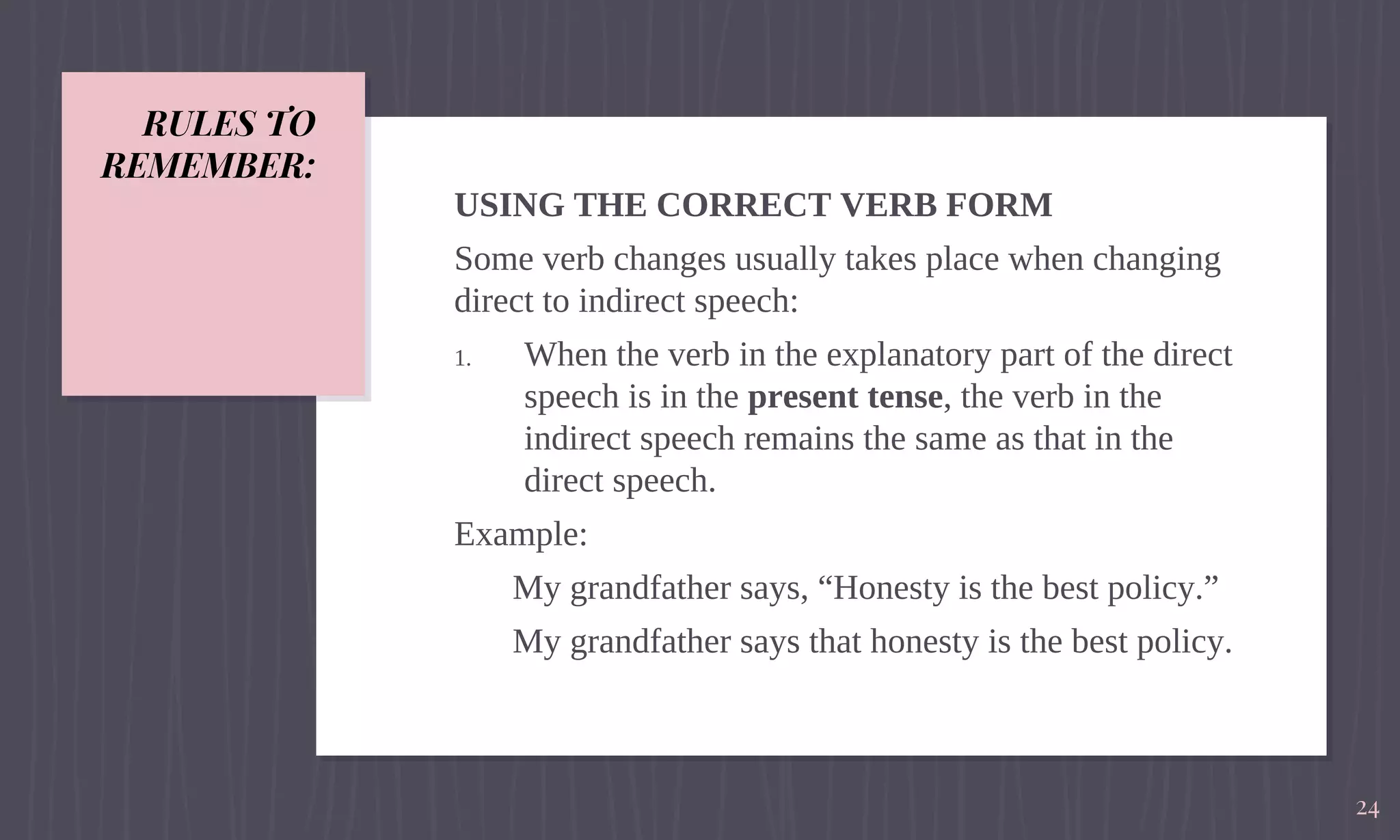
USING THE CORRECT VERB FORM
Some verb changes usually takes place when changing
direct to indirect speech:
1. When the verb in the explanatory part of the direct
speech is in the present tense, the verb in the
indirect speech remains the same as that in the
direct speech.
Example:
My grandfather says, “Honesty is the best policy.”
My grandfather says that honesty is the best policy.
24
RULES TO
REMEMBER:
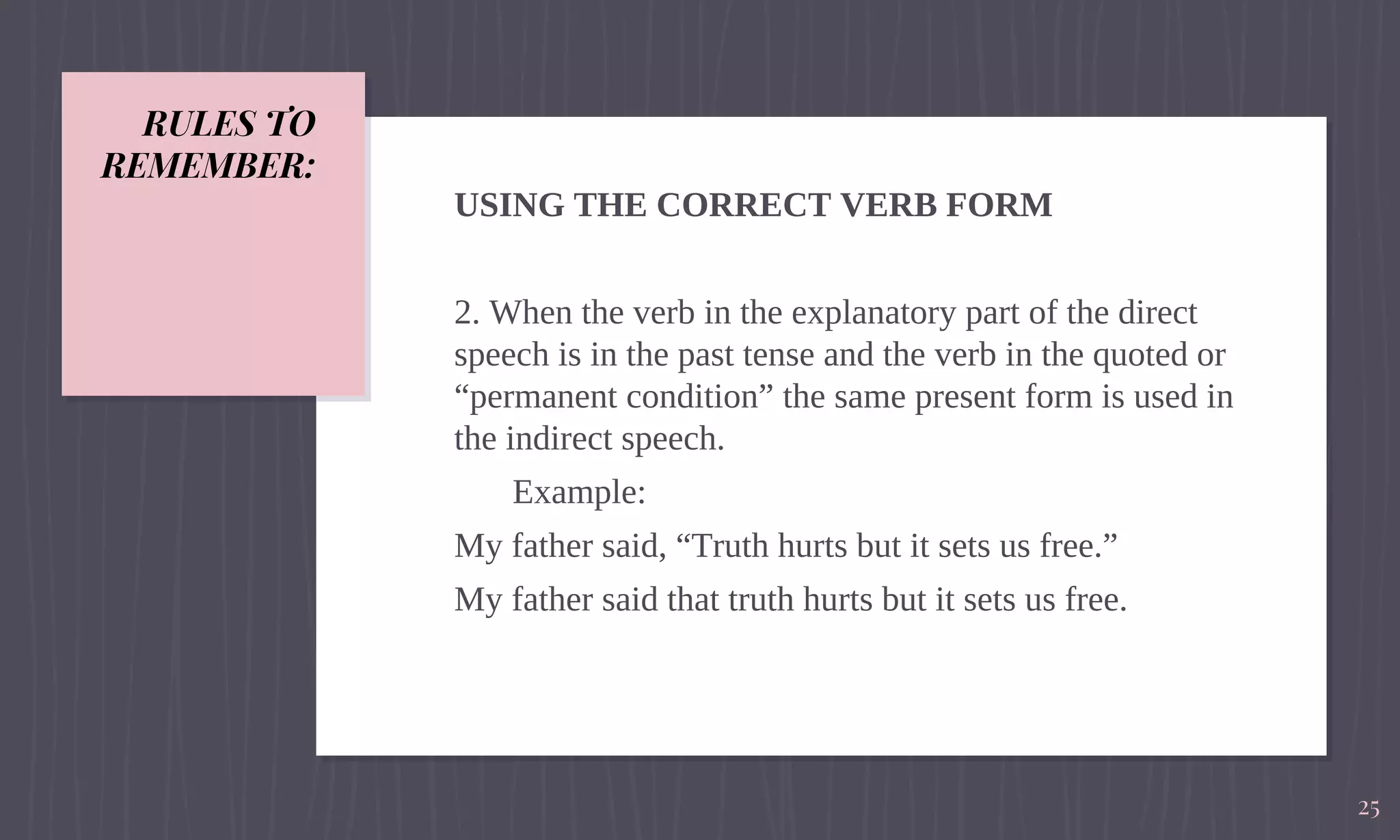
USING THE CORRECT VERB FORM
2. When the verb in the explanatory part of the direct
speech is in the past tense and the verb in the quoted or
“permanent condition” the same present form is used in
the indirect speech.
Example:
My father said, “Truth hurts but it sets us free.”
My father said that truth hurts but it sets us free.
25
RULES TO
REMEMBER:
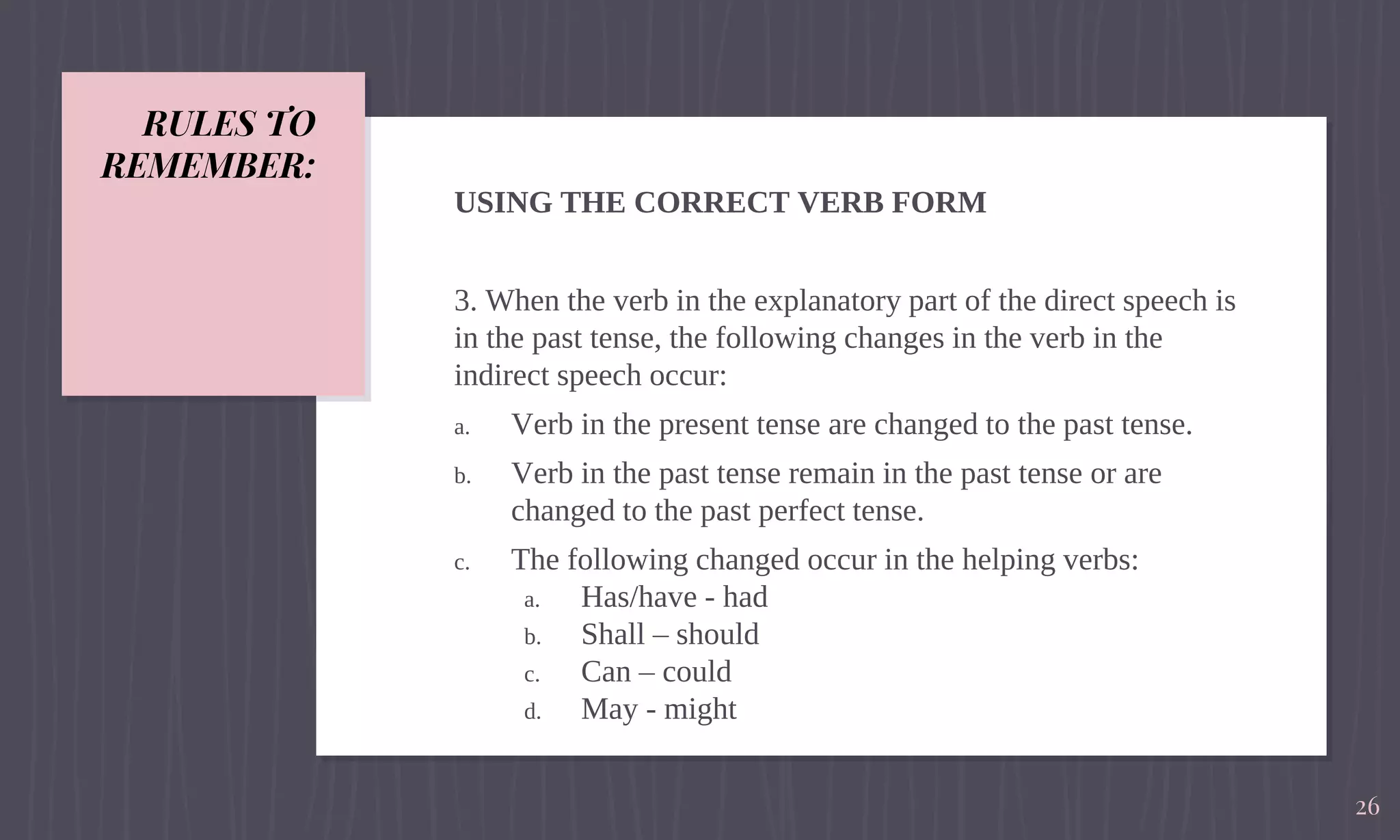
USING THE CORRECT VERB FORM
3. When the verb in the explanatory part of the direct speech is
in the past tense, the following changes in the verb in the
indirect speech occur:
a. Verb in the present tense are changed to the past tense.
b. Verb in the past tense remain in the past tense or are
changed to the past perfect tense.
c. The following changed occur in the helping verbs:
a. Has/have - had
b. Shall – should
c. Can – could
d. May - might
26
RULES TO
REMEMBER:
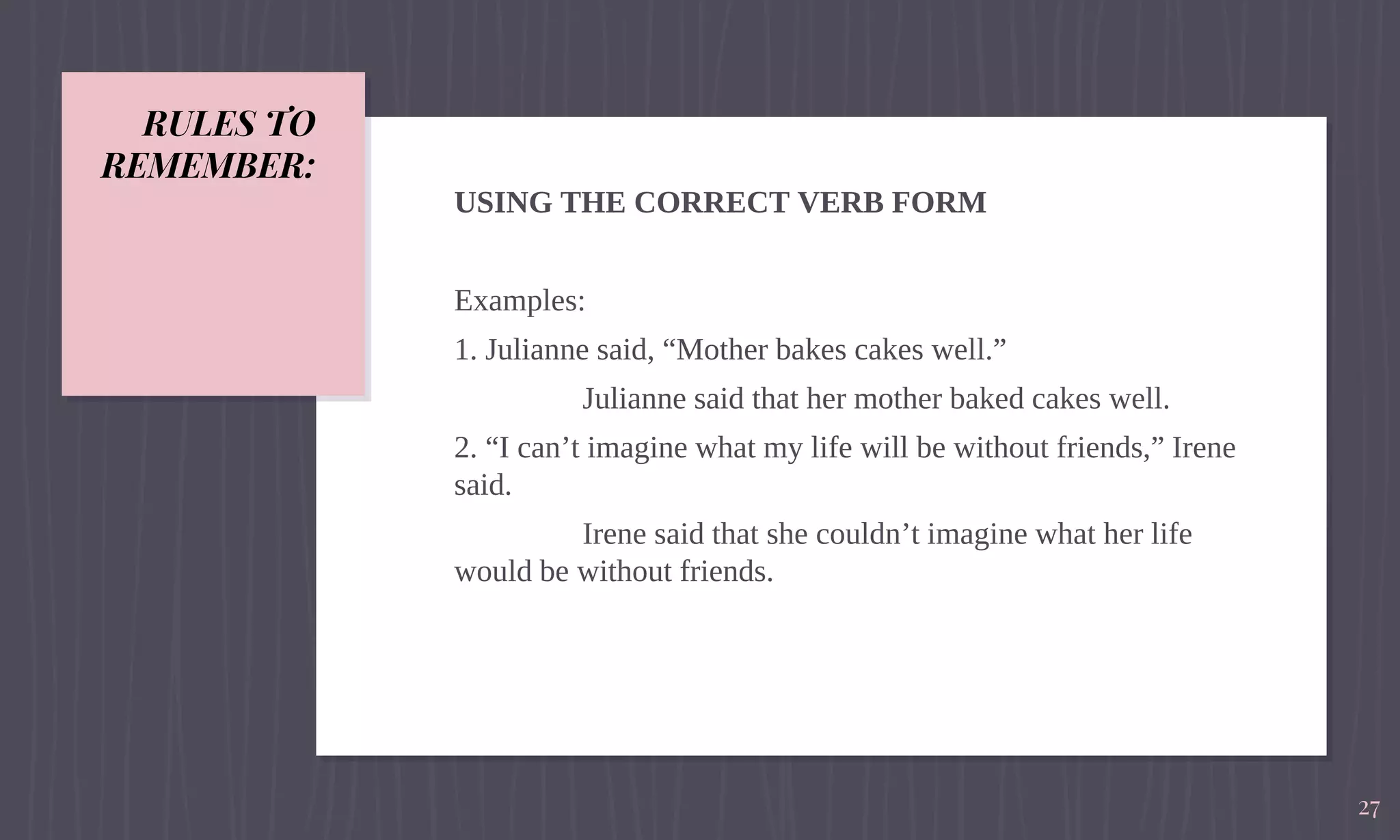
USING THE CORRECT VERB FORM
Examples:
1. Julianne said, “Mother bakes cakes well.”
Julianne said that her mother baked cakes well.
2. “I can’t imagine what my life will be without friends,” Irene
said.
Irene said that she couldn’t imagine what her life
would be without friends.
27
EXERCISE
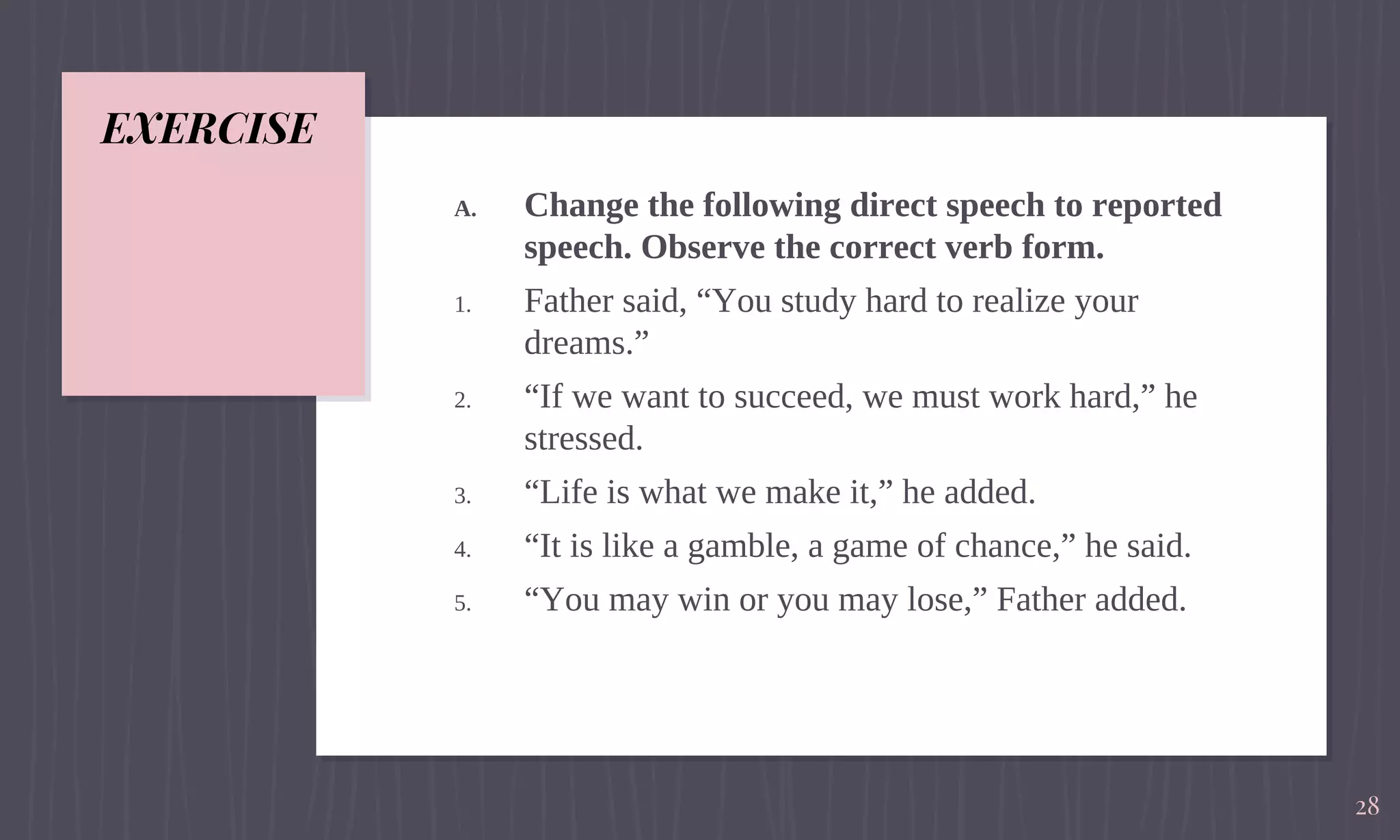
A. Change the following direct speech to reported
speech. Observe the correct verb form.
1. Father said, “You study hard to realize your
dreams.”
2. “If we want to succeed, we must work hard,” he
stressed.
3. “Life is what we make it,” he added.
4. “It is like a gamble, a game of chance,” he said.
5. “You may win or you may lose,” Father added.
28
EXERCISE
A. Change the following direct speech to reported
speech. Observe the correct verb form.
1. Father said, “You study hard to realize your
dreams.”
Ans: Father said to study hard to realize my dreams.
Or Father told me to study hard to realize my dreams.
2. “If we want to succeed, we must work hard,” he
stressed.
Ans: He stressed that if we want to succeed, we must
work hard.
Or He stressed that we must work hard if we want to
succeed.
29
EXERCISE
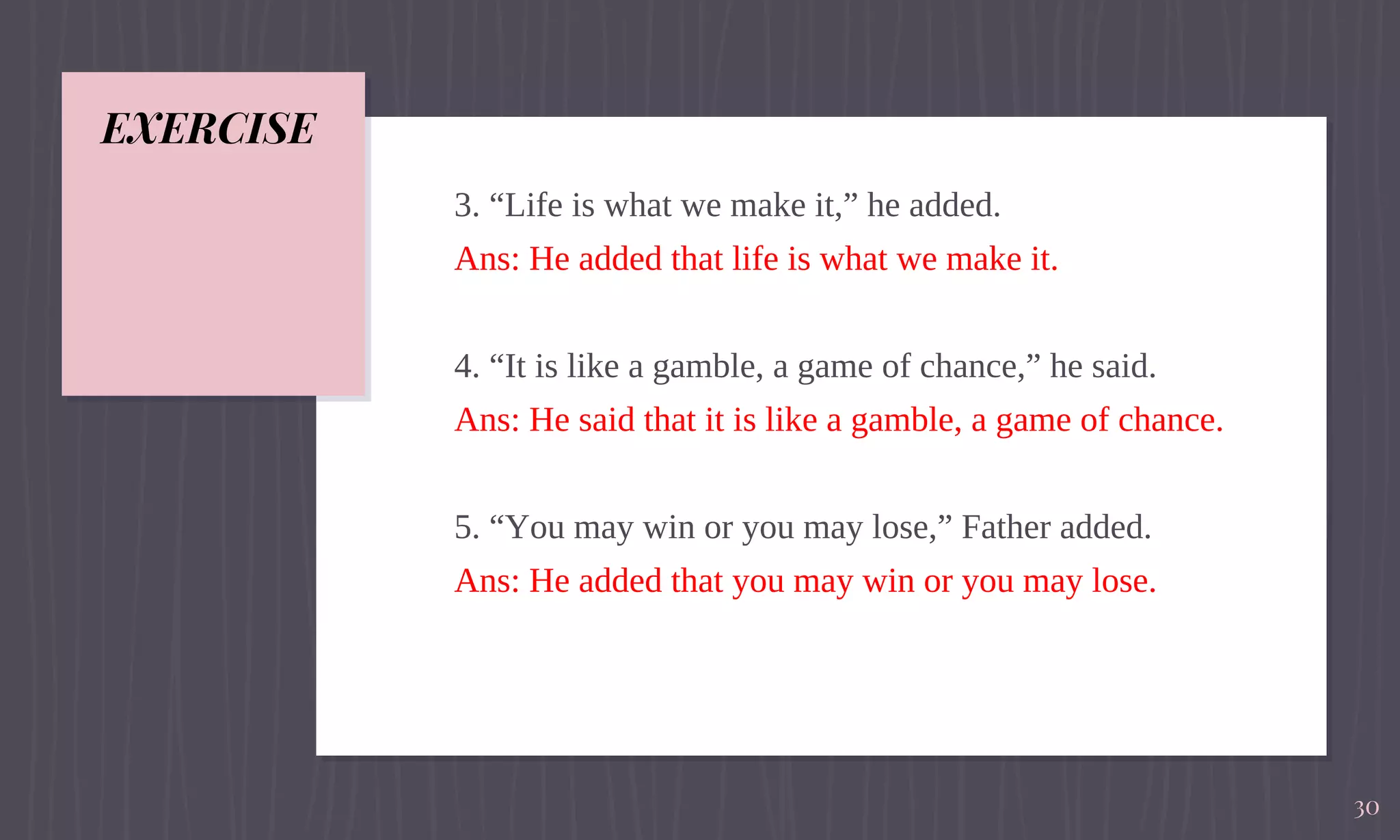
3. “Life is what we make it,” he added.
Ans: He added that life is what we make it.
4. “It is like a gamble, a game of chance,” he said.
Ans: He said that it is like a gamble, a game of chance.
5. “You may win or you may lose,” Father added.
Ans: He added that you may win or you may lose.
30
MORE EXERCISE!
31
QUIZ 4.1: Rewrite the
following to indirect
speech. Observe correct
verb usage and rules.
QUIZ 4.1
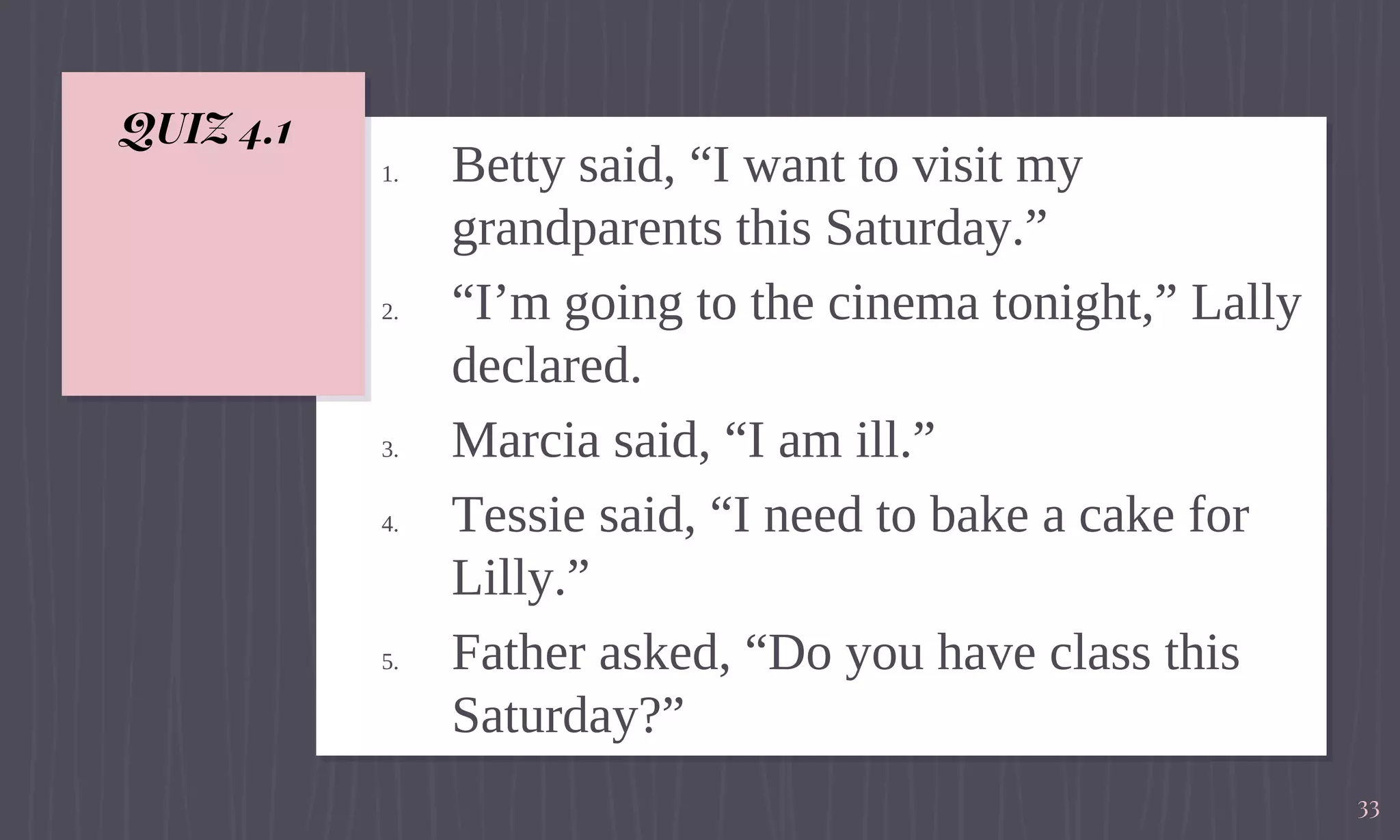
1. Betty said, “I want to visit my
grandparents this Saturday.”
2. “I’m going to the cinema tonight,” Lally
declared.
3. Marcia said, “I am ill.”
4. Tessie said, “I need to bake a cake for
Lilly.”
5. Father asked, “Do you have class this
Saturday?”
33
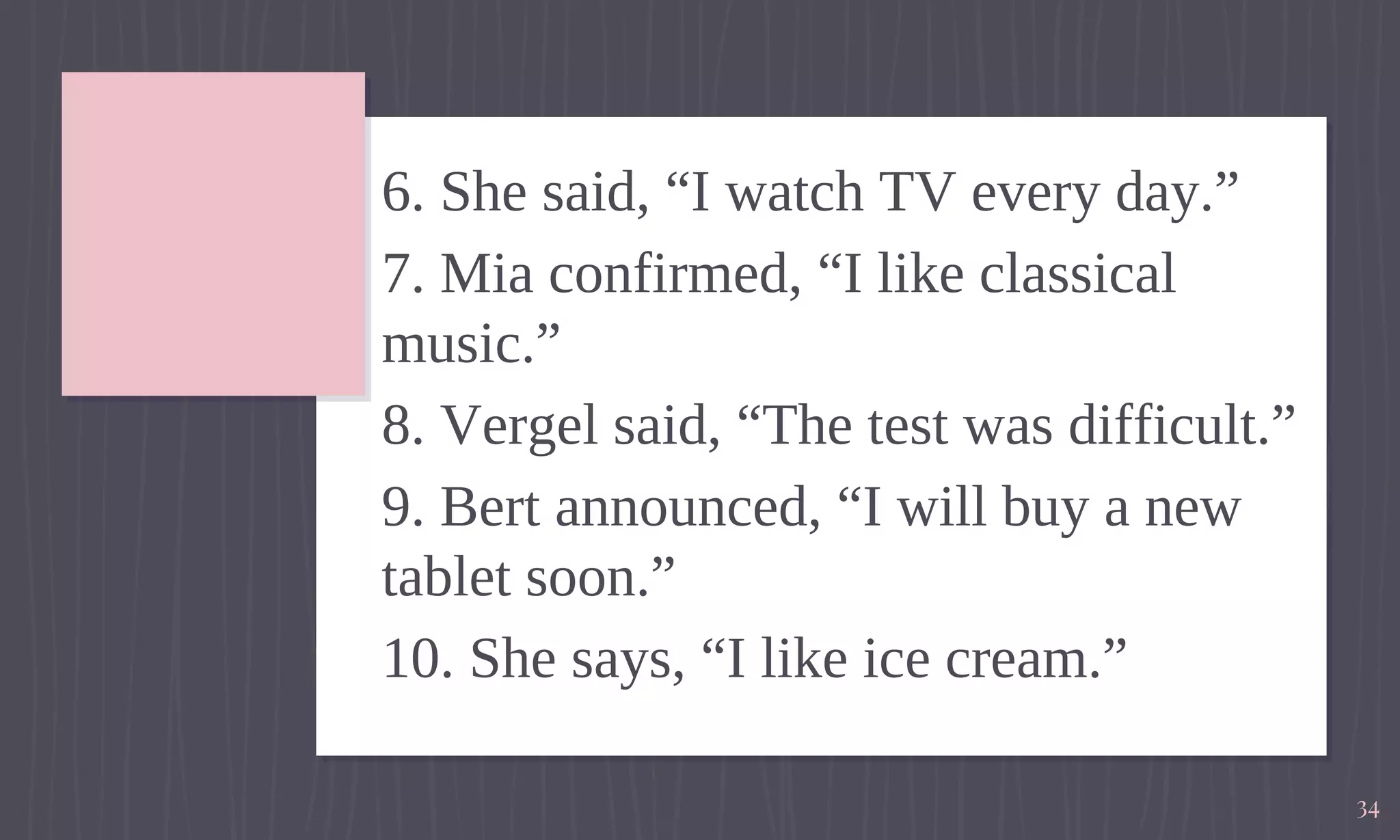
6. She said, “I watch TV every day.”
7. Mia confirmed, “I like classical
music.”
8. Vergel said, “The test was difficult.”
9. Bert announced, “I will buy a new
tablet soon.”
10. She says, “I like ice cream.”
34
Directions: Complete the
sentences using reported
speech. Change the tense
if necessary.
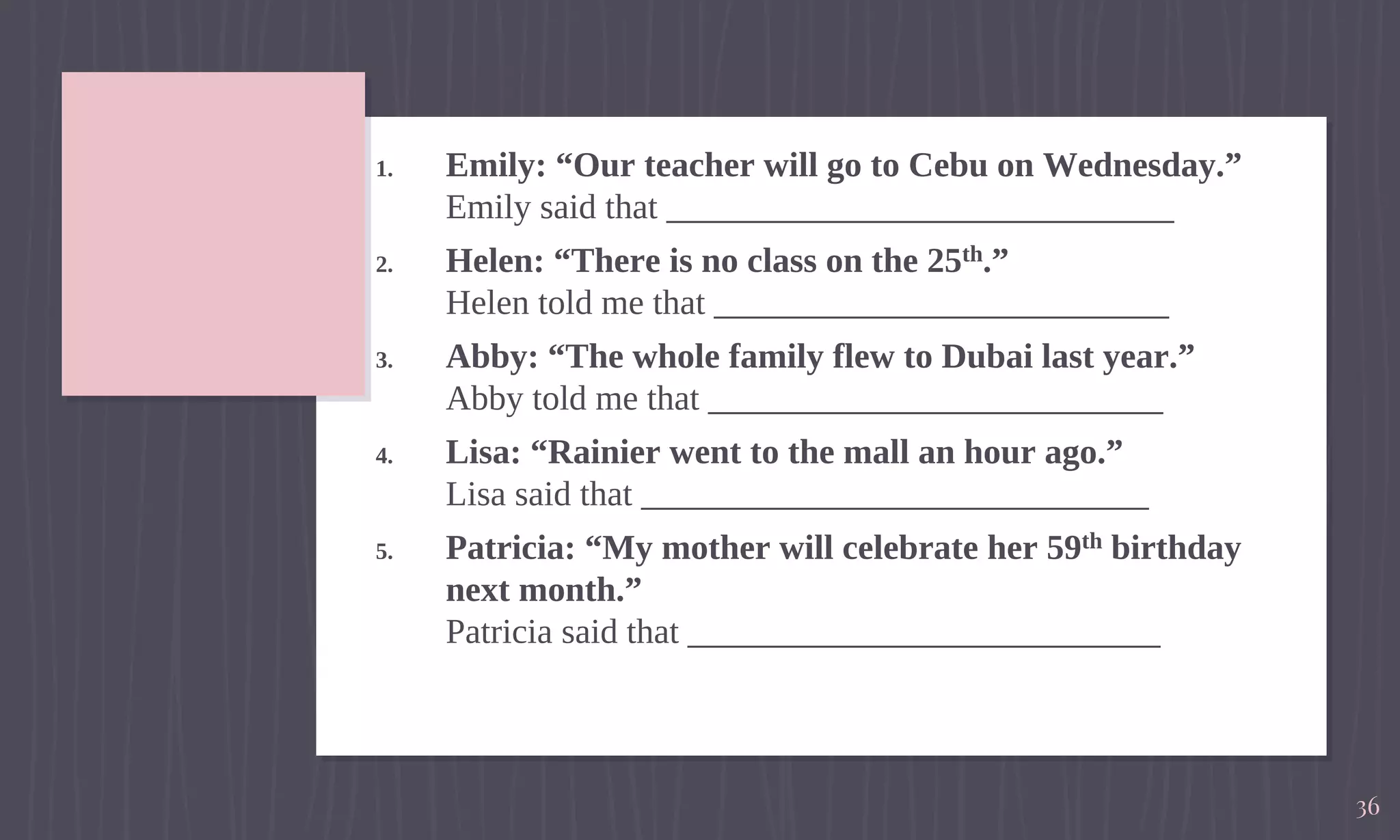
1. Emily: “Our teacher will go to Cebu on Wednesday.”
Emily said that _____________________________
2. Helen: “There is no class on the 25th.”
Helen told me that __________________________
3. Abby: “The whole family flew to Dubai last year.”
Abby told me that __________________________
4. Lisa: “Rainier went to the mall an hour ago.”
Lisa said that _____________________________
5. Patricia: “My mother will celebrate her 59th birthday
next month.”
Patricia said that ___________________________
36
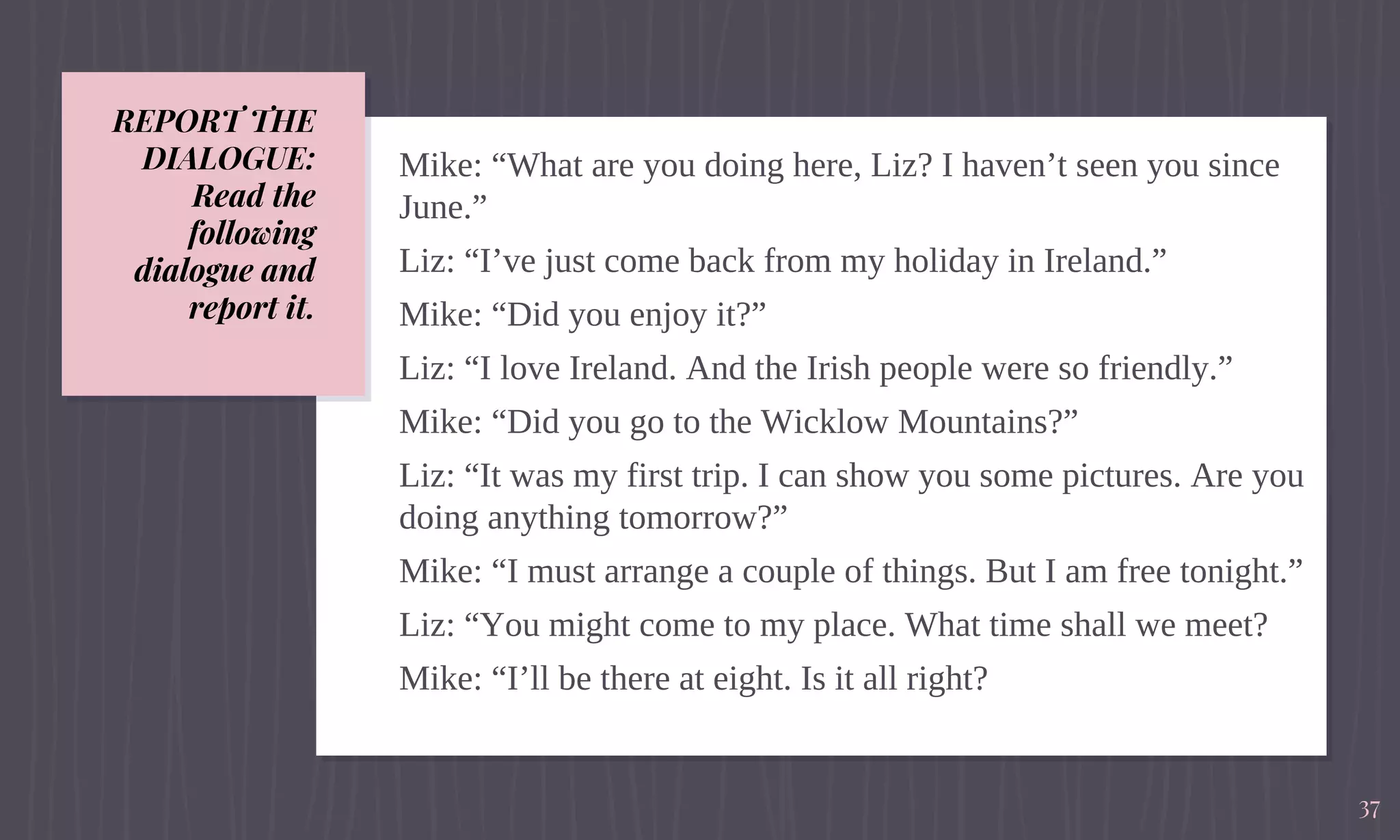
REPORT THE
DIALOGUE:
Read the
following
dialogue and
report it.
Mike: “What are you doing here, Liz? I haven’t seen you since
June.”
Liz: “I’ve just come back from my holiday in Ireland.”
Mike: “Did you enjoy it?”
Liz: “I love Ireland. And the Irish people were so friendly.”
Mike: “Did you go to the Wicklow Mountains?”
Liz: “It was my first trip. I can show you some pictures. Are you
doing anything tomorrow?”
Mike: “I must arrange a couple of things. But I am free tonight.”
Liz: “You might come to my place. What time shall we meet?
Mike: “I’ll be there at eight. Is it all right?
37
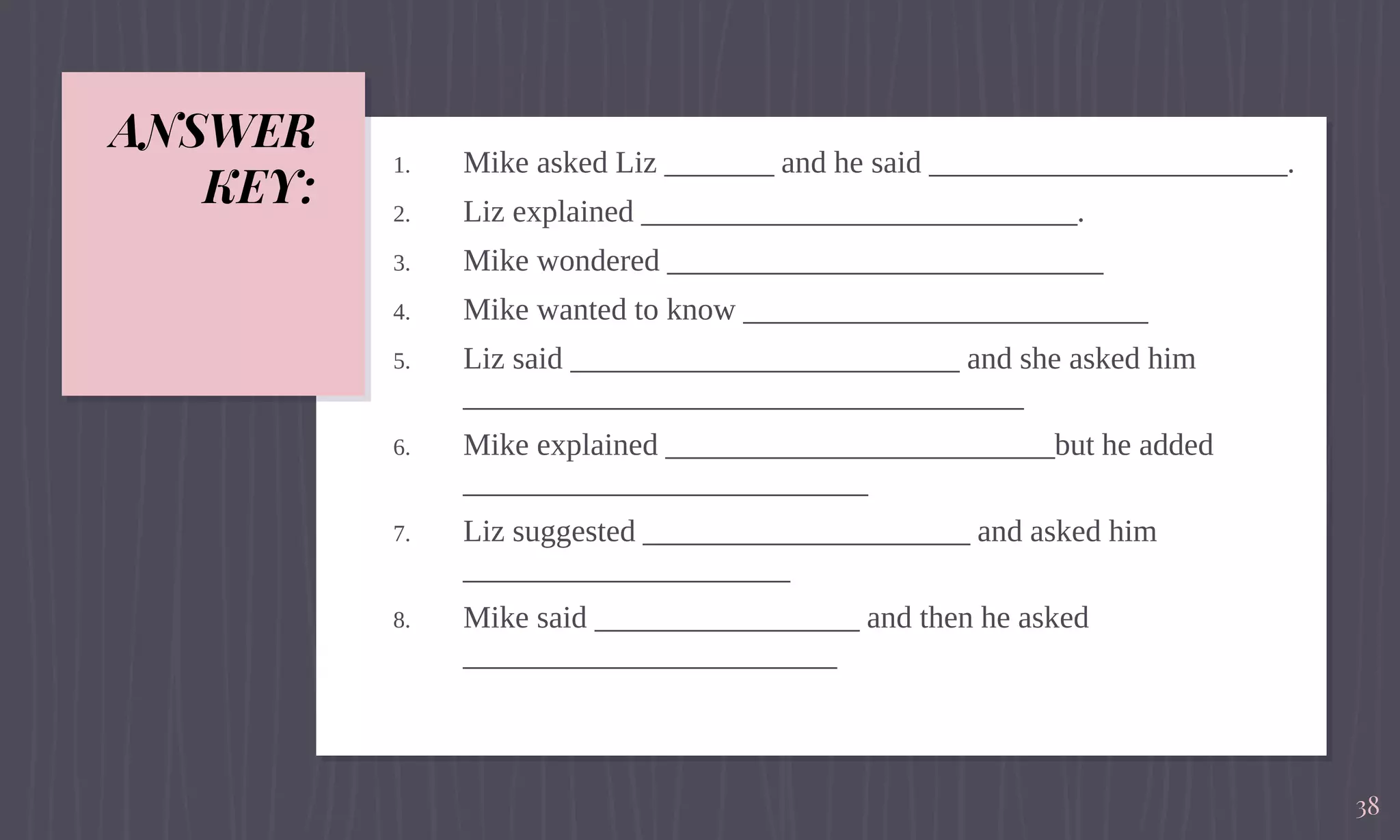
ANSWER
KEY:
1. Mike asked Liz _______ and he said _______________________.
2. Liz explained ____________________________.
3. Mike wondered ____________________________
4. Mike wanted to know __________________________
5. Liz said _________________________ and she asked him
____________________________________
6. Mike explained _________________________but he added
__________________________
7. Liz suggested _____________________ and asked him
_____________________
8. Mike said _________________ and then he asked
________________________
38
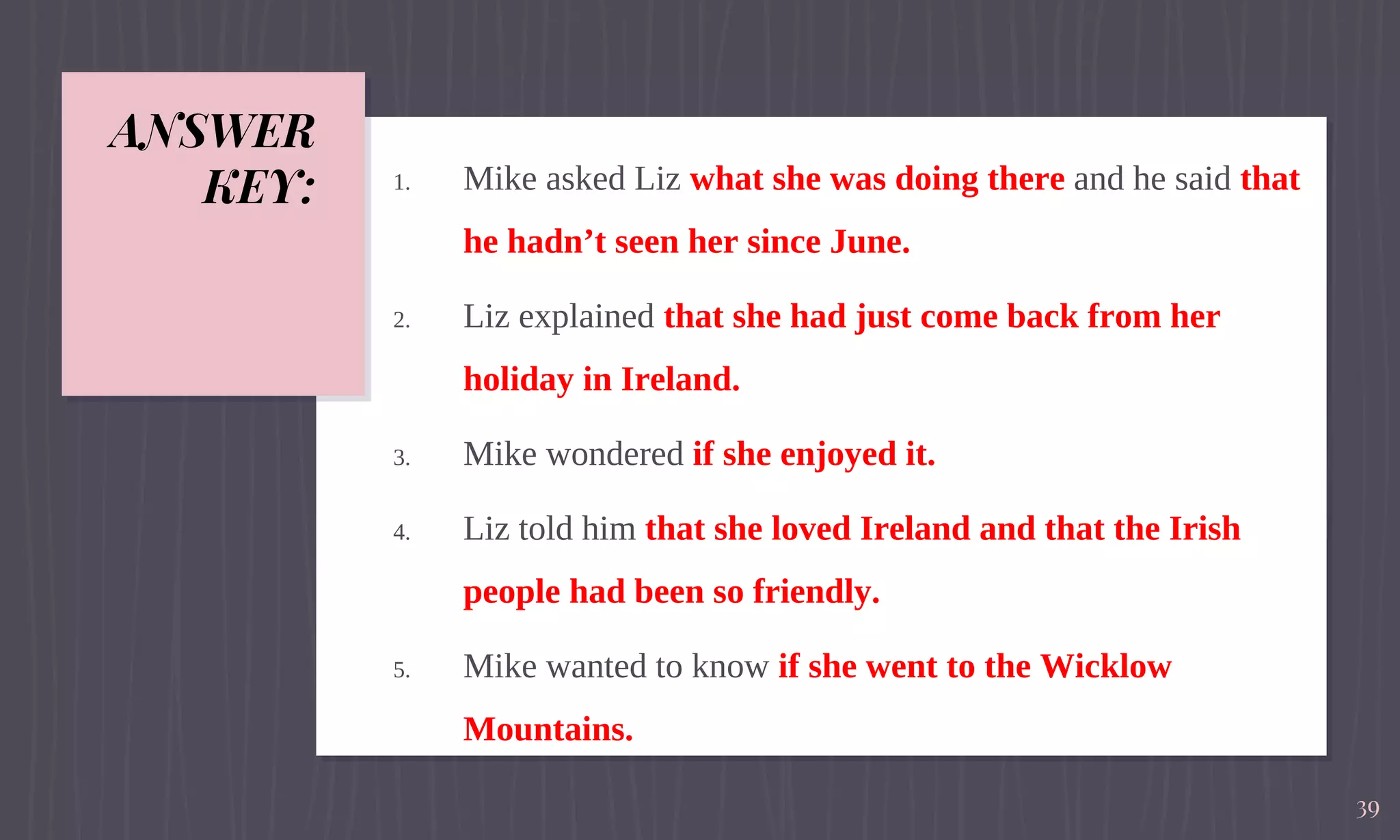
ANSWER
KEY: 1. Mike asked Liz what she was doing there and he said that
he hadn’t seen her since June.
2. Liz explained that she had just come back from her
holiday in Ireland.
3. Mike wondered if she enjoyed it.
4. Liz told him that she loved Ireland and that the Irish
people had been so friendly.
5. Mike wanted to know if she went to the Wicklow
Mountains.
39
ANSWER
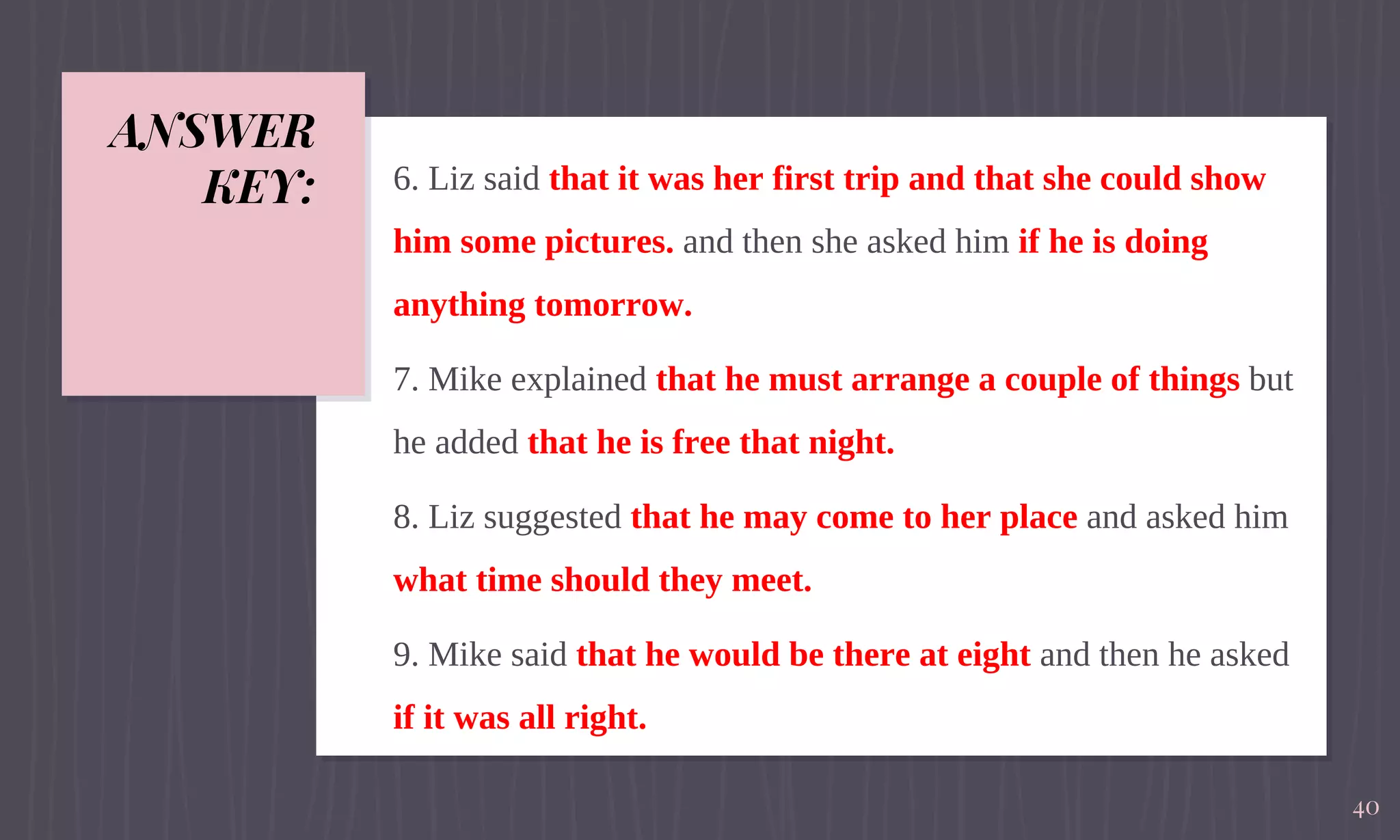
KEY: 6. Liz said that it was her first trip and that she could show
him some pictures. and then she asked him if he is doing
anything tomorrow.
7. Mike explained that he must arrange a couple of things but
he added that he is free that night.
8. Liz suggested that he may come to her place and asked him
what time should they meet.
9. Mike said that he would be there at eight and then he asked
if it was all right.
40
PERFORMANCE
TASK:
WRITING A WRITTEN REPORT OF AN
INTERVIEW
41
42
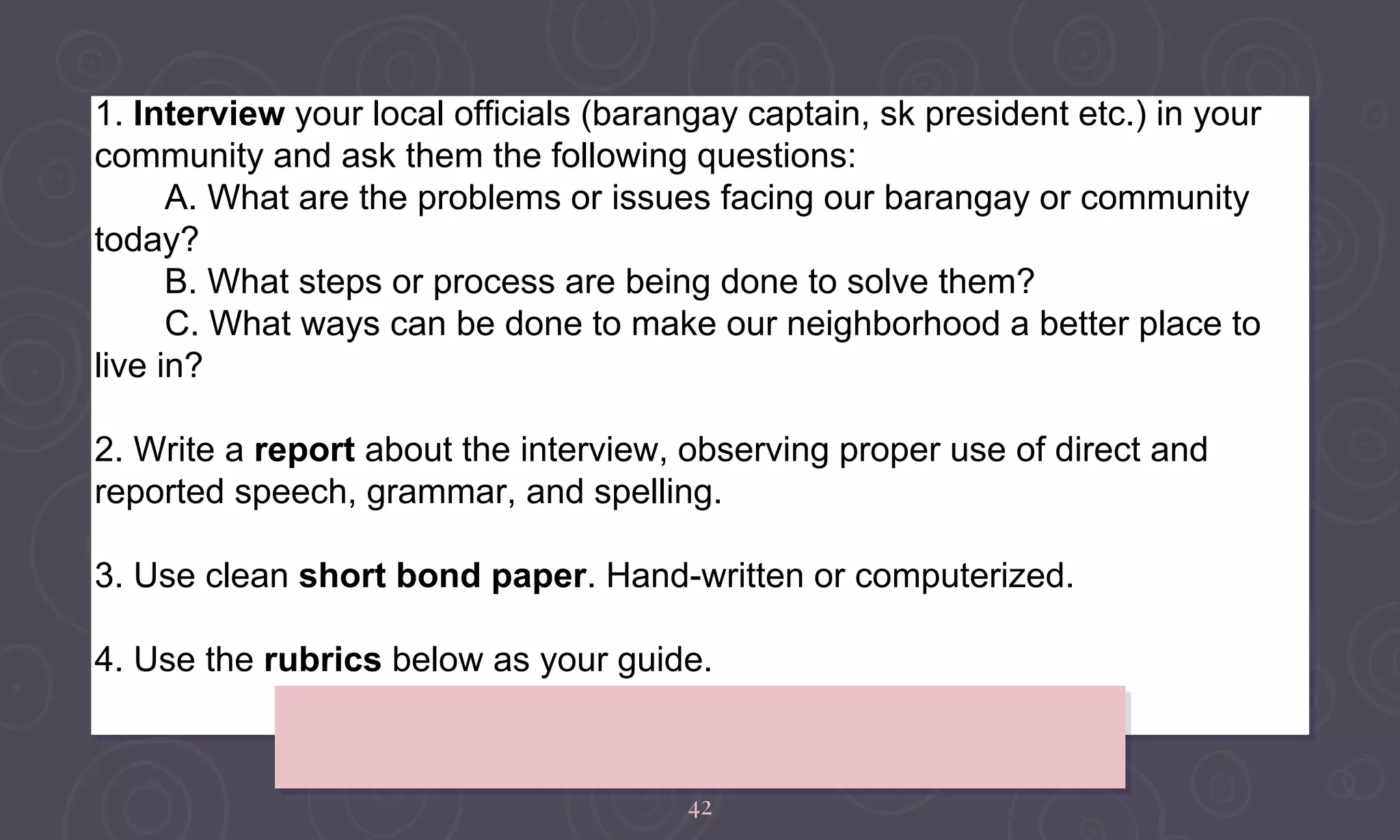
1. Interview your local officials (barangay captain, sk president etc.) in your
community and ask them the following questions:
A. What are the problems or issues facing our barangay or community
today?
B. What steps or process are being done to solve them?
C. What ways can be done to make our neighborhood a better place to
live in?
2. Write a report about the interview, observing proper use of direct and
reported speech, grammar, and spelling.
3. Use clean short bond paper. Hand-written or computerized.
4. Use the rubrics below as your guide.
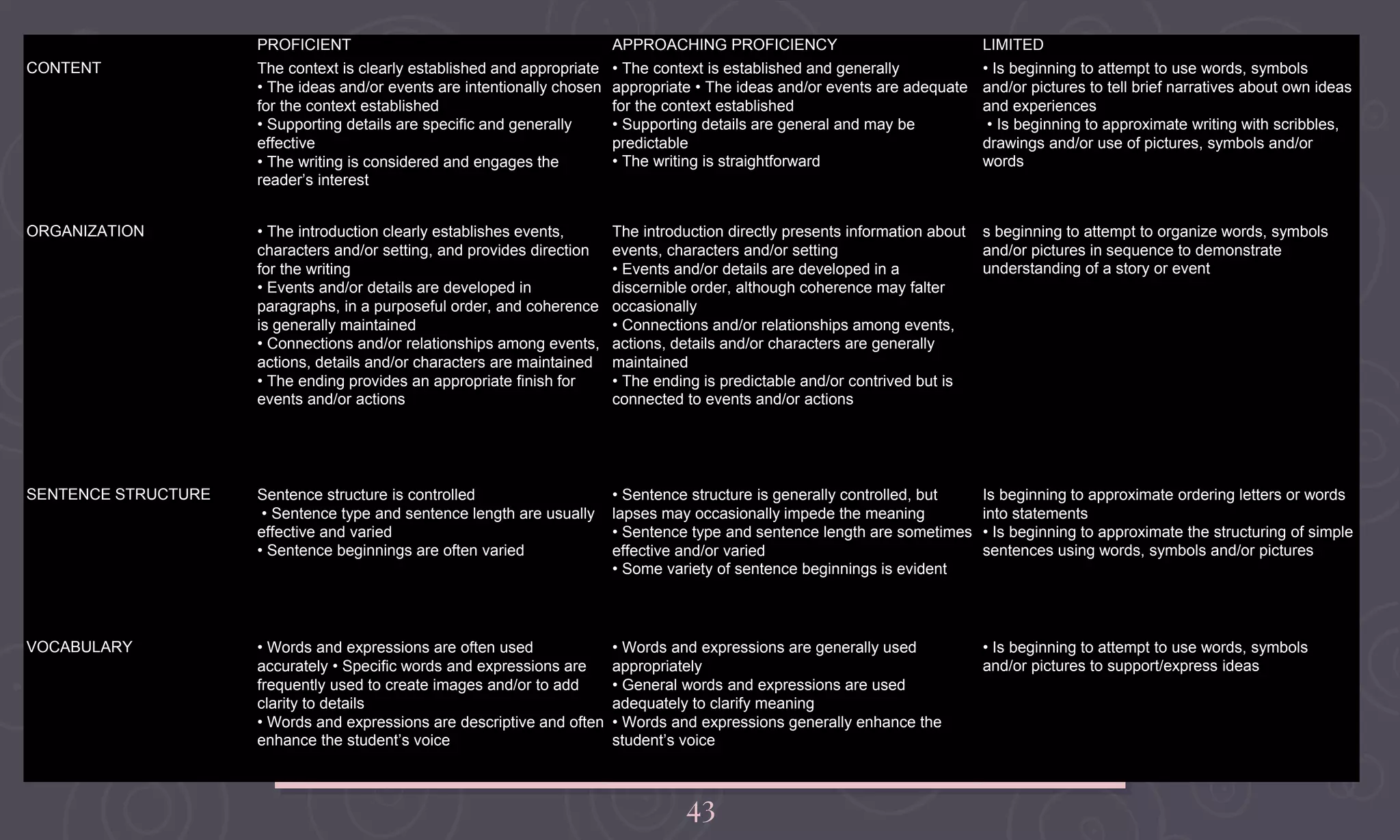
43
PROFICIENT APPROACHING PROFICIENCY LIMITED
CONTENT The context is clearly established and appropriate
• The ideas and/or events are intentionally chosen
for the context established
• Supporting details are specific and generally
effective
• The writing is considered and engages the
reader’s interest
• The context is established and generally
appropriate • The ideas and/or events are adequate
for the context established
• Supporting details are general and may be
predictable
• The writing is straightforward
• Is beginning to attempt to use words, symbols
and/or pictures to tell brief narratives about own ideas
and experiences
• Is beginning to approximate writing with scribbles,
drawings and/or use of pictures, symbols and/or
words
ORGANIZATION • The introduction clearly establishes events,
characters and/or setting, and provides direction
for the writing
• Events and/or details are developed in
paragraphs, in a purposeful order, and coherence
is generally maintained
• Connections and/or relationships among events,
actions, details and/or characters are maintained
• The ending provides an appropriate finish for
events and/or actions
The introduction directly presents information about
events, characters and/or setting
• Events and/or details are developed in a
discernible order, although coherence may falter
occasionally
• Connections and/or relationships among events,
actions, details and/or characters are generally
maintained
• The ending is predictable and/or contrived but is
connected to events and/or actions
s beginning to attempt to organize words, symbols
and/or pictures in sequence to demonstrate
understanding of a story or event
SENTENCE STRUCTURE Sentence structure is controlled
• Sentence type and sentence length are usually
effective and varied
• Sentence beginnings are often varied
• Sentence structure is generally controlled, but
lapses may occasionally impede the meaning
• Sentence type and sentence length are sometimes
effective and/or varied
• Some variety of sentence beginnings is evident
Is beginning to approximate ordering letters or words
into statements
• Is beginning to approximate the structuring of simple
sentences using words, symbols and/or pictures
VOCABULARY • Words and expressions are often used
accurately • Specific words and expressions are
frequently used to create images and/or to add
clarity to details
• Words and expressions are descriptive and often
enhance the student’s voice
• Words and expressions are generally used
appropriately
• General words and expressions are used
adequately to clarify meaning
• Words and expressions generally enhance the
student’s voice
• Is beginning to attempt to use words, symbols
and/or pictures to support/express ideas
RUBRIC OR WRITTEN REPORT
SPELLING
4.1
1. pliant – easily influenced
2. yield – to surrender or to relinquish to the
physical control of another
3. robust- having strength or vigorous health
4. gracefully- displaying grace in form or
action
5. protestations- the act of protesting; a
solemn declaration or avowal
6. onslaught- an especially fierce attack
44
7. survive- to remain alive; to live on
8. dominated- to exert the supreme determining
and guiding influence on
9. experience- practical knowledge, skill or
practice derived from direct observation of or
participation of events
10. vague- not clearly expressed
11. subtle- difficult to understand or perceive

12. pestilence- a contagious or infectious
epidemic disease that is virulent and devastating
45
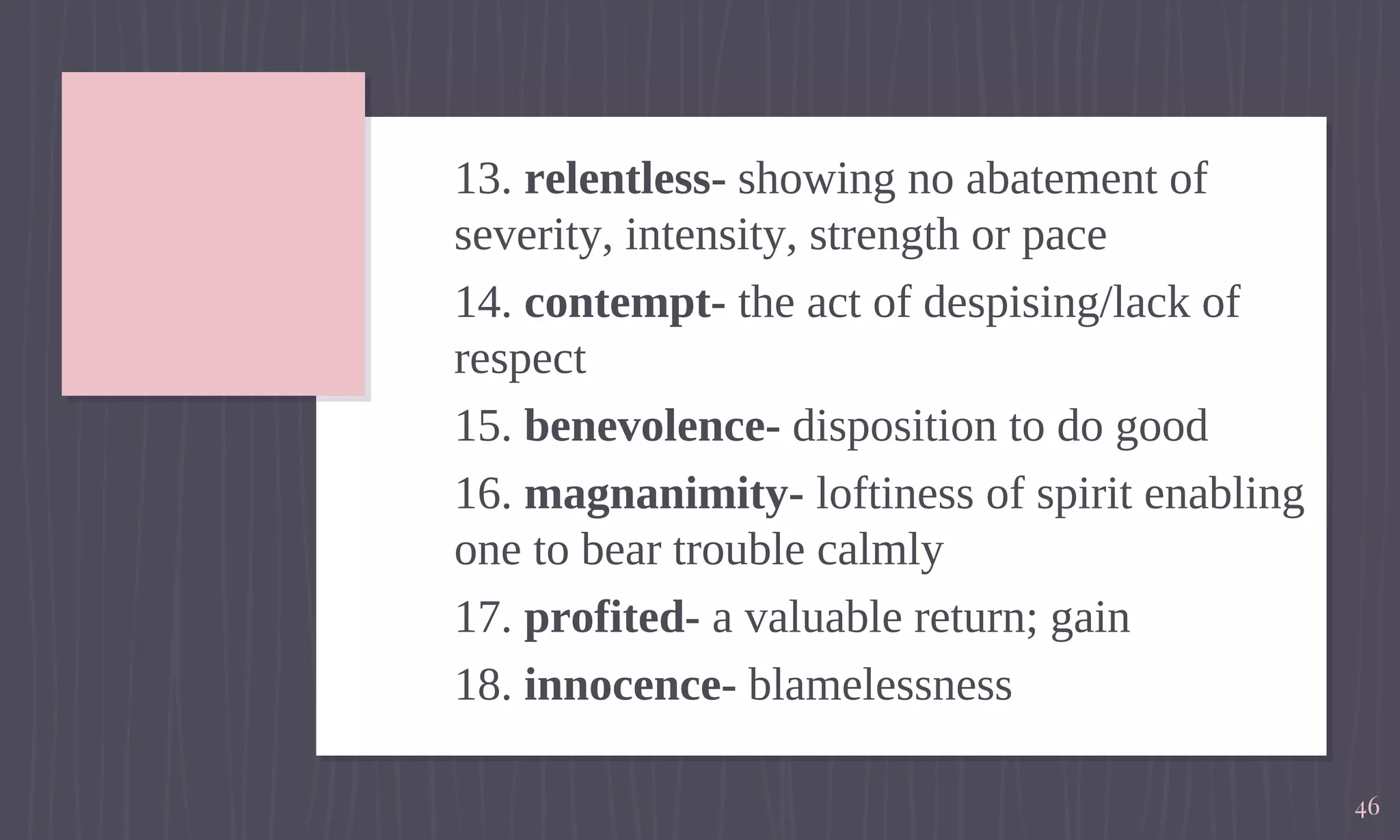
13. relentless- showing no abatement of
severity, intensity, strength or pace
14. contempt- the act of despising/lack of
respect
15. benevolence- disposition to do good
16. magnanimity- loftiness of spirit enabling
one to bear trouble calmly
17. profited- a valuable return; gain
18. innocence- blamelessness
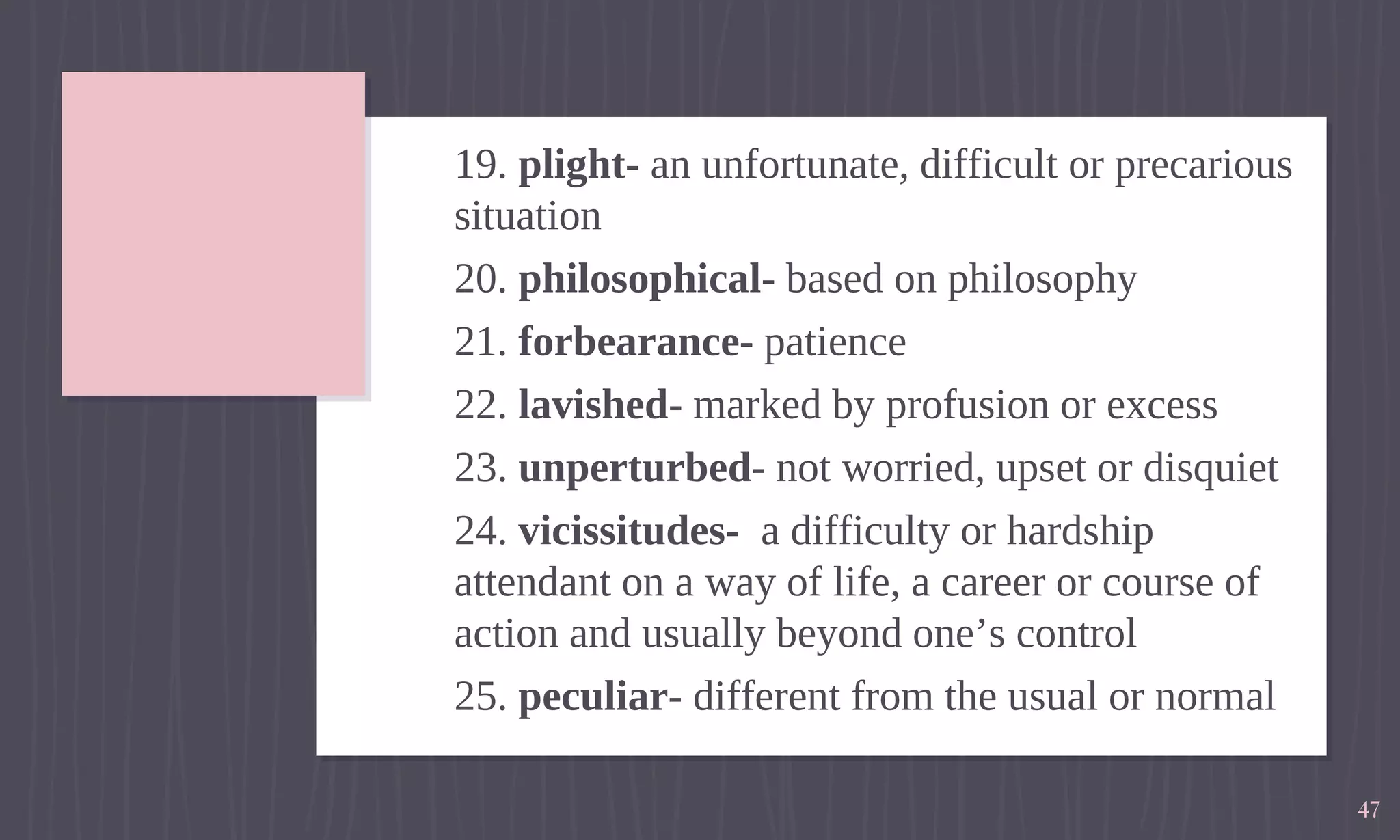
46
19. plight- an unfortunate, difficult or precarious
situation
20. philosophical- based on philosophy
21. forbearance- patience
22. lavished- marked by profusion or excess
23. unperturbed- not worried, upset or disquiet
24. vicissitudes- a difficulty or hardship
attendant on a way of life, a career or course of
action and usually beyond one’s control
25. peculiar- different from the usual or normal
47
THANK YOU!
ROBBIE JEAN B. ALVARADO
DONA LILING NEIS NEGAPATAN NHS

Direct and reported speech

  • 1.
  • 2.
    OBJECTIVES ▹ Differentiate directspeech from reported speech; ▹ Use direct and reported speech using dialog in a given context or situation; ▹ Manifest collaboration and cooperation in creating an dpresenting their dialog; ▹ Express opinions in taking care of their neighborhood. 2
  • 3.
  • 4.
    STEPS: 1. Divide into5 groups, then choose a LEADER, SCRIBE and REPORTER. 2. Each group will have META CARDS and Pentel Pens for writing. 3. You will watch a video then answer the question that will be posted in the video in a complete sentence 4. Write your answer in your META CARDS and post them on the board. 4
  • 5.
  • 6.
  • 7.
    What’s the Difference? 7 SETA • The boy asked Mr. S what was going on. • He told the kids that he has heard them in music class. • He told them that they could really play. • He asked why anyone hadn’t told him. • He asked him what his name was. • Mr. S asked Zack whether he played the guitar. SET B • The boy asked, “Mr. S, what’s going on?” • He told the kids, “I heard you in music class.” • “You can really play.” • He asked them, “Why didn’t anyone tell me?!” • “You. What’s your name?” • “You play the guitar?”
  • 8.
    ▹ Gives theexact words off the speaker. ▹ Has two parts: The introductory part which is set off by a comma (,) and the quoted part which gives the exact words of the speaker and is enclosed in quotation marks (“ “) DIRECT SPEECH 8
  • 9.
    ▹ Gives thewords of the speaker as reported by another person. ▹ Is NOT enclosed in quotation marks. REPORTED SPEECH (Indirect Speech) 9
  • 10.
  • 11.
  • 12.
    STEPS Question: “How wouldyou help your neighborhood to make it a better place to live in?” 1. Brainstorm with your groupmates. 2. Present a short dialog or interview to answer the question. Use direct or reported speech in your dialogs. 3. You have 10 minutes to prepare. 12
  • 13.
  • 14.
    Directions: Write onthe blank DS if the given statement is direct speech and RS if reported speech. _____1. “I’m ready for the meeting.” _____2. She said the clients have arrived. _____3. He told me to let them in. _____4. “We ordered the materials last week.” _____5. She said they would finish production next week. 14
  • 15.
    Directions: Write onthe blank DS if the given statement is direct speech and RS if reported speech. DS 1. “I’m ready for the meeting.” RS 2. She said the clients have arrived. RS 3. He told me to let them in. DS 4. “We ordered the materials last week.” RS 5. She said they would finish production next week. 15
  • 16.
  • 17.
    INTERVIEW REPORT ▹ Withyour groupmates, Interview your local officials (barangay captain, sk president etc.) in your community and ask them the following questions: ▹ What are the problems or issues facing our barangay or community today? ▹ What steps or process are being done to solve them? ▹ What ways can be done to make our neighborhood a better place to live in? Write a report about the interview, observing proper use of direct and reported speech, grammar, and spelling. Use clean short bond paper. Hand-written or computerized. 17
  • 18.
    Changing Direct Speech to IndirectSpeech (and vice-versa)
  • 19.
    RULES TO REMEMBER: CHANGING DIRECT TOREPORTED SPEECH 1. When the direct speech is a declarative sentence, the comma and the quotation marks are removed and the word that is used. Example: Direct Speech – “We should go to school early”, mother said. Reported Speech – Mother said that we should go to school early. 19
  • 20.
    RULES TO REMEMBER: CHANGING DIRECT TOREPORTED SPEECH 2. When the direct speech is an imperative sentence, the introductory word used is the infinitive form (to+ base form of the verb) of the verb in the quoted part. Example: “Go to school early”, mother said. Mother told me to go to school early. Or Mother said to go to school early. 20
  • 21.
    RULES TO REMEMBER: CHANGING DIRECT TOREPORTED SPEECH 3. When the direct speech is a Yes-no question involving a choice, the introductory word whether is used. Example: “Will you attend the party or not?” my friend asked. My friend asked whether I would attend the party or not. 21
  • 22.
    RULES TO REMEMBER: CHANGING DIRECT TOREPORTED SPEECH 4. The introductory word if is used with questions answerable by yes or no. Example: “Are you attending the party? She asked. She asked if I were attending the party. 22
  • 23.
    RULES TO REMEMBER: CHANGING DIRECT TOREPORTED SPEECH 5. When the direct speech is introduced by question words what, who. Whom, why, where, when, which, whose or how, the same question word is used as the introductory word. Example: “Where are you going?” the stranger asked. The stranger asked where I was going. 23
  • 24.
    RULES TO REMEMBER: USING THECORRECT VERB FORM Some verb changes usually takes place when changing direct to indirect speech: 1. When the verb in the explanatory part of the direct speech is in the present tense, the verb in the indirect speech remains the same as that in the direct speech. Example: My grandfather says, “Honesty is the best policy.” My grandfather says that honesty is the best policy. 24
  • 25.
    RULES TO REMEMBER: USING THECORRECT VERB FORM 2. When the verb in the explanatory part of the direct speech is in the past tense and the verb in the quoted or “permanent condition” the same present form is used in the indirect speech. Example: My father said, “Truth hurts but it sets us free.” My father said that truth hurts but it sets us free. 25
  • 26.
    RULES TO REMEMBER: USING THECORRECT VERB FORM 3. When the verb in the explanatory part of the direct speech is in the past tense, the following changes in the verb in the indirect speech occur: a. Verb in the present tense are changed to the past tense. b. Verb in the past tense remain in the past tense or are changed to the past perfect tense. c. The following changed occur in the helping verbs: a. Has/have - had b. Shall – should c. Can – could d. May - might 26
  • 27.
    RULES TO REMEMBER: USING THECORRECT VERB FORM Examples: 1. Julianne said, “Mother bakes cakes well.” Julianne said that her mother baked cakes well. 2. “I can’t imagine what my life will be without friends,” Irene said. Irene said that she couldn’t imagine what her life would be without friends. 27
  • 28.
    EXERCISE A. Change thefollowing direct speech to reported speech. Observe the correct verb form. 1. Father said, “You study hard to realize your dreams.” 2. “If we want to succeed, we must work hard,” he stressed. 3. “Life is what we make it,” he added. 4. “It is like a gamble, a game of chance,” he said. 5. “You may win or you may lose,” Father added. 28
  • 29.
    EXERCISE A. Change thefollowing direct speech to reported speech. Observe the correct verb form. 1. Father said, “You study hard to realize your dreams.” Ans: Father said to study hard to realize my dreams. Or Father told me to study hard to realize my dreams. 2. “If we want to succeed, we must work hard,” he stressed. Ans: He stressed that if we want to succeed, we must work hard. Or He stressed that we must work hard if we want to succeed. 29
  • 30.
    EXERCISE 3. “Life iswhat we make it,” he added. Ans: He added that life is what we make it. 4. “It is like a gamble, a game of chance,” he said. Ans: He said that it is like a gamble, a game of chance. 5. “You may win or you may lose,” Father added. Ans: He added that you may win or you may lose. 30
  • 31.
  • 32.
    QUIZ 4.1: Rewritethe following to indirect speech. Observe correct verb usage and rules.
  • 33.
    QUIZ 4.1 1. Bettysaid, “I want to visit my grandparents this Saturday.” 2. “I’m going to the cinema tonight,” Lally declared. 3. Marcia said, “I am ill.” 4. Tessie said, “I need to bake a cake for Lilly.” 5. Father asked, “Do you have class this Saturday?” 33
  • 34.
    6. She said,“I watch TV every day.” 7. Mia confirmed, “I like classical music.” 8. Vergel said, “The test was difficult.” 9. Bert announced, “I will buy a new tablet soon.” 10. She says, “I like ice cream.” 34
  • 35.
    Directions: Complete the sentencesusing reported speech. Change the tense if necessary.
  • 36.
    1. Emily: “Ourteacher will go to Cebu on Wednesday.” Emily said that _____________________________ 2. Helen: “There is no class on the 25th.” Helen told me that __________________________ 3. Abby: “The whole family flew to Dubai last year.” Abby told me that __________________________ 4. Lisa: “Rainier went to the mall an hour ago.” Lisa said that _____________________________ 5. Patricia: “My mother will celebrate her 59th birthday next month.” Patricia said that ___________________________ 36
  • 37.
    REPORT THE DIALOGUE: Read the following dialogueand report it. Mike: “What are you doing here, Liz? I haven’t seen you since June.” Liz: “I’ve just come back from my holiday in Ireland.” Mike: “Did you enjoy it?” Liz: “I love Ireland. And the Irish people were so friendly.” Mike: “Did you go to the Wicklow Mountains?” Liz: “It was my first trip. I can show you some pictures. Are you doing anything tomorrow?” Mike: “I must arrange a couple of things. But I am free tonight.” Liz: “You might come to my place. What time shall we meet? Mike: “I’ll be there at eight. Is it all right? 37
  • 38.
    ANSWER KEY: 1. Mike askedLiz _______ and he said _______________________. 2. Liz explained ____________________________. 3. Mike wondered ____________________________ 4. Mike wanted to know __________________________ 5. Liz said _________________________ and she asked him ____________________________________ 6. Mike explained _________________________but he added __________________________ 7. Liz suggested _____________________ and asked him _____________________ 8. Mike said _________________ and then he asked ________________________ 38
  • 39.
    ANSWER KEY: 1. Mikeasked Liz what she was doing there and he said that he hadn’t seen her since June. 2. Liz explained that she had just come back from her holiday in Ireland. 3. Mike wondered if she enjoyed it. 4. Liz told him that she loved Ireland and that the Irish people had been so friendly. 5. Mike wanted to know if she went to the Wicklow Mountains. 39
  • 40.
    ANSWER KEY: 6. Lizsaid that it was her first trip and that she could show him some pictures. and then she asked him if he is doing anything tomorrow. 7. Mike explained that he must arrange a couple of things but he added that he is free that night. 8. Liz suggested that he may come to her place and asked him what time should they meet. 9. Mike said that he would be there at eight and then he asked if it was all right. 40
  • 41.
    PERFORMANCE TASK: WRITING A WRITTENREPORT OF AN INTERVIEW 41
  • 42.
    42 1. Interview yourlocal officials (barangay captain, sk president etc.) in your community and ask them the following questions: A. What are the problems or issues facing our barangay or community today? B. What steps or process are being done to solve them? C. What ways can be done to make our neighborhood a better place to live in? 2. Write a report about the interview, observing proper use of direct and reported speech, grammar, and spelling. 3. Use clean short bond paper. Hand-written or computerized. 4. Use the rubrics below as your guide.
  • 43.
    43 PROFICIENT APPROACHING PROFICIENCYLIMITED CONTENT The context is clearly established and appropriate • The ideas and/or events are intentionally chosen for the context established • Supporting details are specific and generally effective • The writing is considered and engages the reader’s interest • The context is established and generally appropriate • The ideas and/or events are adequate for the context established • Supporting details are general and may be predictable • The writing is straightforward • Is beginning to attempt to use words, symbols and/or pictures to tell brief narratives about own ideas and experiences • Is beginning to approximate writing with scribbles, drawings and/or use of pictures, symbols and/or words ORGANIZATION • The introduction clearly establishes events, characters and/or setting, and provides direction for the writing • Events and/or details are developed in paragraphs, in a purposeful order, and coherence is generally maintained • Connections and/or relationships among events, actions, details and/or characters are maintained • The ending provides an appropriate finish for events and/or actions The introduction directly presents information about events, characters and/or setting • Events and/or details are developed in a discernible order, although coherence may falter occasionally • Connections and/or relationships among events, actions, details and/or characters are generally maintained • The ending is predictable and/or contrived but is connected to events and/or actions s beginning to attempt to organize words, symbols and/or pictures in sequence to demonstrate understanding of a story or event SENTENCE STRUCTURE Sentence structure is controlled • Sentence type and sentence length are usually effective and varied • Sentence beginnings are often varied • Sentence structure is generally controlled, but lapses may occasionally impede the meaning • Sentence type and sentence length are sometimes effective and/or varied • Some variety of sentence beginnings is evident Is beginning to approximate ordering letters or words into statements • Is beginning to approximate the structuring of simple sentences using words, symbols and/or pictures VOCABULARY • Words and expressions are often used accurately • Specific words and expressions are frequently used to create images and/or to add clarity to details • Words and expressions are descriptive and often enhance the student’s voice • Words and expressions are generally used appropriately • General words and expressions are used adequately to clarify meaning • Words and expressions generally enhance the student’s voice • Is beginning to attempt to use words, symbols and/or pictures to support/express ideas RUBRIC OR WRITTEN REPORT
  • 44.
    SPELLING 4.1 1. pliant –easily influenced 2. yield – to surrender or to relinquish to the physical control of another 3. robust- having strength or vigorous health 4. gracefully- displaying grace in form or action 5. protestations- the act of protesting; a solemn declaration or avowal 6. onslaught- an especially fierce attack 44
  • 45.
    7. survive- toremain alive; to live on 8. dominated- to exert the supreme determining and guiding influence on 9. experience- practical knowledge, skill or practice derived from direct observation of or participation of events 10. vague- not clearly expressed 11. subtle- difficult to understand or perceive 12. pestilence- a contagious or infectious epidemic disease that is virulent and devastating 45
  • 46.
    13. relentless- showingno abatement of severity, intensity, strength or pace 14. contempt- the act of despising/lack of respect 15. benevolence- disposition to do good 16. magnanimity- loftiness of spirit enabling one to bear trouble calmly 17. profited- a valuable return; gain 18. innocence- blamelessness 46
  • 47.
    19. plight- anunfortunate, difficult or precarious situation 20. philosophical- based on philosophy 21. forbearance- patience 22. lavished- marked by profusion or excess 23. unperturbed- not worried, upset or disquiet 24. vicissitudes- a difficulty or hardship attendant on a way of life, a career or course of action and usually beyond one’s control 25. peculiar- different from the usual or normal 47
  • 48.
    THANK YOU! ROBBIE JEANB. ALVARADO DONA LILING NEIS NEGAPATAN NHS

Editor's Notes

  • #5 Link: https://www.youtube.com/watch?v=rW-Y23KpGEo https://www.youtube.com/watch?v=UpznGgIuTHQ