CHEMISTRY
S PRABHANJAN KUMAR
#Pharm D
What is Chemistry ?
• The branch of science concerned with the
substances of which matter is composed, the
investigation of their properties and reactions,
and the use of such reactions to form new
substances. (or)
• Chemistry is the study of matter, its properties,
how and why substances combine or separate to
form other substances, and how substances
interact with energy.
The history of chemistry represents a time span from
ancient history to the present. By 1000 BC, civilizations
used technologies that would eventually form the basis
of the various branches of chemistry. ... However, by
performing experiments and recording the results,
alchemists set the stage for modern chemistry.
History :
In the eighth century A.D., Jābir ibn Hayyān, a Muslim
astronomer, philosopher and scientist, became one of
the first to use scientific methods to study materials.
Also known by his Latinized name, Geber
Robert Boyle(1627-1691) studied the behavior of gases
and discovered the inverse relationship between volume
and pressure of a gas. He also stated that “all reality and
change can be described in terms of elementary particles
and their motion
By the 1700s, the Age of
Enlightenment had taken
root all over Europe.
Joseph Priestley (1733-
1804) disproved the idea
that air was an indivisible
element. He showed that
it was, instead, a
combination of gases
when he isolated oxygen
and went on to discover
seven other discreet gases
In 1794, Joseph Proust
studied pure chemical
compounds and stated the
Law of Definite Proportions
— a chemical compound
will always have its own
characteristic ratio of
elemental components.
Water, for instance, always
has a two-to-one ratio of
hydrogen to oxygen.
Antoine Lavoisier (1743-1794) was a French chemist who
made important contributions to the science. While
working as a tax collector, Lavoisier helped to develop the
metric system in order to insure uniform weights and
measures.
Amedeo Avogadro (1776-1856) was an Italian lawyer
who began to study science and mathematics in 1800.
Expanding on the work of Boyle and Charles, he clarified
the difference between atoms and molecules
In 1803, an English meteorologist began to speculate on the
phenomenon of water vapor. John Dalton (1766-1844) was
aware that water vapor is part of the atmosphere, but
experiments showed that water vapor would not form in
certain other gases.
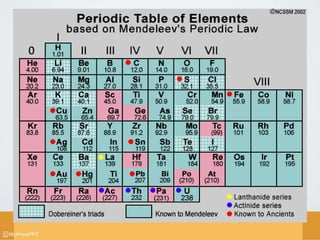
Dmitri Mendeleev (1834-1907) was a Russian chemist
known for developing the first Periodic Table of the
Elements. He listed the 63 known elements and their
properties on cards. When he arranged the elements in
order of increasing atomic mass, he could group elements
with similar properties
In 1896, Henri Becquerel discovered radiation. Along with
Pierre and Marie Curie, he showed that certain elements
emit energy at fixed rates. In 1903, Becquerel shared a
Nobel Prize with the Curies for the discovery of
radioactivity.
In 1900, Max Planck discovered that energy must be
emitted in discreet units that he called “quanta” (since
named photons)
In 1911, Ernst Rutherford demonstrated that atoms
consisted of a tiny dense positively charged region
surrounded by relatively large areas of empty space in
which still smaller, negatively charged particles (electrons)
move. Rutherford assumed that the electrons orbit the
nucleus in separate neat orbits, just as the planets orbit the
sun.
he could not explain why the electrons were not simply
pulled into the nucleus thus destroying the atom.
Niels Bohr’s (1885-1962) atomic model solved this problem
by using Planck’s information. Photons are emitted from an
electrically stimulated atom only at certain frequencies. He
hypothesized that electrons inhabit distinct energy levels
and light is only emitted when an electrically “excited”
electron is forced to change energy levels.
In 1935, James Chadwick was awarded the Nobel Prize for
his discovery that there are an equal number of
electrically neutral particles in the nucleus of an atom.
Since neutrons are electrically neutral, they are not
deflected by either electrons or protons.
Concepts are essential for the study of chemistry
1.MATTER
2.ATOM
3.ELEMENT
4.COMPOUND
5.MOLECULE
6.PHASE
7.BONDING
8.ENERGY
9.REACTION
10.IONS & SALTS
11.ACIDITY & BASICITY
12.REDOX
13.EQUILIBRIUM
14.CHEMICAL LAWS
Types Of Chemistry / Main Branchs :
Organic Chemistry
Analytical Chemistry
Physical Chemistry
Inorganic Chemistry
Biochemistry Chemistry
Organic Chemistry :
Organic chemistry is the study of the structure, properties,
composition, reactions, and preparation of carbon-
containing compounds, which include not only
hydrocarbons but also compounds with any number of
other elements, including hydrogen (most compounds
contain at least one carbon–hydrogen bond), nitrogen,
oxygen, ...
Analytical Chemistry :
Analytical chemistry studies and uses instruments and
methods used to separate, identify, and quantify matter.
In practice, separation, identification or quantification
may constitute the entire analysis or be combined with
another method. Separation isolates analytes.
Physical Chemistry :
Physical chemistry is the study of macroscopic, atomic,
subatomic, and particulate phenomena in chemical
systems in terms of the principles, practices, and concepts
of physics such as motion, energy, force, time,
thermodynamics, quantum chemistry, statistical
mechanics, analytical dynamics and chemical equilibrium
In Organic Chemistry :
Inorganic chemistry deals with the synthesis and
behavior of inorganic and organometallic compounds.
This field covers all chemical compounds except the
myriad organic compounds
Bio Chemistry :
Biochemistry, sometimes called biological chemistry, is
the study of chemical processes within and relating to
living organisms. Biochemical processes give rise to the
complexity of life.
An experiment is a question which science poses
to Nature, and a measurement is the recording
of Nature's answer.
- Max Planck

Chemistry , it's History , Concepts , Types

  • 1.
  • 2.
    What is Chemistry? • The branch of science concerned with the substances of which matter is composed, the investigation of their properties and reactions, and the use of such reactions to form new substances. (or) • Chemistry is the study of matter, its properties, how and why substances combine or separate to form other substances, and how substances interact with energy.
  • 3.
    The history ofchemistry represents a time span from ancient history to the present. By 1000 BC, civilizations used technologies that would eventually form the basis of the various branches of chemistry. ... However, by performing experiments and recording the results, alchemists set the stage for modern chemistry. History :
  • 4.
    In the eighthcentury A.D., Jābir ibn Hayyān, a Muslim astronomer, philosopher and scientist, became one of the first to use scientific methods to study materials. Also known by his Latinized name, Geber Robert Boyle(1627-1691) studied the behavior of gases and discovered the inverse relationship between volume and pressure of a gas. He also stated that “all reality and change can be described in terms of elementary particles and their motion
  • 5.
    By the 1700s,the Age of Enlightenment had taken root all over Europe. Joseph Priestley (1733- 1804) disproved the idea that air was an indivisible element. He showed that it was, instead, a combination of gases when he isolated oxygen and went on to discover seven other discreet gases In 1794, Joseph Proust studied pure chemical compounds and stated the Law of Definite Proportions — a chemical compound will always have its own characteristic ratio of elemental components. Water, for instance, always has a two-to-one ratio of hydrogen to oxygen.
  • 6.
    Antoine Lavoisier (1743-1794)was a French chemist who made important contributions to the science. While working as a tax collector, Lavoisier helped to develop the metric system in order to insure uniform weights and measures. Amedeo Avogadro (1776-1856) was an Italian lawyer who began to study science and mathematics in 1800. Expanding on the work of Boyle and Charles, he clarified the difference between atoms and molecules
  • 7.
    In 1803, anEnglish meteorologist began to speculate on the phenomenon of water vapor. John Dalton (1766-1844) was aware that water vapor is part of the atmosphere, but experiments showed that water vapor would not form in certain other gases. Dmitri Mendeleev (1834-1907) was a Russian chemist known for developing the first Periodic Table of the Elements. He listed the 63 known elements and their properties on cards. When he arranged the elements in order of increasing atomic mass, he could group elements with similar properties
  • 9.
    In 1896, HenriBecquerel discovered radiation. Along with Pierre and Marie Curie, he showed that certain elements emit energy at fixed rates. In 1903, Becquerel shared a Nobel Prize with the Curies for the discovery of radioactivity. In 1900, Max Planck discovered that energy must be emitted in discreet units that he called “quanta” (since named photons)
  • 10.
    In 1911, ErnstRutherford demonstrated that atoms consisted of a tiny dense positively charged region surrounded by relatively large areas of empty space in which still smaller, negatively charged particles (electrons) move. Rutherford assumed that the electrons orbit the nucleus in separate neat orbits, just as the planets orbit the sun. he could not explain why the electrons were not simply pulled into the nucleus thus destroying the atom.
  • 11.
    Niels Bohr’s (1885-1962)atomic model solved this problem by using Planck’s information. Photons are emitted from an electrically stimulated atom only at certain frequencies. He hypothesized that electrons inhabit distinct energy levels and light is only emitted when an electrically “excited” electron is forced to change energy levels.
  • 12.
    In 1935, JamesChadwick was awarded the Nobel Prize for his discovery that there are an equal number of electrically neutral particles in the nucleus of an atom. Since neutrons are electrically neutral, they are not deflected by either electrons or protons.
  • 13.
    Concepts are essentialfor the study of chemistry 1.MATTER 2.ATOM 3.ELEMENT 4.COMPOUND 5.MOLECULE 6.PHASE 7.BONDING 8.ENERGY 9.REACTION 10.IONS & SALTS 11.ACIDITY & BASICITY 12.REDOX 13.EQUILIBRIUM 14.CHEMICAL LAWS
  • 14.
    Types Of Chemistry/ Main Branchs : Organic Chemistry Analytical Chemistry Physical Chemistry Inorganic Chemistry Biochemistry Chemistry
  • 15.
    Organic Chemistry : Organicchemistry is the study of the structure, properties, composition, reactions, and preparation of carbon- containing compounds, which include not only hydrocarbons but also compounds with any number of other elements, including hydrogen (most compounds contain at least one carbon–hydrogen bond), nitrogen, oxygen, ...
  • 16.
    Analytical Chemistry : Analyticalchemistry studies and uses instruments and methods used to separate, identify, and quantify matter. In practice, separation, identification or quantification may constitute the entire analysis or be combined with another method. Separation isolates analytes.
  • 17.
    Physical Chemistry : Physicalchemistry is the study of macroscopic, atomic, subatomic, and particulate phenomena in chemical systems in terms of the principles, practices, and concepts of physics such as motion, energy, force, time, thermodynamics, quantum chemistry, statistical mechanics, analytical dynamics and chemical equilibrium
  • 18.
    In Organic Chemistry: Inorganic chemistry deals with the synthesis and behavior of inorganic and organometallic compounds. This field covers all chemical compounds except the myriad organic compounds
  • 19.
    Bio Chemistry : Biochemistry,sometimes called biological chemistry, is the study of chemical processes within and relating to living organisms. Biochemical processes give rise to the complexity of life.
  • 20.
    An experiment isa question which science poses to Nature, and a measurement is the recording of Nature's answer. - Max Planck