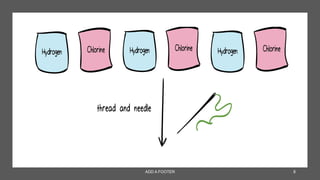
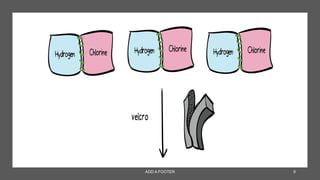
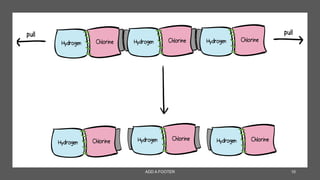
This document discusses different types of forces in physics and chemistry. In physics, a force requires an interaction between objects and can result in motion. There are two types of forces: contact and non-contact. In chemistry, forces can be either intramolecular, within elements combined, or intermolecular, between combined elements. Intramolecular forces include ionic bonding, covalent bonding, and metallic bonding. Intermolecular forces include dipole-dipole interactions, hydrogen bonding, and London dispersion forces. These intermolecular forces influence physical properties like melting point and boiling point.