GO-TO-MARKET
STRATEGY
BWC-2014
90 DAY GTM ACTION PLAN
1. Identify and document internal go-to-market activities, beliefs
and priorities

2. Conduct market and customer analysis
3. Conduct go-to-market competitive analysis
4. Assess findings; go-to-market options, limitations and priorities
5. Review conclusion with set holders and set direction
6. Develop 12-15 month go-to-market implementation plan
1. IDENTIFY AND DOCUMENT INTERNAL
GO-TO-MARKET ACTIVITIES, BELIEFS
AND PRIORITIES
•
•
•
•
•

Markets
Customers
Products
Channels
Value proposition
MARKETS
1. Product markets today? (Geographical, verticals
- product/services)
2. Future market/segments targeting and why?
3. Any markets we are planning to exit, why?
CUSTOMERS
1. Why existing customers do business with us?
2. How do they do business with us?
3. How well do we understand their needs?

4. Feedback/advise received from customers
on our product/strategy?
5. Future customer/accounts definition
PRODUCTS
1. Current product offerings ?
2. Best selling offerings?
3. Least selling offerings?
4. Customer’s demand towards product/offering?
5. Future direction for product/offerings
CHANNELS
1. Existing market coverage strategy
(channels/products/customers)?
2. SWOT analysis of current approach
3. Future channel strategy for new markets
MESSAGE
1. Value proposition for customers/markets?
2. Product promotion strategy
3. Sales pitch effectiveness in current and future scenario
4. Research behind current sales pitch
2. CONDUCT MARKET AND CUSTOMER
ANALYSIS
Four Basic pitfall of target marketing you want to avoid
• Chasing untried and unproven “Blue Sky” markets
• Putting too much weight on third party market research reports
• Assuming a growing market or big market will be good for your product
• Ignoring crucial internal sources of information when evaluating new markets
SIX-STEP PROCESS FOR TARGETING NEW MARKETS
• 1. Develop universe of markets :
Define potential new markets based on geographic, vertical, horizontal or customer
base.

Eliminate bad apples using3 simple steps
• A.

No need for Product or Services

• B.

Prohibitive entry Costs

• C.

Legal or regulatory restrictions

Divide list into smaller sub-markets/segments for precise targeting
SIX-STEP PROCESS FOR TARGETING NEW MARKETS
• 2. Choose Market evaluation criteria
a. Market Size
b. Market growth rate
c. Brand leadership
d. Cost of market entry
e. Cost to serve

f. Channel availability
g. Competition density
h. Strategic fit
SIX-STEP PROCESS FOR TARGETING NEW MARKETS
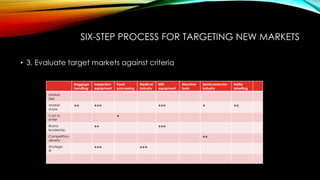
• 3. Evaluate target markets against criteria
Baggage
handling

Inspection
equipment

**

Food
processing

Medical
Industry

***

MRI
equipment

Machine
tools

Semiconductor
industry

Bottle
labelling

*

**

Market
Size
Market
share

*

Cost to
enter
Brand
leadership

***

**

***
**

Competition
density
Strategic
fit

***

***
SIX-STEP PROCESS FOR TARGETING NEW MARKETS
• 4. Validate markets with key prospects :
Interview with key prospects in each
potential markets to ensure that there
is strong buying interest and demand
for your product offering
SIX-STEP PROCESS FOR TARGETING NEW MARKETS
• 5. Prioritize markets for penetration:
•
•
•
•

Immediate sales opportunities
Reach using existing channels/partners
Entail low startup costs
Lesser market hassls

• 6. Fine tune markets over time : Revisit assumptions
CUSTOMER ANALYSIS
• Customer needs
• Customer experience

• Customer buying behavior
• Strengths and weaknesses
• Sources of new business
3. CONDUCT GO-TO-MARKET
COMPETITIVE ANALYSIS
• Analyze market targeting, segmentation and penetration efforts of your
leading competitors by focusing on their
Markets and customers
channel usage
Market coverage model
GTM results
4. ASSESS FINDINGS; GO-TO-MARKET
OPTIONS, LIMITATIONS AND PRIORITIES
• A. Identify the best GTM opportunities
• Define best new opportunities to drive sales?
• Identify markets/segments to achieve short-term wins/long-term customer
penetration?
• Identify customers ready to do business?
• Locate effective channels to serve customers?

• B. Identify GMT limitations
• Which products/markets/channels are NO from management’s perspective
• Identify markets with unacceptable entry costs
• Identify products, services or solutions failing to generate interest
ASSESS FINDINGS; GO-TO-MARKET
OPTIONS, LIMITATIONS AND PRIORITIES
• C. Develop new GTM scenarios
• A Go-to-market scenario is a complete package of market, customer, channel,
product and value proposition

• D. Develop a business case for your top GTM scenarios
• Impact on profits, markets share, sales, time and resource requirements
5. REVIEW CONCLUSION WITH SET
HOLDERS AND SET DIRECTION
• Overview: purpose and scope of initiative
• Major findings from GTM analysis covering markets, customers and
competition
• Overall assessment of market situation, opportunities and priorities
• Discuss each GTM scenarios and impact on customers, products, markets
and value proposition
6. DEVELOP 12-15 MONTH GO-TOMARKET IMPLEMENTATION PLAN
Battle Metaphor for new business development
Select Targets
Create and deploy weapons
Plan and execute the attack
Thank you
Sam Aghi

Bwc gtm

  • 1.
  • 2.
    90 DAY GTMACTION PLAN 1. Identify and document internal go-to-market activities, beliefs and priorities 2. Conduct market and customer analysis 3. Conduct go-to-market competitive analysis 4. Assess findings; go-to-market options, limitations and priorities 5. Review conclusion with set holders and set direction 6. Develop 12-15 month go-to-market implementation plan
  • 3.
    1. IDENTIFY ANDDOCUMENT INTERNAL GO-TO-MARKET ACTIVITIES, BELIEFS AND PRIORITIES • • • • • Markets Customers Products Channels Value proposition
  • 4.
    MARKETS 1. Product marketstoday? (Geographical, verticals - product/services) 2. Future market/segments targeting and why? 3. Any markets we are planning to exit, why?
  • 5.
    CUSTOMERS 1. Why existingcustomers do business with us? 2. How do they do business with us? 3. How well do we understand their needs? 4. Feedback/advise received from customers on our product/strategy? 5. Future customer/accounts definition
  • 6.
    PRODUCTS 1. Current productofferings ? 2. Best selling offerings? 3. Least selling offerings? 4. Customer’s demand towards product/offering? 5. Future direction for product/offerings
  • 7.
    CHANNELS 1. Existing marketcoverage strategy (channels/products/customers)? 2. SWOT analysis of current approach 3. Future channel strategy for new markets
  • 8.
    MESSAGE 1. Value propositionfor customers/markets? 2. Product promotion strategy 3. Sales pitch effectiveness in current and future scenario 4. Research behind current sales pitch
  • 9.
    2. CONDUCT MARKETAND CUSTOMER ANALYSIS Four Basic pitfall of target marketing you want to avoid • Chasing untried and unproven “Blue Sky” markets • Putting too much weight on third party market research reports • Assuming a growing market or big market will be good for your product • Ignoring crucial internal sources of information when evaluating new markets
  • 10.
    SIX-STEP PROCESS FORTARGETING NEW MARKETS • 1. Develop universe of markets : Define potential new markets based on geographic, vertical, horizontal or customer base. Eliminate bad apples using3 simple steps • A. No need for Product or Services • B. Prohibitive entry Costs • C. Legal or regulatory restrictions Divide list into smaller sub-markets/segments for precise targeting
  • 11.
    SIX-STEP PROCESS FORTARGETING NEW MARKETS • 2. Choose Market evaluation criteria a. Market Size b. Market growth rate c. Brand leadership d. Cost of market entry e. Cost to serve f. Channel availability g. Competition density h. Strategic fit
  • 12.
    SIX-STEP PROCESS FORTARGETING NEW MARKETS • 3. Evaluate target markets against criteria Baggage handling Inspection equipment ** Food processing Medical Industry *** MRI equipment Machine tools Semiconductor industry Bottle labelling * ** Market Size Market share * Cost to enter Brand leadership *** ** *** ** Competition density Strategic fit *** ***
  • 13.
    SIX-STEP PROCESS FORTARGETING NEW MARKETS • 4. Validate markets with key prospects : Interview with key prospects in each potential markets to ensure that there is strong buying interest and demand for your product offering
  • 14.
    SIX-STEP PROCESS FORTARGETING NEW MARKETS • 5. Prioritize markets for penetration: • • • • Immediate sales opportunities Reach using existing channels/partners Entail low startup costs Lesser market hassls • 6. Fine tune markets over time : Revisit assumptions
  • 15.
    CUSTOMER ANALYSIS • Customerneeds • Customer experience • Customer buying behavior • Strengths and weaknesses • Sources of new business
  • 16.
    3. CONDUCT GO-TO-MARKET COMPETITIVEANALYSIS • Analyze market targeting, segmentation and penetration efforts of your leading competitors by focusing on their Markets and customers channel usage Market coverage model GTM results
  • 17.
    4. ASSESS FINDINGS;GO-TO-MARKET OPTIONS, LIMITATIONS AND PRIORITIES • A. Identify the best GTM opportunities • Define best new opportunities to drive sales? • Identify markets/segments to achieve short-term wins/long-term customer penetration? • Identify customers ready to do business? • Locate effective channels to serve customers? • B. Identify GMT limitations • Which products/markets/channels are NO from management’s perspective • Identify markets with unacceptable entry costs • Identify products, services or solutions failing to generate interest
  • 18.
    ASSESS FINDINGS; GO-TO-MARKET OPTIONS,LIMITATIONS AND PRIORITIES • C. Develop new GTM scenarios • A Go-to-market scenario is a complete package of market, customer, channel, product and value proposition • D. Develop a business case for your top GTM scenarios • Impact on profits, markets share, sales, time and resource requirements
  • 19.
    5. REVIEW CONCLUSIONWITH SET HOLDERS AND SET DIRECTION • Overview: purpose and scope of initiative • Major findings from GTM analysis covering markets, customers and competition • Overall assessment of market situation, opportunities and priorities • Discuss each GTM scenarios and impact on customers, products, markets and value proposition
  • 20.
    6. DEVELOP 12-15MONTH GO-TOMARKET IMPLEMENTATION PLAN Battle Metaphor for new business development Select Targets Create and deploy weapons Plan and execute the attack Thank you Sam Aghi