for Leveraging Changes
in the Incentive
Compensation Plan Process
Tips
5  

Overview
In today’s business environment the only constant is rapid change. Sales
compensation plans are one of the most powerful tools an organization has to
influence sales behaviors and improve sales performance. That is why it is so critical
than an enterprise is agile enough to rapidly adapt to changes in the organization,
market or competitive landscape.
Studies consistently prove incentive compensation has the strongest and most
immediate impact on selling behaviors. Agile sales organizations can create
competitive advantage when they are able to rapidly design and roll out adjustments
to incentive compensation plans in reaction to competitive threats, new products,
or market changes.
The following tips, derived from a long-term study of the incentive compensation
management, reflect the best cross-
industry practices for profiting from
the ability to manage change in the
incentive compensation plan process.
WWW.SYNYGY.COMCopyright © 2015 Synygy. All rights reserved.
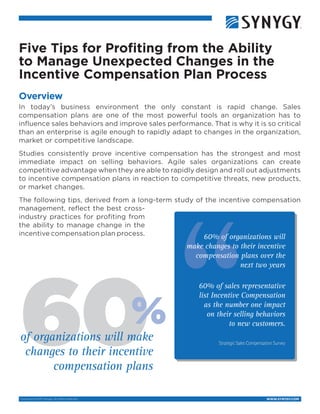
60%of organizations will make
changes to their incentive
compensation plans
Strategic Sales Compensation Survey
60% of organizations will
make changes to their incentive
compensation plans over the
next two years
60% of sales representative
list Incentive Compensation
as the number one impact
on their selling behaviors
to new customers.
Five Tips for Profiting from the Ability
to Manage Unexpected Changes in the
Incentive Compensation Plan Process
WWW.SYNYGY.COMCopyright © 2015 Synygy. All rights reserved.
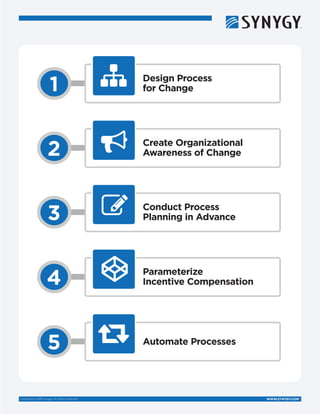
1 Design Process
for Change

2 Create Organizational
Awareness of Change

3 Conduct Process
Planning in Advance

4 Parameterize
Incentive Compensation

5 Automate Processes
Copyright © 2015 Synygy. All rights reserved. WWW.SYNYGY.COM
Anticipate the kinds of incentive
compensation changes you might make in
the future and design processes that can
adapt to those changes.
Incentive compensation plans—even the best of plans—change frequently. While
making plan changes on a whim is not advisable, neither is holding compensation
plans constant and ignoring the dynamics of business reality. In most cases,
incentive compensation plans will change moderately or significantly with
an organization’s annual planning cycle. On a more frequent basis, incentive
compensation plans will—or at least should—change during a year if the plan is
not meeting business goals or driving desired behaviors in the sales organization.
One of the key mistakes in automating incentive compensation management
processes is an unspoken assumption that the plans being implemented are
going to remain in place throughout the year—or even over multiple years.
Those people responsible for implementing and managing plans often try to fit a
“perfect plan” into a “perfect system” without regard to possible change, which
usually results in an inability to easily adapt to a changing business climate.
When designing processes around the management of incentive compensation
plans, it is best to exhaust a series of “what-ifs” through a variety of scenarios. On
the plans themselves, some questions to ask are:
•	 What kinds of plan rules lend themselves to frequent exceptions?
•	 What kinds of exceptions are valid?
•	 Are the processes being designed to handle exceptions?
•	 Are there new plan rules that management considers tentative
and likely to change?
•	 Are there alternate plan rules or measures that might be considered if
current plan rules or measures fail?
Finally, beyond the compensation plans themselves, it is important to anticipate
changes in other processes and systems that may impact the design of current
incentive compensation management processes. For example, if a new HRIS
system is being implemented that changes the format of a salesperson’s unique
identifier, it may impact the ability of the current compensation management
process to appropriately credit a transaction to a sales person.
To be successful, organizations need to identify, address, and plan for potential
incentive compensation plan and process changes prior to beginning a plan
implementation and process automation effort.
Design
Process for
Change1 
WWW.SYNYGY.COMCopyright © 2015 Synygy. All rights reserved.
Have a clearly-defined change management
process and create organizational awareness
of change timelines and the impact of
missing deadlines.
Changes in incentive compensation plans and incentive compensation
management processes are fully expected. Yet, at many organizations, when
it comes time to implement these changes, the organization faces significant
challenges for a variety of reasons, all of which lead to chaos, delays, and worse.
One important part of being able to adapt to change is having a clearly-defined
change management process. This includes having thorough checklists and a
master plan for making changes. It also includes published timelines for data
processing and workflow procedures and having a well-defined and documented
escalation procedure that describes how various changes should be brought to
the attention of the appropriate levels of management.
Another key to being able to successfully adapt to change is managing
organizational expectations about the kinds of changes that can be made,
including individual salesperson exceptions from field sales management.
This can be accomplished by communicating a timeline for different kinds of
changes, “blackout” dates after which changes will not be accepted, and the
impact of not meeting the deadlines. Such communications will help you instill
an organizational discipline around change management.
Whether a change is a simple matter of re-crediting of a transaction or whether
a change involved more complex structural changes in data or systems, it is
important to plan for a range of such changes in the processes for managing
incentive compensation plans.
It’s also important to plan for occasional extreme cases, where management
might determine that it is better that sales commission results—and payments—
are delayed so that desired changes can be implemented. When this is the case,
make sure that salespeople understand the reason for the delay and what is
being done to avoid similar situations in the future.
Conduct a process planning session in
advance of each processing cycle to plan for
both known and unknown issues.
Whether daily, weekly, monthly, or quarterly, every organization has a cycle
for calculating and communicating incentive compensation results. For this
processing cycle to be most effective, proper planning is needed to prepare for
both known and unknown issues to minimize the risks of these issues causing
delays and errors. This preparation should include time for adequate planning,
data validation, and results checking.
Conduct
Process
Planning in
Advance
3 
Create
Organizational
Awareness of
Change
2 
WWW.SYNYGY.COMCopyright © 2015 Synygy. All rights reserved.
One example of a major challenge in the incentive compensation processing
cycle is when data from prior periods are being processed along with the
current period because the prior period cannot yet be closed out for some
reason. When this occurs, sales crediting quickly turns into a tangled mess of
confusions over which transactions should be credited for which period.
There are many other examples of why planning prior to a process cycle is
critical to success, including late data feeds from necessary data sources,
additional batches of manual data, and the demand for additional processing
cycles to facilitate an iterative review process.
If successful, the process planning session—which typically involves a team of
people across several functions—should identify issues to discuss and resolve
prior to the start of the processing cycle so that the issues don’t become
problems in the middle of the cycle.
Parameterize your incentive compensation
management system so that the majority
of changes can be made without
reconfiguring the system.
For most organizations today, words like “hard-coded”, “manual,” and “can’t” are
frequently heard in conversations related to incentive compensation management.
These words are indicative of an inability to easily adapt to change—which is a key
requirement of any incentive compensation management system and processes.
The key to eliminating these words from your organization’s vocabulary is paying
careful attention to the up-front design and the redesign of processes to eliminate
hard-coded, inflexible programs and manual, labor-intensive processes.
One way that this is accomplished is by analyzing the various incentive
compensation plans for structurally similar rules and figuring out how to use
parameters to simplify processes and eliminate hard coding. Such parameters
might include such things as date ranges, field lengths, and input capabilities.
Another way to use parameters is to figure out how tables of data about aspects
of each salesperson, sales team, and other sales entities—including exceptions—
can be used to further eliminate hard-coded rules. These data tables need to
include the effective dating of each parameter to automatically apply the correct
values to the correct processing cycle.
With good parameterization, it is not just faster and easier to make future plan
changes. It also results in improved accuracy and many other related benefits.
Parameterize
Incentive
Compensation4 
WWW.SYNYGY.COMCopyright © 2015 Synygy. All rights reserved.
    
Automate
Processes5  Automate all major processes to free up
time for your staff to handle exceptions,
research and fix problems, and make
unexpected changes.
Many systems and processes used to manage incentive compensation
grow organically and are touched by many hands over the years. As a
result, organizations end up with an inconsistent patchwork of manual,
labor-intensive processes that increase the risks of delays and inaccuracies.
It is common that a compensation analyst might spend a whole day sifting
through reports to find data about additions or deletions to the sales force,
errors in data inputs, inaccurate record counts, uncertain transaction splits, and
disparate codes and unique identifiers that don’t match transaction records.
The key to finding and fixing problems fast is designing automated processes
to do what compensation analysts have traditionally done. As more of these
processes are automated, the role of the analyst shifts from a mere maintainer
of the system to a proactive business partner who can design and automate
new processes and give the organization a greater ability to adapt to change
to unexpected changes.
Automating processes requires discipline throughout the organization and
sometimes means slowing down before speeding up. In the end however, being
relentless about process automation has a long-term payoff. With process
automation, compensation analysts can spend more time dealing with complex
issues such as integrating company acquisitions and expanding or restructuring
sales forces—and transforming incentive compensation management from an
operational hassle into a strategic tool for driving revenue.
WWW.SYNYGY.COMCopyright © 2015 Synygy. All rights reserved.
ABOUT SYNYGY
Synygy provides Sales Performance Management as a Service
TM
.
This enables sales organizations to
rapidly adapt to changes in strategy, markets, and priorities. We do this by combining business process
outsourcing and cloud technology, which makes change a simple and routine part of sales incentive
compensation management, sales operations management, and sales performance management.
See our full Incentive Compensation Expert Tip series
Or contact us directly to speak with one of our Consultants.
info@synygy.com
+1 610.494.3300 x7900
LEVERAGING CHANGE TO IMPROVE OUTCOMES
As the pace of change accelerates many organizations are finding it increasingly challenging to
drive sales performance effectively through in-house people, processes, or technology. If you are
struggling to keep up with changes in strategy, markets, or priorities and drive sales performance,
we invite you to contact us for further discussion on methods for implementing these tips in your
organization and examples of how Synygy’s agile sales performance has improved the outcomes
of hundreds of the world’s largest organizations.
Share!
Follow us on Social Media
PRODUCING BETTER BUSINESS OUTCOMES
Based on client evaluations spanning more than two decades Sales Performance
Management as a Service (SPMaaS) clients report better business outcomes
compared to SPM Software clients in all ten measured categories.
greatest impact:
ABILITY TO ADAPT
TO CHANGE
15%Better
Process
Reliability 13%
Cost Savings

5 Tips for Leveraging Change in Incentive Compensation Plan Process

  • 1.
    for Leveraging Changes inthe Incentive Compensation Plan Process Tips 5   
  • 2.
    Overview In today’s businessenvironment the only constant is rapid change. Sales compensation plans are one of the most powerful tools an organization has to influence sales behaviors and improve sales performance. That is why it is so critical than an enterprise is agile enough to rapidly adapt to changes in the organization, market or competitive landscape. Studies consistently prove incentive compensation has the strongest and most immediate impact on selling behaviors. Agile sales organizations can create competitive advantage when they are able to rapidly design and roll out adjustments to incentive compensation plans in reaction to competitive threats, new products, or market changes. The following tips, derived from a long-term study of the incentive compensation management, reflect the best cross- industry practices for profiting from the ability to manage change in the incentive compensation plan process. WWW.SYNYGY.COMCopyright © 2015 Synygy. All rights reserved. 60%of organizations will make changes to their incentive compensation plans Strategic Sales Compensation Survey 60% of organizations will make changes to their incentive compensation plans over the next two years 60% of sales representative list Incentive Compensation as the number one impact on their selling behaviors to new customers. Five Tips for Profiting from the Ability to Manage Unexpected Changes in the Incentive Compensation Plan Process
  • 3.
    WWW.SYNYGY.COMCopyright © 2015Synygy. All rights reserved. 1 Design Process for Change  2 Create Organizational Awareness of Change  3 Conduct Process Planning in Advance  4 Parameterize Incentive Compensation  5 Automate Processes
  • 4.
    Copyright © 2015Synygy. All rights reserved. WWW.SYNYGY.COM Anticipate the kinds of incentive compensation changes you might make in the future and design processes that can adapt to those changes. Incentive compensation plans—even the best of plans—change frequently. While making plan changes on a whim is not advisable, neither is holding compensation plans constant and ignoring the dynamics of business reality. In most cases, incentive compensation plans will change moderately or significantly with an organization’s annual planning cycle. On a more frequent basis, incentive compensation plans will—or at least should—change during a year if the plan is not meeting business goals or driving desired behaviors in the sales organization. One of the key mistakes in automating incentive compensation management processes is an unspoken assumption that the plans being implemented are going to remain in place throughout the year—or even over multiple years. Those people responsible for implementing and managing plans often try to fit a “perfect plan” into a “perfect system” without regard to possible change, which usually results in an inability to easily adapt to a changing business climate. When designing processes around the management of incentive compensation plans, it is best to exhaust a series of “what-ifs” through a variety of scenarios. On the plans themselves, some questions to ask are: • What kinds of plan rules lend themselves to frequent exceptions? • What kinds of exceptions are valid? • Are the processes being designed to handle exceptions? • Are there new plan rules that management considers tentative and likely to change? • Are there alternate plan rules or measures that might be considered if current plan rules or measures fail? Finally, beyond the compensation plans themselves, it is important to anticipate changes in other processes and systems that may impact the design of current incentive compensation management processes. For example, if a new HRIS system is being implemented that changes the format of a salesperson’s unique identifier, it may impact the ability of the current compensation management process to appropriately credit a transaction to a sales person. To be successful, organizations need to identify, address, and plan for potential incentive compensation plan and process changes prior to beginning a plan implementation and process automation effort. Design Process for Change1 
  • 5.
    WWW.SYNYGY.COMCopyright © 2015Synygy. All rights reserved. Have a clearly-defined change management process and create organizational awareness of change timelines and the impact of missing deadlines. Changes in incentive compensation plans and incentive compensation management processes are fully expected. Yet, at many organizations, when it comes time to implement these changes, the organization faces significant challenges for a variety of reasons, all of which lead to chaos, delays, and worse. One important part of being able to adapt to change is having a clearly-defined change management process. This includes having thorough checklists and a master plan for making changes. It also includes published timelines for data processing and workflow procedures and having a well-defined and documented escalation procedure that describes how various changes should be brought to the attention of the appropriate levels of management. Another key to being able to successfully adapt to change is managing organizational expectations about the kinds of changes that can be made, including individual salesperson exceptions from field sales management. This can be accomplished by communicating a timeline for different kinds of changes, “blackout” dates after which changes will not be accepted, and the impact of not meeting the deadlines. Such communications will help you instill an organizational discipline around change management. Whether a change is a simple matter of re-crediting of a transaction or whether a change involved more complex structural changes in data or systems, it is important to plan for a range of such changes in the processes for managing incentive compensation plans. It’s also important to plan for occasional extreme cases, where management might determine that it is better that sales commission results—and payments— are delayed so that desired changes can be implemented. When this is the case, make sure that salespeople understand the reason for the delay and what is being done to avoid similar situations in the future. Conduct a process planning session in advance of each processing cycle to plan for both known and unknown issues. Whether daily, weekly, monthly, or quarterly, every organization has a cycle for calculating and communicating incentive compensation results. For this processing cycle to be most effective, proper planning is needed to prepare for both known and unknown issues to minimize the risks of these issues causing delays and errors. This preparation should include time for adequate planning, data validation, and results checking. Conduct Process Planning in Advance 3  Create Organizational Awareness of Change 2 
  • 6.
    WWW.SYNYGY.COMCopyright © 2015Synygy. All rights reserved. One example of a major challenge in the incentive compensation processing cycle is when data from prior periods are being processed along with the current period because the prior period cannot yet be closed out for some reason. When this occurs, sales crediting quickly turns into a tangled mess of confusions over which transactions should be credited for which period. There are many other examples of why planning prior to a process cycle is critical to success, including late data feeds from necessary data sources, additional batches of manual data, and the demand for additional processing cycles to facilitate an iterative review process. If successful, the process planning session—which typically involves a team of people across several functions—should identify issues to discuss and resolve prior to the start of the processing cycle so that the issues don’t become problems in the middle of the cycle. Parameterize your incentive compensation management system so that the majority of changes can be made without reconfiguring the system. For most organizations today, words like “hard-coded”, “manual,” and “can’t” are frequently heard in conversations related to incentive compensation management. These words are indicative of an inability to easily adapt to change—which is a key requirement of any incentive compensation management system and processes. The key to eliminating these words from your organization’s vocabulary is paying careful attention to the up-front design and the redesign of processes to eliminate hard-coded, inflexible programs and manual, labor-intensive processes. One way that this is accomplished is by analyzing the various incentive compensation plans for structurally similar rules and figuring out how to use parameters to simplify processes and eliminate hard coding. Such parameters might include such things as date ranges, field lengths, and input capabilities. Another way to use parameters is to figure out how tables of data about aspects of each salesperson, sales team, and other sales entities—including exceptions— can be used to further eliminate hard-coded rules. These data tables need to include the effective dating of each parameter to automatically apply the correct values to the correct processing cycle. With good parameterization, it is not just faster and easier to make future plan changes. It also results in improved accuracy and many other related benefits. Parameterize Incentive Compensation4 
  • 7.
    WWW.SYNYGY.COMCopyright © 2015Synygy. All rights reserved.      Automate Processes5  Automate all major processes to free up time for your staff to handle exceptions, research and fix problems, and make unexpected changes. Many systems and processes used to manage incentive compensation grow organically and are touched by many hands over the years. As a result, organizations end up with an inconsistent patchwork of manual, labor-intensive processes that increase the risks of delays and inaccuracies. It is common that a compensation analyst might spend a whole day sifting through reports to find data about additions or deletions to the sales force, errors in data inputs, inaccurate record counts, uncertain transaction splits, and disparate codes and unique identifiers that don’t match transaction records. The key to finding and fixing problems fast is designing automated processes to do what compensation analysts have traditionally done. As more of these processes are automated, the role of the analyst shifts from a mere maintainer of the system to a proactive business partner who can design and automate new processes and give the organization a greater ability to adapt to change to unexpected changes. Automating processes requires discipline throughout the organization and sometimes means slowing down before speeding up. In the end however, being relentless about process automation has a long-term payoff. With process automation, compensation analysts can spend more time dealing with complex issues such as integrating company acquisitions and expanding or restructuring sales forces—and transforming incentive compensation management from an operational hassle into a strategic tool for driving revenue.
  • 8.
    WWW.SYNYGY.COMCopyright © 2015Synygy. All rights reserved. ABOUT SYNYGY Synygy provides Sales Performance Management as a Service TM . This enables sales organizations to rapidly adapt to changes in strategy, markets, and priorities. We do this by combining business process outsourcing and cloud technology, which makes change a simple and routine part of sales incentive compensation management, sales operations management, and sales performance management. See our full Incentive Compensation Expert Tip series Or contact us directly to speak with one of our Consultants. info@synygy.com +1 610.494.3300 x7900 LEVERAGING CHANGE TO IMPROVE OUTCOMES As the pace of change accelerates many organizations are finding it increasingly challenging to drive sales performance effectively through in-house people, processes, or technology. If you are struggling to keep up with changes in strategy, markets, or priorities and drive sales performance, we invite you to contact us for further discussion on methods for implementing these tips in your organization and examples of how Synygy’s agile sales performance has improved the outcomes of hundreds of the world’s largest organizations. Share! Follow us on Social Media PRODUCING BETTER BUSINESS OUTCOMES Based on client evaluations spanning more than two decades Sales Performance Management as a Service (SPMaaS) clients report better business outcomes compared to SPM Software clients in all ten measured categories. greatest impact: ABILITY TO ADAPT TO CHANGE 15%Better Process Reliability 13% Cost Savings