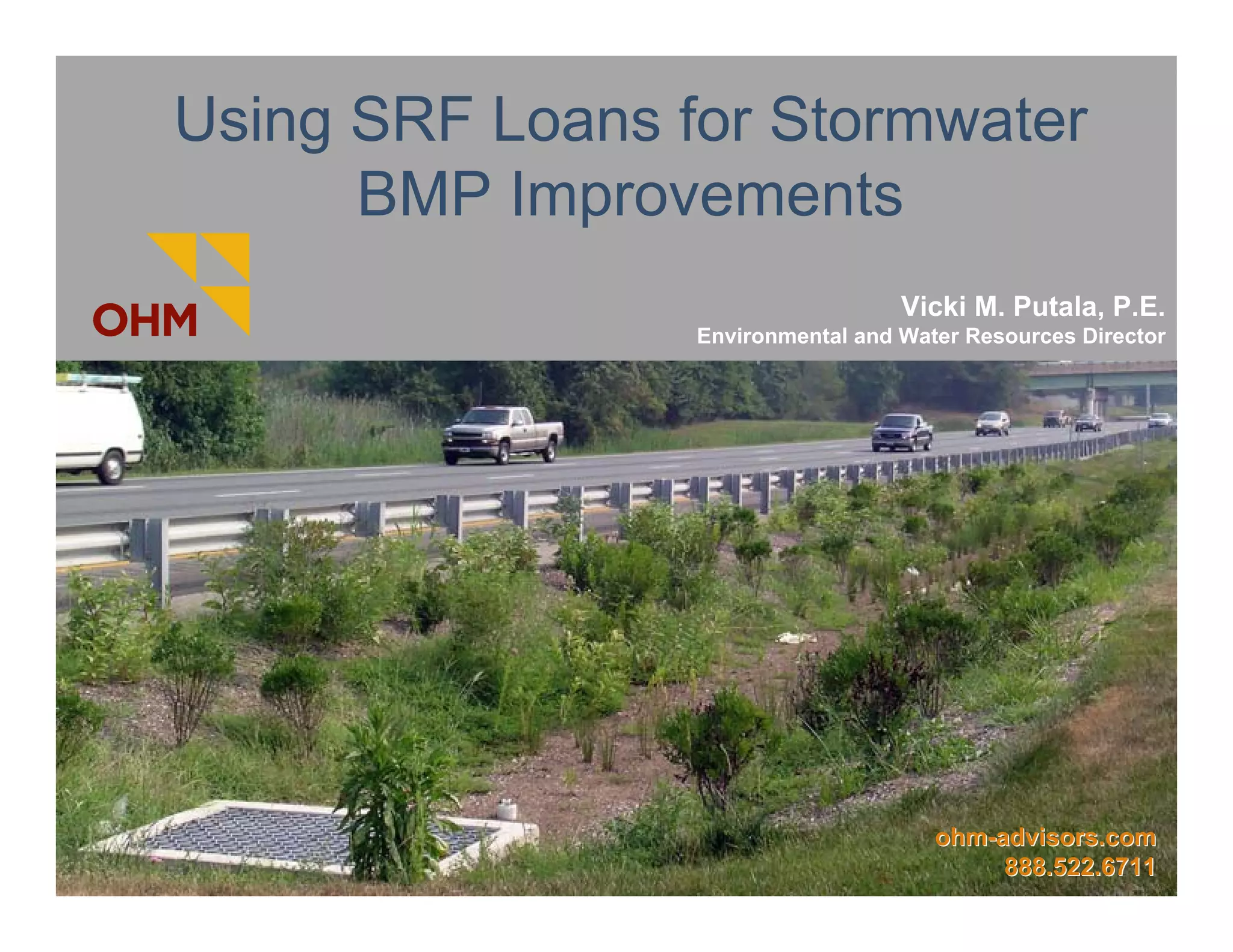

Using SRF Loans for Stormwater
      BMP Improvements
                                   Vicki M. Putala, P.E.
                 Environmental and Water Resources Director


                                      ohm-advisors.com
                                           888.522.6711
Presentation Overview
•   Value of Stormwater BMPs
•   Common Types of Stormwater BMPs
•   Example Nonpoint Source SRF Projects
     • Allens Creek Pioneer High School
     • Auburn Hills City Retrofit
     • Auburn Hills Galloway Creek

•   Maintenance Considerations
•   Funding Stormwater BMPs
•   Tips for Moving Forward
EPA’s Definition of a Stormwater
BMP
A BMP is a technique, process, activity or structure used to
reduce the pollutant content of a stormwater discharge.

BMPs include structural modifications, such as the
installation of bioretention. BMPs are most effective when
used in combination with each other, and customized to
meet specific needs.

BMPs may also include simple nonstructural methods,
such as good housekeeping and preventive maintenance.
Value of Stormwater BMPs
• Reduces nonpoint source pollution


• Helps permittees comply with National Pollution Discharge
 Elimination System (NPDES) requirements

• Helps Meet Total Maximum Daily Load (TMDL) Objectives in
 Streams

• Improves Base Flow in Streams and Reduces Flashy
 Hydrology
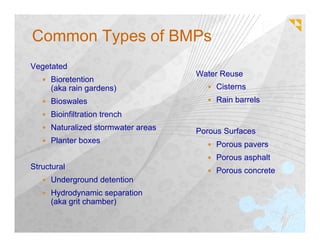
Common Types of BMPs
Vegetated
                                    Water Reuse
     Bioretention
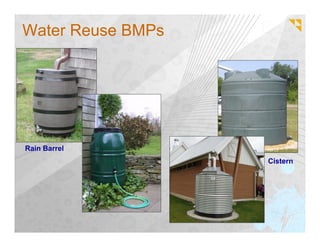
     (aka rain gardens)                  Cisterns
     Bioswales                           Rain barrels
     Bioinfiltration trench
     Naturalized stormwater areas   Porous Surfaces
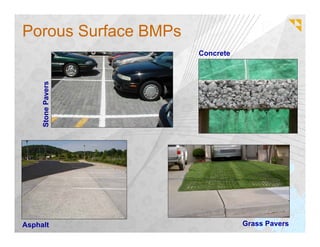
     Planter boxes                       Porous pavers
                                         Porous asphalt
Structural                               Porous concrete
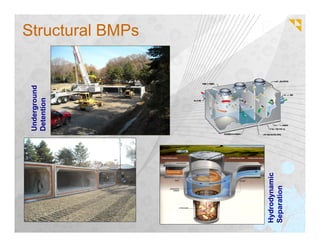
     Underground detention
     Hydrodynamic separation
     (aka grit chamber)
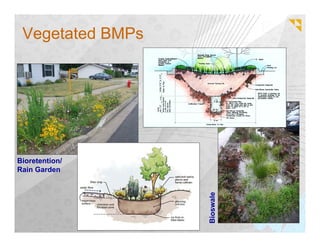
Vegetated BMPs


Bioretention/
Rain Garden


                  Bioswale
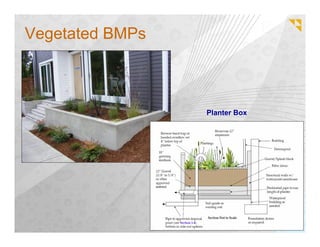
Vegetated BMPs


                 Planter Box
Underground
               Detention
                             Structural BMPs


Hydrodynamic
Separation
Water Reuse BMPs


Rain Barrel
                   Cistern
Porous Surface BMPs
                      Concrete
     Stone Pavers


Asphalt                          Grass Pavers
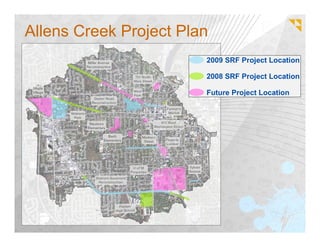
Allens Creek Project Plan
The project plan was originally submitted in
2008
  •Fivesites were identified for stormwater BMPs
  •Three road reconstruction and two retrofits


An amendment was submitted in 2009
  •Seven  sites were identified for stormwater BMPs
  •Five road reconstruction and two site retrofits
Allens Creek Project Plan
                        2009 SRF Project Location

                        2008 SRF Project Location

                        Future Project Location
Example #1: Pioneer High
School
Contributing Area: 308 acres (Allens Creek
watershed 3,360 acres)

Location: City of Ann Arbor

County Jurisdiction: Washtenaw County Water
Resources Commissioner – Janis Bobrin

Stakeholders: Washtenaw County, City of Ann
Arbor, Ann Arbor Public Schools, Allens Creek Advisory
Group & City residents
Example #1: Pioneer High
School
•Project Goal: Reduce total suspended solids,
     phosphorus and E.coli
•Two large underground detention basins with
     infiltration
  – 256,000 cubic feet of storage
  – 10% of stored volume infiltrated
•Hydrodynamic Separators (aka grit chambers)
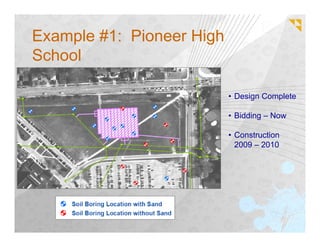
Example #1: Pioneer High
School

                           • Design Complete

                           • Bidding – Now

                           • Construction
                             2009 – 2010
Example #2: City Retrofits
Location: City of Auburn Hills

Stakeholders: City of Auburn Hills and the Clinton
River Watershed Council

Project Oversight: Shawn Keenan – Stormwater
Coordinator (City of Auburn Hills)

BMP Types: Rain gardens, water reuse cisterns,
planter boxes, vegetated filter strip, infiltration trench
and bioswale
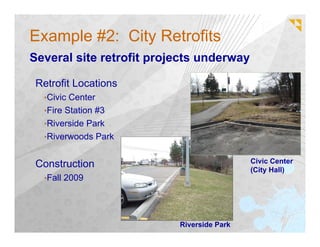
Example #2: City Retrofits
Several site retrofit projects underway

 Retrofit Locations
  •Civic Center
  •Fire Station #3
  •Riverside Park
  •Riverwoods Park


                                           Civic Center
 Construction                              (City Hall)
  •Fall 2009


                          Riverside Park
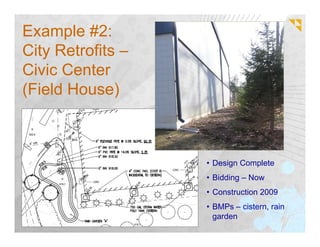
Example #2:
City Retrofits –
Civic Center
(Field House)


                   • Design Complete
                   • Bidding – Now
                   • Construction 2009
                   • BMPs – cistern, rain
                     garden
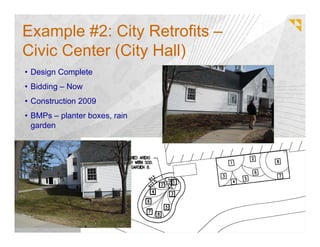
Example #2: City Retrofits –
Civic Center (City Hall)
• Design Complete
• Bidding – Now
• Construction 2009
• BMPs – planter boxes, rain
  garden
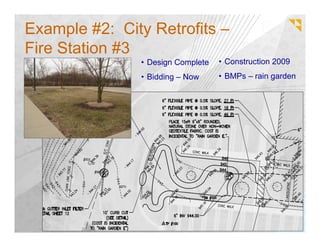
Example #2: City Retrofits –
Fire Station #3
               • Design Complete   • Construction 2009
               • Bidding – Now     • BMPs – rain garden
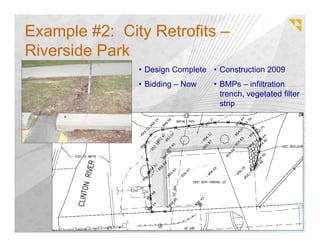
Example #2: City Retrofits –
Riverside Park
               • Design Complete • Construction 2009
               • Bidding – Now   • BMPs – infiltration
                                   trench, vegetated filter
                                   strip
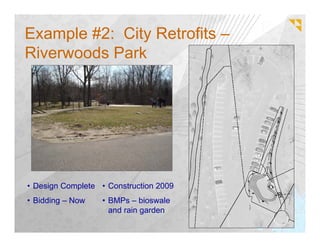
Example #2: City Retrofits –
Riverwoods Park


• Design Complete • Construction 2009
• Bidding – Now   • BMPs – bioswale
                    and rain garden
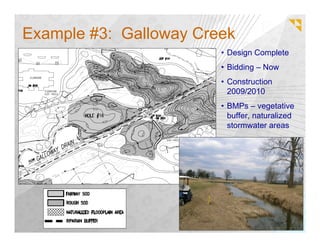
Example #3: Galloway Creek

Location: City of Auburn Hills

Stakeholders: City of Auburn Hills and the Clinton
River Watershed Council

Project Oversight: Shawn Keenan – Stormwater
Coordinator (City of Auburn Hills)

BMP Types: Streambank stabilization, vegetative
buffer and naturalized stormwater detention areas
Example #3: Galloway Creek
                        • Design Complete
                        • Bidding – Now
                        • Construction
                          2009/2010
                        • BMPs – vegetative
                          buffer, naturalized
                          stormwater areas
Maintenance Considerations
 Bioretention/Rain Gardens
  – Biannual weeding
  – Refresh plantings (if necessary)


 Porous concrete/asphalt
  – Annual vacuum sweeping


 Underground Detention/Hydrodynamic Separation
  – Annual inspection and vactoring
Funding Stormwater BMPs

Allens Creek Drainage District is made up of three
entities: City of Ann Arbor, MDOT and Washtenaw
County. The City’s share of the loan is paid from an
existing stormwater utility fee.

City of Auburn Hills will pay back the loan through
their General Fund.
Tips for Moving Forward
Find partners and build a team
 – Local schools
 – Watershed groups
 – Neighborhood groups
 – Local businesses and /or developers


Determine opportune locations within your community
 – Make use of all spatial data (GIS data)
 – Consider upcoming capital improvements projects or
     redevelopment

Identify regional alternatives or site specific
 – Consider large scale or suites of BMPs
Tips for Moving Forward
Gentle/Flat Slopes for Porous Pavement
  – Should be less than 5%


Low/moderate Traffic Volumes
  – Porous surfaces work best on low volume roads and/or parking
   areas

Infiltrating Soils
  – Preferably NRCS hydrologic groups A, B or C
  – When poor soils exist (group D) soil amendments and underdrains
   may be necessary

Salt and Sand Usage
  – Vegetated BMPs must be planted with salt torrent species when
   receiving road runoff
  – Sand usage is discouraged on porous roadways due to increased
   potential for void space clogging
Tips for Moving Forward
Eligibility Criteria
 – Must meet goals identified in a state approved watershed
   management plan (CMI or 319)
 – Must achieve nonpoint source pollution reduction

Public Involvement

SRF application through Project Plan (due annually by July 1st)
 – Project Plan can identify proposed and future projects

 – Work with MDEQ early in planning phase especially in determining
   project eligibility
 – Project Plan must quantify pollution reduction and resulting cost-
   benefit analysis is helpful in prioritizing projects
Questions?
Vicki M. Putala, P.E.
vicki.putala@ohm-advisors.com
734-466-4479

Orchard, Hiltz & McCliment, Inc
34000 Plymouth Road
Livonia, MI 48150
www.ohm-advisors.com
888-522-6711

Stormwater Management Using State Revolving Funds

  • 1.
    Using SRF Loansfor Stormwater BMP Improvements Vicki M. Putala, P.E. Environmental and Water Resources Director ohm-advisors.com 888.522.6711
  • 2.
    Presentation Overview • Value of Stormwater BMPs • Common Types of Stormwater BMPs • Example Nonpoint Source SRF Projects • Allens Creek Pioneer High School • Auburn Hills City Retrofit • Auburn Hills Galloway Creek • Maintenance Considerations • Funding Stormwater BMPs • Tips for Moving Forward
  • 3.
    EPA’s Definition ofa Stormwater BMP A BMP is a technique, process, activity or structure used to reduce the pollutant content of a stormwater discharge. BMPs include structural modifications, such as the installation of bioretention. BMPs are most effective when used in combination with each other, and customized to meet specific needs. BMPs may also include simple nonstructural methods, such as good housekeeping and preventive maintenance.
  • 4.
    Value of StormwaterBMPs • Reduces nonpoint source pollution • Helps permittees comply with National Pollution Discharge Elimination System (NPDES) requirements • Helps Meet Total Maximum Daily Load (TMDL) Objectives in Streams • Improves Base Flow in Streams and Reduces Flashy Hydrology
  • 5.
    Common Types ofBMPs Vegetated Water Reuse Bioretention (aka rain gardens) Cisterns Bioswales Rain barrels Bioinfiltration trench Naturalized stormwater areas Porous Surfaces Planter boxes Porous pavers Porous asphalt Structural Porous concrete Underground detention Hydrodynamic separation (aka grit chamber)
  • 6.
  • 7.
    Vegetated BMPs Planter Box
  • 8.
    Underground Detention Structural BMPs Hydrodynamic Separation
  • 9.
    Water Reuse BMPs RainBarrel Cistern
  • 10.
    Porous Surface BMPs Concrete Stone Pavers Asphalt Grass Pavers
  • 11.
    Allens Creek ProjectPlan The project plan was originally submitted in 2008 •Fivesites were identified for stormwater BMPs •Three road reconstruction and two retrofits An amendment was submitted in 2009 •Seven sites were identified for stormwater BMPs •Five road reconstruction and two site retrofits
  • 12.
    Allens Creek ProjectPlan 2009 SRF Project Location 2008 SRF Project Location Future Project Location
  • 13.
    Example #1: PioneerHigh School Contributing Area: 308 acres (Allens Creek watershed 3,360 acres) Location: City of Ann Arbor County Jurisdiction: Washtenaw County Water Resources Commissioner – Janis Bobrin Stakeholders: Washtenaw County, City of Ann Arbor, Ann Arbor Public Schools, Allens Creek Advisory Group & City residents
  • 14.
    Example #1: PioneerHigh School •Project Goal: Reduce total suspended solids, phosphorus and E.coli •Two large underground detention basins with infiltration – 256,000 cubic feet of storage – 10% of stored volume infiltrated •Hydrodynamic Separators (aka grit chambers)
  • 15.
    Example #1: PioneerHigh School • Design Complete • Bidding – Now • Construction 2009 – 2010
  • 16.
    Example #2: CityRetrofits Location: City of Auburn Hills Stakeholders: City of Auburn Hills and the Clinton River Watershed Council Project Oversight: Shawn Keenan – Stormwater Coordinator (City of Auburn Hills) BMP Types: Rain gardens, water reuse cisterns, planter boxes, vegetated filter strip, infiltration trench and bioswale
  • 17.
    Example #2: CityRetrofits Several site retrofit projects underway Retrofit Locations •Civic Center •Fire Station #3 •Riverside Park •Riverwoods Park Civic Center Construction (City Hall) •Fall 2009 Riverside Park
  • 18.
    Example #2: City Retrofits– Civic Center (Field House) • Design Complete • Bidding – Now • Construction 2009 • BMPs – cistern, rain garden
  • 19.
    Example #2: CityRetrofits – Civic Center (City Hall) • Design Complete • Bidding – Now • Construction 2009 • BMPs – planter boxes, rain garden
  • 20.
    Example #2: CityRetrofits – Fire Station #3 • Design Complete • Construction 2009 • Bidding – Now • BMPs – rain garden
  • 21.
    Example #2: CityRetrofits – Riverside Park • Design Complete • Construction 2009 • Bidding – Now • BMPs – infiltration trench, vegetated filter strip
  • 22.
    Example #2: CityRetrofits – Riverwoods Park • Design Complete • Construction 2009 • Bidding – Now • BMPs – bioswale and rain garden
  • 23.
    Example #3: GallowayCreek Location: City of Auburn Hills Stakeholders: City of Auburn Hills and the Clinton River Watershed Council Project Oversight: Shawn Keenan – Stormwater Coordinator (City of Auburn Hills) BMP Types: Streambank stabilization, vegetative buffer and naturalized stormwater detention areas
  • 24.
    Example #3: GallowayCreek • Design Complete • Bidding – Now • Construction 2009/2010 • BMPs – vegetative buffer, naturalized stormwater areas
  • 25.
    Maintenance Considerations Bioretention/RainGardens – Biannual weeding – Refresh plantings (if necessary) Porous concrete/asphalt – Annual vacuum sweeping Underground Detention/Hydrodynamic Separation – Annual inspection and vactoring
  • 26.
    Funding Stormwater BMPs AllensCreek Drainage District is made up of three entities: City of Ann Arbor, MDOT and Washtenaw County. The City’s share of the loan is paid from an existing stormwater utility fee. City of Auburn Hills will pay back the loan through their General Fund.
  • 27.
    Tips for MovingForward Find partners and build a team – Local schools – Watershed groups – Neighborhood groups – Local businesses and /or developers Determine opportune locations within your community – Make use of all spatial data (GIS data) – Consider upcoming capital improvements projects or redevelopment Identify regional alternatives or site specific – Consider large scale or suites of BMPs
  • 28.
    Tips for MovingForward Gentle/Flat Slopes for Porous Pavement – Should be less than 5% Low/moderate Traffic Volumes – Porous surfaces work best on low volume roads and/or parking areas Infiltrating Soils – Preferably NRCS hydrologic groups A, B or C – When poor soils exist (group D) soil amendments and underdrains may be necessary Salt and Sand Usage – Vegetated BMPs must be planted with salt torrent species when receiving road runoff – Sand usage is discouraged on porous roadways due to increased potential for void space clogging
  • 29.
    Tips for MovingForward Eligibility Criteria – Must meet goals identified in a state approved watershed management plan (CMI or 319) – Must achieve nonpoint source pollution reduction Public Involvement SRF application through Project Plan (due annually by July 1st) – Project Plan can identify proposed and future projects – Work with MDEQ early in planning phase especially in determining project eligibility – Project Plan must quantify pollution reduction and resulting cost- benefit analysis is helpful in prioritizing projects
  • 30.
    Questions? Vicki M. Putala,P.E. vicki.putala@ohm-advisors.com 734-466-4479 Orchard, Hiltz & McCliment, Inc 34000 Plymouth Road Livonia, MI 48150 www.ohm-advisors.com 888-522-6711