Statistics 3 Confidence Intervals and the t - Distribution  - Lesson 1 - Key Learning Points/Vocabulary: The concept of a confidence intervals (notes). Calculating a 95% confidence interval for a sample drawn from a normal population of known variance. Calculating any confidence interval.
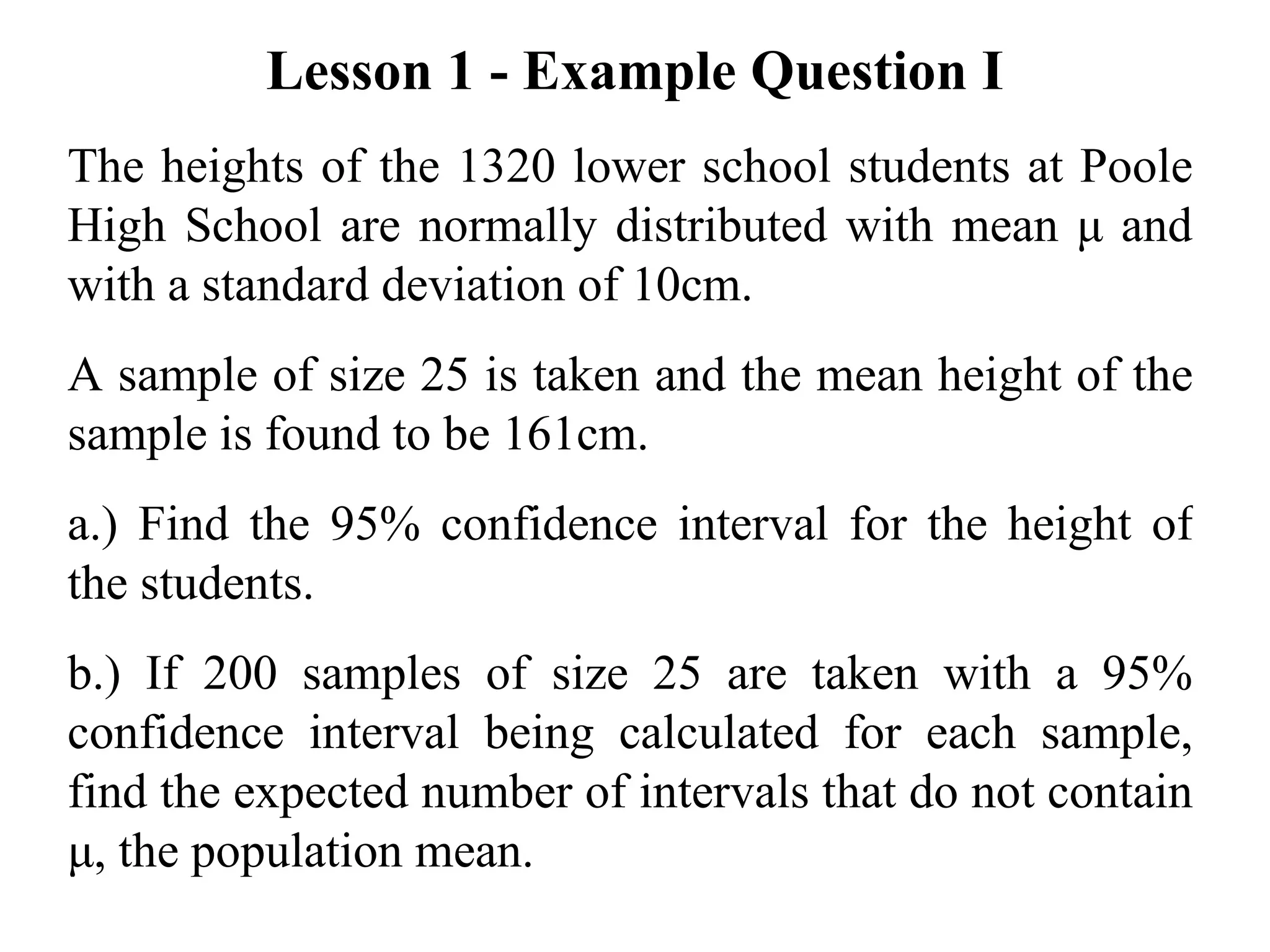
Lesson 1 - Example Question I The heights of the 1320 lower school students at Poole High School are normally distributed with mean  μ  and  with a standard deviation of 10cm. A sample of size 25 is taken and the mean height of the sample is found to be 161cm. a.) Find the 95% confidence interval for the height of the students. b.) If 200 samples of size 25 are taken with a 95% confidence interval being calculated for each sample, find the expected number of intervals that do not contain  μ , the population mean.
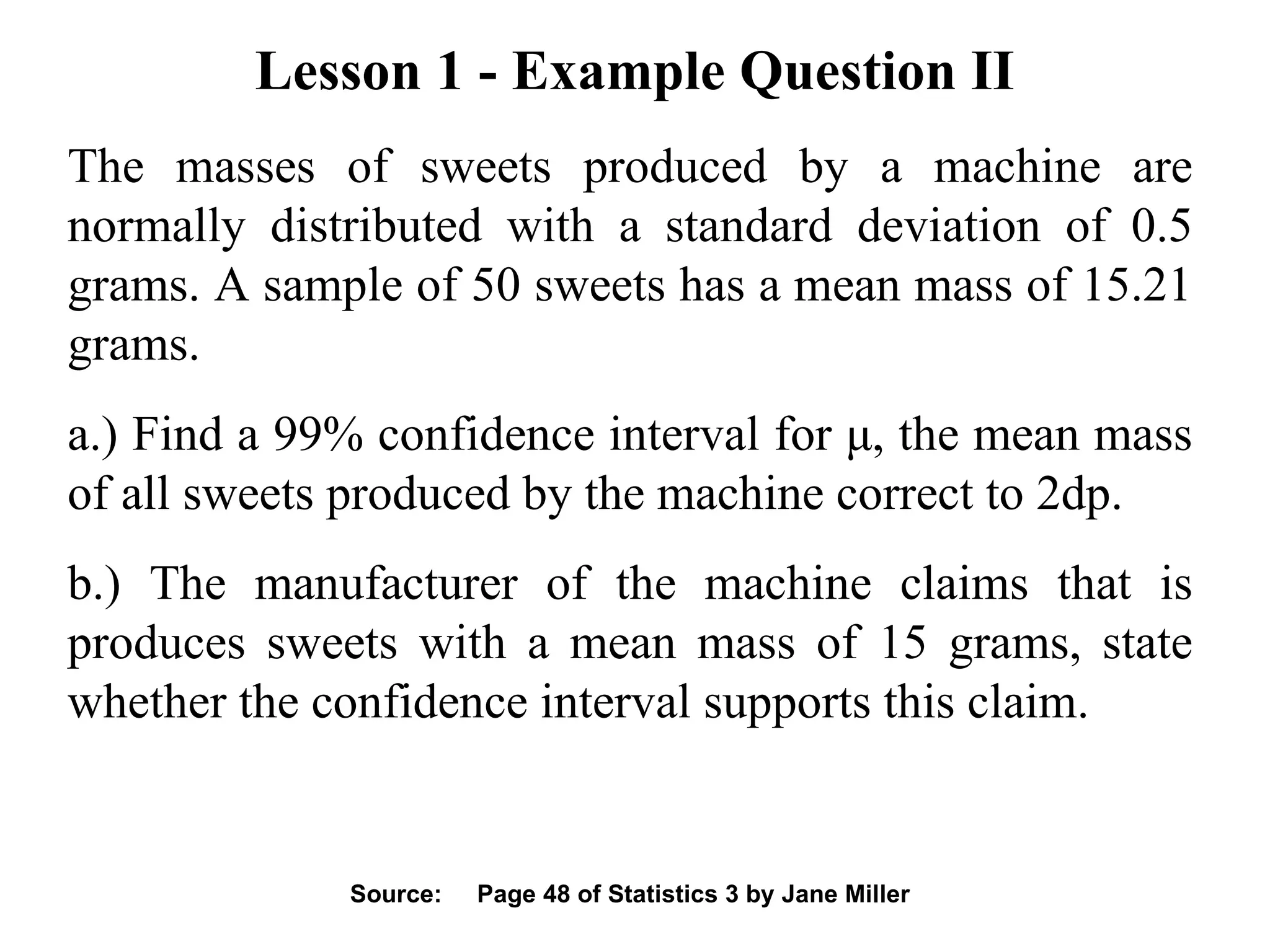
Lesson 1 - Example Question II The masses of sweets produced by a machine are normally distributed with a standard deviation of 0.5 grams. A sample of 50 sweets has a mean mass of 15.21 grams. a.) Find a 99% confidence interval for  μ , the mean mass of all sweets produced by the machine correct to 2dp. b.) The manufacturer of the machine claims that is produces sweets with a mean mass of 15 grams, state whether the confidence interval supports this claim. Source:  Page 48 of Statistics 3 by Jane Miller
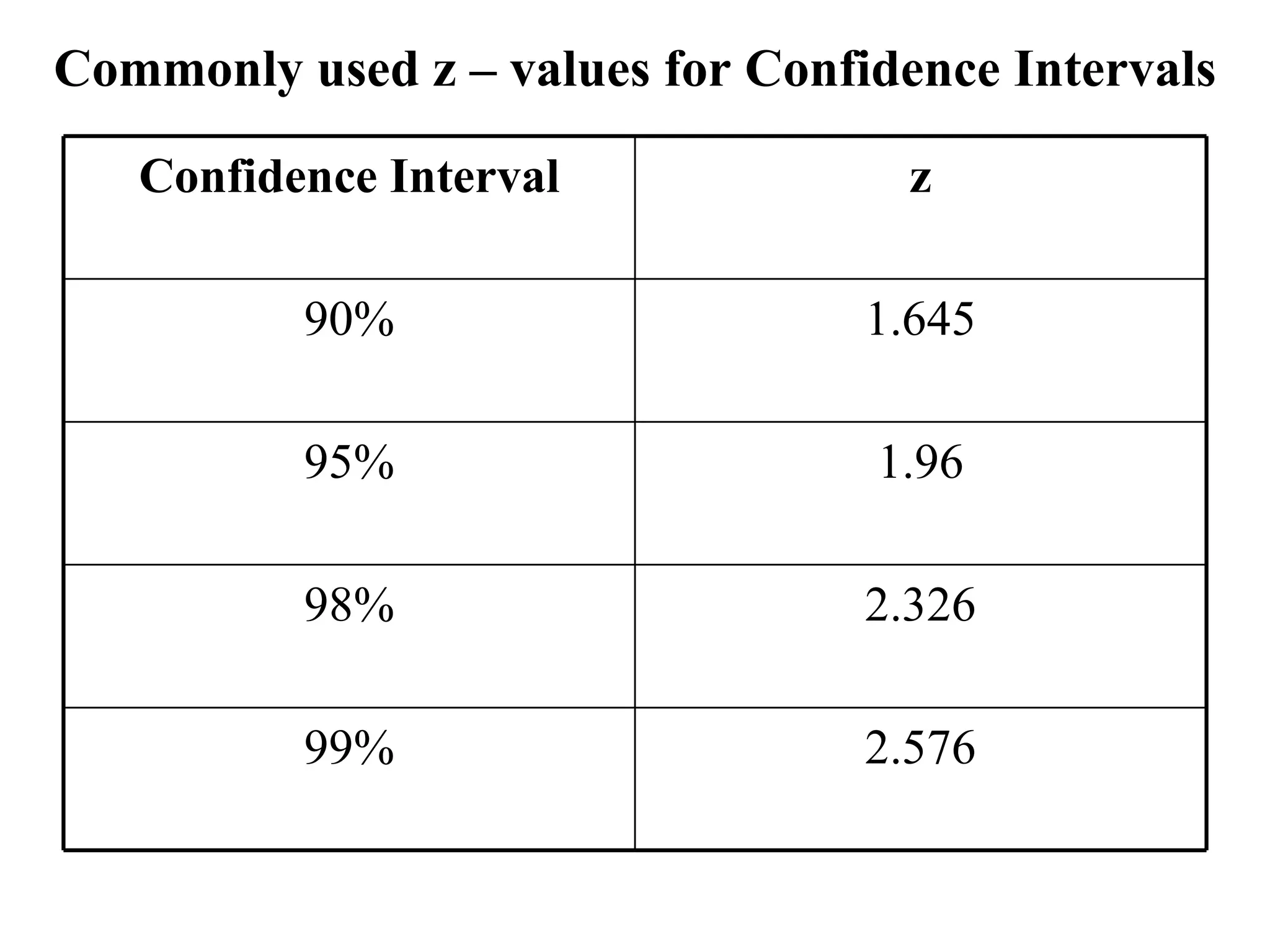
Commonly used z – values for Confidence Intervals  2.576 99% 2.326 98% 1.96 95% 1.645 90% z Confidence Interval
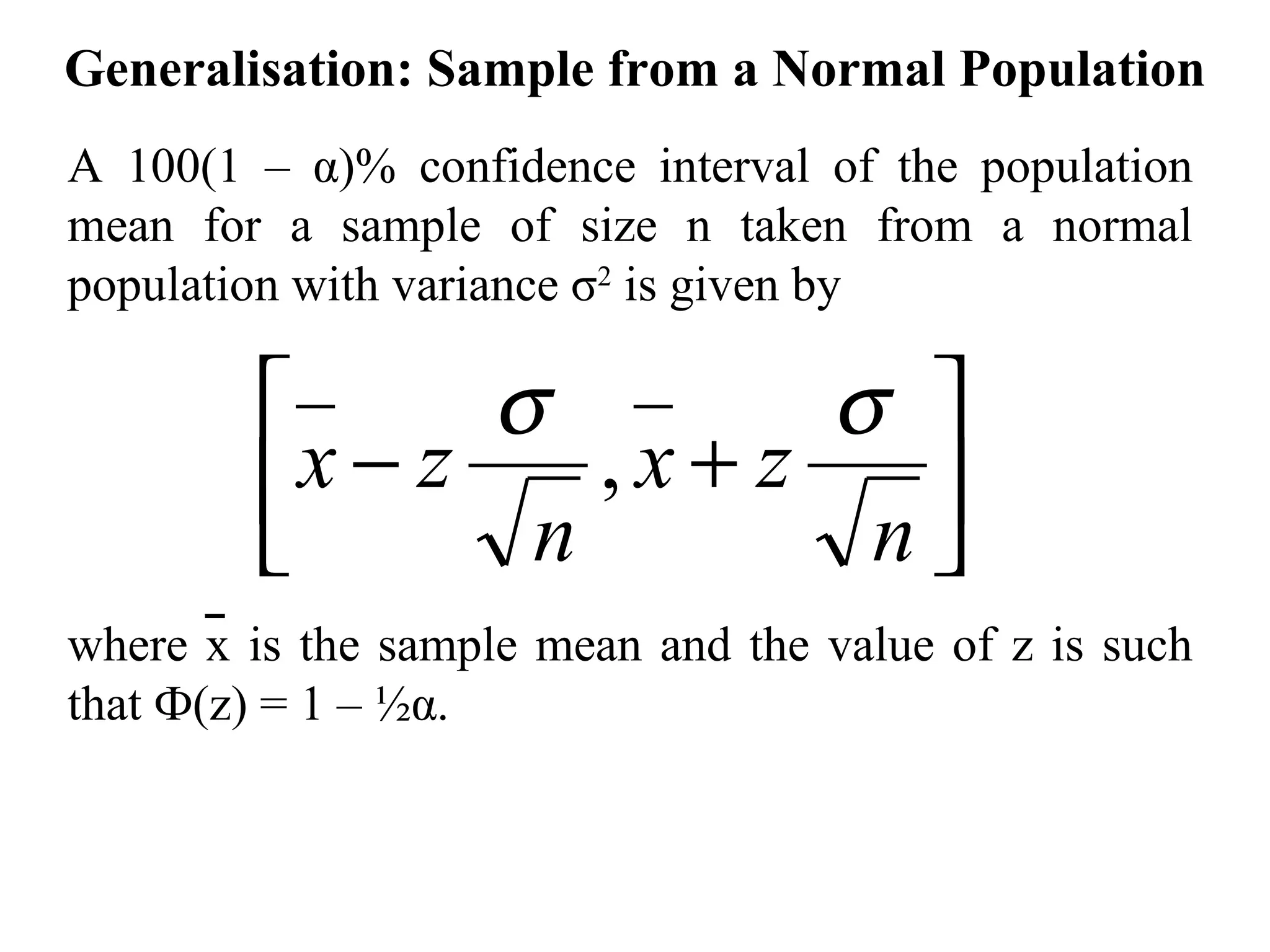
Generalisation: Sample from a Normal Population A 100(1 –  α )% confidence interval of the population mean for a sample of size n taken from a normal population with variance  σ 2  is given by where x is the sample mean and the value of z is such that  Ф (z) = 1 – ½ α .
Practice Questions  Statistics 3 and 4 by Jane Miller Page 50, Exercise 3A Question 1 onwards
Statistics 3 Confidence Intervals and the t - Distribution  - Lesson 2 - Key Learning Points/Vocabulary: The central limit theorem (S2) Unbiased estimate of the population variance (S2). Calculating the confidence interval for a large sample.
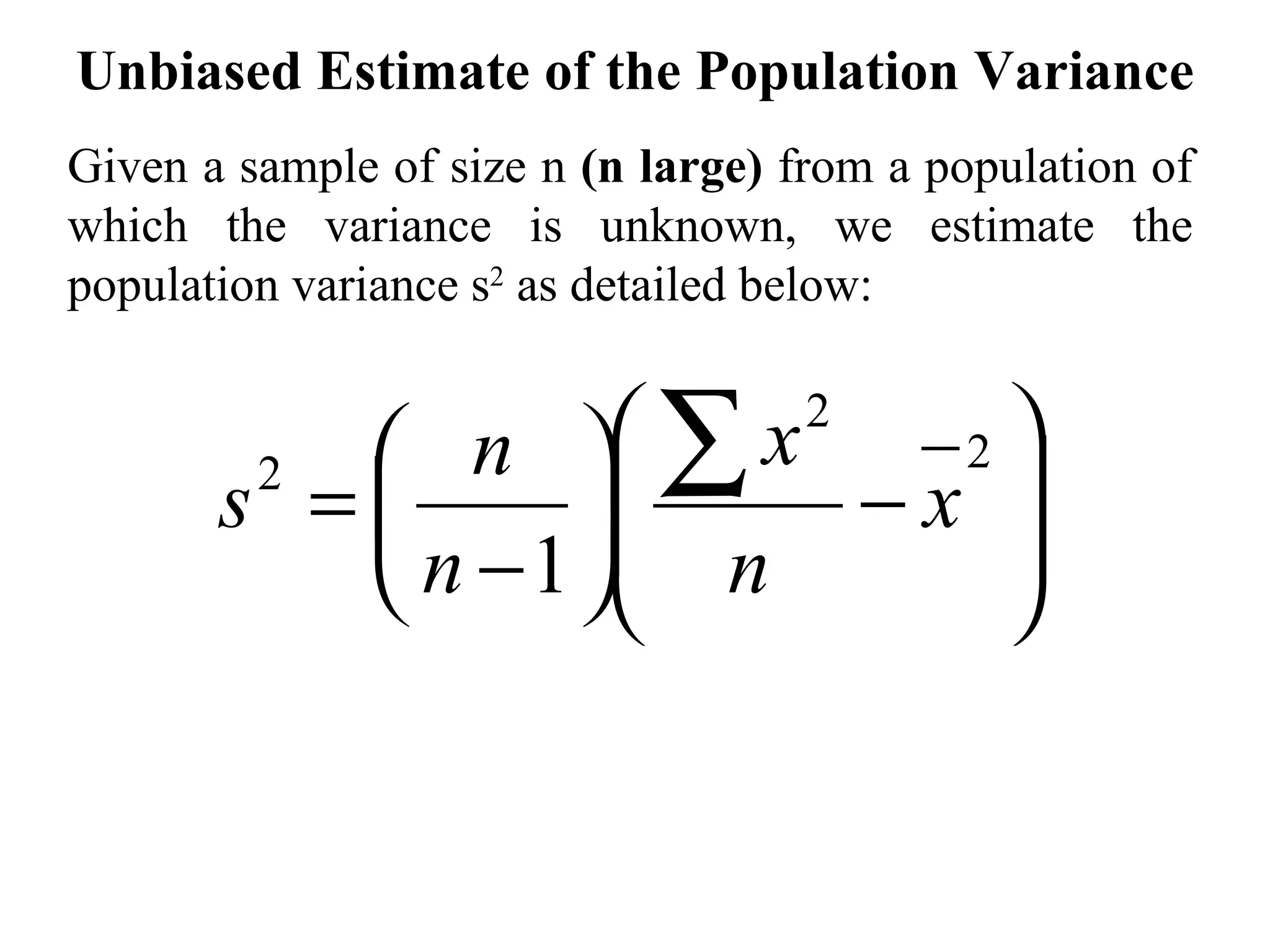
Unbiased Estimate of the Population Variance Given a sample of size n  (n large)  from a population of which the variance is unknown, we estimate the population variance s 2  as detailed below:
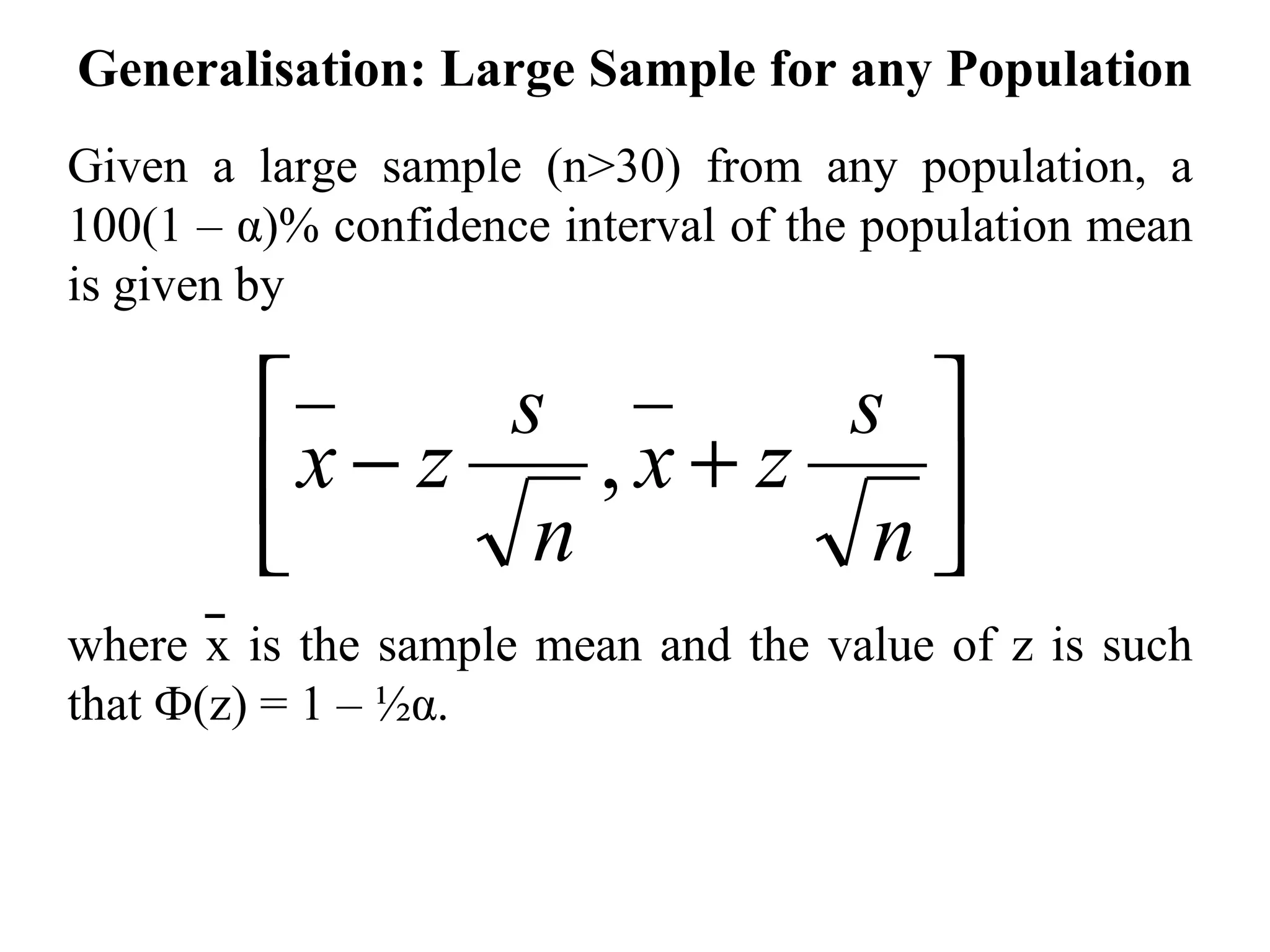
Generalisation: Large Sample for any Population Given a large sample (n>30) from any population, a 100(1 –  α )% confidence interval of the population mean is given by where x is the sample mean and the value of z is such that  Ф (z) = 1 – ½ α .
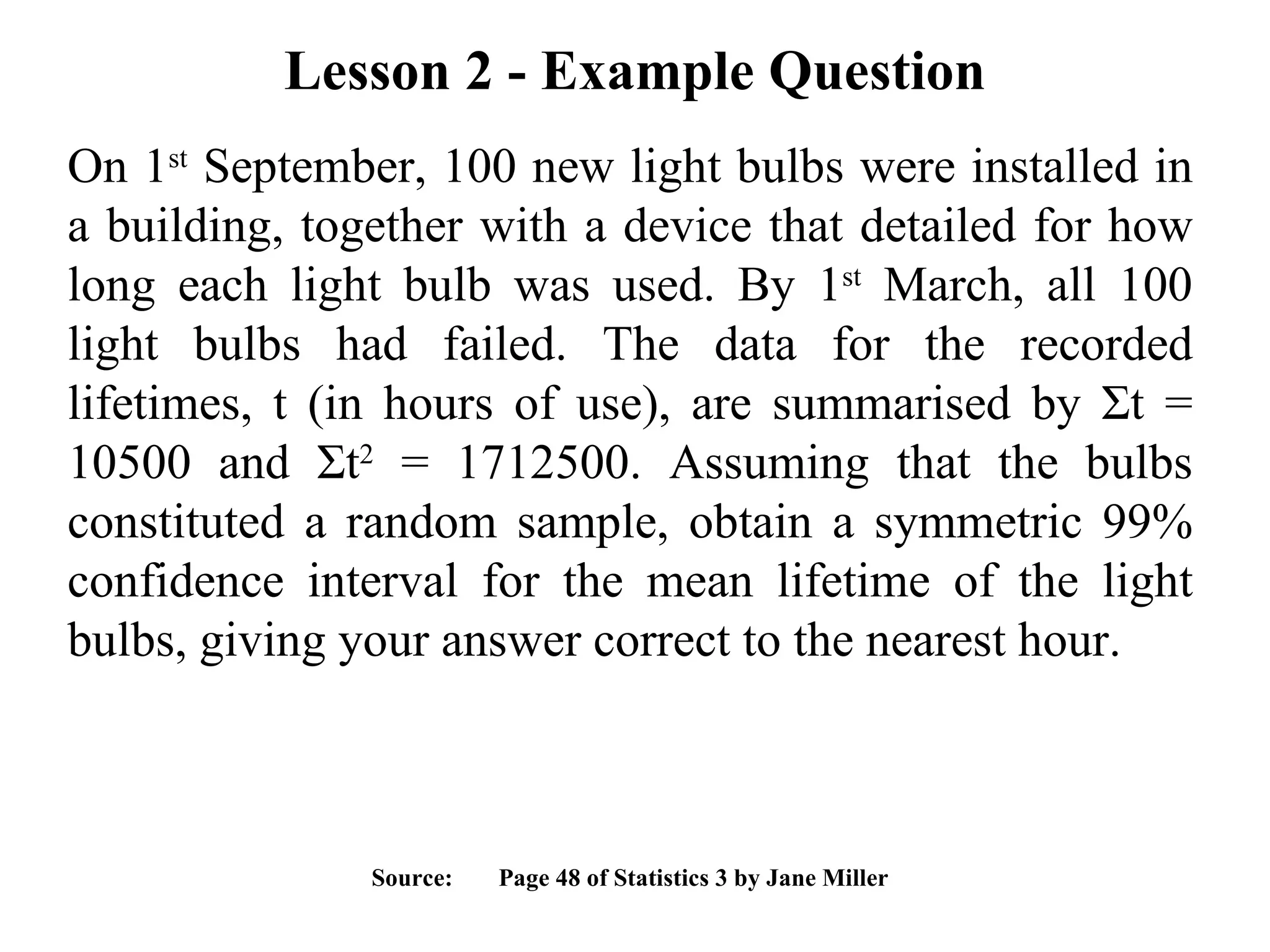
Lesson 2 - Example Question On 1 st  September, 100 new light bulbs were installed in a building, together with a device that detailed for how long each light bulb was used. By 1 st  March, all 100 light bulbs had failed. The data for the recorded lifetimes, t (in hours of use), are summarised by  Σ t = 10500 and  Σ t 2  = 1712500. Assuming that the bulbs constituted a random sample, obtain a symmetric 99% confidence interval for the mean lifetime of the light bulbs, giving your answer correct to the nearest hour. Source:  Page 48 of Statistics 3 by Jane Miller
Practice Questions  Statistics 3 and 4 by Jane Miller Page 50, Exercise 3B Question 1 onwards
Statistics 3 Confidence Intervals and the t - Distribution  - Lesson 3 - Key Learning Points/Vocabulary: Expectation and variance of the binomial distribution. Conditions for normal approximation to the binomial. Calculating the approximate confidence interval for a population proportion from a large sample.
Lesson 3 - Example Question You are the manufacturer of tin openers to be used specifically by left handed people. A random sample of 500 people finds that 60 of them are left handed. What is the 95% confidence interval for this estimate of the proportion of people who are left handed? Source:  Page 55 of Statistics 3 by Jane Miller
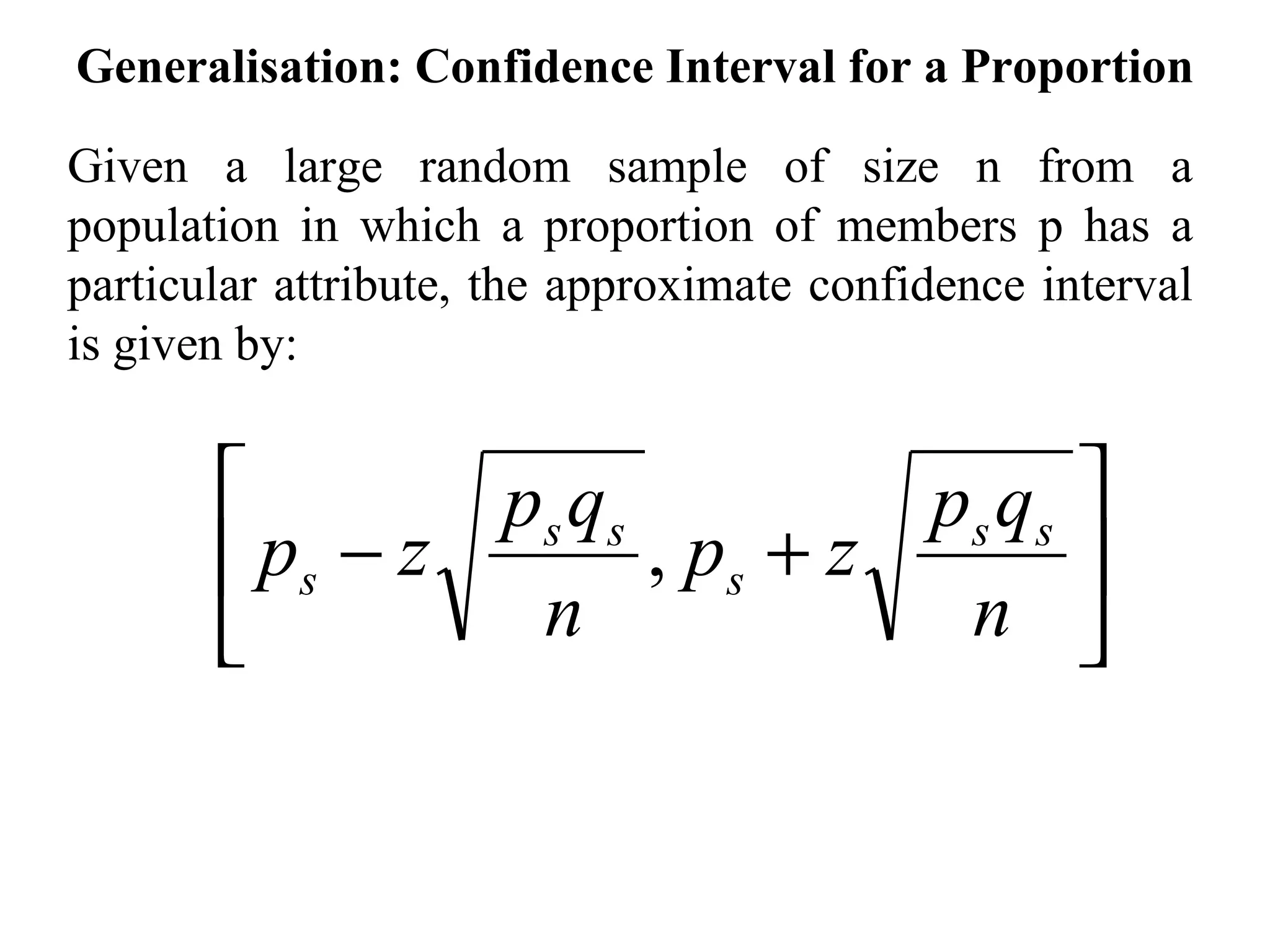
Generalisation: Confidence Interval for a Proportion Given a large random sample of size n from a population in which a proportion of members p has a particular attribute, the approximate confidence interval is given by:
Practice Questions  Statistics 3 and 4 by Jane Miller Page 50, Exercise 3C Question 3 onwards
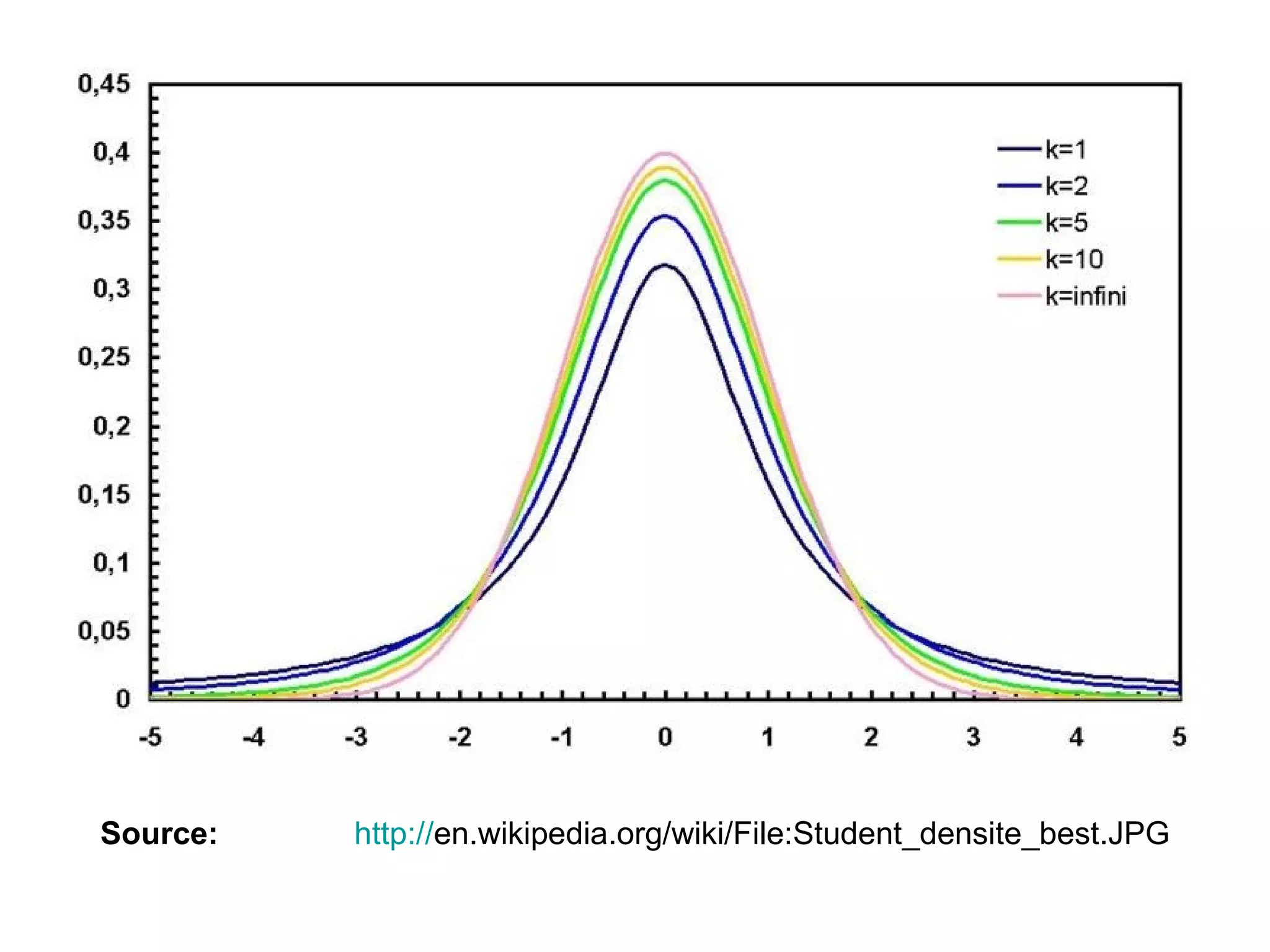
Statistics 3 Confidence Intervals and the t - Distribution  - Lesson 4 - Key Learning Points/Vocabulary: Use flow chart to help decide when to use either the t or z distribution. The t – distribution. Calculating the confidence interval for a small sample drawn from a normal population of unknown variance.
Source: http:// en.wikipedia.org/wiki/File:Student_densite_best.JPG
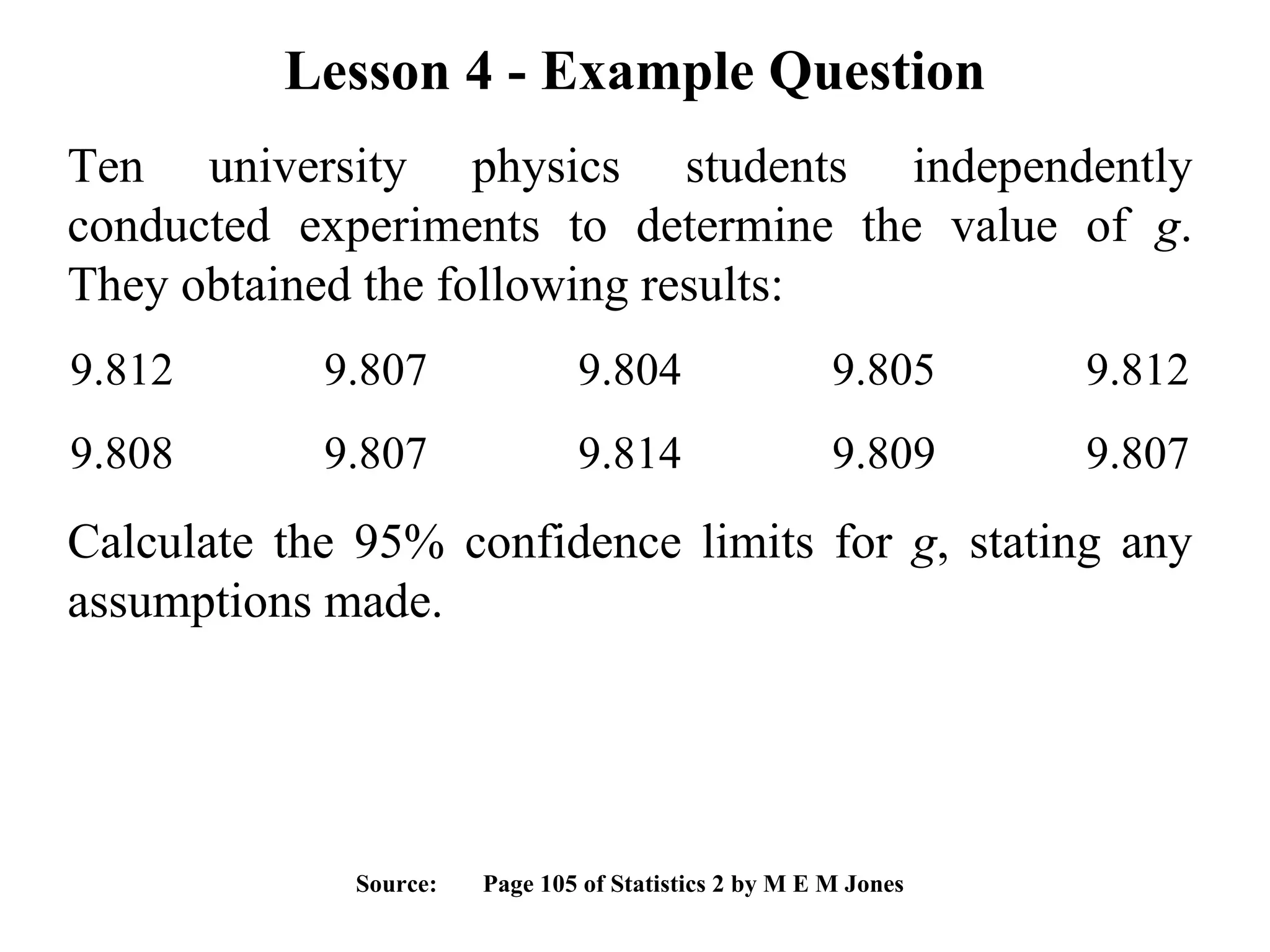
Lesson 4 - Example Question Ten university physics students independently conducted experiments to determine the value of  g . They obtained the following results:  9.812 9.807 9.804 9.805 9.812 9.808 9.807 9.814 9.809 9.807 Calculate the 95% confidence limits for  g , stating any assumptions made. Source:  Page 105 of Statistics 2 by M E M Jones
 
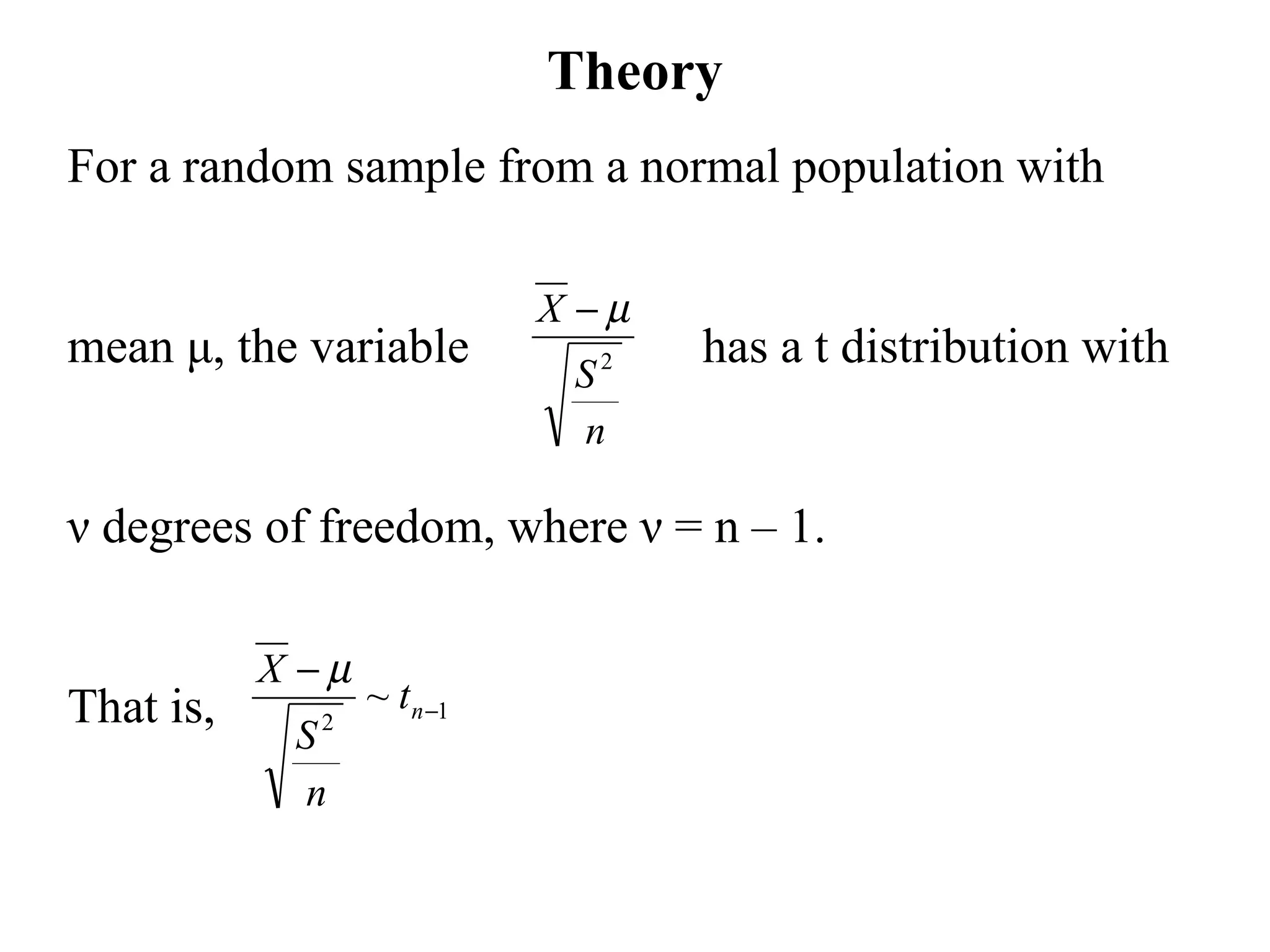
Theory For a random sample from a normal population with  mean  μ , the variable has a t distribution with  ν  degrees of freedom, where  ν  = n – 1. That is,
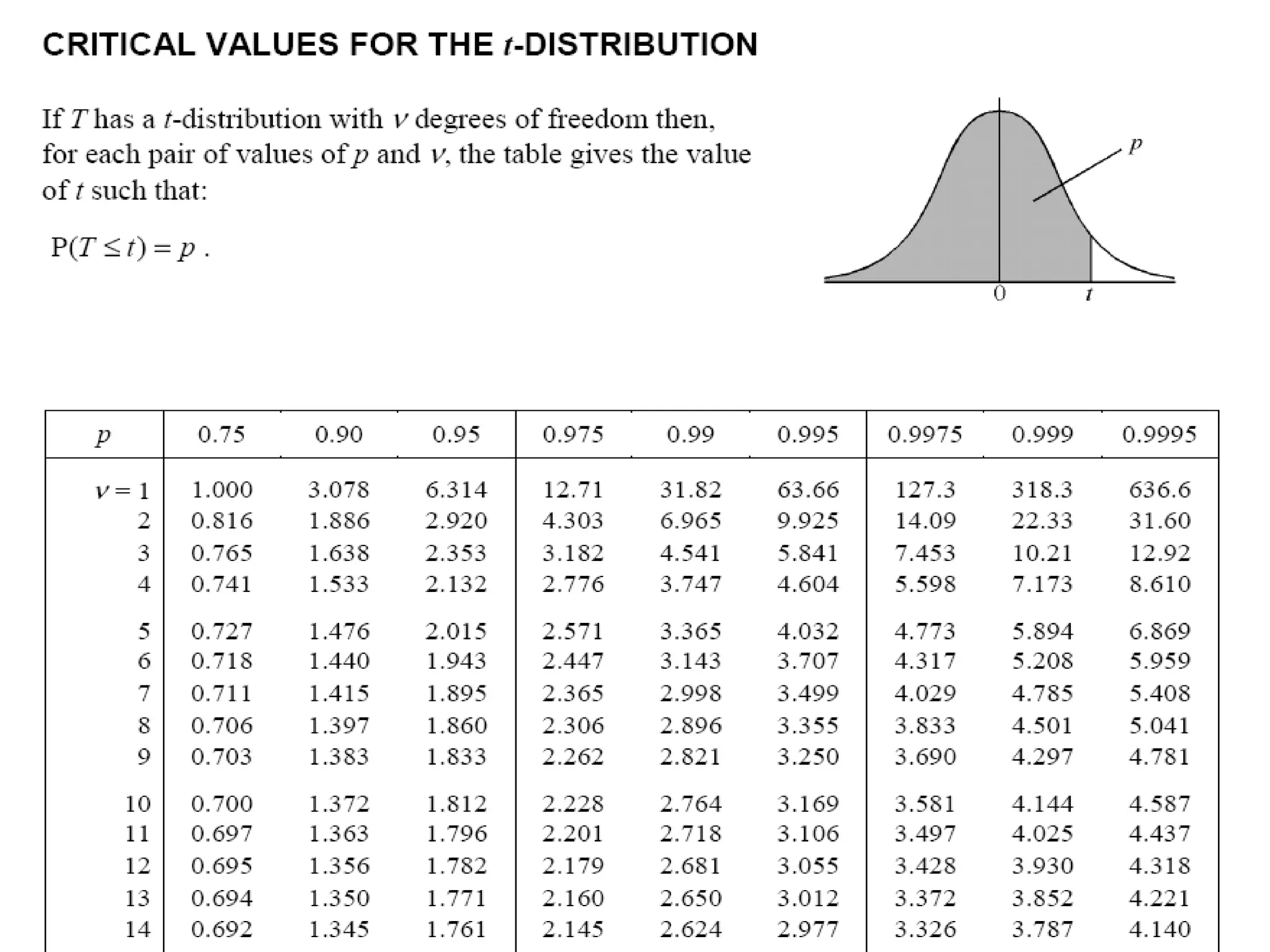
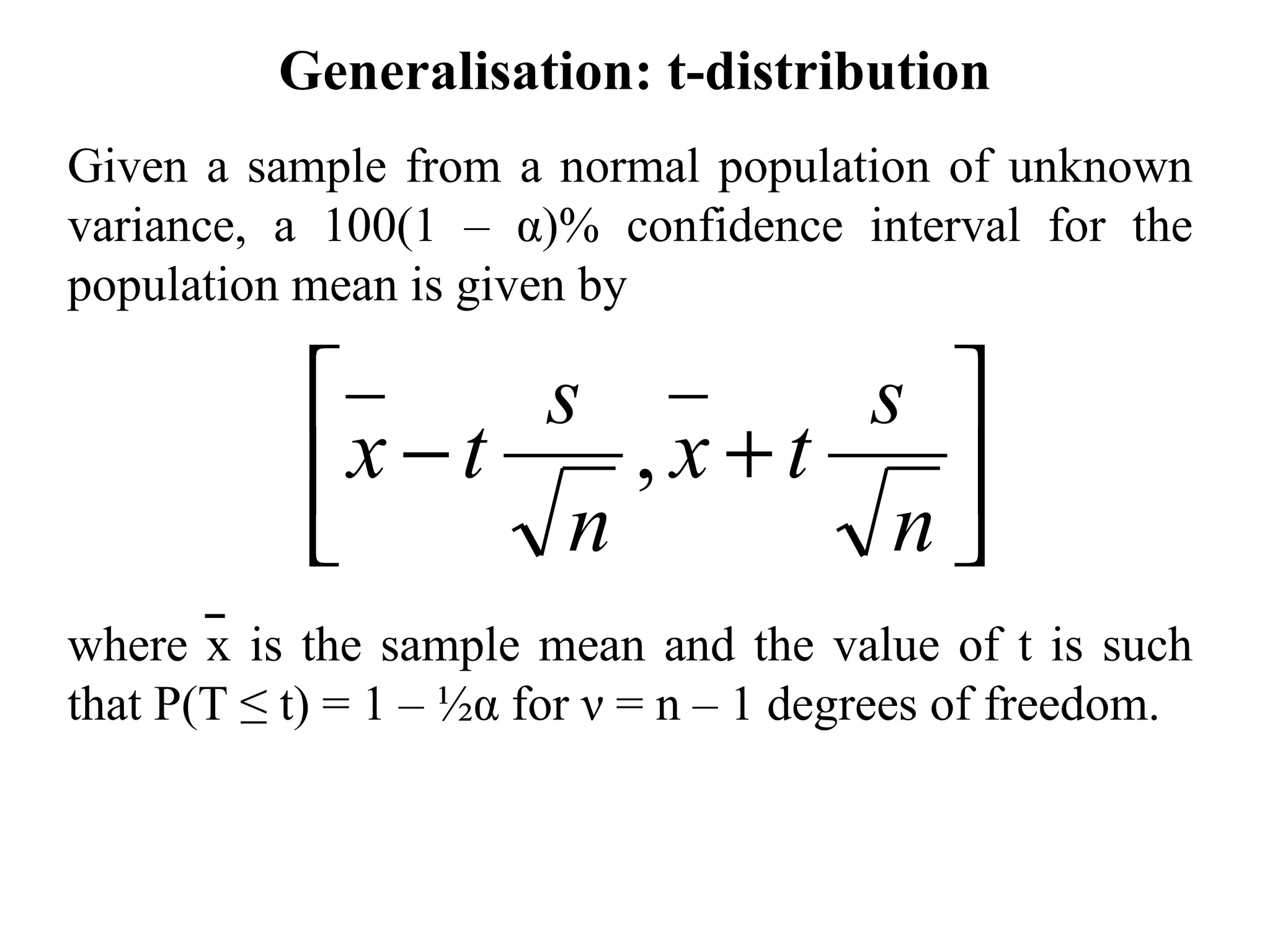
Generalisation: t-distribution Given a sample from a normal population of unknown variance, a 100(1 –  α )% confidence interval for the population  mean is given by where x is the sample mean and the value of t is such that P(T ≤ t)  = 1 – ½ α  for  ν  = n – 1 degrees of freedom.
Practice Questions  Statistics 3 and 4 by Jane Miller Page 62, Exercise 3D Question 2 onwards
Statistics 3 Confidence Intervals and the t - Distribution  - Lesson 5 - Key Learning Points/Vocabulary: Hypothesis test on the population mean for a small sample from a normal population. Shortened name: t-Test.
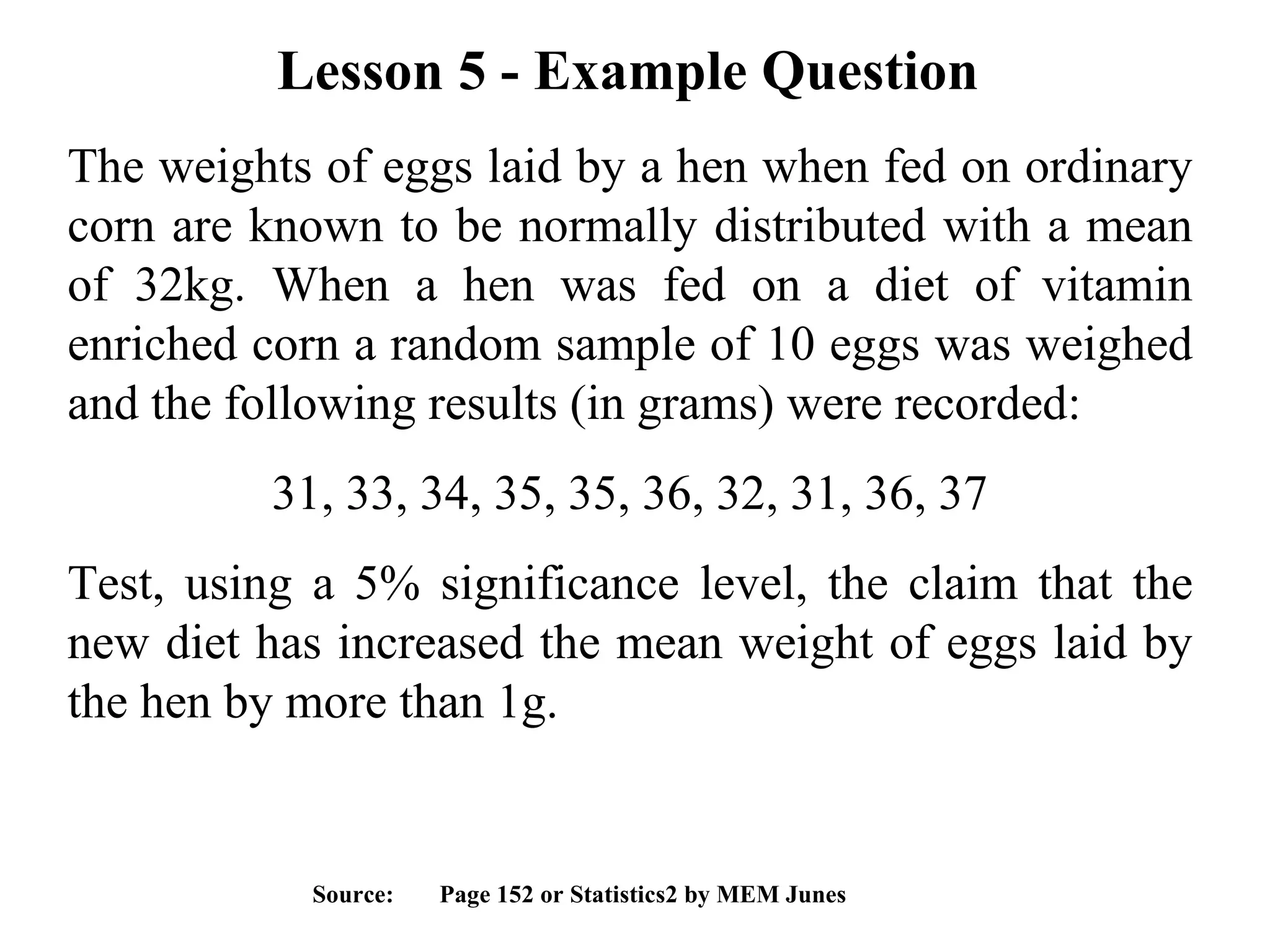
Lesson 5 - Example Question  The weights of eggs laid by a hen when fed on ordinary corn are known to be normally distributed with a mean of 32kg. When a hen was fed on a diet of vitamin enriched corn a random sample of 10 eggs was weighed and the following results (in grams) were recorded:  31, 33, 34, 35, 35, 36, 32, 31, 36, 37 Test, using a 5% significance level, the claim that the new diet has increased the mean weight of eggs laid by the hen by more than 1g. Source:  Page 152 or Statistics2 by MEM Junes
Practice Questions  Statistics 3 and 4 by Jane Miller Page 67, Exercise 3E Question 1 onwards
Statistics 3 Confidence Intervals and the t - Distribution  - Lesson 6 - Key Learning Points/Vocabulary: Mixed questions on Confidence Intervals and the t-Distribution. Mind map to summarise key learning points.
Practice Questions  Statistics 3 and 4 by Jane Miller Page 687, Miscellaneous Exercise 3 Questions 1, 3, 6 and 9 (first part only)

Confidence Intervals And The T Distribution

  • 1.
    Statistics 3 ConfidenceIntervals and the t - Distribution - Lesson 1 - Key Learning Points/Vocabulary: The concept of a confidence intervals (notes). Calculating a 95% confidence interval for a sample drawn from a normal population of known variance. Calculating any confidence interval.
  • 2.
    Lesson 1 -Example Question I The heights of the 1320 lower school students at Poole High School are normally distributed with mean μ and with a standard deviation of 10cm. A sample of size 25 is taken and the mean height of the sample is found to be 161cm. a.) Find the 95% confidence interval for the height of the students. b.) If 200 samples of size 25 are taken with a 95% confidence interval being calculated for each sample, find the expected number of intervals that do not contain μ , the population mean.
  • 3.
    Lesson 1 -Example Question II The masses of sweets produced by a machine are normally distributed with a standard deviation of 0.5 grams. A sample of 50 sweets has a mean mass of 15.21 grams. a.) Find a 99% confidence interval for μ , the mean mass of all sweets produced by the machine correct to 2dp. b.) The manufacturer of the machine claims that is produces sweets with a mean mass of 15 grams, state whether the confidence interval supports this claim. Source: Page 48 of Statistics 3 by Jane Miller
  • 4.
    Commonly used z– values for Confidence Intervals 2.576 99% 2.326 98% 1.96 95% 1.645 90% z Confidence Interval
  • 5.
    Generalisation: Sample froma Normal Population A 100(1 – α )% confidence interval of the population mean for a sample of size n taken from a normal population with variance σ 2 is given by where x is the sample mean and the value of z is such that Ф (z) = 1 – ½ α .
  • 6.
    Practice Questions Statistics 3 and 4 by Jane Miller Page 50, Exercise 3A Question 1 onwards
  • 7.
    Statistics 3 ConfidenceIntervals and the t - Distribution - Lesson 2 - Key Learning Points/Vocabulary: The central limit theorem (S2) Unbiased estimate of the population variance (S2). Calculating the confidence interval for a large sample.
  • 8.
    Unbiased Estimate ofthe Population Variance Given a sample of size n (n large) from a population of which the variance is unknown, we estimate the population variance s 2 as detailed below:
  • 9.
    Generalisation: Large Samplefor any Population Given a large sample (n>30) from any population, a 100(1 – α )% confidence interval of the population mean is given by where x is the sample mean and the value of z is such that Ф (z) = 1 – ½ α .
  • 10.
    Lesson 2 -Example Question On 1 st September, 100 new light bulbs were installed in a building, together with a device that detailed for how long each light bulb was used. By 1 st March, all 100 light bulbs had failed. The data for the recorded lifetimes, t (in hours of use), are summarised by Σ t = 10500 and Σ t 2 = 1712500. Assuming that the bulbs constituted a random sample, obtain a symmetric 99% confidence interval for the mean lifetime of the light bulbs, giving your answer correct to the nearest hour. Source: Page 48 of Statistics 3 by Jane Miller
  • 11.
    Practice Questions Statistics 3 and 4 by Jane Miller Page 50, Exercise 3B Question 1 onwards
  • 12.
    Statistics 3 ConfidenceIntervals and the t - Distribution - Lesson 3 - Key Learning Points/Vocabulary: Expectation and variance of the binomial distribution. Conditions for normal approximation to the binomial. Calculating the approximate confidence interval for a population proportion from a large sample.
  • 13.
    Lesson 3 -Example Question You are the manufacturer of tin openers to be used specifically by left handed people. A random sample of 500 people finds that 60 of them are left handed. What is the 95% confidence interval for this estimate of the proportion of people who are left handed? Source: Page 55 of Statistics 3 by Jane Miller
  • 14.
    Generalisation: Confidence Intervalfor a Proportion Given a large random sample of size n from a population in which a proportion of members p has a particular attribute, the approximate confidence interval is given by:
  • 15.
    Practice Questions Statistics 3 and 4 by Jane Miller Page 50, Exercise 3C Question 3 onwards
  • 16.
    Statistics 3 ConfidenceIntervals and the t - Distribution - Lesson 4 - Key Learning Points/Vocabulary: Use flow chart to help decide when to use either the t or z distribution. The t – distribution. Calculating the confidence interval for a small sample drawn from a normal population of unknown variance.
  • 17.
  • 18.
    Lesson 4 -Example Question Ten university physics students independently conducted experiments to determine the value of g . They obtained the following results: 9.812 9.807 9.804 9.805 9.812 9.808 9.807 9.814 9.809 9.807 Calculate the 95% confidence limits for g , stating any assumptions made. Source: Page 105 of Statistics 2 by M E M Jones
  • 19.
  • 20.
    Theory For arandom sample from a normal population with mean μ , the variable has a t distribution with ν degrees of freedom, where ν = n – 1. That is,
  • 21.
    Generalisation: t-distribution Givena sample from a normal population of unknown variance, a 100(1 – α )% confidence interval for the population mean is given by where x is the sample mean and the value of t is such that P(T ≤ t) = 1 – ½ α for ν = n – 1 degrees of freedom.
  • 22.
    Practice Questions Statistics 3 and 4 by Jane Miller Page 62, Exercise 3D Question 2 onwards
  • 23.
    Statistics 3 ConfidenceIntervals and the t - Distribution - Lesson 5 - Key Learning Points/Vocabulary: Hypothesis test on the population mean for a small sample from a normal population. Shortened name: t-Test.
  • 24.
    Lesson 5 -Example Question The weights of eggs laid by a hen when fed on ordinary corn are known to be normally distributed with a mean of 32kg. When a hen was fed on a diet of vitamin enriched corn a random sample of 10 eggs was weighed and the following results (in grams) were recorded: 31, 33, 34, 35, 35, 36, 32, 31, 36, 37 Test, using a 5% significance level, the claim that the new diet has increased the mean weight of eggs laid by the hen by more than 1g. Source: Page 152 or Statistics2 by MEM Junes
  • 25.
    Practice Questions Statistics 3 and 4 by Jane Miller Page 67, Exercise 3E Question 1 onwards
  • 26.
    Statistics 3 ConfidenceIntervals and the t - Distribution - Lesson 6 - Key Learning Points/Vocabulary: Mixed questions on Confidence Intervals and the t-Distribution. Mind map to summarise key learning points.
  • 27.
    Practice Questions Statistics 3 and 4 by Jane Miller Page 687, Miscellaneous Exercise 3 Questions 1, 3, 6 and 9 (first part only)