Dr Ramachandra
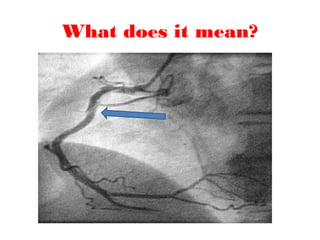
What does it mean?
Introduction
• Pretty H(1931)-1st
reported case
• CAG : 0.2% incidence
• Mean age :40 yrs
• Men:30%,female:70%(peripartum)
• LAD(y) in ladies : most commonly
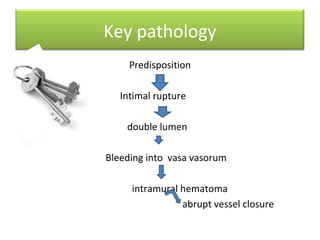
Key pathology
Predisposition
Intimal rupture
double lumen
Bleeding into vasa vasorum
intramural hematoma
abrupt vessel closure
Risk is not clear
remains unclear
CAD/ peripartum: most
common
 hypertension
 CTD:Marfan’s syndrome, EDS,
vasculitis:PAN,SLE, eosinophilic
arteritis, APS, and IBD
Natural history
• Survival rates of SCAD is 70-90% survival
• Outcomes being more favourable should the
acute phase be survived
• 1- and 10- year mortality 1.1% and 7.7%
• Men tend to have better survival rates
• Peri- or postpartum period have an even
better prognosis than not pregnant
Natural history
In a review of 152 cases
Kamineni et al. reported
that 50% of patients
developed recurrent
dissection within two
months.
KamineniR., SadhuA., andAlpert
J.S.: Spontaneouscoronaryarterydissection:
reportoftwocasesanda50-yearreviewofthe
literature. CardiologyinReview. 2002; 10:
pp. 279-284
Natural history
Recurrent dissection within
one month of the first event is
more common .High chance of
developing recurrent
dissection if there is a
generalised vessel weakness
as in pregnant SCAD patients,
where more than 40%
demonstrated dissections in
more than one vessel
Koul A.K., Hollander G.,
Moskovits N., Frankel R.,
Herrera L., and Shani J.:
Coronary artery dissection
during pregnancy and the
postpartum period: two case
reports and review of
literature. Catheterization and
Cardiovascular Interventions:
Official Journal of the Society
for Cardiac Angiography &
Interventions. 2001; 52: pp.
88-94
Natural history
• Tanis W., St ella P.R., Kirkels J .H., Pij lman A.H., Pet ers R.H., and
de Man F.H.: Spont aneous coronar y art ery dissect ion: current
insight s and t her apy. Net herlands Heart J ournal: Mont hly
J ournal of t he Net her lands Societ y of Cardiology and t he
Net herlands Heart Foundat ion. 2008; 16: pp. 344-349
• Hering D., Piper C., Hohmann C., Schult heiss H.P., and
Horst kot t e D.: [Prospect ive st udy of t he incidence, pat hogenesis
and t herapy of spont aneous, by coronary angiography diagnosed
coronary art ery dissect ion]. Zeit schrif t f ur Kardiologie. 1998;
87: pp. 961-970
• Kamineni R., Sadhu A., and Alpert J .S.: Spont aneous coronary
art ery dissect ion: report of t wo cases and a 50-year review of
t he lit erat ure. Cardiology in Review. 2002; 10: pp. 279-284
Must be individualized
Rx like ACS(+UFH)
GP IIB-IIIA/TLT is a either edged
sword-choose it carefully
Angioplasty/surgery to the need
Close F/U must
Follow me up
• Progression of the dissection and formation of
pseudoaneurysms
• Any symptoms of recurrent ischemia
• Stress testing with nuclear perfusion imaging
is preferred over coronary angiography as a
means of surveillance
Conclusion
• Any young woman
• Nil risk factors for coronary artery disease and
acute myocardial infarction
• Propensity for extension of dissection with or
without mechanical revascularization
• Spontaneous healing
• Medical a is rational
• Therapy must be individualized
I am always searching something
better for YOU in this chaotic world.

Spontaneous coronary artery dissection

  • 1.
  • 2.
  • 3.
    Introduction • Pretty H(1931)-1st reportedcase • CAG : 0.2% incidence • Mean age :40 yrs • Men:30%,female:70%(peripartum) • LAD(y) in ladies : most commonly
  • 4.
    Key pathology Predisposition Intimal rupture doublelumen Bleeding into vasa vasorum intramural hematoma abrupt vessel closure
  • 5.
    Risk is notclear remains unclear CAD/ peripartum: most common  hypertension  CTD:Marfan’s syndrome, EDS, vasculitis:PAN,SLE, eosinophilic arteritis, APS, and IBD
  • 6.
    Natural history • Survivalrates of SCAD is 70-90% survival • Outcomes being more favourable should the acute phase be survived • 1- and 10- year mortality 1.1% and 7.7% • Men tend to have better survival rates • Peri- or postpartum period have an even better prognosis than not pregnant
  • 7.
    Natural history In areview of 152 cases Kamineni et al. reported that 50% of patients developed recurrent dissection within two months. KamineniR., SadhuA., andAlpert J.S.: Spontaneouscoronaryarterydissection: reportoftwocasesanda50-yearreviewofthe literature. CardiologyinReview. 2002; 10: pp. 279-284
  • 8.
    Natural history Recurrent dissectionwithin one month of the first event is more common .High chance of developing recurrent dissection if there is a generalised vessel weakness as in pregnant SCAD patients, where more than 40% demonstrated dissections in more than one vessel Koul A.K., Hollander G., Moskovits N., Frankel R., Herrera L., and Shani J.: Coronary artery dissection during pregnancy and the postpartum period: two case reports and review of literature. Catheterization and Cardiovascular Interventions: Official Journal of the Society for Cardiac Angiography & Interventions. 2001; 52: pp. 88-94
  • 9.
    Natural history • TanisW., St ella P.R., Kirkels J .H., Pij lman A.H., Pet ers R.H., and de Man F.H.: Spont aneous coronar y art ery dissect ion: current insight s and t her apy. Net herlands Heart J ournal: Mont hly J ournal of t he Net her lands Societ y of Cardiology and t he Net herlands Heart Foundat ion. 2008; 16: pp. 344-349 • Hering D., Piper C., Hohmann C., Schult heiss H.P., and Horst kot t e D.: [Prospect ive st udy of t he incidence, pat hogenesis and t herapy of spont aneous, by coronary angiography diagnosed coronary art ery dissect ion]. Zeit schrif t f ur Kardiologie. 1998; 87: pp. 961-970 • Kamineni R., Sadhu A., and Alpert J .S.: Spont aneous coronary art ery dissect ion: report of t wo cases and a 50-year review of t he lit erat ure. Cardiology in Review. 2002; 10: pp. 279-284
  • 10.
    Must be individualized Rxlike ACS(+UFH) GP IIB-IIIA/TLT is a either edged sword-choose it carefully Angioplasty/surgery to the need Close F/U must
  • 11.
    Follow me up •Progression of the dissection and formation of pseudoaneurysms • Any symptoms of recurrent ischemia • Stress testing with nuclear perfusion imaging is preferred over coronary angiography as a means of surveillance
  • 12.
    Conclusion • Any youngwoman • Nil risk factors for coronary artery disease and acute myocardial infarction • Propensity for extension of dissection with or without mechanical revascularization • Spontaneous healing • Medical a is rational • Therapy must be individualized
  • 13.
    I am alwayssearching something better for YOU in this chaotic world.