PRESENTED BY
BIBIN BABY
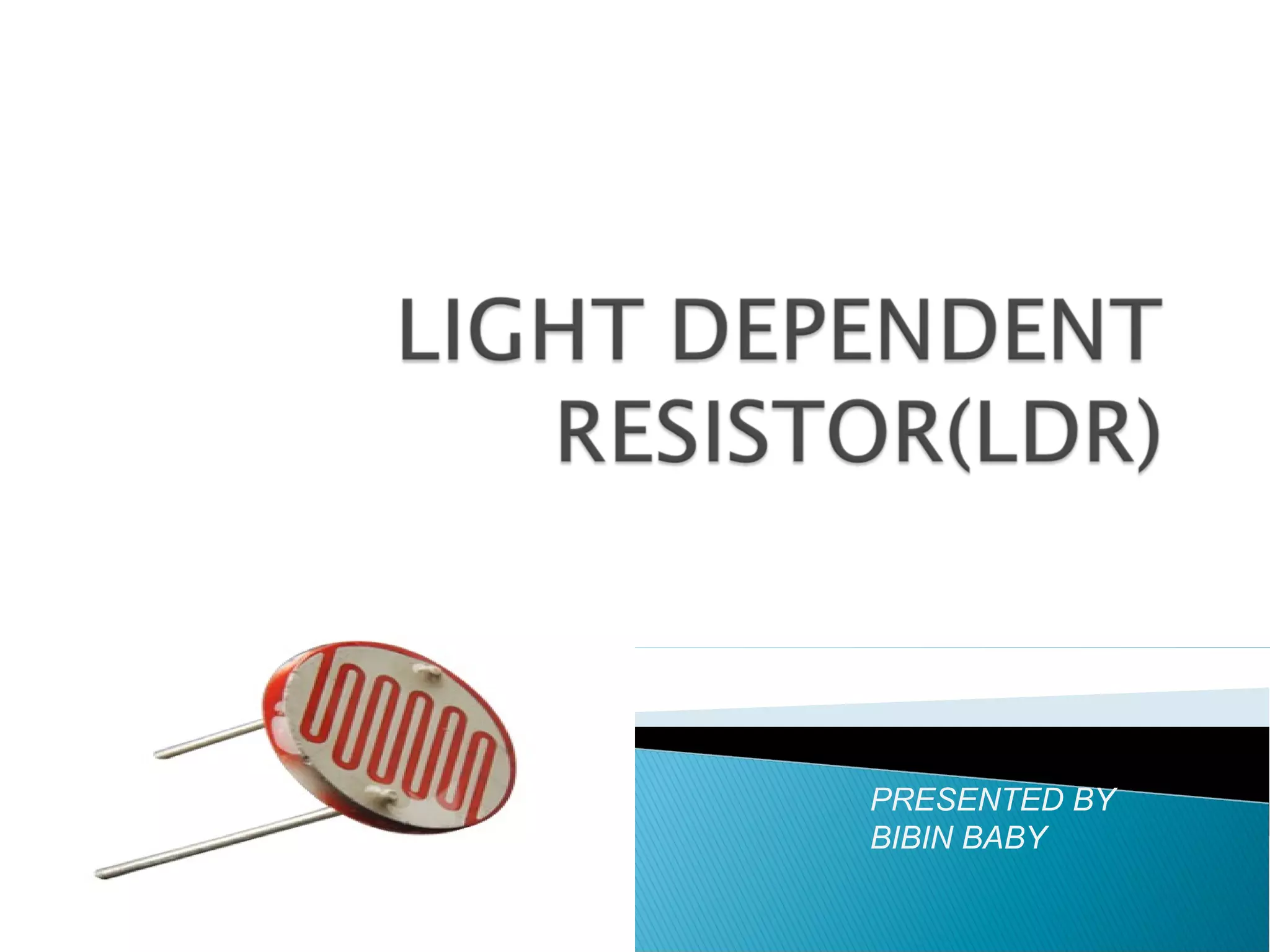
A Light Dependent Resistor (LDR) or a photo
resistor is a device whose resistivity is a function
of the incident electromagnetic radiation. Hence,
they are light sensitive devices. They are also
called as photo conductors, photo conductive cells
or simply photocells. They are made up of
semiconductor materials having high resistance.
Works on the principle of photoconductivity
When light falls i.e. when the photons fall on the device, the
electrons in the valence band of the semiconductor material
are excited to the conduction band. These photons in the
incident light should have energy greater than the band gap of
the semiconductor material to make the electrons jump from
the valence band to the conduction band. Hence when light
having enough energy is incident on the device more & more
electrons are excited to the conduction band which results in
large number of charge carriers. The result of this process is
more and more current starts flowing and hence it is said that
the resistance of the device has decreased. This is the most
common working principle of LDR
Based on the materials used they are classified as:
i) Intrinsic photo resistors (Un doped semiconductor): These are pure
semiconductor materials such as silicon or germanium. Electrons get
excited from valance band to conduction band when photons of enough
energy falls on it and number charge carriers increases.
ii) Extrinsic photo resistors: These are semiconductor materials doped
with impurities which are called as dopants. Theses dopants create new
energy bands above the valence band which are filled with electrons.
Hence this reduces the band gap and less energy is required in exciting
them. Extrinsic photo resistors are generally used for long wavelengths.
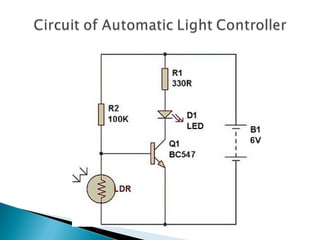
 Transistor
 LDR (Light Dependence Resistor)
 Resistor
 LED
Transistor:
 has an emitter terminal, a base terminal and a
collector terminal
 current flowing from the base to the emitter
controls the collector current
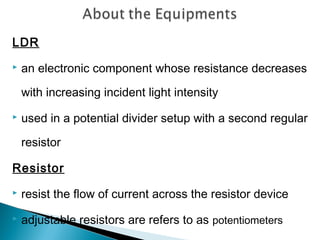
LDR
 an electronic component whose resistance decreases
with increasing incident light intensity
 used in a potential divider setup with a second regular
resistor
Resistor
 resist the flow of current across the resistor device
 adjustable resistors are refers to as potentiometers
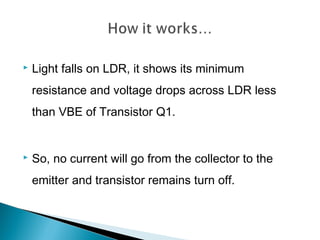
 Light falls on LDR, it shows its minimum
resistance and voltage drops across LDR less
than VBE of Transistor Q1.
 So, no current will go from the collector to the
emitter and transistor remains turn off.
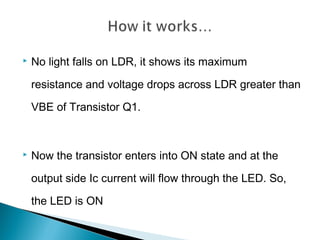
 No light falls on LDR, it shows its maximum
resistance and voltage drops across LDR greater than
VBE of Transistor Q1.
 Now the transistor enters into ON state and at the
output side Ic current will flow through the LED. So,
the LED is ON
 Energy savings
 Low cost
 Safety and Security
 Reducing physical efforts
THANK YOU

Ldrppt

  • 1.
  • 2.
    A Light DependentResistor (LDR) or a photo resistor is a device whose resistivity is a function of the incident electromagnetic radiation. Hence, they are light sensitive devices. They are also called as photo conductors, photo conductive cells or simply photocells. They are made up of semiconductor materials having high resistance.
  • 3.
    Works on theprinciple of photoconductivity When light falls i.e. when the photons fall on the device, the electrons in the valence band of the semiconductor material are excited to the conduction band. These photons in the incident light should have energy greater than the band gap of the semiconductor material to make the electrons jump from the valence band to the conduction band. Hence when light having enough energy is incident on the device more & more electrons are excited to the conduction band which results in large number of charge carriers. The result of this process is more and more current starts flowing and hence it is said that the resistance of the device has decreased. This is the most common working principle of LDR
  • 4.
    Based on thematerials used they are classified as: i) Intrinsic photo resistors (Un doped semiconductor): These are pure semiconductor materials such as silicon or germanium. Electrons get excited from valance band to conduction band when photons of enough energy falls on it and number charge carriers increases. ii) Extrinsic photo resistors: These are semiconductor materials doped with impurities which are called as dopants. Theses dopants create new energy bands above the valence band which are filled with electrons. Hence this reduces the band gap and less energy is required in exciting them. Extrinsic photo resistors are generally used for long wavelengths.
  • 6.
     Transistor  LDR(Light Dependence Resistor)  Resistor  LED
  • 7.
    Transistor:  has anemitter terminal, a base terminal and a collector terminal  current flowing from the base to the emitter controls the collector current
  • 8.
    LDR  an electroniccomponent whose resistance decreases with increasing incident light intensity  used in a potential divider setup with a second regular resistor Resistor  resist the flow of current across the resistor device  adjustable resistors are refers to as potentiometers
  • 10.
     Light fallson LDR, it shows its minimum resistance and voltage drops across LDR less than VBE of Transistor Q1.  So, no current will go from the collector to the emitter and transistor remains turn off.
  • 11.
     No lightfalls on LDR, it shows its maximum resistance and voltage drops across LDR greater than VBE of Transistor Q1.  Now the transistor enters into ON state and at the output side Ic current will flow through the LED. So, the LED is ON
  • 12.
     Energy savings Low cost  Safety and Security  Reducing physical efforts
  • 14.