Theory of Matrices
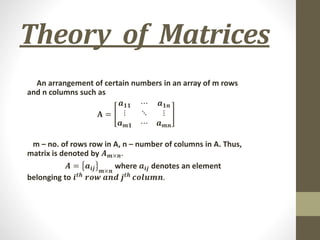
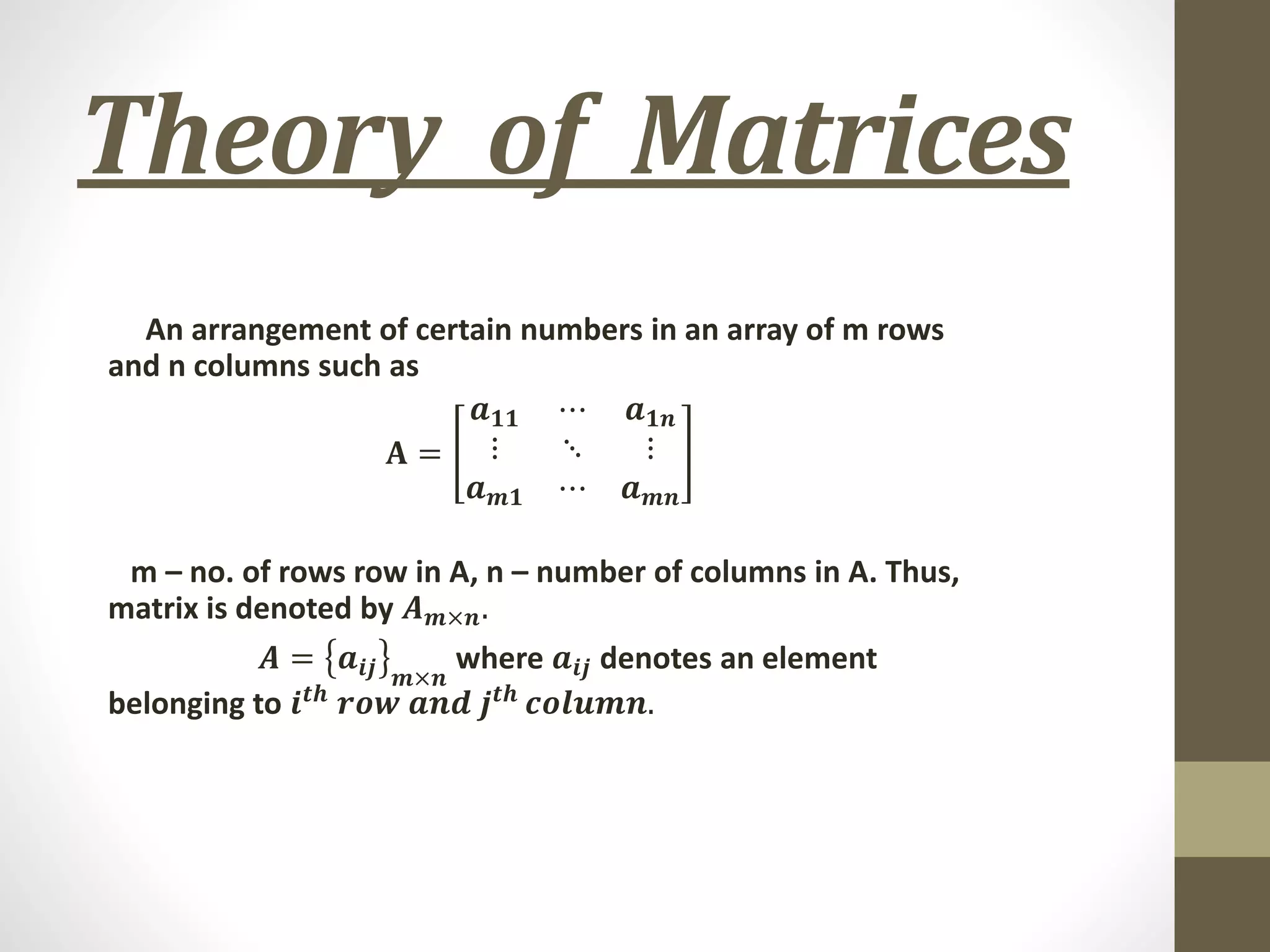
An arrangement of certain numbers in an array of m rows
and n columns such as
𝐀 =
𝒂𝟏𝟏 ⋯ 𝒂𝟏𝒏
⋮ ⋱ ⋮
𝒂𝒎𝟏 ⋯ 𝒂𝒎𝒏
m – no. of rows row in A, n – number of columns in A. Thus,
matrix is denoted by 𝑨𝒎×𝒏.
𝑨 = 𝒂𝒊𝒋 𝒎×𝒏
where 𝒂𝒊𝒋 denotes an element
belonging to 𝒊𝒕𝒉
𝒓𝒐𝒘 𝒂𝒏𝒅 𝒋𝒕𝒉
𝒄𝒐𝒍𝒖𝒎𝒏.
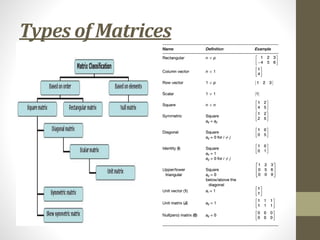
Types of Matrices
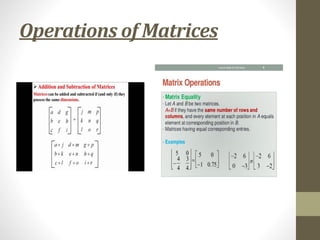
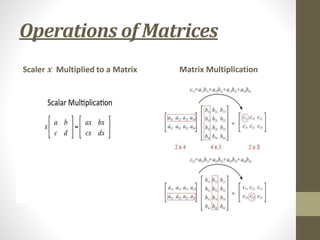
Operations of Matrices
Scaler 𝒙 Multiplied to a Matrix Matrix Multiplication
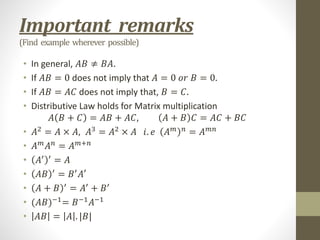
Important remarks
(Find example wherever possible)
• In general, 𝐴𝐵 ≠ 𝐵𝐴.
• If 𝐴𝐵 = 0 does not imply that 𝐴 = 0 𝑜𝑟 𝐵 = 0.
• If 𝐴𝐵 = 𝐴𝐶 does not imply that, 𝐵 = 𝐶.
• Distributive Law holds for Matrix multiplication
𝐴 𝐵 + 𝐶 = 𝐴𝐵 + 𝐴𝐶, 𝐴 + 𝐵 𝐶 = 𝐴𝐶 + 𝐵𝐶
• 𝐴2
= 𝐴 × 𝐴, 𝐴3
= 𝐴2
× 𝐴 𝑖. 𝑒 𝐴𝑚 𝑛
= 𝐴𝑚𝑛
• 𝐴𝑚
𝐴𝑛
= 𝐴𝑚+𝑛
• 𝐴′ ′
= 𝐴
• 𝐴𝐵 ′
= 𝐵′
𝐴′
• 𝐴 + 𝐵 ′
= 𝐴′
+ 𝐵′
• (𝐴𝐵)−1
= 𝐵−1
𝐴−1
• 𝐴𝐵 = 𝐴 . |𝐵|
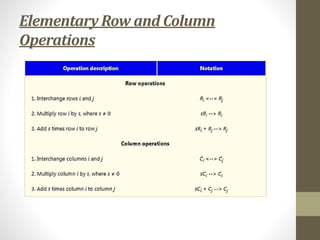
Elementary Row and Column
Operations
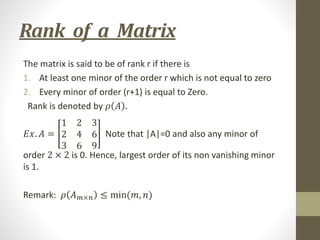
Rank of a Matrix
The matrix is said to be of rank r if there is
1. At least one minor of the order r which is not equal to zero
2. Every minor of order (r+1) is equal to Zero.
Rank is denoted by 𝜌 𝐴 .
𝐸𝑥. 𝐴 =
1 2 3
2 4 6
3 6 9
Note that |A|=0 and also any minor of
order 2 × 2 is 0. Hence, largest order of its non vanishing minor
is 1.
Remark: 𝜌 𝐴𝑚×𝑛 ≤ min(𝑚, 𝑛)
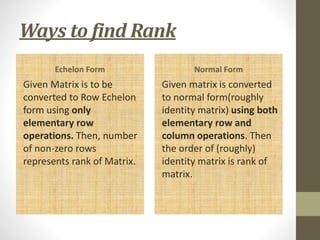
Ways to find Rank
Echelon Form
Given Matrix is to be
converted to Row Echelon
form using only
elementary row
operations. Then, number
of non-zero rows
represents rank of Matrix.
Normal Form
Given matrix is converted
to normal form(roughly
identity matrix) using both
elementary row and
column operations. Then
the order of (roughly)
identity matrix is rank of
matrix.
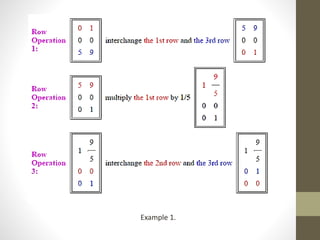
Example 1.
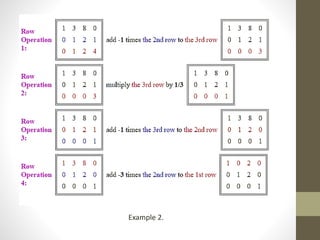
Example 2.
Normal Form
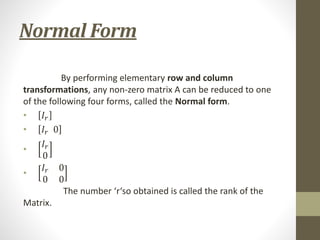
By performing elementary row and column
transformations, any non-zero matrix A can be reduced to one
of the following four forms, called the Normal form.
• 𝐼𝑟
• 𝐼𝑟 0
•
𝐼𝑟
0
•
𝐼𝑟 0
0 0
The number ‘r‘so obtained is called the rank of the
Matrix.
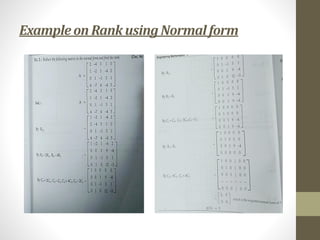
Exampleon Rank using Normalform
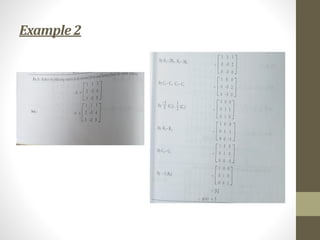
Example2
System of Linear Equations
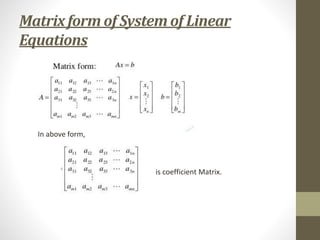
Matrix form of System of Linear
Equations
In above form,
is coefficient Matrix.
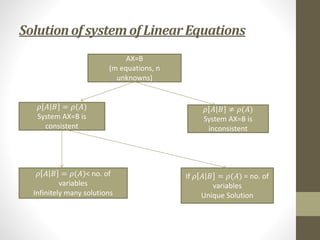
Solutionof systemof LinearEquations
AX=B
(m equations, n
unknowns)
𝜌 𝐴 𝐵 = 𝜌(𝐴)
System AX=B is
consistent
𝜌 𝐴 𝐵 ≠ 𝜌(𝐴)
System AX=B is
inconsistent
𝜌 𝐴 𝐵 = 𝜌(𝐴)< no. of
variables
Infinitely many solutions
If 𝜌 𝐴 𝐵 = 𝜌(𝐴) = no. of
variables
Unique Solution
Solution of System AX=B(Method)
1. Write the given system in matrix form(AX=B).
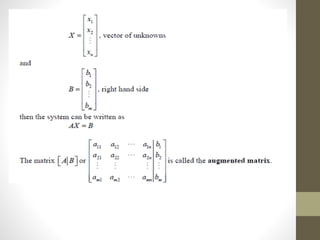
2. Consider the augmented matrix[A|B] from the given system.
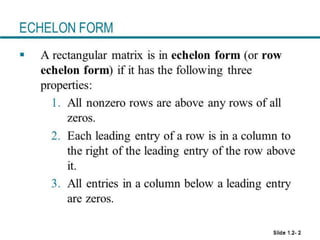
3. Reduce the augmented matrix to the Echelon form.
4. Conclude the system has unique, infinite or no solution.
5. If consistent with 𝜌 𝐴 𝐵 = 𝜌 𝐴 = no. of variables then
rewrite equations and find values.
6. If consistent with 𝜌 𝐴 𝐵 = 𝜌 𝐴 = 𝑟 < no. of variables
then put 𝑛 − 𝑟 variables(free variables) as u, v, w etc. find
values of other variables in terms of free variables.
Note : In [A|B], first part represents 𝜌 𝐴 and whole matrix represents
𝜌 𝐴 𝐵 .
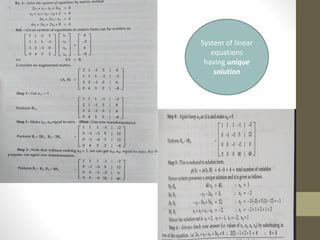
System of linear
equations
having unique
solution
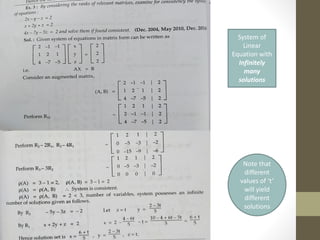
System of
Linear
Equation with
Infinitely
many
solutions
Note that
different
values of ‘t’
will yield
different
solutions
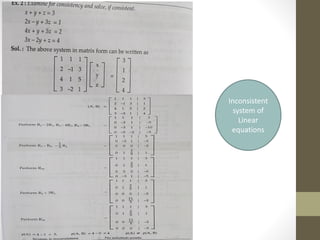
Inconsistent
system of
Linear
equations
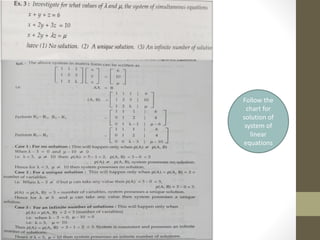
Follow the
chart for
solution of
system of
linear
equations
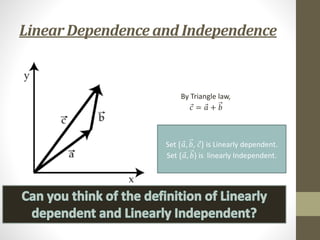
Linear Dependence and Independence
By Triangle law,
Ԧ
𝑐 = Ԧ
𝑎 + 𝑏
Set { Ԧ
𝑎, 𝑏, Ԧ
𝑐} is Linearly dependent.
Set { Ԧ
𝑎, 𝑏} is linearly Independent.
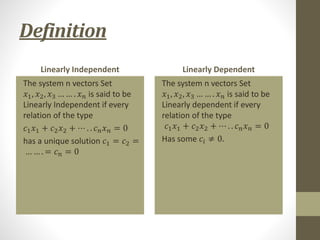
Definition
Linearly Independent
The system n vectors Set
𝑥1, 𝑥2, 𝑥3 … … . 𝑥𝑛 is said to be
Linearly Independent if every
relation of the type
𝑐1𝑥1 + 𝑐2𝑥2 + ⋯ . . 𝑐𝑛𝑥𝑛 = 0
has a unique solution 𝑐1 = 𝑐2 =
… … . = 𝑐𝑛 = 0
Linearly Dependent
The system n vectors Set
𝑥1, 𝑥2, 𝑥3 … … . 𝑥𝑛 is said to be
Linearly dependent if every
relation of the type
𝑐1𝑥1 + 𝑐2𝑥2 + ⋯ . . 𝑐𝑛𝑥𝑛 = 0
Has some 𝑐𝑖 ≠ 0.
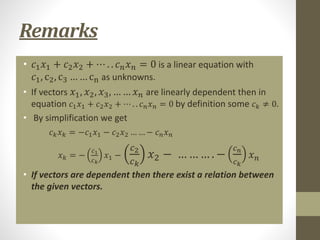
Remarks
• 𝑐1𝑥1 + 𝑐2𝑥2 + ⋯ . . 𝑐𝑛𝑥𝑛 = 0 is a linear equation with
𝑐1, c2, c3 … … cn as unknowns.
• If vectors 𝑥1, 𝑥2, 𝑥3, … … 𝑥𝑛 are linearly dependent then in
equation 𝑐1𝑥1 + 𝑐2𝑥2 + ⋯ . . 𝑐𝑛𝑥𝑛 = 0 by definition some 𝑐𝑘 ≠ 0.
• By simplification we get
• 𝑐𝑘𝑥𝑘 = −𝑐1𝑥1 − 𝑐2𝑥2 … … − 𝑐𝑛𝑥𝑛
• 𝑥𝑘 = −
𝑐1
𝑐𝑘
𝑥1 −
𝑐2
𝑐𝑘
𝑥2 − … … … . −
𝑐𝑛
𝑐𝑘
𝑥𝑛
• If vectors are dependent then there exist a relation between
the given vectors.
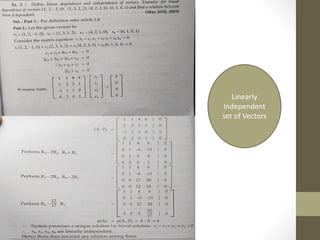
Linearly
Independent
set of Vectors
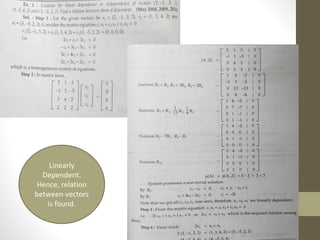
Linearly
Dependent.
Hence, relation
between vectors
is found.
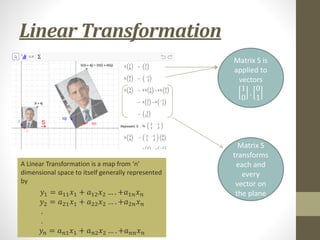
Linear Transformation
Matrix S is
applied to
vectors
1
0
,
0
1
Matrix S
transforms
each and
every
vector on
the plane
A Linear Transformation is a map from ‘n’
dimensional space to itself generally represented
by
𝑦1 = 𝑎11𝑥1 + 𝑎12𝑥2 … . +𝑎1𝑛𝑥𝑛
𝑦2 = 𝑎21𝑥1 + 𝑎22𝑥2 … . +𝑎2𝑛𝑥𝑛
.
.
𝑦𝑛 = 𝑎𝑛1𝑥1 + 𝑎𝑛2𝑥2 … . +𝑎𝑛𝑛𝑥𝑛
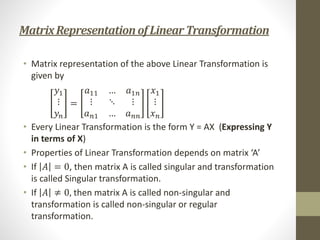
MatrixRepresentationofLinear Transformation
• Matrix representation of the above Linear Transformation is
given by
𝑦1
⋮
𝑦𝑛
=
𝑎11 … 𝑎1𝑛
⋮ ⋱ ⋮
𝑎𝑛1 … 𝑎𝑛𝑛
𝑥1
⋮
𝑥𝑛
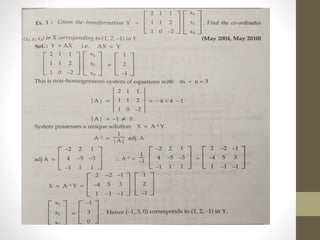
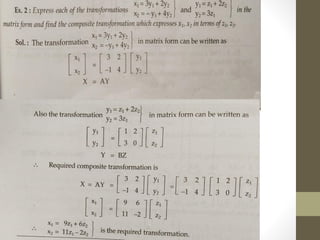
• Every Linear Transformation is the form Y = AX (Expressing Y
in terms of X)
• Properties of Linear Transformation depends on matrix ‘A’
• If 𝐴 = 0, then matrix A is called singular and transformation
is called Singular transformation.
• If 𝐴 ≠ 0, then matrix A is called non-singular and
transformation is called non-singular or regular
transformation.
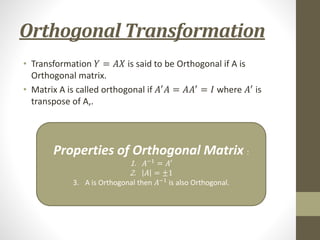
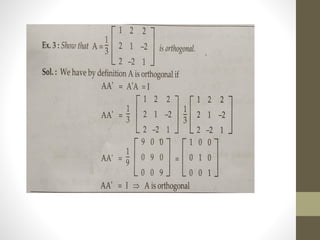
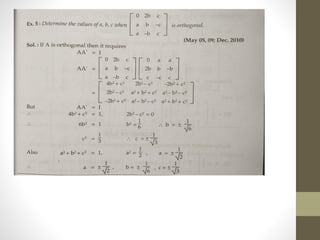
Orthogonal Transformation
• Transformation 𝑌 = 𝐴𝑋 is said to be Orthogonal if A is
Orthogonal matrix.
• Matrix A is called orthogonal if 𝐴′
𝐴 = 𝐴𝐴′
= 𝐼 where 𝐴′
is
transpose of A,.
Properties of Orthogonal Matrix :
1. 𝐴−1
= 𝐴′
2. 𝐴 = ±1
3. A is Orthogonal then 𝐴−1
is also Orthogonal.
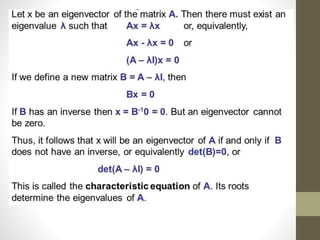
Eigen Values and Eigen Vectors
Linearly Transformed
(Using some matrix ‘A’)
• Observe blue and red vectors before and after the transformation.
Blue vector has same direction even after the transformation where
as red vector changes its direction.
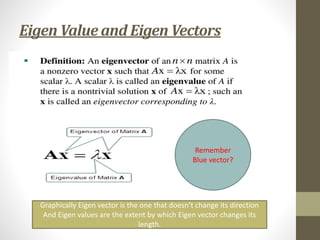
Eigen Value and Eigen Vectors
Remember
Blue vector?
Graphically Eigen vector is the one that doesn’t change its direction
And Eigen values are the extent by which Eigen vector changes its
length.
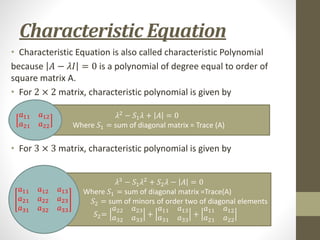
Characteristic Equation
• Characteristic Equation is also called characteristic Polynomial
because 𝐴 − 𝜆𝐼 = 0 is a polynomial of degree equal to order of
square matrix A.
• For 2 × 2 matrix, characteristic polynomial is given by
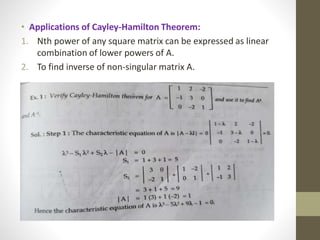
• For 3 × 3 matrix, characteristic polynomial is given by
𝜆2
− 𝑆1𝜆 + 𝐴 = 0
Where 𝑆1 = sum of diagonal matrix = Trace (A)
𝜆3
− 𝑆1𝜆2
+ 𝑆2𝜆 − 𝐴 = 0
Where 𝑆1 = sum of diagonal matrix =Trace(A)
𝑆2 = sum of minors of order two of diagonal elements
𝑆2=
𝑎22 𝑎23
𝑎32 𝑎33
+
𝑎11 𝑎13
𝑎31 𝑎33
+
𝑎11 𝑎12
𝑎21 𝑎22
𝑎11 𝑎12
𝑎21 𝑎22
𝑎11 𝑎12 𝑎13
𝑎21 𝑎22 𝑎23
𝑎31 𝑎32 𝑎33
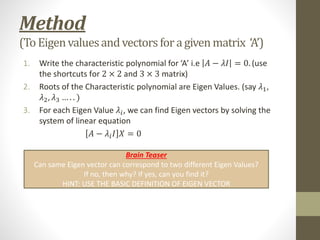
Method
(To Eigenvaluesandvectorsforagivenmatrix ‘A’)
1. Write the characteristic polynomial for ‘A’ i.e 𝐴 − 𝜆𝐼 = 0. (use
the shortcuts for 2 × 2 and 3 × 3 matrix)
2. Roots of the Characteristic polynomial are Eigen Values. (say 𝜆1,
𝜆2, 𝜆3 … . . )
3. For each Eigen Value 𝜆𝑖, we can find Eigen vectors by solving the
system of linear equation
𝐴 − 𝜆𝑖𝐼 𝑋 = 0
Brain Teaser
Can same Eigen vector can correspond to two different Eigen Values?
If no, then why? If yes, can you find it?
HINT: USE THE BASIC DEFINITION OF EIGEN VECTOR
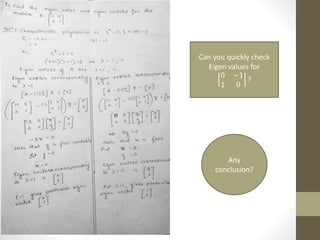
Can you quickly check
Eigen values for
0 −1
1 0
?
Any
conclusion?
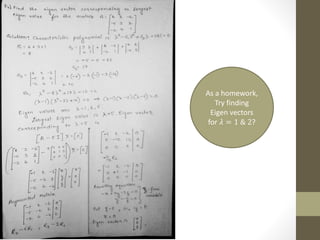
As a homework,
Try finding
Eigen vectors
for 𝜆 = 1 & 2?
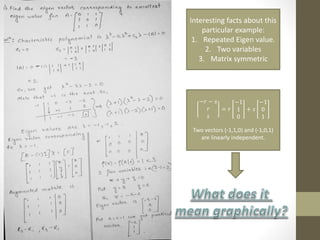
Interesting facts about this
particular example:
1. Repeated Eigen value.
2. Two variables
3. Matrix symmetric
−𝑟 − 𝑠
𝑟
𝑠
= 𝑟
−1
1
0
+ 𝑠
−1
0
1
Two vectors (-1,1,0) and (-1,0,1)
are linearly independent.
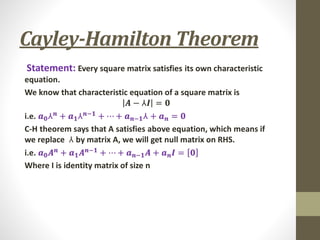
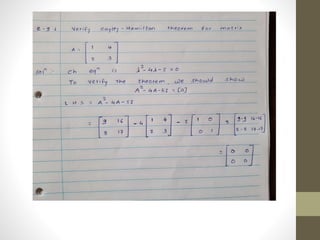
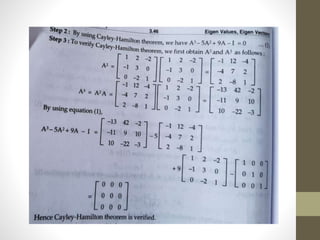
Cayley-Hamilton Theorem
Statement: Every square matrix satisfies its own characteristic
equation.
We know that characteristic equation of a square matrix is
𝑨 − ⅄𝑰 = 𝟎
i.e. 𝒂𝟎⅄𝒏 + 𝒂𝟏⅄𝒏−𝟏 + ⋯ + 𝒂𝒏−𝟏⅄ + 𝒂𝒏 = 𝟎
C-H theorem says that A satisfies above equation, which means if
we replace ⅄ by matrix A, we will get null matrix on RHS.
i.e. 𝒂𝟎𝑨𝒏 + 𝒂𝟏𝑨𝒏−𝟏 + ⋯ + 𝒂𝒏−𝟏𝑨 + 𝒂𝒏𝑰 = 𝟎
Where I is identity matrix of size n
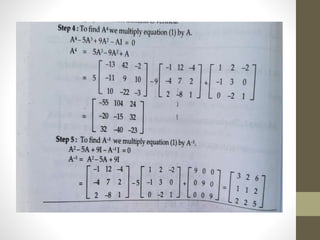
• Applications of Cayley-Hamilton Theorem:
1. Nth power of any square matrix can be expressed as linear
combination of lower powers of A.
2. To find inverse of non-singular matrix A.
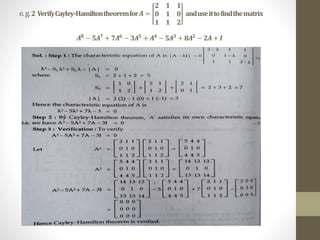
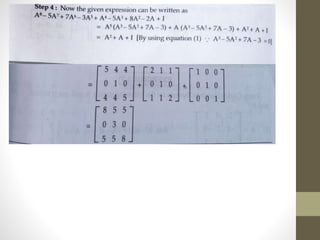
e.g.2 VerifyCayley-Hamiltontheoremfor𝑨 =
𝟐 𝟏 𝟏
𝟎 𝟏 𝟎
𝟏 𝟏 𝟐
anduseittofindthematrix
𝑨𝟖
− 𝟓𝑨𝟕
+ 𝟕𝑨𝟔
−𝟑𝑨𝟓
+ 𝑨𝟒
−𝟓𝑨𝟑
+ 𝟖𝑨𝟐
− 𝟐𝑨 +𝑰
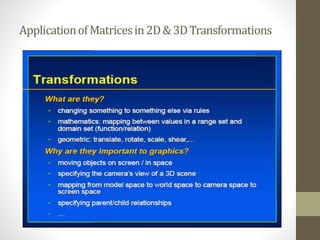
ApplicationofMatricesin2D&3DTransformations
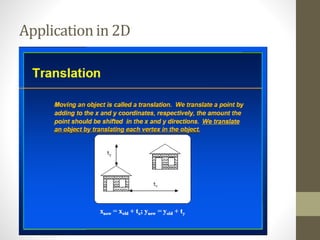
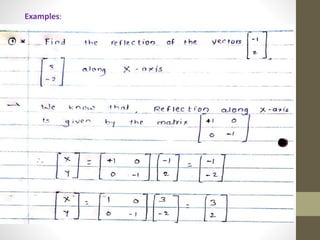
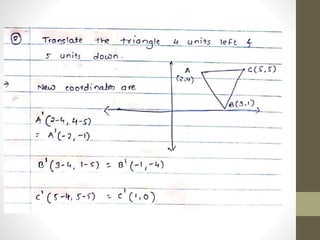
Applicationin 2D
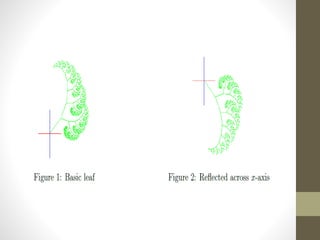
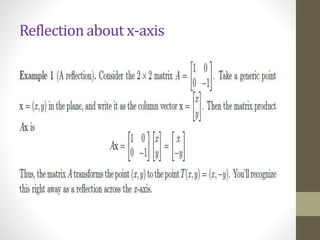
Reflectionabout x-axis
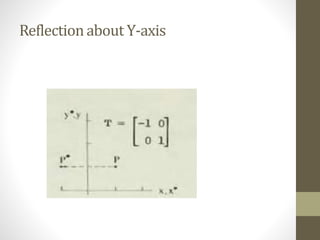
Reflectionabout Y-axis
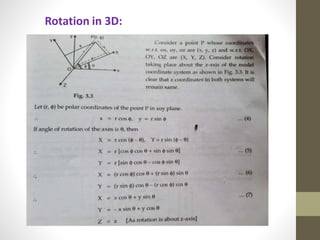
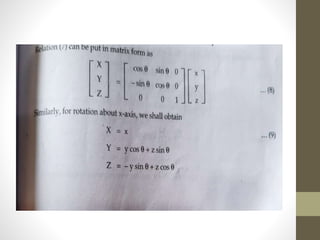
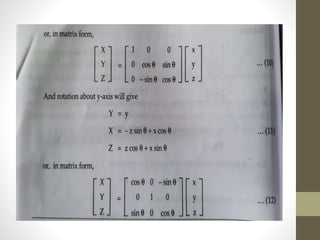
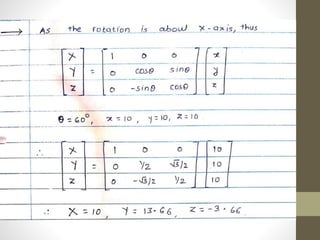
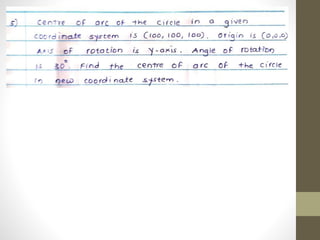
Rotation in 3D:
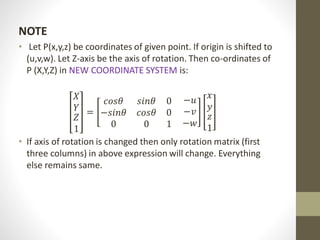
NOTE
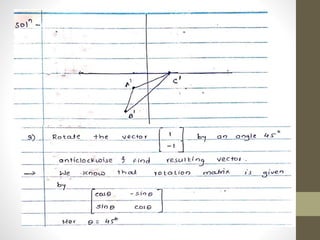
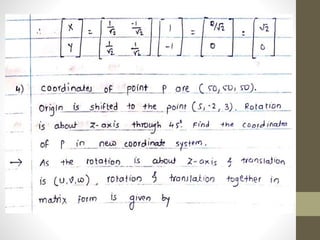
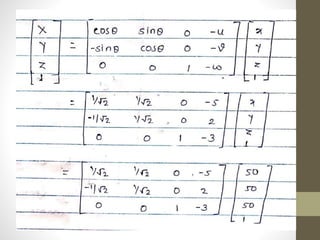
• Let P(x,y,z) be coordinates of given point. If origin is shifted to
(u,v,w). Let Z-axis be the axis of rotation. Then co-ordinates of
P (X,Y,Z) in NEW COORDINATE SYSTEM is:
𝑋
𝑌
𝑍
1
=
𝑐𝑜𝑠𝜃 𝑠𝑖𝑛𝜃 0
−𝑠𝑖𝑛𝜃 𝑐𝑜𝑠𝜃 0
0 0 1
−𝑢
−𝑣
−𝑤
𝑥
𝑦
𝑧
1
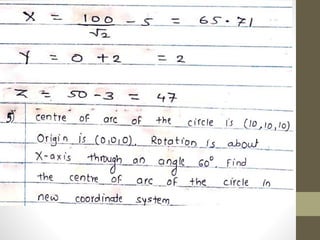
• If axis of rotation is changed then only rotation matrix (first
three columns) in above expression will change. Everything
else remains same.
Examples:
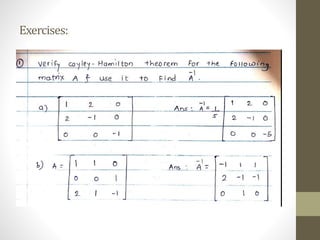
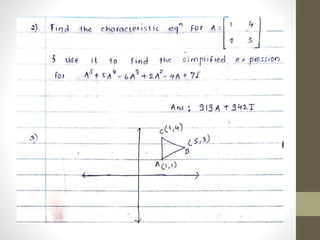
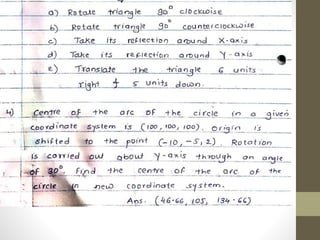
Exercises:
Module 1 Theory of Matrices.pdf

Module 1 Theory of Matrices.pdf

  • 1.
    Theory of Matrices Anarrangement of certain numbers in an array of m rows and n columns such as 𝐀 = 𝒂𝟏𝟏 ⋯ 𝒂𝟏𝒏 ⋮ ⋱ ⋮ 𝒂𝒎𝟏 ⋯ 𝒂𝒎𝒏 m – no. of rows row in A, n – number of columns in A. Thus, matrix is denoted by 𝑨𝒎×𝒏. 𝑨 = 𝒂𝒊𝒋 𝒎×𝒏 where 𝒂𝒊𝒋 denotes an element belonging to 𝒊𝒕𝒉 𝒓𝒐𝒘 𝒂𝒏𝒅 𝒋𝒕𝒉 𝒄𝒐𝒍𝒖𝒎𝒏.
  • 2.
  • 3.
  • 4.
    Operations of Matrices Scaler𝒙 Multiplied to a Matrix Matrix Multiplication
  • 5.
    Important remarks (Find examplewherever possible) • In general, 𝐴𝐵 ≠ 𝐵𝐴. • If 𝐴𝐵 = 0 does not imply that 𝐴 = 0 𝑜𝑟 𝐵 = 0. • If 𝐴𝐵 = 𝐴𝐶 does not imply that, 𝐵 = 𝐶. • Distributive Law holds for Matrix multiplication 𝐴 𝐵 + 𝐶 = 𝐴𝐵 + 𝐴𝐶, 𝐴 + 𝐵 𝐶 = 𝐴𝐶 + 𝐵𝐶 • 𝐴2 = 𝐴 × 𝐴, 𝐴3 = 𝐴2 × 𝐴 𝑖. 𝑒 𝐴𝑚 𝑛 = 𝐴𝑚𝑛 • 𝐴𝑚 𝐴𝑛 = 𝐴𝑚+𝑛 • 𝐴′ ′ = 𝐴 • 𝐴𝐵 ′ = 𝐵′ 𝐴′ • 𝐴 + 𝐵 ′ = 𝐴′ + 𝐵′ • (𝐴𝐵)−1 = 𝐵−1 𝐴−1 • 𝐴𝐵 = 𝐴 . |𝐵|
  • 6.
    Elementary Row andColumn Operations
  • 7.
    Rank of aMatrix The matrix is said to be of rank r if there is 1. At least one minor of the order r which is not equal to zero 2. Every minor of order (r+1) is equal to Zero. Rank is denoted by 𝜌 𝐴 . 𝐸𝑥. 𝐴 = 1 2 3 2 4 6 3 6 9 Note that |A|=0 and also any minor of order 2 × 2 is 0. Hence, largest order of its non vanishing minor is 1. Remark: 𝜌 𝐴𝑚×𝑛 ≤ min(𝑚, 𝑛)
  • 8.
    Ways to findRank Echelon Form Given Matrix is to be converted to Row Echelon form using only elementary row operations. Then, number of non-zero rows represents rank of Matrix. Normal Form Given matrix is converted to normal form(roughly identity matrix) using both elementary row and column operations. Then the order of (roughly) identity matrix is rank of matrix.
  • 10.
  • 11.
  • 12.
    Normal Form By performingelementary row and column transformations, any non-zero matrix A can be reduced to one of the following four forms, called the Normal form. • 𝐼𝑟 • 𝐼𝑟 0 • 𝐼𝑟 0 • 𝐼𝑟 0 0 0 The number ‘r‘so obtained is called the rank of the Matrix.
  • 13.
  • 14.
  • 15.
  • 16.
    Matrix form ofSystem of Linear Equations In above form, is coefficient Matrix.
  • 18.
    Solutionof systemof LinearEquations AX=B (mequations, n unknowns) 𝜌 𝐴 𝐵 = 𝜌(𝐴) System AX=B is consistent 𝜌 𝐴 𝐵 ≠ 𝜌(𝐴) System AX=B is inconsistent 𝜌 𝐴 𝐵 = 𝜌(𝐴)< no. of variables Infinitely many solutions If 𝜌 𝐴 𝐵 = 𝜌(𝐴) = no. of variables Unique Solution
  • 19.
    Solution of SystemAX=B(Method) 1. Write the given system in matrix form(AX=B). 2. Consider the augmented matrix[A|B] from the given system. 3. Reduce the augmented matrix to the Echelon form. 4. Conclude the system has unique, infinite or no solution. 5. If consistent with 𝜌 𝐴 𝐵 = 𝜌 𝐴 = no. of variables then rewrite equations and find values. 6. If consistent with 𝜌 𝐴 𝐵 = 𝜌 𝐴 = 𝑟 < no. of variables then put 𝑛 − 𝑟 variables(free variables) as u, v, w etc. find values of other variables in terms of free variables. Note : In [A|B], first part represents 𝜌 𝐴 and whole matrix represents 𝜌 𝐴 𝐵 .
  • 20.
  • 21.
    System of Linear Equation with Infinitely many solutions Notethat different values of ‘t’ will yield different solutions
  • 22.
  • 23.
    Follow the chart for solutionof system of linear equations
  • 24.
    Linear Dependence andIndependence By Triangle law, Ԧ 𝑐 = Ԧ 𝑎 + 𝑏 Set { Ԧ 𝑎, 𝑏, Ԧ 𝑐} is Linearly dependent. Set { Ԧ 𝑎, 𝑏} is linearly Independent.
  • 25.
    Definition Linearly Independent The systemn vectors Set 𝑥1, 𝑥2, 𝑥3 … … . 𝑥𝑛 is said to be Linearly Independent if every relation of the type 𝑐1𝑥1 + 𝑐2𝑥2 + ⋯ . . 𝑐𝑛𝑥𝑛 = 0 has a unique solution 𝑐1 = 𝑐2 = … … . = 𝑐𝑛 = 0 Linearly Dependent The system n vectors Set 𝑥1, 𝑥2, 𝑥3 … … . 𝑥𝑛 is said to be Linearly dependent if every relation of the type 𝑐1𝑥1 + 𝑐2𝑥2 + ⋯ . . 𝑐𝑛𝑥𝑛 = 0 Has some 𝑐𝑖 ≠ 0.
  • 26.
    Remarks • 𝑐1𝑥1 +𝑐2𝑥2 + ⋯ . . 𝑐𝑛𝑥𝑛 = 0 is a linear equation with 𝑐1, c2, c3 … … cn as unknowns. • If vectors 𝑥1, 𝑥2, 𝑥3, … … 𝑥𝑛 are linearly dependent then in equation 𝑐1𝑥1 + 𝑐2𝑥2 + ⋯ . . 𝑐𝑛𝑥𝑛 = 0 by definition some 𝑐𝑘 ≠ 0. • By simplification we get • 𝑐𝑘𝑥𝑘 = −𝑐1𝑥1 − 𝑐2𝑥2 … … − 𝑐𝑛𝑥𝑛 • 𝑥𝑘 = − 𝑐1 𝑐𝑘 𝑥1 − 𝑐2 𝑐𝑘 𝑥2 − … … … . − 𝑐𝑛 𝑐𝑘 𝑥𝑛 • If vectors are dependent then there exist a relation between the given vectors.
  • 27.
  • 28.
  • 29.
    Linear Transformation Matrix Sis applied to vectors 1 0 , 0 1 Matrix S transforms each and every vector on the plane A Linear Transformation is a map from ‘n’ dimensional space to itself generally represented by 𝑦1 = 𝑎11𝑥1 + 𝑎12𝑥2 … . +𝑎1𝑛𝑥𝑛 𝑦2 = 𝑎21𝑥1 + 𝑎22𝑥2 … . +𝑎2𝑛𝑥𝑛 . . 𝑦𝑛 = 𝑎𝑛1𝑥1 + 𝑎𝑛2𝑥2 … . +𝑎𝑛𝑛𝑥𝑛
  • 30.
    MatrixRepresentationofLinear Transformation • Matrixrepresentation of the above Linear Transformation is given by 𝑦1 ⋮ 𝑦𝑛 = 𝑎11 … 𝑎1𝑛 ⋮ ⋱ ⋮ 𝑎𝑛1 … 𝑎𝑛𝑛 𝑥1 ⋮ 𝑥𝑛 • Every Linear Transformation is the form Y = AX (Expressing Y in terms of X) • Properties of Linear Transformation depends on matrix ‘A’ • If 𝐴 = 0, then matrix A is called singular and transformation is called Singular transformation. • If 𝐴 ≠ 0, then matrix A is called non-singular and transformation is called non-singular or regular transformation.
  • 33.
    Orthogonal Transformation • Transformation𝑌 = 𝐴𝑋 is said to be Orthogonal if A is Orthogonal matrix. • Matrix A is called orthogonal if 𝐴′ 𝐴 = 𝐴𝐴′ = 𝐼 where 𝐴′ is transpose of A,. Properties of Orthogonal Matrix : 1. 𝐴−1 = 𝐴′ 2. 𝐴 = ±1 3. A is Orthogonal then 𝐴−1 is also Orthogonal.
  • 36.
    Eigen Values andEigen Vectors Linearly Transformed (Using some matrix ‘A’) • Observe blue and red vectors before and after the transformation. Blue vector has same direction even after the transformation where as red vector changes its direction.
  • 37.
    Eigen Value andEigen Vectors Remember Blue vector? Graphically Eigen vector is the one that doesn’t change its direction And Eigen values are the extent by which Eigen vector changes its length.
  • 39.
    Characteristic Equation • CharacteristicEquation is also called characteristic Polynomial because 𝐴 − 𝜆𝐼 = 0 is a polynomial of degree equal to order of square matrix A. • For 2 × 2 matrix, characteristic polynomial is given by • For 3 × 3 matrix, characteristic polynomial is given by 𝜆2 − 𝑆1𝜆 + 𝐴 = 0 Where 𝑆1 = sum of diagonal matrix = Trace (A) 𝜆3 − 𝑆1𝜆2 + 𝑆2𝜆 − 𝐴 = 0 Where 𝑆1 = sum of diagonal matrix =Trace(A) 𝑆2 = sum of minors of order two of diagonal elements 𝑆2= 𝑎22 𝑎23 𝑎32 𝑎33 + 𝑎11 𝑎13 𝑎31 𝑎33 + 𝑎11 𝑎12 𝑎21 𝑎22 𝑎11 𝑎12 𝑎21 𝑎22 𝑎11 𝑎12 𝑎13 𝑎21 𝑎22 𝑎23 𝑎31 𝑎32 𝑎33
  • 40.
    Method (To Eigenvaluesandvectorsforagivenmatrix ‘A’) 1.Write the characteristic polynomial for ‘A’ i.e 𝐴 − 𝜆𝐼 = 0. (use the shortcuts for 2 × 2 and 3 × 3 matrix) 2. Roots of the Characteristic polynomial are Eigen Values. (say 𝜆1, 𝜆2, 𝜆3 … . . ) 3. For each Eigen Value 𝜆𝑖, we can find Eigen vectors by solving the system of linear equation 𝐴 − 𝜆𝑖𝐼 𝑋 = 0 Brain Teaser Can same Eigen vector can correspond to two different Eigen Values? If no, then why? If yes, can you find it? HINT: USE THE BASIC DEFINITION OF EIGEN VECTOR
  • 41.
    Can you quicklycheck Eigen values for 0 −1 1 0 ? Any conclusion?
  • 42.
    As a homework, Tryfinding Eigen vectors for 𝜆 = 1 & 2?
  • 43.
    Interesting facts aboutthis particular example: 1. Repeated Eigen value. 2. Two variables 3. Matrix symmetric −𝑟 − 𝑠 𝑟 𝑠 = 𝑟 −1 1 0 + 𝑠 −1 0 1 Two vectors (-1,1,0) and (-1,0,1) are linearly independent.
  • 45.
    Cayley-Hamilton Theorem Statement: Everysquare matrix satisfies its own characteristic equation. We know that characteristic equation of a square matrix is 𝑨 − ⅄𝑰 = 𝟎 i.e. 𝒂𝟎⅄𝒏 + 𝒂𝟏⅄𝒏−𝟏 + ⋯ + 𝒂𝒏−𝟏⅄ + 𝒂𝒏 = 𝟎 C-H theorem says that A satisfies above equation, which means if we replace ⅄ by matrix A, we will get null matrix on RHS. i.e. 𝒂𝟎𝑨𝒏 + 𝒂𝟏𝑨𝒏−𝟏 + ⋯ + 𝒂𝒏−𝟏𝑨 + 𝒂𝒏𝑰 = 𝟎 Where I is identity matrix of size n
  • 47.
    • Applications ofCayley-Hamilton Theorem: 1. Nth power of any square matrix can be expressed as linear combination of lower powers of A. 2. To find inverse of non-singular matrix A.
  • 50.
    e.g.2 VerifyCayley-Hamiltontheoremfor𝑨 = 𝟐𝟏 𝟏 𝟎 𝟏 𝟎 𝟏 𝟏 𝟐 anduseittofindthematrix 𝑨𝟖 − 𝟓𝑨𝟕 + 𝟕𝑨𝟔 −𝟑𝑨𝟓 + 𝑨𝟒 −𝟓𝑨𝟑 + 𝟖𝑨𝟐 − 𝟐𝑨 +𝑰
  • 52.
  • 53.
  • 58.
  • 60.
  • 61.
  • 64.
    NOTE • Let P(x,y,z)be coordinates of given point. If origin is shifted to (u,v,w). Let Z-axis be the axis of rotation. Then co-ordinates of P (X,Y,Z) in NEW COORDINATE SYSTEM is: 𝑋 𝑌 𝑍 1 = 𝑐𝑜𝑠𝜃 𝑠𝑖𝑛𝜃 0 −𝑠𝑖𝑛𝜃 𝑐𝑜𝑠𝜃 0 0 0 1 −𝑢 −𝑣 −𝑤 𝑥 𝑦 𝑧 1 • If axis of rotation is changed then only rotation matrix (first three columns) in above expression will change. Everything else remains same.
  • 65.
  • 72.