1
The Database Environment
(Data and Information Management IS331)
Lecture 2
Abdisalam Issa-Salwe
Taibah University
College of Computer Science & Engineering
Information Systems Department
Jeffrey A. Hoffer, et al: Modern Database Management, 8th Edition, 2007, Prentice Hall
Objectives
 Definition of terms
 Explain growth and importance of databases
 Name limitations of conventional file processing
 Identify five categories of databases
 Explain advantages of databases
 Identify costs and risks of databases
 List components of database environment
 Describe evolution of database systems
2
Definitions
 Database: organized collection of logically
related data
 Data: stored representations of meaningful
objects and events
 Structured: numbers, text, dates
 Unstructured: images, video, documents
 Information: data processed to increase
knowledge in the person using the data
 Metadata: data that describes the properties and
context of user data
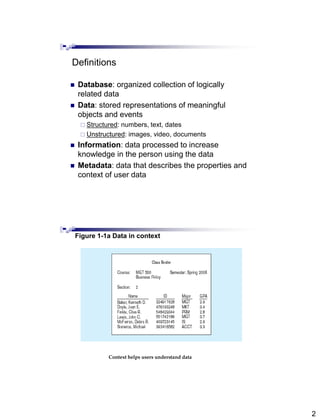
Figure 1-1a Data in context
Context helps users understand data
3
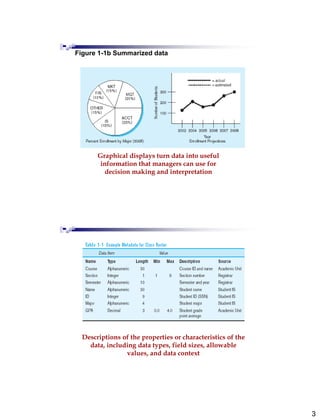
Graphical displays turn data into useful
information that managers can use for
decision making and interpretation
Figure 1-1b Summarized data
Descriptions of the properties or characteristics of the
data, including data types, field sizes, allowable
values, and data context
4
Disadvantages of File Processing
 Program-Data Dependence
 All programs maintain metadata for each file they use
 Duplication of Data
 Different systems/programs have separate copies of the same data
 Limited Data Sharing
 No centralized control of data
 Lengthy Development Times
 Programmers must design their own file formats
 Excessive Program Maintenance
 80% of information systems budget
Problems with Data Dependency
 Each application programmer must
maintain his/her own data
 Each application program needs to
include code for the metadata of each file
 Each application program must have its
own processing routines for reading,
inserting, updating, and deleting data
 Lack of coordination and central control
 Non-standard file formats
5
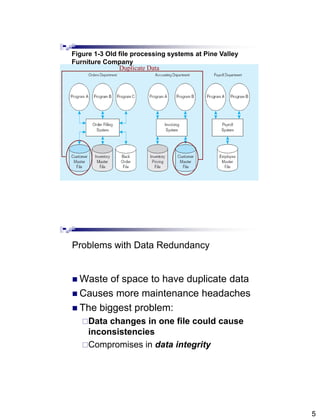
Figure 1-3 Old file processing systems at Pine Valley
Furniture Company
Duplicate Data
Problems with Data Redundancy
 Waste of space to have duplicate data
 Causes more maintenance headaches
 The biggest problem:
Data changes in one file could cause
inconsistencies
Compromises in data integrity
6
SOLUTION:
The DATABASE Approach
 Central repository of shared data
 Data is managed by a controlling
agent
 Stored in a standardized, convenient
form
Requires a Database Management System (DBMS)
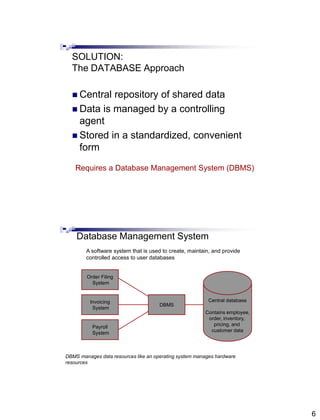
Database Management System
DBMS manages data resources like an operating system manages hardware
resources
 A software system that is used to create, maintain, and provide
controlled access to user databases
Order Filing
System
Invoicing
System
Payroll
System
DBMS
Central database
Contains employee,
order, inventory,
pricing, and
customer data
7
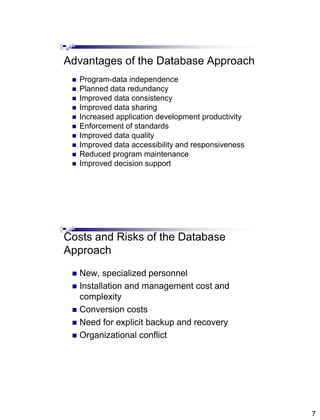
Advantages of the Database Approach
 Program-data independence
 Planned data redundancy
 Improved data consistency
 Improved data sharing
 Increased application development productivity
 Enforcement of standards
 Improved data quality
 Improved data accessibility and responsiveness
 Reduced program maintenance
 Improved decision support
Costs and Risks of the Database
Approach
 New, specialized personnel
 Installation and management cost and
complexity
 Conversion costs
 Need for explicit backup and recovery
 Organizational conflict
8
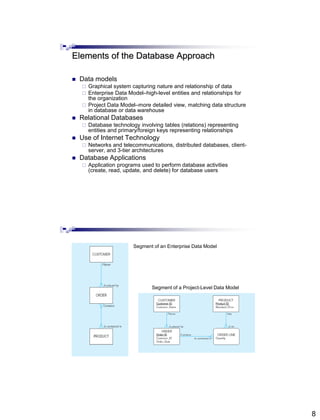
Elements of the Database Approach
 Data models
 Graphical system capturing nature and relationship of data
 Enterprise Data Model–high-level entities and relationships for
the organization
 Project Data Model–more detailed view, matching data structure
in database or data warehouse
 Relational Databases
 Database technology involving tables (relations) representing
entities and primary/foreign keys representing relationships
 Use of Internet Technology
 Networks and telecommunications, distributed databases, client-
server, and 3-tier architectures
 Database Applications
 Application programs used to perform database activities
(create, read, update, and delete) for database users
Segment of an Enterprise Data Model
Segment of a Project-Level Data Model
9
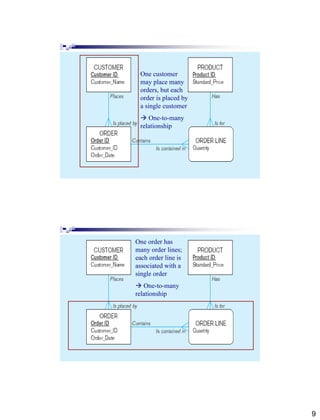
One customer
may place many
orders, but each
order is placed by
a single customer
 One-to-many
relationship
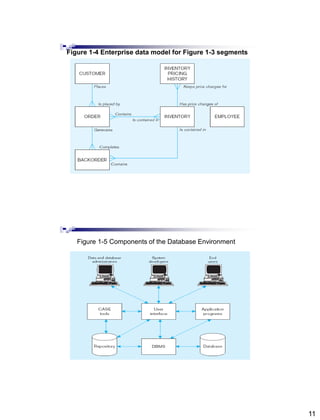
One order has
many order lines;
each order line is
associated with a
single order
 One-to-many
relationship
10
One product can
be in many
order lines, each
order line refers
to a single
product
 One-to-many
relationship
Therefore, one
order involves
many products
and one product is
involved in many
orders
 Many-to-many
relationship
11
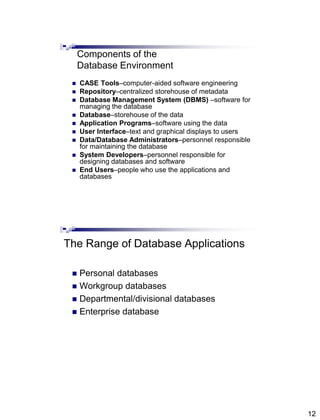
Figure 1-4 Enterprise data model for Figure 1-3 segments
Figure 1-5 Components of the Database Environment
12
Components of the
Database Environment
 CASE Tools–computer-aided software engineering
 Repository–centralized storehouse of metadata
 Database Management System (DBMS) –software for
managing the database
 Database–storehouse of the data
 Application Programs–software using the data
 User Interface–text and graphical displays to users
 Data/Database Administrators–personnel responsible
for maintaining the database
 System Developers–personnel responsible for
designing databases and software
 End Users–people who use the applications and
databases
The Range of Database Applications
 Personal databases
 Workgroup databases
 Departmental/divisional databases
 Enterprise database
13
Figure 1-6
Typical data
from a
personal
database
14
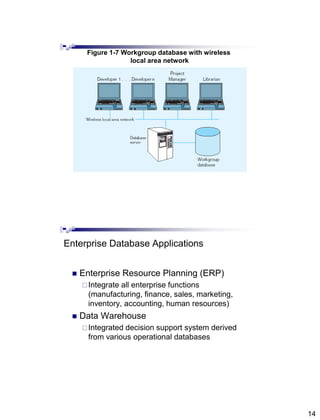
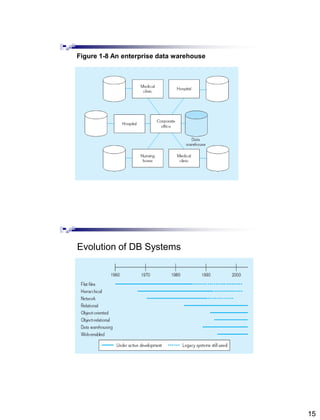
Figure 1-7 Workgroup database with wireless
local area network
Enterprise Database Applications
 Enterprise Resource Planning (ERP)
Integrate all enterprise functions
(manufacturing, finance, sales, marketing,
inventory, accounting, human resources)
 Data Warehouse
Integrated decision support system derived
from various operational databases
15
Figure 1-8 An enterprise data warehouse
Evolution of DB Systems
16
References
Jeffrey A. Hoffer, Mary B. Prescott and Fred R.
McFadden: Modern Database Management,
8th Edition, 2007, Prentice Hall

Lecture2 is331 data&infomanag(databaseenv)

  • 1.
    1 The Database Environment (Dataand Information Management IS331) Lecture 2 Abdisalam Issa-Salwe Taibah University College of Computer Science & Engineering Information Systems Department Jeffrey A. Hoffer, et al: Modern Database Management, 8th Edition, 2007, Prentice Hall Objectives  Definition of terms  Explain growth and importance of databases  Name limitations of conventional file processing  Identify five categories of databases  Explain advantages of databases  Identify costs and risks of databases  List components of database environment  Describe evolution of database systems
  • 2.
    2 Definitions  Database: organizedcollection of logically related data  Data: stored representations of meaningful objects and events  Structured: numbers, text, dates  Unstructured: images, video, documents  Information: data processed to increase knowledge in the person using the data  Metadata: data that describes the properties and context of user data Figure 1-1a Data in context Context helps users understand data
  • 3.
    3 Graphical displays turndata into useful information that managers can use for decision making and interpretation Figure 1-1b Summarized data Descriptions of the properties or characteristics of the data, including data types, field sizes, allowable values, and data context
  • 4.
    4 Disadvantages of FileProcessing  Program-Data Dependence  All programs maintain metadata for each file they use  Duplication of Data  Different systems/programs have separate copies of the same data  Limited Data Sharing  No centralized control of data  Lengthy Development Times  Programmers must design their own file formats  Excessive Program Maintenance  80% of information systems budget Problems with Data Dependency  Each application programmer must maintain his/her own data  Each application program needs to include code for the metadata of each file  Each application program must have its own processing routines for reading, inserting, updating, and deleting data  Lack of coordination and central control  Non-standard file formats
  • 5.
    5 Figure 1-3 Oldfile processing systems at Pine Valley Furniture Company Duplicate Data Problems with Data Redundancy  Waste of space to have duplicate data  Causes more maintenance headaches  The biggest problem: Data changes in one file could cause inconsistencies Compromises in data integrity
  • 6.
    6 SOLUTION: The DATABASE Approach Central repository of shared data  Data is managed by a controlling agent  Stored in a standardized, convenient form Requires a Database Management System (DBMS) Database Management System DBMS manages data resources like an operating system manages hardware resources  A software system that is used to create, maintain, and provide controlled access to user databases Order Filing System Invoicing System Payroll System DBMS Central database Contains employee, order, inventory, pricing, and customer data
  • 7.
    7 Advantages of theDatabase Approach  Program-data independence  Planned data redundancy  Improved data consistency  Improved data sharing  Increased application development productivity  Enforcement of standards  Improved data quality  Improved data accessibility and responsiveness  Reduced program maintenance  Improved decision support Costs and Risks of the Database Approach  New, specialized personnel  Installation and management cost and complexity  Conversion costs  Need for explicit backup and recovery  Organizational conflict
  • 8.
    8 Elements of theDatabase Approach  Data models  Graphical system capturing nature and relationship of data  Enterprise Data Model–high-level entities and relationships for the organization  Project Data Model–more detailed view, matching data structure in database or data warehouse  Relational Databases  Database technology involving tables (relations) representing entities and primary/foreign keys representing relationships  Use of Internet Technology  Networks and telecommunications, distributed databases, client- server, and 3-tier architectures  Database Applications  Application programs used to perform database activities (create, read, update, and delete) for database users Segment of an Enterprise Data Model Segment of a Project-Level Data Model
  • 9.
    9 One customer may placemany orders, but each order is placed by a single customer  One-to-many relationship One order has many order lines; each order line is associated with a single order  One-to-many relationship
  • 10.
    10 One product can bein many order lines, each order line refers to a single product  One-to-many relationship Therefore, one order involves many products and one product is involved in many orders  Many-to-many relationship
  • 11.
    11 Figure 1-4 Enterprisedata model for Figure 1-3 segments Figure 1-5 Components of the Database Environment
  • 12.
    12 Components of the DatabaseEnvironment  CASE Tools–computer-aided software engineering  Repository–centralized storehouse of metadata  Database Management System (DBMS) –software for managing the database  Database–storehouse of the data  Application Programs–software using the data  User Interface–text and graphical displays to users  Data/Database Administrators–personnel responsible for maintaining the database  System Developers–personnel responsible for designing databases and software  End Users–people who use the applications and databases The Range of Database Applications  Personal databases  Workgroup databases  Departmental/divisional databases  Enterprise database
  • 13.
  • 14.
    14 Figure 1-7 Workgroupdatabase with wireless local area network Enterprise Database Applications  Enterprise Resource Planning (ERP) Integrate all enterprise functions (manufacturing, finance, sales, marketing, inventory, accounting, human resources)  Data Warehouse Integrated decision support system derived from various operational databases
  • 15.
    15 Figure 1-8 Anenterprise data warehouse Evolution of DB Systems
  • 16.
    16 References Jeffrey A. Hoffer,Mary B. Prescott and Fred R. McFadden: Modern Database Management, 8th Edition, 2007, Prentice Hall