1
Abdisalam Issa-Salwe
Taibah University
College of Computer Science & Engineering
Information Systems Department
The Open Group Architectural
Framework (TOGAF)
(Enterprise Architecture IS353)
Lecture 3
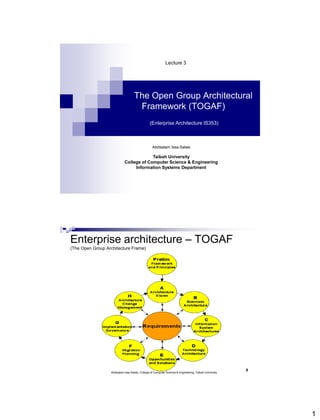
Enterprise architecture – TOGAF
(The Open Group Architecture Frame)
Abdisalam Issa-Salwe, College of Computer Science & Engineering, Taibah University
2
2
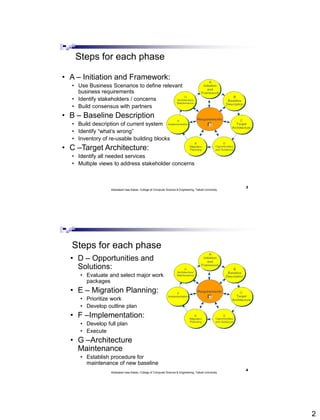
Steps for each phase
• A – Initiation and Framework:
• Use Business Scenarios to define relevant
business requirements
• Identify stakeholders / concerns
• Build consensus with partners
• B – Baseline Description
• Build description of current system
• Identify “what’s wrong”
• Inventory of re-usable building blocks
• C –Target Architecture:
• Identify all needed services
• Multiple views to address stakeholder concerns
Abdisalam Issa-Salwe, College of Computer Science & Engineering, Taibah University
3
Steps for each phase
• D – Opportunities and
Solutions:
• Evaluate and select major work
packages
• E – Migration Planning:
• Prioritize work
• Develop outline plan
• F –Implementation:
• Develop full plan
• Execute
• G –Architecture
Maintenance
• Establish procedure for
maintenance of new baseline
Abdisalam Issa-Salwe, College of Computer Science & Engineering, Taibah University
4
3
Definition
 The Open Group Architecture Framework is best known
by its acronym, TOGAF.
 TOGAF is owned by The Open Group
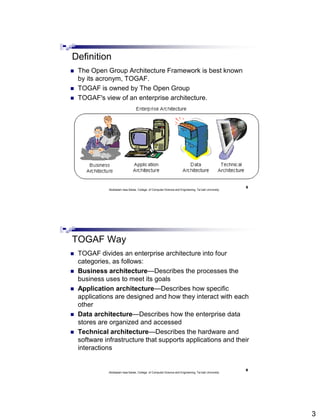
 TOGAF's view of an enterprise architecture.
5
Abdisalam Issa-Salwe, College of Computer Science and Engineering, Tai bah University
TOGAF Way
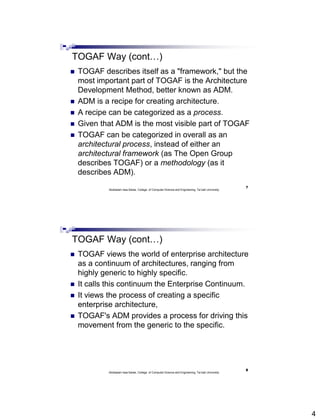
 TOGAF divides an enterprise architecture into four
categories, as follows:
 Business architecture—Describes the processes the
business uses to meet its goals
 Application architecture—Describes how specific
applications are designed and how they interact with each
other
 Data architecture—Describes how the enterprise data
stores are organized and accessed
 Technical architecture—Describes the hardware and
software infrastructure that supports applications and their
interactions
6
Abdisalam Issa-Salwe, College of Computer Science and Engineering, Tai bah University
4
TOGAF Way (cont…)
 TOGAF describes itself as a "framework," but the
most important part of TOGAF is the Architecture
Development Method, better known as ADM.
 ADM is a recipe for creating architecture.
 A recipe can be categorized as a process.
 Given that ADM is the most visible part of TOGAF
 TOGAF can be categorized in overall as an
architectural process, instead of either an
architectural framework (as The Open Group
describes TOGAF) or a methodology (as it
describes ADM).
7
Abdisalam Issa-Salwe, College of Computer Science and Engineering, Tai bah University
TOGAF Way (cont…)
 TOGAF views the world of enterprise architecture
as a continuum of architectures, ranging from
highly generic to highly specific.
 It calls this continuum the Enterprise Continuum.
 It views the process of creating a specific
enterprise architecture,
 TOGAF's ADM provides a process for driving this
movement from the generic to the specific.
8
Abdisalam Issa-Salwe, College of Computer Science and Engineering, Tai bah University
5
TOGAF Way (cont…)
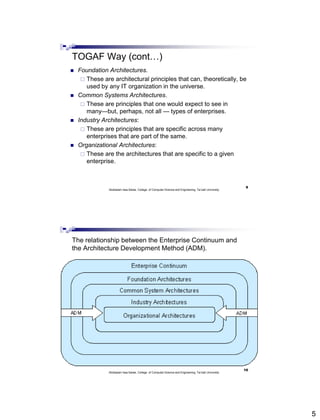
 Foundation Architectures.
 These are architectural principles that can, theoretically, be
used by any IT organization in the universe.
 Common Systems Architectures.
 These are principles that one would expect to see in
many—but, perhaps, not all — types of enterprises.
 Industry Architectures:
 These are principles that are specific across many
enterprises that are part of the same.
 Organizational Architectures:
 These are the architectures that are specific to a given
enterprise.
9
Abdisalam Issa-Salwe, College of Computer Science and Engineering, Tai bah University
The relationship between the Enterprise Continuum and
the Architecture Development Method (ADM).
10
Abdisalam Issa-Salwe, College of Computer Science and Engineering, Tai bah University
6
TOGAF Way (cont…)
 TOGAF defines the various knowledge bases
that live in the Foundation Architecture.
 Two that might run into are the Technical
Reference Model (TRM) and the Standards
Information Base (SIB).
 The TRM is a suggested description of a generic
IT architecture.
 The SIB is a collection of standards and pseudo-
standards that The Open Group recommends
that you consider in building an IT architecture.
11
Abdisalam Issa-Salwe, College of Computer Science and Engineering, Tai bah University
TOGAF Way (cont…)
 TOGAF presents both the TRM and the SIB as suggestions;
neither is required.
 The TRM and the SIB are flawed for the same reason:
 They are biased toward application portability, at the
expense of application interoperability and application
autonomy. This can be considered an outdated view of
technical architectures.
 For an organization TOGAF largely boils down to the
Architecture Development Method (ADM).
 Individuals is exposed to the Enterprise Continuum, the SIB,
and the TRM (as well as a few other TOGAF features).
 But the day-to-day experience of creating an enterprise
architecture will be driven by the ADM,
12
Abdisalam Issa-Salwe, College of Computer Science and Engineering, Tai bah University
7
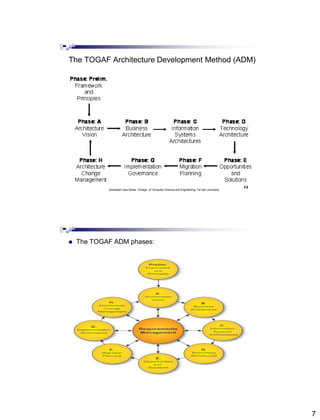
The TOGAF Architecture Development Method (ADM)
13
Abdisalam Issa-Salwe, College of Computer Science and Engineering, Tai bah University
 The TOGAF ADM phases:
14
Abdisalam Issa-Salwe, College of Computer Science and Engineering, Tai bah University

Lecture3 is353-ea(togaf)

  • 1.
    1 Abdisalam Issa-Salwe Taibah University Collegeof Computer Science & Engineering Information Systems Department The Open Group Architectural Framework (TOGAF) (Enterprise Architecture IS353) Lecture 3 Enterprise architecture – TOGAF (The Open Group Architecture Frame) Abdisalam Issa-Salwe, College of Computer Science & Engineering, Taibah University 2
  • 2.
    2 Steps for eachphase • A – Initiation and Framework: • Use Business Scenarios to define relevant business requirements • Identify stakeholders / concerns • Build consensus with partners • B – Baseline Description • Build description of current system • Identify “what’s wrong” • Inventory of re-usable building blocks • C –Target Architecture: • Identify all needed services • Multiple views to address stakeholder concerns Abdisalam Issa-Salwe, College of Computer Science & Engineering, Taibah University 3 Steps for each phase • D – Opportunities and Solutions: • Evaluate and select major work packages • E – Migration Planning: • Prioritize work • Develop outline plan • F –Implementation: • Develop full plan • Execute • G –Architecture Maintenance • Establish procedure for maintenance of new baseline Abdisalam Issa-Salwe, College of Computer Science & Engineering, Taibah University 4
  • 3.
    3 Definition  The OpenGroup Architecture Framework is best known by its acronym, TOGAF.  TOGAF is owned by The Open Group  TOGAF's view of an enterprise architecture. 5 Abdisalam Issa-Salwe, College of Computer Science and Engineering, Tai bah University TOGAF Way  TOGAF divides an enterprise architecture into four categories, as follows:  Business architecture—Describes the processes the business uses to meet its goals  Application architecture—Describes how specific applications are designed and how they interact with each other  Data architecture—Describes how the enterprise data stores are organized and accessed  Technical architecture—Describes the hardware and software infrastructure that supports applications and their interactions 6 Abdisalam Issa-Salwe, College of Computer Science and Engineering, Tai bah University
  • 4.
    4 TOGAF Way (cont…) TOGAF describes itself as a "framework," but the most important part of TOGAF is the Architecture Development Method, better known as ADM.  ADM is a recipe for creating architecture.  A recipe can be categorized as a process.  Given that ADM is the most visible part of TOGAF  TOGAF can be categorized in overall as an architectural process, instead of either an architectural framework (as The Open Group describes TOGAF) or a methodology (as it describes ADM). 7 Abdisalam Issa-Salwe, College of Computer Science and Engineering, Tai bah University TOGAF Way (cont…)  TOGAF views the world of enterprise architecture as a continuum of architectures, ranging from highly generic to highly specific.  It calls this continuum the Enterprise Continuum.  It views the process of creating a specific enterprise architecture,  TOGAF's ADM provides a process for driving this movement from the generic to the specific. 8 Abdisalam Issa-Salwe, College of Computer Science and Engineering, Tai bah University
  • 5.
    5 TOGAF Way (cont…) Foundation Architectures.  These are architectural principles that can, theoretically, be used by any IT organization in the universe.  Common Systems Architectures.  These are principles that one would expect to see in many—but, perhaps, not all — types of enterprises.  Industry Architectures:  These are principles that are specific across many enterprises that are part of the same.  Organizational Architectures:  These are the architectures that are specific to a given enterprise. 9 Abdisalam Issa-Salwe, College of Computer Science and Engineering, Tai bah University The relationship between the Enterprise Continuum and the Architecture Development Method (ADM). 10 Abdisalam Issa-Salwe, College of Computer Science and Engineering, Tai bah University
  • 6.
    6 TOGAF Way (cont…) TOGAF defines the various knowledge bases that live in the Foundation Architecture.  Two that might run into are the Technical Reference Model (TRM) and the Standards Information Base (SIB).  The TRM is a suggested description of a generic IT architecture.  The SIB is a collection of standards and pseudo- standards that The Open Group recommends that you consider in building an IT architecture. 11 Abdisalam Issa-Salwe, College of Computer Science and Engineering, Tai bah University TOGAF Way (cont…)  TOGAF presents both the TRM and the SIB as suggestions; neither is required.  The TRM and the SIB are flawed for the same reason:  They are biased toward application portability, at the expense of application interoperability and application autonomy. This can be considered an outdated view of technical architectures.  For an organization TOGAF largely boils down to the Architecture Development Method (ADM).  Individuals is exposed to the Enterprise Continuum, the SIB, and the TRM (as well as a few other TOGAF features).  But the day-to-day experience of creating an enterprise architecture will be driven by the ADM, 12 Abdisalam Issa-Salwe, College of Computer Science and Engineering, Tai bah University
  • 7.
    7 The TOGAF ArchitectureDevelopment Method (ADM) 13 Abdisalam Issa-Salwe, College of Computer Science and Engineering, Tai bah University  The TOGAF ADM phases: 14 Abdisalam Issa-Salwe, College of Computer Science and Engineering, Tai bah University