MODERN DATABASE
MANAGEMENT
SYSTEM
Written by:-
Jeffrey Hoofer
DATABASE
Definition:-
Database is a shared collection of logically
related data , that is stored to meet requirements of different
user.
Types of Database:-
Database may be of any size:-
i. Small Database
ii. Large Database
iii. Very large Data Warehouse
SMALL DATABASE
Definition:-
For example, a salesperson may maintain a small
database of customer contacts consisting of few mega bytes of
data
on her laptop computer.
LARGE DATABASE
Definition:-
A large corporation may build a large database
consisting of several terabyte of data(a terabyte a large is a
trillion bytes)
on a large mainframe computer that is used for decision
support application.
VERY LARGE DATA
WAREHOUSE
Definition:-
Very large data warehouse contain more than a
pet byte of data(a pet byte is quadrillion bytes).
DATA
Definition:-
Data is a collection of raw , facts and figures .
Data is a stored representation of objects and events that have
meaning in the user’s environment . Data have little meaning
unless they have been organized into some logical order.
 Examples:-
For examples, birth date, customer’s name, and
a year-to-date sales value.
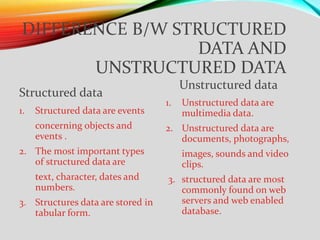
DIFFERENCE B/W STRUCTURED
DATA AND
UNSTRUCTURED DATA
Structured data
1. Structured data are events
concerning objects and
events .
2. The most important types
of structured data are
text, character, dates and
numbers.
3. Structures data are stored in
tabular form.
Unstructured data
1. Unstructured data are
multimedia data.
2. Unstructured data are
documents, photographs,
images, sounds and video
clips.
3. structured data are most
commonly found on web
servers and web enabled
database.
METADATA
Definition:-
Data about data is called metadata
Metadata are data that describes the properties or characteristic of
end user and the context of that data. Metadata is a piece of
information describing a resource .
Examples of resource are books, websites, and videos.
DATABASE APPROACHES
Database approaches are as follows:-
Data models:-
Data models capture the nature of and
relationship among data and are used at different levels of
abstraction as the database is conceptualized and designed.
Entity:-
An entity is a person, a place, an object, an event, or a
concept in the user’s environment about which the organization
wishes to maintain data.
DATABASE APPROACHES
Relationship:-
A relationship is an association
representing an interaction among the instances of one or more
entity types that is of interest to the organization.
DATABASE APPROACHES
Relational database:-
Relational database establishes
the relationship b/w data by means of common fields include in
a file is called a relation.
The database that represents data as a collection of tables in
which all
DATABASE MANAGEMENT
SYSTEM
Definition:-
A database management system is a software
that enables the use of database approach . The primary purpose
of DBMS is to provide a systematic method to create, update,
stores and retrieving data stores in the database.
ADVANTAGES OF
DATABASE APPROACH
Program data independence:-
The separation of
data models(metadata) from the application program that use
the data is called data independence . With the database
approach, the data description are stored in a central location
called the repository. The property of database system allows an
organization’s data to change and evolve(within limits)without
the application program that process the data.
ADVANTAGES OF
DATABASE APPROACH
Program data redundancy:-
Good database design
attempts to integrate previously separate(and redundant
data)into single logical structure.
 Examples:-
For example, facts about products such as pine
valley oak computer desk its finish , price and so forth are
located together in a same place in a Product table which
contains about each of the pine valley’s products.
ADVANTAGES OF
DATABASE APPROACH
Improved data consistency:-
By eliminating or
controlling data redundancy , we greatly reduce the opportunity
of inconsistency .
 Example:-
For example, if a customer address is stored only
once we cannot disagree about customer address . When
customer address changes, updating address is greatly
simplified because customer address is stored only in one place.
ADVANTAGES OF
DATABASE APPROACH
Improved data sharing
Improved data quality
Improved data accessibility and responsiveness
Increased productivity of software development
Reduced program maintenance
COMPONENTS OF DATABASE
ENVIRONMENT
Computer aided software engineering:-
Case tools
are automated tool used to design database and application
programs. These tools also help with creation of data models and
in some cases can also help automatically to create a database.
COMPONENTS OF DATABASE
ENVIRONMENT
Repository:-
A repository is a centralized knowledge base
for all data definitions, data relationship, screen and report
formats.
A repository contains an extended set of metadata data
important for managing database as well as other components
of information system.
COMPONENTS OF DATABASE
ENVIRONMENT
DBMS:-
A database management system is a software
that enables the use of database approach . The primary purpose
of DBMS is to provide a systematic method to create, update,
stores and retrieving data stores in the database.
COMPONENTS OF DATABASE
ENVIRONMENT
Database:-
Database is a shared collection of logically
related data , that is stored to meet requirements of different
user.
Application Program:-
Computer based application
program are used to create and maintain the database and
provide information to user.
COMPONENTS OF DATABASE
ENVIRONMENT
User Interface:-
The user interface includes languages,
menus and other system components by which users interact
with various system components such as CASE tool,
application programs, user interface and other system
components.
COMPONENTS OF DATABASE
ENVIRONMENT
Data and Database administrator:-
Data
administrator are person who are responsible for overall
management for data resource in an organization.
Database administrator are responsible for physical database
design and for managing technical issues in the user’s
environment.
COMPONENTS OF DATABASE
ENVIRONMENT
System developer:-
System developer are person such
as System analyst and Programmer who design new application
programs.
User Interface:-
The user interface are person
throughout the organization who add, delete and modify data
stored in the database
and who request or receive information from it.

Modern database management system chapter 1

  • 1.
  • 2.
    DATABASE Definition:- Database is ashared collection of logically related data , that is stored to meet requirements of different user. Types of Database:- Database may be of any size:- i. Small Database ii. Large Database iii. Very large Data Warehouse
  • 3.
    SMALL DATABASE Definition:- For example,a salesperson may maintain a small database of customer contacts consisting of few mega bytes of data on her laptop computer.
  • 4.
    LARGE DATABASE Definition:- A largecorporation may build a large database consisting of several terabyte of data(a terabyte a large is a trillion bytes) on a large mainframe computer that is used for decision support application.
  • 5.
    VERY LARGE DATA WAREHOUSE Definition:- Verylarge data warehouse contain more than a pet byte of data(a pet byte is quadrillion bytes).
  • 6.
    DATA Definition:- Data is acollection of raw , facts and figures . Data is a stored representation of objects and events that have meaning in the user’s environment . Data have little meaning unless they have been organized into some logical order.  Examples:- For examples, birth date, customer’s name, and a year-to-date sales value.
  • 7.
    DIFFERENCE B/W STRUCTURED DATAAND UNSTRUCTURED DATA Structured data 1. Structured data are events concerning objects and events . 2. The most important types of structured data are text, character, dates and numbers. 3. Structures data are stored in tabular form. Unstructured data 1. Unstructured data are multimedia data. 2. Unstructured data are documents, photographs, images, sounds and video clips. 3. structured data are most commonly found on web servers and web enabled database.
  • 8.
    METADATA Definition:- Data about datais called metadata Metadata are data that describes the properties or characteristic of end user and the context of that data. Metadata is a piece of information describing a resource . Examples of resource are books, websites, and videos.
  • 9.
    DATABASE APPROACHES Database approachesare as follows:- Data models:- Data models capture the nature of and relationship among data and are used at different levels of abstraction as the database is conceptualized and designed. Entity:- An entity is a person, a place, an object, an event, or a concept in the user’s environment about which the organization wishes to maintain data.
  • 10.
    DATABASE APPROACHES Relationship:- A relationshipis an association representing an interaction among the instances of one or more entity types that is of interest to the organization.
  • 11.
    DATABASE APPROACHES Relational database:- Relationaldatabase establishes the relationship b/w data by means of common fields include in a file is called a relation. The database that represents data as a collection of tables in which all
  • 12.
    DATABASE MANAGEMENT SYSTEM Definition:- A databasemanagement system is a software that enables the use of database approach . The primary purpose of DBMS is to provide a systematic method to create, update, stores and retrieving data stores in the database.
  • 13.
    ADVANTAGES OF DATABASE APPROACH Programdata independence:- The separation of data models(metadata) from the application program that use the data is called data independence . With the database approach, the data description are stored in a central location called the repository. The property of database system allows an organization’s data to change and evolve(within limits)without the application program that process the data.
  • 14.
    ADVANTAGES OF DATABASE APPROACH Programdata redundancy:- Good database design attempts to integrate previously separate(and redundant data)into single logical structure.  Examples:- For example, facts about products such as pine valley oak computer desk its finish , price and so forth are located together in a same place in a Product table which contains about each of the pine valley’s products.
  • 15.
    ADVANTAGES OF DATABASE APPROACH Improveddata consistency:- By eliminating or controlling data redundancy , we greatly reduce the opportunity of inconsistency .  Example:- For example, if a customer address is stored only once we cannot disagree about customer address . When customer address changes, updating address is greatly simplified because customer address is stored only in one place.
  • 16.
    ADVANTAGES OF DATABASE APPROACH Improveddata sharing Improved data quality Improved data accessibility and responsiveness Increased productivity of software development Reduced program maintenance
  • 17.
    COMPONENTS OF DATABASE ENVIRONMENT Computeraided software engineering:- Case tools are automated tool used to design database and application programs. These tools also help with creation of data models and in some cases can also help automatically to create a database.
  • 18.
    COMPONENTS OF DATABASE ENVIRONMENT Repository:- Arepository is a centralized knowledge base for all data definitions, data relationship, screen and report formats. A repository contains an extended set of metadata data important for managing database as well as other components of information system.
  • 19.
    COMPONENTS OF DATABASE ENVIRONMENT DBMS:- Adatabase management system is a software that enables the use of database approach . The primary purpose of DBMS is to provide a systematic method to create, update, stores and retrieving data stores in the database.
  • 20.
    COMPONENTS OF DATABASE ENVIRONMENT Database:- Databaseis a shared collection of logically related data , that is stored to meet requirements of different user. Application Program:- Computer based application program are used to create and maintain the database and provide information to user.
  • 21.
    COMPONENTS OF DATABASE ENVIRONMENT UserInterface:- The user interface includes languages, menus and other system components by which users interact with various system components such as CASE tool, application programs, user interface and other system components.
  • 22.
    COMPONENTS OF DATABASE ENVIRONMENT Dataand Database administrator:- Data administrator are person who are responsible for overall management for data resource in an organization. Database administrator are responsible for physical database design and for managing technical issues in the user’s environment.
  • 23.
    COMPONENTS OF DATABASE ENVIRONMENT Systemdeveloper:- System developer are person such as System analyst and Programmer who design new application programs. User Interface:- The user interface are person throughout the organization who add, delete and modify data stored in the database and who request or receive information from it.