1
Abdisalam Issa-Salwe
Taibah University
College of Computer Science & Engineering
Information Systems Department
The Federal Enterprise Architecture
(FEA)
(Enterprise Architecture IS353)
Lecture 4
Federal Enterprise Architecture (FEA)
 The Federal Enterprise Architecture (FEA) is the latest
attempt by the US federal government to unite its myriad
agencies and functions under a single common and
ubiquitous enterprise architecture.
 FEA is still in its infancy, as most of the major pieces have
been available only since 2006.
 FEA is the most complete of all the methodologies
discussed so far. It has both a comprehensive taxonomy,
like Zachman, and an architectural process, like TOGAF.
 FEA can be viewed as either a methodology for creating
an enterprise architecture or the result of applying that
process to a particular enterprise — namely, the U.S.
Government.

2
Abdisalam Issa-Salwe, College of Computer Science and Engineering, Tai bah University
2
Federal Enterprise Architecture (FEA) (cont…)
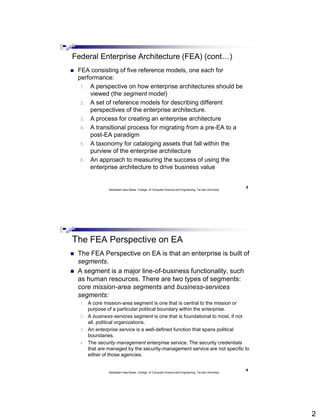
 FEA consisting of five reference models, one each for
performance:
1. A perspective on how enterprise architectures should be
viewed (the segment model)
2. A set of reference models for describing different
perspectives of the enterprise architecture.
3. A process for creating an enterprise architecture
4. A transitional process for migrating from a pre-EA to a
post-EA paradigm
5. A taxonomy for cataloging assets that fall within the
purview of the enterprise architecture
6. An approach to measuring the success of using the
enterprise architecture to drive business value
3
Abdisalam Issa-Salwe, College of Computer Science and Engineering, Tai bah University
The FEA Perspective on EA
 The FEA Perspective on EA is that an enterprise is built of
segments.
 A segment is a major line-of-business functionality, such
as human resources. There are two types of segments:
core mission-area segments and business-services
segments:
1. A core mission-area segment is one that is central to the mission or
purpose of a particular political boundary within the enterprise.
2. A business-services segment is one that is foundational to most, if not
all, political organizations.
3. An enterprise service is a well-defined function that spans political
boundaries.
4. The security management enterprise service. The security credentials
that are managed by the security-management service are not specific to
either of those agencies.
4
Abdisalam Issa-Salwe, College of Computer Science and Engineering, Tai bah University
3
Federal Enterprise Architecture (cont…)
 A full treatment of FEA needs to include all of the following:
 A perspective on how enterprise architectures should be
viewed (the segment model, that I will describe shortly)
 A set of reference models for describing different
perspectives of the enterprise architecture (the five models,
mentioned earlier)
 A process for creating an enterprise architecture
 A transitional process for migrating from a pre-EA to a post-
EA paradigm
 A taxonomy for cataloging assets that fall within the purview
of the enterprise architecture
 An approach to measuring the success of using the
enterprise architecture to drive business value
5
Abdisalam Issa-Salwe, College of Computer Science and Engineering, Tai bah University
FEA Principles
 Establish Federal interoperability standards.
 Minimize the data collection burden.
 Secure Federal information against
unauthorized access.
 Take advantage of standardization based on
common functions and customers.
 Provide access to information.
 Select and implement proven market
technologies.
 Comply with the Privacy Act of 1974.
 Coordinate technology investments with the
Federal business and architecture.
4
7
Federal Enterprise Architecture
 Core Principles
 Business-driven: The FEA is most useful when it is closely aligned
with government strategic plans and executive level direction.
Agency mission statements, presidential management directives
and agency business owners give direction to each agency’s
enterprise architecture (EA) and to the FEA.
 Proactive and collaborative across the Federal government:
Adoption of the FEA is achieved through active participation by the
EA community in its development and use. The FEA community is
responsible for the development, evolution and adoption of the
FEA.
 Architecture improves the effectiveness and efficiency of
government processes: Architecture development is an integral
part of the capital investment process. Investment decisions
should be based on business-approved architecture.
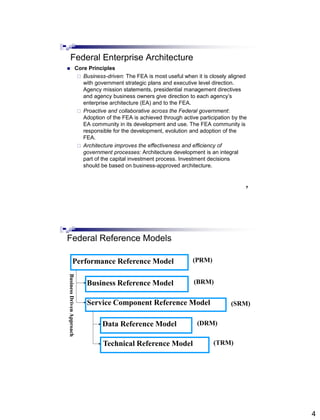
(PRM)
(BRM)
(SRM)
(DRM)
(TRM)
Performance Reference Model
Business Reference Model
Service Component Reference Model
Data Reference Model
Technical Reference Model
BusinessDrivenApproach
Federal Reference Models
5
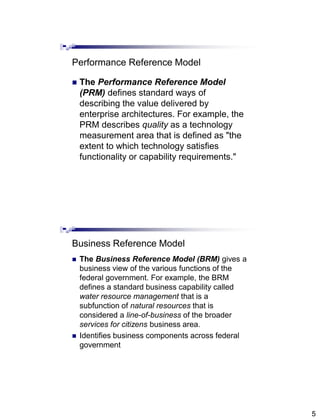
Performance Reference Model
 The Performance Reference Model
(PRM) defines standard ways of
describing the value delivered by
enterprise architectures. For example, the
PRM describes quality as a technology
measurement area that is defined as "the
extent to which technology satisfies
functionality or capability requirements."
Business Reference Model
 The Business Reference Model (BRM) gives a
business view of the various functions of the
federal government. For example, the BRM
defines a standard business capability called
water resource management that is a
subfunction of natural resources that is
considered a line-of-business of the broader
services for citizens business area.
 Identifies business components across federal
government
6
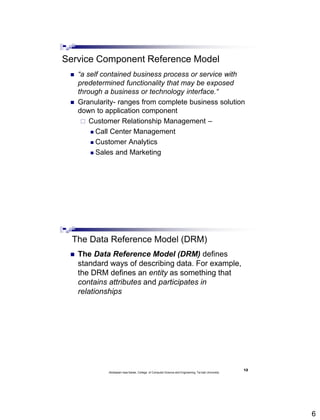
Service Component Reference Model
 “a self contained business process or service with
predetermined functionality that may be exposed
through a business or technology interface.“
 Granularity- ranges from complete business solution
down to application component
 Customer Relationship Management –
 Call Center Management
 Customer Analytics
 Sales and Marketing
The Data Reference Model (DRM)
 The Data Reference Model (DRM) defines
standard ways of describing data. For example,
the DRM defines an entity as something that
contains attributes and participates in
relationships
12
Abdisalam Issa-Salwe, College of Computer Science and Engineering, Tai bah University
7
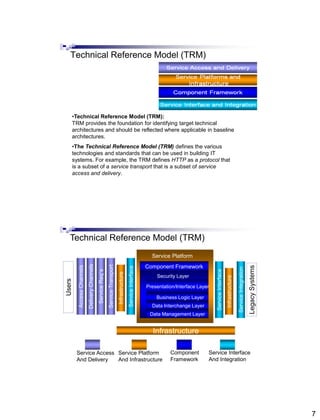
Technical Reference Model (TRM)
•Technical Reference Model (TRM):
TRM provides the foundation for identifying target technical
architectures and should be reflected where applicable in baseline
architectures.
•The Technical Reference Model (TRM) defines the various
technologies and standards that can be used in building IT
systems. For example, the TRM defines HTTP as a protocol that
is a subset of a service transport that is a subset of service
access and delivery.
Infrastructure
Service Platform
And Infrastructure
Service Platform
Service Access
And Delivery
Component Framework
Security Layer
Presentation/Interface Layer
Business Logic Layer
Data Interchange Layer
Data Management Layer
Component
Framework
Service Interface
And Integration
Technical Reference Model (TRM)
8
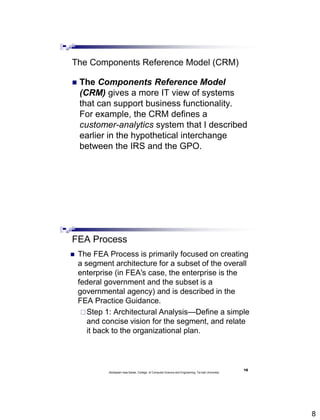
The Components Reference Model (CRM)
 The Components Reference Model
(CRM) gives a more IT view of systems
that can support business functionality.
For example, the CRM defines a
customer-analytics system that I described
earlier in the hypothetical interchange
between the IRS and the GPO.
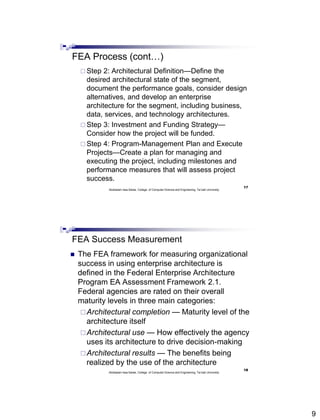
FEA Process
 The FEA Process is primarily focused on creating
a segment architecture for a subset of the overall
enterprise (in FEA's case, the enterprise is the
federal government and the subset is a
governmental agency) and is described in the
FEA Practice Guidance.
Step 1: Architectural Analysis—Define a simple
and concise vision for the segment, and relate
it back to the organizational plan.
16
Abdisalam Issa-Salwe, College of Computer Science and Engineering, Tai bah University
9
FEA Process (cont…)
 Step 2: Architectural Definition—Define the
desired architectural state of the segment,
document the performance goals, consider design
alternatives, and develop an enterprise
architecture for the segment, including business,
data, services, and technology architectures.
 Step 3: Investment and Funding Strategy—
Consider how the project will be funded.
 Step 4: Program-Management Plan and Execute
Projects—Create a plan for managing and
executing the project, including milestones and
performance measures that will assess project
success.
17
Abdisalam Issa-Salwe, College of Computer Science and Engineering, Tai bah University
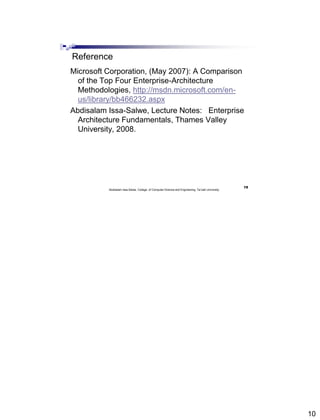
FEA Success Measurement
 The FEA framework for measuring organizational
success in using enterprise architecture is
defined in the Federal Enterprise Architecture
Program EA Assessment Framework 2.1.
Federal agencies are rated on their overall
maturity levels in three main categories:
Architectural completion — Maturity level of the
architecture itself
Architectural use — How effectively the agency
uses its architecture to drive decision-making
Architectural results — The benefits being
realized by the use of the architecture
18
Abdisalam Issa-Salwe, College of Computer Science and Engineering, Tai bah University
10
Reference
Microsoft Corporation, (May 2007): A Comparison
of the Top Four Enterprise-Architecture
Methodologies, http://msdn.microsoft.com/en-
us/library/bb466232.aspx
Abdisalam Issa-Salwe, Lecture Notes: Enterprise
Architecture Fundamentals, Thames Valley
University, 2008.
19
Abdisalam Issa-Salwe, College of Computer Science and Engineering, Tai bah University

Lecture4 is353-ea(fea)

  • 1.
    1 Abdisalam Issa-Salwe Taibah University Collegeof Computer Science & Engineering Information Systems Department The Federal Enterprise Architecture (FEA) (Enterprise Architecture IS353) Lecture 4 Federal Enterprise Architecture (FEA)  The Federal Enterprise Architecture (FEA) is the latest attempt by the US federal government to unite its myriad agencies and functions under a single common and ubiquitous enterprise architecture.  FEA is still in its infancy, as most of the major pieces have been available only since 2006.  FEA is the most complete of all the methodologies discussed so far. It has both a comprehensive taxonomy, like Zachman, and an architectural process, like TOGAF.  FEA can be viewed as either a methodology for creating an enterprise architecture or the result of applying that process to a particular enterprise — namely, the U.S. Government.  2 Abdisalam Issa-Salwe, College of Computer Science and Engineering, Tai bah University
  • 2.
    2 Federal Enterprise Architecture(FEA) (cont…)  FEA consisting of five reference models, one each for performance: 1. A perspective on how enterprise architectures should be viewed (the segment model) 2. A set of reference models for describing different perspectives of the enterprise architecture. 3. A process for creating an enterprise architecture 4. A transitional process for migrating from a pre-EA to a post-EA paradigm 5. A taxonomy for cataloging assets that fall within the purview of the enterprise architecture 6. An approach to measuring the success of using the enterprise architecture to drive business value 3 Abdisalam Issa-Salwe, College of Computer Science and Engineering, Tai bah University The FEA Perspective on EA  The FEA Perspective on EA is that an enterprise is built of segments.  A segment is a major line-of-business functionality, such as human resources. There are two types of segments: core mission-area segments and business-services segments: 1. A core mission-area segment is one that is central to the mission or purpose of a particular political boundary within the enterprise. 2. A business-services segment is one that is foundational to most, if not all, political organizations. 3. An enterprise service is a well-defined function that spans political boundaries. 4. The security management enterprise service. The security credentials that are managed by the security-management service are not specific to either of those agencies. 4 Abdisalam Issa-Salwe, College of Computer Science and Engineering, Tai bah University
  • 3.
    3 Federal Enterprise Architecture(cont…)  A full treatment of FEA needs to include all of the following:  A perspective on how enterprise architectures should be viewed (the segment model, that I will describe shortly)  A set of reference models for describing different perspectives of the enterprise architecture (the five models, mentioned earlier)  A process for creating an enterprise architecture  A transitional process for migrating from a pre-EA to a post- EA paradigm  A taxonomy for cataloging assets that fall within the purview of the enterprise architecture  An approach to measuring the success of using the enterprise architecture to drive business value 5 Abdisalam Issa-Salwe, College of Computer Science and Engineering, Tai bah University FEA Principles  Establish Federal interoperability standards.  Minimize the data collection burden.  Secure Federal information against unauthorized access.  Take advantage of standardization based on common functions and customers.  Provide access to information.  Select and implement proven market technologies.  Comply with the Privacy Act of 1974.  Coordinate technology investments with the Federal business and architecture.
  • 4.
    4 7 Federal Enterprise Architecture Core Principles  Business-driven: The FEA is most useful when it is closely aligned with government strategic plans and executive level direction. Agency mission statements, presidential management directives and agency business owners give direction to each agency’s enterprise architecture (EA) and to the FEA.  Proactive and collaborative across the Federal government: Adoption of the FEA is achieved through active participation by the EA community in its development and use. The FEA community is responsible for the development, evolution and adoption of the FEA.  Architecture improves the effectiveness and efficiency of government processes: Architecture development is an integral part of the capital investment process. Investment decisions should be based on business-approved architecture. (PRM) (BRM) (SRM) (DRM) (TRM) Performance Reference Model Business Reference Model Service Component Reference Model Data Reference Model Technical Reference Model BusinessDrivenApproach Federal Reference Models
  • 5.
    5 Performance Reference Model The Performance Reference Model (PRM) defines standard ways of describing the value delivered by enterprise architectures. For example, the PRM describes quality as a technology measurement area that is defined as "the extent to which technology satisfies functionality or capability requirements." Business Reference Model  The Business Reference Model (BRM) gives a business view of the various functions of the federal government. For example, the BRM defines a standard business capability called water resource management that is a subfunction of natural resources that is considered a line-of-business of the broader services for citizens business area.  Identifies business components across federal government
  • 6.
    6 Service Component ReferenceModel  “a self contained business process or service with predetermined functionality that may be exposed through a business or technology interface.“  Granularity- ranges from complete business solution down to application component  Customer Relationship Management –  Call Center Management  Customer Analytics  Sales and Marketing The Data Reference Model (DRM)  The Data Reference Model (DRM) defines standard ways of describing data. For example, the DRM defines an entity as something that contains attributes and participates in relationships 12 Abdisalam Issa-Salwe, College of Computer Science and Engineering, Tai bah University
  • 7.
    7 Technical Reference Model(TRM) •Technical Reference Model (TRM): TRM provides the foundation for identifying target technical architectures and should be reflected where applicable in baseline architectures. •The Technical Reference Model (TRM) defines the various technologies and standards that can be used in building IT systems. For example, the TRM defines HTTP as a protocol that is a subset of a service transport that is a subset of service access and delivery. Infrastructure Service Platform And Infrastructure Service Platform Service Access And Delivery Component Framework Security Layer Presentation/Interface Layer Business Logic Layer Data Interchange Layer Data Management Layer Component Framework Service Interface And Integration Technical Reference Model (TRM)
  • 8.
    8 The Components ReferenceModel (CRM)  The Components Reference Model (CRM) gives a more IT view of systems that can support business functionality. For example, the CRM defines a customer-analytics system that I described earlier in the hypothetical interchange between the IRS and the GPO. FEA Process  The FEA Process is primarily focused on creating a segment architecture for a subset of the overall enterprise (in FEA's case, the enterprise is the federal government and the subset is a governmental agency) and is described in the FEA Practice Guidance. Step 1: Architectural Analysis—Define a simple and concise vision for the segment, and relate it back to the organizational plan. 16 Abdisalam Issa-Salwe, College of Computer Science and Engineering, Tai bah University
  • 9.
    9 FEA Process (cont…) Step 2: Architectural Definition—Define the desired architectural state of the segment, document the performance goals, consider design alternatives, and develop an enterprise architecture for the segment, including business, data, services, and technology architectures.  Step 3: Investment and Funding Strategy— Consider how the project will be funded.  Step 4: Program-Management Plan and Execute Projects—Create a plan for managing and executing the project, including milestones and performance measures that will assess project success. 17 Abdisalam Issa-Salwe, College of Computer Science and Engineering, Tai bah University FEA Success Measurement  The FEA framework for measuring organizational success in using enterprise architecture is defined in the Federal Enterprise Architecture Program EA Assessment Framework 2.1. Federal agencies are rated on their overall maturity levels in three main categories: Architectural completion — Maturity level of the architecture itself Architectural use — How effectively the agency uses its architecture to drive decision-making Architectural results — The benefits being realized by the use of the architecture 18 Abdisalam Issa-Salwe, College of Computer Science and Engineering, Tai bah University
  • 10.
    10 Reference Microsoft Corporation, (May2007): A Comparison of the Top Four Enterprise-Architecture Methodologies, http://msdn.microsoft.com/en- us/library/bb466232.aspx Abdisalam Issa-Salwe, Lecture Notes: Enterprise Architecture Fundamentals, Thames Valley University, 2008. 19 Abdisalam Issa-Salwe, College of Computer Science and Engineering, Tai bah University