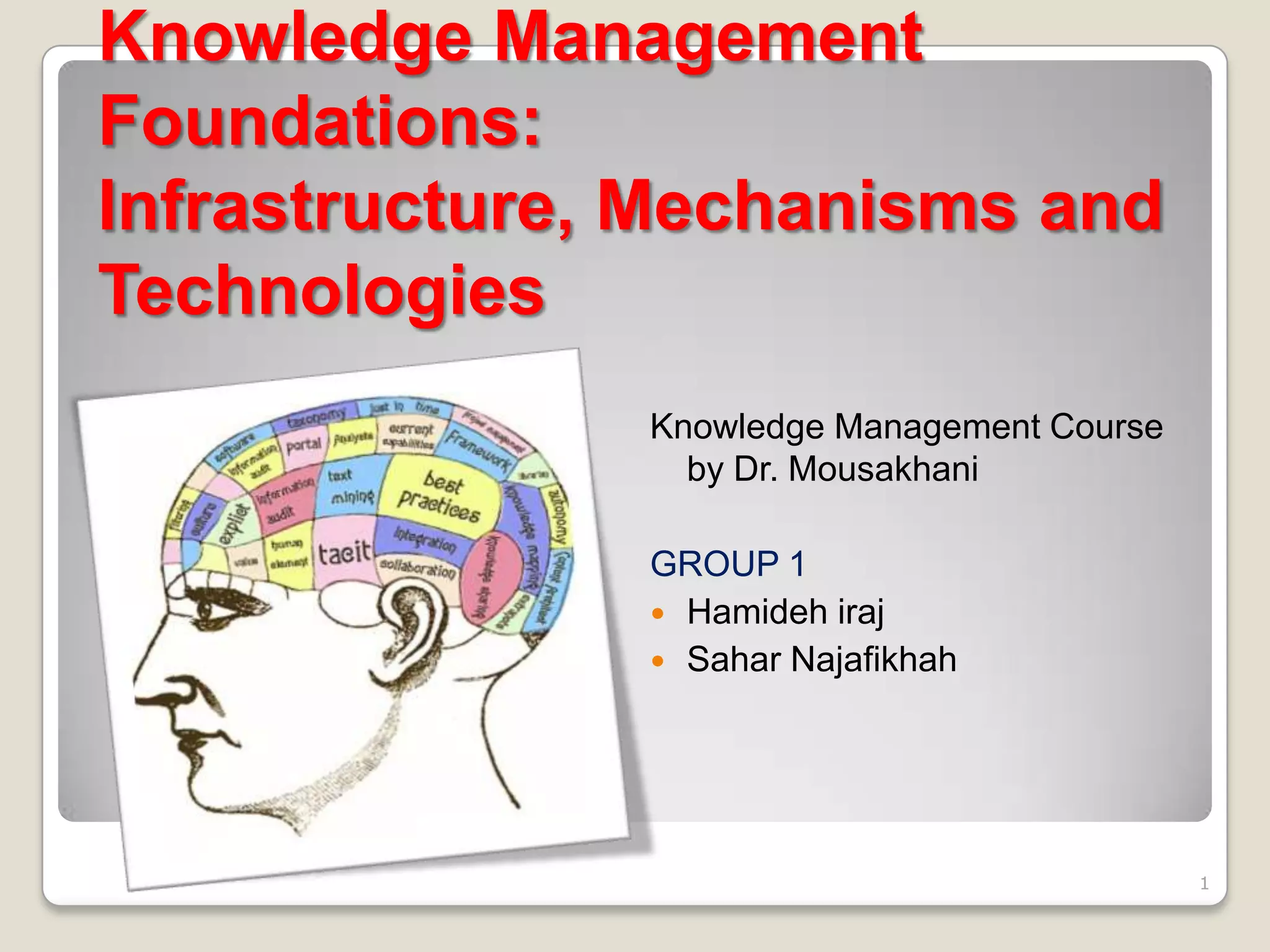
Knowledge Management
Foundations:
Infrastructure, Mechanisms and
Technologies
Knowledge Management Course
by Dr. Mousakhani
GROUP 1
 Hamideh iraj
 Sahar Najafikhah
1
Chapter 3 of:
Knowledge Management
Systems and Processes
Irma Becerra-Fernandez and
Rajiv Sabherwal
Armonk, New York
London, England
What is Knowledge
Management?
 Doing What is needed to get the most out of
knowledge resources
 Performing the activities involved in
discovering, capturing, sharing, and applying
knowledge so as to enhance, in a cost-effective
fashion, the impact of knowledge on the unit’s goal
achievement.
What is Business Intelligence?
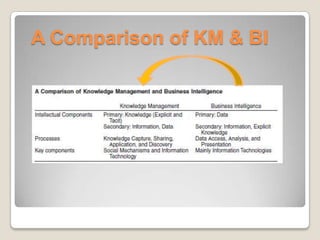
A Comparison of KM & BI
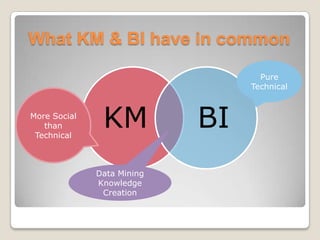
What KM & BI have in common
KM BIMore Social
than
Technical
Pure
Technical
Data Mining
Knowledge
Creation
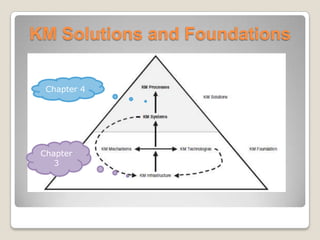
KM Solutions and Foundations
Chapter 4
Chapter
3
KM Solutions
the ways in which specific aspects of KM
(discovery, capture, sharing, and application
of knowledge) can be accomplished.
KM solutions include KM processes and KM
systems.
KM Foundations
the broad organizational aspects
that support KM in the short- and long-term.
They include KM infrastructure, KM
mechanisms, and KM technologies.
KM Processes
the broad processes that help in
discovering, capturing, sharing and applying
knowledge.
KM Systems
The integration of technologies and
mechanisms that are developed
to support the four KM processes.
KM Infrastructure
1. Organization Culture
2. Organization Structure
3. Information technology structure
4. Common Knowledge
5. Physical Environment
1. Organization Culture
Organization culture reflects the norms and beliefs
that guide the behavior of the organization’s
members. It is an important enabler of knowledge
management in organizations
2. Organization Structure
Knowledge management also depends to a
considerable extent on the organization
structure.
2. Organization Structure – cont.
 Hierarchical structure of the organization
 Facilitating KM through communities of practice
 Facilitate KM through specialized structures and
roles that specifically support KM
3. Information Technology
Infrastructure
Knowledge management is facilitated by the
organization’s IT infrastructure.
Four Important Capabilities
Reach: Reach pertains to access and connection
and the efficiency of such access
Depth focuses on the detail and amount of
information that can be effectively
communicated over a medium
Four Important Capabilities- cont.
Richness the ability to:
(a) provide multiple cues (e.g., body language, facial
expression, tone of voice) simultaneously
(b) provide quick feedback
(c) personalize messages
(d) use natural language to convey subtleties
Aggregation the ability to store and quickly process
information enables the aggregation of large
volumes of information drawn from multiple
sources
4. Common Knowledge
organization’s cumulative experiences in
comprehending a category of knowledge and
activities and the organizing principles that
support communication and coordination
5. Physical Environment
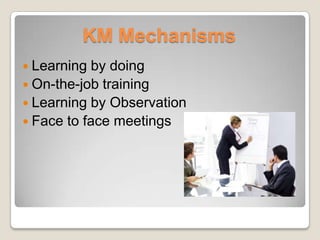
KM Mechanisms
 Learning by doing
 On-the-job training
 Learning by Observation
 Face to face meetings
More Long Term KM Mechanisms
 Hiring of a CKO
 Cooperative Projects across departments
 Traditional Hierarchical Relationships
 Organizational policies
 Standards
 Initiation Process for new employees
 Employee Rotation
KM Technologies
• Artificial Intelligence
• used for knowledge acquisition and case-based
reasoning systems, electronic discussion
groups, computer-based simulations,
• databases,
• decision support systems,
• ERP systems,
• expert systems,
• MIS
• expertise locator systems,
• Videoconferencing
KM Technologies- cont.
Information Repositories
• best practices databases
• lessons learned systems
KM Technologies
Web 2.0 technologies
wikis and blogs
Case Study
Incentives for Knowledge Sharing
at Hill and Knowlton
Beenz system
Best contributor
English presentation- knowledge management foundations infrastructure, mechanisms and technologies

English presentation- knowledge management foundations infrastructure, mechanisms and technologies

  • 1.
    Knowledge Management Foundations: Infrastructure, Mechanismsand Technologies Knowledge Management Course by Dr. Mousakhani GROUP 1  Hamideh iraj  Sahar Najafikhah 1
  • 2.
    Chapter 3 of: KnowledgeManagement Systems and Processes Irma Becerra-Fernandez and Rajiv Sabherwal Armonk, New York London, England
  • 3.
    What is Knowledge Management? Doing What is needed to get the most out of knowledge resources  Performing the activities involved in discovering, capturing, sharing, and applying knowledge so as to enhance, in a cost-effective fashion, the impact of knowledge on the unit’s goal achievement.
  • 4.
    What is BusinessIntelligence?
  • 5.
  • 6.
    What KM &BI have in common KM BIMore Social than Technical Pure Technical Data Mining Knowledge Creation
  • 7.
    KM Solutions andFoundations Chapter 4 Chapter 3
  • 8.
    KM Solutions the waysin which specific aspects of KM (discovery, capture, sharing, and application of knowledge) can be accomplished. KM solutions include KM processes and KM systems.
  • 9.
    KM Foundations the broadorganizational aspects that support KM in the short- and long-term. They include KM infrastructure, KM mechanisms, and KM technologies.
  • 10.
    KM Processes the broadprocesses that help in discovering, capturing, sharing and applying knowledge.
  • 11.
    KM Systems The integrationof technologies and mechanisms that are developed to support the four KM processes.
  • 12.
    KM Infrastructure 1. OrganizationCulture 2. Organization Structure 3. Information technology structure 4. Common Knowledge 5. Physical Environment
  • 13.
    1. Organization Culture Organizationculture reflects the norms and beliefs that guide the behavior of the organization’s members. It is an important enabler of knowledge management in organizations
  • 14.
    2. Organization Structure Knowledgemanagement also depends to a considerable extent on the organization structure.
  • 15.
    2. Organization Structure– cont.  Hierarchical structure of the organization  Facilitating KM through communities of practice  Facilitate KM through specialized structures and roles that specifically support KM
  • 16.
    3. Information Technology Infrastructure Knowledgemanagement is facilitated by the organization’s IT infrastructure.
  • 17.
    Four Important Capabilities Reach:Reach pertains to access and connection and the efficiency of such access Depth focuses on the detail and amount of information that can be effectively communicated over a medium
  • 18.
    Four Important Capabilities-cont. Richness the ability to: (a) provide multiple cues (e.g., body language, facial expression, tone of voice) simultaneously (b) provide quick feedback (c) personalize messages (d) use natural language to convey subtleties Aggregation the ability to store and quickly process information enables the aggregation of large volumes of information drawn from multiple sources
  • 19.
    4. Common Knowledge organization’scumulative experiences in comprehending a category of knowledge and activities and the organizing principles that support communication and coordination
  • 20.
  • 21.
    KM Mechanisms  Learningby doing  On-the-job training  Learning by Observation  Face to face meetings
  • 22.
    More Long TermKM Mechanisms  Hiring of a CKO  Cooperative Projects across departments  Traditional Hierarchical Relationships  Organizational policies  Standards  Initiation Process for new employees  Employee Rotation
  • 23.
    KM Technologies • ArtificialIntelligence • used for knowledge acquisition and case-based reasoning systems, electronic discussion groups, computer-based simulations, • databases, • decision support systems, • ERP systems, • expert systems, • MIS • expertise locator systems, • Videoconferencing
  • 24.
    KM Technologies- cont. InformationRepositories • best practices databases • lessons learned systems
  • 25.
    KM Technologies Web 2.0technologies wikis and blogs
  • 26.
    Case Study Incentives forKnowledge Sharing at Hill and Knowlton Beenz system Best contributor