1
Abdisalam Issa-Salwe
Information Systems Department
College of Computer Science & Engineering Taibah University
Abdisalam Issa-Salwe, Taibah University
1
Introduction to Knowledge
Management Systems
(Knowledge Management Systems IS421)
Lecture 1
Irma Becerra-Fernandez, Avelino Gonzalez & Rajiv Sabherwal (2004) Knowledge Management: Challenges,
Solutions and Technologies, Prentice Hall
2
Abdisalam Issa-Salwe , College of Computer Science & Engineering, Taibah University
Topic list
 Definition of Knowledge Management
 Forces Driving Knowledge Management Data, Information and Knowledge
 Importance of Knowledge
 Managing Knowledge
 Organizational Learning
 Through Knowledge Management
 Knowledge-based Economy
 Components of Knowledge Management Systems
 KM & Information Technologies
 Components of Knowledge Management Systems
 Approaches to Knowledge Management
 Objectives of Knowledge Management
 Essence of KM
 Knowledge Repositories
 Knowledge Management System Cycle
 KM Benefits
 KM Integration
 Factors Leading to Success and Failure of Systems
 Knowledge Management Issues
2
3
Abdisalam Issa-Salwe , College of Computer Science & Engineering, Taibah University
Definition of Knowledge Managment
 Knowledge management (KM) is defined
as doing what is needed to get the most
out of knowledge resources.
 KM focuses on organizing and making
available important knowledge, wherever
and whenever it is needed.
 KM is a clear and certain perception of
something understanding learning
4
Abdisalam Issa-Salwe , College of Computer Science & Engineering, Taibah University
Definition of Knowledge Management (cont…)
 KM is what is perceived or grasped by
the mind
 KM is a practical experience and skill
which is organized information applicable
to problem solving
 KM is a collection of specialized facts,
procedures and judgment rules.
 KM is also related to the concept of
intellectual capital.
3
5
Abdisalam Issa-Salwe , College of Computer Science & Engineering, Taibah University
Forces Driving Knowledge Management
1. Increasing Domain Complexity: Intricacy of internal and
external processes, increased competition, and the rapid
advancement of technology all contribute to increasing
domain complexity.
2. Accelerating Market Volatility: The pace of change, or
volatility, within each market domain has increased rapidly
in the past decade.
3. Intensified Speed of Responsiveness: The time
required to take action based upon subtle changes within
and across domains is decreasing.
4. Diminishing Individual Experience: High employee
turnover rates have resulted in individuals with decision-
making authority having less tenure within their
organizations than ever before.
6
Abdisalam Issa-Salwe , College of Computer Science & Engineering, Taibah University
 Data
 Data represents raw numbers or assertions
 Data comprises facts, observations, or
perceptionsRefers to isolated facts such as individual
measurements.
 Data are raw facts about the organisation and its
business transactions.
 No meaning on their own
 Do not signify anything
 Useless unless placed in some sort of context.
 Most data items have little meaning and use by
themselves.
Data, Information and Knowledge
4
7
Abdisalam Issa-Salwe , College of Computer Science & Engineering, Taibah University
Data, Information and Knowledge (cont…)
 Information: It is data with semantics.
 Information is data that has been refined and
organised by processing and purposeful intelligence.
 Information, purposeful intelligence, is crucial to the
definition
 People provide the purpose and the intelligence that
produces true information.
 Information is data with context and relevance
 In contrast, data can include millions of useless garbage bits,
which are nothing more than uninterpretable zeros and ones
 Information involves manipulation of raw data
 Often, information can be used to obtain a more meaningful
indication of trends or patterns
8
Abdisalam Issa-Salwe , College of Computer Science & Engineering, Taibah University
Data, Information and Knowledge (cont…)
 Knowledge: It is information with direction.
Knowledge is information with decision-
making and action-directed utility and purpose
Knowledge is defined by some as “a justified
true belief” (Nonaka and Takeuchi 1995)
Different from data & information
 Knowledge is at the highest level in a hierarchy
with information at the middle level, and data to be
at the lowest level
 It is the richest, deepest & most valuable of the
three.
5
9
Abdisalam Issa-Salwe , College of Computer Science & Engineering, Taibah University
9
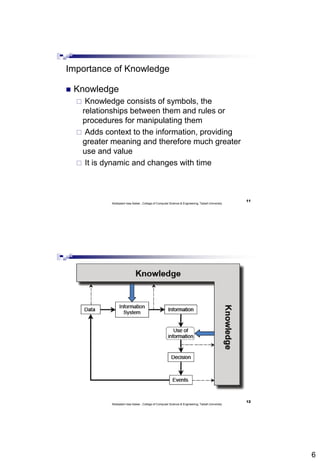
Data are raw facts that constitute building
blocks of information.
 Information science defines data as unprocessed
information.
 Information is data that have been organized and
communicated in a coherent and meaningful
manner.
 Data is converted into information, and information
is converted into knowledge.
 Knowledge: information that is evaluated and
organized so that it can be used purposefully.
Data, Information and Knowledge (cont…)
10
Abdisalam Issa-Salwe , College of Computer Science & Engineering, Taibah University
Data, Information and Knowledge (cont…)
6
11
Abdisalam Issa-Salwe , College of Computer Science & Engineering, Taibah University
Importance of Knowledge
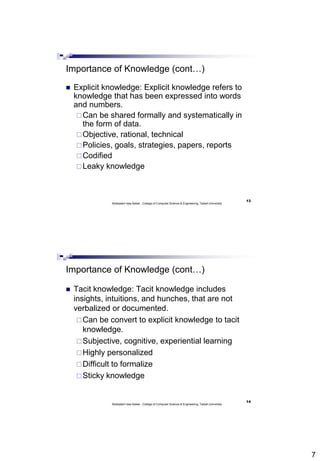
 Knowledge
 Knowledge consists of symbols, the
relationships between them and rules or
procedures for manipulating them
 Adds context to the information, providing
greater meaning and therefore much greater
use and value
 It is dynamic and changes with time
12
Abdisalam Issa-Salwe , College of Computer Science & Engineering, Taibah University
7
13
Abdisalam Issa-Salwe , College of Computer Science & Engineering, Taibah University
Importance of Knowledge (cont…)
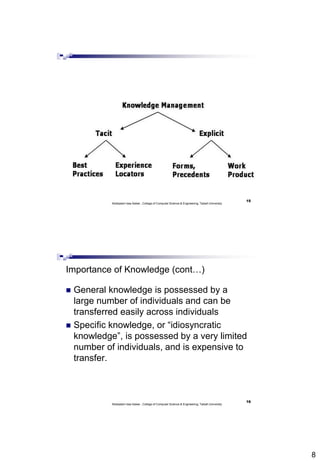
 Explicit knowledge: Explicit knowledge refers to
knowledge that has been expressed into words
and numbers.
Can be shared formally and systematically in
the form of data.
Objective, rational, technical
Policies, goals, strategies, papers, reports
Codified
Leaky knowledge
14
Abdisalam Issa-Salwe , College of Computer Science & Engineering, Taibah University
Importance of Knowledge (cont…)
 Tacit knowledge: Tacit knowledge includes
insights, intuitions, and hunches, that are not
verbalized or documented.
Can be convert to explicit knowledge to tacit
knowledge.
Subjective, cognitive, experiential learning
Highly personalized
Difficult to formalize
Sticky knowledge
8
15
Abdisalam Issa-Salwe , College of Computer Science & Engineering, Taibah University
16
Abdisalam Issa-Salwe , College of Computer Science & Engineering, Taibah University
Importance of Knowledge (cont…)
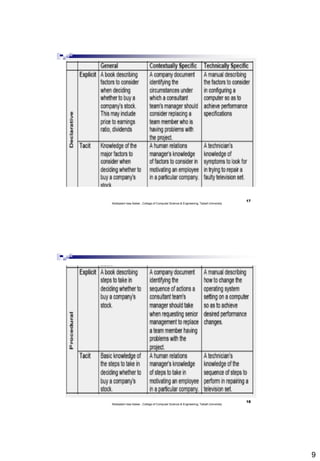
 General knowledge is possessed by a
large number of individuals and can be
transferred easily across individuals
 Specific knowledge, or “idiosyncratic
knowledge”, is possessed by a very limited
number of individuals, and is expensive to
transfer.
9
17
Abdisalam Issa-Salwe , College of Computer Science & Engineering, Taibah University
18
Abdisalam Issa-Salwe , College of Computer Science & Engineering, Taibah University
10
19
Abdisalam Issa-Salwe , College of Computer Science & Engineering, Taibah University
Types of Knowledge (cont…)
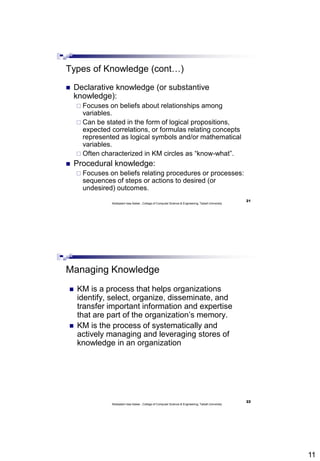
 Subjective View of knowledge:
 Knowledge reality is entirely dependent on human
perception, and is socially constructed through
interactions with individuals.
 Knowledge has no existence independently of social
practices and human experiences.
 Knowledge is not an independent object.
 Knowledge has no single location.
 Knowledge is viewed as an ongoing accomplishment, which
continuously affects and is influenced by social practices.
 Knowledge as State of Mind
 Knowledge as Practice
20
Abdisalam Issa-Salwe , College of Computer Science & Engineering, Taibah University
Types of Knowledge (cont…)
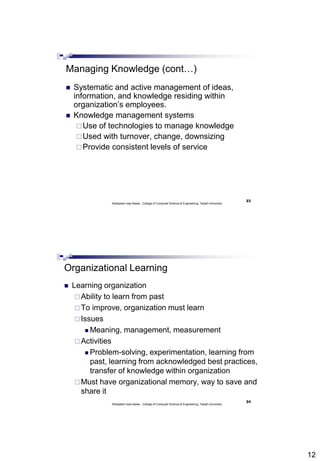
 Objective Subjective View of knowledge:
 Reality is independent of human perceptions and can be
structured in terms of a priori categories and concepts.
 Knowledge can be located.
 Knowledge as Objects
 Something that can be stored, transferred, and manipulated.
 Object-oriented programming analogy: instances of structs
(classes).
 Knowledge as Access to Information
 Knowledge enables access and utilization of information.
 Object-oriented programming analogy: Interfaces and methods are
more important than structs.
 Knowledge as Capability
 Not merely access to information – instead, emphasizes knowledge
as a strategic capability that can potentially be applied to seek a
competitive advantage.
11
21
Abdisalam Issa-Salwe , College of Computer Science & Engineering, Taibah University
Types of Knowledge (cont…)
 Declarative knowledge (or substantive
knowledge):
 Focuses on beliefs about relationships among
variables.
 Can be stated in the form of logical propositions,
expected correlations, or formulas relating concepts
represented as logical symbols and/or mathematical
variables.
 Often characterized in KM circles as “know-what”.
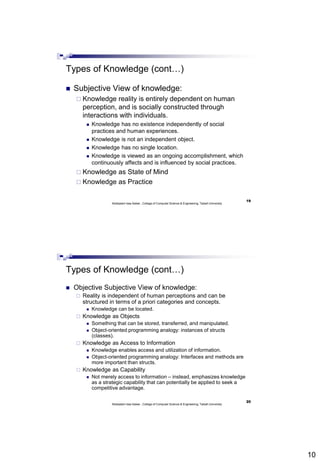
 Procedural knowledge:
 Focuses on beliefs relating procedures or processes:
sequences of steps or actions to desired (or
undesired) outcomes.
22
Abdisalam Issa-Salwe , College of Computer Science & Engineering, Taibah University
Managing Knowledge
 KM is a process that helps organizations
identify, select, organize, disseminate, and
transfer important information and expertise
that are part of the organization’s memory.
 KM is the process of systematically and
actively managing and leveraging stores of
knowledge in an organization
12
23
Abdisalam Issa-Salwe , College of Computer Science & Engineering, Taibah University
Managing Knowledge (cont…)
 Systematic and active management of ideas,
information, and knowledge residing within
organization’s employees.
 Knowledge management systems
Use of technologies to manage knowledge
Used with turnover, change, downsizing
Provide consistent levels of service
24
Abdisalam Issa-Salwe , College of Computer Science & Engineering, Taibah University
Organizational Learning
 Learning organization
 Ability to learn from past
 To improve, organization must learn
 Issues
 Meaning, management, measurement
 Activities
 Problem-solving, experimentation, learning from
past, learning from acknowledged best practices,
transfer of knowledge within organization
 Must have organizational memory, way to save and
share it
13
25
Abdisalam Issa-Salwe , College of Computer Science & Engineering, Taibah University
Organizational Learning (cont…)
 Organizational learning
 Develop new knowledge
 Corporate memory critical
 Organizational culture
 Pattern of shared basic assumptions
 Organizations are realizing how important it is
to "know what they know" and be able to
make maximum use of the knowledge.
 Preventing “reinvent the wheel” many times.
26
Abdisalam Issa-Salwe , College of Computer Science & Engineering, Taibah University
Organizational Learning (cont…)
 Organizations need to know:
what their knowledge assets are;
how to manage and make use of these assets
to get maximum return.
 KM can improve organization efficiency by
providing framework, tools and techniques to
reuse captured intellectual assets.
14
27
Abdisalam Issa-Salwe , College of Computer Science & Engineering, Taibah University
Examples of Organizational Learning (cont…)
 “We have four people in Makkah who know
how to solve this problem. How can we get
them to help our team in Madinah?”
 "People are leaving the company with a
lifetime's experience. How can we capture and
re-use that?"
 "We had a team that did a successful proposal
for aerospace five years ago. Why did they
make the decisions they did? How did they deal
with the customer? What made the team tick?"
28
Abdisalam Issa-Salwe , College of Computer Science & Engineering, Taibah University
Examples of Organizational Learning (cont…)
 "How do we start learning from our
experiences and help our people stop
repeating others' mistakes?"
 "We're involved in an exciting project
with four other companies. How can we
all learn how these virtual teams tick?"
 "Needs change often these days and
we're always bringing new people into
projects. How can we get them up to
speed and contributing quickly?"
15
29
Abdisalam Issa-Salwe , College of Computer Science & Engineering, Taibah University
Knowledge-based Economy
 Rapid changes in the business environment
cannot be handled in traditional ways.
Firms are much larger, with higher turnover
and require better tools for collaboration,
communication, and knowledge sharing.
Firms must develop strategies to sustain
competitive advantage by leveraging their
intellectual assets for optimum performance.
 Managing knowledge is now critical for firms
spread out over wide geographical areas, and for
virtual organizations.
30
Abdisalam Issa-Salwe , College of Computer Science & Engineering, Taibah University
Components of Knowledge Management
Systems
 Technologies
 Communication
 Access knowledge
 Communicates with others
Collaboration
 Perform group-work
 Synchronous or asynchronous
 Same place/different place
Storage and retrieval
 Capture, storing, retrieval, and management of
both explicit and tacit knowledge through
collaborative systems
16
31
Abdisalam Issa-Salwe , College of Computer Science & Engineering, Taibah University
KM & Information Technologies
The KMS challenge is to identify and integrate
the following three technologies:
 Communication technologies allow
users to access needed knowledge, and to
communicate with each other--especially
with experts.
 Collaboration technologies provide the
means to perform group work.
 Storage and retrieval technologies use a
database management system to capture,
store and manage knowledge.
32
Abdisalam Issa-Salwe , College of Computer Science & Engineering, Taibah University
KM & Information Technologies
 Information technology facilitates sharing as
well as accelerated growth of knowledge.
Information technology allows the movement
of information at increasing speeds and
efficiencies
Knowware are technology tools that support
KM.
Collaboration tools, or groupware, were the
first used to enhance collaboration for tacit
knowledge transfer within an organization.
KM suites are complete KM solutions out-of-
the-box.
Knowledge Servers contain the main KM
software, including the knowledge repository.
17
33
Abdisalam Issa-Salwe , College of Computer Science & Engineering, Taibah University
Components of Knowledge Management
Systems
 Supporting technologies
 Artificial intelligence
 Expert systems, neural networks, fuzzy logicIntelligent agents
 Systems that learn how users work and provide assistance
 Knowledge discovery in databases
 Process used to search for and extract information
 Internal = data and document mining
 External = model marts and model warehouses
 XML Extensible Markup Language
 Enables standardized representations of data
 Better collaboration and communication through portals
34
Abdisalam Issa-Salwe , College of Computer Science & Engineering, Taibah University
Sharing Knowledge
Some people are reluctant to share knowledge due to the
following reasons:;
 No skill in knowledge management techniques.
 Willing to share, but not enough time to do so.
 Don’t understand knowledge management and
benefits.
 Lack of appropriate technology.
 No commitment from senior managers.
 No funding for knowledge management.
 Culture does not encourage knowledge sharing.
18
35
Abdisalam Issa-Salwe , College of Computer Science & Engineering, Taibah University
Discussion
1. Why knowledge management (KM) is important
to organizations?
2. How knowledge management (KM) can help
organizations in their competitive advantage?
3. What we mean by knowledge sharing in
knowledge management (KM)?
4. How sharing knowledge can be made available
to those who need it?
5. How do you manage your personal knowledge
so you can best reuse it?
6. How do you share your knowledge with others?
36
Abdisalam Issa-Salwe , College of Computer Science & Engineering, Taibah University
36
Abdisalam Issa-Salwe, Faculty of Computer Science & Engineering, Taibah University
Reference
 Irma Becerra-Fernandez, Avelino Gonzalez &
Rajiv Sabherwal: Knowledge Management:
Challenges, Solutions and Technologies.
Prentice Hall, 2004.
 Abdisalam Issa-Salwe, Lecture Notes, Taibah
University, 2010.

Is421 lecture01(intro to knowledge management systems)

  • 1.
    1 Abdisalam Issa-Salwe Information SystemsDepartment College of Computer Science & Engineering Taibah University Abdisalam Issa-Salwe, Taibah University 1 Introduction to Knowledge Management Systems (Knowledge Management Systems IS421) Lecture 1 Irma Becerra-Fernandez, Avelino Gonzalez & Rajiv Sabherwal (2004) Knowledge Management: Challenges, Solutions and Technologies, Prentice Hall 2 Abdisalam Issa-Salwe , College of Computer Science & Engineering, Taibah University Topic list  Definition of Knowledge Management  Forces Driving Knowledge Management Data, Information and Knowledge  Importance of Knowledge  Managing Knowledge  Organizational Learning  Through Knowledge Management  Knowledge-based Economy  Components of Knowledge Management Systems  KM & Information Technologies  Components of Knowledge Management Systems  Approaches to Knowledge Management  Objectives of Knowledge Management  Essence of KM  Knowledge Repositories  Knowledge Management System Cycle  KM Benefits  KM Integration  Factors Leading to Success and Failure of Systems  Knowledge Management Issues
  • 2.
    2 3 Abdisalam Issa-Salwe ,College of Computer Science & Engineering, Taibah University Definition of Knowledge Managment  Knowledge management (KM) is defined as doing what is needed to get the most out of knowledge resources.  KM focuses on organizing and making available important knowledge, wherever and whenever it is needed.  KM is a clear and certain perception of something understanding learning 4 Abdisalam Issa-Salwe , College of Computer Science & Engineering, Taibah University Definition of Knowledge Management (cont…)  KM is what is perceived or grasped by the mind  KM is a practical experience and skill which is organized information applicable to problem solving  KM is a collection of specialized facts, procedures and judgment rules.  KM is also related to the concept of intellectual capital.
  • 3.
    3 5 Abdisalam Issa-Salwe ,College of Computer Science & Engineering, Taibah University Forces Driving Knowledge Management 1. Increasing Domain Complexity: Intricacy of internal and external processes, increased competition, and the rapid advancement of technology all contribute to increasing domain complexity. 2. Accelerating Market Volatility: The pace of change, or volatility, within each market domain has increased rapidly in the past decade. 3. Intensified Speed of Responsiveness: The time required to take action based upon subtle changes within and across domains is decreasing. 4. Diminishing Individual Experience: High employee turnover rates have resulted in individuals with decision- making authority having less tenure within their organizations than ever before. 6 Abdisalam Issa-Salwe , College of Computer Science & Engineering, Taibah University  Data  Data represents raw numbers or assertions  Data comprises facts, observations, or perceptionsRefers to isolated facts such as individual measurements.  Data are raw facts about the organisation and its business transactions.  No meaning on their own  Do not signify anything  Useless unless placed in some sort of context.  Most data items have little meaning and use by themselves. Data, Information and Knowledge
  • 4.
    4 7 Abdisalam Issa-Salwe ,College of Computer Science & Engineering, Taibah University Data, Information and Knowledge (cont…)  Information: It is data with semantics.  Information is data that has been refined and organised by processing and purposeful intelligence.  Information, purposeful intelligence, is crucial to the definition  People provide the purpose and the intelligence that produces true information.  Information is data with context and relevance  In contrast, data can include millions of useless garbage bits, which are nothing more than uninterpretable zeros and ones  Information involves manipulation of raw data  Often, information can be used to obtain a more meaningful indication of trends or patterns 8 Abdisalam Issa-Salwe , College of Computer Science & Engineering, Taibah University Data, Information and Knowledge (cont…)  Knowledge: It is information with direction. Knowledge is information with decision- making and action-directed utility and purpose Knowledge is defined by some as “a justified true belief” (Nonaka and Takeuchi 1995) Different from data & information  Knowledge is at the highest level in a hierarchy with information at the middle level, and data to be at the lowest level  It is the richest, deepest & most valuable of the three.
  • 5.
    5 9 Abdisalam Issa-Salwe ,College of Computer Science & Engineering, Taibah University 9 Data are raw facts that constitute building blocks of information.  Information science defines data as unprocessed information.  Information is data that have been organized and communicated in a coherent and meaningful manner.  Data is converted into information, and information is converted into knowledge.  Knowledge: information that is evaluated and organized so that it can be used purposefully. Data, Information and Knowledge (cont…) 10 Abdisalam Issa-Salwe , College of Computer Science & Engineering, Taibah University Data, Information and Knowledge (cont…)
  • 6.
    6 11 Abdisalam Issa-Salwe ,College of Computer Science & Engineering, Taibah University Importance of Knowledge  Knowledge  Knowledge consists of symbols, the relationships between them and rules or procedures for manipulating them  Adds context to the information, providing greater meaning and therefore much greater use and value  It is dynamic and changes with time 12 Abdisalam Issa-Salwe , College of Computer Science & Engineering, Taibah University
  • 7.
    7 13 Abdisalam Issa-Salwe ,College of Computer Science & Engineering, Taibah University Importance of Knowledge (cont…)  Explicit knowledge: Explicit knowledge refers to knowledge that has been expressed into words and numbers. Can be shared formally and systematically in the form of data. Objective, rational, technical Policies, goals, strategies, papers, reports Codified Leaky knowledge 14 Abdisalam Issa-Salwe , College of Computer Science & Engineering, Taibah University Importance of Knowledge (cont…)  Tacit knowledge: Tacit knowledge includes insights, intuitions, and hunches, that are not verbalized or documented. Can be convert to explicit knowledge to tacit knowledge. Subjective, cognitive, experiential learning Highly personalized Difficult to formalize Sticky knowledge
  • 8.
    8 15 Abdisalam Issa-Salwe ,College of Computer Science & Engineering, Taibah University 16 Abdisalam Issa-Salwe , College of Computer Science & Engineering, Taibah University Importance of Knowledge (cont…)  General knowledge is possessed by a large number of individuals and can be transferred easily across individuals  Specific knowledge, or “idiosyncratic knowledge”, is possessed by a very limited number of individuals, and is expensive to transfer.
  • 9.
    9 17 Abdisalam Issa-Salwe ,College of Computer Science & Engineering, Taibah University 18 Abdisalam Issa-Salwe , College of Computer Science & Engineering, Taibah University
  • 10.
    10 19 Abdisalam Issa-Salwe ,College of Computer Science & Engineering, Taibah University Types of Knowledge (cont…)  Subjective View of knowledge:  Knowledge reality is entirely dependent on human perception, and is socially constructed through interactions with individuals.  Knowledge has no existence independently of social practices and human experiences.  Knowledge is not an independent object.  Knowledge has no single location.  Knowledge is viewed as an ongoing accomplishment, which continuously affects and is influenced by social practices.  Knowledge as State of Mind  Knowledge as Practice 20 Abdisalam Issa-Salwe , College of Computer Science & Engineering, Taibah University Types of Knowledge (cont…)  Objective Subjective View of knowledge:  Reality is independent of human perceptions and can be structured in terms of a priori categories and concepts.  Knowledge can be located.  Knowledge as Objects  Something that can be stored, transferred, and manipulated.  Object-oriented programming analogy: instances of structs (classes).  Knowledge as Access to Information  Knowledge enables access and utilization of information.  Object-oriented programming analogy: Interfaces and methods are more important than structs.  Knowledge as Capability  Not merely access to information – instead, emphasizes knowledge as a strategic capability that can potentially be applied to seek a competitive advantage.
  • 11.
    11 21 Abdisalam Issa-Salwe ,College of Computer Science & Engineering, Taibah University Types of Knowledge (cont…)  Declarative knowledge (or substantive knowledge):  Focuses on beliefs about relationships among variables.  Can be stated in the form of logical propositions, expected correlations, or formulas relating concepts represented as logical symbols and/or mathematical variables.  Often characterized in KM circles as “know-what”.  Procedural knowledge:  Focuses on beliefs relating procedures or processes: sequences of steps or actions to desired (or undesired) outcomes. 22 Abdisalam Issa-Salwe , College of Computer Science & Engineering, Taibah University Managing Knowledge  KM is a process that helps organizations identify, select, organize, disseminate, and transfer important information and expertise that are part of the organization’s memory.  KM is the process of systematically and actively managing and leveraging stores of knowledge in an organization
  • 12.
    12 23 Abdisalam Issa-Salwe ,College of Computer Science & Engineering, Taibah University Managing Knowledge (cont…)  Systematic and active management of ideas, information, and knowledge residing within organization’s employees.  Knowledge management systems Use of technologies to manage knowledge Used with turnover, change, downsizing Provide consistent levels of service 24 Abdisalam Issa-Salwe , College of Computer Science & Engineering, Taibah University Organizational Learning  Learning organization  Ability to learn from past  To improve, organization must learn  Issues  Meaning, management, measurement  Activities  Problem-solving, experimentation, learning from past, learning from acknowledged best practices, transfer of knowledge within organization  Must have organizational memory, way to save and share it
  • 13.
    13 25 Abdisalam Issa-Salwe ,College of Computer Science & Engineering, Taibah University Organizational Learning (cont…)  Organizational learning  Develop new knowledge  Corporate memory critical  Organizational culture  Pattern of shared basic assumptions  Organizations are realizing how important it is to "know what they know" and be able to make maximum use of the knowledge.  Preventing “reinvent the wheel” many times. 26 Abdisalam Issa-Salwe , College of Computer Science & Engineering, Taibah University Organizational Learning (cont…)  Organizations need to know: what their knowledge assets are; how to manage and make use of these assets to get maximum return.  KM can improve organization efficiency by providing framework, tools and techniques to reuse captured intellectual assets.
  • 14.
    14 27 Abdisalam Issa-Salwe ,College of Computer Science & Engineering, Taibah University Examples of Organizational Learning (cont…)  “We have four people in Makkah who know how to solve this problem. How can we get them to help our team in Madinah?”  "People are leaving the company with a lifetime's experience. How can we capture and re-use that?"  "We had a team that did a successful proposal for aerospace five years ago. Why did they make the decisions they did? How did they deal with the customer? What made the team tick?" 28 Abdisalam Issa-Salwe , College of Computer Science & Engineering, Taibah University Examples of Organizational Learning (cont…)  "How do we start learning from our experiences and help our people stop repeating others' mistakes?"  "We're involved in an exciting project with four other companies. How can we all learn how these virtual teams tick?"  "Needs change often these days and we're always bringing new people into projects. How can we get them up to speed and contributing quickly?"
  • 15.
    15 29 Abdisalam Issa-Salwe ,College of Computer Science & Engineering, Taibah University Knowledge-based Economy  Rapid changes in the business environment cannot be handled in traditional ways. Firms are much larger, with higher turnover and require better tools for collaboration, communication, and knowledge sharing. Firms must develop strategies to sustain competitive advantage by leveraging their intellectual assets for optimum performance.  Managing knowledge is now critical for firms spread out over wide geographical areas, and for virtual organizations. 30 Abdisalam Issa-Salwe , College of Computer Science & Engineering, Taibah University Components of Knowledge Management Systems  Technologies  Communication  Access knowledge  Communicates with others Collaboration  Perform group-work  Synchronous or asynchronous  Same place/different place Storage and retrieval  Capture, storing, retrieval, and management of both explicit and tacit knowledge through collaborative systems
  • 16.
    16 31 Abdisalam Issa-Salwe ,College of Computer Science & Engineering, Taibah University KM & Information Technologies The KMS challenge is to identify and integrate the following three technologies:  Communication technologies allow users to access needed knowledge, and to communicate with each other--especially with experts.  Collaboration technologies provide the means to perform group work.  Storage and retrieval technologies use a database management system to capture, store and manage knowledge. 32 Abdisalam Issa-Salwe , College of Computer Science & Engineering, Taibah University KM & Information Technologies  Information technology facilitates sharing as well as accelerated growth of knowledge. Information technology allows the movement of information at increasing speeds and efficiencies Knowware are technology tools that support KM. Collaboration tools, or groupware, were the first used to enhance collaboration for tacit knowledge transfer within an organization. KM suites are complete KM solutions out-of- the-box. Knowledge Servers contain the main KM software, including the knowledge repository.
  • 17.
    17 33 Abdisalam Issa-Salwe ,College of Computer Science & Engineering, Taibah University Components of Knowledge Management Systems  Supporting technologies  Artificial intelligence  Expert systems, neural networks, fuzzy logicIntelligent agents  Systems that learn how users work and provide assistance  Knowledge discovery in databases  Process used to search for and extract information  Internal = data and document mining  External = model marts and model warehouses  XML Extensible Markup Language  Enables standardized representations of data  Better collaboration and communication through portals 34 Abdisalam Issa-Salwe , College of Computer Science & Engineering, Taibah University Sharing Knowledge Some people are reluctant to share knowledge due to the following reasons:;  No skill in knowledge management techniques.  Willing to share, but not enough time to do so.  Don’t understand knowledge management and benefits.  Lack of appropriate technology.  No commitment from senior managers.  No funding for knowledge management.  Culture does not encourage knowledge sharing.
  • 18.
    18 35 Abdisalam Issa-Salwe ,College of Computer Science & Engineering, Taibah University Discussion 1. Why knowledge management (KM) is important to organizations? 2. How knowledge management (KM) can help organizations in their competitive advantage? 3. What we mean by knowledge sharing in knowledge management (KM)? 4. How sharing knowledge can be made available to those who need it? 5. How do you manage your personal knowledge so you can best reuse it? 6. How do you share your knowledge with others? 36 Abdisalam Issa-Salwe , College of Computer Science & Engineering, Taibah University 36 Abdisalam Issa-Salwe, Faculty of Computer Science & Engineering, Taibah University Reference  Irma Becerra-Fernandez, Avelino Gonzalez & Rajiv Sabherwal: Knowledge Management: Challenges, Solutions and Technologies. Prentice Hall, 2004.  Abdisalam Issa-Salwe, Lecture Notes, Taibah University, 2010.