Copyright © 2004 Pearson Education, Inc.
Chapter 1
Introduction and
Conceptual Modeling
Elmasri and Navathe, Fundamentals of Database Systems, Fourth Edition
Copyright © 2004 Pearson Education, Inc.
Slide 1-3
Types of Databases and
Database Applications
Numeric and Textual Databases
Traditional database applications, where most of the information that
is stored and accessed is either textual or numeric.
Multimedia Databases
Store pictures, video clips, and sound messages.
Geographic Information Systems (GIS)
Store and analyze maps, weather data, and satellite images
Elmasri and Navathe, Fundamentals of Database Systems, Fourth Edition
Copyright © 2004 Pearson Education, Inc.
Slide 1-4
Types of Databases and
Database Applications
Data Warehouses
Systems are used in many companies to extract and analyze useful
information from very large databases for decision making.
Real-time and Active Databases
Used in controlling industrial and manufacturing processes.
Elmasri and Navathe, Fundamentals of Database Systems, Fourth Edition
Copyright © 2004 Pearson Education, Inc.
Slide 1-5
Basic Definitions
Database: A collection of related data.
Data: Known facts that can be recorded and have an
implicit meaning. For example, names, telephone
numbers, and addresses of the people you know.
Mini-world: Some part of the real world about which
data is stored in a database. For example, student
grades and transcripts at a university.
Elmasri and Navathe, Fundamentals of Database Systems, Fourth Edition
Copyright © 2004 Pearson Education, Inc.
Slide 1-6
Basic Definitions
 Database Management System (DBMS):
(DBMS) is a collection of programs that enables users to
create and maintain a database.
 Database System: The DBMS software together with the data
itself. Sometimes, the applications are also included.
Elmasri and Navathe, Fundamentals of Database Systems, Fourth Edition
Copyright © 2004 Pearson Education, Inc.
Slide 1-7
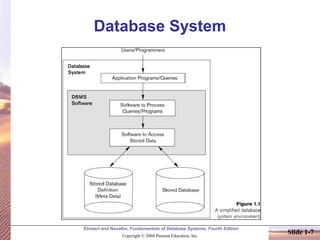
Database System
Elmasri and Navathe, Fundamentals of Database Systems, Fourth Edition
Copyright © 2004 Pearson Education, Inc.
Slide 1-8
Typical DBMS Functionality
Define a database : in terms of data types,
structures and constraints
Construct or Load the Database on a
secondary storage medium
Manipulating the database : querying,
generating reports, insertions, deletions and
modifications to its content
Concurrent Processing and Sharing by a
set of users and programs, keeping all data
valid and consistent
Elmasri and Navathe, Fundamentals of Database Systems, Fourth Edition
Copyright © 2004 Pearson Education, Inc.
Slide 1-9
Typical DBMS Functionality
Other features:
– Protection or Security measures to
prevent unauthorized access
– “Active” processing to take internal
actions on data
– Presentation and Visualization of data
Elmasri and Navathe, Fundamentals of Database Systems, Fourth Edition
Copyright © 2004 Pearson Education, Inc.
Slide 1-10
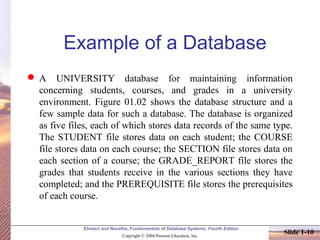
Example of a Database
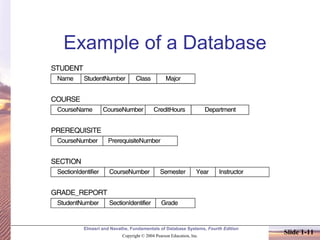
 A UNIVERSITY database for maintaining information
concerning students, courses, and grades in a university
environment. Figure 01.02 shows the database structure and a
few sample data for such a database. The database is organized
as five files, each of which stores data records of the same type.
The STUDENT file stores data on each student; the COURSE
file stores data on each course; the SECTION file stores data on
each section of a course; the GRADE_REPORT file stores the
grades that students receive in the various sections they have
completed; and the PREREQUISITE file stores the prerequisites
of each course.
Elmasri and Navathe, Fundamentals of Database Systems, Fourth Edition
Copyright © 2004 Pearson Education, Inc.
Slide 1-11
Example of a Database
Elmasri and Navathe, Fundamentals of Database Systems, Fourth Edition
Copyright © 2004 Pearson Education, Inc.
Slide 1-12
Example of a Database
Mini-world for the example: Part of a
UNIVERSITY environment.
Some mini-world entities:
– STUDENTs
– COURSEs
– SECTIONs (of COURSEs)
– (academic) DEPARTMENTs
– INSTRUCTORs
Elmasri and Navathe, Fundamentals of Database Systems, Fourth Edition
Copyright © 2004 Pearson Education, Inc.
Slide 1-13
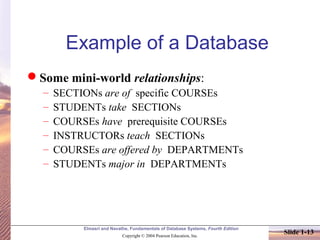
Example of a Database
Some mini-world relationships:
– SECTIONs are of specific COURSEs
– STUDENTs take SECTIONs
– COURSEs have prerequisite COURSEs
– INSTRUCTORs teach SECTIONs
– COURSEs are offered by DEPARTMENTs
– STUDENTs major in DEPARTMENTs
Elmasri and Navathe, Fundamentals of Database Systems, Fourth Edition
Copyright © 2004 Pearson Education, Inc.
Slide 1-14
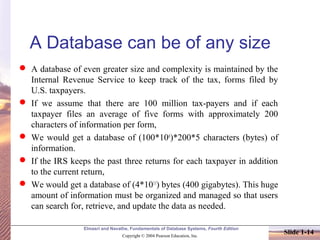
A Database can be of any size
 A database of even greater size and complexity is maintained by the
Internal Revenue Service to keep track of the tax, forms filed by
U.S. taxpayers.
 If we assume that there are 100 million tax-payers and if each
taxpayer files an average of five forms with approximately 200
characters of information per form,
 We would get a database of (100*106
)*200*5 characters (bytes) of
information.
 If the IRS keeps the past three returns for each taxpayer in addition
to the current return,
 We would get a database of (4*1011
) bytes (400 gigabytes). This huge
amount of information must be organized and managed so that users
can search for, retrieve, and update the data as needed.
Elmasri and Navathe, Fundamentals of Database Systems, Fourth Edition
Copyright © 2004 Pearson Education, Inc.
Slide 1-15
Main Characteristics of the Database
Approach
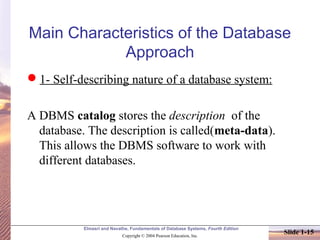
1- Self-describing nature of a database system:
A DBMS catalog stores the description of the
database. The description is called(meta-data).
This allows the DBMS software to work with
different databases.
Elmasri and Navathe, Fundamentals of Database Systems, Fourth Edition
Copyright © 2004 Pearson Education, Inc.
Slide 1-16
Main Characteristics of the Database
Approach
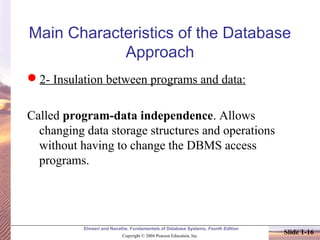
2- Insulation between programs and data:
Called program-data independence. Allows
changing data storage structures and operations
without having to change the DBMS access
programs.
Elmasri and Navathe, Fundamentals of Database Systems, Fourth Edition
Copyright © 2004 Pearson Education, Inc.
Slide 1-17
Main Characteristics of the Database
Approach
3- Data Abstraction:
A data model is used to hide storage details and
present the users with a conceptual view of
the database.
4- Support of multiple views of the data:
Each user may see a different view of the
database, which describes only the data of
interest to that user.
Elmasri and Navathe, Fundamentals of Database Systems, Fourth Edition
Copyright © 2004 Pearson Education, Inc.
Slide 1-18
Main Characteristics of the Database
Approach
5- Sharing of data and multiuser transaction
processing :
Allowing a set of concurrent users to retrieve and to
update the database.
Concurrency control within the DBMS guarantees
that each transaction is correctly executed or
completely aborted.
Elmasri and Navathe, Fundamentals of Database Systems, Fourth Edition
Copyright © 2004 Pearson Education, Inc.
Slide 1-19
Database Users
Users may be divided into those:
Who actually use and control the content
(called “Actors on the Scene”)
Who enable the database to be developed
and the DBMS software to be designed and
implemented
(called “Workers Behind the Scene”).
Elmasri and Navathe, Fundamentals of Database Systems, Fourth Edition
Copyright © 2004 Pearson Education, Inc.
Slide 1-20
Database Users
1- Database administrators:
Responsible for:
1. Authorizing access to the database.
2. Coordinating and monitoring database.
3. Acquiring software and hardware resources.
4. Controlling its use and monitoring efficiency of
operations.
Elmasri and Navathe, Fundamentals of Database Systems, Fourth Edition
Copyright © 2004 Pearson Education, Inc.
Slide 1-21
Database Users
2- Database Designers:
Responsible to define:
Content, Structure, Constraints, and functions or
transactions of the database.
They must communicate with the end-users and
understand their needs.
Elmasri and Navathe, Fundamentals of Database Systems, Fourth Edition
Copyright © 2004 Pearson Education, Inc.
Slide 1-22
Database Users
3- End-users:
They use the data for queries, reports and some of
them actually update the database content.
Elmasri and Navathe, Fundamentals of Database Systems, Fourth Edition
Copyright © 2004 Pearson Education, Inc.
Slide 1-23
Categories of End-users
1- Casual :
Access database when needed but they may need different
information each time. They use database query language to
specify their requests and are typically middle- or high-level
managers or other occasional browsers.
2- Parametric :
They make up a large section of the end-user population.
Examples are bank-tellers or reservation clerks who do this
activity for an entire shift of operations.
Elmasri and Navathe, Fundamentals of Database Systems, Fourth Edition
Copyright © 2004 Pearson Education, Inc.
Slide 1-24
Categories of End-users
3- Stand-alone :
Mostly maintain personal databases using ready-
to-use packaged applications.
An example is a tax program user that creates his
or her own internal database.
Elmasri and Navathe, Fundamentals of Database Systems, Fourth Edition
Copyright © 2004 Pearson Education, Inc.
Slide 1-25
Advantages of Using the
Database Approach
Controlling redundancy in data storage and
in development and maintenence efforts.
Sharing of data among multiple users.
Restricting unauthorized access to data.
Providing persistent storage for program
Objects
Providing Storage Structures for efficient
Query Processing
Elmasri and Navathe, Fundamentals of Database Systems, Fourth Edition
Copyright © 2004 Pearson Education, Inc.
Slide 1-26
Advantages of Using the
Database Approach
Providing backup and recovery
services.
Providing multiple interfaces to
different classes of users.
Representing complex relationships
among data.
Enforcing integrity constraints on the
database.
Elmasri and Navathe, Fundamentals of Database Systems, Fourth Edition
Copyright © 2004 Pearson Education, Inc.
Slide 1-27
Additional Implications of Using
the Database Approach
Enforcing standards: this is very important for
the success of database applications in large
organizations.
Standards refer to data item names, display
formats, screens, report structures, meta-data
(description of data) etc.
Elmasri and Navathe, Fundamentals of Database Systems, Fourth Edition
Copyright © 2004 Pearson Education, Inc.
Slide 1-28
Additional Implications of Using
the Database Approach
Reduced application development time:
Incremental time to add each new application
is reduced.
Elmasri and Navathe, Fundamentals of Database Systems, Fourth Edition
Copyright © 2004 Pearson Education, Inc.
Slide 1-29
Additional Implications of Using
the Database Approach
Flexibility to change data structures:
database structure may evolve as new
requirements are defined.
Availability of up-to-date information – very
important for on-line transaction systems
such as airline, hotel, car reservations.
Elmasri and Navathe, Fundamentals of Database Systems, Fourth Edition
Copyright © 2004 Pearson Education, Inc.
Slide 1-30
Historical Development of
Database Technology
Early Database Applications: The
Hierarchical and Network Models were
introduced in mid 1960’s and dominated
during the seventies.
Relational Model based Systems: The
model that was originally introduced in 1970
was heavily researched and experimented
with in IBM and the universities. Relational
DBMS Products emerged in the 1980’s.
Elmasri and Navathe, Fundamentals of Database Systems, Fourth Edition
Copyright © 2004 Pearson Education, Inc.
Slide 1-31
Historical Development of
Database Technology
Object-oriented applications: OODBMSs
were introduced in late 1980’s and early
1990’s to cover the need of complex data
processing in CAD and other applications.
Their use has not taken off much.
Data on the Web and E-commerce
Applications: Web contains data in HTML
with links among pages. This has given rise
to a new set of applications and E-commerce
is using new standards like XML (eXtended
Markup Language).
Elmasri and Navathe, Fundamentals of Database Systems, Fourth Edition
Copyright © 2004 Pearson Education, Inc.
Slide 1-32
When not to use a DBMS
Main inhibitors (costs) of using a DBMS:
– High initial investment and possible need for
additional hardware & software
When a DBMS may be unnecessary:
– If the database and applications are simple, well
defined, and not expected to change.
– If there are stringent real-time requirements that
may not be met because of DBMS overhead.
– If access to data by multiple users is not required.
Elmasri and Navathe, Fundamentals of Database Systems, Fourth Edition
Copyright © 2004 Pearson Education, Inc.
Slide 1-33
When not to use a DBMS
When no DBMS may be enough :
– If the database system is not able to handle the
complexity of data because of modeling
limitations
– If the database users need special operations not
supported by the DBMS.
Elmasri and Navathe, Fundamentals of Database Systems, Fourth Edition
Copyright © 2004 Pearson Education, Inc.
Slide 1-34
End

Database Presentation

  • 1.
    Copyright © 2004Pearson Education, Inc.
  • 2.
    Copyright © 2004Pearson Education, Inc. Chapter 1 Introduction and Conceptual Modeling
  • 3.
    Elmasri and Navathe,Fundamentals of Database Systems, Fourth Edition Copyright © 2004 Pearson Education, Inc. Slide 1-3 Types of Databases and Database Applications Numeric and Textual Databases Traditional database applications, where most of the information that is stored and accessed is either textual or numeric. Multimedia Databases Store pictures, video clips, and sound messages. Geographic Information Systems (GIS) Store and analyze maps, weather data, and satellite images
  • 4.
    Elmasri and Navathe,Fundamentals of Database Systems, Fourth Edition Copyright © 2004 Pearson Education, Inc. Slide 1-4 Types of Databases and Database Applications Data Warehouses Systems are used in many companies to extract and analyze useful information from very large databases for decision making. Real-time and Active Databases Used in controlling industrial and manufacturing processes.
  • 5.
    Elmasri and Navathe,Fundamentals of Database Systems, Fourth Edition Copyright © 2004 Pearson Education, Inc. Slide 1-5 Basic Definitions Database: A collection of related data. Data: Known facts that can be recorded and have an implicit meaning. For example, names, telephone numbers, and addresses of the people you know. Mini-world: Some part of the real world about which data is stored in a database. For example, student grades and transcripts at a university.
  • 6.
    Elmasri and Navathe,Fundamentals of Database Systems, Fourth Edition Copyright © 2004 Pearson Education, Inc. Slide 1-6 Basic Definitions  Database Management System (DBMS): (DBMS) is a collection of programs that enables users to create and maintain a database.  Database System: The DBMS software together with the data itself. Sometimes, the applications are also included.
  • 7.
    Elmasri and Navathe,Fundamentals of Database Systems, Fourth Edition Copyright © 2004 Pearson Education, Inc. Slide 1-7 Database System
  • 8.
    Elmasri and Navathe,Fundamentals of Database Systems, Fourth Edition Copyright © 2004 Pearson Education, Inc. Slide 1-8 Typical DBMS Functionality Define a database : in terms of data types, structures and constraints Construct or Load the Database on a secondary storage medium Manipulating the database : querying, generating reports, insertions, deletions and modifications to its content Concurrent Processing and Sharing by a set of users and programs, keeping all data valid and consistent
  • 9.
    Elmasri and Navathe,Fundamentals of Database Systems, Fourth Edition Copyright © 2004 Pearson Education, Inc. Slide 1-9 Typical DBMS Functionality Other features: – Protection or Security measures to prevent unauthorized access – “Active” processing to take internal actions on data – Presentation and Visualization of data
  • 10.
    Elmasri and Navathe,Fundamentals of Database Systems, Fourth Edition Copyright © 2004 Pearson Education, Inc. Slide 1-10 Example of a Database  A UNIVERSITY database for maintaining information concerning students, courses, and grades in a university environment. Figure 01.02 shows the database structure and a few sample data for such a database. The database is organized as five files, each of which stores data records of the same type. The STUDENT file stores data on each student; the COURSE file stores data on each course; the SECTION file stores data on each section of a course; the GRADE_REPORT file stores the grades that students receive in the various sections they have completed; and the PREREQUISITE file stores the prerequisites of each course.
  • 11.
    Elmasri and Navathe,Fundamentals of Database Systems, Fourth Edition Copyright © 2004 Pearson Education, Inc. Slide 1-11 Example of a Database
  • 12.
    Elmasri and Navathe,Fundamentals of Database Systems, Fourth Edition Copyright © 2004 Pearson Education, Inc. Slide 1-12 Example of a Database Mini-world for the example: Part of a UNIVERSITY environment. Some mini-world entities: – STUDENTs – COURSEs – SECTIONs (of COURSEs) – (academic) DEPARTMENTs – INSTRUCTORs
  • 13.
    Elmasri and Navathe,Fundamentals of Database Systems, Fourth Edition Copyright © 2004 Pearson Education, Inc. Slide 1-13 Example of a Database Some mini-world relationships: – SECTIONs are of specific COURSEs – STUDENTs take SECTIONs – COURSEs have prerequisite COURSEs – INSTRUCTORs teach SECTIONs – COURSEs are offered by DEPARTMENTs – STUDENTs major in DEPARTMENTs
  • 14.
    Elmasri and Navathe,Fundamentals of Database Systems, Fourth Edition Copyright © 2004 Pearson Education, Inc. Slide 1-14 A Database can be of any size  A database of even greater size and complexity is maintained by the Internal Revenue Service to keep track of the tax, forms filed by U.S. taxpayers.  If we assume that there are 100 million tax-payers and if each taxpayer files an average of five forms with approximately 200 characters of information per form,  We would get a database of (100*106 )*200*5 characters (bytes) of information.  If the IRS keeps the past three returns for each taxpayer in addition to the current return,  We would get a database of (4*1011 ) bytes (400 gigabytes). This huge amount of information must be organized and managed so that users can search for, retrieve, and update the data as needed.
  • 15.
    Elmasri and Navathe,Fundamentals of Database Systems, Fourth Edition Copyright © 2004 Pearson Education, Inc. Slide 1-15 Main Characteristics of the Database Approach 1- Self-describing nature of a database system: A DBMS catalog stores the description of the database. The description is called(meta-data). This allows the DBMS software to work with different databases.
  • 16.
    Elmasri and Navathe,Fundamentals of Database Systems, Fourth Edition Copyright © 2004 Pearson Education, Inc. Slide 1-16 Main Characteristics of the Database Approach 2- Insulation between programs and data: Called program-data independence. Allows changing data storage structures and operations without having to change the DBMS access programs.
  • 17.
    Elmasri and Navathe,Fundamentals of Database Systems, Fourth Edition Copyright © 2004 Pearson Education, Inc. Slide 1-17 Main Characteristics of the Database Approach 3- Data Abstraction: A data model is used to hide storage details and present the users with a conceptual view of the database. 4- Support of multiple views of the data: Each user may see a different view of the database, which describes only the data of interest to that user.
  • 18.
    Elmasri and Navathe,Fundamentals of Database Systems, Fourth Edition Copyright © 2004 Pearson Education, Inc. Slide 1-18 Main Characteristics of the Database Approach 5- Sharing of data and multiuser transaction processing : Allowing a set of concurrent users to retrieve and to update the database. Concurrency control within the DBMS guarantees that each transaction is correctly executed or completely aborted.
  • 19.
    Elmasri and Navathe,Fundamentals of Database Systems, Fourth Edition Copyright © 2004 Pearson Education, Inc. Slide 1-19 Database Users Users may be divided into those: Who actually use and control the content (called “Actors on the Scene”) Who enable the database to be developed and the DBMS software to be designed and implemented (called “Workers Behind the Scene”).
  • 20.
    Elmasri and Navathe,Fundamentals of Database Systems, Fourth Edition Copyright © 2004 Pearson Education, Inc. Slide 1-20 Database Users 1- Database administrators: Responsible for: 1. Authorizing access to the database. 2. Coordinating and monitoring database. 3. Acquiring software and hardware resources. 4. Controlling its use and monitoring efficiency of operations.
  • 21.
    Elmasri and Navathe,Fundamentals of Database Systems, Fourth Edition Copyright © 2004 Pearson Education, Inc. Slide 1-21 Database Users 2- Database Designers: Responsible to define: Content, Structure, Constraints, and functions or transactions of the database. They must communicate with the end-users and understand their needs.
  • 22.
    Elmasri and Navathe,Fundamentals of Database Systems, Fourth Edition Copyright © 2004 Pearson Education, Inc. Slide 1-22 Database Users 3- End-users: They use the data for queries, reports and some of them actually update the database content.
  • 23.
    Elmasri and Navathe,Fundamentals of Database Systems, Fourth Edition Copyright © 2004 Pearson Education, Inc. Slide 1-23 Categories of End-users 1- Casual : Access database when needed but they may need different information each time. They use database query language to specify their requests and are typically middle- or high-level managers or other occasional browsers. 2- Parametric : They make up a large section of the end-user population. Examples are bank-tellers or reservation clerks who do this activity for an entire shift of operations.
  • 24.
    Elmasri and Navathe,Fundamentals of Database Systems, Fourth Edition Copyright © 2004 Pearson Education, Inc. Slide 1-24 Categories of End-users 3- Stand-alone : Mostly maintain personal databases using ready- to-use packaged applications. An example is a tax program user that creates his or her own internal database.
  • 25.
    Elmasri and Navathe,Fundamentals of Database Systems, Fourth Edition Copyright © 2004 Pearson Education, Inc. Slide 1-25 Advantages of Using the Database Approach Controlling redundancy in data storage and in development and maintenence efforts. Sharing of data among multiple users. Restricting unauthorized access to data. Providing persistent storage for program Objects Providing Storage Structures for efficient Query Processing
  • 26.
    Elmasri and Navathe,Fundamentals of Database Systems, Fourth Edition Copyright © 2004 Pearson Education, Inc. Slide 1-26 Advantages of Using the Database Approach Providing backup and recovery services. Providing multiple interfaces to different classes of users. Representing complex relationships among data. Enforcing integrity constraints on the database.
  • 27.
    Elmasri and Navathe,Fundamentals of Database Systems, Fourth Edition Copyright © 2004 Pearson Education, Inc. Slide 1-27 Additional Implications of Using the Database Approach Enforcing standards: this is very important for the success of database applications in large organizations. Standards refer to data item names, display formats, screens, report structures, meta-data (description of data) etc.
  • 28.
    Elmasri and Navathe,Fundamentals of Database Systems, Fourth Edition Copyright © 2004 Pearson Education, Inc. Slide 1-28 Additional Implications of Using the Database Approach Reduced application development time: Incremental time to add each new application is reduced.
  • 29.
    Elmasri and Navathe,Fundamentals of Database Systems, Fourth Edition Copyright © 2004 Pearson Education, Inc. Slide 1-29 Additional Implications of Using the Database Approach Flexibility to change data structures: database structure may evolve as new requirements are defined. Availability of up-to-date information – very important for on-line transaction systems such as airline, hotel, car reservations.
  • 30.
    Elmasri and Navathe,Fundamentals of Database Systems, Fourth Edition Copyright © 2004 Pearson Education, Inc. Slide 1-30 Historical Development of Database Technology Early Database Applications: The Hierarchical and Network Models were introduced in mid 1960’s and dominated during the seventies. Relational Model based Systems: The model that was originally introduced in 1970 was heavily researched and experimented with in IBM and the universities. Relational DBMS Products emerged in the 1980’s.
  • 31.
    Elmasri and Navathe,Fundamentals of Database Systems, Fourth Edition Copyright © 2004 Pearson Education, Inc. Slide 1-31 Historical Development of Database Technology Object-oriented applications: OODBMSs were introduced in late 1980’s and early 1990’s to cover the need of complex data processing in CAD and other applications. Their use has not taken off much. Data on the Web and E-commerce Applications: Web contains data in HTML with links among pages. This has given rise to a new set of applications and E-commerce is using new standards like XML (eXtended Markup Language).
  • 32.
    Elmasri and Navathe,Fundamentals of Database Systems, Fourth Edition Copyright © 2004 Pearson Education, Inc. Slide 1-32 When not to use a DBMS Main inhibitors (costs) of using a DBMS: – High initial investment and possible need for additional hardware & software When a DBMS may be unnecessary: – If the database and applications are simple, well defined, and not expected to change. – If there are stringent real-time requirements that may not be met because of DBMS overhead. – If access to data by multiple users is not required.
  • 33.
    Elmasri and Navathe,Fundamentals of Database Systems, Fourth Edition Copyright © 2004 Pearson Education, Inc. Slide 1-33 When not to use a DBMS When no DBMS may be enough : – If the database system is not able to handle the complexity of data because of modeling limitations – If the database users need special operations not supported by the DBMS.
  • 34.
    Elmasri and Navathe,Fundamentals of Database Systems, Fourth Edition Copyright © 2004 Pearson Education, Inc. Slide 1-34 End