Topics in Data Management include: Data analysis  Database management system  Data modeling  Database administration  Data warehousing  Data mining  Data quality assurance  Data security  Data architecture
Data analysis  is the process of looking at and summarizing data  with the intent to extract useful  information  and develop conclusions. Data Analysis as a process plays a significant role on an important  level and is used in: ________________________________________________________________ Nuclear and particle physics,  In nuclear and particle physics the data usually originate from the experimental apparatus via a  Data acquisition system . Social Sciences  ,Qualitative data analysis (QDA) or qualitative research is the analysis of non-numerical data, for example words, photographs, observations, etc. Business intelligence ( BI) ,dates to 1958. It refers to technologies, applications, and practices for the collection, integration, analysis, and presentation of business information.
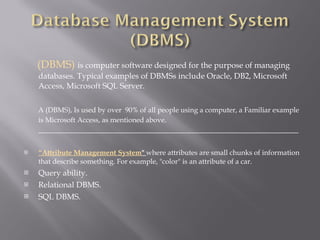
(DBMS)  is computer software designed for the purpose of managing databases. Typical examples of DBMSs include Oracle, DB2, Microsoft Access, Microsoft SQL Server. A (DBMS), Is used by over  90% of all people using a computer, a Familiar example is Microsoft Access, as mentioned above .  _________________________________________________________________ “ Attribute Management System "  where attributes are small chunks of information that describe something. For example, "color" is an attribute of a car. Query ability. Relational DBMS. SQL DBMS.
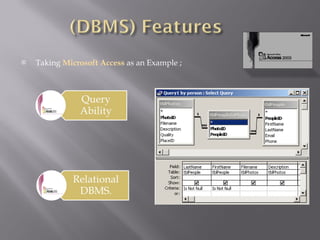
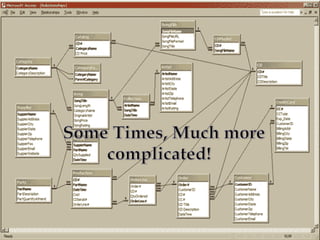
Taking  Microsoft Access  as an Example ;
 
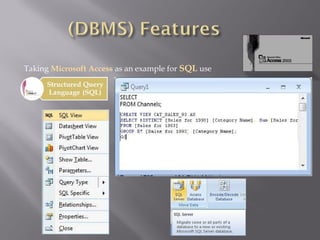
Taking  Microsoft Access  as an example for  SQL  use
Data Modeling  ,  is the process of creating a data model by applying a data model theory. A data model theory is a formal data model description. When data modeling, we are structuring and organizing data. These data structures are then typically implemented in a database management system.  ____________________________________________________________________________________ There are 3 Parts ; The structural part:  a collection of data structures which are used to create databases representing the entities or objects modeled by the database. The integrity part:  a collection of rules governing the constraints placed on these data structures to ensure structural integrity. The manipulation part:   a collection of operators which can be applied to the data structures, to update and query the data contained in the database.
A  (DBA)  is a person who is responsible for the environmental aspects of a database. _________________________________________________________________ In general these aspects, include; Recoverability  - Creating and testing Backups  Integrity  - Verifying or helping to verify data integrity  Security  - Defining and/or implementing access controls to the data  Availability  - Ensuring maximum uptime  Performance  - Ensuring maximum performance given budgetary constraints  Development and testing support  - Helping programmers and engineers to efficiently utilize the database.
(DW)  is the main repository of an organization's historical data, its corporate memory. It contains the raw material for management's decision support system. The critical factor leading to the use of a data warehouse is that a data analyst can perform complex queries and analysis, such as data mining, on the information without slowing down the operational systems. _________________________________________________________________________   Extract ,  Transform, and Load ( ETL)   is a process in data warehousing that involves Extracting data from outside sources, transforming it to fit business needs (which can include quality levels), and ultimately  Loading it into the end target, i.e. the data warehouse.  ETL  is important, as it is the way data actually gets loaded into the warehouse.
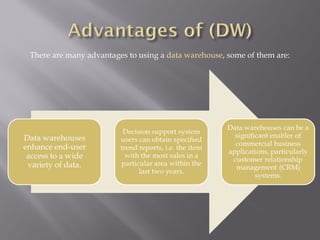
There are many advantages to using a  data warehouse , some of them are:
 
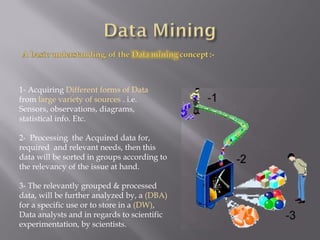
1- Acquiring  Different forms of Data  from  large variety of sources  . i.e. Sensors, observations, diagrams, statistical info. Etc. 2-  Processing  the Acquired data for, required  and relevant needs, then this data will be sorted in groups according to the relevancy of the issue at hand. 3- The relevantly grouped & processed data, will be further analyzed by, a  (DBA)  for a specific use or to store in a  (DW) , Data analysts and in regards to scientific experimentation, by scientists.
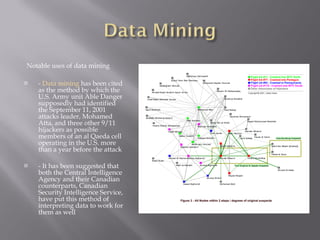
Notable uses of data mining -  Data mining  has been cited as the method by which the U.S. Army unit Able Danger supposedly had identified the September 11, 2001 attacks leader, Mohamed Atta, and three other 9/11 hijackers as possible members of an al Qaeda cell operating in the U.S. more than a year before the attack - It has been suggested that both the Central Intelligence Agency and their Canadian counterparts, Canadian Security Intelligence Service, have put this method of interpreting data to work for them as well
 
Data Security  is the means of ensuring that data is kept safe from corruption and that access to it is suitably controlled. Thus data security helps to ensure privacy. It also helps in protecting personal data. This is done by following the Data protection Act  (DPA).
Data Architecture :  is the design of data for use in defining the target state and the subsequent planning needed to hit the target state. Data Architecture is one of the pillars of Enterprise Architecture and handshakes with its peer pillars of Business Architecture, Application Architecture and Integration Architecture. Enterprise Technology drivers   Economics Business policies   Data processing needs

Data management new

  • 1.
  • 2.
    Topics in DataManagement include: Data analysis Database management system Data modeling Database administration Data warehousing Data mining Data quality assurance Data security Data architecture
  • 3.
    Data analysis is the process of looking at and summarizing data with the intent to extract useful information and develop conclusions. Data Analysis as a process plays a significant role on an important level and is used in: ________________________________________________________________ Nuclear and particle physics, In nuclear and particle physics the data usually originate from the experimental apparatus via a Data acquisition system . Social Sciences ,Qualitative data analysis (QDA) or qualitative research is the analysis of non-numerical data, for example words, photographs, observations, etc. Business intelligence ( BI) ,dates to 1958. It refers to technologies, applications, and practices for the collection, integration, analysis, and presentation of business information.
  • 4.
    (DBMS) iscomputer software designed for the purpose of managing databases. Typical examples of DBMSs include Oracle, DB2, Microsoft Access, Microsoft SQL Server. A (DBMS), Is used by over 90% of all people using a computer, a Familiar example is Microsoft Access, as mentioned above . _________________________________________________________________ “ Attribute Management System " where attributes are small chunks of information that describe something. For example, "color" is an attribute of a car. Query ability. Relational DBMS. SQL DBMS.
  • 5.
    Taking MicrosoftAccess as an Example ;
  • 6.
  • 7.
    Taking MicrosoftAccess as an example for SQL use
  • 8.
    Data Modeling , is the process of creating a data model by applying a data model theory. A data model theory is a formal data model description. When data modeling, we are structuring and organizing data. These data structures are then typically implemented in a database management system. ____________________________________________________________________________________ There are 3 Parts ; The structural part: a collection of data structures which are used to create databases representing the entities or objects modeled by the database. The integrity part: a collection of rules governing the constraints placed on these data structures to ensure structural integrity. The manipulation part: a collection of operators which can be applied to the data structures, to update and query the data contained in the database.
  • 9.
    A (DBA) is a person who is responsible for the environmental aspects of a database. _________________________________________________________________ In general these aspects, include; Recoverability - Creating and testing Backups Integrity - Verifying or helping to verify data integrity Security - Defining and/or implementing access controls to the data Availability - Ensuring maximum uptime Performance - Ensuring maximum performance given budgetary constraints Development and testing support - Helping programmers and engineers to efficiently utilize the database.
  • 10.
    (DW) isthe main repository of an organization's historical data, its corporate memory. It contains the raw material for management's decision support system. The critical factor leading to the use of a data warehouse is that a data analyst can perform complex queries and analysis, such as data mining, on the information without slowing down the operational systems. _________________________________________________________________________ Extract , Transform, and Load ( ETL) is a process in data warehousing that involves Extracting data from outside sources, transforming it to fit business needs (which can include quality levels), and ultimately Loading it into the end target, i.e. the data warehouse. ETL is important, as it is the way data actually gets loaded into the warehouse.
  • 11.
    There are manyadvantages to using a data warehouse , some of them are:
  • 12.
  • 13.
    1- Acquiring Different forms of Data from large variety of sources . i.e. Sensors, observations, diagrams, statistical info. Etc. 2- Processing the Acquired data for, required and relevant needs, then this data will be sorted in groups according to the relevancy of the issue at hand. 3- The relevantly grouped & processed data, will be further analyzed by, a (DBA) for a specific use or to store in a (DW) , Data analysts and in regards to scientific experimentation, by scientists.
  • 14.
    Notable uses ofdata mining - Data mining has been cited as the method by which the U.S. Army unit Able Danger supposedly had identified the September 11, 2001 attacks leader, Mohamed Atta, and three other 9/11 hijackers as possible members of an al Qaeda cell operating in the U.S. more than a year before the attack - It has been suggested that both the Central Intelligence Agency and their Canadian counterparts, Canadian Security Intelligence Service, have put this method of interpreting data to work for them as well
  • 15.
  • 16.
    Data Security is the means of ensuring that data is kept safe from corruption and that access to it is suitably controlled. Thus data security helps to ensure privacy. It also helps in protecting personal data. This is done by following the Data protection Act (DPA).
  • 17.
    Data Architecture : is the design of data for use in defining the target state and the subsequent planning needed to hit the target state. Data Architecture is one of the pillars of Enterprise Architecture and handshakes with its peer pillars of Business Architecture, Application Architecture and Integration Architecture. Enterprise Technology drivers Economics Business policies Data processing needs

Editor's Notes

  • #4 Data analysis is closely related to Data mining, but data mining tends to focus on larger data sets. I will be explaining it later on.
  • #5 DBMSs are typically used by Database administrators in the creation of Database systems