Part-B1   Stacks
Abstract Data Types (ADTs) An abstract data type (ADT) is an abstraction of a data structure An ADT specifies: Data stored Operations on the data Error conditions associated with operations Example: ADT modeling a students record The data stored are  Student name, id No., as1, as2,as3,  exam The operations supported are int  averageAs (as1,as2,as3) Int  finalMark (as1, as2,as3, exam) ) Error conditions: Calculate the final mark for absent student
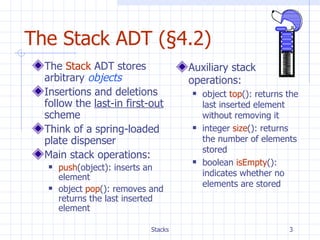
The Stack ADT (§4.2) The  Stack  ADT stores arbitrary  objects Insertions and deletions follow the  last-in first-out  scheme Think of a spring-loaded plate dispenser Main stack operations: push (object): inserts an element object  pop (): removes and returns the last inserted element Auxiliary stack operations: object  top (): returns the last inserted element without removing it integer  size (): returns the number of elements stored boolean  isEmpty (): indicates whether no elements are stored
Stack Interface in Java Java interface corresponding to our Stack ADT Requires the definition of class  EmptyStackException public interface   Stack   { public  int  size() ; public  boolean  isEmpty() ; public  Object  top() throws   EmptyStackException ; public void   push(Object o) ; public  Object  pop()   throws   EmptyStackException ; }
Exceptions Attempting the execution of an operation of ADT may sometimes cause an error condition, called an exception Exceptions are said to be “thrown” by an operation that cannot be executed In the Stack ADT, operations pop and top cannot be performed if the stack is empty Attempting the execution of pop or top on an empty stack throws an  EmptyStackException
Applications of Stacks Direct applications Undo sequence in a text editor Chain of method calls in the Java Virtual Machine Indirect applications Auxiliary data structure for algorithms Component of other data structures
Array-based Stack  (Implementation)   A simple way of implementing the Stack ADT uses an array We add elements from left to right A variable  t  keeps track of the  index of the top element  S 0 1 2 t … Algorithm   size () return   t  +   1 Algorithm   pop () if   isEmpty ()   then throw  EmptyStackException   else  t      t      1 return   S [ t  +   1]
Array-based Stack (cont.) The array storing the stack elements may become full A push operation will then throw a  FullStackException Limitation of the array-based  implementation Not intrinsic to the Stack ADT Algorithm   push ( o ) if   t   =   S.length      1   then throw  FullStackException   else  t      t  +   1 S [ t ]     o S 0 1 2 t …
Array-based Stack  (Cont.)  A Stack might be empty top  returns the element at the top of the Stack, but does not remove the top element. When the Stack is empty, an error occurs. S 0 1 2 t … Algorithm   isEmpty() if   t<0   then   return   true else   return   false Algorithm   top () if   isEmpty ()   then throw  EmptyStackException   return   S [ t  ]
Performance and Limitations for array-based Stack Performance Let  n  be the number of elements in the stack The space used is  O ( n ) Each operation runs in time  O (1) Limitations The maximum size of the stack must be defined a priori and cannot be changed Trying to push a new element into a full stack causes an implementation-specific exception
Array-based Stack in Java public class   ArrayStack  implements  Stack { // holds the stack elements   private  Object S[ ]; // index to top element private  int top = -1; // constructor public   ArrayStack(int capacity)   {   S = new Object[capacity]);   }
Array-based Stack in Java public  Object  pop()   throws   EmptyStackException { if  isEmpty() throw new   EmptyStackException (“ Empty stack: cannot pop ”); Object temp = S[top]; // facilitates garbage collection   S[top] =   null ; top = top – 1; return   temp;   } public  int  size()   { return  (top + 1);
Array-based Stack in Java public boolean isEmpty() { return (top < 0); } public void push(Object obj) throws FullStackException { if (size() == capacity) throw new FullStackException(&quot;Stack overflow.&quot;); S[++top] = obj; } public Object top() throws EmptyStackException { if (isEmpty()) throw new EmptyStackException(&quot;Stack is empty.&quot;); return S[top]; }
Parentheses Matching An expression, i.e.,[(2+3)*x+5]*2.  Each “(”, “{”, or “[” must be paired with a matching “)”, “}”, or “[” correct:  ( )(( )) { ([( )]) } correct:  ((( )(( )) { ([( )]) } incorrect:  )(( )) { ([( )]) } incorrect:  ( { [ ]) } incorrect:  (
Parentheses Matching Algorithm Algorithm  ParenMatch ( X , n ) : Input:  An array  X  of  n  tokens, each of which is either a grouping symbol, a variable, an arithmetic operator, or a number Output:  true  if and only if all the grouping symbols in  X  match Let  S  be an empty stack for  i = 0 to  n - 1  do if  X [ i ]  is an opening grouping symbol  then S . push ( X [ i ] ) else if  X [ i ]  is a closing grouping symbol  then if  S . isEmpty ()  then return false  { nothing to match with }  if  S . pop () does not match the type of  X [ i ]  then return false  { wrong type }  if  S . isEmpty ()  then return true  { every symbol matched }  else return false  { some symbols were never matched }
Parentheses Matching Example 1 Input: () (() [()]) ([ Push  [  [ 5 ( Pop  ( Test if ( and X[i] match?  YES ) 4 (( Push ( ( 3 ( Push ( ( 2 Pop  (  Test if  ( and X[i] match?  YES ) 1 ( Push ( ( 0 Output Stack Operation X[i] i
Parentheses Matching Example 1 Input: () (() [()]) Pop ( Test if ( and X[i]  match?  YES ) 9 TRUE Test if  stack is Empty?  YES ( Pop  [ Test if  [ and X[i] match?  YES ] 8 ([ Pop  ( Test if  ( and X[i] match?  YES ) 7 ([( Push ( ( 6 Output Stack Operation X[i] i
Parentheses Matching Example 2 Input:  ( () [] ]() FASLE Pop ( Test if ( and X[i] match ?  NO  ] 5 ( Pop  [ Test if [ and X[i] match?  YES ] 4 ([ Push [ [ 3 ( Pop  ( Test if ( and X[i] match?  YES ) 2 (( Push ( ( 1 ( Push ( ( 0 Output Stack Operation X[i] i
Computing Spans (not in book) We show how to use a stack as an auxiliary data structure in an algorithm Given an  array  X , the span  S [ i ]  of  X [ i ]  is the maximum number of consecutive elements  X [ j ]  immediately preceding  X [ i ]  and such that  X [ j ]    X [ j+1 ]   Spans have applications to financial analysis E.g., stock at 52-week high X S 1 3 2 1 1 2 5 4 3 6
Quadratic Algorithm Algorithm   spans1 ( X, n ) Input   array  X  of  n  integers Output   array  S  of spans of  X   # S      new array of  n  integers   n for   i      0   to   n     1   do n s     1 n while  s     i      X [ i   s ]      X [ i -s+1 ]   1   2   …   ( n     1)   s      s     1   1   2   …   ( n     1) S [ i ]      s     n return   S    1 X[]= 1,2,3, …, n-1, n. Algorithm  spans1  runs in  O ( n 2 )  time
Computing Spans with a Stack We push the n elements in the stack We sacn the elements in the  stack in the reverse order. We find the last element x[j] with x[j]<=x[i] and x[j-1]>x[i] and set s[i]=i-j+1. If no such a j exists, s[i]=i+1.  Compute the s[i] for the remaining i’s as follows: for (i=n-2; i>=0; i--) if  (s[i+1]>1 & s[i]==0) then s[i]=s[i+1]-1
Example:  i= 0, 1, 2, 3, 4, 5, 6, 7  X[i]= 6, 3, 4, 1, 2, 3, 5, 4 S[i]= 1, 1, 2, 1, 2, 3, 4, 1. 4  5  5 3  3 2  2 1  1  4  4  4 3  3  3 6  6  6  6 Stack  Stack  Stack  Stack  Stack
Linear Algorithm Algorithm   spans2 ( X, n )   # S      new array of  n  integers     n A      new empty stack     1 for   i      0   to   n     1   do A.push(i)   n   i=n-1  ;  j=n-1 ;  1 while  (i<=0)  do  while   (  A . isEmpty ()     X [ A.top ()]      X [ j ]  )   do   n   j      A.pop ()   n   if  A . isEmpty ()   then       n S [ i ]      i     1   1   else   S [ i ]      i    j +1  n i=j-1;   n return   S      1 Each index of the array Is pushed into the stack exactly one  Is popped from the stack at most once The statements in the two while loops  are executed at most  n  times  Algorithm  spans2  runs in  O ( n )  time for (i=n-2; i>=0; i--) if  (s[i+1]>1 & s[i]==0) then  s[i]=s[i+1]-1
Summary of Stack  Understand the definition of Stack  ( basic ) Applications Parentheses  ( moderate ) Computing Spans ( not required ) Implementation of Stack is not required. You should be able to use stack to write programs to solve problems
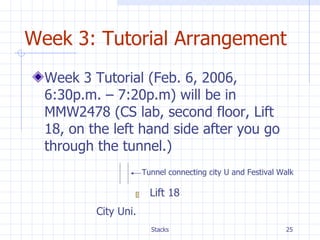
Week 3: Tutorial Arrangement Week 3 Tutorial (Feb. 6, 2006, 6:30p.m. – 7:20p.m) will be in MMW2478 (CS lab, second floor, Lift  18, on the left hand side after you go through the tunnel.)  City Uni. Lift 18 Tunnel connecting city U and Festival Walk
Remarks Emphasize the concept of ADT. More examples about ADT Delete the Span application examples.  Add Queue  part (perhaps to week 3) Teach slowly.

Lecture2

  • 1.
    Part-B1 Stacks
  • 2.
    Abstract Data Types(ADTs) An abstract data type (ADT) is an abstraction of a data structure An ADT specifies: Data stored Operations on the data Error conditions associated with operations Example: ADT modeling a students record The data stored are Student name, id No., as1, as2,as3, exam The operations supported are int averageAs (as1,as2,as3) Int finalMark (as1, as2,as3, exam) ) Error conditions: Calculate the final mark for absent student
  • 3.
    The Stack ADT(§4.2) The Stack ADT stores arbitrary objects Insertions and deletions follow the last-in first-out scheme Think of a spring-loaded plate dispenser Main stack operations: push (object): inserts an element object pop (): removes and returns the last inserted element Auxiliary stack operations: object top (): returns the last inserted element without removing it integer size (): returns the number of elements stored boolean isEmpty (): indicates whether no elements are stored
  • 4.
    Stack Interface inJava Java interface corresponding to our Stack ADT Requires the definition of class EmptyStackException public interface Stack { public int size() ; public boolean isEmpty() ; public Object top() throws EmptyStackException ; public void push(Object o) ; public Object pop() throws EmptyStackException ; }
  • 5.
    Exceptions Attempting theexecution of an operation of ADT may sometimes cause an error condition, called an exception Exceptions are said to be “thrown” by an operation that cannot be executed In the Stack ADT, operations pop and top cannot be performed if the stack is empty Attempting the execution of pop or top on an empty stack throws an EmptyStackException
  • 6.
    Applications of StacksDirect applications Undo sequence in a text editor Chain of method calls in the Java Virtual Machine Indirect applications Auxiliary data structure for algorithms Component of other data structures
  • 7.
    Array-based Stack (Implementation) A simple way of implementing the Stack ADT uses an array We add elements from left to right A variable t keeps track of the index of the top element S 0 1 2 t … Algorithm size () return t + 1 Algorithm pop () if isEmpty () then throw EmptyStackException else t  t  1 return S [ t + 1]
  • 8.
    Array-based Stack (cont.)The array storing the stack elements may become full A push operation will then throw a FullStackException Limitation of the array-based implementation Not intrinsic to the Stack ADT Algorithm push ( o ) if t = S.length  1 then throw FullStackException else t  t + 1 S [ t ]  o S 0 1 2 t …
  • 9.
    Array-based Stack (Cont.) A Stack might be empty top returns the element at the top of the Stack, but does not remove the top element. When the Stack is empty, an error occurs. S 0 1 2 t … Algorithm isEmpty() if t<0 then return true else return false Algorithm top () if isEmpty () then throw EmptyStackException return S [ t ]
  • 10.
    Performance and Limitationsfor array-based Stack Performance Let n be the number of elements in the stack The space used is O ( n ) Each operation runs in time O (1) Limitations The maximum size of the stack must be defined a priori and cannot be changed Trying to push a new element into a full stack causes an implementation-specific exception
  • 11.
    Array-based Stack inJava public class ArrayStack implements Stack { // holds the stack elements private Object S[ ]; // index to top element private int top = -1; // constructor public ArrayStack(int capacity) { S = new Object[capacity]); }
  • 12.
    Array-based Stack inJava public Object pop() throws EmptyStackException { if isEmpty() throw new EmptyStackException (“ Empty stack: cannot pop ”); Object temp = S[top]; // facilitates garbage collection S[top] = null ; top = top – 1; return temp; } public int size() { return (top + 1);
  • 13.
    Array-based Stack inJava public boolean isEmpty() { return (top < 0); } public void push(Object obj) throws FullStackException { if (size() == capacity) throw new FullStackException(&quot;Stack overflow.&quot;); S[++top] = obj; } public Object top() throws EmptyStackException { if (isEmpty()) throw new EmptyStackException(&quot;Stack is empty.&quot;); return S[top]; }
  • 14.
    Parentheses Matching Anexpression, i.e.,[(2+3)*x+5]*2. Each “(”, “{”, or “[” must be paired with a matching “)”, “}”, or “[” correct: ( )(( )) { ([( )]) } correct: ((( )(( )) { ([( )]) } incorrect: )(( )) { ([( )]) } incorrect: ( { [ ]) } incorrect: (
  • 15.
    Parentheses Matching AlgorithmAlgorithm ParenMatch ( X , n ) : Input: An array X of n tokens, each of which is either a grouping symbol, a variable, an arithmetic operator, or a number Output: true if and only if all the grouping symbols in X match Let S be an empty stack for i = 0 to n - 1 do if X [ i ] is an opening grouping symbol then S . push ( X [ i ] ) else if X [ i ] is a closing grouping symbol then if S . isEmpty () then return false { nothing to match with } if S . pop () does not match the type of X [ i ] then return false { wrong type } if S . isEmpty () then return true { every symbol matched } else return false { some symbols were never matched }
  • 16.
    Parentheses Matching Example1 Input: () (() [()]) ([ Push [ [ 5 ( Pop ( Test if ( and X[i] match? YES ) 4 (( Push ( ( 3 ( Push ( ( 2 Pop ( Test if ( and X[i] match? YES ) 1 ( Push ( ( 0 Output Stack Operation X[i] i
  • 17.
    Parentheses Matching Example1 Input: () (() [()]) Pop ( Test if ( and X[i] match? YES ) 9 TRUE Test if stack is Empty? YES ( Pop [ Test if [ and X[i] match? YES ] 8 ([ Pop ( Test if ( and X[i] match? YES ) 7 ([( Push ( ( 6 Output Stack Operation X[i] i
  • 18.
    Parentheses Matching Example2 Input: ( () [] ]() FASLE Pop ( Test if ( and X[i] match ? NO ] 5 ( Pop [ Test if [ and X[i] match? YES ] 4 ([ Push [ [ 3 ( Pop ( Test if ( and X[i] match? YES ) 2 (( Push ( ( 1 ( Push ( ( 0 Output Stack Operation X[i] i
  • 19.
    Computing Spans (notin book) We show how to use a stack as an auxiliary data structure in an algorithm Given an array X , the span S [ i ] of X [ i ] is the maximum number of consecutive elements X [ j ] immediately preceding X [ i ] and such that X [ j ]  X [ j+1 ] Spans have applications to financial analysis E.g., stock at 52-week high X S 1 3 2 1 1 2 5 4 3 6
  • 20.
    Quadratic Algorithm Algorithm spans1 ( X, n ) Input array X of n integers Output array S of spans of X # S  new array of n integers n for i  0 to n  1 do n s  1 n while s  i  X [ i  s ]  X [ i -s+1 ] 1  2  …  ( n  1) s  s  1 1  2  …  ( n  1) S [ i ]  s n return S 1 X[]= 1,2,3, …, n-1, n. Algorithm spans1 runs in O ( n 2 ) time
  • 21.
    Computing Spans witha Stack We push the n elements in the stack We sacn the elements in the stack in the reverse order. We find the last element x[j] with x[j]<=x[i] and x[j-1]>x[i] and set s[i]=i-j+1. If no such a j exists, s[i]=i+1. Compute the s[i] for the remaining i’s as follows: for (i=n-2; i>=0; i--) if (s[i+1]>1 & s[i]==0) then s[i]=s[i+1]-1
  • 22.
    Example: i=0, 1, 2, 3, 4, 5, 6, 7 X[i]= 6, 3, 4, 1, 2, 3, 5, 4 S[i]= 1, 1, 2, 1, 2, 3, 4, 1. 4 5 5 3 3 2 2 1 1 4 4 4 3 3 3 6 6 6 6 Stack Stack Stack Stack Stack
  • 23.
    Linear Algorithm Algorithm spans2 ( X, n ) # S  new array of n integers n A  new empty stack 1 for i  0 to n  1 do A.push(i) n i=n-1 ; j=n-1 ; 1 while (i<=0) do while (  A . isEmpty ()  X [ A.top ()]  X [ j ] ) do n j  A.pop () n if A . isEmpty () then n S [ i ]  i  1 1 else S [ i ]  i  j +1 n i=j-1; n return S 1 Each index of the array Is pushed into the stack exactly one Is popped from the stack at most once The statements in the two while loops are executed at most n times Algorithm spans2 runs in O ( n ) time for (i=n-2; i>=0; i--) if (s[i+1]>1 & s[i]==0) then s[i]=s[i+1]-1
  • 24.
    Summary of Stack Understand the definition of Stack ( basic ) Applications Parentheses ( moderate ) Computing Spans ( not required ) Implementation of Stack is not required. You should be able to use stack to write programs to solve problems
  • 25.
    Week 3: TutorialArrangement Week 3 Tutorial (Feb. 6, 2006, 6:30p.m. – 7:20p.m) will be in MMW2478 (CS lab, second floor, Lift 18, on the left hand side after you go through the tunnel.) City Uni. Lift 18 Tunnel connecting city U and Festival Walk
  • 26.
    Remarks Emphasize theconcept of ADT. More examples about ADT Delete the Span application examples. Add Queue part (perhaps to week 3) Teach slowly.