DATA STRUCTURES
COL 106
AMIT KUMAR, SHWETA AGRAWAL
Why are we studying Data Structures ?
Modern world all about … DATA
Dealing with data…
• How to use it ?
• How to store it ?
• How to process it ?
• How to gain “knowledge” from it ?
• How to keep it secret?
Dealing with data…
• How to use it ?
• How to store it ?
• How to process it ?
• How to gain “knowledge” from it ?
• How to keep it secret?
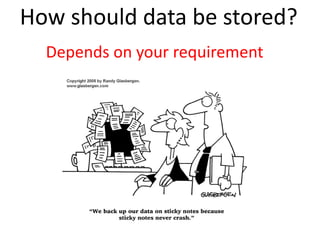
How should data be stored?
Depends on your requirement
But we have some building blocks
Data is diverse ..
To store our big data
10
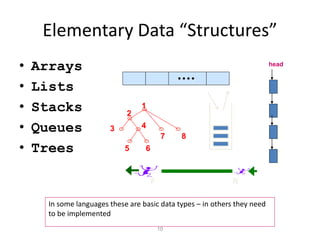
Elementary Data “Structures”
• Arrays
• Lists
• Stacks
• Queues
• Trees
R
F
1
2
3 4
5 6
7 8
In some languages these are basic data types – in others they need
to be implemented
head
Stacks
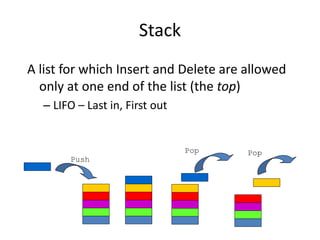
Stack
A list for which Insert and Delete are allowed
only at one end of the list (the top)
– LIFO – Last in, First out
Push
Pop Pop
What is this good for ?
• Page-visited history in a Web browser
What is this good for ?
• Page-visited history in a Web browser
• Undo sequence in a text editor
What is this good for ?
• Page-visited history in a Web browser
• Undo sequence in a text editor
• Saving local variables when one function
calls another, and this one calls another
How should we represent it ?
• Write code in python ?
How should we represent it ?
• Write code in python ?
• Write code in C ?
How should we represent it ?
• Write code in python ?
• Write code in C ?
• Write code in Java ?
Aren’t we essentially doing the same
thing?
19
Abstract Data Type
A mathematical definition of objects, with
operations defined on them
20
Examples
• Basic Types
– integer, real (floating point), boolean (0,1),
character
• Arrays
– A[0..99] : integer array
– A[0..99] : array of images
0 1 2 3 4 5 6 7 99
A …
2 1 3 3 2 9 9 6 10
0 1 2 99
…
21
A mapping from an index set, such as
{0,1,2,…,n}, into a cell type
Objects: set of cells
Operations:
• create(A,n)
• put(A,v,i) or A[i] = v
• value(A,i)
ADT: Array
22
Abstract Data Types (ADTs)
• An abstract data type (ADT) is an
abstraction of a data structure
• An ADT specifies:
–Data stored
–Operations on the data
–Error conditions associated with
operations
23
ADT for stock trade
– The data stored are buy/sell orders
– The operations supported are
• order buy (stock, shares)
• order sell(stock, shares )
• void cancel(order)
– Error conditions:
• Buy/sell a nonexistent stock
• Cancel a nonexistent order
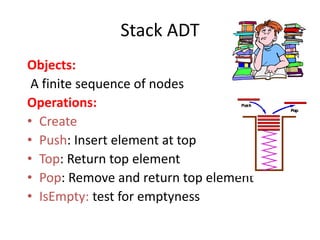
Objects:
A finite sequence of nodes
Operations:
• Create
• Push: Insert element at top
• Top: Return top element
• Pop: Remove and return top element
• IsEmpty: test for emptyness
Stack ADT
25
Exceptions
• Attempting the execution of an operation of ADT
may sometimes cause an error condition, called
an exception
• Exceptions are said to be “thrown” by an
operation that cannot be executed
• In the Stack ADT, operations pop and top cannot
be performed if the stack is empty
• Attempting the execution of pop or top on an
empty stack throws an EmptyStackException
26
Exercise: Stacks
• Describe the output of the following series of stack
operations
– Push(8)
– Push(3)
– Pop()
– Push(2)
– Push(5)
– Pop()
– Pop()
– Push(9)
– Push(1)
27
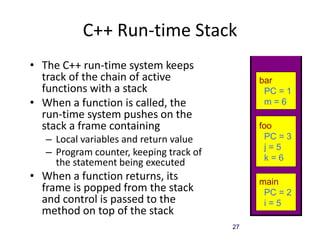
C++ Run-time Stack
• The C++ run-time system keeps
track of the chain of active
functions with a stack
• When a function is called, the
run-time system pushes on the
stack a frame containing
– Local variables and return value
– Program counter, keeping track of
the statement being executed
• When a function returns, its
frame is popped from the stack
and control is passed to the
method on top of the stack
main() {
int i;
i = 5;
foo(i);
}
foo(int j)
{
int k;
k = j+1;
bar(k);
}
bar(int m)
{
…
}
bar
PC = 1
m = 6
foo
PC = 3
j = 5
k = 6
main
PC = 2
i = 5
Stacks 28
Parentheses Matching
• Each “(”, “{”, or “[” must be paired with a
matching “)”, “}”, or “[”
– correct: ( )(( )){([( )])}
– correct: ((( )(( )){([( )])}
– incorrect: )(( )){([( )])}
– incorrect: ({[ ])}
– incorrect: (
Stacks 29
Parentheses Matching Algorithm
Algorithm ParenMatch(X,n):
Input: An array X of n tokens, each of which is either a grouping symbol, a
variable, an arithmetic operator, or a number
Output: true if and only if all the grouping symbols in X match
Let S be an empty stack
for i=0 to n-1 do
if X[i] is an opening grouping symbol then
S.push(X[i])
else if X[i] is a closing grouping symbol then
if S.isEmpty() then
return false {nothing to match with}
if S.pop() does not match the type of X[i] then
return false {wrong type}
if S.isEmpty() then
return true {every symbol matched}
else
return false {some symbols were never matched}
Stacks 30
Postfix Evaluator
• 5 3 6 * + 7 - = ?
Array-based Stack
• A simple way of
implementing the
Stack ADT uses an
array
• We add elements
from left to right
• A variable keeps track
of the index of the
top element
S
0 1 2 t
…
Algorithm size()
return t + 1
Algorithm pop()
if empty() then
throw EmptyStackException
else
t = t - 1
return S[t + 1]
32
Array-based Stack (cont.)
• The array storing the
stack elements may
become full
• A push operation will
then throw a
FullStackException
– Limitation of the
array-based
implementation
– Not intrinsic to the
Stack ADT
S
0 1 2 t
…
Algorithm push(o)
if t = S.length - 1 then
throw FullStackException
else
t = t + 1
S[t] = o
33
Performance and Limitations
- array-based implementation of stack ADT
• Performance
– Let n be the number of elements in the stack
– The space used is O(n)
– Each operation runs in time O(1)
• Limitations
– The maximum size of the stack must be defined a
priori , and cannot be changed
– Trying to push a new element into a full stack causes
an implementation-specific exception
Growable Array-based Stack
• In a push operation, when the
array is full, instead of
throwing an exception, we
can replace the array with a
larger one
• How large should the new
array be?
– incremental strategy: increase
the size by a constant c
– doubling strategy: double the
size
Algorithm push(o)
if t = S.length - 1
then
A = new array of
size …
for i = 0 to t do
A[i] = S[i]
S = A
t = t + 1
S[t] = o
35
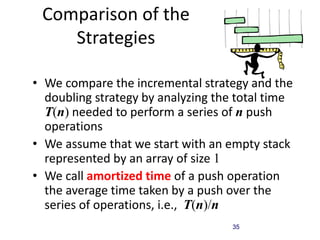
Comparison of the
Strategies
• We compare the incremental strategy and the
doubling strategy by analyzing the total time
T(n) needed to perform a series of n push
operations
• We assume that we start with an empty stack
represented by an array of size 1
• We call amortized time of a push operation
the average time taken by a push over the
series of operations, i.e., T(n)/n
36
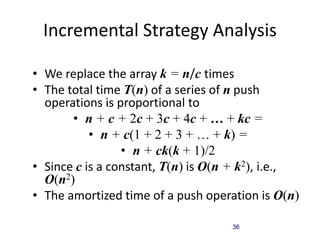
Incremental Strategy Analysis
• We replace the array k = n/c times
• The total time T(n) of a series of n push
operations is proportional to
• n + c + 2c + 3c + 4c + … + kc =
• n + c(1 + 2 + 3 + … + k) =
• n + ck(k + 1)/2
• Since c is a constant, T(n) is O(n + k2), i.e.,
O(n2)
• The amortized time of a push operation is O(n)
37
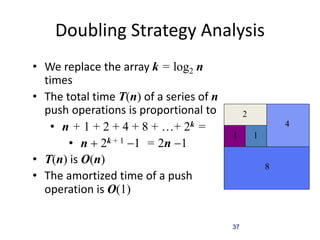
Doubling Strategy Analysis
• We replace the array k = log2 n
times
• The total time T(n) of a series of n
push operations is proportional to
• n + 1 + 2 + 4 + 8 + …+ 2k =
• n + 2k + 1 -1 = 2n -1
• T(n) is O(n)
• The amortized time of a push
operation is O(1)
geometric series
1
2
1
4
8
38
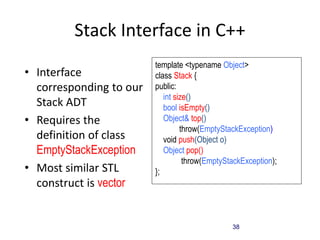
Stack Interface in C++
• Interface
corresponding to our
Stack ADT
• Requires the
definition of class
EmptyStackException
• Most similar STL
construct is vector
template <typename Object>
class Stack {
public:
int size();
bool isEmpty();
Object& top()
throw(EmptyStackException);
void push(Object o);
Object pop()
throw(EmptyStackException);
};
39
Array-based Stack in C++
template <typename Object>
class ArrayStack {
private:
int capacity; // stack capacity
Object *S; // stack array
int top; // top of stack
public:
ArrayStack(int c) {
capacity = c;
S = new Object[capacity];
t = –1;
}
bool isEmpty()
{ return (t < 0); }
Object pop()
{
if(isEmpty())
throw EmptyStackException
(“Access to empty stack”);
return S[t--];
}
// … (other functions omitted)
40
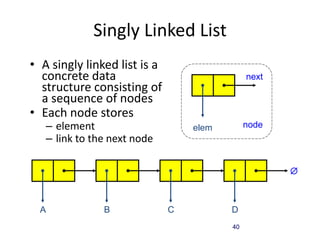
Singly Linked List
• A singly linked list is a
concrete data
structure consisting of
a sequence of nodes
• Each node stores
– element
– link to the next node
next
elem node
A B C D

1/8/2024 9:29 PM
Vectors 41
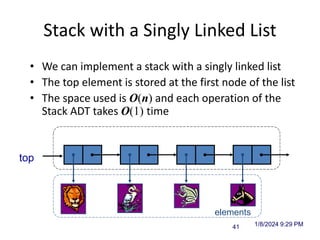
Stack with a Singly Linked List
• We can implement a stack with a singly linked list
• The top element is stored at the first node of the list
• The space used is O(n) and each operation of the
Stack ADT takes O(1) time

t
nodes
elements
top
1/8/2024 9:29 PM
Vectors 42
Exercise
• Describe how to implement a stack using a
singly-linked list
– Stack operations: push(x), pop( ), size(),
isEmpty()
– For each operation, give the running time
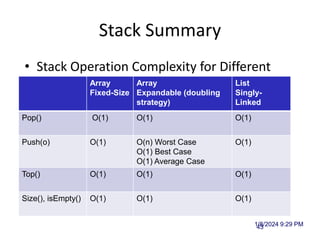
Stack Summary
• Stack Operation Complexity for Different
Implementations
1/8/2024 9:29 PM
Vectors 43
Array
Fixed-Size
Array
Expandable (doubling
strategy)
List
Singly-
Linked
Pop() O(1) O(1) O(1)
Push(o) O(1) O(n) Worst Case
O(1) Best Case
O(1) Average Case
O(1)
Top() O(1) O(1) O(1)
Size(), isEmpty() O(1) O(1) O(1)
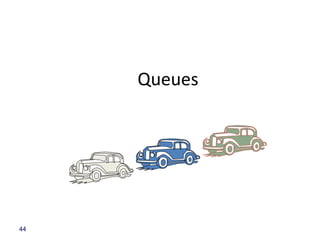
Queues
44
45
Outline and Reading
• The Queue ADT (§5.2.1)
• Implementation with a circular array (§5.2.4)
– Growable array-based queue
• List-based queue
46
The Queue ADT
• The Queue ADT stores arbitrary
objects
• Insertions and deletions follow
the first-in first-out (FIFO)
scheme
• Insertions are at the rear of the
queue and removals are at the
front of the queue
• Main queue operations:
– enqueue(object o): inserts
element o at the end of the
queue
– dequeue(): removes and returns
the element at the front of the
queue
• Auxiliary queue operations:
– front(): returns the element at
the front without removing it
– size(): returns the number of
elements stored
– isEmpty(): returns a Boolean
value indicating whether no
elements are stored
• Exceptions
– Attempting the execution of
dequeue or front on an empty
queue throws an
EmptyQueueException
47
Exercise: Queues
• Describe the output of the following series of queue
operations
– enqueue(8)
– enqueue(3)
– dequeue()
– enqueue(2)
– enqueue(5)
– dequeue()
– dequeue()
– enqueue(9)
– enqueue(1)
48
Applications of Queues
• Direct applications
– Waiting lines
– Access to shared resources (e.g., printer)
• Indirect applications
– Auxiliary data structure for algorithms
– Component of other data structures
49
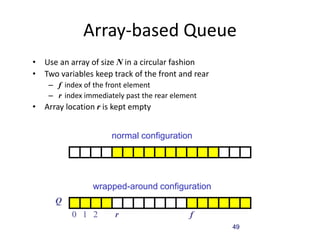
Array-based Queue
• Use an array of size N in a circular fashion
• Two variables keep track of the front and rear
– f index of the front element
– r index immediately past the rear element
• Array location r is kept empty
Q
0 1 2 r
f
normal configuration
Q
0 1 2 f
r
wrapped-around configuration
50
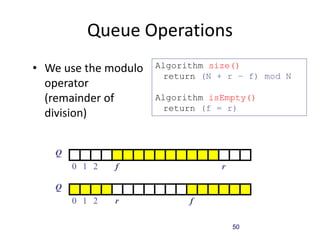
Queue Operations
• We use the modulo
operator
(remainder of
division)
Algorithm size()
return (N + r – f) mod N
Algorithm isEmpty()
return (f = r)
Q
0 1 2 r
f
Q
0 1 2 f
r
51
Queue Operations (cont.)
Algorithm enqueue(o)
if size() = N - 1 then
throw FullQueueException
else
Q[r] = o
r = (r + 1) mod N
• Operation enqueue throws an
exception if the array is full
• This exception is
implementation-dependent
Q
0 1 2 r
f
Q
0 1 2 f
r
52
Queue Operations (cont.)
• Operation dequeue
throws an exception
if the queue is
empty
• This exception is
specified in the
queue ADT
Algorithm dequeue()
if isEmpty() then
throw EmptyQueueException
else
o = Q[f]
f = (f + 1) mod N
return o
Q
0 1 2 r
f
Q
0 1 2 f
r
Performance and Limitations
- array-based implementation of queue ADT
• Performance
– Let n be the number of elements in the queue
– The space used is O(n)
– Each operation runs in time O(1)
• Limitations
– The maximum size of the queue must be defined a
priori , and cannot be changed
– Trying to enqueue an element into a full queue causes
an implementation-specific exception
54
Growable Array-based Queue
• In an enqueue operation, when the array is full,
instead of throwing an exception, we can
replace the array with a larger one
• Similar to what we did for an array-based stack
• The enqueue operation has amortized running
time
– O(n) with the incremental strategy
– O(1) with the doubling strategy
Vectors
Exercise
• Describe how to implement a queue using a
singly-linked list
– Queue operations: enqueue(x), dequeue(),
size(), isEmpty()
– For each operation, give the running time
56
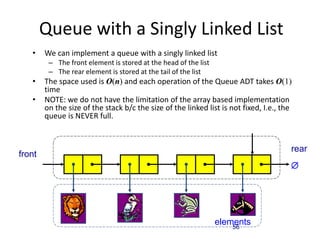
Queue with a Singly Linked List
• We can implement a queue with a singly linked list
– The front element is stored at the head of the list
– The rear element is stored at the tail of the list
• The space used is O(n) and each operation of the Queue ADT takes O(1)
time
• NOTE: we do not have the limitation of the array based implementation
on the size of the stack b/c the size of the linked list is not fixed, I.e., the
queue is NEVER full.
f
r

nodes
elements
front
rear
57
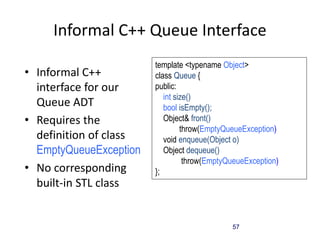
Informal C++ Queue Interface
• Informal C++
interface for our
Queue ADT
• Requires the
definition of class
EmptyQueueException
• No corresponding
built-in STL class
template <typename Object>
class Queue {
public:
int size();
bool isEmpty();
Object& front()
throw(EmptyQueueException);
void enqueue(Object o);
Object dequeue()
throw(EmptyQueueException);
};
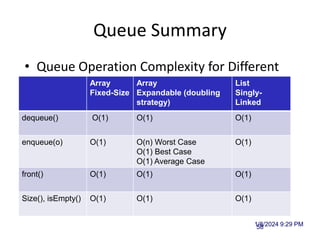
Queue Summary
• Queue Operation Complexity for Different
Implementations
1/8/2024 9:29 PM
Vectors 58
Array
Fixed-Size
Array
Expandable (doubling
strategy)
List
Singly-
Linked
dequeue() O(1) O(1) O(1)
enqueue(o) O(1) O(n) Worst Case
O(1) Best Case
O(1) Average Case
O(1)
front() O(1) O(1) O(1)
Size(), isEmpty() O(1) O(1) O(1)
59
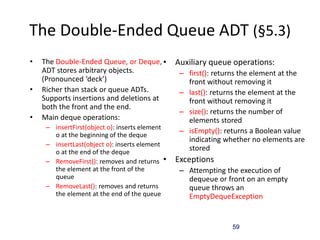
The Double-Ended Queue ADT (§5.3)
• The Double-Ended Queue, or Deque,
ADT stores arbitrary objects.
(Pronounced ‘deck’)
• Richer than stack or queue ADTs.
Supports insertions and deletions at
both the front and the end.
• Main deque operations:
– insertFirst(object o): inserts element
o at the beginning of the deque
– insertLast(object o): inserts element
o at the end of the deque
– RemoveFirst(): removes and returns
the element at the front of the
queue
– RemoveLast(): removes and returns
the element at the end of the queue
• Auxiliary queue operations:
– first(): returns the element at the
front without removing it
– last(): returns the element at the
front without removing it
– size(): returns the number of
elements stored
– isEmpty(): returns a Boolean value
indicating whether no elements are
stored
• Exceptions
– Attempting the execution of
dequeue or front on an empty
queue throws an
EmptyDequeException
60
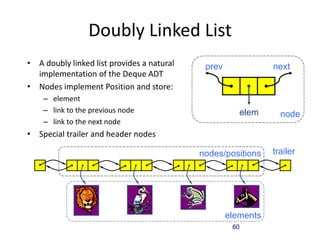
Doubly Linked List
• A doubly linked list provides a natural
implementation of the Deque ADT
• Nodes implement Position and store:
– element
– link to the previous node
– link to the next node
• Special trailer and header nodes
prev next
elem
trailer
header nodes/positions
elements
node
61
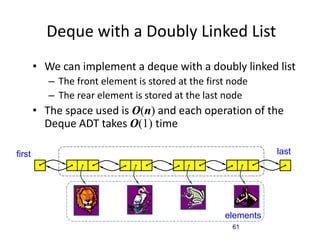
Deque with a Doubly Linked List
• We can implement a deque with a doubly linked list
– The front element is stored at the first node
– The rear element is stored at the last node
• The space used is O(n) and each operation of the
Deque ADT takes O(1) time
last
first
elements
first
62
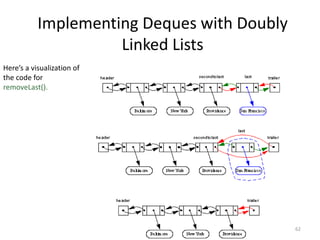
Implementing Deques with Doubly
Linked Lists
Here’s a visualization of
the code for
removeLast().
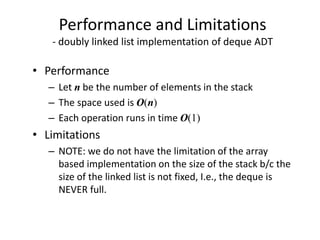
Performance and Limitations
- doubly linked list implementation of deque ADT
• Performance
– Let n be the number of elements in the stack
– The space used is O(n)
– Each operation runs in time O(1)
• Limitations
– NOTE: we do not have the limitation of the array
based implementation on the size of the stack b/c the
size of the linked list is not fixed, I.e., the deque is
NEVER full.
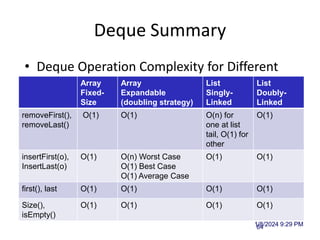
Deque Summary
• Deque Operation Complexity for Different
Implementations
1/8/2024 9:29 PM
Vectors 64
Array
Fixed-
Size
Array
Expandable
(doubling strategy)
List
Singly-
Linked
List
Doubly-
Linked
removeFirst(),
removeLast()
O(1) O(1) O(n) for
one at list
tail, O(1) for
other
O(1)
insertFirst(o),
InsertLast(o)
O(1) O(n) Worst Case
O(1) Best Case
O(1) Average Case
O(1) O(1)
first(), last O(1) O(1) O(1) O(1)
Size(),
isEmpty()
O(1) O(1) O(1) O(1)
65
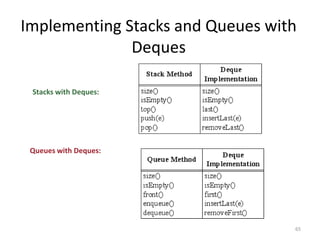
Implementing Stacks and Queues with
Deques
Stacks with Deques:
Queues with Deques:
66
The Adaptor Pattern
• Using a deque to implement a stack or queue is an example of the
adaptor pattern. Adaptor patterns implement a class by using
methods of another class
• In general, adaptor classes specialize general classes
• Two such applications:
-- Specialize a general class by changing some methods.
Ex: implementing a stack with a deque.
-- Specialize the types of objects used by a general class.
Ex: Defining an IntegerArrayStack class that adapts
ArrayStack to only store integers.

Week2-stacks-queues.pptx

  • 1.
    DATA STRUCTURES COL 106 AMITKUMAR, SHWETA AGRAWAL
  • 2.
    Why are westudying Data Structures ?
  • 3.
    Modern world allabout … DATA
  • 5.
    Dealing with data… •How to use it ? • How to store it ? • How to process it ? • How to gain “knowledge” from it ? • How to keep it secret?
  • 6.
    Dealing with data… •How to use it ? • How to store it ? • How to process it ? • How to gain “knowledge” from it ? • How to keep it secret?
  • 7.
    How should databe stored? Depends on your requirement
  • 8.
    But we havesome building blocks Data is diverse ..
  • 9.
    To store ourbig data
  • 10.
    10 Elementary Data “Structures” •Arrays • Lists • Stacks • Queues • Trees R F 1 2 3 4 5 6 7 8 In some languages these are basic data types – in others they need to be implemented head
  • 11.
  • 12.
    Stack A list forwhich Insert and Delete are allowed only at one end of the list (the top) – LIFO – Last in, First out Push Pop Pop
  • 13.
    What is thisgood for ? • Page-visited history in a Web browser
  • 14.
    What is thisgood for ? • Page-visited history in a Web browser • Undo sequence in a text editor
  • 15.
    What is thisgood for ? • Page-visited history in a Web browser • Undo sequence in a text editor • Saving local variables when one function calls another, and this one calls another
  • 16.
    How should werepresent it ? • Write code in python ?
  • 17.
    How should werepresent it ? • Write code in python ? • Write code in C ?
  • 18.
    How should werepresent it ? • Write code in python ? • Write code in C ? • Write code in Java ? Aren’t we essentially doing the same thing?
  • 19.
    19 Abstract Data Type Amathematical definition of objects, with operations defined on them
  • 20.
    20 Examples • Basic Types –integer, real (floating point), boolean (0,1), character • Arrays – A[0..99] : integer array – A[0..99] : array of images 0 1 2 3 4 5 6 7 99 A … 2 1 3 3 2 9 9 6 10 0 1 2 99 …
  • 21.
    21 A mapping froman index set, such as {0,1,2,…,n}, into a cell type Objects: set of cells Operations: • create(A,n) • put(A,v,i) or A[i] = v • value(A,i) ADT: Array
  • 22.
    22 Abstract Data Types(ADTs) • An abstract data type (ADT) is an abstraction of a data structure • An ADT specifies: –Data stored –Operations on the data –Error conditions associated with operations
  • 23.
    23 ADT for stocktrade – The data stored are buy/sell orders – The operations supported are • order buy (stock, shares) • order sell(stock, shares ) • void cancel(order) – Error conditions: • Buy/sell a nonexistent stock • Cancel a nonexistent order
  • 24.
    Objects: A finite sequenceof nodes Operations: • Create • Push: Insert element at top • Top: Return top element • Pop: Remove and return top element • IsEmpty: test for emptyness Stack ADT
  • 25.
    25 Exceptions • Attempting theexecution of an operation of ADT may sometimes cause an error condition, called an exception • Exceptions are said to be “thrown” by an operation that cannot be executed • In the Stack ADT, operations pop and top cannot be performed if the stack is empty • Attempting the execution of pop or top on an empty stack throws an EmptyStackException
  • 26.
    26 Exercise: Stacks • Describethe output of the following series of stack operations – Push(8) – Push(3) – Pop() – Push(2) – Push(5) – Pop() – Pop() – Push(9) – Push(1)
  • 27.
    27 C++ Run-time Stack •The C++ run-time system keeps track of the chain of active functions with a stack • When a function is called, the run-time system pushes on the stack a frame containing – Local variables and return value – Program counter, keeping track of the statement being executed • When a function returns, its frame is popped from the stack and control is passed to the method on top of the stack main() { int i; i = 5; foo(i); } foo(int j) { int k; k = j+1; bar(k); } bar(int m) { … } bar PC = 1 m = 6 foo PC = 3 j = 5 k = 6 main PC = 2 i = 5
  • 28.
    Stacks 28 Parentheses Matching •Each “(”, “{”, or “[” must be paired with a matching “)”, “}”, or “[” – correct: ( )(( )){([( )])} – correct: ((( )(( )){([( )])} – incorrect: )(( )){([( )])} – incorrect: ({[ ])} – incorrect: (
  • 29.
    Stacks 29 Parentheses MatchingAlgorithm Algorithm ParenMatch(X,n): Input: An array X of n tokens, each of which is either a grouping symbol, a variable, an arithmetic operator, or a number Output: true if and only if all the grouping symbols in X match Let S be an empty stack for i=0 to n-1 do if X[i] is an opening grouping symbol then S.push(X[i]) else if X[i] is a closing grouping symbol then if S.isEmpty() then return false {nothing to match with} if S.pop() does not match the type of X[i] then return false {wrong type} if S.isEmpty() then return true {every symbol matched} else return false {some symbols were never matched}
  • 30.
  • 31.
    Array-based Stack • Asimple way of implementing the Stack ADT uses an array • We add elements from left to right • A variable keeps track of the index of the top element S 0 1 2 t … Algorithm size() return t + 1 Algorithm pop() if empty() then throw EmptyStackException else t = t - 1 return S[t + 1]
  • 32.
    32 Array-based Stack (cont.) •The array storing the stack elements may become full • A push operation will then throw a FullStackException – Limitation of the array-based implementation – Not intrinsic to the Stack ADT S 0 1 2 t … Algorithm push(o) if t = S.length - 1 then throw FullStackException else t = t + 1 S[t] = o
  • 33.
    33 Performance and Limitations -array-based implementation of stack ADT • Performance – Let n be the number of elements in the stack – The space used is O(n) – Each operation runs in time O(1) • Limitations – The maximum size of the stack must be defined a priori , and cannot be changed – Trying to push a new element into a full stack causes an implementation-specific exception
  • 34.
    Growable Array-based Stack •In a push operation, when the array is full, instead of throwing an exception, we can replace the array with a larger one • How large should the new array be? – incremental strategy: increase the size by a constant c – doubling strategy: double the size Algorithm push(o) if t = S.length - 1 then A = new array of size … for i = 0 to t do A[i] = S[i] S = A t = t + 1 S[t] = o
  • 35.
    35 Comparison of the Strategies •We compare the incremental strategy and the doubling strategy by analyzing the total time T(n) needed to perform a series of n push operations • We assume that we start with an empty stack represented by an array of size 1 • We call amortized time of a push operation the average time taken by a push over the series of operations, i.e., T(n)/n
  • 36.
    36 Incremental Strategy Analysis •We replace the array k = n/c times • The total time T(n) of a series of n push operations is proportional to • n + c + 2c + 3c + 4c + … + kc = • n + c(1 + 2 + 3 + … + k) = • n + ck(k + 1)/2 • Since c is a constant, T(n) is O(n + k2), i.e., O(n2) • The amortized time of a push operation is O(n)
  • 37.
    37 Doubling Strategy Analysis •We replace the array k = log2 n times • The total time T(n) of a series of n push operations is proportional to • n + 1 + 2 + 4 + 8 + …+ 2k = • n + 2k + 1 -1 = 2n -1 • T(n) is O(n) • The amortized time of a push operation is O(1) geometric series 1 2 1 4 8
  • 38.
    38 Stack Interface inC++ • Interface corresponding to our Stack ADT • Requires the definition of class EmptyStackException • Most similar STL construct is vector template <typename Object> class Stack { public: int size(); bool isEmpty(); Object& top() throw(EmptyStackException); void push(Object o); Object pop() throw(EmptyStackException); };
  • 39.
    39 Array-based Stack inC++ template <typename Object> class ArrayStack { private: int capacity; // stack capacity Object *S; // stack array int top; // top of stack public: ArrayStack(int c) { capacity = c; S = new Object[capacity]; t = –1; } bool isEmpty() { return (t < 0); } Object pop() { if(isEmpty()) throw EmptyStackException (“Access to empty stack”); return S[t--]; } // … (other functions omitted)
  • 40.
    40 Singly Linked List •A singly linked list is a concrete data structure consisting of a sequence of nodes • Each node stores – element – link to the next node next elem node A B C D 
  • 41.
    1/8/2024 9:29 PM Vectors41 Stack with a Singly Linked List • We can implement a stack with a singly linked list • The top element is stored at the first node of the list • The space used is O(n) and each operation of the Stack ADT takes O(1) time  t nodes elements top
  • 42.
    1/8/2024 9:29 PM Vectors42 Exercise • Describe how to implement a stack using a singly-linked list – Stack operations: push(x), pop( ), size(), isEmpty() – For each operation, give the running time
  • 43.
    Stack Summary • StackOperation Complexity for Different Implementations 1/8/2024 9:29 PM Vectors 43 Array Fixed-Size Array Expandable (doubling strategy) List Singly- Linked Pop() O(1) O(1) O(1) Push(o) O(1) O(n) Worst Case O(1) Best Case O(1) Average Case O(1) Top() O(1) O(1) O(1) Size(), isEmpty() O(1) O(1) O(1)
  • 44.
  • 45.
    45 Outline and Reading •The Queue ADT (§5.2.1) • Implementation with a circular array (§5.2.4) – Growable array-based queue • List-based queue
  • 46.
    46 The Queue ADT •The Queue ADT stores arbitrary objects • Insertions and deletions follow the first-in first-out (FIFO) scheme • Insertions are at the rear of the queue and removals are at the front of the queue • Main queue operations: – enqueue(object o): inserts element o at the end of the queue – dequeue(): removes and returns the element at the front of the queue • Auxiliary queue operations: – front(): returns the element at the front without removing it – size(): returns the number of elements stored – isEmpty(): returns a Boolean value indicating whether no elements are stored • Exceptions – Attempting the execution of dequeue or front on an empty queue throws an EmptyQueueException
  • 47.
    47 Exercise: Queues • Describethe output of the following series of queue operations – enqueue(8) – enqueue(3) – dequeue() – enqueue(2) – enqueue(5) – dequeue() – dequeue() – enqueue(9) – enqueue(1)
  • 48.
    48 Applications of Queues •Direct applications – Waiting lines – Access to shared resources (e.g., printer) • Indirect applications – Auxiliary data structure for algorithms – Component of other data structures
  • 49.
    49 Array-based Queue • Usean array of size N in a circular fashion • Two variables keep track of the front and rear – f index of the front element – r index immediately past the rear element • Array location r is kept empty Q 0 1 2 r f normal configuration Q 0 1 2 f r wrapped-around configuration
  • 50.
    50 Queue Operations • Weuse the modulo operator (remainder of division) Algorithm size() return (N + r – f) mod N Algorithm isEmpty() return (f = r) Q 0 1 2 r f Q 0 1 2 f r
  • 51.
    51 Queue Operations (cont.) Algorithmenqueue(o) if size() = N - 1 then throw FullQueueException else Q[r] = o r = (r + 1) mod N • Operation enqueue throws an exception if the array is full • This exception is implementation-dependent Q 0 1 2 r f Q 0 1 2 f r
  • 52.
    52 Queue Operations (cont.) •Operation dequeue throws an exception if the queue is empty • This exception is specified in the queue ADT Algorithm dequeue() if isEmpty() then throw EmptyQueueException else o = Q[f] f = (f + 1) mod N return o Q 0 1 2 r f Q 0 1 2 f r
  • 53.
    Performance and Limitations -array-based implementation of queue ADT • Performance – Let n be the number of elements in the queue – The space used is O(n) – Each operation runs in time O(1) • Limitations – The maximum size of the queue must be defined a priori , and cannot be changed – Trying to enqueue an element into a full queue causes an implementation-specific exception
  • 54.
    54 Growable Array-based Queue •In an enqueue operation, when the array is full, instead of throwing an exception, we can replace the array with a larger one • Similar to what we did for an array-based stack • The enqueue operation has amortized running time – O(n) with the incremental strategy – O(1) with the doubling strategy
  • 55.
    Vectors Exercise • Describe howto implement a queue using a singly-linked list – Queue operations: enqueue(x), dequeue(), size(), isEmpty() – For each operation, give the running time
  • 56.
    56 Queue with aSingly Linked List • We can implement a queue with a singly linked list – The front element is stored at the head of the list – The rear element is stored at the tail of the list • The space used is O(n) and each operation of the Queue ADT takes O(1) time • NOTE: we do not have the limitation of the array based implementation on the size of the stack b/c the size of the linked list is not fixed, I.e., the queue is NEVER full. f r  nodes elements front rear
  • 57.
    57 Informal C++ QueueInterface • Informal C++ interface for our Queue ADT • Requires the definition of class EmptyQueueException • No corresponding built-in STL class template <typename Object> class Queue { public: int size(); bool isEmpty(); Object& front() throw(EmptyQueueException); void enqueue(Object o); Object dequeue() throw(EmptyQueueException); };
  • 58.
    Queue Summary • QueueOperation Complexity for Different Implementations 1/8/2024 9:29 PM Vectors 58 Array Fixed-Size Array Expandable (doubling strategy) List Singly- Linked dequeue() O(1) O(1) O(1) enqueue(o) O(1) O(n) Worst Case O(1) Best Case O(1) Average Case O(1) front() O(1) O(1) O(1) Size(), isEmpty() O(1) O(1) O(1)
  • 59.
    59 The Double-Ended QueueADT (§5.3) • The Double-Ended Queue, or Deque, ADT stores arbitrary objects. (Pronounced ‘deck’) • Richer than stack or queue ADTs. Supports insertions and deletions at both the front and the end. • Main deque operations: – insertFirst(object o): inserts element o at the beginning of the deque – insertLast(object o): inserts element o at the end of the deque – RemoveFirst(): removes and returns the element at the front of the queue – RemoveLast(): removes and returns the element at the end of the queue • Auxiliary queue operations: – first(): returns the element at the front without removing it – last(): returns the element at the front without removing it – size(): returns the number of elements stored – isEmpty(): returns a Boolean value indicating whether no elements are stored • Exceptions – Attempting the execution of dequeue or front on an empty queue throws an EmptyDequeException
  • 60.
    60 Doubly Linked List •A doubly linked list provides a natural implementation of the Deque ADT • Nodes implement Position and store: – element – link to the previous node – link to the next node • Special trailer and header nodes prev next elem trailer header nodes/positions elements node
  • 61.
    61 Deque with aDoubly Linked List • We can implement a deque with a doubly linked list – The front element is stored at the first node – The rear element is stored at the last node • The space used is O(n) and each operation of the Deque ADT takes O(1) time last first elements first
  • 62.
    62 Implementing Deques withDoubly Linked Lists Here’s a visualization of the code for removeLast().
  • 63.
    Performance and Limitations -doubly linked list implementation of deque ADT • Performance – Let n be the number of elements in the stack – The space used is O(n) – Each operation runs in time O(1) • Limitations – NOTE: we do not have the limitation of the array based implementation on the size of the stack b/c the size of the linked list is not fixed, I.e., the deque is NEVER full.
  • 64.
    Deque Summary • DequeOperation Complexity for Different Implementations 1/8/2024 9:29 PM Vectors 64 Array Fixed- Size Array Expandable (doubling strategy) List Singly- Linked List Doubly- Linked removeFirst(), removeLast() O(1) O(1) O(n) for one at list tail, O(1) for other O(1) insertFirst(o), InsertLast(o) O(1) O(n) Worst Case O(1) Best Case O(1) Average Case O(1) O(1) first(), last O(1) O(1) O(1) O(1) Size(), isEmpty() O(1) O(1) O(1) O(1)
  • 65.
    65 Implementing Stacks andQueues with Deques Stacks with Deques: Queues with Deques:
  • 66.
    66 The Adaptor Pattern •Using a deque to implement a stack or queue is an example of the adaptor pattern. Adaptor patterns implement a class by using methods of another class • In general, adaptor classes specialize general classes • Two such applications: -- Specialize a general class by changing some methods. Ex: implementing a stack with a deque. -- Specialize the types of objects used by a general class. Ex: Defining an IntegerArrayStack class that adapts ArrayStack to only store integers.