More Sorting

 radix sort
 bucket sort
 in-place sorting
 how fast can we sort?


                          1
Radix Sort
    Unlike other sorting methods, radix sort considers the
     structure of the keys
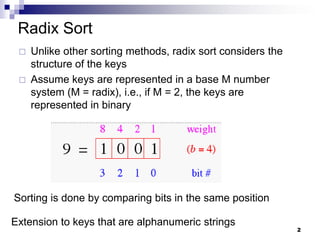
    Assume keys are represented in a base M number
     system (M = radix), i.e., if M = 2, the keys are
     represented in binary


Sorting is done by comparing bits in the same position

Extension to keys that are alphanumeric strings
                                                              2
Radix Exchange Sort
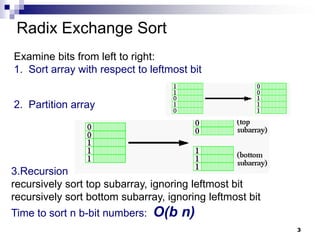
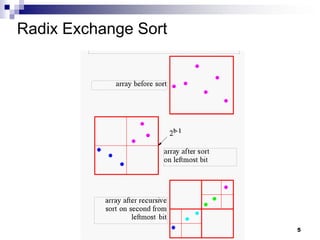
Examine bits from left to right:
1. Sort array with respect to leftmost bit


2. Partition array


3.Recursion
recursively sort top subarray, ignoring leftmost bit
recursively sort bottom subarray, ignoring leftmost bit
Time to sort n b-bit numbers:   O(b n)
                                                          3
Radix Exchange Sort
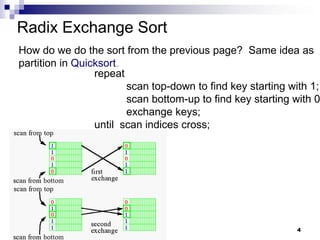
How do we do the sort from the previous page? Same idea as
partition in Quicksort.
                 repeat
                        scan top-down to find key starting with 1;
                        scan bottom-up to find key starting with 0
                        exchange keys;
                 until scan indices cross;


                                                            4
Radix Exchange Sort


                      5
Radix Exchange Sort vs. Quicksort
Similarities
       both partition array
       both recursively sort sub-arrays
Differences
       Method of partitioning
              radix exchange divides array based on greater
than or                less than 2b-1
              quicksort partitions based on greater  than or
less than              some element of the array
       Time complexity
              Radix exchange            O (bn)
              Quicksort average case O (n log n)


                                                           6
Straight Radix Sort
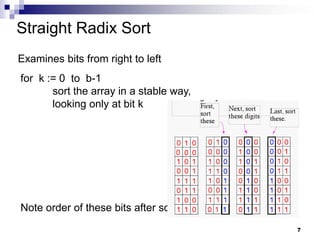
Examines bits from right to left
for k := 0 to b-1
       sort the array in a stable way,
       looking only at bit k


Note order of these bits after sort.
                                         7
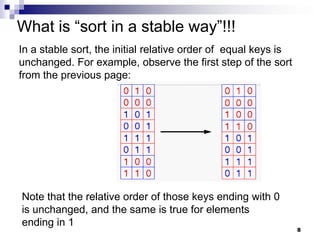
What is “sort in a stable way”!!!
In a stable sort, the initial relative order of equal keys is
unchanged. For example, observe the first step of the sort
from the previous page:


Note that the relative order of those keys ending with 0
is unchanged, and the same is true for elements
ending in 1
                                                                8
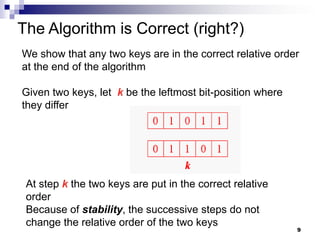
The Algorithm is Correct (right?)
We show that any two keys are in the correct relative order
at the end of the algorithm

Given two keys, let k be the leftmost bit-position where
they differ


 At step k the two keys are put in the correct relative
 order
 Because of stability, the successive steps do not
 change the relative order of the two keys
                                                           9
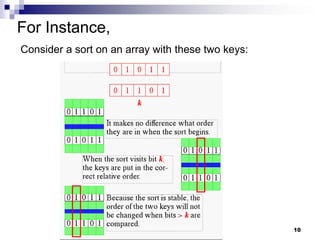
For Instance,
Consider a sort on an array with these two keys:


                                                   10
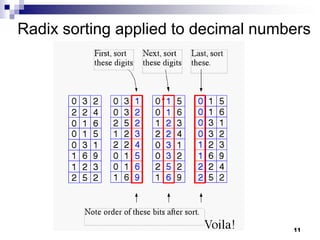
Radix sorting applied to decimal numbers


                                     11
Straight Radix Sort Time Complexity
for k = 0 to b - 1
       sort the array in a stable way, looking only at bit k


Suppose we can perform the stable sort above in O(n)
time. The total time complexity would be
      O(bn)
As you might have guessed, we can perform a stable
sort based on the keys’ kth digit in O(n) time.

The method, you ask? Why it’s Bucket Sort, of course.


                                                               12
Bucket Sort

 BASICS:
     n numbers
     Each number  {1, 2, 3, ...
     m}
     Stable
     Time: O (n + m)
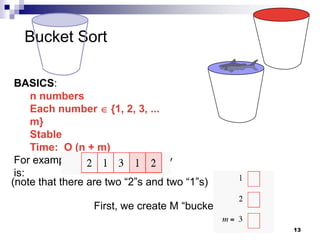
 For example, m = 3 and our array
 is:
(note that there are two “2”s and two “1”s)

                  First, we create M “buckets”

                                                 13
Bucket Sort
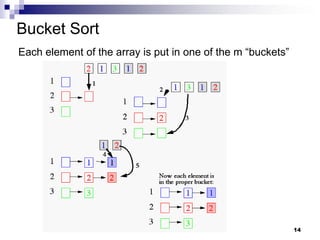
Each element of the array is put in one of the m “buckets”


                                                             14
Bucket Sort


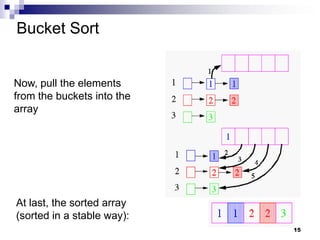
Now, pull the elements
from the buckets into the
array


At last, the sorted array
(sorted in a stable way):
                            15
In-Place Sorting
   A sorting algorithm is said to be in-place if
      it uses no auxiliary data structures (however, O(1)
      auxiliary variables are allowed)
     it updates the input sequence only by means of
      operations replaceElement and swapElements
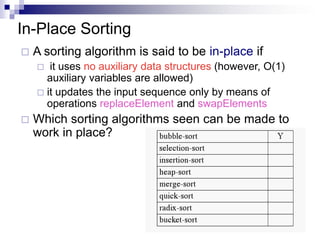
   Which sorting algorithms seen can be made to
    work in place?


                                                             16
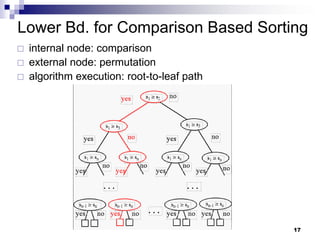
Lower Bd. for Comparison Based Sorting
   internal node: comparison
   external node: permutation
   algorithm execution: root-to-leaf path


                                             17
How Fast Can We Sort?
 How Fast Can We Sort?
 Proposition: The running time of any
  comparison-based algorithm for sorting an n-
  element sequence S is (n log n).
 Justification: The running time of a
  comparison-based sorting algorithm must be
  equal to or greater than the depth of the
  decision tree T associated with this algorithm.


                                                    18
How Fast Can We Sort? (2)
 Each internal node of T is associated with a
  comparison that establishes the ordering of two
  elements of S.
 Each external node of T represents a distinct
  permutation of the elements of S.
 Hence T must have at least n! external nodes which
  again implies T has a height of at least log(n!)
 Since n! has at least n/2 terms that are greater than
  or equal to n/2, we have: log(n!) ≥ (n/2) log(n/2)
 Total Time Complexity: (n log n).


                                                   19

Lec23

  • 1.
    More Sorting  radixsort  bucket sort  in-place sorting  how fast can we sort? 1
  • 2.
    Radix Sort  Unlike other sorting methods, radix sort considers the structure of the keys  Assume keys are represented in a base M number system (M = radix), i.e., if M = 2, the keys are represented in binary Sorting is done by comparing bits in the same position Extension to keys that are alphanumeric strings 2
  • 3.
    Radix Exchange Sort Examinebits from left to right: 1. Sort array with respect to leftmost bit 2. Partition array 3.Recursion recursively sort top subarray, ignoring leftmost bit recursively sort bottom subarray, ignoring leftmost bit Time to sort n b-bit numbers: O(b n) 3
  • 4.
    Radix Exchange Sort Howdo we do the sort from the previous page? Same idea as partition in Quicksort. repeat scan top-down to find key starting with 1; scan bottom-up to find key starting with 0 exchange keys; until scan indices cross; 4
  • 5.
  • 6.
    Radix Exchange Sortvs. Quicksort Similarities both partition array both recursively sort sub-arrays Differences Method of partitioning radix exchange divides array based on greater than or less than 2b-1 quicksort partitions based on greater than or less than some element of the array Time complexity Radix exchange O (bn) Quicksort average case O (n log n) 6
  • 7.
    Straight Radix Sort Examinesbits from right to left for k := 0 to b-1 sort the array in a stable way, looking only at bit k Note order of these bits after sort. 7
  • 8.
    What is “sortin a stable way”!!! In a stable sort, the initial relative order of equal keys is unchanged. For example, observe the first step of the sort from the previous page: Note that the relative order of those keys ending with 0 is unchanged, and the same is true for elements ending in 1 8
  • 9.
    The Algorithm isCorrect (right?) We show that any two keys are in the correct relative order at the end of the algorithm Given two keys, let k be the leftmost bit-position where they differ At step k the two keys are put in the correct relative order Because of stability, the successive steps do not change the relative order of the two keys 9
  • 10.
    For Instance, Consider asort on an array with these two keys: 10
  • 11.
    Radix sorting appliedto decimal numbers 11
  • 12.
    Straight Radix SortTime Complexity for k = 0 to b - 1 sort the array in a stable way, looking only at bit k Suppose we can perform the stable sort above in O(n) time. The total time complexity would be O(bn) As you might have guessed, we can perform a stable sort based on the keys’ kth digit in O(n) time. The method, you ask? Why it’s Bucket Sort, of course. 12
  • 13.
    Bucket Sort BASICS: n numbers Each number  {1, 2, 3, ... m} Stable Time: O (n + m) For example, m = 3 and our array is: (note that there are two “2”s and two “1”s) First, we create M “buckets” 13
  • 14.
    Bucket Sort Each elementof the array is put in one of the m “buckets” 14
  • 15.
    Bucket Sort Now, pullthe elements from the buckets into the array At last, the sorted array (sorted in a stable way): 15
  • 16.
    In-Place Sorting  A sorting algorithm is said to be in-place if  it uses no auxiliary data structures (however, O(1) auxiliary variables are allowed)  it updates the input sequence only by means of operations replaceElement and swapElements  Which sorting algorithms seen can be made to work in place? 16
  • 17.
    Lower Bd. forComparison Based Sorting  internal node: comparison  external node: permutation  algorithm execution: root-to-leaf path 17
  • 18.
    How Fast CanWe Sort?  How Fast Can We Sort?  Proposition: The running time of any comparison-based algorithm for sorting an n- element sequence S is (n log n).  Justification: The running time of a comparison-based sorting algorithm must be equal to or greater than the depth of the decision tree T associated with this algorithm. 18
  • 19.
    How Fast CanWe Sort? (2)  Each internal node of T is associated with a comparison that establishes the ordering of two elements of S.  Each external node of T represents a distinct permutation of the elements of S.  Hence T must have at least n! external nodes which again implies T has a height of at least log(n!)  Since n! has at least n/2 terms that are greater than or equal to n/2, we have: log(n!) ≥ (n/2) log(n/2)  Total Time Complexity: (n log n). 19