1
The Earth is
layered
knowledge of layering is recent (late
1800s); prior to that, only knew
interior must be hot (volcanoes)
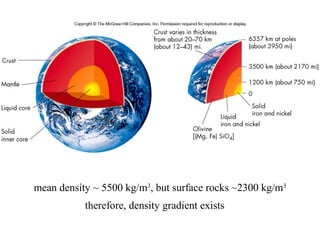
mean density ~ 5500 kg/m3, but surface rocks ~2300 kg/m3
therefore, density gradient exists
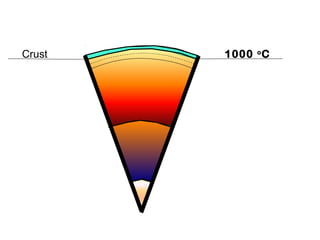
Crust

1000 o C
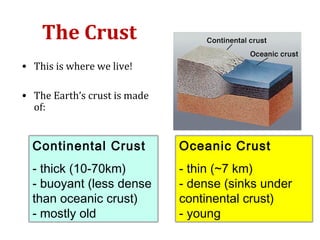
The Crust
• This is where we live!
• The Earth’s crust is made
of:

Continental Crust

Oceanic Crust

- thick (10-70km)
- buoyant (less dense
than oceanic crust)
- mostly old

- thin (~7 km)
- dense (sinks under
continental crust)
- young
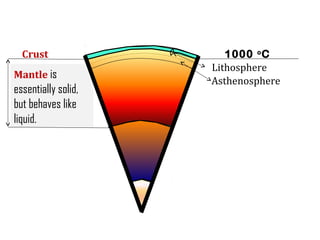
Crust
Mantle is

essentially solid,
but behaves like
liquid.

1000 o C
Lithosphere
Asthenosphere
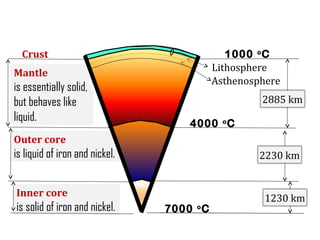
Crust

1000 o C
Lithosphere
Asthenosphere

Mantle

is essentially solid,
but behaves like
liquid.

2885 km
4000 o C

Outer core

is liquid of iron and nickel.

2230 km

Inner core

is solid of iron and nickel.

7000 o C

1230 km
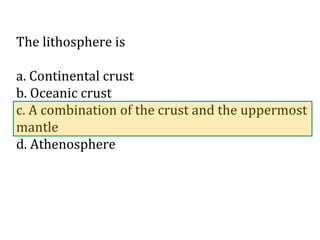
The lithosphere is
a. Continental crust
b. Oceanic crust
c. A combination of the crust and the uppermost
mantle
d. Athenosphere
How do we
know the Earth
is layered?
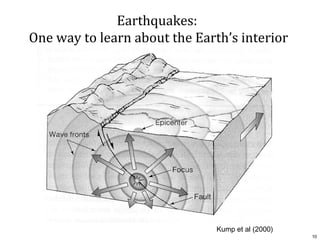
Earthquakes:
One way to learn about the Earth’s interior

Kump et al (2000)

10
Seismic body
waves: P and
S waves
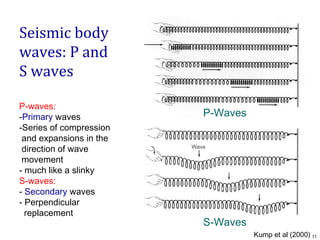
P-waves:
-Primary waves
-Series of compression
and expansions in the
direction of wave
movement
- much like a slinky
S-waves:
- Secondary waves
- Perpendicular
replacement

P-Waves

S-Waves
Kump et al (2000) 11
How to remember them
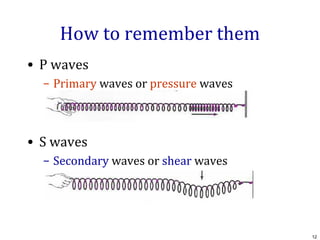
• P waves
– Primary waves or pressure waves

• S waves
– Secondary waves or shear waves

12
Where do P and S waves
propagate?
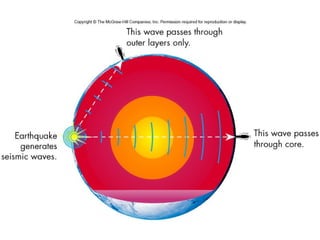
• P waves travel though both
solids and liquids
• S waves travel only through
solids
13
Fig. 5.04
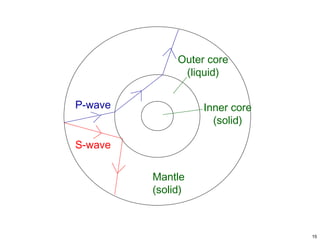
Outer core
(liquid)
P-wave

Inner core
(solid)

S-wave
Mantle
(solid)

15
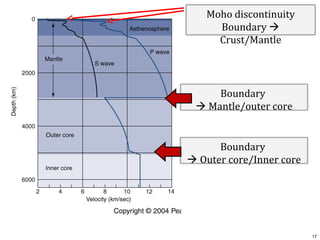
Moho
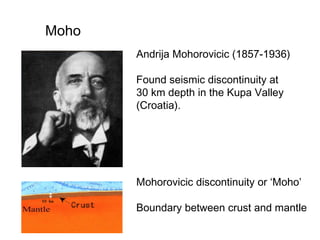
Andrija Mohorovicic (1857-1936)
Found seismic discontinuity at
30 km depth in the Kupa Valley
(Croatia).

Mohorovicic discontinuity or ‘Moho’  
Boundary between crust and mantle
Moho discontinuity
Boundary 
Crust/Mantle

Boundary
 Mantle/outer core

Boundary
 Outer core/Inner core

17
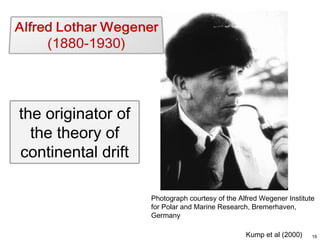
the originator of
the theory of
continental drift
Photograph courtesy of the Alfred Wegener Institute
for Polar and Marine Research, Bremerhaven,
Germany
Kump et al (2000)

19
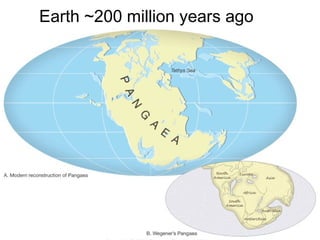
1. Supercontinent Pangaea started to break up
about 200 million years ago.
2. Continents "drifted" to their present positions.
3. Continents "plowed" through the ocean crust.

21
Earth ~200 million years ago
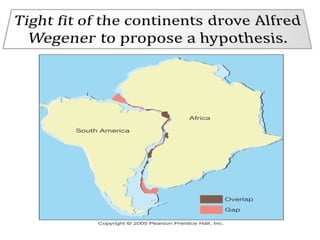
Wegener used land features, fossils, and
climate as evidence to support his
hypothesis of continental drift.
Examples of land features such as mountain ranges in
Africa and South America lined up; also coal fields on Europe
matched up with coal fields in North America. Wegener
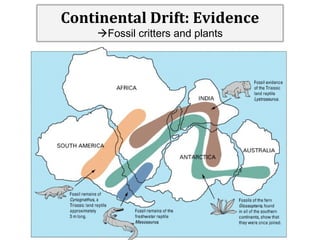
noticed that fossils from reptiles that were found in places
that are now separated by oceans. Since neither reptile
could have swum great distances, Wegener inferred that
these reptiles had once lived on a single landmass that split
apart.
23
Continental Drift: Evidence
Fossil critters and plants
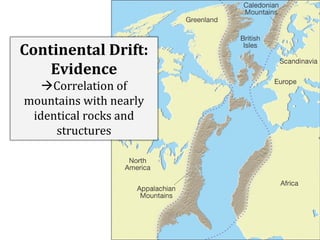
Continental Drift:
Evidence
Correlation of
mountains with nearly
identical rocks and
structures
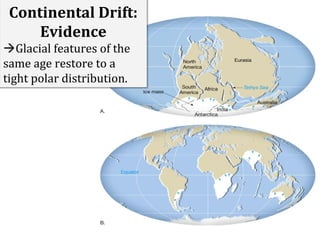
Continental Drift:
Evidence
Glacial features of the
same age restore to a
tight polar distribution.
Alfred Wegener published his book
with title “The Origin of Continents
and Oceans” in 1915.

In his book, Dr. Wegener drew
together evidence from various
fields. Expanded editions during
the 1920s presented the
accumulating evidence.
27
Alfred Wegener also came up with
a theory to explain continental
drift, although it was in error.
His theory of continental drift proposed that centrifugal
force moved the heavy continents toward the equator as
the Earth spun. He thought that inertia, from centrifugal
movement combined with tidal drag on the continents
(caused by the gravitational pull of the sun and moon)
would account for continental drift.
28
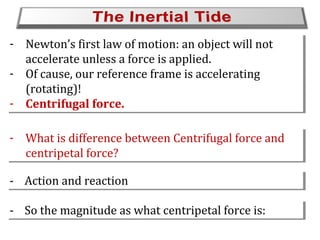
-- Newton’s first law of motion: an object will not
Newton’s first law of motion: an object will not
accelerate unless a force is applied.
-- Of cause, our reference frame is accelerating
Of cause, our reference frame is accelerating
(rotating)!
(rotating)!
-- Centrifugal force.
Centrifugal force.
-- What is difference between Centrifugal force and
What is difference between Centrifugal force and
centripetal force?
centripetal force?
-- Action and reaction
Action and reaction
-- So the magnitude as what centripetal force is:
So the magnitude as what centripetal force is:
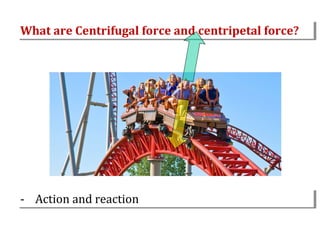
What are Centrifugal force and centripetal force?

-- Action and reaction
Action and reaction
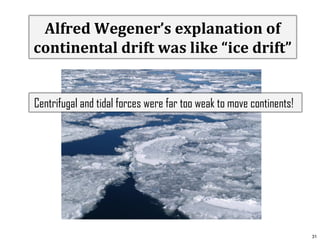
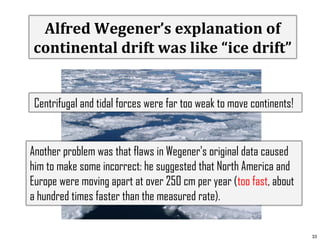
Alfred Wegener’s explanation of
continental drift was like “ice drift”
Centrifugal and tidal forces were far too weak to move continents!

31
Fig. 5.02a
Alfred Wegener’s explanation of
continental drift was like “ice drift”
Centrifugal and tidal forces were far too weak to move continents!

Another problem was that flaws in Wegener's original data caused
him to make some incorrect: he suggested that North America and
Europe were moving apart at over 250 cm per year (too fast, about
a hundred times faster than the measured rate).
33
Reaction of Alfred Wegener’s
continental drift theory
While his ideas attracted a few early supporters from South Africa
and Europe, the hypothesis was generally met with skepticism.
The one American edition of Wegener's work, published in 1924, was
received so poorly that the American Association of Petroleum
Geologists organized a symposium specifically in opposition to the
continental drift hypothesis. Also its opponents could argue that the
oceanic crust was too firm for the continents to "simply plow through".
through
By the 1930s, Wegener's geological work was almost universally
dismissed by the scientific community and remained obscure for some
thirty years.
34
35
Resurrection of Alfred Wegener’s
continental drift theory
•In the 1950s and 1960s, several developments in geology,
notably the discoveries of seafloor spreading, led to the
rapid resurrection of the continental drift hypothesis and
its direct descendant, the theory of plate tectonics.
tectonics
•Alfred Wegener was quickly recognized as a founding
father of one of the major scientific revolutions of the
20th century.
36
Who resurrected the theory of
continental drift?
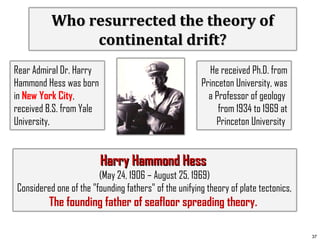
Rear Admiral Dr. Harry
Hammond Hess was born
in New York City,
received B.S. from Yale
University,

He received Ph.D. from
Princeton University, was
a Professor of geology
from 1934 to 1969 at
Princeton University

Harry Hammond Hess
(May 24, 1906 – August 25, 1969)
Considered one of the "founding fathers" of the unifying theory of plate tectonics,

The founding father of seafloor spreading theory.
37
Who resurrected the theory of
continental drift?

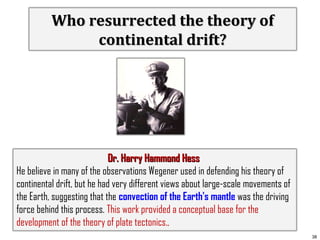
Dr. Harry Hammond Hess
He believe in many of the observations Wegener used in defending his theory of
continental drift, but he had very different views about large-scale movements of
the Earth, suggesting that the convection of the Earth's mantle was the driving
force behind this process. This work provided a conceptual base for the
development of the theory of plate tectonics.,
38
Hess was in World War II
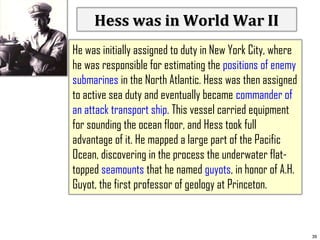
He was initially assigned to duty in New York City, where
he was responsible for estimating the positions of enemy
submarines in the North Atlantic. Hess was then assigned
to active sea duty and eventually became commander of
an attack transport ship. This vessel carried equipment
for sounding the ocean floor, and Hess took full
advantage of it. He mapped a large part of the Pacific
Ocean, discovering in the process the underwater flattopped seamounts that he named guyots, in honor of A.H.
Guyot, the first professor of geology at Princeton.

39
Sonar
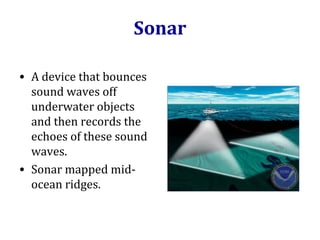
• A device that bounces
sound waves off
underwater objects
and then records the
echoes of these sound
waves.
• Sonar mapped midocean ridges.

Lecture19 nov20-bb

  • 1.
  • 2.
    The Earth is layered knowledgeof layering is recent (late 1800s); prior to that, only knew interior must be hot (volcanoes)
  • 3.
    mean density ~5500 kg/m3, but surface rocks ~2300 kg/m3 therefore, density gradient exists
  • 4.
  • 5.
    The Crust • Thisis where we live! • The Earth’s crust is made of: Continental Crust Oceanic Crust - thick (10-70km) - buoyant (less dense than oceanic crust) - mostly old - thin (~7 km) - dense (sinks under continental crust) - young
  • 6.
    Crust Mantle is essentially solid, butbehaves like liquid. 1000 o C Lithosphere Asthenosphere
  • 7.
    Crust 1000 o C Lithosphere Asthenosphere Mantle isessentially solid, but behaves like liquid. 2885 km 4000 o C Outer core is liquid of iron and nickel. 2230 km Inner core is solid of iron and nickel. 7000 o C 1230 km
  • 8.
    The lithosphere is a.Continental crust b. Oceanic crust c. A combination of the crust and the uppermost mantle d. Athenosphere
  • 9.
    How do we knowthe Earth is layered?
  • 10.
    Earthquakes: One way tolearn about the Earth’s interior Kump et al (2000) 10
  • 11.
    Seismic body waves: Pand S waves P-waves: -Primary waves -Series of compression and expansions in the direction of wave movement - much like a slinky S-waves: - Secondary waves - Perpendicular replacement P-Waves S-Waves Kump et al (2000) 11
  • 12.
    How to rememberthem • P waves – Primary waves or pressure waves • S waves – Secondary waves or shear waves 12
  • 13.
    Where do Pand S waves propagate? • P waves travel though both solids and liquids • S waves travel only through solids 13
  • 14.
  • 15.
  • 16.
    Moho Andrija Mohorovicic (1857-1936) Foundseismic discontinuity at 30 km depth in the Kupa Valley (Croatia). Mohorovicic discontinuity or ‘Moho’   Boundary between crust and mantle
  • 17.
    Moho discontinuity Boundary  Crust/Mantle Boundary Mantle/outer core Boundary  Outer core/Inner core 17
  • 19.
    the originator of thetheory of continental drift Photograph courtesy of the Alfred Wegener Institute for Polar and Marine Research, Bremerhaven, Germany Kump et al (2000) 19
  • 21.
    1. Supercontinent Pangaeastarted to break up about 200 million years ago. 2. Continents "drifted" to their present positions. 3. Continents "plowed" through the ocean crust. 21
  • 22.
  • 23.
    Wegener used landfeatures, fossils, and climate as evidence to support his hypothesis of continental drift. Examples of land features such as mountain ranges in Africa and South America lined up; also coal fields on Europe matched up with coal fields in North America. Wegener noticed that fossils from reptiles that were found in places that are now separated by oceans. Since neither reptile could have swum great distances, Wegener inferred that these reptiles had once lived on a single landmass that split apart. 23
  • 24.
  • 25.
    Continental Drift: Evidence Correlation of mountainswith nearly identical rocks and structures
  • 26.
    Continental Drift: Evidence Glacial featuresof the same age restore to a tight polar distribution.
  • 27.
    Alfred Wegener publishedhis book with title “The Origin of Continents and Oceans” in 1915. In his book, Dr. Wegener drew together evidence from various fields. Expanded editions during the 1920s presented the accumulating evidence. 27
  • 28.
    Alfred Wegener alsocame up with a theory to explain continental drift, although it was in error. His theory of continental drift proposed that centrifugal force moved the heavy continents toward the equator as the Earth spun. He thought that inertia, from centrifugal movement combined with tidal drag on the continents (caused by the gravitational pull of the sun and moon) would account for continental drift. 28
  • 29.
    -- Newton’s firstlaw of motion: an object will not Newton’s first law of motion: an object will not accelerate unless a force is applied. accelerate unless a force is applied. -- Of cause, our reference frame is accelerating Of cause, our reference frame is accelerating (rotating)! (rotating)! -- Centrifugal force. Centrifugal force. -- What is difference between Centrifugal force and What is difference between Centrifugal force and centripetal force? centripetal force? -- Action and reaction Action and reaction -- So the magnitude as what centripetal force is: So the magnitude as what centripetal force is:
  • 30.
    What are Centrifugalforce and centripetal force? What are Centrifugal force and centripetal force? -- Action and reaction Action and reaction
  • 31.
    Alfred Wegener’s explanationof continental drift was like “ice drift” Centrifugal and tidal forces were far too weak to move continents! 31
  • 32.
  • 33.
    Alfred Wegener’s explanationof continental drift was like “ice drift” Centrifugal and tidal forces were far too weak to move continents! Another problem was that flaws in Wegener's original data caused him to make some incorrect: he suggested that North America and Europe were moving apart at over 250 cm per year (too fast, about a hundred times faster than the measured rate). 33
  • 34.
    Reaction of AlfredWegener’s continental drift theory While his ideas attracted a few early supporters from South Africa and Europe, the hypothesis was generally met with skepticism. The one American edition of Wegener's work, published in 1924, was received so poorly that the American Association of Petroleum Geologists organized a symposium specifically in opposition to the continental drift hypothesis. Also its opponents could argue that the oceanic crust was too firm for the continents to "simply plow through". through By the 1930s, Wegener's geological work was almost universally dismissed by the scientific community and remained obscure for some thirty years. 34
  • 35.
  • 36.
    Resurrection of AlfredWegener’s continental drift theory •In the 1950s and 1960s, several developments in geology, notably the discoveries of seafloor spreading, led to the rapid resurrection of the continental drift hypothesis and its direct descendant, the theory of plate tectonics. tectonics •Alfred Wegener was quickly recognized as a founding father of one of the major scientific revolutions of the 20th century. 36
  • 37.
    Who resurrected thetheory of continental drift? Rear Admiral Dr. Harry Hammond Hess was born in New York City, received B.S. from Yale University, He received Ph.D. from Princeton University, was a Professor of geology from 1934 to 1969 at Princeton University Harry Hammond Hess (May 24, 1906 – August 25, 1969) Considered one of the "founding fathers" of the unifying theory of plate tectonics, The founding father of seafloor spreading theory. 37
  • 38.
    Who resurrected thetheory of continental drift? Dr. Harry Hammond Hess He believe in many of the observations Wegener used in defending his theory of continental drift, but he had very different views about large-scale movements of the Earth, suggesting that the convection of the Earth's mantle was the driving force behind this process. This work provided a conceptual base for the development of the theory of plate tectonics., 38
  • 39.
    Hess was inWorld War II He was initially assigned to duty in New York City, where he was responsible for estimating the positions of enemy submarines in the North Atlantic. Hess was then assigned to active sea duty and eventually became commander of an attack transport ship. This vessel carried equipment for sounding the ocean floor, and Hess took full advantage of it. He mapped a large part of the Pacific Ocean, discovering in the process the underwater flattopped seamounts that he named guyots, in honor of A.H. Guyot, the first professor of geology at Princeton. 39
  • 40.
    Sonar • A devicethat bounces sound waves off underwater objects and then records the echoes of these sound waves. • Sonar mapped midocean ridges.

Editor's Notes

  • #6 The Earth has two different types of crust: Continental crust and Oceanic crust. Each has different properties and therefore behaves in different ways. Continental crust: Continental crust forms the land (the continents, as the name suggests) that we see today. Continental crust averages about 35 km thick. Under some mountain chains, crustal thickness is approximately twice that thickness (about 70 km thick). - The mountains we see on earth have deep roots in the crust that we can’t see. The crust “floats” on the more dense mantle and, like how only the tip of an iceberg sticks up out of the water, we see only the tip of the continental crust - the mountain ranges. Continental crust is less dense and therefore more buoyant than oceanic crust Continental crust contains some of the oldest rocks on Earth. - Ancient rocks exceeding 3.5 billion years in age are found on all of Earth's continents. The oldest rocks on Earth found so far are the Acasta Gneisses in northwestern Canada near Great Slave Lake (4.03 Ga) [Ga = billion years ago] and the Isua Supracrustal rocks in West Greenland (3.7 to 3.8 Ga), but well-studied rocks nearly as old are also found in the Minnesota River Valley in the USA (3.5-3.7 billion years), in Swaziland (3.4-3.5 billion years), and in Western Australia (3.4-3.6 billion years). Oceanic crust: As the name already suggests, this crust is below the oceans. Compared to continental crust, Oceanic crust is thin (6-11 km). It is more dense than continental crust and therefore when the two types of crust meet, oceanic crust will sink underneath continental crust. The rocks of the oceanic crust are very young compared with most of the rocks of the continental crust. They are not older than 200 million years.
  • #17 Moho is one of the key boundaries in the Earth. Marks the velocity increase at the base of the crust.